U. S. HIGHER
EDUCATION
Mylokosta Iryna (605 Group)
Plan
1.Stages of the U. S. Higher Education
2.Types of institutions
3.Degrees and procedure of their learning
4.Grading system
5.The curriculum structure and academic
year
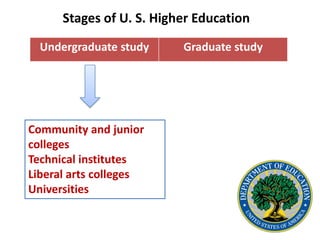
Stages of U. S. Higher Education
Undergraduate study

Community and junior
colleges
Technical institutes
Liberal arts colleges
Universities

Graduate study
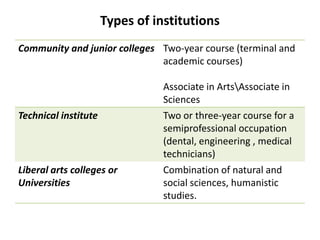
Types of institutions
Community and junior colleges Two-year course (terminal and
academic courses)

Technical institute

Liberal arts colleges or
Universities

Associate in ArtsAssociate in
Sciences
Two or three-year course for a
semiprofessional occupation
(dental, engineering , medical
technicians)
Combination of natural and
social sciences, humanistic
studies.
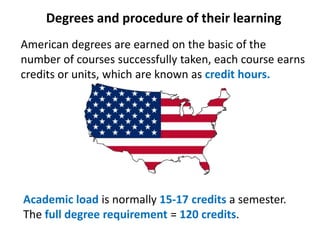
Degrees and procedure of their learning
American degrees are earned on the basic of the
number of courses successfully taken, each course earns
credits or units, which are known as credit hours.

Academic load is normally 15-17 credits a semester.
The full degree requirement = 120 credits.
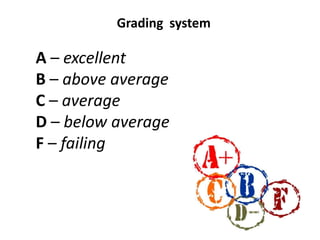
Grading system

A – excellent
B – above average
C – average
D – below average
F – failing
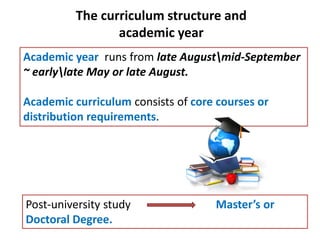
The curriculum structure and
academic year
Academic year runs from late Augustmid-September
~ earlylate May or late August.
Academic curriculum consists of core courses or
distribution requirements.

Post-university study
Doctoral Degree.

Master’s or
Conclusions
U. S. Higher Education is divided into two stages: the
undergraduate study (community and junior colleges, technical
institutes, liberal arts colleges or universities) and graduate study.
Universities are the largest and most complex of the country’s
higher education institutions.
American degrees are earned on the basic of the number of
courses successfully taken. Each course earns credit hours.
Most colleges use latter grades from A to F.
The academic year runs from late Augustmid-September ~
earlylate May or late August.
The academic curriculum consists of core courses or distribution
requirements.
There is also post-university study leading to the Master’s or
Doctoral degree.

U. S. higher education

  • 1.
  • 2.
    Plan 1.Stages of theU. S. Higher Education 2.Types of institutions 3.Degrees and procedure of their learning 4.Grading system 5.The curriculum structure and academic year
  • 3.
    Stages of U.S. Higher Education Undergraduate study Community and junior colleges Technical institutes Liberal arts colleges Universities Graduate study
  • 4.
    Types of institutions Communityand junior colleges Two-year course (terminal and academic courses) Technical institute Liberal arts colleges or Universities Associate in ArtsAssociate in Sciences Two or three-year course for a semiprofessional occupation (dental, engineering , medical technicians) Combination of natural and social sciences, humanistic studies.
  • 5.
    Degrees and procedureof their learning American degrees are earned on the basic of the number of courses successfully taken, each course earns credits or units, which are known as credit hours. Academic load is normally 15-17 credits a semester. The full degree requirement = 120 credits.
  • 6.
    Grading system A –excellent B – above average C – average D – below average F – failing
  • 7.
    The curriculum structureand academic year Academic year runs from late Augustmid-September ~ earlylate May or late August. Academic curriculum consists of core courses or distribution requirements. Post-university study Doctoral Degree. Master’s or
  • 8.
    Conclusions U. S. HigherEducation is divided into two stages: the undergraduate study (community and junior colleges, technical institutes, liberal arts colleges or universities) and graduate study. Universities are the largest and most complex of the country’s higher education institutions. American degrees are earned on the basic of the number of courses successfully taken. Each course earns credit hours. Most colleges use latter grades from A to F. The academic year runs from late Augustmid-September ~ earlylate May or late August. The academic curriculum consists of core courses or distribution requirements. There is also post-university study leading to the Master’s or Doctoral degree.