COLLEGEPLANNINGFOR
MIDDLESCHOOLFAMILIES
MASSACHUSETTS EDUCATIONAL FINANCING AUTHORITY
The Importance of Education After High School
“People who have a bachelor’s degree have lower unemployment and
earn more money than people who have less education.”
*Bureau of Labor Statistics 2013
The word “college” has come to mean many different things (4-year
colleges and universities, 2-year community colleges, and career
institutions, also known as technical, vocational, or trade schools.)
2
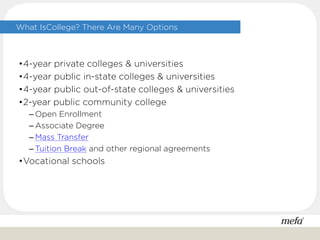
What IsCollege? There Are Many Options
•4-year private colleges & universities
•4-year public in-state colleges & universities
•4-year public out-of-state colleges & universities
•2-year public community college
– Open Enrollment
– Associate Degree
– Mass Transfer
– Tuition Break and other regional agreements
•Vocational schools
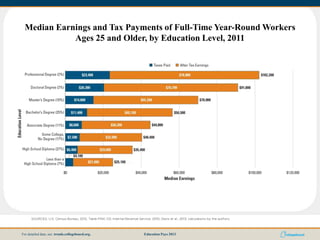
Education Pays 2013For detailed data, see: trends.collegeboard.org.
Median Earnings and Tax Payments of Full-Time Year-Round Workers
Ages 25 and Older, by Education Level, 2011
SOURCES: U.S. Census Bureau, 2012, Table PINC-03; Internal Revenue Service, 2010; Davis et al., 2013; calculations by the authors.
The Importance of Higher Education
“Evidence is overwhelming that for most people, education
beyond high school is a prerequisite for a secure lifestyle and
significantly improves the probabilities of employment and a
stable career with a positive earnings trajectory. It also provides
tools that help people to live healthier and more satisfying lives,
to participate actively in civil society, and to create
opportunities for their children.”
*Education Pays 2013, The College Board
5
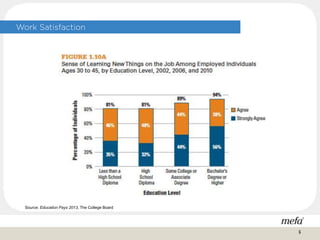
Work Satisfaction
Source: Education Pays 2013, The College Board
6
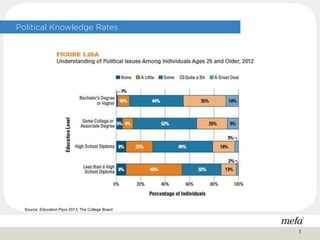
Political Knowledge Rates
Source: Education Pays 2013, The College Board
7
How Do I Prepare for College Now?
•Academic preparation:
–Check prerequisites for high school courses
–Do well in middle school courses that count into GPA
•Become involved in extracurricular activities
•Start exploring information about colleges
•Meet with your school counselor
YourPlanForTheFuture.org
FREE college and career planning tool
Resources include:
–Skills and interests assessments
–Career exploration
–College search
–Financial aid and scholarship information
–Personalized portfolio
Available in English and Spanish
A Generation Hobbled by the soaring
cost of college – NY Times
Dealing with
College Cost
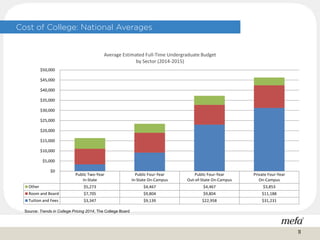
Cost of College: National Averages
Source: Trends in College Pricing 2014, The College Board
Public Two-Year
In-State
Public Four-Year
In-State On-Campus
Public Four-Year
Out-of-State On-Campus
Private Four-Year
On-Campus
Other $5,273 $4,467 $4,467 $3,853
Room and Board $7,705 $9,804 $9,804 $11,188
Tuition and Fees $3,347 $9,139 $22,958 $31,231
$0
$5,000
$10,000
$15,000
$20,000
$25,000
$30,000
$35,000
$40,000
$45,000
$50,000
Average Estimated Full-Time Undergraduate Budget
by Sector (2014-2015)
11
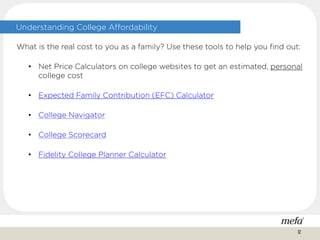
Understanding College Affordability
What is the real cost to you as a family? Use these tools to help you find out:
• Net Price Calculators on college websites to get an estimated, personal
college cost
• Expected Family Contribution (EFC) Calculator
• College Navigator
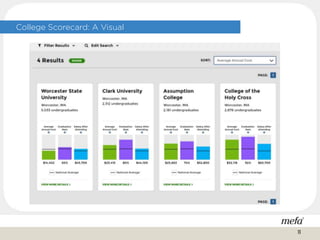
• College Scorecard
• Fidelity College Planner Calculator
12
College Scorecard: A Visual
13
What is Financial Aid?
•Money to help students pay for college
•3 main types
–Grants and scholarships (gift aid)
–Work-Study
–Student Loans
Merit-Based vs. Need-Based Aid
Merit-Based Aid
•Awarded in recognition of student achievements
(academic, artistic, athletic, etc.)
•Criteria differs from school to school
•Often has requirements for renewal
Need-Based Aid
•Awarded based on family’s financial eligibility
•Determined by standardized formula
•Includes most federal, state, and institutional (college) aid
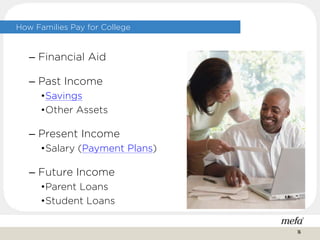
How Families Pay for College
– Financial Aid
– Past Income
•Savings
•Other Assets
– Present Income
•Salary (Payment Plans)
– Future Income
•Parent Loans
•Student Loans
16
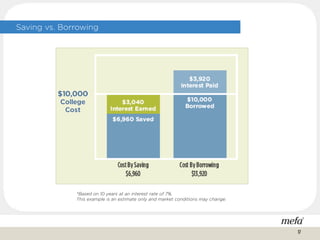
Saving vs. Borrowing
*Based on 10 years at an interest rate of 7%.
This example is an estimate only and market conditions may change.
17
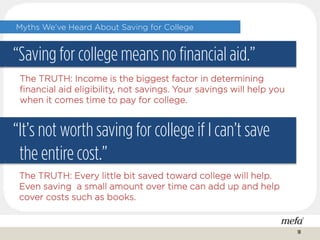
Myths We’ve Heard About Saving for College
“Saving for college means no financial aid.”
“It’s not worth saving for college if I can’t save
the entire cost.”
The TRUTH: Income is the biggest factor in determining
financial aid eligibility, not savings. Your savings will help you
when it comes time to pay for college.
The TRUTH: Every little bit saved toward college will help.
Even saving a small amount over time can add up and help
cover costs such as books.
18
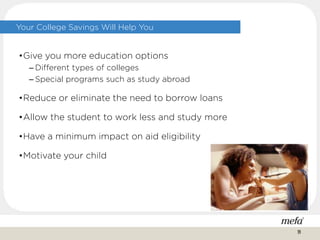
Your College Savings Will Help You
•Give you more education options
– Different types of colleges
– Special programs such as study abroad
•Reduce or eliminate the need to borrow loans
•Allow the student to work less and study more
•Have a minimum impact on aid eligibility
•Motivate your child
19
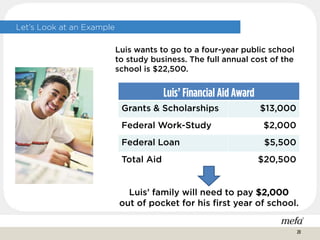
Luis wants to go to a four-year public school
to study business. The full annual cost of the
school is $22,500.
Luis’ Financial Aid Award
Grants & Scholarships $13,000
Federal Work-Study $2,000
Federal Loan $5,500
Total Aid $20,500
Luis’ family will need to pay $2,000
out of pocket for his first year of school.
Let’s Look at an Example
20
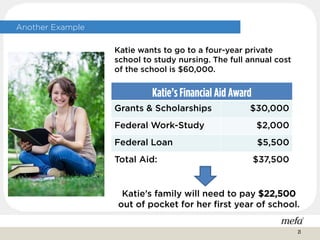
Katie wants to go to a four-year private
school to study nursing. The full annual cost
of the school is $60,000.
Katie’s Financial Aid Award
Grants & Scholarships $30,000
Federal Work-Study $2,000
Federal Loan $5,500
Total Aid: $37,500
Katie’s family will need to pay $22,500
out of pocket for her first year of school.
Another Example
21
22
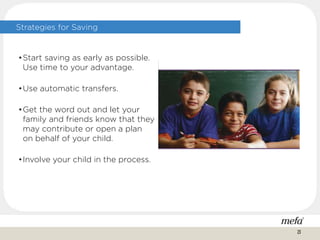
Strategies for Saving
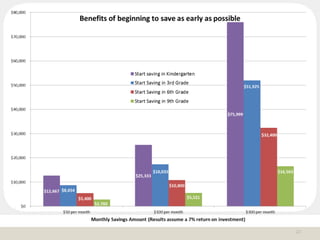
•Start saving as early as possible.
Use time to your advantage.
•Use automatic transfers.
•Get the word out and let your
family and friends know that they
may contribute or open a plan
on behalf of your child.
•Involve your child in the process.
23
Two Good Savings Options
24
Established in 1999
U.Fund 529 College Investing Plan
How the U.Fund works:
• Save for qualified higher education expenses
– Tuition, fees, room, board, books, supplies, and equipment
• Savings can be used at any accredited college or university nation wide
• Minimum Initial Investment: $50 lump sum or $15/monthly automatic investments
• Combined Account Maximum: $375,000
• No Annual Account Maintenance Fee
• Multiple investment options
– Active management, indexed portfolio, individual allocation portfolios, FDIC insured
Learn more at mefa.org/ufund or by calling (800) 544-2776
25
What are the benefits of the U.Fund?
• Parent or adult account owner maintains control over account on behalf of the student
• Minimal impact on financial aid eligibility
• Qualified withdrawals are free from federal and MA state income taxes
• Flexibility:
– Use for a wide range of college expenses, such as tuition, fees, room, board, books,
supplies, and equipment
– Use at most accredited colleges and universities (and career schools eligible for
Title IV funding) nationwide and at eligible foreign institutions
– Multiple investment options, including an FDIC insured option
– Can change student beneficiary
26
The U.Plan Prepaid Tuition Program
How the U.Plan works:
• Allows you to prepay up to 100% of tuition & mandatory fees at a large network of
MA public and private colleges & universities
• By purchasing Tuition Certificates now, you lock in today’s tuition and mandatory fee
rates
• U.Plan Tuition Certificates:
• Represent interest in Commonwealth General Obligation Bonds
• Are backed by the full faith and credit of the Commonwealth of MA
• Are not subject to market fluctuation
• Require $300 minimum to get started
• Annual enrollment period: May 1st to June 30th
To learn more about the U.Plan visit mefa.org/uplan
Established in 1995
27
American International College
Amherst College
Anna Maria College
Art Institute of Boston at Lesley University
Assumption College
Babson College
Bay Path College
Benjamin Franklin Institute of Technology
Bentley College
Berklee College of Music
Berkshire Community College
Boston College
Boston University
Bridgewater State University
Bristol Community College
Bunker Hill Community College
Cape Cod Community College
Clark University
College of Our Lady of the Elms
College of the Holy Cross
Curry College
Dean College
Eastern Nazarene College
Emerson College
Emmanuel College
Endicott College
Fisher College
Fitchburg State University
Framingham State University
Gordon College
Greenfield Community College
Hampshire College
Hebrew College
Hellenic College
Holyoke Community College
Laboure College
Lasell College
Lesley University
Massachusetts Bay Community College
Massachusetts College of Art and Design
Massachusetts College of Liberal Arts
Massachusetts Maritime Academy
Massasoit Community College
Merrimack College
Middlesex Community College
Montserrat College of Art
Mount Holyoke College
Mount Ida College
Mount Wachusett Community College
New England Conservatory of Music
Newbury College
Nichols College
North Shore Community College
Northeastern University
Northern Essex Community College
Pine Manor College
Quinsigamond Community College
Regis College
Roxbury Community College
Salem State University
Simmons College
Smith College
Springfield College
Springfield Technical Community College
Stonehill College
Suffolk University
University of Massachusetts Amherst
University of Massachusetts Boston
University of Massachusetts Dartmouth
University of Massachusetts Lowell
Wellesley College
Wentworth Institute of Technology
Western New England University
Westfield State University
Wheaton College
Wheelock College
Worcester Polytechnic Institute
Worcester State University
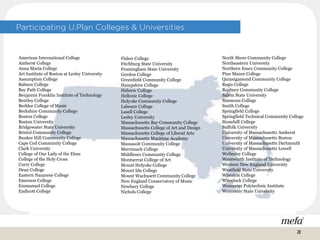
Participating U.Plan Colleges & Universities
28
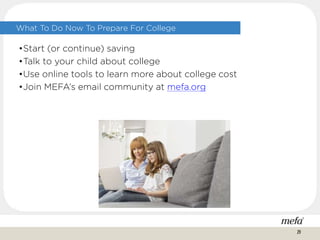
What To Do Now To Prepare For College
•Start (or continue) saving
•Talk to your child about college
•Use online tools to learn more about college cost
•Join MEFA’s email community at mefa.org
29

Preparing for college with middle schoolers

  • 1.
  • 2.
    The Importance ofEducation After High School “People who have a bachelor’s degree have lower unemployment and earn more money than people who have less education.” *Bureau of Labor Statistics 2013 The word “college” has come to mean many different things (4-year colleges and universities, 2-year community colleges, and career institutions, also known as technical, vocational, or trade schools.) 2
  • 3.
    What IsCollege? ThereAre Many Options •4-year private colleges & universities •4-year public in-state colleges & universities •4-year public out-of-state colleges & universities •2-year public community college – Open Enrollment – Associate Degree – Mass Transfer – Tuition Break and other regional agreements •Vocational schools
  • 4.
    Education Pays 2013Fordetailed data, see: trends.collegeboard.org. Median Earnings and Tax Payments of Full-Time Year-Round Workers Ages 25 and Older, by Education Level, 2011 SOURCES: U.S. Census Bureau, 2012, Table PINC-03; Internal Revenue Service, 2010; Davis et al., 2013; calculations by the authors.
  • 5.
    The Importance ofHigher Education “Evidence is overwhelming that for most people, education beyond high school is a prerequisite for a secure lifestyle and significantly improves the probabilities of employment and a stable career with a positive earnings trajectory. It also provides tools that help people to live healthier and more satisfying lives, to participate actively in civil society, and to create opportunities for their children.” *Education Pays 2013, The College Board 5
  • 6.
    Work Satisfaction Source: EducationPays 2013, The College Board 6
  • 7.
    Political Knowledge Rates Source:Education Pays 2013, The College Board 7
  • 8.
    How Do IPrepare for College Now? •Academic preparation: –Check prerequisites for high school courses –Do well in middle school courses that count into GPA •Become involved in extracurricular activities •Start exploring information about colleges •Meet with your school counselor
  • 9.
    YourPlanForTheFuture.org FREE college andcareer planning tool Resources include: –Skills and interests assessments –Career exploration –College search –Financial aid and scholarship information –Personalized portfolio Available in English and Spanish
  • 10.
    A Generation Hobbledby the soaring cost of college – NY Times Dealing with College Cost
  • 11.
    Cost of College:National Averages Source: Trends in College Pricing 2014, The College Board Public Two-Year In-State Public Four-Year In-State On-Campus Public Four-Year Out-of-State On-Campus Private Four-Year On-Campus Other $5,273 $4,467 $4,467 $3,853 Room and Board $7,705 $9,804 $9,804 $11,188 Tuition and Fees $3,347 $9,139 $22,958 $31,231 $0 $5,000 $10,000 $15,000 $20,000 $25,000 $30,000 $35,000 $40,000 $45,000 $50,000 Average Estimated Full-Time Undergraduate Budget by Sector (2014-2015) 11
  • 12.
    Understanding College Affordability Whatis the real cost to you as a family? Use these tools to help you find out: • Net Price Calculators on college websites to get an estimated, personal college cost • Expected Family Contribution (EFC) Calculator • College Navigator • College Scorecard • Fidelity College Planner Calculator 12
  • 13.
  • 14.
    What is FinancialAid? •Money to help students pay for college •3 main types –Grants and scholarships (gift aid) –Work-Study –Student Loans
  • 15.
    Merit-Based vs. Need-BasedAid Merit-Based Aid •Awarded in recognition of student achievements (academic, artistic, athletic, etc.) •Criteria differs from school to school •Often has requirements for renewal Need-Based Aid •Awarded based on family’s financial eligibility •Determined by standardized formula •Includes most federal, state, and institutional (college) aid
  • 16.
    How Families Payfor College – Financial Aid – Past Income •Savings •Other Assets – Present Income •Salary (Payment Plans) – Future Income •Parent Loans •Student Loans 16
  • 17.
    Saving vs. Borrowing *Basedon 10 years at an interest rate of 7%. This example is an estimate only and market conditions may change. 17
  • 18.
    Myths We’ve HeardAbout Saving for College “Saving for college means no financial aid.” “It’s not worth saving for college if I can’t save the entire cost.” The TRUTH: Income is the biggest factor in determining financial aid eligibility, not savings. Your savings will help you when it comes time to pay for college. The TRUTH: Every little bit saved toward college will help. Even saving a small amount over time can add up and help cover costs such as books. 18
  • 19.
    Your College SavingsWill Help You •Give you more education options – Different types of colleges – Special programs such as study abroad •Reduce or eliminate the need to borrow loans •Allow the student to work less and study more •Have a minimum impact on aid eligibility •Motivate your child 19
  • 20.
    Luis wants togo to a four-year public school to study business. The full annual cost of the school is $22,500. Luis’ Financial Aid Award Grants & Scholarships $13,000 Federal Work-Study $2,000 Federal Loan $5,500 Total Aid $20,500 Luis’ family will need to pay $2,000 out of pocket for his first year of school. Let’s Look at an Example 20
  • 21.
    Katie wants togo to a four-year private school to study nursing. The full annual cost of the school is $60,000. Katie’s Financial Aid Award Grants & Scholarships $30,000 Federal Work-Study $2,000 Federal Loan $5,500 Total Aid: $37,500 Katie’s family will need to pay $22,500 out of pocket for her first year of school. Another Example 21
  • 22.
  • 23.
    Strategies for Saving •Startsaving as early as possible. Use time to your advantage. •Use automatic transfers. •Get the word out and let your family and friends know that they may contribute or open a plan on behalf of your child. •Involve your child in the process. 23
  • 24.
    Two Good SavingsOptions 24
  • 25.
    Established in 1999 U.Fund529 College Investing Plan How the U.Fund works: • Save for qualified higher education expenses – Tuition, fees, room, board, books, supplies, and equipment • Savings can be used at any accredited college or university nation wide • Minimum Initial Investment: $50 lump sum or $15/monthly automatic investments • Combined Account Maximum: $375,000 • No Annual Account Maintenance Fee • Multiple investment options – Active management, indexed portfolio, individual allocation portfolios, FDIC insured Learn more at mefa.org/ufund or by calling (800) 544-2776 25
  • 26.
    What are thebenefits of the U.Fund? • Parent or adult account owner maintains control over account on behalf of the student • Minimal impact on financial aid eligibility • Qualified withdrawals are free from federal and MA state income taxes • Flexibility: – Use for a wide range of college expenses, such as tuition, fees, room, board, books, supplies, and equipment – Use at most accredited colleges and universities (and career schools eligible for Title IV funding) nationwide and at eligible foreign institutions – Multiple investment options, including an FDIC insured option – Can change student beneficiary 26
  • 27.
    The U.Plan PrepaidTuition Program How the U.Plan works: • Allows you to prepay up to 100% of tuition & mandatory fees at a large network of MA public and private colleges & universities • By purchasing Tuition Certificates now, you lock in today’s tuition and mandatory fee rates • U.Plan Tuition Certificates: • Represent interest in Commonwealth General Obligation Bonds • Are backed by the full faith and credit of the Commonwealth of MA • Are not subject to market fluctuation • Require $300 minimum to get started • Annual enrollment period: May 1st to June 30th To learn more about the U.Plan visit mefa.org/uplan Established in 1995 27
  • 28.
    American International College AmherstCollege Anna Maria College Art Institute of Boston at Lesley University Assumption College Babson College Bay Path College Benjamin Franklin Institute of Technology Bentley College Berklee College of Music Berkshire Community College Boston College Boston University Bridgewater State University Bristol Community College Bunker Hill Community College Cape Cod Community College Clark University College of Our Lady of the Elms College of the Holy Cross Curry College Dean College Eastern Nazarene College Emerson College Emmanuel College Endicott College Fisher College Fitchburg State University Framingham State University Gordon College Greenfield Community College Hampshire College Hebrew College Hellenic College Holyoke Community College Laboure College Lasell College Lesley University Massachusetts Bay Community College Massachusetts College of Art and Design Massachusetts College of Liberal Arts Massachusetts Maritime Academy Massasoit Community College Merrimack College Middlesex Community College Montserrat College of Art Mount Holyoke College Mount Ida College Mount Wachusett Community College New England Conservatory of Music Newbury College Nichols College North Shore Community College Northeastern University Northern Essex Community College Pine Manor College Quinsigamond Community College Regis College Roxbury Community College Salem State University Simmons College Smith College Springfield College Springfield Technical Community College Stonehill College Suffolk University University of Massachusetts Amherst University of Massachusetts Boston University of Massachusetts Dartmouth University of Massachusetts Lowell Wellesley College Wentworth Institute of Technology Western New England University Westfield State University Wheaton College Wheelock College Worcester Polytechnic Institute Worcester State University Participating U.Plan Colleges & Universities 28
  • 29.
    What To DoNow To Prepare For College •Start (or continue) saving •Talk to your child about college •Use online tools to learn more about college cost •Join MEFA’s email community at mefa.org 29