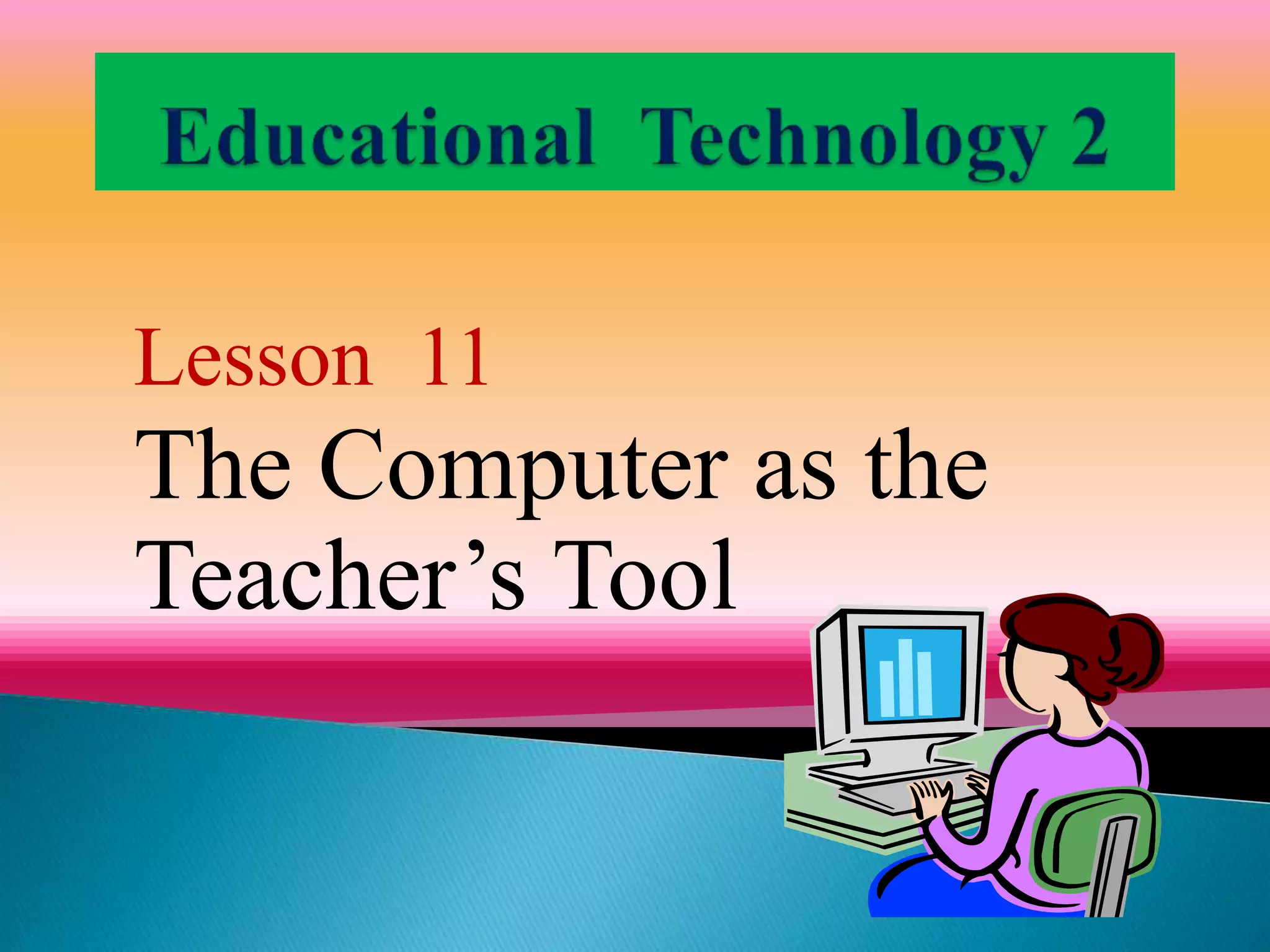

Lesson 11
The Computer as the
Teacher’s Tool
 In this lesson , we shall again look at the computer
, but this time from another perspective, the
computer as the teacher’s handy-tool. It can in
fact support the constructivist and social
constructivist paradigms of constructivist learning.
 Constructivist was introduce by Piaget (1981)
and Bruner (1990). They gave stress to
knowledge discovery of new meaning/
concepts/principles in the learning process.
While knowledge is constructed by the individual
learner in constructivism, knowledge can also be
socially constructed.
 The psychologist Vygotsky stressed that learning is
affected by social influences. He therefore suggested the
interactive process in learning. The more capable adult
(teacher or parent) or classmate can aid or complement
what the learner sees in a given class project. In
addition, Dewey sees language as a medium for social
coordination and adaptation. For Dewey human learning
is really human languaging that occurs when students
socially share, build and agree upon meanings and
knowledge.
 Learning Framework Constructivism Social
Constructivism Assumption Knowledge is
constructed by the individual. Knowledge is
constructed within a social context. Definition
of Learning Students build their own learning.
 Students build knowledge influenced by the
social context. Learning Strategies gather
unorganized information to create new
concept/principle, exchange and share from
ideas, stimulates thinking.
 The Computer’s Capabilities given its
present-day speed, flexibility and
sophistication, the computer can provide;
 -access to information
 -foster creative social knowledge building
 -and enhance the communication of the
achieved project package.
 Based on the two learning theories, the
teacher can employ the computer a/an:
 -as an information tool
 -a communication tool
 -a constructive tool
 -as co-constructive tool
 -a situating tool
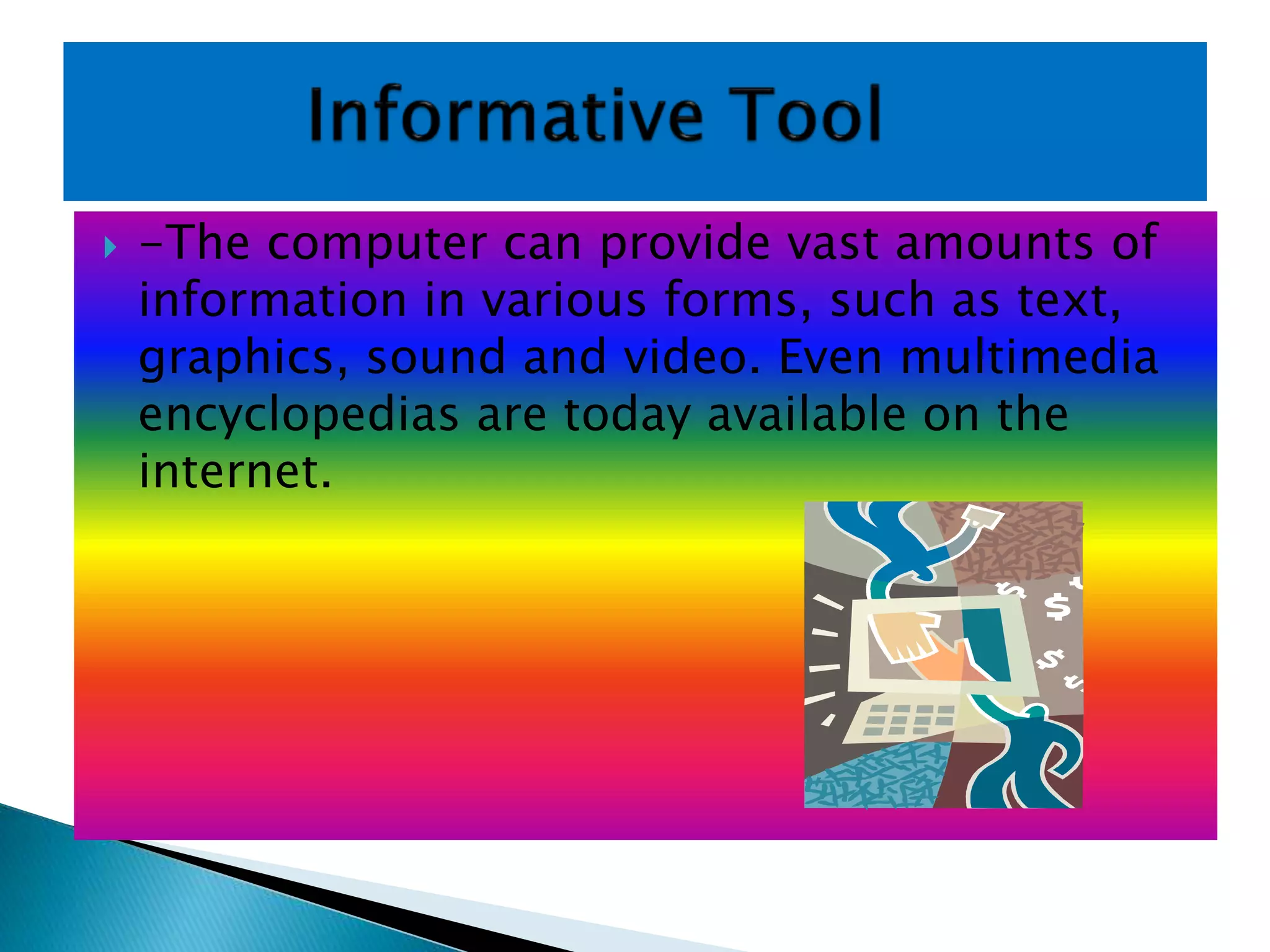
 -The computer can provide vast amounts of
information in various forms, such as text,
graphics, sound and video. Even multimedia
encyclopedias are today available on the
internet.
 - Along the constructivist point of view, it is
not enough for the learners to download
relevant information using the computer as
an information tool. Students can use
gathered information for composition nor
presentation projects as may be assigned by
the teacher. Given the fact that the internet
can serve as a channel for global
communication, the computer can very well
be the key tool for video teleconferencing
sessions.
 - The computer itself can be used for
manipulating information, visualizing one’s
understanding and building new knowledge.
The Microsoft Word computer program itself
is a desktop publishing software that allows
uses to organize and present their ideas in
attractive formats.
 - Students can use constructive tools to work
cooperatively and construct a shared
understanding of new knowledge. On ways of
co-constructive is the use of the electronic
whiteboard where students may post notices
to a shared document/whiteboard. Students
may also co-edit the same document from
their homes.
 - By means of virtual reality (RS) extension
systems, the computer can create 3-D images
on display to give the user the feeling that are
situated in a virtual environment. A flight
simulation program is an example of
situating tool which places the user in a
simulated flying environment. To caution
users, the computer as a situating tool is
news and still undergoing further research
and development.
DANICA MARIE V. TURMA
BEED-II

Lesson 11 - The Computer as the Teacher's Tool

  • 1.
    Lesson 11 The Computeras the Teacher’s Tool
  • 2.
     In thislesson , we shall again look at the computer , but this time from another perspective, the computer as the teacher’s handy-tool. It can in fact support the constructivist and social constructivist paradigms of constructivist learning.
  • 3.
     Constructivist wasintroduce by Piaget (1981) and Bruner (1990). They gave stress to knowledge discovery of new meaning/ concepts/principles in the learning process. While knowledge is constructed by the individual learner in constructivism, knowledge can also be socially constructed.
  • 4.
     The psychologistVygotsky stressed that learning is affected by social influences. He therefore suggested the interactive process in learning. The more capable adult (teacher or parent) or classmate can aid or complement what the learner sees in a given class project. In addition, Dewey sees language as a medium for social coordination and adaptation. For Dewey human learning is really human languaging that occurs when students socially share, build and agree upon meanings and knowledge.
  • 5.
     Learning FrameworkConstructivism Social Constructivism Assumption Knowledge is constructed by the individual. Knowledge is constructed within a social context. Definition of Learning Students build their own learning.
  • 6.
     Students buildknowledge influenced by the social context. Learning Strategies gather unorganized information to create new concept/principle, exchange and share from ideas, stimulates thinking.
  • 7.
     The Computer’sCapabilities given its present-day speed, flexibility and sophistication, the computer can provide;  -access to information  -foster creative social knowledge building  -and enhance the communication of the achieved project package.
  • 8.
     Based onthe two learning theories, the teacher can employ the computer a/an:  -as an information tool  -a communication tool  -a constructive tool  -as co-constructive tool  -a situating tool
  • 9.
     -The computercan provide vast amounts of information in various forms, such as text, graphics, sound and video. Even multimedia encyclopedias are today available on the internet.
  • 10.
     - Alongthe constructivist point of view, it is not enough for the learners to download relevant information using the computer as an information tool. Students can use gathered information for composition nor presentation projects as may be assigned by the teacher. Given the fact that the internet can serve as a channel for global communication, the computer can very well be the key tool for video teleconferencing sessions.
  • 11.
     - Thecomputer itself can be used for manipulating information, visualizing one’s understanding and building new knowledge. The Microsoft Word computer program itself is a desktop publishing software that allows uses to organize and present their ideas in attractive formats.
  • 12.
     - Studentscan use constructive tools to work cooperatively and construct a shared understanding of new knowledge. On ways of co-constructive is the use of the electronic whiteboard where students may post notices to a shared document/whiteboard. Students may also co-edit the same document from their homes.
  • 13.
     - Bymeans of virtual reality (RS) extension systems, the computer can create 3-D images on display to give the user the feeling that are situated in a virtual environment. A flight simulation program is an example of situating tool which places the user in a simulated flying environment. To caution users, the computer as a situating tool is news and still undergoing further research and development.
  • 14.
    DANICA MARIE V.TURMA BEED-II