RESEARCH METHODS
SUBMITTED TO: DR. TARIQ MEHMOOD CH.
Educational Research
Submitted by: Ghulam Mujtaba
Student id: E/2017-211
1
IERDepartmentofPU.1/1/2018
INTRODUCTION TO EDUCATIONAL RESEARCH
AS A STUDENT, TEACHER, OR ADMINISTRATOR, CONSIDER HOW MANY
TIMES YOU HAVE HEARD, “EVIDENCE-BASED PRACTICE” OR
“ACCORDING TO THE RESEARCH.”
It seems that every new idea in education is research-based,
2
IERDepartmentofPU.1/1/2018
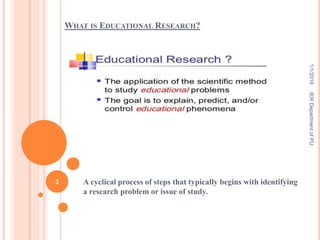
WHAT IS EDUCATIONAL RESEARCH?
A cyclical process of steps that typically begins with identifying
a research problem or issue of study.
3
IERDepartmentofPU.1/1/2018
WHY EDUCATIONAL RESEARCH?
SIX POINTS ARE FOLLOWING DOWN TO KNOW ABOUT WHY
EDUCATIONAL RESEARCH IS IMPORTANT?
1. Improve Practice
2. Add to Knowledge
3. Address Gaps in Knowledge
4. Expand Knowledge
5. Replicate Knowledge
6. Add Voices of Individuals to Knowledge
4
IERDepartmentofPU.1/1/2018
1. IMPROVE PRACTICE
RESEARCH CAN SUGGEST WAYS OF IMPROVING PRACTICE THAT
HAVE BEEN VERIFIED WITH MANY APPLICATIONS
AND BY MANY DIFFERENT TYPES OF PEOPLE, WHICH IS DIFFICULT
FOR PRACTITIONERS.
2. Add to Knowledge
Research can add to what we know about how people
learn and what we can do help facilitate
the learning process.
5
IERDepartmentofPU.1/1/2018
3. ADDRESS GAPS IN KNOWLEDGE
RESEARCH CAN ADDRESS AREAS IN WHICH
LITTLE IS KNOW, LIKE PERHAPS THE EFFECTS
OF ONLINE VERSUS
TRADITIONAL CLASSROOM LEARNING.
4. Expand Knowledge
Research can allow us to extend what we know in ways
we never conceived.
6
IERDepartmentofPU.1/1/2018
5. REPLICATE KNOWLEDGE
RESEARCH CAN ACT AS A TEST TO VERIFY PREVIOUS
FINDINGS.
6. Add Voices of Individuals to Knowledge
Research can add an important perspective for
different learning types. Much of the educational
research prior to the Eighties is based on able, white,
middle-to-upper class males.
7
IERDepartmentofPU.1/1/2018
WHAT ARE THE BASIC TYPES OF
RESEARCH?
Briefly, get used to using the following words:
quantitative, qualitative, network analysis, and mixed
methods. We will review each on this.
8
IERDepartmentofPU.1/1/2018
1. QUANTITATIVE RESEARCH (QUANT)
DESCRIPTIVE AND INFERENTIAL STATISTICS.
THIS TYPE OF RESEARCH DESIGN IS BEST FOR “WHAT?” QUESTIONS.
9
IERDepartmentofPU.1/1/2018
2. QUALITATIVE RESEARCH (QUAL)
DESCRIPTIVE AND THEMATIC ANALYSIS.
THIS TYPE OF RESEARCH DESIGN IS BEST FOR “HOW?”
AND “WHY?” QUESTIONS.
1/1/2018IERDepartmentofPU.
10
3. MIXED METHODS (MIXED)
INTEGRATED, SYNTHESIS, AND MULTI-
METHOD APPROACHES.
This type of research design is good for any questions you can
think of, particularly those that can’t be answer easily with
numbers alone. Consider the “best” way to evaluate student
achievement, for example.
11
IERDepartmentofPU.1/1/2018
REFERANCE:
CRESWELL (2002)
Thank you12
IERDepartmentofPU.1/1/2018
HOW IS RESEARCH DISTINGUISHED?
THE FINAL EMPHASIS POINT IN THIS BRIEF INTRODUCTION IS
FUNDAMENTAL YOUR UNDERSTANDING AS A SOON-TO-BE
CONSUMER/PRODUCER OF RESEARCH.
Where most introductory students struggle is in distinguishing
primary and secondary sources. We’ll return to this later, but
to be sure we are clear from the beginning. . .
13
IERDepartmentofPU.1/1/2018

Educational research 1

  • 1.
    RESEARCH METHODS SUBMITTED TO:DR. TARIQ MEHMOOD CH. Educational Research Submitted by: Ghulam Mujtaba Student id: E/2017-211 1 IERDepartmentofPU.1/1/2018
  • 2.
    INTRODUCTION TO EDUCATIONALRESEARCH AS A STUDENT, TEACHER, OR ADMINISTRATOR, CONSIDER HOW MANY TIMES YOU HAVE HEARD, “EVIDENCE-BASED PRACTICE” OR “ACCORDING TO THE RESEARCH.” It seems that every new idea in education is research-based, 2 IERDepartmentofPU.1/1/2018
  • 3.
    WHAT IS EDUCATIONALRESEARCH? A cyclical process of steps that typically begins with identifying a research problem or issue of study. 3 IERDepartmentofPU.1/1/2018
  • 4.
    WHY EDUCATIONAL RESEARCH? SIXPOINTS ARE FOLLOWING DOWN TO KNOW ABOUT WHY EDUCATIONAL RESEARCH IS IMPORTANT? 1. Improve Practice 2. Add to Knowledge 3. Address Gaps in Knowledge 4. Expand Knowledge 5. Replicate Knowledge 6. Add Voices of Individuals to Knowledge 4 IERDepartmentofPU.1/1/2018
  • 5.
    1. IMPROVE PRACTICE RESEARCHCAN SUGGEST WAYS OF IMPROVING PRACTICE THAT HAVE BEEN VERIFIED WITH MANY APPLICATIONS AND BY MANY DIFFERENT TYPES OF PEOPLE, WHICH IS DIFFICULT FOR PRACTITIONERS. 2. Add to Knowledge Research can add to what we know about how people learn and what we can do help facilitate the learning process. 5 IERDepartmentofPU.1/1/2018
  • 6.
    3. ADDRESS GAPSIN KNOWLEDGE RESEARCH CAN ADDRESS AREAS IN WHICH LITTLE IS KNOW, LIKE PERHAPS THE EFFECTS OF ONLINE VERSUS TRADITIONAL CLASSROOM LEARNING. 4. Expand Knowledge Research can allow us to extend what we know in ways we never conceived. 6 IERDepartmentofPU.1/1/2018
  • 7.
    5. REPLICATE KNOWLEDGE RESEARCHCAN ACT AS A TEST TO VERIFY PREVIOUS FINDINGS. 6. Add Voices of Individuals to Knowledge Research can add an important perspective for different learning types. Much of the educational research prior to the Eighties is based on able, white, middle-to-upper class males. 7 IERDepartmentofPU.1/1/2018
  • 8.
    WHAT ARE THEBASIC TYPES OF RESEARCH? Briefly, get used to using the following words: quantitative, qualitative, network analysis, and mixed methods. We will review each on this. 8 IERDepartmentofPU.1/1/2018
  • 9.
    1. QUANTITATIVE RESEARCH(QUANT) DESCRIPTIVE AND INFERENTIAL STATISTICS. THIS TYPE OF RESEARCH DESIGN IS BEST FOR “WHAT?” QUESTIONS. 9 IERDepartmentofPU.1/1/2018
  • 10.
    2. QUALITATIVE RESEARCH(QUAL) DESCRIPTIVE AND THEMATIC ANALYSIS. THIS TYPE OF RESEARCH DESIGN IS BEST FOR “HOW?” AND “WHY?” QUESTIONS. 1/1/2018IERDepartmentofPU. 10
  • 11.
    3. MIXED METHODS(MIXED) INTEGRATED, SYNTHESIS, AND MULTI- METHOD APPROACHES. This type of research design is good for any questions you can think of, particularly those that can’t be answer easily with numbers alone. Consider the “best” way to evaluate student achievement, for example. 11 IERDepartmentofPU.1/1/2018
  • 12.
  • 13.
    HOW IS RESEARCHDISTINGUISHED? THE FINAL EMPHASIS POINT IN THIS BRIEF INTRODUCTION IS FUNDAMENTAL YOUR UNDERSTANDING AS A SOON-TO-BE CONSUMER/PRODUCER OF RESEARCH. Where most introductory students struggle is in distinguishing primary and secondary sources. We’ll return to this later, but to be sure we are clear from the beginning. . . 13 IERDepartmentofPU.1/1/2018