Taxonomy
Taxonomy comes from the Greek word “taxis which means
“arrangements” and “nomos which means “science”
Taxonomy is “Science of arrangements”
Bloom’s Taxonomy
Bloom's taxonomy is a classification system used to define and
distinguish different levels of human cognition
For Example: thinking, learning, and understanding.
Educators have typically used Bloom’s taxonomy to inform or
guide the development of assessments (tests and other
evaluations of student learning), curriculum (units, lessons,
projects, and other learning activities), and instructional methods
such as questioning strategies.
Domains Of Bloom’s Taxonomy
Bloom was the head of a group in the 1950’s and 1960’s that
created the classic definition of the levels of educational activity,
from the very simple (like memorizing facts) to the more
complex (such as analyzing or evaluating information). The
three types, or domains, of knowledge they defined are cognitive
(knowledge), affective (attitudes) and psychomotor (physical
skills).
Cognitive Domain
(Bloom’s Taxonomy)
Knowledge
Recall and remember information.
Comprehension
Understand the meaning, translation, interpolation, and
interpretation of instructions and problems. State a problem in
one's own words. Establish relationships between dates,
principles, generalizations or values.
Application
Use a concept in a new situation or unprompted use of an
abstraction. Applies what was learned in the classroom into
novel situations in the workplace. Facilitate transfer of
knowledge to new or unique situations.
Analysis
Separates material or concepts into component parts so that its
organizational structure may be understood. Distinguishes
between facts and inferences.
Synthesis
Builds a structure or pattern from diverse elements. Put parts
together to form a whole, with emphasis on creating a new
meaning or structure. Originality and creativity.
Evaluation
Make judgments about the value of ideas or materials.
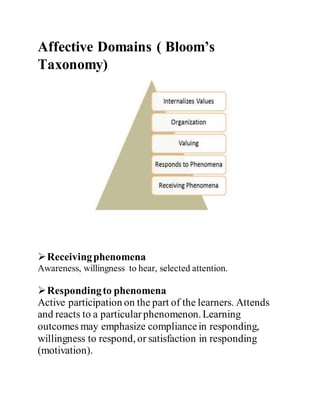
Affective Domains ( Bloom’s
Taxonomy)
Receivingphenomena
Awareness, willingness to hear, selected attention.
Respondingto phenomena
Active participation on the part of the learners. Attends
and reacts to a particularphenomenon.Learning
outcomes may emphasize compliancein responding,
willingness to respond, or satisfaction in responding
(motivation).
Valuing
The worth or value a person attaches to a particular object,
phenomenon, or behavior. This ranges from simple acceptance
to the more complex state of commitment.
Organization
Organizes values into priorities by contrastingdifferent
values, resolving conflicts between them, and creating a
uniquevalue system. The emphasis is on comparing,
relating, and synthesizing values.
Internalizing Values
Has a value system that controls their behavior. The behavior is
pervasive, consistent, predictable, and most importantly,
characteristic of the learner.
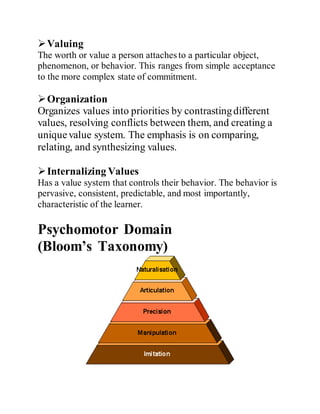
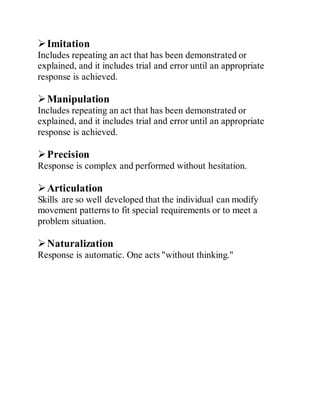
Psychomotor Domain
(Bloom’s Taxonomy)
Imitation
Includes repeating an act that has been demonstrated or
explained, and it includes trial and error until an appropriate
response is achieved.
Manipulation
Includes repeating an act that has been demonstrated or
explained, and it includes trial and error until an appropriate
response is achieved.
Precision
Response is complex and performed without hesitation.
Articulation
Skills are so well developed that the individual can modify
movement patterns to fit special requirements or to meet a
problem situation.
Naturalization
Response is automatic. One acts "without thinking."
Maslow's Hierarchy of Needs
Each of us is motivated by needs. Our most basic needs are
inborn, having evolved over tens of thousands of years.
Abraham Maslow's Hierarchy of Needs helps to explain how
these needs motivate us all. Maslow's Hierarchy of Needs states
that we must satisfy each need in turn, starting with the first,
which deals with the most obvious needs for survival itself.
Only when the lower order needs of physical and emotional
well-being are satisfied are we concerned with the higher order
needs of influence and personal development.
Contributors
Abraham Maslow (1908 – 1970)
Key Concepts
Abraham H. Maslow felt as though conditioningtheories
did not adequatelycapturethe complexity of human
behavior. In a 1943 paper called A Theory of Human
Motivation, Maslow presented the idea that human
actions are directed toward goal attainment. Any given
behavior could satisfy several functions at the same time;
for instance, going to a bar could satisfy one’s needs for
self-esteem and for social interaction.
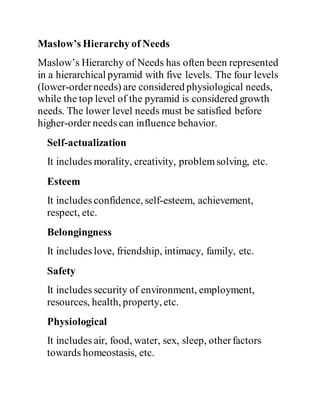
Maslow’s Hierarchy of Needs
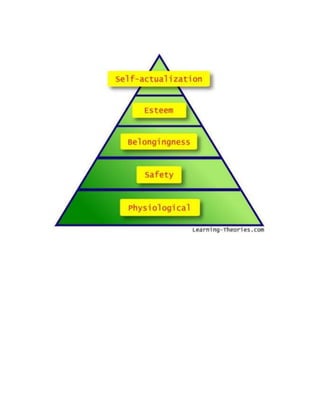
Maslow’s Hierarchy of Needs has often been represented
in a hierarchical pyramid with five levels. The four levels
(lower-orderneeds) are considered physiological needs,
while the top level of the pyramid is considered growth
needs. The lower level needs must be satisfied before
higher-order needs can influence behavior.
Self-actualization
It includes morality, creativity, problemsolving, etc.
Esteem
It includes confidence, self-esteem, achievement,
respect, etc.
Belongingness
It includes love, friendship, intimacy, family, etc.
Safety
It includes security of environment, employment,
resources, health, property, etc.
Physiological
It includes air, food, water, sex, sleep, otherfactors
towards homeostasis, etc.
Educational psychology Taxonomy

Educational psychology Taxonomy

  • 1.
    Taxonomy Taxonomy comes fromthe Greek word “taxis which means “arrangements” and “nomos which means “science” Taxonomy is “Science of arrangements” Bloom’s Taxonomy Bloom's taxonomy is a classification system used to define and distinguish different levels of human cognition For Example: thinking, learning, and understanding. Educators have typically used Bloom’s taxonomy to inform or guide the development of assessments (tests and other evaluations of student learning), curriculum (units, lessons, projects, and other learning activities), and instructional methods such as questioning strategies. Domains Of Bloom’s Taxonomy Bloom was the head of a group in the 1950’s and 1960’s that created the classic definition of the levels of educational activity, from the very simple (like memorizing facts) to the more complex (such as analyzing or evaluating information). The three types, or domains, of knowledge they defined are cognitive (knowledge), affective (attitudes) and psychomotor (physical skills).
  • 2.
  • 3.
    Knowledge Recall and rememberinformation. Comprehension Understand the meaning, translation, interpolation, and interpretation of instructions and problems. State a problem in one's own words. Establish relationships between dates, principles, generalizations or values. Application Use a concept in a new situation or unprompted use of an abstraction. Applies what was learned in the classroom into novel situations in the workplace. Facilitate transfer of knowledge to new or unique situations. Analysis Separates material or concepts into component parts so that its organizational structure may be understood. Distinguishes between facts and inferences. Synthesis Builds a structure or pattern from diverse elements. Put parts together to form a whole, with emphasis on creating a new meaning or structure. Originality and creativity. Evaluation Make judgments about the value of ideas or materials.
  • 4.
    Affective Domains (Bloom’s Taxonomy) Receivingphenomena Awareness, willingness to hear, selected attention. Respondingto phenomena Active participation on the part of the learners. Attends and reacts to a particularphenomenon.Learning outcomes may emphasize compliancein responding, willingness to respond, or satisfaction in responding (motivation).
  • 5.
    Valuing The worth orvalue a person attaches to a particular object, phenomenon, or behavior. This ranges from simple acceptance to the more complex state of commitment. Organization Organizes values into priorities by contrastingdifferent values, resolving conflicts between them, and creating a uniquevalue system. The emphasis is on comparing, relating, and synthesizing values. Internalizing Values Has a value system that controls their behavior. The behavior is pervasive, consistent, predictable, and most importantly, characteristic of the learner. Psychomotor Domain (Bloom’s Taxonomy)
  • 6.
    Imitation Includes repeating anact that has been demonstrated or explained, and it includes trial and error until an appropriate response is achieved. Manipulation Includes repeating an act that has been demonstrated or explained, and it includes trial and error until an appropriate response is achieved. Precision Response is complex and performed without hesitation. Articulation Skills are so well developed that the individual can modify movement patterns to fit special requirements or to meet a problem situation. Naturalization Response is automatic. One acts "without thinking."
  • 7.
    Maslow's Hierarchy ofNeeds Each of us is motivated by needs. Our most basic needs are inborn, having evolved over tens of thousands of years. Abraham Maslow's Hierarchy of Needs helps to explain how these needs motivate us all. Maslow's Hierarchy of Needs states that we must satisfy each need in turn, starting with the first, which deals with the most obvious needs for survival itself. Only when the lower order needs of physical and emotional well-being are satisfied are we concerned with the higher order needs of influence and personal development. Contributors Abraham Maslow (1908 – 1970) Key Concepts Abraham H. Maslow felt as though conditioningtheories did not adequatelycapturethe complexity of human behavior. In a 1943 paper called A Theory of Human Motivation, Maslow presented the idea that human actions are directed toward goal attainment. Any given behavior could satisfy several functions at the same time; for instance, going to a bar could satisfy one’s needs for self-esteem and for social interaction.
  • 8.
    Maslow’s Hierarchy ofNeeds Maslow’s Hierarchy of Needs has often been represented in a hierarchical pyramid with five levels. The four levels (lower-orderneeds) are considered physiological needs, while the top level of the pyramid is considered growth needs. The lower level needs must be satisfied before higher-order needs can influence behavior. Self-actualization It includes morality, creativity, problemsolving, etc. Esteem It includes confidence, self-esteem, achievement, respect, etc. Belongingness It includes love, friendship, intimacy, family, etc. Safety It includes security of environment, employment, resources, health, property, etc. Physiological It includes air, food, water, sex, sleep, otherfactors towards homeostasis, etc.