Presentation prepared by:

Ms. Roxanne Jane M Ballecer
1.1 Context and Culture

1.2 Interactive Nature and Context of
  Leadership

1.3 Time and Nature of Truth

1.4 Paradigms in Educational
  Administration
“teachers open the door.
 You enter by yourself”
    –Chinese Proverb
-discusses the dynamic roles of leadership,
  management, and administration as they
  relate to educational organizations
  (NCPAE)
 Educational administration evolved out of a need to
  operate schools under a set of practical and applied
  administrative skills.
 The bureaucratization of educational organizations
  during the 19th and 20th centuries required
  specialized professional knowledge in order to
  become and to succeed as an educational leader.
 The academic, scientific, and theory basis for
  educational administration provided educational
  leaders with advanced tools, conceptual
  frameworks, and contemporary and theoretical
  knowledge required to lead educational
  organizations.
curriculum developers,

school principals

district superintendents

Workers in state and federal education
 agencies

teachers
 
   They can make a difference between teachers feeling good and
    bad about themselves
   They can create a climate in schools that is productive and fun.
    Can work on improving school climate if this is main target
   They can help teachers grow and retain their professional
    resiliency.
   They can influence whole schools and hundreds of children (e.g.
    if one teacher can make a difference with thirty or fifty kids, a
    school administrator can have a positive effect on more kids.)
   They can move and improve school systems and an opportunity
    to change whole schools or “shaping up” a school and providing
    a more work-oriented environment
   Improving school’s performance in terms of scores and
    statewide competency battery
   Increase in salary, prestige and other perks (benefits) that goes
    with it.
is not only to learn the theories,
movements traditions, and skills of the
discipline, but to be exposed to the
dominant paradigm and have it raised to
the level of cognitive awareness
required to fully appreciate its
contribution, strengths, and
weaknesses, as one goes about
practicing educational administration in
schools and colleges.
Context (language)
 -the text in which a word or passage
  appears and which affects its meaning;
  also the words and social setting which
  surrounds a spoken word or passage.
1.2 Interactive Nature and
  Context of Leadership
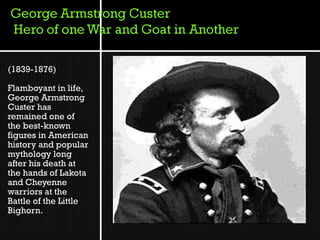
(1839-1876)

Flamboyant in life,
George Armstrong
Custer has
remained one of
the best-known
figures in American
history and popular
mythology long
after his death at
the hands of Lakota
and Cheyenne
warriors at the
Battle of the Little
Bighorn.
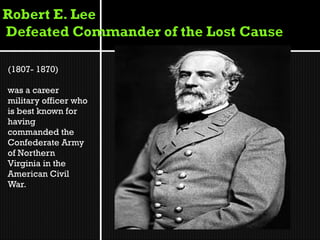
(1807- 1870)

was a career
military officer who
is best known for
having
commanded the
Confederate Army
of Northern
Virginia in the
American Civil
War.
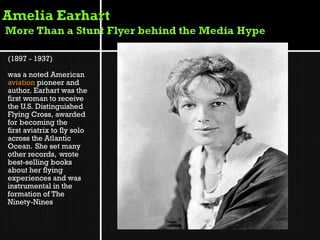
(1897 - 1937)

was a noted American 
aviation pioneer and
author. Earhart was the
first woman to receive
the U.S. Distinguished
Flying Cross, awarded
for becoming the
first aviatrix to fly solo
across the Atlantic
Ocean.  She set many
other records,  wrote
best-selling books
about her flying
experiences and was
instrumental in the
formation of The
Ninety-Nines
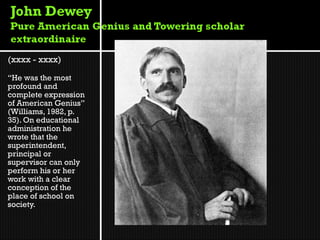
(xxxx - xxxx)

“He was the most
profound and
complete expression
of American Genius”
(Williams, 1982, p.
35). On educational
administration he
wrote that the
superintendent,
principal or
supervisor can only
perform his or her
work with a clear
conception of the
place of school on
society.
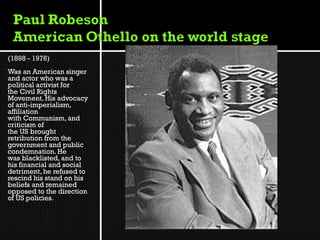
(1898 - 1976)
Was an American singer
and actor who was a
political activist for
the Civil Rights
Movement, His advocacy
of anti-imperialism,
affiliation
with Communism, and
criticism of
the US brought
retribution from the
government and public
condemnation. He
was blacklisted, and to
his financial and social
detriment, he refused to
rescind his stand on his
beliefs and remained
opposed to the direction
of US policies.
Truth has a variety of meanings, primarily being in accord
  with fact or reality, fidelity to an original or to a standard or
  ideal and, in common usage, constancy or sincerity in
  action or character. The opposite of truth is falsehood,
  which, correspondingly, can also take on a logical, factual,
  or ethical meaning. The concept of truth is discussed and
  debated in several contexts, including philosophy and
  religion. Many human activities depend upon the concept,
  which is assumed rather than a subject of discussion,
  including science, law, and everyday life.
Truth – is an objective “thing” and as such needs nothing else
  except facts to support it. The truth requires no
  embellishment. Since it is immortal it needs no human law
  or government to cradle or sponsor it. (Dudley Field
  Malone)
Paradigm
- is a Greek word that means as example or pattern. But used by American
    scientist- historians, Thomas Kuhn, it meant a group of scientist who are
    bound by the traditions of the solution of central scientific problem. Thus
    paradigm is a shared pre understanding necessary to be part of the field.
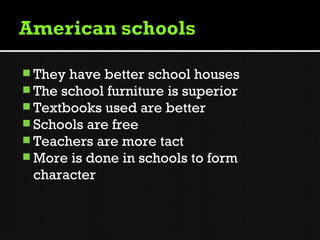
 They have better school houses
 The school furniture is superior
 Textbooks used are better
 Schools are free
 Teachers are more tact
 More is done in schools to form
 character
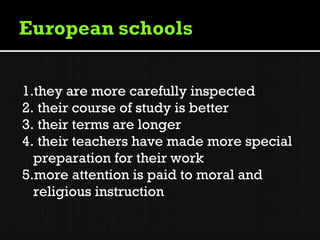
1.they are more carefully inspected
2. their course of study is better
3. their terms are longer
4. their teachers have made more special
  preparation for their work
5.more attention is paid to moral and
  religious instruction
-”father of scientific management”

He wrote “principles of scientific
 management”
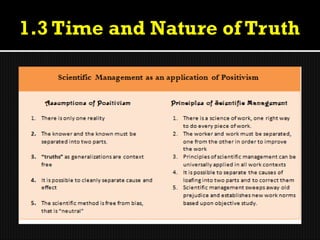
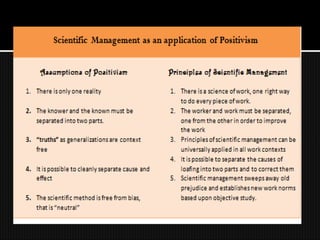
- Is an application of the tenets of
   positivism in a specific content.
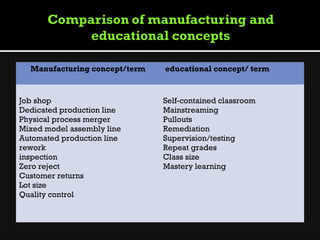
Manufacturing concept/term   educational concept/ term


Job shop                       Self-contained classroom
Dedicated production line      Mainstreaming
Physical process merger        Pullouts
Mixed model assembly line      Remediation
Automated production line      Supervision/testing
rework                         Repeat grades
inspection                     Class size
Zero reject                    Mastery learning
Customer returns
Lot size
Quality control
This is a hybrid blend of two or more
  paradigms.
This is a process concerned with “what
  the organization wants to be and how
  should it get there”
Is based on the premise that
  organizations, like biological organisms
  are competing with one another for
  survival.
DEMOCRATIC
ADMINISTRATION


                 HUMAN RELATION
 Focused  on their efforts on chaging the
 style of leadership and its autocratic
 overtones. They desire a “soft” and
 even non-directive stance in regard to
 leadership. This body of thought did not
 however conflict with permutations of
 positivism.
This was replaced by behaviorist
 approach to study human in
 organizations represented the apogee of
 triumph of positivism.
Educadm 1 (presentation)

Educadm 1 (presentation)

  • 1.
    Presentation prepared by: Ms.Roxanne Jane M Ballecer
  • 2.
    1.1 Context andCulture 1.2 Interactive Nature and Context of Leadership 1.3 Time and Nature of Truth 1.4 Paradigms in Educational Administration
  • 3.
    “teachers open thedoor. You enter by yourself” –Chinese Proverb
  • 6.
    -discusses the dynamicroles of leadership, management, and administration as they relate to educational organizations (NCPAE)
  • 7.
     Educational administrationevolved out of a need to operate schools under a set of practical and applied administrative skills.  The bureaucratization of educational organizations during the 19th and 20th centuries required specialized professional knowledge in order to become and to succeed as an educational leader.  The academic, scientific, and theory basis for educational administration provided educational leaders with advanced tools, conceptual frameworks, and contemporary and theoretical knowledge required to lead educational organizations.
  • 8.
    curriculum developers, school principals districtsuperintendents Workers in state and federal education agencies teachers
  • 9.
       They can make a difference between teachers feeling good and bad about themselves  They can create a climate in schools that is productive and fun. Can work on improving school climate if this is main target  They can help teachers grow and retain their professional resiliency.  They can influence whole schools and hundreds of children (e.g. if one teacher can make a difference with thirty or fifty kids, a school administrator can have a positive effect on more kids.)  They can move and improve school systems and an opportunity to change whole schools or “shaping up” a school and providing a more work-oriented environment  Improving school’s performance in terms of scores and statewide competency battery  Increase in salary, prestige and other perks (benefits) that goes with it.
  • 10.
    is not onlyto learn the theories, movements traditions, and skills of the discipline, but to be exposed to the dominant paradigm and have it raised to the level of cognitive awareness required to fully appreciate its contribution, strengths, and weaknesses, as one goes about practicing educational administration in schools and colleges.
  • 11.
    Context (language) -thetext in which a word or passage appears and which affects its meaning; also the words and social setting which surrounds a spoken word or passage.
  • 12.
    1.2 Interactive Natureand Context of Leadership
  • 13.
    (1839-1876) Flamboyant in life, GeorgeArmstrong Custer has remained one of the best-known figures in American history and popular mythology long after his death at the hands of Lakota and Cheyenne warriors at the Battle of the Little Bighorn.
  • 14.
    (1807- 1870) was acareer military officer who is best known for having commanded the Confederate Army of Northern Virginia in the American Civil War.
  • 15.
    (1897 - 1937) wasa noted American  aviation pioneer and author. Earhart was the first woman to receive the U.S. Distinguished Flying Cross, awarded for becoming the first aviatrix to fly solo across the Atlantic Ocean.  She set many other records,  wrote best-selling books about her flying experiences and was instrumental in the formation of The Ninety-Nines
  • 16.
    (xxxx - xxxx) “Hewas the most profound and complete expression of American Genius” (Williams, 1982, p. 35). On educational administration he wrote that the superintendent, principal or supervisor can only perform his or her work with a clear conception of the place of school on society.
  • 17.
    (1898 - 1976) Wasan American singer and actor who was a political activist for the Civil Rights Movement, His advocacy of anti-imperialism, affiliation with Communism, and criticism of the US brought retribution from the government and public condemnation. He was blacklisted, and to his financial and social detriment, he refused to rescind his stand on his beliefs and remained opposed to the direction of US policies.
  • 18.
    Truth has avariety of meanings, primarily being in accord with fact or reality, fidelity to an original or to a standard or ideal and, in common usage, constancy or sincerity in action or character. The opposite of truth is falsehood, which, correspondingly, can also take on a logical, factual, or ethical meaning. The concept of truth is discussed and debated in several contexts, including philosophy and religion. Many human activities depend upon the concept, which is assumed rather than a subject of discussion, including science, law, and everyday life. Truth – is an objective “thing” and as such needs nothing else except facts to support it. The truth requires no embellishment. Since it is immortal it needs no human law or government to cradle or sponsor it. (Dudley Field Malone)
  • 20.
    Paradigm - is aGreek word that means as example or pattern. But used by American scientist- historians, Thomas Kuhn, it meant a group of scientist who are bound by the traditions of the solution of central scientific problem. Thus paradigm is a shared pre understanding necessary to be part of the field.
  • 21.
     They havebetter school houses  The school furniture is superior  Textbooks used are better  Schools are free  Teachers are more tact  More is done in schools to form character
  • 22.
    1.they are morecarefully inspected 2. their course of study is better 3. their terms are longer 4. their teachers have made more special preparation for their work 5.more attention is paid to moral and religious instruction
  • 23.
    -”father of scientificmanagement” He wrote “principles of scientific management”
  • 24.
    - Is anapplication of the tenets of positivism in a specific content.
  • 25.
    Manufacturing concept/term educational concept/ term Job shop Self-contained classroom Dedicated production line Mainstreaming Physical process merger Pullouts Mixed model assembly line Remediation Automated production line Supervision/testing rework Repeat grades inspection Class size Zero reject Mastery learning Customer returns Lot size Quality control
  • 27.
    This is ahybrid blend of two or more paradigms. This is a process concerned with “what the organization wants to be and how should it get there” Is based on the premise that organizations, like biological organisms are competing with one another for survival.
  • 28.
  • 29.
     Focused on their efforts on chaging the style of leadership and its autocratic overtones. They desire a “soft” and even non-directive stance in regard to leadership. This body of thought did not however conflict with permutations of positivism.
  • 30.
    This was replacedby behaviorist approach to study human in organizations represented the apogee of triumph of positivism.