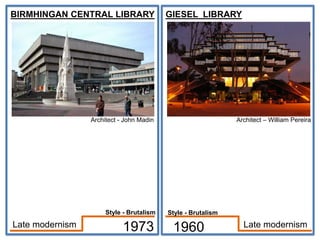
BIRMHINGAN CENTRAL LIBRARY
Architect - John Madin
1973
GIESEL LIBRARY
Architect – William Pereira
1960 Late modernism
Late modernism
Style - Brutalism Style - Brutalism
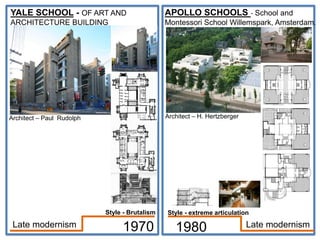
YALE SCHOOL - OF ART AND
ARCHITECTURE BUILDING
Architect – Paul Rudolph
1970
Architect – H. Hertzberger
1980 Late modernism
Late modernism
APOLLO SCHOOLS - School and
Montessori School Willemspark, Amsterdam.
Style - Brutalism Style - extreme articulation
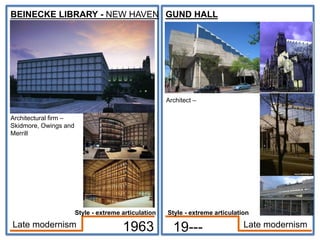
BEINECKE LIBRARY - NEW HAVEN
Architectural firm –
Skidmore, Owings and
Merrill
1963
GUND HALL
Architect –
19--- Late modernism
Late modernism
Style - extreme articulation
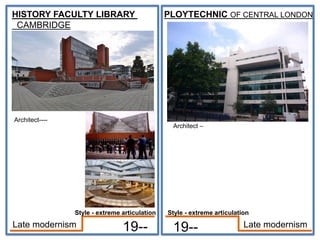
HISTORY FACULTY LIBRARY
CAMBRIDGE
Architect----
19--
PLOYTECHNIC OF CENTRAL LONDON
Architect –
19-- Late modernism
Late modernism
Style - extreme articulation
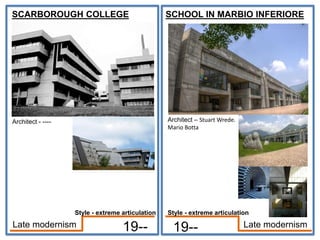
SCARBOROUGH COLLEGE
Architect - ----
19--
SCHOOL IN MARBIO INFERIORE
Architect – Stuart Wrede.
Mario Botta
19-- Late modernism
Late modernism
Style - extreme articulation
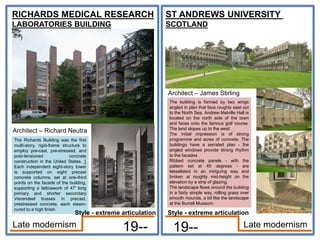
RICHARDS MEDICAL RESEARCH
LABORATORIES BUILDING
Architect – Richard Neutra
19--
ST ANDREWS UNIVERSITY
SCOTLAND
Architect – James Stirling
19-- Late modernism
Late modernism
The Richards Building was the first
multi-story, rigid-frame structure to
employ pre-cast, pre-stressed, and
post-tensioned concrete
construction in the United States. 1
Each independent eight-story tower
is supported on eight precast
concrete columns, set at one-third
points on the facade of the building,
supporting a latticework of 47' long
primary and shorter secondary
Vierendeel trusses in precast,
prestressed concrete, each steam-
cured to a high finish.
The building is formed by two wings
angled in plan that face roughly east out
to the North Sea. Andrew Melville Hall is
located on the north side of the town
and faces onto the famous golf course.
The land slopes up to the west.
The initial impression is of strong
programme and acres of concrete. The
buildings have a serrated plan - the
angled windows provide strong rhythm
to the facades
Ribbed concrete panels - with the
pattern set at 45 degrees - are
tessellated in an intriguing way and
broken at roughly mid-height on the
elevation by a strip of glazing.
The landscape flows around the building
in a fairly simple way, rolling grass over
smooth mounds, a bit like the landscape
at the Burrell Museum.
Style - extreme articulation
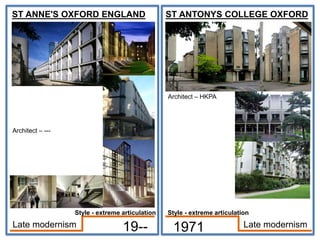
ST ANNE'S OXFORD ENGLAND
Architect – ---
19--
ST ANTONYS COLLEGE OXFORD
Architect – HKPA
1971 Late modernism
Late modernism
Style - extreme articulation
UNIVERSITY OF EAST ANGLIA, NORWICH
Arch – Denys Lasdun
1960
CAMBRIDGE FACULTY OF LAW
19-- Late modernism
Late modernism
Designed by Denys Lasdun in the
early 60’s and implemented in
stages through the latter half of
the C20 the masterplan for the
UEA is based on the idea of the
‘five minute university’. The idea
that students should be able to
get from lectures to halls in five
minutes or less. At the front are
the iconic ziggurats where the
students live and behind the
‘teaching wall’, an enormous
snake of a building connected by
high-level walkways to the
ziggurats and to the right to the
social area with the union, shops
and lecture theatres and finally
more of the ziggurats at the
bottom.
Combining a sense of tradition with a
forward-looking commitment to
change, the new Faculty of Law
provides state-of-the-art facilities as
well as setting new standards for
energy efficiency on the Cambridge
campus. The curving glass of the
north façade floods the atrium and
library with light, providing a sense of
transparency and helping the building
to recede visually.
Style – slick tech
Style - extreme articulation
Architect – Norman Foster
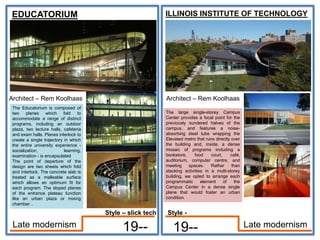
EDUCATORIUM
Architect – Rem Koolhaas
19--
ILLINOIS INSTITUTE OF TECHNOLOGY
19-- Late modernism
Late modernism
The Educatorium is composed of
two planes which fold to
accommodate a range of distinct
programs, including an outdoor
plaza, two lecture halls, cafeteria
and exam halls. Planes interlock to
create a single trajectory in which
the entire university experience -
socialization, learning,
examination - is encapsulated
The point of departure of the
design are two sheets which fold
and interlock. The concrete slab is
treated as a malleable surface
which allows an optimum fit for
each program. The sloped planes
of the entrance plateau function
like an urban plaza or mixing
chamber. .
Architect – Rem Koolhaas
The large single-storey Campus
Center provides a focal point for the
previously sundered halves of the
campus, and features a noise-
absorbing steel tube wrapping the
Elevated metro that runs directly over
the building and, inside, a dense
mosaic of programs including a
bookstore, food court, café,
auditorium, computer centre, and
meeting spaces. Rather than
stacking activities in a multi-storey
building, we opted to arrange each
programmatic element of the
Campus Center in a dense single
plane that would foster an urban
condition.
Style -
Style – slick tech
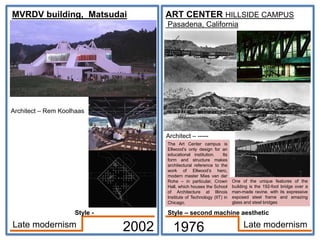
MVRDV building, Matsudai
Architect – Rem Koolhaas
2002
ART CENTER HILLSIDE CAMPUS
Pasadena, California
Architect – -----
1976 Late modernism
Late modernism
The Art Center campus is
Ellwood’s only design for an
educational institution. Its
form and structure makes
architectural reference to the
work of Ellwood’s hero,
modern master Mies van der
Rohe – in particular, Crown
Hall, which houses the School
of Architecture at Illinois
Institute of Technology (IIT) in
Chicago.
One of the unique features of the
building is the 192-foot bridge over a
man-made ravine. with its expressive
exposed steel frame and amazing
glass and steel bridges
Style – second machine aesthetic
Style -
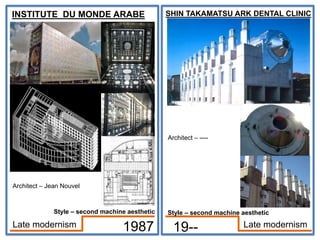
INSTITUTE DU MONDE ARABE
Architect – Jean Nouvel
1987
SHIN TAKAMATSU ARK DENTAL CLINIC
Architect – ----
19-- Late modernism
Late modernism
Style – second machine aesthetic
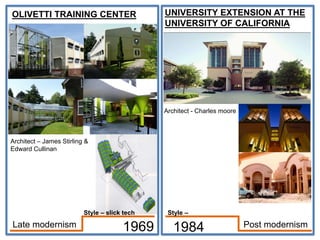
OLIVETTI TRAINING CENTER
Architect – James Stirling &
Edward Cullinan
1969 1984 Post modernism
Late modernism
UNIVERSITY EXTENSION AT THE
UNIVERSITY OF CALIFORNIA
Architect - Charles moore
Style –
Style – slick tech
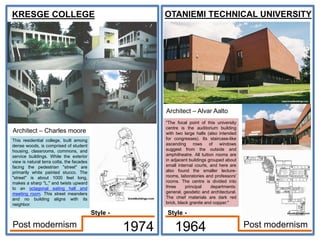
KRESGE COLLEGE
Architect – Charles moore
1974
OTANIEMI TECHNICAL UNIVERSITY
Architect – Alvar Aalto
1964 Post modernism
Post modernism
"The focal point of this university
centre is the auditorium building
with two large halls (also intended
for congresses). Its staircase-like
ascending rows of windows
suggest from the outside and
amphitheatre. All tuition rooms are
in adjacent buildings grouped about
small internal courts, and here are
also found the smaller lecture-
rooms, laboratories and professors'
rooms. The centre is divided into
three principal departments:
general, geodetic and architectural.
The chief materials are dark red
brick, black granite and copper."
This residential college, built among
dense woods, is comprised of student
housing, classrooms, commons, and
service buildings. While the exterior
view is natural terra cotta, the facades
facing the pedestrian "street" are
primarily white painted stucco. The
"street" is about 1000 feet long,
makes a sharp "L," and twists upward
to an octagonal eating hall and
meeting room. This street meanders
and no building aligns with its
neighbor.
Style -
Style -
NATIONAL DONG HWA
UNIVERSITY, HUALIEN, TAIWAN
Architect – Chares W Moore
1992
FACULTY CLUB UNIVT. OF CALIFORNIA
1967 Post modernism
Post modernism
National Dong Hwa University is situated
on the unpolluted and unadulterated
Taiwanese East Coast in the middle of
Hualien County. To the west of the
University towers the foothills of the
Central Mountain Range, and to the east
lies the emerald-green Pacific Ocean. The
Hualien Rift Valley area possesses a
variety of unique geographical features,
ranging from rustic valleys and rolling hills
to vast open prairies. The campus layout
is basically designed with a south-facing
orientation with the central axis tilting 20°
west from the north to avoid direct
sunlight
Architect – Chares W
Moore
The front wall of the club, which
faces the lagoon, is partially the
result of a controversy with the
campus architect, Charles
Luckman. When he saw our
building, he said is was
unacceptable, that it looked
terrible, didn’t look like his stuff,
and had to have a bris-soleil. He
thought that would cause us to
put a screen over it which would
hide this awful building which we
had done, and he wouldn’t have
to worry about it any more. It
swept over me in the middle of
the night, that all we have to do is
have another wall in front of our
opening, with other holes in it.
Thanks to Charles Luckman, then
came our first free standing
walls.”
Style -
Style -
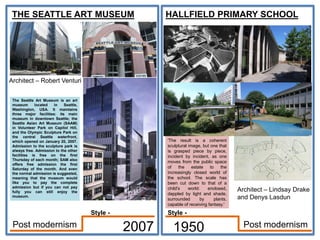
THE SEATTLE ART MUSEUM
Architect – Robert Venturi
2007
HALLFIELD PRIMARY SCHOOL
Architect – Lindsay Drake
and Denys Lasdun
1950 Post modernism
Post modernism
The Seattle Art Museum is an art
museum located in Seattle,
Washington, USA. It maintains
three major facilities: its main
museum in downtown Seattle; the
Seattle Asian Art Museum (SAAM)
in Volunteer Park on Capitol Hill,
and the Olympic Sculpture Park on
the central Seattle waterfront,
which opened on January 20, 2007.
Admission to the sculpture park is
always free. Admission to the other
facilities is free on the first
Thursday of each month; SAM also
offers free admission the first
Saturday of the month. And even
the normal admission is suggested,
meaning that the museum would
like you to pay the complete
admission but if you can not pay
fully you can still enjoy the
museum.
'The result is a coherent
sculptural image, but one that
is grasped piece by piece,
incident by incident, as one
moves from the public space
of the estate to the
increasingly closed world of
the school. The scale has
been cut down to that of a
child's world: enclosed,
dappled by light and shade,
surrounded by plants,
capable of receiving fantasy.'
Style -
Style -
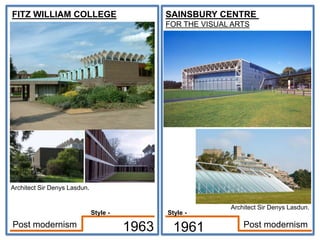
FITZ WILLIAM COLLEGE
Architect Sir Denys Lasdun.
1963
SAINSBURY CENTRE
FOR THE VISUAL ARTS
1961 Post modernism
Post modernism
Architect Sir Denys Lasdun.
Style -
Style -
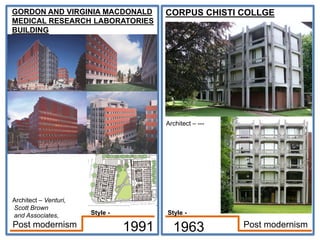
GORDON AND VIRGINIA MACDONALD
MEDICAL RESEARCH LABORATORIES
BUILDING
Architect – Venturi,
Scott Brown
and Associates,
1991
CORPUS CHISTI COLLGE
Architect – ---
1963 Post modernism
Post modernism
Style -
Style -
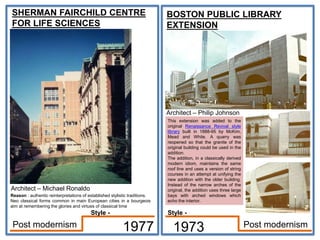
SHERMAN FAIRCHILD CENTRE
FOR LIFE SCIENCES
Architect – Michael Ronaldo
1977 1973 Post modernism
Post modernism
This extension was added to the
original Renaissance Revival style
library built in 1888-95 by McKim,
Mead and White. A quarry was
reopened so that the granite of the
original building could be used in the
addition.
The addition, in a classically derived
modern idiom, maintains the same
roof line and uses a version of string
courses in an attempt at unifying the
new addition with the older building.
Instead of the narrow arches of the
original, the addition uses three large
bays with arched windows which
echo the interior.
Architect – Philip Johnson
BOSTON PUBLIC LIBRARY
EXTENSION
Reason : authentic reinterpretations of established stylistic traditions.
Neo classical forms common in main European cities in a bourgeois
aim at remembering the glories and virtues of classical time
Style -
Style -
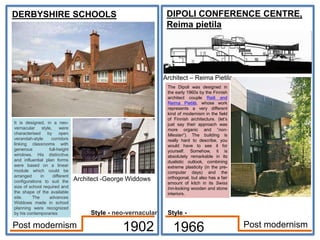
DERBYSHIRE SCHOOLS
Architect -George Widdows
1902 1966 Post modernism
Post modernism
It is designed, in a neo-
vernacular style, were
characterised by open
verandah-style corridors
linking classrooms with
generous full-height
windows. His distinctive
and influential plan forms
were based on a linear
module which could be
arranged in different
configurations to suit the
size of school required and
the shape of the available
site. The advances
Widdows made in school
planning were recognized
by his contemporaries
The Dipoli was designed in
the early 1960s by the Finnish
architect couple Raili and
Reima Pietilä, whose work
represents a very different
kind of modernism in the field
of Finnish architecture. (let’s
just say their approach was
more organic and “non-
Miesian”). The building is
really hard to describe, you
would have to see it for
yourself. Somehow, it is
absolutely remarkable in its
dualistic outlook, combining
extreme plasticity (in the pre-
computer days) and the
orthogonal, but also has a fair
amount of kitch in its Swiss
Inn-looking wooden and stone
interiors.
DIPOLI CONFERENCE CENTRE,
Reima pietila
Architect – Reima Pietila
Style -
Style - neo-vernacular
ENGINEERING RESEARCH CENTER
Architect -Michael Graves
1995 1957 Post modernism
Post modernism
Made of stone stone and brick,
the Engineering Research
Center is part of the new East
Campus at the University of
Cincinnati. An upper level
bridge connects the Center to
the Schneider Engineering
Quadrangle.
Each section of the Engineering
Research Center is ornamented
with a row of sculptural
smokestacks. The building is
also adorned with porthole
windows, masonry designs, and
a steeply arched copper-clad
roof.
FOTHILL COLLEGE CALIFORNIA
Foothill's unique neo-Japanese
architecture is well-known among
architects;[5] the campus was
designed by architect Ernest Kump
and landscape architect Hideo Sasaki.
Peter Walker created a master plan,
landscape design and development
for this 122-acre campus, including
roads, parking, grading, planting,
courts, and plazas. An acropolis
scheme of two hilltops—one for
academics, the other for athletics—
were linked by a pedestrian bridge.
Several groves lie throughout the
campus including a central formal
one, a parking lot dotted with flowering
pear trees, and two smaller ones of
California sycamore and birch
respectively.
Architect –Hideo Sasaki
Style -
Style - Neo historicism,
neo eclectic
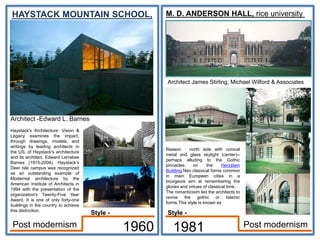
HAYSTACK MOUNTAIN SCHOOL,
Architect -Edward L. Barnes
1960 1981 Post modernism
Post modernism
Haystack's Architecture: Vision &
Legacy examines the impact,
through drawings, models, and
writings by leading architects in
the US, of Haystack's architecture
and its architect, Edward Larrabee
Barnes (1915-2004). Haystack’s
Deer Isle campus was recognized
as an outstanding example of
Modernist architecture by the
American Institute of Architects in
1994 with the presentation of the
organization's Twenty-Five Year
Award. It is one of only forty-one
buildings in the country to achieve
this distinction.
M. D. ANDERSON HALL, rice university
Architect James Stirling, Michael Wilford & Associates
Reason : north side with conical
metal and glass skylight (center)--
perhaps alluding to the Gothic
pinnacles on the Herzstein
Building.Neo classical forms common
in main European cities in a
bourgeois aim at remembering the
glories and virtues of classical time.
The romanticisim led the architects to
revive the gothic or Islamic
forms.This style is known as
Style -
Style -
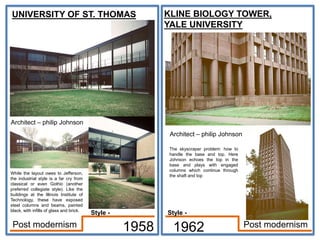
UNIVERSITY OF ST. THOMAS
Architect – philip Johnson
1958 1962 Post modernism
Post modernism
While the layout owes to Jefferson,
the industrial style is a far cry from
classical or even Gothic (another
preferred collegiate style). Like the
buildings at the Illinois Institute of
Technology, these have exposed
steel columns and beams, painted
black, with infills of glass and brick.
KLINE BIOLOGY TOWER,
YALE UNIVERSITY
The skyscraper problem: how to
handle the base and top. Here
Johnson echoes the top in the
base and plays with engaged
columns which continue through
the shaft and top
Architect – philip Johnson
Style -
Style -
INDIANAPOLIS ART CENTER
Architect – Michael Graves
1996 1992 Post modernism
Post modernism
MATHEMATICS TOWER, OHIO
STATE UNIVERSITY
Architect – Philip Johnson
This large center (more than 40,000
square feet) houses studios for
painting and drawing classes, for
print making, for photography, for
computer graphics, for
woodworking, for glassblowing,
ceramics, metalsmithing, and steel
and stone sculpture. In addition, it
has several exhibit areas, an
auditorium, a library, and
administrative offices Although the
building is essentially a long rectangle,
the entrance adds interest and
focus. where the facade of an
essentially planar front is enlivened
with a dramatic entrance
A symmetrical building with
imaginative masonry
Bricks are layered here to define
arches and the pediment. A
different brick/tile is used to
accentuate the central archway
Style -
Style -
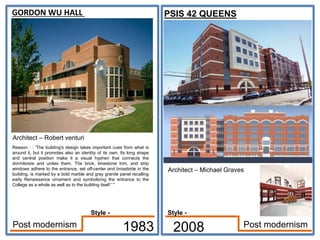
GORDON WU HALL
Architect – Robert venturi
1983 2008 Post modernism
Post modernism
PSIS 42 QUEENS
Architect – Michael Graves
Reason : : 'The building's design takes important cues from what is
around it, but it promotes also an identity of its own. Its long shape
and central position make it a visual hyphen that connects the
dormitoreis and unites them. The brick, limestone trim, and strip
windows adhere to the entrance, set off-center and broadside in the
building, is marked by a bold marble and gray granite panel recalling
early Renaissance ornament and symbolizing the entrance to the
College as a whole as well as to the building itself.' "
Style -
Style -
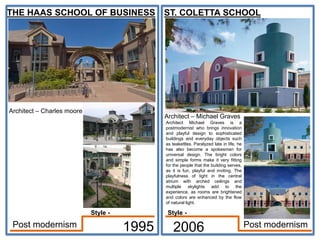
THE HAAS SCHOOL OF BUSINESS
Architect – Charles moore
1995 2006 Post modernism
Post modernism
ST. COLETTA SCHOOL
Architect – Michael Graves
Architect Michael Graves is a
postmodernist who brings innovation
and playful design to sophisticated
buildings and everyday objects such
as teakettles. Paralyzed late in life, he
has also become a spokesman for
universal design. The bright colors
and simple forms make it very fitting
for the people that the building serves,
as it is fun, playful and inviting. The
playfulness of light in the central
atrium with arched ceilings and
multiple skylights add to the
experience, as rooms are brightened
and colors are enhanced by the flow
of natural light.
Style -
Style -

Brutalism - Late and post modernism

  • 1.
    BIRMHINGAN CENTRAL LIBRARY Architect- John Madin 1973 GIESEL LIBRARY Architect – William Pereira 1960 Late modernism Late modernism Style - Brutalism Style - Brutalism
  • 2.
    YALE SCHOOL -OF ART AND ARCHITECTURE BUILDING Architect – Paul Rudolph 1970 Architect – H. Hertzberger 1980 Late modernism Late modernism APOLLO SCHOOLS - School and Montessori School Willemspark, Amsterdam. Style - Brutalism Style - extreme articulation
  • 3.
    BEINECKE LIBRARY -NEW HAVEN Architectural firm – Skidmore, Owings and Merrill 1963 GUND HALL Architect – 19--- Late modernism Late modernism Style - extreme articulation Style - extreme articulation
  • 4.
    HISTORY FACULTY LIBRARY CAMBRIDGE Architect---- 19-- PLOYTECHNICOF CENTRAL LONDON Architect – 19-- Late modernism Late modernism Style - extreme articulation Style - extreme articulation
  • 5.
    SCARBOROUGH COLLEGE Architect ----- 19-- SCHOOL IN MARBIO INFERIORE Architect – Stuart Wrede. Mario Botta 19-- Late modernism Late modernism Style - extreme articulation Style - extreme articulation
  • 6.
    RICHARDS MEDICAL RESEARCH LABORATORIESBUILDING Architect – Richard Neutra 19-- ST ANDREWS UNIVERSITY SCOTLAND Architect – James Stirling 19-- Late modernism Late modernism The Richards Building was the first multi-story, rigid-frame structure to employ pre-cast, pre-stressed, and post-tensioned concrete construction in the United States. 1 Each independent eight-story tower is supported on eight precast concrete columns, set at one-third points on the facade of the building, supporting a latticework of 47' long primary and shorter secondary Vierendeel trusses in precast, prestressed concrete, each steam- cured to a high finish. The building is formed by two wings angled in plan that face roughly east out to the North Sea. Andrew Melville Hall is located on the north side of the town and faces onto the famous golf course. The land slopes up to the west. The initial impression is of strong programme and acres of concrete. The buildings have a serrated plan - the angled windows provide strong rhythm to the facades Ribbed concrete panels - with the pattern set at 45 degrees - are tessellated in an intriguing way and broken at roughly mid-height on the elevation by a strip of glazing. The landscape flows around the building in a fairly simple way, rolling grass over smooth mounds, a bit like the landscape at the Burrell Museum. Style - extreme articulation Style - extreme articulation
  • 7.
    ST ANNE'S OXFORDENGLAND Architect – --- 19-- ST ANTONYS COLLEGE OXFORD Architect – HKPA 1971 Late modernism Late modernism Style - extreme articulation Style - extreme articulation
  • 8.
    UNIVERSITY OF EASTANGLIA, NORWICH Arch – Denys Lasdun 1960 CAMBRIDGE FACULTY OF LAW 19-- Late modernism Late modernism Designed by Denys Lasdun in the early 60’s and implemented in stages through the latter half of the C20 the masterplan for the UEA is based on the idea of the ‘five minute university’. The idea that students should be able to get from lectures to halls in five minutes or less. At the front are the iconic ziggurats where the students live and behind the ‘teaching wall’, an enormous snake of a building connected by high-level walkways to the ziggurats and to the right to the social area with the union, shops and lecture theatres and finally more of the ziggurats at the bottom. Combining a sense of tradition with a forward-looking commitment to change, the new Faculty of Law provides state-of-the-art facilities as well as setting new standards for energy efficiency on the Cambridge campus. The curving glass of the north façade floods the atrium and library with light, providing a sense of transparency and helping the building to recede visually. Style – slick tech Style - extreme articulation Architect – Norman Foster
  • 9.
    EDUCATORIUM Architect – RemKoolhaas 19-- ILLINOIS INSTITUTE OF TECHNOLOGY 19-- Late modernism Late modernism The Educatorium is composed of two planes which fold to accommodate a range of distinct programs, including an outdoor plaza, two lecture halls, cafeteria and exam halls. Planes interlock to create a single trajectory in which the entire university experience - socialization, learning, examination - is encapsulated The point of departure of the design are two sheets which fold and interlock. The concrete slab is treated as a malleable surface which allows an optimum fit for each program. The sloped planes of the entrance plateau function like an urban plaza or mixing chamber. . Architect – Rem Koolhaas The large single-storey Campus Center provides a focal point for the previously sundered halves of the campus, and features a noise- absorbing steel tube wrapping the Elevated metro that runs directly over the building and, inside, a dense mosaic of programs including a bookstore, food court, café, auditorium, computer centre, and meeting spaces. Rather than stacking activities in a multi-storey building, we opted to arrange each programmatic element of the Campus Center in a dense single plane that would foster an urban condition. Style - Style – slick tech
  • 10.
    MVRDV building, Matsudai Architect– Rem Koolhaas 2002 ART CENTER HILLSIDE CAMPUS Pasadena, California Architect – ----- 1976 Late modernism Late modernism The Art Center campus is Ellwood’s only design for an educational institution. Its form and structure makes architectural reference to the work of Ellwood’s hero, modern master Mies van der Rohe – in particular, Crown Hall, which houses the School of Architecture at Illinois Institute of Technology (IIT) in Chicago. One of the unique features of the building is the 192-foot bridge over a man-made ravine. with its expressive exposed steel frame and amazing glass and steel bridges Style – second machine aesthetic Style -
  • 11.
    INSTITUTE DU MONDEARABE Architect – Jean Nouvel 1987 SHIN TAKAMATSU ARK DENTAL CLINIC Architect – ---- 19-- Late modernism Late modernism Style – second machine aesthetic Style – second machine aesthetic
  • 12.
    OLIVETTI TRAINING CENTER Architect– James Stirling & Edward Cullinan 1969 1984 Post modernism Late modernism UNIVERSITY EXTENSION AT THE UNIVERSITY OF CALIFORNIA Architect - Charles moore Style – Style – slick tech
  • 13.
    KRESGE COLLEGE Architect –Charles moore 1974 OTANIEMI TECHNICAL UNIVERSITY Architect – Alvar Aalto 1964 Post modernism Post modernism "The focal point of this university centre is the auditorium building with two large halls (also intended for congresses). Its staircase-like ascending rows of windows suggest from the outside and amphitheatre. All tuition rooms are in adjacent buildings grouped about small internal courts, and here are also found the smaller lecture- rooms, laboratories and professors' rooms. The centre is divided into three principal departments: general, geodetic and architectural. The chief materials are dark red brick, black granite and copper." This residential college, built among dense woods, is comprised of student housing, classrooms, commons, and service buildings. While the exterior view is natural terra cotta, the facades facing the pedestrian "street" are primarily white painted stucco. The "street" is about 1000 feet long, makes a sharp "L," and twists upward to an octagonal eating hall and meeting room. This street meanders and no building aligns with its neighbor. Style - Style -
  • 14.
    NATIONAL DONG HWA UNIVERSITY,HUALIEN, TAIWAN Architect – Chares W Moore 1992 FACULTY CLUB UNIVT. OF CALIFORNIA 1967 Post modernism Post modernism National Dong Hwa University is situated on the unpolluted and unadulterated Taiwanese East Coast in the middle of Hualien County. To the west of the University towers the foothills of the Central Mountain Range, and to the east lies the emerald-green Pacific Ocean. The Hualien Rift Valley area possesses a variety of unique geographical features, ranging from rustic valleys and rolling hills to vast open prairies. The campus layout is basically designed with a south-facing orientation with the central axis tilting 20° west from the north to avoid direct sunlight Architect – Chares W Moore The front wall of the club, which faces the lagoon, is partially the result of a controversy with the campus architect, Charles Luckman. When he saw our building, he said is was unacceptable, that it looked terrible, didn’t look like his stuff, and had to have a bris-soleil. He thought that would cause us to put a screen over it which would hide this awful building which we had done, and he wouldn’t have to worry about it any more. It swept over me in the middle of the night, that all we have to do is have another wall in front of our opening, with other holes in it. Thanks to Charles Luckman, then came our first free standing walls.” Style - Style -
  • 15.
    THE SEATTLE ARTMUSEUM Architect – Robert Venturi 2007 HALLFIELD PRIMARY SCHOOL Architect – Lindsay Drake and Denys Lasdun 1950 Post modernism Post modernism The Seattle Art Museum is an art museum located in Seattle, Washington, USA. It maintains three major facilities: its main museum in downtown Seattle; the Seattle Asian Art Museum (SAAM) in Volunteer Park on Capitol Hill, and the Olympic Sculpture Park on the central Seattle waterfront, which opened on January 20, 2007. Admission to the sculpture park is always free. Admission to the other facilities is free on the first Thursday of each month; SAM also offers free admission the first Saturday of the month. And even the normal admission is suggested, meaning that the museum would like you to pay the complete admission but if you can not pay fully you can still enjoy the museum. 'The result is a coherent sculptural image, but one that is grasped piece by piece, incident by incident, as one moves from the public space of the estate to the increasingly closed world of the school. The scale has been cut down to that of a child's world: enclosed, dappled by light and shade, surrounded by plants, capable of receiving fantasy.' Style - Style -
  • 16.
    FITZ WILLIAM COLLEGE ArchitectSir Denys Lasdun. 1963 SAINSBURY CENTRE FOR THE VISUAL ARTS 1961 Post modernism Post modernism Architect Sir Denys Lasdun. Style - Style -
  • 17.
    GORDON AND VIRGINIAMACDONALD MEDICAL RESEARCH LABORATORIES BUILDING Architect – Venturi, Scott Brown and Associates, 1991 CORPUS CHISTI COLLGE Architect – --- 1963 Post modernism Post modernism Style - Style -
  • 18.
    SHERMAN FAIRCHILD CENTRE FORLIFE SCIENCES Architect – Michael Ronaldo 1977 1973 Post modernism Post modernism This extension was added to the original Renaissance Revival style library built in 1888-95 by McKim, Mead and White. A quarry was reopened so that the granite of the original building could be used in the addition. The addition, in a classically derived modern idiom, maintains the same roof line and uses a version of string courses in an attempt at unifying the new addition with the older building. Instead of the narrow arches of the original, the addition uses three large bays with arched windows which echo the interior. Architect – Philip Johnson BOSTON PUBLIC LIBRARY EXTENSION Reason : authentic reinterpretations of established stylistic traditions. Neo classical forms common in main European cities in a bourgeois aim at remembering the glories and virtues of classical time Style - Style -
  • 19.
    DERBYSHIRE SCHOOLS Architect -GeorgeWiddows 1902 1966 Post modernism Post modernism It is designed, in a neo- vernacular style, were characterised by open verandah-style corridors linking classrooms with generous full-height windows. His distinctive and influential plan forms were based on a linear module which could be arranged in different configurations to suit the size of school required and the shape of the available site. The advances Widdows made in school planning were recognized by his contemporaries The Dipoli was designed in the early 1960s by the Finnish architect couple Raili and Reima Pietilä, whose work represents a very different kind of modernism in the field of Finnish architecture. (let’s just say their approach was more organic and “non- Miesian”). The building is really hard to describe, you would have to see it for yourself. Somehow, it is absolutely remarkable in its dualistic outlook, combining extreme plasticity (in the pre- computer days) and the orthogonal, but also has a fair amount of kitch in its Swiss Inn-looking wooden and stone interiors. DIPOLI CONFERENCE CENTRE, Reima pietila Architect – Reima Pietila Style - Style - neo-vernacular
  • 20.
    ENGINEERING RESEARCH CENTER Architect-Michael Graves 1995 1957 Post modernism Post modernism Made of stone stone and brick, the Engineering Research Center is part of the new East Campus at the University of Cincinnati. An upper level bridge connects the Center to the Schneider Engineering Quadrangle. Each section of the Engineering Research Center is ornamented with a row of sculptural smokestacks. The building is also adorned with porthole windows, masonry designs, and a steeply arched copper-clad roof. FOTHILL COLLEGE CALIFORNIA Foothill's unique neo-Japanese architecture is well-known among architects;[5] the campus was designed by architect Ernest Kump and landscape architect Hideo Sasaki. Peter Walker created a master plan, landscape design and development for this 122-acre campus, including roads, parking, grading, planting, courts, and plazas. An acropolis scheme of two hilltops—one for academics, the other for athletics— were linked by a pedestrian bridge. Several groves lie throughout the campus including a central formal one, a parking lot dotted with flowering pear trees, and two smaller ones of California sycamore and birch respectively. Architect –Hideo Sasaki Style - Style - Neo historicism, neo eclectic
  • 21.
    HAYSTACK MOUNTAIN SCHOOL, Architect-Edward L. Barnes 1960 1981 Post modernism Post modernism Haystack's Architecture: Vision & Legacy examines the impact, through drawings, models, and writings by leading architects in the US, of Haystack's architecture and its architect, Edward Larrabee Barnes (1915-2004). Haystack’s Deer Isle campus was recognized as an outstanding example of Modernist architecture by the American Institute of Architects in 1994 with the presentation of the organization's Twenty-Five Year Award. It is one of only forty-one buildings in the country to achieve this distinction. M. D. ANDERSON HALL, rice university Architect James Stirling, Michael Wilford & Associates Reason : north side with conical metal and glass skylight (center)-- perhaps alluding to the Gothic pinnacles on the Herzstein Building.Neo classical forms common in main European cities in a bourgeois aim at remembering the glories and virtues of classical time. The romanticisim led the architects to revive the gothic or Islamic forms.This style is known as Style - Style -
  • 22.
    UNIVERSITY OF ST.THOMAS Architect – philip Johnson 1958 1962 Post modernism Post modernism While the layout owes to Jefferson, the industrial style is a far cry from classical or even Gothic (another preferred collegiate style). Like the buildings at the Illinois Institute of Technology, these have exposed steel columns and beams, painted black, with infills of glass and brick. KLINE BIOLOGY TOWER, YALE UNIVERSITY The skyscraper problem: how to handle the base and top. Here Johnson echoes the top in the base and plays with engaged columns which continue through the shaft and top Architect – philip Johnson Style - Style -
  • 23.
    INDIANAPOLIS ART CENTER Architect– Michael Graves 1996 1992 Post modernism Post modernism MATHEMATICS TOWER, OHIO STATE UNIVERSITY Architect – Philip Johnson This large center (more than 40,000 square feet) houses studios for painting and drawing classes, for print making, for photography, for computer graphics, for woodworking, for glassblowing, ceramics, metalsmithing, and steel and stone sculpture. In addition, it has several exhibit areas, an auditorium, a library, and administrative offices Although the building is essentially a long rectangle, the entrance adds interest and focus. where the facade of an essentially planar front is enlivened with a dramatic entrance A symmetrical building with imaginative masonry Bricks are layered here to define arches and the pediment. A different brick/tile is used to accentuate the central archway Style - Style -
  • 24.
    GORDON WU HALL Architect– Robert venturi 1983 2008 Post modernism Post modernism PSIS 42 QUEENS Architect – Michael Graves Reason : : 'The building's design takes important cues from what is around it, but it promotes also an identity of its own. Its long shape and central position make it a visual hyphen that connects the dormitoreis and unites them. The brick, limestone trim, and strip windows adhere to the entrance, set off-center and broadside in the building, is marked by a bold marble and gray granite panel recalling early Renaissance ornament and symbolizing the entrance to the College as a whole as well as to the building itself.' " Style - Style -
  • 25.
    THE HAAS SCHOOLOF BUSINESS Architect – Charles moore 1995 2006 Post modernism Post modernism ST. COLETTA SCHOOL Architect – Michael Graves Architect Michael Graves is a postmodernist who brings innovation and playful design to sophisticated buildings and everyday objects such as teakettles. Paralyzed late in life, he has also become a spokesman for universal design. The bright colors and simple forms make it very fitting for the people that the building serves, as it is fun, playful and inviting. The playfulness of light in the central atrium with arched ceilings and multiple skylights add to the experience, as rooms are brightened and colors are enhanced by the flow of natural light. Style - Style -