PROFESSIONAL PRACTICE
9th SEM.
Professional Practice-Vth Yr.
Lecture plan
⚫ L-1. Valuation
⚫ Definitions of Price, Value, cost, market value, Essential
characteristic of value,
⚫ L-2 Value classifications, Factors affecting Value of a
property. Methods of Valuation,
⚫ L-3 Explanation for methods of valuation
⚫ L-4 Various forms of rent, type of leases, Annuity,
Sinking fund, Ratable value
⚫ L-5 Dilapidation and waste.
⚫ Covenants, - by lessee, by lessor, tenantable repair and
structural repairs,
Professional Practice-Vth Yr.
Lecture plan
L-6 Law relating to repairs. Report on schedule of dilapidation,
Right of land lords to demolish tenanted bldgs.
L-7 Easements
What is easement, What are its characteristics, Dominant
heritage, Servient heritage, Other rights resembling easement.
L-8 ancient light, Natural rights and customary rights, Types of
easements and modes of acquisition
L-9 1st Test comprising the above topics
L-10 Consumer protection Act 1986
Its impact on architects
Professional Practice-Vth Yr.
⚫ L-11. Land acquisition
⚫ Land acquisition act 1894,Basic principles of land acquisition
act,
⚫ L-12. Procedure for acquisition, Compulsory acquisition,
solatium, apportionment.
⚫ L-13 Standard rent
⚫ Rent control act, standard rent, methods of ascertaining std.
rent, theory of comparable, Rent act in Mumbai
⚫ L-14. Fire Insurance essential for formation, Proposal Form,
Cover note,
⚫ Procedural conditions for claims, Average Clause,
⚫ L-15. Reinstatement clause, How Architect is professionally
connected with Fire insurance, Salvage value,
⚫ L-16. 2nd test
EASEMENT
⚫ It is a right the owner or occupier of certain land
possesses for the beneficial enjoymentof that land.
1) to do and continueto do something
2) to prevent and continueto prevent something from
being done
CHARACTERISTICS OF EASEMENTS
1. Owner or occupier of land necessary
2. Right to do or continue to do or prevent and continue to prevent
something being done
3. The right should be for the beneficial enjoyment of the
dominant heritage. Since it is attached to the land, it gets
automatically transferred on sale. (right of Access)
EASEMENT
⚫ Dominant heritage
The land for the beneficial enjoyment for which the right of easement
exists is called dominant heritage. The land whose owner is
entitled to claim certain concessions from the owner of the
servient heritage.
It is the owner of the dominant heritage who is benefited from the
provision of Act.
⚫ Servient heritage
The land on which the liability of beneficial enjoyment of the
easement is imposed is called servient heritage. The owner of the
servient heritage has to sacrifice a part of his absolute right of
enjoyment and ownership of his land to the beneficial enjoyment
of the land of the dominant owner
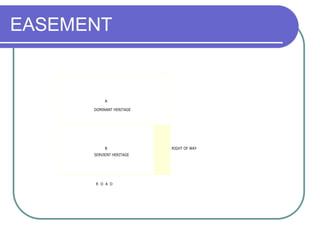
EASEMENT
A
B RIGHT OF WAY
R O A D
DOMINANT HERITAGE
SERVIENT HERITAGE
EASEMENT
Other rights resembling easement
a) Natural rights
b) Customary rights
⚫ Natural rights
Normally arise out of geographical configuration
of the property and are inherent in the
property itself. Natural situation- Water
discharged into the lower level land from the
higher one is a natural right.
EASEMENT
Some natural rights
1. To receive air and light freely
2. To receive light which falls vertically upon the land and
not light from the adjacent plot.
3. No right to pollute air.
4. Right of support to land in its natural condition- digging
by adjoining owner endangering the property.
5. Right to discharge water from the higher plot to lower
plot. But right to discharge polluted water is not a
natural right. Such right should be acquired thru
prescription or easement.
EASEMENT
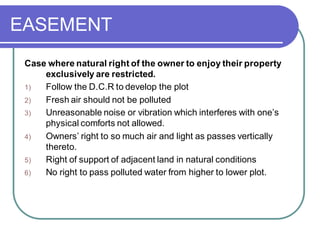
Case where natural right of the owner to enjoy their property
exclusively are restricted.
1) Follow the D.C.R to develop the plot
2) Fresh air should not be polluted
3) Unreasonable noise or vibration which interferes with one’s
physical comforts not allowed.
4) Owners’ right to so much air and light as passes vertically
thereto.
5) Right of support of adjacent land in natural conditions
6) No right to pass polluted water from higher to lower plot.
EASEMENT
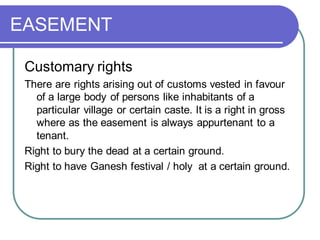
Customary rights
There are rights arising out of customs vested in favour
of a large body of persons like inhabitants of a
particular village or certain caste. It is a right in gross
where as the easement is always appurtenant to a
tenant.
Right to bury the dead at a certain ground.
Right to have Ganesh festival / holy at a certain ground.
EASEMENT
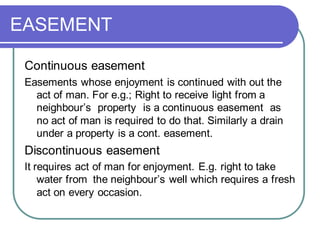
Continuous easement
Easements whose enjoyment is continued with out the
act of man. For e.g.; Right to receive light from a
neighbour’s property is a continuous easement as
no act of man is required to do that. Similarly a drain
under a property is a cont. easement.
Discontinuous easement
It requires act of man for enjoyment. E.g. right to take
water from the neighbour’s well which requires a fresh
act on every occasion.
EASEMENT
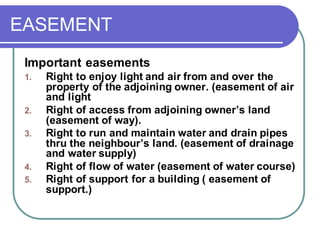
Important easements
1. Right to enjoy light and air from and over the
property of the adjoining owner. (easement of air
and light
2. Right of access from adjoining owner’s land
(easement of way).
3. Right to run and maintain water and drain pipes
thru the neighbour’s land. (easement of drainage
and water supply)
4. Right of flow of water (easement of water course)
5. Right of support for a building ( easement of
support.)
EASEMENT
Modes of acquisition of easements
1. By grant
2. By necessity
3. By prescription
By grant
An easement may be imposed by anyone in the
circumstances and to the extent to which he
may transfer his interest in the heritage on
which the liability is imposed
EASEMENT
By necessity.
This arises when one property is severed into 2 either by sale,
mortgage, partition etc. and they are so situated that one can not
be enjoyed without exercising a particular privilege upon the other.
By prescription
As acquisition of a right or title due to constant use or possession for
20 years. If claimed against the govt. 60 years in the mode and
manner as prescribed in the easement act 1882.
However it is necessary to obtain declaratory order from the court that
the dominant owner is entitled to the prescriptive easement
claimed there in within 2 years after the expiry of 20 years . To
acquire the easement by prescription it must be proved that
⚫ It has been enjoyed peacefully
⚫ As an easement
⚫ Without interruption
⚫ For 20 years.,
EASEMENT
Ancient Lights
⚫ When an owner acquires easement of light and air, the
openings ( windows, opening with or with out grill on
the wall deriving light and air from neighbour’s
property are known as Ancient lights.
⚫ The servient owner can not carry out any construction
on his land which will substantially diminish light
enjoyed by such ancient lights. He must leave
sufficient open space in the form of external chowks.
LAND ACQUISITION ACT
⚫ LAND ACQISITION ACT 1894 was enacted by the G.O.I. to
acquire land required by Govt. for various public purposes. It is
amended from time to time.
⚫ The basic principles of L.A.A are
1. Land required for a purpose
2. Sale by an owner is compulsory and there is no option
3. Owner to get market value as against sentimental/ monopoly
value.
4. Property acquired free from any encumbrances
5. In addition to the market value an owner is entitled to additional
compensation of 30% on the value of such land for compulsory
acquisition which is known as solatium.
Acquisition means that the entire bundle of rights which were vested
with the original owner pass on acquisition to the acquirer by
leaving nothing to the former.
LAND ACQUISITION ACT
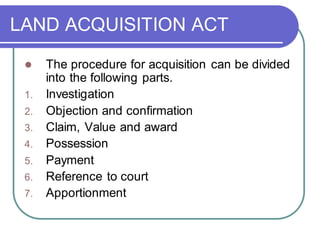
⚫ The procedure for acquisition can be divided
into the following parts.
1. Investigation
2. Objection and confirmation
3. Claim, Value and award
4. Possession
5. Payment
6. Reference to court
7. Apportionment
LAND ACQUISITION ACT
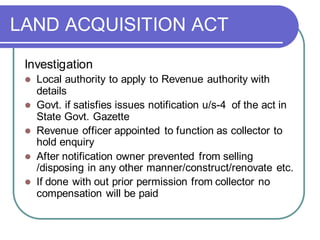
Investigation
⚫ Local authority to apply to Revenue authority with
details
⚫ Govt. if satisfies issues notification u/s-4 of the act in
State Govt. Gazette
⚫ Revenue officer appointed to function as collector to
hold enquiry
⚫ After notification owner prevented from selling
/disposing in any other manner/construct/renovate etc.
⚫ If done with out prior permission from collector no
compensation will be paid
LAND ACQUISITION ACT
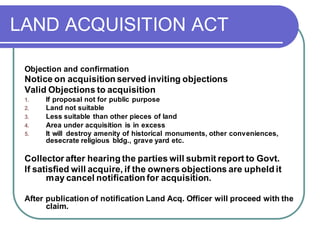
Objection and confirmation
Notice on acquisition served inviting objections
Valid Objections to acquisition
1. If proposal not for public purpose
2. Land not suitable
3. Less suitable than other pieces of land
4. Area under acquisition is in excess
5. It will destroy amenity of historical monuments, other conveniences,
desecrate religious bldg., grave yard etc.
Collector after hearing the parties will submit report to Govt.
If satisfied will acquire, if the owners objections are upheld it
may cancel notification for acquisition.
After publication of notification Land Acq. Officer will proceed with the
claim.
LAND ACQUISITION ACT
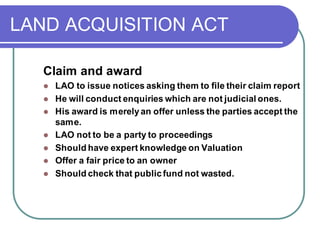
Claim and award
⚫ LAO to issue notices asking them to file their claim report
⚫ He will conduct enquiries which are not judicial ones.
⚫ His award is merelyan offer unless the parties accept the
same.
⚫ LAO not to be a party to proceedings
⚫ Should have expert knowledge on Valuation
⚫ Offer a fair price to an owner
⚫ Should check that publicfund not wasted.
LAND ACQUISITION ACT
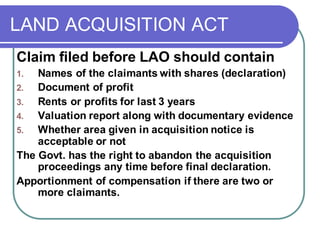
Claim filed before LAO should contain
1. Names of the claimants with shares (declaration)
2. Document of profit
3. Rents or profits for last 3 years
4. Valuation report along with documentary evidence
5. Whether area given in acquisition notice is
acceptable or not
The Govt. has the right to abandon the acquisition
proceedings any time before final declaration.
Apportionment of compensation if there are two or
more claimants.
LAND ACQUISITION ACT
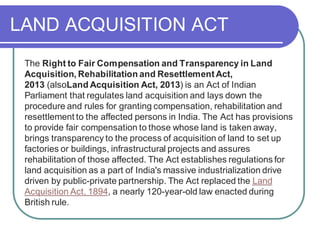
The Right to Fair Compensation and Transparency in Land
Acquisition, Rehabilitation and ResettlementAct,
2013 (alsoLand Acquisition Act, 2013) is an Act of Indian
Parliament that regulates land acquisition and lays down the
procedure and rules for granting compensation, rehabilitation and
resettlement to the affected persons in India. The Act has provisions
to provide fair compensation to those whose land is taken away,
brings transparency to the process of acquisition of land to set up
factories or buildings, infrastructural projects and assures
rehabilitation of those affected. The Act establishes regulations for
land acquisition as a part of India's massive industrialization drive
driven by public-private partnership. The Act replaced the Land
Acquisition Act, 1894, a nearly 120-year-old law enacted during
British rule.
LAND ACQUISITION ACT
The Land Acquisition, Rehabilitation and Resettlement
Bill, 2011 was introduced in Lok Sabha on 7 September
2011.The bill was then passed by it on 29 August 2013
and by Rajya Sabha on 4 September 2013. The bill then
received the assent of thePresident of India, Pranab
Mukherjee on 27 September 2013.[4] The Act came into
force from 1 January 2014.
An amendment bill was then introduced in Parliament to
endorse the Ordinance. Lok Sabha passed the bill but
the same is still lying for passage by the Rajya Sabha.
On 30 May 2015, President of India promulgated the
amendment ordinance for third time.[5]
LAND ACQUISITION ACT
⚫ Aims and objectives
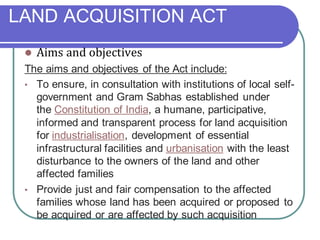
The aims and objectives of the Act include:
• To ensure, in consultation with institutions of local self-
government and Gram Sabhas established under
the Constitution of India, a humane, participative,
informed and transparent process for land acquisition
for industrialisation, development of essential
infrastructural facilities and urbanisation with the least
disturbance to the owners of the land and other
affected families
• Provide just and fair compensation to the affected
families whose land has been acquired or proposed to
be acquired or are affected by such acquisition
LAND ACQUISITION ACT
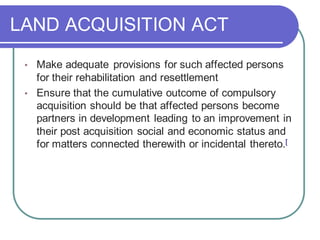
• Make adequate provisions for such affected persons
for their rehabilitation and resettlement
• Ensure that the cumulative outcome of compulsory
acquisition should be that affected persons become
partners in development leading to an improvement in
their post acquisition social and economic status and
for matters connected therewith or incidental thereto.[
LAND ACQUISITION ACT
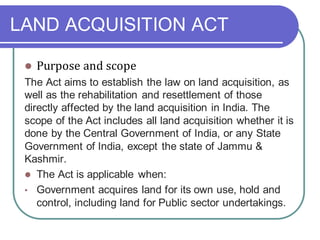
⚫ Purpose and scope
The Act aims to establish the law on land acquisition, as
well as the rehabilitation and resettlement of those
directly affected by the land acquisition in India. The
scope of the Act includes all land acquisition whether it is
done by the Central Government of India, or any State
Government of India, except the state of Jammu &
Kashmir.
⚫ The Act is applicable when:
• Government acquires land for its own use, hold and
control, including land for Public sector undertakings.
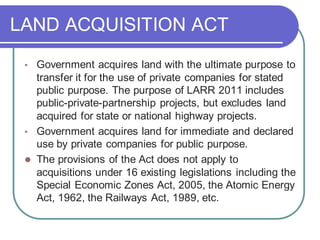
LAND ACQUISITION ACT
• Government acquires land with the ultimate purpose to
transfer it for the use of private companies for stated
public purpose. The purpose of LARR 2011 includes
public-private-partnership projects, but excludes land
acquired for state or national highway projects.
• Government acquires land for immediate and declared
use by private companies for public purpose.
⚫ The provisions of the Act does not apply to
acquisitions under 16 existing legislations including the
Special Economic Zones Act, 2005, the Atomic Energy
Act, 1962, the Railways Act, 1989, etc.
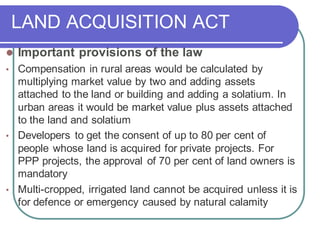
LAND ACQUISITION ACT
⚫ Important provisions of the law
• Compensation in rural areas would be calculated by
multiplying market value by two and adding assets
attached to the land or building and adding a solatium. In
urban areas it would be market value plus assets attached
to the land and solatium
• Developers to get the consent of up to 80 per cent of
people whose land is acquired for private projects. For
PPP projects, the approval of 70 per cent of land owners is
mandatory
• Multi-cropped, irrigated land cannot be acquired unless it is
for defence or emergency caused by natural calamity
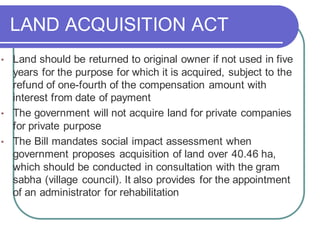
LAND ACQUISITION ACT
• Land should be returned to original owner if not used in five
years for the purpose for which it is acquired, subject to the
refund of one-fourth of the compensation amount with
interest from date of payment
• The government will not acquire land for private companies
for private purpose
• The Bill mandates social impact assessment when
government proposes acquisition of land over 40.46 ha,
which should be conducted in consultation with the gram
sabha (village council). It also provides for the appointment
of an administrator for rehabilitation
LAND ACQUSITION ACT
• Both land acquisition and resettlement and rehabilitation
provisions of the Bill will apply to projects when government
acquires land for its own use or on behalf of private
companies for stated public purpose, including PPP projects.
In case companies directly acquire over 40 ha from land
owners, they will be responsible for resettlement and
rehabilitation
• The Bill also proposes amenities like schools, health centres
and civic infrastructure in places where project-affected
people are resettled
• The urgency clause should be exercised in the rarest of rare
cases like national defence or for resettlement purposes. This
means no land acquisition can proceed without public
hearing
LAND ACQUSITION ACT
⚫ Salient features of the Land Bill, 2015:-
⚫ Five categories of land use has been created:
(i) Defense and national security projects,
(ii) Affordable Housing = housing for the poor,
(iii) Rural/ Social Infrastructure,
(iv) Industrial Corridors,
(v) PPP infrastructure projects, wherein Central Government own
the lands;
and these five categories do not require Social Impact Assessment
to be done and neither require 70-80% approval of the
landowners for private/ PPP projects respectively.
LAND ACQUSITION ACT
⚫ Moreover, one person from each family of farm labourers
will be given (guaranteed) employment when the land on
which they were employed as farm hands is acquired.
⚫ The Amendment also looks to limit the amount that can
be acquired for industrial purposes
⚫ In the LARR Act, 2013 – ‘private companies’ was
mentioned. The Bill has changed the wordings to ‘private
entities’ which bring many other institutions under the
purview of the Act, such as companies, NGOs, NPOs,
corporation, firms and individual etc.
LAND ACQUSITION ACT
⚫ Land if unutilized will be returned after the later of (i) 5 years,
or (ii) such period as is mentioned at the time of setting up of
the project agreement. Earlier it was just 5 years.
Some projects may by their inherent nature require more time
to materialize and hence the ‘later’ period clause has been
introduced.
⚫ The LARR Act, 2013 did not apply to 13 other Statutory Acts,
such as the Atomic Energy Act, Petroleum Act, Railways Act,
Electricity Act etc. – these have been brought under the
purview of the Land Ordinance, 2014 and to be included
ultimately into the Amendment Act, 2015 – which will require
amendments and RS approval on those 13 Act separately too!
LAND ACQUSITION ACT
1. Private Hospitals and Private Educational Institutions
which were earlier excluded from the LARR 2013, are
now through the proposed bill brought under the purview
of the LARR.
2. One for the Government Officials – if an offence is
committed by a Government Official he can only be
prosecuted with prior approval of the Government.
⚫ These are the 9 important amendments passed in the
Lok Sabha and was rejected by Rajya Sabha.
Sessional work.
Explain Land Acquisition, Rehabilitation and
Resettlement Act 2013 enacted by the UPA Govt.
Compare the same with the Land Bill 2015 proposed by
the BJP Govt. but rejected by the Rajya Sabha.
Submit on or before 18th July 2017
Marks 50
DILAPIDATION AND WASTE
Dilapidation is the state of disrepair. This may arise due
to neglect to carry out repairs whereby the buildings
become dilapidated or reaches a ruinous condition.
1. To stop leakage from toilet is tenantable repair
2. If not attended to in time will affect the beams and
slab and will lead to structural repairs.
3. Again neglect in attending the above structural
repairs will result in dilapidation.
Want of repair is not the only cause of dilapidation, it can
be due to the wrong act of the tenants such as using
the res. Premises for storage or removing some
structural members to have more space beneath etc.
DILAPIDATION AND WASTE
Law relating to repairs and dilapidation
The relationship between landlord and tenant is created by a
contract of tenancy called lease. The landlord gives the
tenant exclusive possession and quite enjoyment of the
landlord’s premises for a definite period for a periodic
payment called rent. (As per the recent amendment of rent
act in Maharashtra the lease agreement between the tenant
and owner shall be registered and stamp duty paid)
Sometimes it is an oral agreement. In case of monthly
tenancy rent receipt and delivery of possession of premises
form important ingredient to justify relationship of landlord
and tenants and agreement is absent here. The liabilities for
repairs to a property can be contractual one or statutory
depending on the circumstances. Thecontractual liability is
spelt out thru the covenants in the lease deed.
DILAPIDATION AND WASTE
Covenants
They are conditions in agreements which spell
out rights and liabilities of parties to such
agreements as also their successors. In
certain circumstances these are enforceable
against the third party. These take the form of
express covenants when given on leases and
implied covenants which arise from
relationship of landlord with tenant.
DILAPIDATION AND WASTE
2 types of covenants
1. Personal covenant
2. Touch and concern Land- having reference to the
subject matters of lease.
⚫ The covenant to pay rent, to keep in repair the
demised premises clearly affect the landlord and
tenants in their capacities and as such are touching
and concerning land.
⚫ But if an option is given to the tenants to purchase
freehold after a specified period at a specified
amount the same does not affect the relationship
between landlord and tenant but as vendor and
purchaser and as such it is a personal covenant.
DILAPIDATION AND WASTE
Covenant by Lessor
1. To put lessee in possession of the property.
2. Allow lessee quiet and peaceful possession
of the premises on payment regular rent.
3. To carry out heavy or special or structural
repairs if so provided.
4. To renew the lease if so provided
5. To pay specified outgoings.
DILAPIDATION AND WASTE
Covenant by lessee
1. To pay the rent regularly
2. To repair and keep in repair the demised premises.
3. Not to make additions and alterations to the premises
4. Not to cut or maim any part of the fabric of the structure, walls
or timber
5. Not to commit waste
6. Not to change user of premises
7. Not to erect permanent structure without prior permission of
lessor
8. To insure against fire and bear other outgoings as specified
9. Not to assign, transfer, sublet or part with possession with out
prior consent
10. To remove tenants fixture without damaging the property.
11. To surrender the property in the same condition as it was
originally leased at the expiry of lease period.
DILAPIDATION AND WASTE
REPAIRS
Any labour or material provided to restore, reconstruct or
renew any existing part of a building, its fixtures or
appurtenances.
Classified as Tenantable repairs and structural repairs.
Tenantable repairs are usually the repairs done to put the premises
in a tenantable condition so as to command the rent and make it
fit for human habitation.
Structural repairs will pertain to the fabric of structure including walls
and floors supporting members. Water proofing will be tenantable
repair while repair of joist will be structural repair. If the floor is
raised and paved with tiles in place of i. p. s, it is known as
improvements.
VALUATION
Valuation is an adventure in economic research leading to an
economical decision of a valuer which indicatethe conclusion
arrived at after taking into consideration all factors like
economic, social, political, Legal and physical which affects
the value one way or the other.
Value
A commodity to have value must possess 3 essential qualifications
i) It must possess utility
ii) It must be scarce
iii) It must be transferable/ marketable
b) It can be said to be a ratio between price of money and price of
commodity in return
c) It is not necessarily the price of a commodity.
d) It can be an unearned increment or unfortunate decrement in
the price
VALUATION
Price
i) Cost of a commodity + additional reward for
production for the labour and capital
ii) It is a special form of value
iii) It is fixed depending on the demand and the
adjustments of price brings into existence the
‘value’.
iv) It depends on utility, durability, satisfaction and
the extent to which a commodity is scarce
VALUATION
Cost
i) Expenditure to produce a commodity having a
value
ii) Depreciation is worked out on the cost of
commodity rather than the value.
Market Value
It has been defined as the amount which might be
expected to be realised from a willing purchaser
on a sale of a property by a willing seller.
VALUATION
Essential characteristics
1. Vendor willing to sell
2. Purchaser willing to purchase
3. No compulsion on either
4. Urgent necessity of sale/purchase to be
discarded
5. Disinclination of the vendor to be ignored
6. Settlement value to the vendor will have no place
7. Present and future uses known as potentials are
to be taken into account.
VALUATION
Factors affecting the value of an item
1. Supply and demand
If the number of plots available for sale in a
particular locality is more and buyers less it will
affect the value and vice versa. Rise in population
due to influx of people will result in heavy
demand and will require more land. If there is
shortage of land it will result in increase in the
price of land
2. Cost of replacement
When a built-up property is available for sale, the
purchaser will always consider the cost of
replacement of the same bldg.
VALUATION
3. Occupational value
When a property is required for the purpose of residential
occupation, the price paid is generally more than its
market value arrived at by rental method
4. Interest and security of a capital
A person who invest in a property always expects some
reward in return which is known as interest available in
gen. investment market and security of capital. If the
capital is secured and realisable at any time then the
rate of interest expected will be low compared to the
one where there is no security of capital
VALUATION
5. Rent Restriction Act
The value of a property depends upon its annual rental
and in case of an old building let out prior to 1.9.1940
the same is not allowed to be increased under the rent
act except for permitted increase. Thus the net return
is pegged down to the economic level of 1940 where
as the cost of living has gone up. Due to this the
capital has drifted away from the property market into
industries thus affecting the rental property market
6. Abnormal condition
Value may go down due to abnormal conditions like war,
riots or due to insecure conditions.
VALUATION
7. Town planning act.
Due to declaration of a town planning
scheme in a particular area where by it
is proposed to be provided with all civic
amenities like roads, gardens, drainage,
etc. the value of open plot in this locality
will be going up.
VALUATION
Methods of valuation
1. Land and building method
2. Income capitalisation method
3. Profit basis
4. Development method or plotting
scheme
VALUATION
Land and building method
One of the well known methods of valuation and applied
for valuation of properties where no direct evidence
of rent. ( schools, welfare centres, owner occupied
proposals, purpose built Ind. Bldgs. Etc.)
Determine the market value of land and cost of
construction (depreciated or otherwise)
VALUATION
The value of land in the vicinity may range depending upon the
following facts.
1. Period of valuation- rise or fall if any during that period
2. Location and situation of the property
3. Proximity to civic amenities and meansof access
4. Shape of the plot.
5. Area of the plot
6. Ratio of frontage to the depth
7. Frontages and vistas on two roads
8. Condition of the plot- low lying etc.
9. Encumbrances like easement, tenancy right etc.
mode of payment.
VALUATION
Profit method
It deals in working out the profit from a property and
capitalising the same at appropriate rate of
return. The following factors shall be considered.
1. The net profit to be adopted should be an
average of last 3 years profit
2. Part of the profit is due to good will which should
be properly reflected in the rate of return
3. Applicable to cinemas, hotels etc.
VALUATION
Rental method of Valuation
The main purpose is present worth or future benefit. The receipt
of benefit being the receipt of net income as the true basis
to judge the value would be net income.
The capitalised value of the net income at appropriate figure of
year’s purchase will represent the value of the property In
this case the building on the plot should have a future life
expectancy of 60 years and necessarily the value of land is
negligible.
Net rent = Gross rent- outgoings
Capitalised value = Net rent x years purchase
This method calls for detail study of many factors like rent,
outgoings and factors on which year’s purchase will depend.
VALUATION
Rent for the purpose of valuation
1. It must be fair rent maintainable for a
considerable period with no threat of
being reduced in future
2. Its limit will be standard rent
3. Chance higher rent need not be
considered.
VALUATION
⚫ Out goings (for an urban property)
1. Municipal charges
2. Repairs
3. Insurance
4. Collection & management charges,
cost of services and amenities
5. Vacancies and bad debts
6. Ground rent in case of lease hold prop.
VALUATION
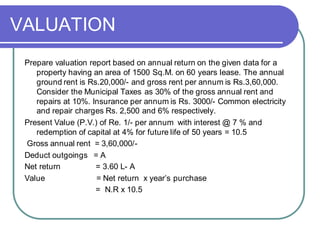
Prepare valuation report based on annual return on the given data for a
property having an area of 1500 Sq.M. on 60 years lease. The annual
ground rent is Rs.20,000/- and gross rent per annum is Rs.3,60,000.
Consider the Municipal Taxes as 30% of the gross annual rent and
repairs at 10%. Insurance per annum is Rs. 3000/- Common electricity
and repair charges Rs. 2,500 and 6% respectively.
Present Value (P.V.) of Re. 1/- per annum with interest @ 7 % and
redemption of capital at 4% for future life of 50 years = 10.5
Gross annual rent = 3,60,000/-
Deduct outgoings = A
Net return = 3.60 L- A
Value = Net return x year’s purchase
= N.R x 10.5
VALUATION
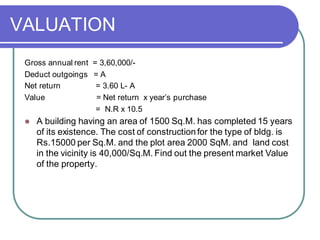
Gross annual rent = 3,60,000/-
Deduct outgoings = A
Net return = 3.60 L- A
Value = Net return x year’s purchase
= N.R x 10.5
⚫ A building having an area of 1500 Sq.M. has completed 15 years
of its existence. The cost of construction for the type of bldg. is
Rs.15000 per Sq.M. and the plot area 2000 SqM. and land cost
in the vicinity is 40,000/Sq.M. Find out the present market Value
of the property.
VALUATION
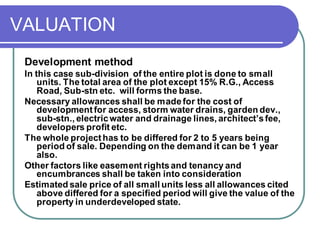
Development method
In this case sub-division of the entire plot is done to small
units. The total area of the plot except 15% R.G., Access
Road, Sub-stn etc. will forms the base.
Necessary allowances shall be madefor the cost of
development for access, storm water drains, garden dev.,
sub-stn., electricwater and drainage lines, architect’sfee,
developers profit etc.
The whole projecthas to be differed for 2 to 5 years being
period of sale. Depending on the demand it can be 1 year
also.
Other factors like easement rightsand tenancy and
encumbrances shall be taken into consideration
Estimated sale price of all small units less all allowances cited
above differed for a specified period will give the value of the
property in underdeveloped state.
VALUATION
Purpose of Valuation
1. Purchase for investment or for occupation
2. Sale
3. Mortgage
4. Rent fixation
5. Land acquisition
6. Betterment charges
7. Auction bids
8. Probate
9. Speculation
10. Insurance
11. Wealth tax
12. Capital gain tax
13. Stamp duty
14. Gift tax
15. General court purpose ( for court fee stamp etc.)
VALUATION
Year’s Purchase
It is the figure which shows how many times the net annual
income is secured for its value. If the annual income is 15000
and the value is 300000 then we say that the income is
secured by 20 times.
In other words year’s purchase representscapitalised value to
receive Re.1/ P.A. in perpetuity (for an indefinite period) or
for a fixed number of years.
A person investing Rs.100 in a fixed deposit of a bank with 5%
interest rate will receive Rs.5 as net income. To get an
income of Re.1 per annum how much amount to be invested.
100x1/5 = 20 years purchase.
VALUATION
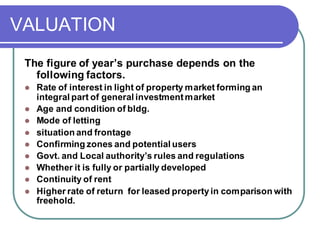
The figure of year’s purchase depends on the
following factors.
⚫ Rate of interest in light of property market forming an
integral part of general investmentmarket
⚫ Age and condition of bldg.
⚫ Mode of letting
⚫ situation and frontage
⚫ Confirming zones and potential users
⚫ Govt. and Local authority’s rules and regulations
⚫ Whether it is fully or partially developed
⚫ Continuity of rent
⚫ Higher rate of return for leased property in comparison with
freehold.
VALUATION
Bonds or guilt- edged security
Finance required by the State Govt., Central Govt. Local authorities
etc. is raised from the public by the issue of loans in the form of
bonds having a fixed rate of interest and mostly having a fixed
date of repayment a few years from the date of issue.
The Govt. stocks satisfy most of the conditions of ‘ideal securities
like:
i) Capital invested must be safe
ii) Income in the form of interest must be safe and regular
iii) No trouble in collection of interest
iv) Realisation of capital with least possible expenses
STANDARD RENT
⚫ Rent control act
It is a piece of social legislation whose
principal aim is to afford protection
against eviction and exploitation of the
tenants. In the absence of adequate
protection it is likely that tenants may be
asked to vacate their premises and also
be asked to pay exorbitant rent as there
is always a demand for housing stock.
STANDARD RENT
⚫ In Mumbai Province ‘Mumbai Rent Restriction Act 1939 was
introduced. This Act applied to all premises whose rent did not
exceed Rs. 80/Month as on 1-1-39. There after Mumbai Rents,
Hotel Rates and lodging house rates(Control) Act 1944 was
enacted. This Act did not apply to premises whose rent did not
exceed `Rs. 250PM between 22-4-1942 to 15-2-1943. Since 13-2-
1948 this Act was in force. This is renewed from time to time and
applies to all premises let out for residences, education, business,
trade or storage etc.
⚫ The Act is not applicable to the premises belonging to the Govt.
and local authorities.
⚫ This act has been replaced with Maharashtra Rent Control Act
1999.
STANDARD RENT
Standard rent
Rent is defined as the periodic payment made by the tenant to his
land lord for use and occupation of premises as well as its
appurtenances, furnishing and other amenities provided by the
land lord.
It normally includes all outgoings like Mun. Taxes, Property tax,
Govt. tax., all permitted increases that are recoverable from the
tenants and necessary allowances for repairs and maintenances
depending upon the terms and condition of the tenancy. The rent
fixed between the landlord and the tenant at the inception of the
tenancy either by negotiation or by bargaining is known as
contractual rent.
STANDARD RENT
Standard rent is the rent which would be permissible
under the law to be charged to a tenant. Very often
there is a vide gap between contractual rent and
standard rent. The act does not give any definition or
the meaning of standard rent except that it is the rent
fixed by the court after taking into consideration 3
basis namely
⚫ The provision of the act
⚫ The circumstances of the case
⚫ Fair and or just character of the amount involved
STANDARD RENT
If the premises or bldg. constructed on or
after 1-9-1940 is let out for the 1st time
after 1-9-1940 the rent at which they
are let out is std rent. Or call it ad-
interim std. rent or presumptive std.
rent.
Methods of ascertaining std. rent
a) Theory of comparable
b) Investments
STANDARD RENT
Theory of comparables
It consists in comparing the premises in application with letting
rate of more or less similar premises in the locality for rate.
a) Premisesshould be more or less similarly situated in same
locality with the similar user
b) Location of premises w.r.t. floor/view/road/sea etc.
c) Type of construction
d) The extent of the area
e) Planning, finishing and amenities.
f) Relevant period of letting out
g) Whether the rent of it is fair and reasonable
h) Terms of tenancies
i) Age of building and extent of repairs.
STANDARD RENT
By investment theory
Std rent is made up of comparables. a) Net return to the land lord for his
investment b) out goings
SR= Net return + out goings
In order to estimate the std. rent by the method it will be essential to study the
following.
1. Period of 1st letting
2. a) Value of land b) area of land
3. Cubic content, Carpet area, plinth area
4. Cost of construction
5. Future life expectancy
6. Return on investment
7. Repairs
8. Insurance
9. Sinking fund
10. Collection and management
11. Loading and apportionment
12. Municipal taxes.
Fire Insurance
Life insurance-General Insurance
Nationalization -L.I.C.-1956, G.I.C-1972
Now Private players allowed.
⚫ It is a contract of insurance
⚫ There must be consideration (premium)
⚫ Identification
Essentials for formation of Fire insurance
contract
Fire Insurance
Essentials for formation of Fire insurance
contract
1. Proposal must be made by the insured
2. Deposit receipt for payment of Premium
called cover note
3. If proposal rejected premium deposit
will be refunded otherwise policy issued
Fire Insurance
Cover note- essential characteristic
1. If the fire takes place between the date of
receipt of cover note and the date of intimation
by the company of acceptance/rejection of
policy the company will be responsible.
2. It is a protection for a limited period as
intimated.
3. It is also known as interim protection note.
4. It is a contract of insurance and not a policy of
insurance.
Fire Insurance
Procedural conditions to claims
1. Notice of fire forthwith and to file claim
report within 15 days with details
2. Forfeiture condition if claim found
fraudulent
3. Reinstatement clause
4. Right of entry and salvage value.
5. Arbitration condition
Fire Insurance
⚫ Average clause
⚫ Double Insurance
⚫ Salvage value
⚫ Reinstatement clause
⚫ When property under-insured
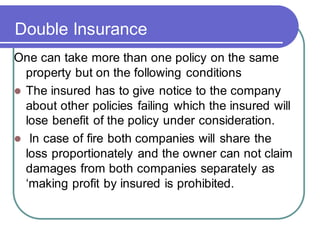
Double Insurance
One can take more than one policy on the same
property but on the following conditions
⚫ The insured has to give notice to the company
about other policies failing which the insured will
lose benefit of the policy under consideration.
⚫ In case of fire both companies will share the
loss proportionately and the owner can not claim
damages from both companies separately as
‘making profit by insured is prohibited.
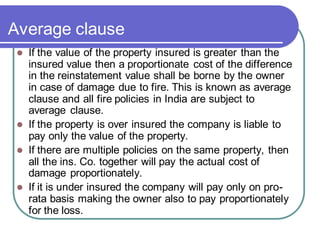
Average clause
⚫ If the value of the property insured is greater than the
insured value then a proportionate cost of the difference
in the reinstatement value shall be borne by the owner
in case of damage due to fire. This is known as average
clause and all fire policies in India are subject to
average clause.
⚫ If the property is over insured the company is liable to
pay only the value of the property.
⚫ If there are multiple policies on the same property, then
all the ins. Co. together will pay the actual cost of
damage proportionately.
⚫ If it is under insured the company will pay only on pro-
rata basis making the owner also to pay proportionately
for the loss.
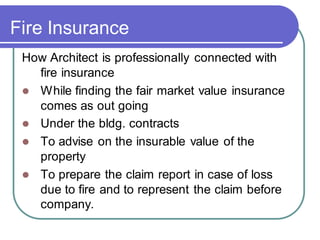
Fire Insurance
How Architect is professionally connected with
fire insurance
⚫ While finding the fair market value insurance
comes as out going
⚫ Under the bldg. contracts
⚫ To advise on the insurable value of the
property
⚫ To prepare the claim report in case of loss
due to fire and to represent the claim before
company.
Standard Rent
⚫ Rent- different types of rent- working out
std rent. Ratable value and its relation to
rent.
⚫ Rent control Act.
⚫ Submission on the topic or debate on it
including the recent amendments to the
rent control act initiated by the
Maharashtra Govt.
ARBITRATION & CONCILIATION
⚫ Arbitration is a method of settling disputes and
differences between two or more parties whereby they
appoint one or more persons to adjudicate on the said
disputes that have arisen and agree to abide by the
decision of the adjudicators
Or
An Arbitration is the reference of a dispute or difference
between not less than two parties for determination after
hearing both sides in a judicial manner by a person or
persons other than a court of competent jurisdiction
ARBITRATION & CONCILIATION
⚫ Mediation is a process involving chosen intervention
by a neutral person appointed by both the parties to
settle their disputes and differences.
⚫ It is a term of International Law which signify the
interposition by a neutral and friendly state between
two states at war or on the eve of war, of its good
offices to restore or preserve peace.
⚫ Both the parties lay bare facts before mediator and
after hearing both the sides separately show its
relative position, law applicable as well as impacts
beside persuasions and to some extent spirit of ‘give
and take.’
ARBITRATION & CONCILIATION
⚫ Based on the opinion of the mediator the parties have
two options available namely:-
a) Enter into further negotiations
b) Settle the matter
The mediator is not an arbitrator and signed settlement is
not an award but a mere contract. Complete process of
mediation is with out prejudice to the legal rights of
parties to the disputes unless otherwise agreed.
ARBITRATION & CONCILIATION
Draw backs
1) Hearing each party in the absence of
the other.
2) Disclosure or information of one to
another for settlement can rebound if
fails to settle and can use the above
facts in the court of law.
ARBITRATION & CONCILIATION
Conciliation
It is a process alternative to arbitration for settling the
disputes though it resembles arbitration. Conciliator
usually possessing relevant expertise can be sole,
appointed by both parties or joint one appointed by both
the parties.
If there are two or more conciliators they meet together
after study with an open mind to ascertain the fields of
agreements/dis-agreement. The result will be agreement
on a number of issues where by the field of disputes gets
reduced.
ARBITRATION & CONCILIATION
However it will become a failure if the
conciliators :
1) Are emotionally involved
2) Suffer from superiority complex
3) Are under the dictates of the parties.
Meeting between the conciliators are
without prejudice and it is not advisable for
them to rush to the parties for their dictate
on every act
ARBITRATION & CONCILIATION
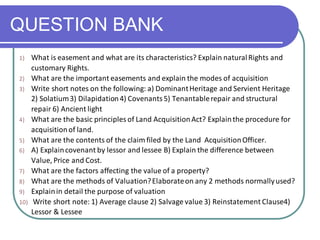
QUESTION BANK
1) What is easement and what are its characteristics? Explain naturalRights and
customary Rights.
2) What are the important easements and explain the modes of acquisition
3) Write short notes on the following: a) DominantHeritage and Servient Heritage
2) Solatium3) Dilapidation4) Covenants5) Tenantablerepair and structural
repair 6) Ancient light
4) What are the basic principles of Land AcquisitionAct? Explainthe procedure for
acquisitionof land.
5) What are the contents of the claim filed by the Land AcquisitionOfficer.
6) A) Explaincovenant by lessor and lessee B) Explain the difference between
Value, Price and Cost.
7) What are the factors affecting the value of a property?
8) What are the methods of Valuation?Elaborateon any 2 methods normallyused?
9) Explainin detail the purpose of valuation
10) Write short note: 1) Average clause 2) Salvage value 3) Reinstatement Clause4)
Lessor & Lessee
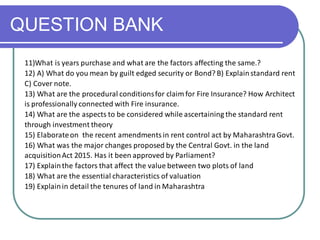
QUESTION BANK
11)What is years purchase and what are the factors affecting the same.?
12) A) What do you mean by guilt edged security or Bond? B) Explainstandard rent
C) Cover note.
13) What are the procedural conditionsfor claim for Fire Insurance? How Architect
is professionally connected with Fire insurance.
14) What are the aspects to be considered while ascertaining the standard rent
through investment theory
15) Elaborateon the recent amendmentsin rent control act by MaharashtraGovt.
16) What was the major changes proposed by the Central Govt. in the land
acquisitionAct 2015. Has it been approved by Parliament?
17) Explainthe factors that affect the value between two plots of land
18) What are the essential characteristics of valuation
19) Explainin detail the tenures of land in Maharashtra

Professional practice vth year

  • 1.
  • 2.
    Professional Practice-Vth Yr. Lectureplan ⚫ L-1. Valuation ⚫ Definitions of Price, Value, cost, market value, Essential characteristic of value, ⚫ L-2 Value classifications, Factors affecting Value of a property. Methods of Valuation, ⚫ L-3 Explanation for methods of valuation ⚫ L-4 Various forms of rent, type of leases, Annuity, Sinking fund, Ratable value ⚫ L-5 Dilapidation and waste. ⚫ Covenants, - by lessee, by lessor, tenantable repair and structural repairs,
  • 3.
    Professional Practice-Vth Yr. Lectureplan L-6 Law relating to repairs. Report on schedule of dilapidation, Right of land lords to demolish tenanted bldgs. L-7 Easements What is easement, What are its characteristics, Dominant heritage, Servient heritage, Other rights resembling easement. L-8 ancient light, Natural rights and customary rights, Types of easements and modes of acquisition L-9 1st Test comprising the above topics L-10 Consumer protection Act 1986 Its impact on architects
  • 4.
    Professional Practice-Vth Yr. ⚫L-11. Land acquisition ⚫ Land acquisition act 1894,Basic principles of land acquisition act, ⚫ L-12. Procedure for acquisition, Compulsory acquisition, solatium, apportionment. ⚫ L-13 Standard rent ⚫ Rent control act, standard rent, methods of ascertaining std. rent, theory of comparable, Rent act in Mumbai ⚫ L-14. Fire Insurance essential for formation, Proposal Form, Cover note, ⚫ Procedural conditions for claims, Average Clause, ⚫ L-15. Reinstatement clause, How Architect is professionally connected with Fire insurance, Salvage value, ⚫ L-16. 2nd test
  • 5.
    EASEMENT ⚫ It isa right the owner or occupier of certain land possesses for the beneficial enjoymentof that land. 1) to do and continueto do something 2) to prevent and continueto prevent something from being done CHARACTERISTICS OF EASEMENTS 1. Owner or occupier of land necessary 2. Right to do or continue to do or prevent and continue to prevent something being done 3. The right should be for the beneficial enjoyment of the dominant heritage. Since it is attached to the land, it gets automatically transferred on sale. (right of Access)
  • 6.
    EASEMENT ⚫ Dominant heritage Theland for the beneficial enjoyment for which the right of easement exists is called dominant heritage. The land whose owner is entitled to claim certain concessions from the owner of the servient heritage. It is the owner of the dominant heritage who is benefited from the provision of Act. ⚫ Servient heritage The land on which the liability of beneficial enjoyment of the easement is imposed is called servient heritage. The owner of the servient heritage has to sacrifice a part of his absolute right of enjoyment and ownership of his land to the beneficial enjoyment of the land of the dominant owner
  • 7.
    EASEMENT A B RIGHT OFWAY R O A D DOMINANT HERITAGE SERVIENT HERITAGE
  • 8.
    EASEMENT Other rights resemblingeasement a) Natural rights b) Customary rights ⚫ Natural rights Normally arise out of geographical configuration of the property and are inherent in the property itself. Natural situation- Water discharged into the lower level land from the higher one is a natural right.
  • 9.
    EASEMENT Some natural rights 1.To receive air and light freely 2. To receive light which falls vertically upon the land and not light from the adjacent plot. 3. No right to pollute air. 4. Right of support to land in its natural condition- digging by adjoining owner endangering the property. 5. Right to discharge water from the higher plot to lower plot. But right to discharge polluted water is not a natural right. Such right should be acquired thru prescription or easement.
  • 10.
    EASEMENT Case where naturalright of the owner to enjoy their property exclusively are restricted. 1) Follow the D.C.R to develop the plot 2) Fresh air should not be polluted 3) Unreasonable noise or vibration which interferes with one’s physical comforts not allowed. 4) Owners’ right to so much air and light as passes vertically thereto. 5) Right of support of adjacent land in natural conditions 6) No right to pass polluted water from higher to lower plot.
  • 11.
    EASEMENT Customary rights There arerights arising out of customs vested in favour of a large body of persons like inhabitants of a particular village or certain caste. It is a right in gross where as the easement is always appurtenant to a tenant. Right to bury the dead at a certain ground. Right to have Ganesh festival / holy at a certain ground.
  • 12.
    EASEMENT Continuous easement Easements whoseenjoyment is continued with out the act of man. For e.g.; Right to receive light from a neighbour’s property is a continuous easement as no act of man is required to do that. Similarly a drain under a property is a cont. easement. Discontinuous easement It requires act of man for enjoyment. E.g. right to take water from the neighbour’s well which requires a fresh act on every occasion.
  • 13.
    EASEMENT Important easements 1. Rightto enjoy light and air from and over the property of the adjoining owner. (easement of air and light 2. Right of access from adjoining owner’s land (easement of way). 3. Right to run and maintain water and drain pipes thru the neighbour’s land. (easement of drainage and water supply) 4. Right of flow of water (easement of water course) 5. Right of support for a building ( easement of support.)
  • 14.
    EASEMENT Modes of acquisitionof easements 1. By grant 2. By necessity 3. By prescription By grant An easement may be imposed by anyone in the circumstances and to the extent to which he may transfer his interest in the heritage on which the liability is imposed
  • 15.
    EASEMENT By necessity. This ariseswhen one property is severed into 2 either by sale, mortgage, partition etc. and they are so situated that one can not be enjoyed without exercising a particular privilege upon the other. By prescription As acquisition of a right or title due to constant use or possession for 20 years. If claimed against the govt. 60 years in the mode and manner as prescribed in the easement act 1882. However it is necessary to obtain declaratory order from the court that the dominant owner is entitled to the prescriptive easement claimed there in within 2 years after the expiry of 20 years . To acquire the easement by prescription it must be proved that ⚫ It has been enjoyed peacefully ⚫ As an easement ⚫ Without interruption ⚫ For 20 years.,
  • 16.
    EASEMENT Ancient Lights ⚫ Whenan owner acquires easement of light and air, the openings ( windows, opening with or with out grill on the wall deriving light and air from neighbour’s property are known as Ancient lights. ⚫ The servient owner can not carry out any construction on his land which will substantially diminish light enjoyed by such ancient lights. He must leave sufficient open space in the form of external chowks.
  • 17.
    LAND ACQUISITION ACT ⚫LAND ACQISITION ACT 1894 was enacted by the G.O.I. to acquire land required by Govt. for various public purposes. It is amended from time to time. ⚫ The basic principles of L.A.A are 1. Land required for a purpose 2. Sale by an owner is compulsory and there is no option 3. Owner to get market value as against sentimental/ monopoly value. 4. Property acquired free from any encumbrances 5. In addition to the market value an owner is entitled to additional compensation of 30% on the value of such land for compulsory acquisition which is known as solatium. Acquisition means that the entire bundle of rights which were vested with the original owner pass on acquisition to the acquirer by leaving nothing to the former.
  • 18.
    LAND ACQUISITION ACT ⚫The procedure for acquisition can be divided into the following parts. 1. Investigation 2. Objection and confirmation 3. Claim, Value and award 4. Possession 5. Payment 6. Reference to court 7. Apportionment
  • 19.
    LAND ACQUISITION ACT Investigation ⚫Local authority to apply to Revenue authority with details ⚫ Govt. if satisfies issues notification u/s-4 of the act in State Govt. Gazette ⚫ Revenue officer appointed to function as collector to hold enquiry ⚫ After notification owner prevented from selling /disposing in any other manner/construct/renovate etc. ⚫ If done with out prior permission from collector no compensation will be paid
  • 20.
    LAND ACQUISITION ACT Objectionand confirmation Notice on acquisition served inviting objections Valid Objections to acquisition 1. If proposal not for public purpose 2. Land not suitable 3. Less suitable than other pieces of land 4. Area under acquisition is in excess 5. It will destroy amenity of historical monuments, other conveniences, desecrate religious bldg., grave yard etc. Collector after hearing the parties will submit report to Govt. If satisfied will acquire, if the owners objections are upheld it may cancel notification for acquisition. After publication of notification Land Acq. Officer will proceed with the claim.
  • 21.
    LAND ACQUISITION ACT Claimand award ⚫ LAO to issue notices asking them to file their claim report ⚫ He will conduct enquiries which are not judicial ones. ⚫ His award is merelyan offer unless the parties accept the same. ⚫ LAO not to be a party to proceedings ⚫ Should have expert knowledge on Valuation ⚫ Offer a fair price to an owner ⚫ Should check that publicfund not wasted.
  • 22.
    LAND ACQUISITION ACT Claimfiled before LAO should contain 1. Names of the claimants with shares (declaration) 2. Document of profit 3. Rents or profits for last 3 years 4. Valuation report along with documentary evidence 5. Whether area given in acquisition notice is acceptable or not The Govt. has the right to abandon the acquisition proceedings any time before final declaration. Apportionment of compensation if there are two or more claimants.
  • 23.
    LAND ACQUISITION ACT TheRight to Fair Compensation and Transparency in Land Acquisition, Rehabilitation and ResettlementAct, 2013 (alsoLand Acquisition Act, 2013) is an Act of Indian Parliament that regulates land acquisition and lays down the procedure and rules for granting compensation, rehabilitation and resettlement to the affected persons in India. The Act has provisions to provide fair compensation to those whose land is taken away, brings transparency to the process of acquisition of land to set up factories or buildings, infrastructural projects and assures rehabilitation of those affected. The Act establishes regulations for land acquisition as a part of India's massive industrialization drive driven by public-private partnership. The Act replaced the Land Acquisition Act, 1894, a nearly 120-year-old law enacted during British rule.
  • 24.
    LAND ACQUISITION ACT TheLand Acquisition, Rehabilitation and Resettlement Bill, 2011 was introduced in Lok Sabha on 7 September 2011.The bill was then passed by it on 29 August 2013 and by Rajya Sabha on 4 September 2013. The bill then received the assent of thePresident of India, Pranab Mukherjee on 27 September 2013.[4] The Act came into force from 1 January 2014. An amendment bill was then introduced in Parliament to endorse the Ordinance. Lok Sabha passed the bill but the same is still lying for passage by the Rajya Sabha. On 30 May 2015, President of India promulgated the amendment ordinance for third time.[5]
  • 25.
    LAND ACQUISITION ACT ⚫Aims and objectives The aims and objectives of the Act include: • To ensure, in consultation with institutions of local self- government and Gram Sabhas established under the Constitution of India, a humane, participative, informed and transparent process for land acquisition for industrialisation, development of essential infrastructural facilities and urbanisation with the least disturbance to the owners of the land and other affected families • Provide just and fair compensation to the affected families whose land has been acquired or proposed to be acquired or are affected by such acquisition
  • 26.
    LAND ACQUISITION ACT •Make adequate provisions for such affected persons for their rehabilitation and resettlement • Ensure that the cumulative outcome of compulsory acquisition should be that affected persons become partners in development leading to an improvement in their post acquisition social and economic status and for matters connected therewith or incidental thereto.[
  • 27.
    LAND ACQUISITION ACT ⚫Purpose and scope The Act aims to establish the law on land acquisition, as well as the rehabilitation and resettlement of those directly affected by the land acquisition in India. The scope of the Act includes all land acquisition whether it is done by the Central Government of India, or any State Government of India, except the state of Jammu & Kashmir. ⚫ The Act is applicable when: • Government acquires land for its own use, hold and control, including land for Public sector undertakings.
  • 28.
    LAND ACQUISITION ACT •Government acquires land with the ultimate purpose to transfer it for the use of private companies for stated public purpose. The purpose of LARR 2011 includes public-private-partnership projects, but excludes land acquired for state or national highway projects. • Government acquires land for immediate and declared use by private companies for public purpose. ⚫ The provisions of the Act does not apply to acquisitions under 16 existing legislations including the Special Economic Zones Act, 2005, the Atomic Energy Act, 1962, the Railways Act, 1989, etc.
  • 29.
    LAND ACQUISITION ACT ⚫Important provisions of the law • Compensation in rural areas would be calculated by multiplying market value by two and adding assets attached to the land or building and adding a solatium. In urban areas it would be market value plus assets attached to the land and solatium • Developers to get the consent of up to 80 per cent of people whose land is acquired for private projects. For PPP projects, the approval of 70 per cent of land owners is mandatory • Multi-cropped, irrigated land cannot be acquired unless it is for defence or emergency caused by natural calamity
  • 30.
    LAND ACQUISITION ACT •Land should be returned to original owner if not used in five years for the purpose for which it is acquired, subject to the refund of one-fourth of the compensation amount with interest from date of payment • The government will not acquire land for private companies for private purpose • The Bill mandates social impact assessment when government proposes acquisition of land over 40.46 ha, which should be conducted in consultation with the gram sabha (village council). It also provides for the appointment of an administrator for rehabilitation
  • 31.
    LAND ACQUSITION ACT •Both land acquisition and resettlement and rehabilitation provisions of the Bill will apply to projects when government acquires land for its own use or on behalf of private companies for stated public purpose, including PPP projects. In case companies directly acquire over 40 ha from land owners, they will be responsible for resettlement and rehabilitation • The Bill also proposes amenities like schools, health centres and civic infrastructure in places where project-affected people are resettled • The urgency clause should be exercised in the rarest of rare cases like national defence or for resettlement purposes. This means no land acquisition can proceed without public hearing
  • 32.
    LAND ACQUSITION ACT ⚫Salient features of the Land Bill, 2015:- ⚫ Five categories of land use has been created: (i) Defense and national security projects, (ii) Affordable Housing = housing for the poor, (iii) Rural/ Social Infrastructure, (iv) Industrial Corridors, (v) PPP infrastructure projects, wherein Central Government own the lands; and these five categories do not require Social Impact Assessment to be done and neither require 70-80% approval of the landowners for private/ PPP projects respectively.
  • 33.
    LAND ACQUSITION ACT ⚫Moreover, one person from each family of farm labourers will be given (guaranteed) employment when the land on which they were employed as farm hands is acquired. ⚫ The Amendment also looks to limit the amount that can be acquired for industrial purposes ⚫ In the LARR Act, 2013 – ‘private companies’ was mentioned. The Bill has changed the wordings to ‘private entities’ which bring many other institutions under the purview of the Act, such as companies, NGOs, NPOs, corporation, firms and individual etc.
  • 34.
    LAND ACQUSITION ACT ⚫Land if unutilized will be returned after the later of (i) 5 years, or (ii) such period as is mentioned at the time of setting up of the project agreement. Earlier it was just 5 years. Some projects may by their inherent nature require more time to materialize and hence the ‘later’ period clause has been introduced. ⚫ The LARR Act, 2013 did not apply to 13 other Statutory Acts, such as the Atomic Energy Act, Petroleum Act, Railways Act, Electricity Act etc. – these have been brought under the purview of the Land Ordinance, 2014 and to be included ultimately into the Amendment Act, 2015 – which will require amendments and RS approval on those 13 Act separately too!
  • 35.
    LAND ACQUSITION ACT 1.Private Hospitals and Private Educational Institutions which were earlier excluded from the LARR 2013, are now through the proposed bill brought under the purview of the LARR. 2. One for the Government Officials – if an offence is committed by a Government Official he can only be prosecuted with prior approval of the Government. ⚫ These are the 9 important amendments passed in the Lok Sabha and was rejected by Rajya Sabha.
  • 36.
    Sessional work. Explain LandAcquisition, Rehabilitation and Resettlement Act 2013 enacted by the UPA Govt. Compare the same with the Land Bill 2015 proposed by the BJP Govt. but rejected by the Rajya Sabha. Submit on or before 18th July 2017 Marks 50
  • 37.
    DILAPIDATION AND WASTE Dilapidationis the state of disrepair. This may arise due to neglect to carry out repairs whereby the buildings become dilapidated or reaches a ruinous condition. 1. To stop leakage from toilet is tenantable repair 2. If not attended to in time will affect the beams and slab and will lead to structural repairs. 3. Again neglect in attending the above structural repairs will result in dilapidation. Want of repair is not the only cause of dilapidation, it can be due to the wrong act of the tenants such as using the res. Premises for storage or removing some structural members to have more space beneath etc.
  • 38.
    DILAPIDATION AND WASTE Lawrelating to repairs and dilapidation The relationship between landlord and tenant is created by a contract of tenancy called lease. The landlord gives the tenant exclusive possession and quite enjoyment of the landlord’s premises for a definite period for a periodic payment called rent. (As per the recent amendment of rent act in Maharashtra the lease agreement between the tenant and owner shall be registered and stamp duty paid) Sometimes it is an oral agreement. In case of monthly tenancy rent receipt and delivery of possession of premises form important ingredient to justify relationship of landlord and tenants and agreement is absent here. The liabilities for repairs to a property can be contractual one or statutory depending on the circumstances. Thecontractual liability is spelt out thru the covenants in the lease deed.
  • 39.
    DILAPIDATION AND WASTE Covenants Theyare conditions in agreements which spell out rights and liabilities of parties to such agreements as also their successors. In certain circumstances these are enforceable against the third party. These take the form of express covenants when given on leases and implied covenants which arise from relationship of landlord with tenant.
  • 40.
    DILAPIDATION AND WASTE 2types of covenants 1. Personal covenant 2. Touch and concern Land- having reference to the subject matters of lease. ⚫ The covenant to pay rent, to keep in repair the demised premises clearly affect the landlord and tenants in their capacities and as such are touching and concerning land. ⚫ But if an option is given to the tenants to purchase freehold after a specified period at a specified amount the same does not affect the relationship between landlord and tenant but as vendor and purchaser and as such it is a personal covenant.
  • 41.
    DILAPIDATION AND WASTE Covenantby Lessor 1. To put lessee in possession of the property. 2. Allow lessee quiet and peaceful possession of the premises on payment regular rent. 3. To carry out heavy or special or structural repairs if so provided. 4. To renew the lease if so provided 5. To pay specified outgoings.
  • 42.
    DILAPIDATION AND WASTE Covenantby lessee 1. To pay the rent regularly 2. To repair and keep in repair the demised premises. 3. Not to make additions and alterations to the premises 4. Not to cut or maim any part of the fabric of the structure, walls or timber 5. Not to commit waste 6. Not to change user of premises 7. Not to erect permanent structure without prior permission of lessor 8. To insure against fire and bear other outgoings as specified 9. Not to assign, transfer, sublet or part with possession with out prior consent 10. To remove tenants fixture without damaging the property. 11. To surrender the property in the same condition as it was originally leased at the expiry of lease period.
  • 43.
    DILAPIDATION AND WASTE REPAIRS Anylabour or material provided to restore, reconstruct or renew any existing part of a building, its fixtures or appurtenances. Classified as Tenantable repairs and structural repairs. Tenantable repairs are usually the repairs done to put the premises in a tenantable condition so as to command the rent and make it fit for human habitation. Structural repairs will pertain to the fabric of structure including walls and floors supporting members. Water proofing will be tenantable repair while repair of joist will be structural repair. If the floor is raised and paved with tiles in place of i. p. s, it is known as improvements.
  • 44.
    VALUATION Valuation is anadventure in economic research leading to an economical decision of a valuer which indicatethe conclusion arrived at after taking into consideration all factors like economic, social, political, Legal and physical which affects the value one way or the other. Value A commodity to have value must possess 3 essential qualifications i) It must possess utility ii) It must be scarce iii) It must be transferable/ marketable b) It can be said to be a ratio between price of money and price of commodity in return c) It is not necessarily the price of a commodity. d) It can be an unearned increment or unfortunate decrement in the price
  • 45.
    VALUATION Price i) Cost ofa commodity + additional reward for production for the labour and capital ii) It is a special form of value iii) It is fixed depending on the demand and the adjustments of price brings into existence the ‘value’. iv) It depends on utility, durability, satisfaction and the extent to which a commodity is scarce
  • 46.
    VALUATION Cost i) Expenditure toproduce a commodity having a value ii) Depreciation is worked out on the cost of commodity rather than the value. Market Value It has been defined as the amount which might be expected to be realised from a willing purchaser on a sale of a property by a willing seller.
  • 47.
    VALUATION Essential characteristics 1. Vendorwilling to sell 2. Purchaser willing to purchase 3. No compulsion on either 4. Urgent necessity of sale/purchase to be discarded 5. Disinclination of the vendor to be ignored 6. Settlement value to the vendor will have no place 7. Present and future uses known as potentials are to be taken into account.
  • 48.
    VALUATION Factors affecting thevalue of an item 1. Supply and demand If the number of plots available for sale in a particular locality is more and buyers less it will affect the value and vice versa. Rise in population due to influx of people will result in heavy demand and will require more land. If there is shortage of land it will result in increase in the price of land 2. Cost of replacement When a built-up property is available for sale, the purchaser will always consider the cost of replacement of the same bldg.
  • 49.
    VALUATION 3. Occupational value Whena property is required for the purpose of residential occupation, the price paid is generally more than its market value arrived at by rental method 4. Interest and security of a capital A person who invest in a property always expects some reward in return which is known as interest available in gen. investment market and security of capital. If the capital is secured and realisable at any time then the rate of interest expected will be low compared to the one where there is no security of capital
  • 50.
    VALUATION 5. Rent RestrictionAct The value of a property depends upon its annual rental and in case of an old building let out prior to 1.9.1940 the same is not allowed to be increased under the rent act except for permitted increase. Thus the net return is pegged down to the economic level of 1940 where as the cost of living has gone up. Due to this the capital has drifted away from the property market into industries thus affecting the rental property market 6. Abnormal condition Value may go down due to abnormal conditions like war, riots or due to insecure conditions.
  • 51.
    VALUATION 7. Town planningact. Due to declaration of a town planning scheme in a particular area where by it is proposed to be provided with all civic amenities like roads, gardens, drainage, etc. the value of open plot in this locality will be going up.
  • 52.
    VALUATION Methods of valuation 1.Land and building method 2. Income capitalisation method 3. Profit basis 4. Development method or plotting scheme
  • 53.
    VALUATION Land and buildingmethod One of the well known methods of valuation and applied for valuation of properties where no direct evidence of rent. ( schools, welfare centres, owner occupied proposals, purpose built Ind. Bldgs. Etc.) Determine the market value of land and cost of construction (depreciated or otherwise)
  • 54.
    VALUATION The value ofland in the vicinity may range depending upon the following facts. 1. Period of valuation- rise or fall if any during that period 2. Location and situation of the property 3. Proximity to civic amenities and meansof access 4. Shape of the plot. 5. Area of the plot 6. Ratio of frontage to the depth 7. Frontages and vistas on two roads 8. Condition of the plot- low lying etc. 9. Encumbrances like easement, tenancy right etc. mode of payment.
  • 55.
    VALUATION Profit method It dealsin working out the profit from a property and capitalising the same at appropriate rate of return. The following factors shall be considered. 1. The net profit to be adopted should be an average of last 3 years profit 2. Part of the profit is due to good will which should be properly reflected in the rate of return 3. Applicable to cinemas, hotels etc.
  • 56.
    VALUATION Rental method ofValuation The main purpose is present worth or future benefit. The receipt of benefit being the receipt of net income as the true basis to judge the value would be net income. The capitalised value of the net income at appropriate figure of year’s purchase will represent the value of the property In this case the building on the plot should have a future life expectancy of 60 years and necessarily the value of land is negligible. Net rent = Gross rent- outgoings Capitalised value = Net rent x years purchase This method calls for detail study of many factors like rent, outgoings and factors on which year’s purchase will depend.
  • 57.
    VALUATION Rent for thepurpose of valuation 1. It must be fair rent maintainable for a considerable period with no threat of being reduced in future 2. Its limit will be standard rent 3. Chance higher rent need not be considered.
  • 58.
    VALUATION ⚫ Out goings(for an urban property) 1. Municipal charges 2. Repairs 3. Insurance 4. Collection & management charges, cost of services and amenities 5. Vacancies and bad debts 6. Ground rent in case of lease hold prop.
  • 59.
    VALUATION Prepare valuation reportbased on annual return on the given data for a property having an area of 1500 Sq.M. on 60 years lease. The annual ground rent is Rs.20,000/- and gross rent per annum is Rs.3,60,000. Consider the Municipal Taxes as 30% of the gross annual rent and repairs at 10%. Insurance per annum is Rs. 3000/- Common electricity and repair charges Rs. 2,500 and 6% respectively. Present Value (P.V.) of Re. 1/- per annum with interest @ 7 % and redemption of capital at 4% for future life of 50 years = 10.5 Gross annual rent = 3,60,000/- Deduct outgoings = A Net return = 3.60 L- A Value = Net return x year’s purchase = N.R x 10.5
  • 60.
    VALUATION Gross annual rent= 3,60,000/- Deduct outgoings = A Net return = 3.60 L- A Value = Net return x year’s purchase = N.R x 10.5 ⚫ A building having an area of 1500 Sq.M. has completed 15 years of its existence. The cost of construction for the type of bldg. is Rs.15000 per Sq.M. and the plot area 2000 SqM. and land cost in the vicinity is 40,000/Sq.M. Find out the present market Value of the property.
  • 61.
    VALUATION Development method In thiscase sub-division of the entire plot is done to small units. The total area of the plot except 15% R.G., Access Road, Sub-stn etc. will forms the base. Necessary allowances shall be madefor the cost of development for access, storm water drains, garden dev., sub-stn., electricwater and drainage lines, architect’sfee, developers profit etc. The whole projecthas to be differed for 2 to 5 years being period of sale. Depending on the demand it can be 1 year also. Other factors like easement rightsand tenancy and encumbrances shall be taken into consideration Estimated sale price of all small units less all allowances cited above differed for a specified period will give the value of the property in underdeveloped state.
  • 62.
    VALUATION Purpose of Valuation 1.Purchase for investment or for occupation 2. Sale 3. Mortgage 4. Rent fixation 5. Land acquisition 6. Betterment charges 7. Auction bids 8. Probate 9. Speculation 10. Insurance 11. Wealth tax 12. Capital gain tax 13. Stamp duty 14. Gift tax 15. General court purpose ( for court fee stamp etc.)
  • 63.
    VALUATION Year’s Purchase It isthe figure which shows how many times the net annual income is secured for its value. If the annual income is 15000 and the value is 300000 then we say that the income is secured by 20 times. In other words year’s purchase representscapitalised value to receive Re.1/ P.A. in perpetuity (for an indefinite period) or for a fixed number of years. A person investing Rs.100 in a fixed deposit of a bank with 5% interest rate will receive Rs.5 as net income. To get an income of Re.1 per annum how much amount to be invested. 100x1/5 = 20 years purchase.
  • 64.
    VALUATION The figure ofyear’s purchase depends on the following factors. ⚫ Rate of interest in light of property market forming an integral part of general investmentmarket ⚫ Age and condition of bldg. ⚫ Mode of letting ⚫ situation and frontage ⚫ Confirming zones and potential users ⚫ Govt. and Local authority’s rules and regulations ⚫ Whether it is fully or partially developed ⚫ Continuity of rent ⚫ Higher rate of return for leased property in comparison with freehold.
  • 65.
    VALUATION Bonds or guilt-edged security Finance required by the State Govt., Central Govt. Local authorities etc. is raised from the public by the issue of loans in the form of bonds having a fixed rate of interest and mostly having a fixed date of repayment a few years from the date of issue. The Govt. stocks satisfy most of the conditions of ‘ideal securities like: i) Capital invested must be safe ii) Income in the form of interest must be safe and regular iii) No trouble in collection of interest iv) Realisation of capital with least possible expenses
  • 66.
    STANDARD RENT ⚫ Rentcontrol act It is a piece of social legislation whose principal aim is to afford protection against eviction and exploitation of the tenants. In the absence of adequate protection it is likely that tenants may be asked to vacate their premises and also be asked to pay exorbitant rent as there is always a demand for housing stock.
  • 67.
    STANDARD RENT ⚫ InMumbai Province ‘Mumbai Rent Restriction Act 1939 was introduced. This Act applied to all premises whose rent did not exceed Rs. 80/Month as on 1-1-39. There after Mumbai Rents, Hotel Rates and lodging house rates(Control) Act 1944 was enacted. This Act did not apply to premises whose rent did not exceed `Rs. 250PM between 22-4-1942 to 15-2-1943. Since 13-2- 1948 this Act was in force. This is renewed from time to time and applies to all premises let out for residences, education, business, trade or storage etc. ⚫ The Act is not applicable to the premises belonging to the Govt. and local authorities. ⚫ This act has been replaced with Maharashtra Rent Control Act 1999.
  • 68.
    STANDARD RENT Standard rent Rentis defined as the periodic payment made by the tenant to his land lord for use and occupation of premises as well as its appurtenances, furnishing and other amenities provided by the land lord. It normally includes all outgoings like Mun. Taxes, Property tax, Govt. tax., all permitted increases that are recoverable from the tenants and necessary allowances for repairs and maintenances depending upon the terms and condition of the tenancy. The rent fixed between the landlord and the tenant at the inception of the tenancy either by negotiation or by bargaining is known as contractual rent.
  • 69.
    STANDARD RENT Standard rentis the rent which would be permissible under the law to be charged to a tenant. Very often there is a vide gap between contractual rent and standard rent. The act does not give any definition or the meaning of standard rent except that it is the rent fixed by the court after taking into consideration 3 basis namely ⚫ The provision of the act ⚫ The circumstances of the case ⚫ Fair and or just character of the amount involved
  • 70.
    STANDARD RENT If thepremises or bldg. constructed on or after 1-9-1940 is let out for the 1st time after 1-9-1940 the rent at which they are let out is std rent. Or call it ad- interim std. rent or presumptive std. rent. Methods of ascertaining std. rent a) Theory of comparable b) Investments
  • 71.
    STANDARD RENT Theory ofcomparables It consists in comparing the premises in application with letting rate of more or less similar premises in the locality for rate. a) Premisesshould be more or less similarly situated in same locality with the similar user b) Location of premises w.r.t. floor/view/road/sea etc. c) Type of construction d) The extent of the area e) Planning, finishing and amenities. f) Relevant period of letting out g) Whether the rent of it is fair and reasonable h) Terms of tenancies i) Age of building and extent of repairs.
  • 72.
    STANDARD RENT By investmenttheory Std rent is made up of comparables. a) Net return to the land lord for his investment b) out goings SR= Net return + out goings In order to estimate the std. rent by the method it will be essential to study the following. 1. Period of 1st letting 2. a) Value of land b) area of land 3. Cubic content, Carpet area, plinth area 4. Cost of construction 5. Future life expectancy 6. Return on investment 7. Repairs 8. Insurance 9. Sinking fund 10. Collection and management 11. Loading and apportionment 12. Municipal taxes.
  • 73.
    Fire Insurance Life insurance-GeneralInsurance Nationalization -L.I.C.-1956, G.I.C-1972 Now Private players allowed. ⚫ It is a contract of insurance ⚫ There must be consideration (premium) ⚫ Identification Essentials for formation of Fire insurance contract
  • 74.
    Fire Insurance Essentials forformation of Fire insurance contract 1. Proposal must be made by the insured 2. Deposit receipt for payment of Premium called cover note 3. If proposal rejected premium deposit will be refunded otherwise policy issued
  • 75.
    Fire Insurance Cover note-essential characteristic 1. If the fire takes place between the date of receipt of cover note and the date of intimation by the company of acceptance/rejection of policy the company will be responsible. 2. It is a protection for a limited period as intimated. 3. It is also known as interim protection note. 4. It is a contract of insurance and not a policy of insurance.
  • 76.
    Fire Insurance Procedural conditionsto claims 1. Notice of fire forthwith and to file claim report within 15 days with details 2. Forfeiture condition if claim found fraudulent 3. Reinstatement clause 4. Right of entry and salvage value. 5. Arbitration condition
  • 77.
    Fire Insurance ⚫ Averageclause ⚫ Double Insurance ⚫ Salvage value ⚫ Reinstatement clause ⚫ When property under-insured
  • 78.
    Double Insurance One cantake more than one policy on the same property but on the following conditions ⚫ The insured has to give notice to the company about other policies failing which the insured will lose benefit of the policy under consideration. ⚫ In case of fire both companies will share the loss proportionately and the owner can not claim damages from both companies separately as ‘making profit by insured is prohibited.
  • 79.
    Average clause ⚫ Ifthe value of the property insured is greater than the insured value then a proportionate cost of the difference in the reinstatement value shall be borne by the owner in case of damage due to fire. This is known as average clause and all fire policies in India are subject to average clause. ⚫ If the property is over insured the company is liable to pay only the value of the property. ⚫ If there are multiple policies on the same property, then all the ins. Co. together will pay the actual cost of damage proportionately. ⚫ If it is under insured the company will pay only on pro- rata basis making the owner also to pay proportionately for the loss.
  • 80.
    Fire Insurance How Architectis professionally connected with fire insurance ⚫ While finding the fair market value insurance comes as out going ⚫ Under the bldg. contracts ⚫ To advise on the insurable value of the property ⚫ To prepare the claim report in case of loss due to fire and to represent the claim before company.
  • 81.
    Standard Rent ⚫ Rent-different types of rent- working out std rent. Ratable value and its relation to rent. ⚫ Rent control Act. ⚫ Submission on the topic or debate on it including the recent amendments to the rent control act initiated by the Maharashtra Govt.
  • 82.
    ARBITRATION & CONCILIATION ⚫Arbitration is a method of settling disputes and differences between two or more parties whereby they appoint one or more persons to adjudicate on the said disputes that have arisen and agree to abide by the decision of the adjudicators Or An Arbitration is the reference of a dispute or difference between not less than two parties for determination after hearing both sides in a judicial manner by a person or persons other than a court of competent jurisdiction
  • 83.
    ARBITRATION & CONCILIATION ⚫Mediation is a process involving chosen intervention by a neutral person appointed by both the parties to settle their disputes and differences. ⚫ It is a term of International Law which signify the interposition by a neutral and friendly state between two states at war or on the eve of war, of its good offices to restore or preserve peace. ⚫ Both the parties lay bare facts before mediator and after hearing both the sides separately show its relative position, law applicable as well as impacts beside persuasions and to some extent spirit of ‘give and take.’
  • 84.
    ARBITRATION & CONCILIATION ⚫Based on the opinion of the mediator the parties have two options available namely:- a) Enter into further negotiations b) Settle the matter The mediator is not an arbitrator and signed settlement is not an award but a mere contract. Complete process of mediation is with out prejudice to the legal rights of parties to the disputes unless otherwise agreed.
  • 85.
    ARBITRATION & CONCILIATION Drawbacks 1) Hearing each party in the absence of the other. 2) Disclosure or information of one to another for settlement can rebound if fails to settle and can use the above facts in the court of law.
  • 86.
    ARBITRATION & CONCILIATION Conciliation Itis a process alternative to arbitration for settling the disputes though it resembles arbitration. Conciliator usually possessing relevant expertise can be sole, appointed by both parties or joint one appointed by both the parties. If there are two or more conciliators they meet together after study with an open mind to ascertain the fields of agreements/dis-agreement. The result will be agreement on a number of issues where by the field of disputes gets reduced.
  • 87.
    ARBITRATION & CONCILIATION Howeverit will become a failure if the conciliators : 1) Are emotionally involved 2) Suffer from superiority complex 3) Are under the dictates of the parties. Meeting between the conciliators are without prejudice and it is not advisable for them to rush to the parties for their dictate on every act
  • 88.
  • 89.
    QUESTION BANK 1) Whatis easement and what are its characteristics? Explain naturalRights and customary Rights. 2) What are the important easements and explain the modes of acquisition 3) Write short notes on the following: a) DominantHeritage and Servient Heritage 2) Solatium3) Dilapidation4) Covenants5) Tenantablerepair and structural repair 6) Ancient light 4) What are the basic principles of Land AcquisitionAct? Explainthe procedure for acquisitionof land. 5) What are the contents of the claim filed by the Land AcquisitionOfficer. 6) A) Explaincovenant by lessor and lessee B) Explain the difference between Value, Price and Cost. 7) What are the factors affecting the value of a property? 8) What are the methods of Valuation?Elaborateon any 2 methods normallyused? 9) Explainin detail the purpose of valuation 10) Write short note: 1) Average clause 2) Salvage value 3) Reinstatement Clause4) Lessor & Lessee
  • 90.
    QUESTION BANK 11)What isyears purchase and what are the factors affecting the same.? 12) A) What do you mean by guilt edged security or Bond? B) Explainstandard rent C) Cover note. 13) What are the procedural conditionsfor claim for Fire Insurance? How Architect is professionally connected with Fire insurance. 14) What are the aspects to be considered while ascertaining the standard rent through investment theory 15) Elaborateon the recent amendmentsin rent control act by MaharashtraGovt. 16) What was the major changes proposed by the Central Govt. in the land acquisitionAct 2015. Has it been approved by Parliament? 17) Explainthe factors that affect the value between two plots of land 18) What are the essential characteristics of valuation 19) Explainin detail the tenures of land in Maharashtra