EDUCATION
 By –
 Roll No:
 MA Mass Communication
 ASSIGNMENT
What is education?
Education is the process of facilitating learning, or the
acquisition of knowledge, skills, values, beliefs, and habits.
Educational methods
include storytelling, discussion, teaching, training, and
directed research.
Education frequently takes place under the guidance of
educators, but learners may also educate themselves.
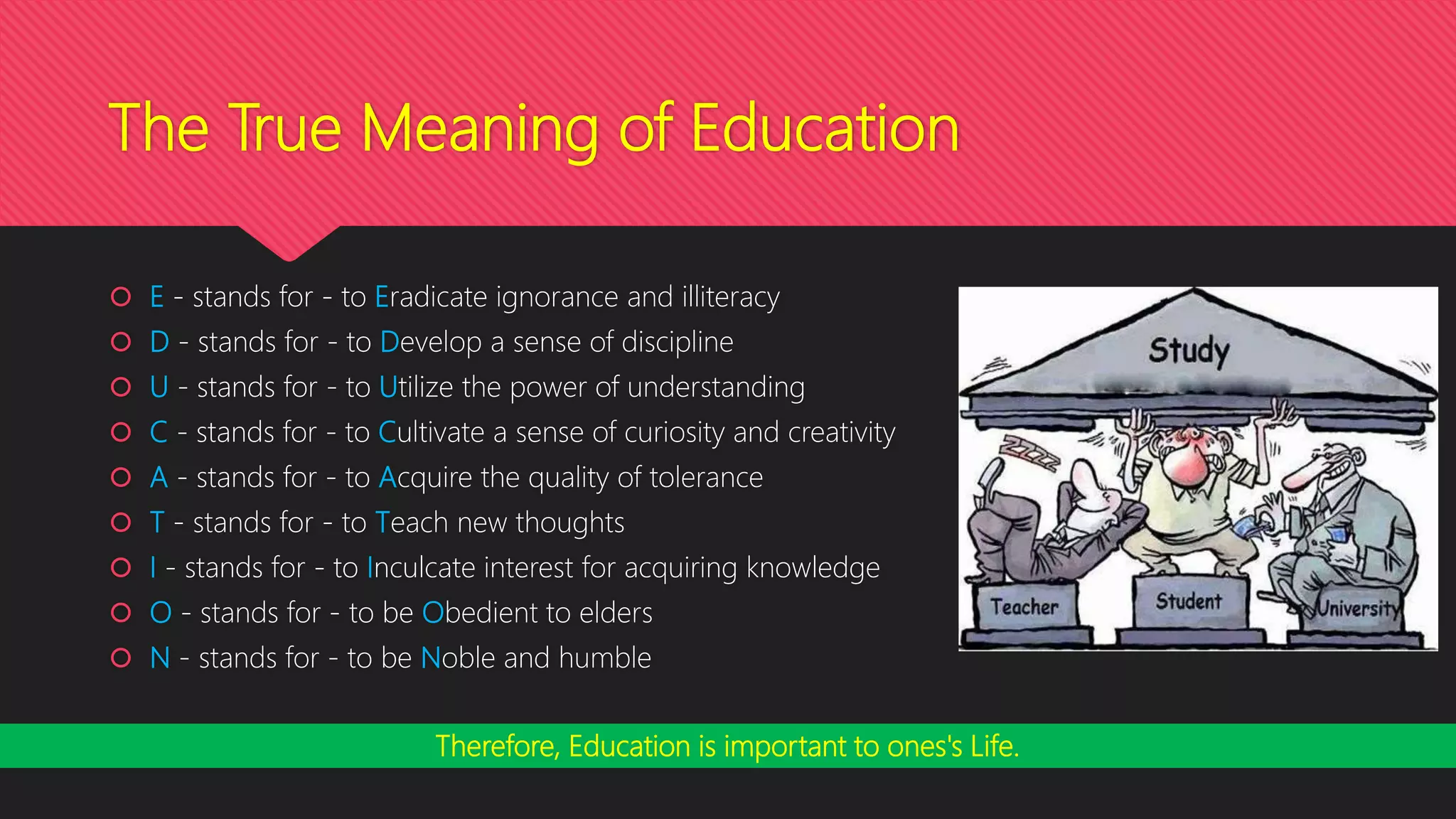
The True Meaning of Education
 E - stands for - to Eradicate ignorance and illiteracy
 D - stands for - to Develop a sense of discipline
 U - stands for - to Utilize the power of understanding
 C - stands for - to Cultivate a sense of curiosity and creativity
 A - stands for - to Acquire the quality of tolerance
 T - stands for - to Teach new thoughts
 I - stands for - to Inculcate interest for acquiring knowledge
 O - stands for - to be Obedient to elders
 N - stands for - to be Noble and humble
Therefore, Education is important to ones's Life.
Types of Education
Education can be formal, informal and non-formal. It employs
different educational techniques and methods like lecture
method, storytelling, learning by doing etc. Generally it starts
from pre-school to university stage.
Some Qotations by famous people
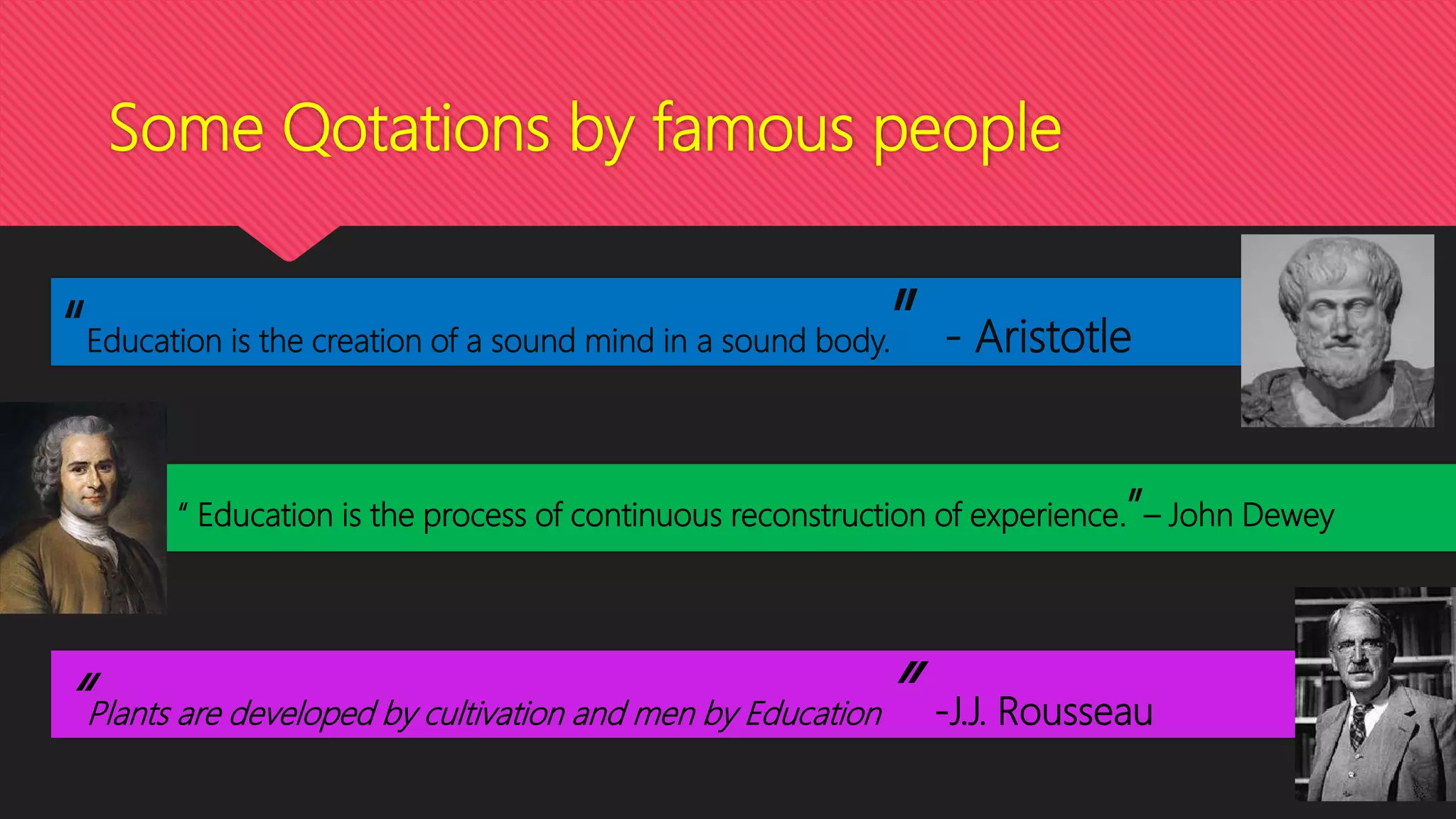
“Education is the creation of a sound mind in a sound body.” - Aristotle
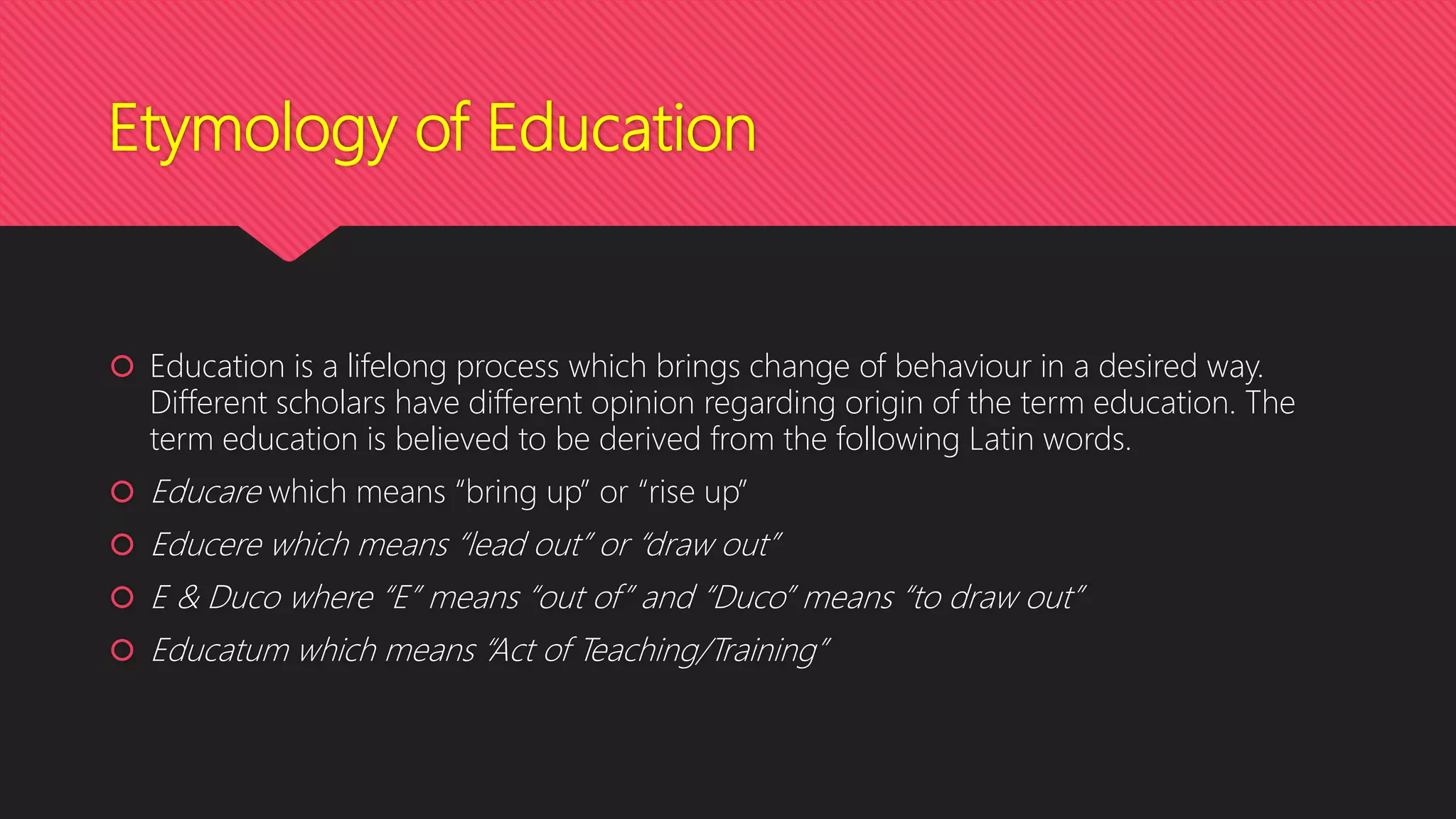
“ Education is the process of continuous reconstruction of experience.”– John Dewey
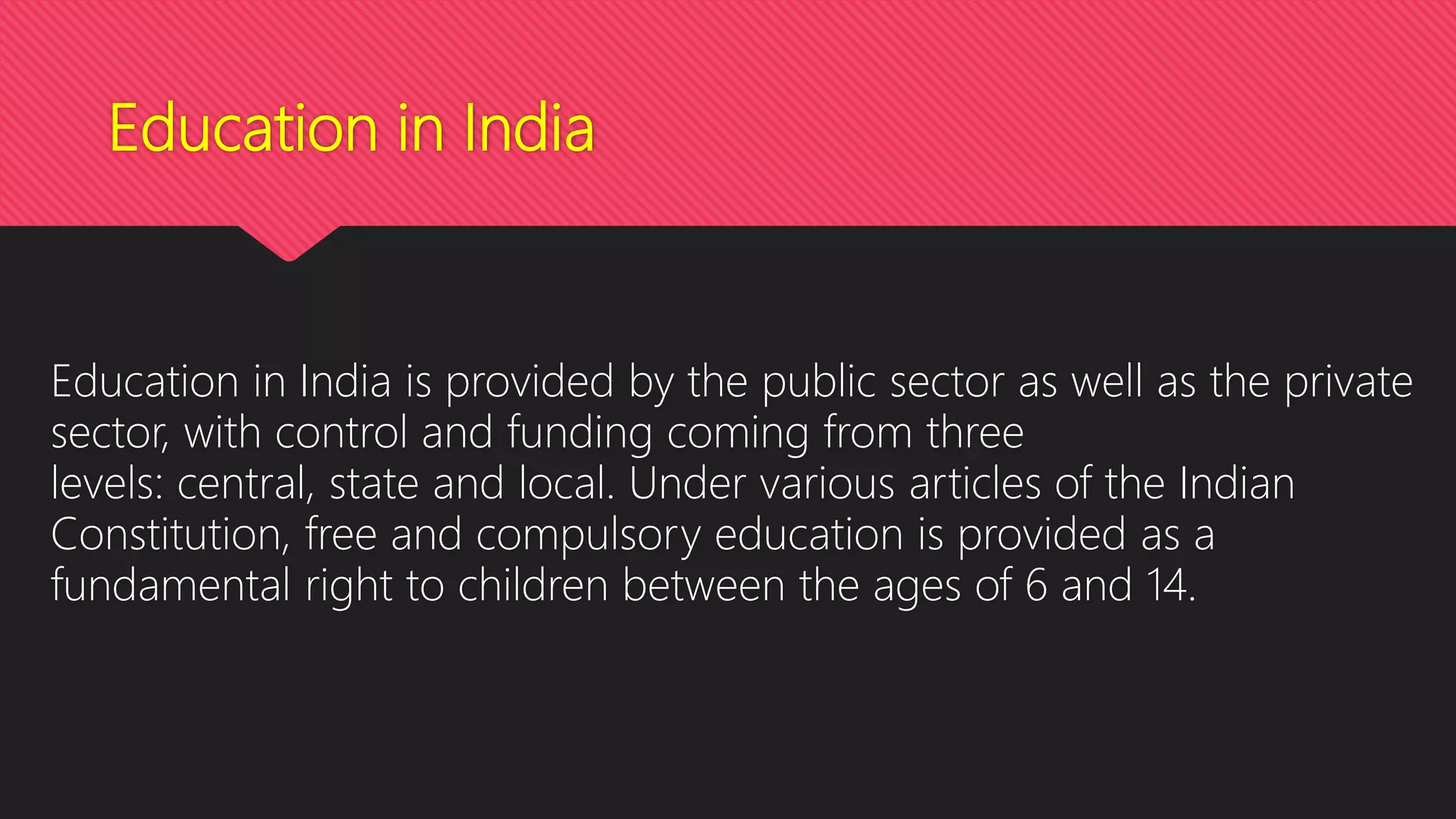
“Plants are developed by cultivation and men by Education” -J.J. Rousseau
Etymology of Education
 Education is a lifelong process which brings change of behaviour in a desired way.
Different scholars have different opinion regarding origin of the term education. The
term education is believed to be derived from the following Latin words.
 Educare which means “bring up” or “rise up”
 Educere which means “lead out” or “draw out”
 E & Duco where “E” means “out of” and “Duco” means “to draw out”
 Educatum which means “Act of Teaching/Training”
Education in India
Education in India is provided by the public sector as well as the private
sector, with control and funding coming from three
levels: central, state and local. Under various articles of the Indian
Constitution, free and compulsory education is provided as a
fundamental right to children between the ages of 6 and 14.
History of Education (India)
Takshasila (in modern-day Pakistan) was the earliest recorded centre of higher
learning in India from possibly 8th Century BCE, and it is debatable whether it
could be regarded a university or not in modern sense, since teachers living there
may not have had official membership of particular colleges, and there did not
seem to have existed purpose-built lecture halls and residential quarters in Taxila.
In contrast to the later Nalanda university in eastern
India. Nalanda was the oldest university-system of education in
the world (Bihar) in the modern sense of university. There all
subjects were taught in Ariano -páli Language.
Women’s Education in India
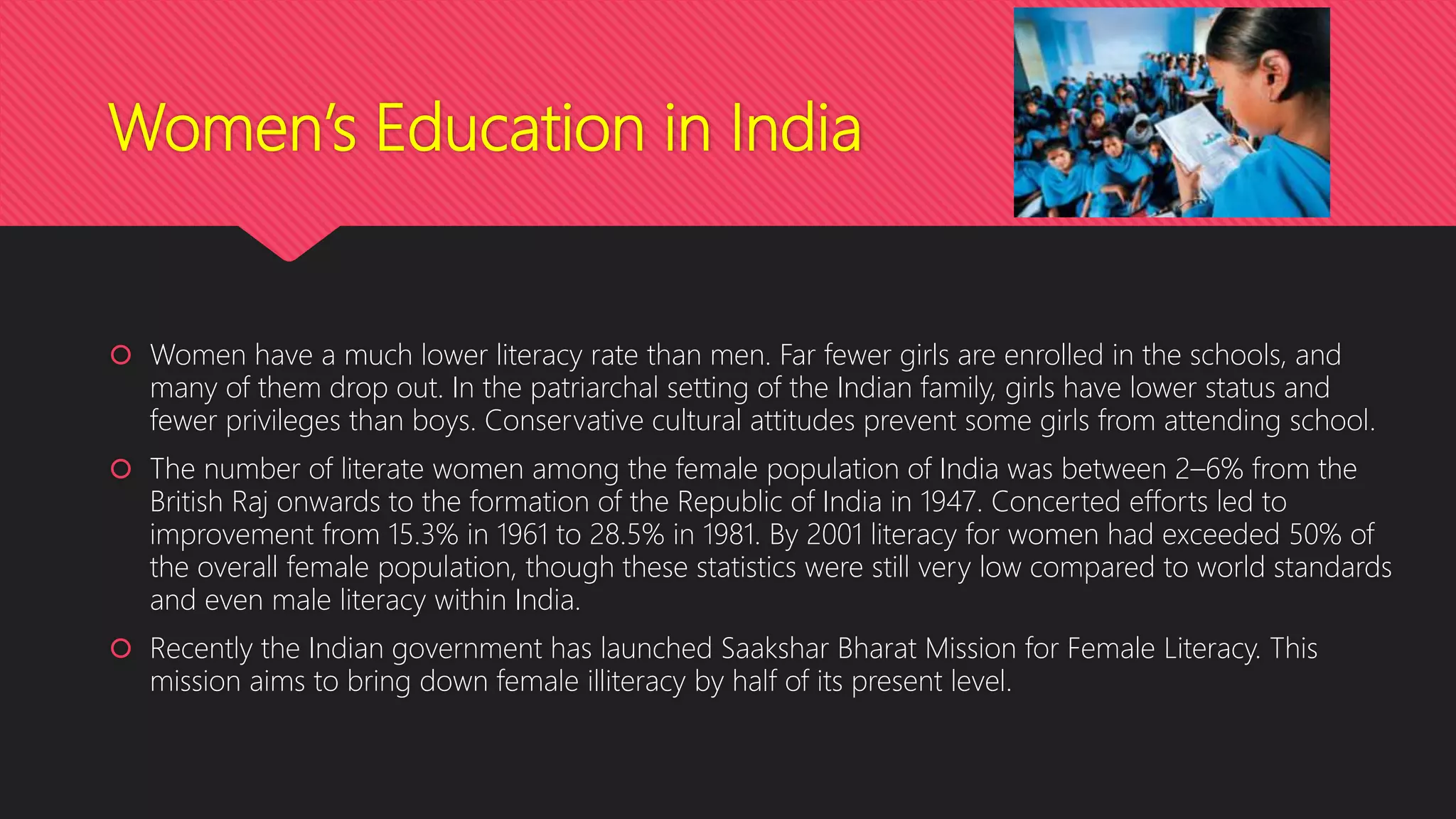
 Women have a much lower literacy rate than men. Far fewer girls are enrolled in the schools, and
many of them drop out. In the patriarchal setting of the Indian family, girls have lower status and
fewer privileges than boys. Conservative cultural attitudes prevent some girls from attending school.
 The number of literate women among the female population of India was between 2–6% from the
British Raj onwards to the formation of the Republic of India in 1947. Concerted efforts led to
improvement from 15.3% in 1961 to 28.5% in 1981. By 2001 literacy for women had exceeded 50% of
the overall female population, though these statistics were still very low compared to world standards
and even male literacy within India.
 Recently the Indian government has launched Saakshar Bharat Mission for Female Literacy. This
mission aims to bring down female illiteracy by half of its present level.
Challenges of Education in India
 Modern education in India is often criticised for being based on rote learning rather than
problem solving.
 New Indian Express says that Indian Education system seems to be producing zombies since in
most of the schools students seemed to be spending majority of their time in preparing for
competitive exams rather than learning or playing.
 BusinessWeek criticises the Indian curriculum, saying it revolves around rote learning
and ExpressIndia suggests that students are focused on cramming.
 Preschool for Child Rights states that almost 99% of pre-schools do not have any curriculum at
all. Also creativity is not encouraged or is considered as a form of entertainment in most
THANK YOU

Education (India)

  • 1.
    EDUCATION  By – Roll No:  MA Mass Communication  ASSIGNMENT
  • 2.
    What is education? Educationis the process of facilitating learning, or the acquisition of knowledge, skills, values, beliefs, and habits. Educational methods include storytelling, discussion, teaching, training, and directed research. Education frequently takes place under the guidance of educators, but learners may also educate themselves.
  • 3.
    The True Meaningof Education  E - stands for - to Eradicate ignorance and illiteracy  D - stands for - to Develop a sense of discipline  U - stands for - to Utilize the power of understanding  C - stands for - to Cultivate a sense of curiosity and creativity  A - stands for - to Acquire the quality of tolerance  T - stands for - to Teach new thoughts  I - stands for - to Inculcate interest for acquiring knowledge  O - stands for - to be Obedient to elders  N - stands for - to be Noble and humble Therefore, Education is important to ones's Life.
  • 4.
    Types of Education Educationcan be formal, informal and non-formal. It employs different educational techniques and methods like lecture method, storytelling, learning by doing etc. Generally it starts from pre-school to university stage.
  • 5.
    Some Qotations byfamous people “Education is the creation of a sound mind in a sound body.” - Aristotle “ Education is the process of continuous reconstruction of experience.”– John Dewey “Plants are developed by cultivation and men by Education” -J.J. Rousseau
  • 6.
    Etymology of Education Education is a lifelong process which brings change of behaviour in a desired way. Different scholars have different opinion regarding origin of the term education. The term education is believed to be derived from the following Latin words.  Educare which means “bring up” or “rise up”  Educere which means “lead out” or “draw out”  E & Duco where “E” means “out of” and “Duco” means “to draw out”  Educatum which means “Act of Teaching/Training”
  • 7.
    Education in India Educationin India is provided by the public sector as well as the private sector, with control and funding coming from three levels: central, state and local. Under various articles of the Indian Constitution, free and compulsory education is provided as a fundamental right to children between the ages of 6 and 14.
  • 8.
    History of Education(India) Takshasila (in modern-day Pakistan) was the earliest recorded centre of higher learning in India from possibly 8th Century BCE, and it is debatable whether it could be regarded a university or not in modern sense, since teachers living there may not have had official membership of particular colleges, and there did not seem to have existed purpose-built lecture halls and residential quarters in Taxila. In contrast to the later Nalanda university in eastern India. Nalanda was the oldest university-system of education in the world (Bihar) in the modern sense of university. There all subjects were taught in Ariano -páli Language.
  • 9.
    Women’s Education inIndia  Women have a much lower literacy rate than men. Far fewer girls are enrolled in the schools, and many of them drop out. In the patriarchal setting of the Indian family, girls have lower status and fewer privileges than boys. Conservative cultural attitudes prevent some girls from attending school.  The number of literate women among the female population of India was between 2–6% from the British Raj onwards to the formation of the Republic of India in 1947. Concerted efforts led to improvement from 15.3% in 1961 to 28.5% in 1981. By 2001 literacy for women had exceeded 50% of the overall female population, though these statistics were still very low compared to world standards and even male literacy within India.  Recently the Indian government has launched Saakshar Bharat Mission for Female Literacy. This mission aims to bring down female illiteracy by half of its present level.
  • 10.
    Challenges of Educationin India  Modern education in India is often criticised for being based on rote learning rather than problem solving.  New Indian Express says that Indian Education system seems to be producing zombies since in most of the schools students seemed to be spending majority of their time in preparing for competitive exams rather than learning or playing.  BusinessWeek criticises the Indian curriculum, saying it revolves around rote learning and ExpressIndia suggests that students are focused on cramming.  Preschool for Child Rights states that almost 99% of pre-schools do not have any curriculum at all. Also creativity is not encouraged or is considered as a form of entertainment in most
  • 11.