Education
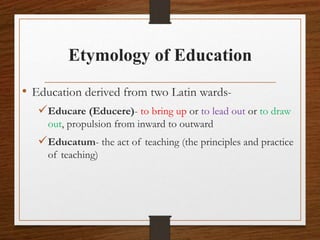
Etymology of Education
• Education derived from two Latin wards-
Educare (Educere)- to bring up or to lead out or to draw
out, propulsion from inward to outward
Educatum- the act of teaching (the principles and practice
of teaching)
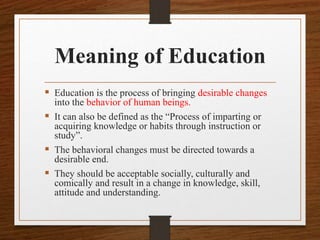
Meaning of Education
 Education is the process of bringing desirable changes
into the behavior of human beings.
 It can also be defined as the “Process of imparting or
acquiring knowledge or habits through instruction or
study”.
 The behavioral changes must be directed towards a
desirable end.
 They should be acceptable socially, culturally and
comically and result in a change in knowledge, skill,
attitude and understanding.
Great educators say-
• Education is the manifestation of perfection already in man.
Like fire in a piece of flint, knowledge exists in the mind.
Suggestion is the friction; which brings it out.
- Swami Vivekananda
• Education develops in the body and soul of the pupil all the
beauty and all the perfection he is capable of. -Plato
• Education is the creation of sound mind in a sound body. It
develops man’s faculty specially his mind so that he may be able
to enjoy the contemplation of supreme truth, goodness and
beauty.
-Aristotle
• The highest education is that which does not merely give us
information but makes our life in harmony with all existence.
-Rabindranath Tagore
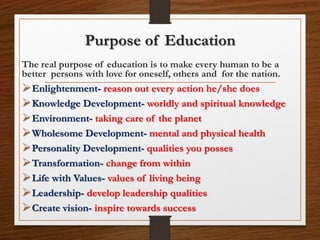
Purpose of Education
The real purpose of education is to make every human to be a
better persons with love for oneself, others and for the nation.
Enlightenment- reason out every action he/she does
Knowledge Development- worldly and spiritual knowledge
Environment- taking care of the planet
Wholesome Development- mental and physical health
Personality Development- qualities you posses
Transformation- change from within
Life with Values- values of living being
Leadership- develop leadership qualities
Create vision- inspire towards success
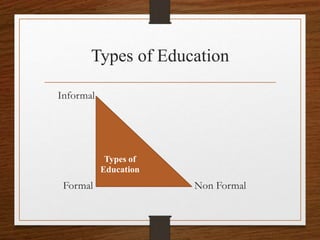
Types of Education
Informal
Formal Non Formal
Types of
Education
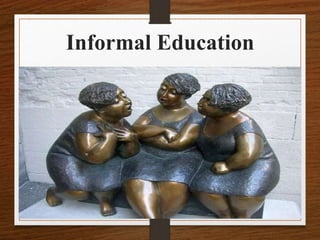
Informal Education
Informal Education
Life long process
Individual learns from daily
experiences
Individual learns from exposure to the
environment at home, at work, at play,
etc.
E.g. from parents, friends, neighbors, etc.
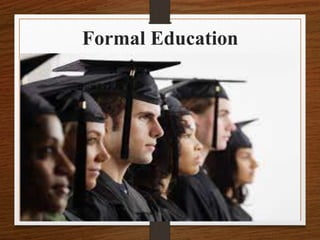
Formal Education
Formal Education
 Institutional activity
 Chronologically graded structure
 Uniform
 Subject oriented
 Full time
 Leads to certificates, diplomas, degrees
E.g. University education
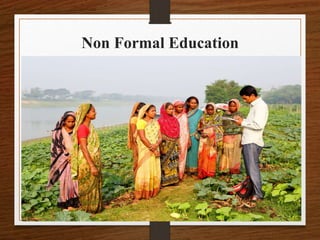
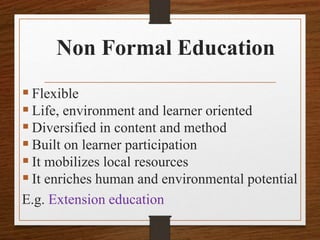
Non Formal Education
 Flexible
 Life, environment and learner oriented
 Diversified in content and method
 Built on learner participation
 It mobilizes local resources
 It enriches human and environmental potential
E.g. Extension education
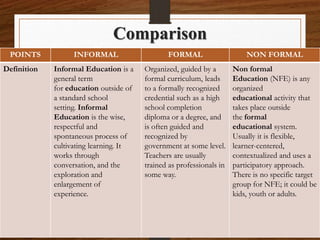
Comparison
POINTS INFORMAL FORMAL NON FORMAL
Definition Informal Education is a
general term
for education outside of
a standard school
setting. Informal
Education is the wise,
respectful and
spontaneous process of
cultivating learning. It
works through
conversation, and the
exploration and
enlargement of
experience.
Organized, guided by a
formal curriculum, leads
to a formally recognized
credential such as a high
school completion
diploma or a degree, and
is often guided and
recognized by
government at some level.
Teachers are usually
trained as professionals in
some way.
Non formal
Education (NFE) is any
organized
educational activity that
takes place outside
the formal
educational system.
Usually it is flexible,
learner-centered,
contextualized and uses a
participatory approach.
There is no specific target
group for NFE; it could be
kids, youth or adults.
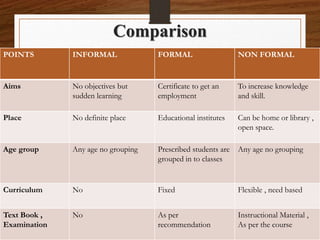
Comparison
POINTS INFORMAL FORMAL NON FORMAL
Aims No objectives but
sudden learning
Certificate to get an
employment
To increase knowledge
and skill.
Place No definite place Educational institutes Can be home or library ,
open space.
Age group Any age no grouping Prescribed students are
grouped in to classes
Any age no grouping
Curriculum No Fixed Flexible , need based
Text Book ,
Examination
No As per
recommendation
Instructional Material ,
As per the course
References
• https://en.wikipedia.org/wiki/Education
• http://agriinfo.in/?page=topic&superid=7&topicid=524
• http://www.bibl.uszeged.hu/oseas/lithedu.html
• http://www.merinews.com/article/different-forms-of-education/15784144.shtml
• http://www.studiesinaustralia.com/types-of-education
• http://www.hualonginfo.com/Blog/JohnVu/2010/May/20100519-01.en.htm l
• http://lifestyle.iloveindia.com/lounge/types-of-education-10749.htm l
• https://www.google.co.in/search?q=types+of+education&es_sm=93&biw=1137&bi
h=752&tbm=isch&tbo=u&source=univ&sa=X&sqi=2&ved=0CC8QsARqFQoTC
KDwuMDcxsgCFUQajgodRrUMpw&dpr=0.9#tbm=isch&q=informal+education+
examples
Don’t Limit a Child to Your Own
Learning, for He Was Born in
Another Time.
- RABINDRANATH TAGORE
Thank You

Education and Its Types.pptx

  • 1.
  • 3.
    Etymology of Education •Education derived from two Latin wards- Educare (Educere)- to bring up or to lead out or to draw out, propulsion from inward to outward Educatum- the act of teaching (the principles and practice of teaching)
  • 4.
    Meaning of Education Education is the process of bringing desirable changes into the behavior of human beings.  It can also be defined as the “Process of imparting or acquiring knowledge or habits through instruction or study”.  The behavioral changes must be directed towards a desirable end.  They should be acceptable socially, culturally and comically and result in a change in knowledge, skill, attitude and understanding.
  • 5.
    Great educators say- •Education is the manifestation of perfection already in man. Like fire in a piece of flint, knowledge exists in the mind. Suggestion is the friction; which brings it out. - Swami Vivekananda • Education develops in the body and soul of the pupil all the beauty and all the perfection he is capable of. -Plato • Education is the creation of sound mind in a sound body. It develops man’s faculty specially his mind so that he may be able to enjoy the contemplation of supreme truth, goodness and beauty. -Aristotle • The highest education is that which does not merely give us information but makes our life in harmony with all existence. -Rabindranath Tagore
  • 7.
    Purpose of Education Thereal purpose of education is to make every human to be a better persons with love for oneself, others and for the nation. Enlightenment- reason out every action he/she does Knowledge Development- worldly and spiritual knowledge Environment- taking care of the planet Wholesome Development- mental and physical health Personality Development- qualities you posses Transformation- change from within Life with Values- values of living being Leadership- develop leadership qualities Create vision- inspire towards success
  • 8.
    Types of Education Informal FormalNon Formal Types of Education
  • 9.
  • 10.
    Informal Education Life longprocess Individual learns from daily experiences Individual learns from exposure to the environment at home, at work, at play, etc. E.g. from parents, friends, neighbors, etc.
  • 11.
  • 12.
    Formal Education  Institutionalactivity  Chronologically graded structure  Uniform  Subject oriented  Full time  Leads to certificates, diplomas, degrees E.g. University education
  • 14.
  • 15.
    Non Formal Education Flexible  Life, environment and learner oriented  Diversified in content and method  Built on learner participation  It mobilizes local resources  It enriches human and environmental potential E.g. Extension education
  • 16.
    Comparison POINTS INFORMAL FORMALNON FORMAL Definition Informal Education is a general term for education outside of a standard school setting. Informal Education is the wise, respectful and spontaneous process of cultivating learning. It works through conversation, and the exploration and enlargement of experience. Organized, guided by a formal curriculum, leads to a formally recognized credential such as a high school completion diploma or a degree, and is often guided and recognized by government at some level. Teachers are usually trained as professionals in some way. Non formal Education (NFE) is any organized educational activity that takes place outside the formal educational system. Usually it is flexible, learner-centered, contextualized and uses a participatory approach. There is no specific target group for NFE; it could be kids, youth or adults.
  • 17.
    Comparison POINTS INFORMAL FORMALNON FORMAL Aims No objectives but sudden learning Certificate to get an employment To increase knowledge and skill. Place No definite place Educational institutes Can be home or library , open space. Age group Any age no grouping Prescribed students are grouped in to classes Any age no grouping Curriculum No Fixed Flexible , need based Text Book , Examination No As per recommendation Instructional Material , As per the course
  • 19.
    References • https://en.wikipedia.org/wiki/Education • http://agriinfo.in/?page=topic&superid=7&topicid=524 •http://www.bibl.uszeged.hu/oseas/lithedu.html • http://www.merinews.com/article/different-forms-of-education/15784144.shtml • http://www.studiesinaustralia.com/types-of-education • http://www.hualonginfo.com/Blog/JohnVu/2010/May/20100519-01.en.htm l • http://lifestyle.iloveindia.com/lounge/types-of-education-10749.htm l • https://www.google.co.in/search?q=types+of+education&es_sm=93&biw=1137&bi h=752&tbm=isch&tbo=u&source=univ&sa=X&sqi=2&ved=0CC8QsARqFQoTC KDwuMDcxsgCFUQajgodRrUMpw&dpr=0.9#tbm=isch&q=informal+education+ examples
  • 20.
    Don’t Limit aChild to Your Own Learning, for He Was Born in Another Time. - RABINDRANATH TAGORE Thank You