MASTER OF EDUCATION OF STRATEGIC 
MANAGEMENT AND LEADERSHIP (ED705) 
EDU 701- EDUCATION AND HUMAN DEVELOPMENT 
COUNSELLING, MENTORING AND COACHING IN 
HIGHER EDUCATION 
Presenter: Nour Amera Binti Md Nordin 
Student ID: 2014285724 
Date: Tuesday, 2 December 2014 
Lecturer Name: Dr Nabilah Binti Abdullah (PhD)
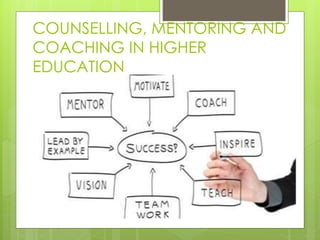
COUNSELLING, MENTORING AND 
COACHING IN HIGHER 
EDUCATION
COUNSELLING 
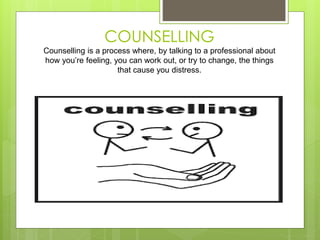
Counselling is a process where, by talking to a professional about 
how you’re feeling, you can work out, or try to change, the things 
that cause you distress.
COUNSELLING 
 A good counsellor will work with you to find a solution 
to your problem, even if that solution just means 
accepting that a particular situation cannot be 
changed, and helping you to cope with this. 
 Every counsellor is a bit different and will have their 
own approach. Some will do more talking or ask more 
questions, and some will want to just let you talk. 
Finding someone you’re happy to talk to is really 
important. 
 The term ‘counselling’ includes work with individuals 
and with relationships which may be developmental, 
crisis support, psychotherapeutic, guiding or problem 
solving The task of counselling is to give the ‘client’ an 
opportunity to explore, discover and clarify ways of 
living more satisfyingly and resourcefully.(BAC 1984)
COUNSELLING 
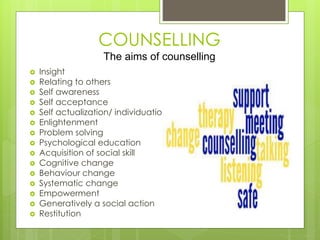
The aims of counselling 
 Insight 
 Relating to others 
 Self awareness 
 Self acceptance 
 Self actualization/ individuation 
 Enlightenment 
 Problem solving 
 Psychological education 
 Acquisition of social skill 
 Cognitive change 
 Behaviour change 
 Systematic change 
 Empowerment 
 Generatively a social action 
 Restitution
COUNSELLING 
Student Services/Special Education: School Guidance 
and Counselling 
 The guidance and counselling of students 
is an integral component of the 
educational mission of the school. 
Guidance and counselling services and 
programs promote the personal/social, 
educational, and career development of 
all students.
COUNSELLING 
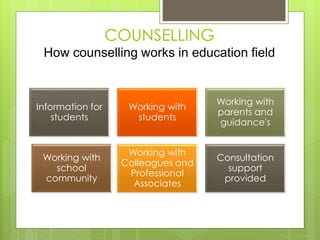
How counselling works in education field 
Information for 
students 
Working with 
students 
Working with 
parents and 
guidance's 
Working with 
school 
community 
Working with 
Colleagues and 
Professional 
Associates 
Consultation 
support 
provided
MENTORING 
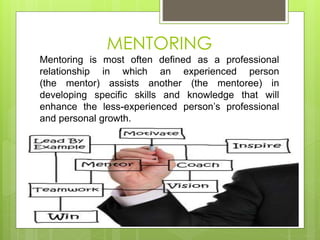
Mentoring is most often defined as a professional 
relationship in which an experienced person 
(the mentor) assists another (the mentoree) in 
developing specific skills and knowledge that will 
enhance the less-experienced person’s professional 
and personal growth.
MENTORING 
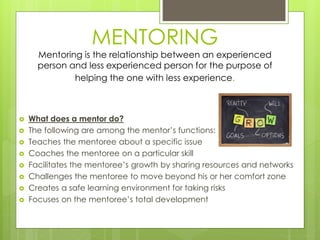
Mentoring is the relationship between an experienced 
person and less experienced person for the purpose of 
helping the one with less experience. 
 What does a mentor do? 
 The following are among the mentor’s functions: 
 Teaches the mentoree about a specific issue 
 Coaches the mentoree on a particular skill 
 Facilitates the mentoree’s growth by sharing resources and networks 
 Challenges the mentoree to move beyond his or her comfort zone 
 Creates a safe learning environment for taking risks 
 Focuses on the mentoree’s total development
MENTORING 
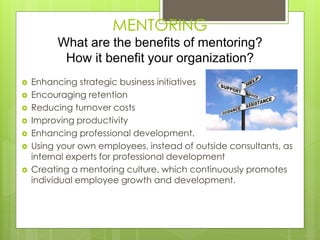
What are the benefits of mentoring? 
How it benefit your organization? 
 Enhancing strategic business initiatives 
 Encouraging retention 
 Reducing turnover costs 
 Improving productivity 
 Enhancing professional development. 
 Using your own employees, instead of outside consultants, as 
internal experts for professional development 
 Creating a mentoring culture, which continuously promotes 
individual employee growth and development.
Mentors enjoy many benefits, 
including: 
 Gains insights from the mentoree’s background 
and history that can be used in the mentor’s 
professional and personal development. 
 Gains satisfaction in sharing expertise with 
others. 
 Re-energizes the mentor’s career. 
 Gains an ally in promoting the organization’s 
well-being. 
 Learns more about other areas within the 
organization.
Mentorees enjoy many 
benefits, including: 
 Gains from the mentor’s expertise 
 Receives critical feedback in key areas, such as 
communications, interpersonal relationships, technical 
abilities, change management and leadership skills 
 Develops a sharper focus on what is needed to grow 
professionally within the organization 
 Learns specific skills and knowledge that are relevant to 
personal goals 
 Networks with a more influential employee 
 Gains knowledge about the organization’s culture and 
unspoken rules that can be critical for success; as a result, 
adapts more quickly to the organization’s culture 
 Has a friendly ear with which to share frustrations as well 
as successes.
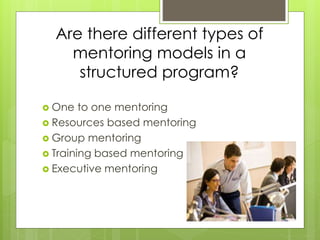
Are there different types of 
mentoring models in a 
structured program? 
 One to one mentoring 
 Resources based mentoring 
 Group mentoring 
 Training based mentoring 
 Executive mentoring
COACHING 
 Coaching – Coaching is the training or development or 
development processes via which an individual is 
supported while achieving a specific personal or 
professional competence result or goal.
COACHING 
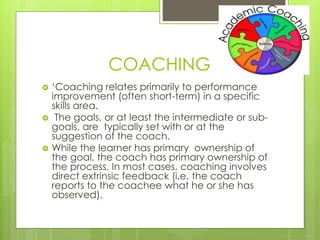
 ‘Coaching relates primarily to performance 
improvement (often short-term) in a specific 
skills area. 
 The goals, or at least the intermediate or sub-goals, 
are typically set with or at the 
suggestion of the coach. 
 While the learner has primary ownership of 
the goal, the coach has primary ownership of 
the process. In most cases, coaching involves 
direct extrinsic feedback (i.e. the coach 
reports to the coachee what he or she has 
observed).
COACHING 
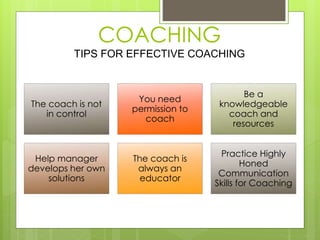
TIPS FOR EFFECTIVE COACHING 
The coach is not 
in control 
You need 
permission to 
coach 
Be a 
knowledgeable 
coach and 
resources 
Help manager 
develops her own 
solutions 
The coach is 
always an 
educator 
Practice Highly 
Honed 
Communication 
Skills for Coaching
COMPARISON BETWEEN 
COUNSELLING, MENTORING AND 
COACHING
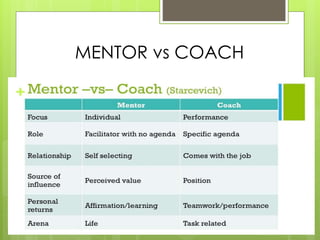
MENTOR vs COACH
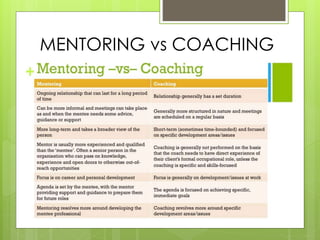
MENTORING vs COACHING
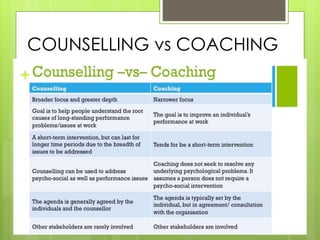
COUNSELLING vs COACHING

EDUCATION AND HUMAN DEVLOPMENT

  • 1.
    MASTER OF EDUCATIONOF STRATEGIC MANAGEMENT AND LEADERSHIP (ED705) EDU 701- EDUCATION AND HUMAN DEVELOPMENT COUNSELLING, MENTORING AND COACHING IN HIGHER EDUCATION Presenter: Nour Amera Binti Md Nordin Student ID: 2014285724 Date: Tuesday, 2 December 2014 Lecturer Name: Dr Nabilah Binti Abdullah (PhD)
  • 2.
    COUNSELLING, MENTORING AND COACHING IN HIGHER EDUCATION
  • 3.
    COUNSELLING Counselling isa process where, by talking to a professional about how you’re feeling, you can work out, or try to change, the things that cause you distress.
  • 4.
    COUNSELLING  Agood counsellor will work with you to find a solution to your problem, even if that solution just means accepting that a particular situation cannot be changed, and helping you to cope with this.  Every counsellor is a bit different and will have their own approach. Some will do more talking or ask more questions, and some will want to just let you talk. Finding someone you’re happy to talk to is really important.  The term ‘counselling’ includes work with individuals and with relationships which may be developmental, crisis support, psychotherapeutic, guiding or problem solving The task of counselling is to give the ‘client’ an opportunity to explore, discover and clarify ways of living more satisfyingly and resourcefully.(BAC 1984)
  • 5.
    COUNSELLING The aimsof counselling  Insight  Relating to others  Self awareness  Self acceptance  Self actualization/ individuation  Enlightenment  Problem solving  Psychological education  Acquisition of social skill  Cognitive change  Behaviour change  Systematic change  Empowerment  Generatively a social action  Restitution
  • 6.
    COUNSELLING Student Services/SpecialEducation: School Guidance and Counselling  The guidance and counselling of students is an integral component of the educational mission of the school. Guidance and counselling services and programs promote the personal/social, educational, and career development of all students.
  • 7.
    COUNSELLING How counsellingworks in education field Information for students Working with students Working with parents and guidance's Working with school community Working with Colleagues and Professional Associates Consultation support provided
  • 8.
    MENTORING Mentoring ismost often defined as a professional relationship in which an experienced person (the mentor) assists another (the mentoree) in developing specific skills and knowledge that will enhance the less-experienced person’s professional and personal growth.
  • 9.
    MENTORING Mentoring isthe relationship between an experienced person and less experienced person for the purpose of helping the one with less experience.  What does a mentor do?  The following are among the mentor’s functions:  Teaches the mentoree about a specific issue  Coaches the mentoree on a particular skill  Facilitates the mentoree’s growth by sharing resources and networks  Challenges the mentoree to move beyond his or her comfort zone  Creates a safe learning environment for taking risks  Focuses on the mentoree’s total development
  • 10.
    MENTORING What arethe benefits of mentoring? How it benefit your organization?  Enhancing strategic business initiatives  Encouraging retention  Reducing turnover costs  Improving productivity  Enhancing professional development.  Using your own employees, instead of outside consultants, as internal experts for professional development  Creating a mentoring culture, which continuously promotes individual employee growth and development.
  • 11.
    Mentors enjoy manybenefits, including:  Gains insights from the mentoree’s background and history that can be used in the mentor’s professional and personal development.  Gains satisfaction in sharing expertise with others.  Re-energizes the mentor’s career.  Gains an ally in promoting the organization’s well-being.  Learns more about other areas within the organization.
  • 12.
    Mentorees enjoy many benefits, including:  Gains from the mentor’s expertise  Receives critical feedback in key areas, such as communications, interpersonal relationships, technical abilities, change management and leadership skills  Develops a sharper focus on what is needed to grow professionally within the organization  Learns specific skills and knowledge that are relevant to personal goals  Networks with a more influential employee  Gains knowledge about the organization’s culture and unspoken rules that can be critical for success; as a result, adapts more quickly to the organization’s culture  Has a friendly ear with which to share frustrations as well as successes.
  • 13.
    Are there differenttypes of mentoring models in a structured program?  One to one mentoring  Resources based mentoring  Group mentoring  Training based mentoring  Executive mentoring
  • 14.
    COACHING  Coaching– Coaching is the training or development or development processes via which an individual is supported while achieving a specific personal or professional competence result or goal.
  • 15.
    COACHING  ‘Coachingrelates primarily to performance improvement (often short-term) in a specific skills area.  The goals, or at least the intermediate or sub-goals, are typically set with or at the suggestion of the coach.  While the learner has primary ownership of the goal, the coach has primary ownership of the process. In most cases, coaching involves direct extrinsic feedback (i.e. the coach reports to the coachee what he or she has observed).
  • 16.
    COACHING TIPS FOREFFECTIVE COACHING The coach is not in control You need permission to coach Be a knowledgeable coach and resources Help manager develops her own solutions The coach is always an educator Practice Highly Honed Communication Skills for Coaching
  • 17.
    COMPARISON BETWEEN COUNSELLING,MENTORING AND COACHING
  • 18.
  • 19.
  • 20.