Name:
Course and
Year Level
Gmail
Account
Republic of the Philippines
Bangsamoro Autonomous Region in Muslim Mindanao
GANI L. ABPI COLLEGE, INCORPORATED
Formerly Central Maguindanao Institute
Buayan, Datu Piang Maguindanao, 9607
(Professional Education)
LEARNING MODULE ON
EDUC 4
ASSESSMENT OF
LEARNING 1
Bai Sittie Norhannie S. Abpi, LPT
Instructor
This Learning Module belongs to:
C o l l e g e o f E d u c a t i o n
Page 2
EDUC 4: Assessment of Learning 1 First Semester
About this Module….
This module presents the assessment of student learning, its concepts and
components. This contains also the testing principles and its preparation, the
instructional /classroom development, and the development of Learning Target.
Educ 4: Assessment of Learning is one of the professional Education, and we
can say that this is one of the most essential and important part of teaching.
Assessment of learning is one of the obligations of teachers on the students.
This module will help the future teachers and educators in teaching
strategies, methods, understand processes of learning, and interrelationship of
instructional goals and assessment.
Assessing student learning is the monitoring of learning progress of the
students, which is crucial to the education of the students.
Enjoy the path of Teaching!
- Yannie Abpi
References:
This Learning Module contains information that belongs to their rightful
owners:
 Assessment of Student Learning 1 (Cognitive Learning) Copyright © 2010 by
C & E Publiching, Inc.
Authors: Arnulfo Aaron R. Reganit, Ed.D.
Ronaldo SP. Elicay, Ph.D.
Cresencia C. Laguerta, M.S.
 Assessment of Student Learning 1 Copyright © 2010 by REX BOOKSTORE
Author: Flordeliza C. Buendicho, Ph.D.
EDUC 4: Assessment of Learning 1 First Semester
C o l l e g e o f E d u c a t i o n Page 3
Nature and Purposes of Assessment
Objectives:
1. Discuss the importance of assessment in Classroom instruction
2. Differentiate test, measurement and assessment from evaluation
3. Enumerate the sound principles of assessment in Education
4. Cite examples of norm and criterion – referenced evaluation
Introduction
Assessment of Learning refers to strategies designed to confirm what students know, determine
whether they have met the curriculum outcomes or the goals of their individualized programs, or to
certify proficiency and make decisions about students’ future programs or placements. It is designed to
provide evidence of achievement to parents, other educators, the students themselves and sometimes to
outside groups (e.g. employers, other educational institutions).
In the most general sense, assessment is the process of making a judgment or measurement of
worth of an entity (e.g., person, process or program). Educational Assessment involves gathering and
evaluating data evolving from planned learning activities or programs. This form of assessment is often
referred to as evaluation.
Learner Assessment represents a particular type of educational Assessment normally conducted
by teachers ad designed to serve several related purposes (Phye, 2004) these purposes include:
Motivating and directing learning, providing feedback to student on their performance, providing
feedback on instruction and /or the curriculum and Ensuring that standards of progression are met.
Learner Assessment is best conceived as a form of two-way communication in which feedback on
the educational process or product is provided to its key stakeholders (Cronbach, 1988). Specifically,
learner assessment involves communication to:
1. Teachers - Feedback to Teaching
2. Students – Feedback to Learning
3. Curriculum Designers – Feedback on Curriculum
4. Administrators – Feedback on use of resources
Classroom Assessment can help teachers answer the following specific questions:
1. To what extent are my students achieving the stated goals?
2. How should I allocate class time for the current topic?
3. Can I teach this topic n a more efficient or effective way?
4. What parts of this course/unit are my students finding most valuable?
5. How will I change this course/unit the next time I teach it?
6. Which grades do I assign my students?
The aim of assessment is to improve and develop student learning not just to find out how good
C o l l e g e o f E d u c a t i o n
Page 4
EDUC 4: Assessment of Learning 1 First Semester
students are at some kinds of examination. Assessment system should be convenient for all students and
should contribute to the development and improvement of all the students’ potentials toward a higher
level of learning.
(Assessment of Learning 1; Flordeliza C. Buendicho, Ph.D., Rex Bookstore; Page 1: Copyright 2010)
Definition of Terms
In the field of Testing, the terms test, measurement, assessment and evaluation are often used
interchangeably. Identifying the nuances in their meaning may aid test developers and test users to
design and construct effective tests and use the results appropriately.
Test – a set of items or questions measuring a sample behavior or tasks from a specific domain of
knowledge or skills;
 It is designed to be presented to one or more examinees under specific conditions, with
definite boundaries and limits (UP Open University)
 Consists of questions, exercises or other devices to measure the outcomes of learning.
Measurement – establishes the characteristics of individuals through the assignment of numerals
according to rules that give these numerals quantitative meaning (ASEAN Seminar-Workshop on
Test Items Writing/Construction and Development 1998)
 A process of obtaining a numerical description of the degree to which an individual possesses
a particular characteristic
Assessment – any of the variety of procedures used to obtain information about student performance
(Linn & Gronlund, 2000).
 Systematic, continuous process of monitoring the various pieces of learning to evaluate the
student achievement and instructional effectiveness (Hewitt-Gervais & Baylen, 1998).
 Answers the questions: “How much of a given skill does a student possesses BEFORE, DURING
and AFTER instruction?” and “How much changed has occurred?”
Evaluation – involves a broader process that includes examining several components f a whole and making
instructional decisions (Gredler, 1996)
 The process of delineating, obtaining and providing useful information for judging decision
alternatives (Popham, 1993)
 The process of summing up the results of measurements or tests and giving them some
meaning based on value judgments (Hopkins & Stanley, 1981)
 A holistic way of looking at the effectiveness of the learning process by considering both the
learner and the learning product and applying quantitative and qualitative judgments.
EDUC 4: Assessment of Learning 1 First Semester
C o l l e g e o f E d u c a t i o n Page 5
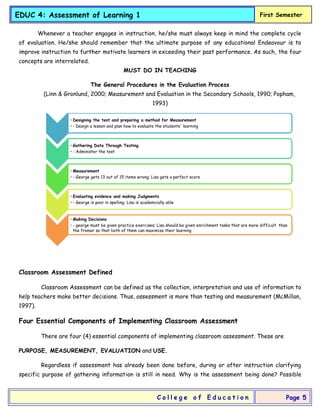
Whenever a teacher engages in instruction, he/she must always keep in mind the complete cycle
of evaluation. He/she should remember that the ultimate purpose of any educational Endeavour is to
improve instruction to further motivate learners in exceeding their past performance. As such, the four
concepts are interrelated.
MUST DO IN TEACHING
The General Procedures in the Evaluation Process
(Linn & Gronlund, 2000; Measurement and Evaluation in the Secondary Schools, 1990; Popham,
1993)
Classroom Assessment Defined
Classroom Assessment can be defined as the collection, interpretation and use of information to
help teachers make better decisions. Thus, assessment is more than testing and measurement (McMillan,
1997).
Four Essential Components of Implementing Classroom Assessment
There are four (4) essential components of implementing classroom assessment. These are
PURPOSE, MEASUREMENT, EVALUATION and USE.
Regardless if assessment has already been done before, during or after instruction clarifying
specific purpose of gathering information is still in need. Why is the assessment being done? Possible
• Designing the test and preparing a method for Measurement
• - Design a lesson and plan how to evaluate the students' learning
• Gathering Data Through Testing
• - Administer the test
• Measurement
• - George gets 13 out of 15 items wrong; Lisa gets a perfect score
• Evaluating evidence and making Judgments
• - George is poor in spelling; Lisa is academically able
• Making Decisions
• - george must be given practice exercises; Lisa should be given enrichment tasks that are more difficult than
the fromer so that both of them can maximize their learning
C o l l e g e o f E d u c a t i o n
Page 6
EDUC 4: Assessment of Learning 1 First Semester
reasons of doing assessment are:
1. To monitor student learning – measure what students have and have not learned and grade them
2. To provide feedback of students’ performance; and
3. To motivate the students by giving them positive reinforcement.
Measurement as define is a systematic process of obtaining a numerical description of the
degree to which an individual possesses a particular characteristic. Also, measurement is the process by
which attributes, traits, behavior, or characteristics are determined and differentiated.
A variety of techniques such as tests, ratings, observations and interviews can be used to
measure a defined trait or learning target.
After gathering information through varied techniques, value judgment on said information
needs to be given. This process is called evaluation. Evaluation involves the interpretation of what has
been gathered through measurement, in which value judgments are made regarding performance.
The final stage of implementing assessment is the use of evaluation. The use of test scores and
other information is closely tied to the decisions one must take to provide effective instructions, and to
the needs of the students and parents.
PURPOSES AND FUNCTIONS OF ASSESSEMENT
There are four purposes of assessment according to Wyatt (1988). These are:
 To inform the teacher about the student’s progress;
 To inform the students about their progress;
 To inform other about the students’ progress (parents and future teachers); and
 To provide information for the public.
These purposes can be summed up into three: ASSESSMENT FOR LEARNING, ASSESSMENT
OF LEARNING and ASSESSMENT AS LEARNING (Earl, 2005).
In Assessment for Learning, Teacher’s use the student’s prior knowledge as a starting point of
instruction. The results of assessments are communicated clearly and immediately to the students to
determine effective ways to teach.
In Assessment of Learning or Summative Assessment is done after the instruction. It is used to
identify what students know ad can do and the level of their proficiency of competency. Its results
reveal whether or not instructions have successfully achieved the desired curriculum outcome. The
information from assessment of learning is usually expressed as grades and is made known to the
students, parents and other stakeholders for better decision making.
EDUC 4: Assessment of Learning 1 First Semester
C o l l e g e o f E d u c a t i o n Page 7
In Assessment for Learning, is done for teachers to understand and perform well their role of
assessing for and of learning. It requires teachers to undergo training on how to assess learning and be
equipped with the competencies needed in performing their work as assessors. To assess for and of
learning, teachers should have the needed skills in assessment. This could be made possible through the
different forms of capacity building.
The purposes of assessment lead to the development and improvement and accountability and
confidence. In this context of assessment and accountability, Eisner (1993) listed 5 functions of
assessment.
1. Temperature-taking function. Describes the educational health of the country rather than
individual students or systems.
2. Gate-keeping function. Directs students along certain paths of learning based in the view that
the school has a social selection function.
3. Feedback-to-Teachers function. Provides information to teachers about the quality of their
work.
4. Appraisal-of-program function. Provides an indication of the quality of the program.
Beyond the relationship of assessment and accountability, assessment serves valuable functions for
students in the classroom.
 It concentrates attention on the specific aspects of a subject.
 It provides necessary feedback.
 It redirects attention to particular areas to increase mastery.
 It necessitates the consolidation of learning/practice of skills.
 It facilitates the student’s self-assessment of his/her progress.
Importance of Assessment
Assessment serves specific purposes. The results of assessment are generally used to:
1. Provide essential guides for planning, implementing and improving instructional programs and
techniques;
2. Monitor student progress;
3. Promote learning by providing positive information like knowledge of results, knowledge of tasks
well-done, good grades and praises;
4. Measure the outcomes of instruction; and
5. Provide the parents with information on how well their children are doing in school.
C o l l e g e o f E d u c a t i o n
Page 8
EDUC 4: Assessment of Learning 1 First Semester
Scope of Assessment
The chief purpose of assessment is the improvement of the student. Specifically, it assesses
the learning outcomes of instruction which are:
1. Cognitive behaviors (knowledge and information gained, intellectual abilities)
2. Affective behaviors (attitudes, interests, appreciation and values) and
3. Psychomotor behaviors (perceptual and motor skills and abilities in performing tasks)
Principles of Assessment
Assessment is an integrated process for determining the nature and extent of student learning
and development. This process will be most effective when the following principles are taken into
consideration (Gronlund, 1995):
1. Specifying clearly what is to be assessed is prioritized in an assessment. The effectiveness
of an assessment depends as much on a careful description of what needs to be assessed as it
does on the technical qualities of the assessment procedure that was used. Thus, the
specification of the characteristics to be measured should precede the selection or development
of assessment procedures.
2. An assessment procedure should be selected because of its relevance to the characteristics
or performance to be measured. Assessment procedures are frequently selected on the basis of
their objectivity, accuracy or convenience. These criteria are important; however, they are only
secondary to the major question asked before the assessment, which is whether the chosen
procedure is the most effective method of measuring the learning or development that needs to
be assessed.
3. A comprehensive assessment of student achievement land development requires a variety of
procedures. No single type of instrument or procedure can assess the vast array of learning and
development outcomes emphasized in a school program.
4. Proper use of assessment procedures requires an awareness of their limitations for them to
be used more effectively. No test or assessment is composed of purely of questions or problems
that might be presented in a comprehensive coverage of the knowledge, skills and understanding
relevant to the objectives of a course. On the other hand, limitations of assessment procedures
do not negate the value of tests and other types of assessments.
5. Assessment is a means to an end, not an end itself. The use of assessment procedures implies
that some useful purpose is being served that the user is clearly aware of this purpose.
Assessment is best viewed as a process of obtaining information on which to base educational
decisions.
Numerous Principles for Effective Assessment have been suggested by the NEW SOUTH WALES
(NSW) Board of Studies 1996; NSW Department of School Education, 1996; Brady, 1995; Eisner, 1993;
EDUC 4: Assessment of Learning 1 First Semester
C o l l e g e o f E d u c a t i o n Page 9
Broadfooh, 1991; and Griffin and Nix, 1991. The following is a selection of those principles considered by
the authors to have the most value:
1. Assessment should be a continuous and an integral part of teaching and learning.
 Continuous assessment is necessary to provide regular feedback t the students. This information
can also be used to modify the purpose of teaching.
2. Assessments should be varied to give students multiple opportunities to demonstrate what
they know.
 The strategies should be diverse as the scope of outcomes, and provisions should be made to
assess more than a solo performance.
3. Assessment should be valid.
 They should accurately assess what they are designed to assess. Problems of invalidity usually
arise when assessment is based on imprecise statement of educational intent.
4. Assessment should engage the learner.
 An effective assessment involves a democratic relationship between the teacher and the student.
It should enhance the students’ abilities of being self-critical and taking responsibility for their
own learning.
5. Assessment should be diagnostic.
 The strategies used t assess students should indicate not only the result but also the processes
that resulted in an acceptable performance. Thus, the assessment should show the students’
needs, strengths, and weaknesses.
6. Assessments should value teacher judgment.
 Teacher judgment based on well-defined outcomes and classroom experiences is a rich form of
student assessment that should not be considered secondary to formal testing.
7. Assessments should be situated.
 The strategies used to assess students should be reflections of what they might encounter in the
outside world.
8. Assessment should require students to display sensitivity to the “wholes” rather than
discrete elements.
 Methods of assessment should allow the students to see the larger picture rather than a series
of small, finite steps.
9. Assessment should have the same meaning for all teachers, parents, and students.
 Teachers need to compare their interpretation of student performance, and the assessment
information should be communicated in such a way that it is understood by all stakeholders.
Principles for Effective Classroom Assessment (Reganit, Reyes and Marquez, 2004)
1. Assessment must be based on a previously accepted set of objectives. Assessment takes place
only in relation to the objectives that have been previously set up.
2. Assessment should be a continuous, cumulative process and must be operative throughout the
C o l l e g e o f E d u c a t i o n
Page 10
EDUC 4: Assessment of Learning 1 First Semester
entire teaching and learning process.
3. Assessment must recognize that the total individual personality is involved in learning.
4. The assessment process should encourage and give opportunity to the student to become
increasingly independent in self-appraisal and self-direction.
5. Assessment must be done cooperatively.
6. Assessment is positive in nature and promotes action. It includes planning for improvement and
overcoming weaknesses.
7. Assessment is governed by true democratic principles.
8. Assessment should include all significant evidences from every possible source.
9. A comprehensive record of the evidences gathered in the process of assessment is necessary to
ensure an intelligent interpretation of the data.
10. Assessment should take into consideration the nature of the opportunities and limitations of the
educational experiences provided by the school.
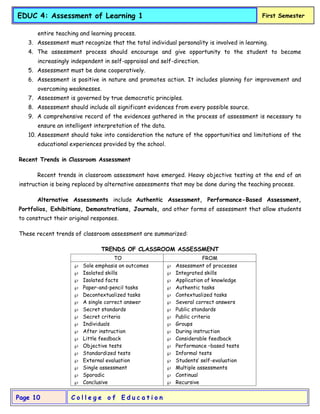
Recent Trends in Classroom Assessment
Recent trends in classroom assessment have emerged. Heavy objective testing at the end of an
instruction is being replaced by alternative assessments that may be done during the teaching process.
Alternative Assessments include Authentic Assessment, Performance-Based Assessment,
Portfolios, Exhibitions, Demonstrations, Journals, and other forms of assessment that allow students
to construct their original responses.
These recent trends of classroom assessment are summarized:
TRENDS OF CLASSROOM ASSESSMENT
TO FROM
 Sole emphasis on outcomes
 Isolated skills
 Isolated facts
 Paper-and-pencil tasks
 Decontextualized tasks
 A single correct answer
 Secret standards
 Secret criteria
 Individuals
 After instruction
 Little feedback
 Objective tests
 Standardized tests
 External evaluation
 Single assessment
 Sporadic
 Conclusive
 Assessment of processes
 Integrated skills
 Application of knowledge
 Authentic tasks
 Contextualized tasks
 Several correct answers
 Public standards
 Public criteria
 Groups
 During instruction
 Considerable feedback
 Performance –based tests
 Informal tests
 Students’ self-evaluation
 Multiple assessments
 Continual
 Recursive
EDUC 4: Assessment of Learning 1 First Semester
C o l l e g e o f E d u c a t i o n Page 11
Non-Testing
Non-Testing is an alternative assessment in the sense that it diverts from the paper-and-pen
test. There are two major non-testing techniques: Performance-based Assessment and Portfolio
Assessment.
A Performance-based Assessment is a method to measure skill and product learning targets, as well as
knowledge and reasoning targets. In contrast to paper-and –pen tests, a performance-based assessment
requires students to construct an original response to a task through teacher judgment. Students
provide explanations, and so there is no single correct answer.
Authentic Assessment involves a performance-based task that approximates what students are likely to
do in a real-world setting. It integrates instruction with an evaluation of student achievement and is
based on the constructivist learning theory. Like the performance-based assessment, it is most
frequently used with reasoning, skill, and product learning targets/ the scoring criteria are the basis for
evaluating student performances.
PORTFOLIO
A Portfolio is a purposeful collection of student work that exhibits the student’s efforts,
progress and achievements in one or more areas of the curriculum. The collection must include the
following:
1. Student participation in the selection of contents;
2. Criteria for selection;
3. Criteria for judging merits; and
4. Evidence of a student’s self-reflection
Purposes of Using a Portfolio
1. Encouraging self-directed learning;
2. Giving a comprehensive view of what has been learned;
3. Fostering learning about learning;
4. Demonstrating progress toward identified outcomes;
5. Creating an intersection for instruction and assessment;
6. Providing a way for students to value themselves as learners; and
7. Offering opportunities for peer-supported growth.
Characteristics of an Effective Portfolio (McMillan, 1997)
1. Effective Portfolios are continuous and ongoing, providing both formative and summative
opportunity for monitoring students’ progress toward achieving learning objectives. Quality
portfolios will highlight growth and development overtime. In addition, portfolios should reflect
C o l l e g e o f E d u c a t i o n
Page 12
EDUC 4: Assessment of Learning 1 First Semester
the interactive nature of learning that occurs through feedback and revision.
2. Portfolios should be multidimensional and reflect a wide variety of artifacts. The range of entries
should highlight various learning processes, skills and abilities. Essentially, a good portfolio will
provide a comprehensive profile of the student’s abilities.
3. Reflections are essential part of an effective portfolio. Quality reflections include insight on
individual learning processes, metacognitive introspection, thoughts on problem-solving, decision-
making skills, and observations on intellectual strengths and weaknesses.
4. Portfolios should clearly reflect learning objectives as identified in the course curriculum. In
addition, portfolios should provide a match between instructional activities, student experiences,
and assessment.
5. Effective portfolios provide evidence of performance-based learning experiences as well as
students’ understanding of course-specific knowledge and skills.
6. Portfolios are targeted selection of student work; avoid haphazard collections without purpose,
rationale and justification. The selection process is as important as the quality of the selected
entries.
7. Quality portfolios must contain an element of self-assessment. By reflecting on their own learning
experiences, students can identify their personal strengths and weaknesses. The self-assessment
process can be used as a basis for forming personal improvement goals.
8. Evaluation criteria for selecting and assessing the portfolio contents, as well as the overall
portfolio goal, must be clear to both the instructor and the students prior to the developing of
the portfolio.
9. Portfolios should highlight the depth of the student’s knowledge and skills. In contrast to a
traditional test, portfolios showcase the quality of the work that can be accomplished with
adequate resources, and with adequate resources, and without pressure or time constraints.
10. While portfolios should be structured to ensure they meet the goals and purposes of the
assessment, it is important to allow a degree of freedom for students to express their own
individuality and personal strengths.
(Assessment of Learning 1; Flordeliza C. Buendicho, Ph.D., Rex Bookstore; Page 1: Copyright 2010)
TYPES OF ASSESSMENT PORTFOLIOS
Portfolios can take on many forms depending on the purpose and goal of the assessment. Typically,
portfolios can be divided into three different types:
1. DOCUMENTATION PORTFOLIO. The goal of documentation portfolios (also known as working
portfolios) is to highlight development and improvement over time. Documentation portfolios
showcase the process of learning by including the full progression of project development. Often,
documentation portfolios will contain a range of artifacts from brainstormed lists to rough drafts
to finished products.
EDUC 4: Assessment of Learning 1 First Semester
C o l l e g e o f E d u c a t i o n Page 13
2. PROCESS PORTFOLIO. The purpose of process portfolios is to document all stages of the
learning process. Like documentation portfolios, process portfolios include samples of student
work from throughout the entire educational progression. The difference is that process
portfolios expand on the information in a documentation portfolio by integrating reflections and
higher-order cognitive activities. In addition to showcasing the students’ work, process portfolios
emphasize metacognitive functioning and encourage students to become active participants in
understanding their own learning. As such, process portfolios include documentation of reflection
such as learning logs, journals or documented discussions.
3. PRODUCT PORTFOLIO. The goal of product portfolios (also called Showcase Portfolios) is to
highlight a student’s best work by showcasing the quality and range of student accomplishments.
Typically, product portfolios are utilized as a means of summative assessment to evaluate mastery
of learning objectives. Since the focus is on the final product, there is no reflection on the
learning process, but the students may want to include justification, explaining criteria for
artifact selection.
RELATIONSHIP BETWEEN INSTRUCTION AND ASSESSMENT
ACCORDING TO Gronlund (1998), in preparing for any type of instructional program, the
teacher’s main concern is how to effectively bring about student learning. Hence, there is a need to that
learning outcomes be specified to be achieved by the students.
Instruction is most effective when:
1. Directed toward a clearly defined set of intended learning outcomes.
2. The methods and materials of instruction are congruent with the outcomes to be achieved.
3. The instruction is designed to fit the characteristics and needs of the students.
4. Instructional decisions are based on the information that is meaningful, dependable and relevant.
5. Students are periodically informed concerning their learning progress.
6. Remediation is provided for students not achieving the intended learning.
7. Instructional effectiveness is periodically reviewed and the intended learning outcomes and
instruction are modified as needed.
Assessment is most effective when:
1. Designed to assess a clearly defined set of intended learning outcomes.
2. The nature and function of the assessment are congruent with the outcomes to be tested.
3. The assessments are designed to fit the relevant student characteristics and are fair to
everyone.
4. Assessments provide information that is meaningful, dependable and relevant.
5. Provision is made for giving the students early feedback of assessment results.
6. Specific learning weaknesses are revealed by the assessment results.
C o l l e g e o f E d u c a t i o n
Page 14
EDUC 4: Assessment of Learning 1 First Semester
7. Assessments results provide information useful for evaluating the appropriateness of the
objectives, the methods and the materials of instruction.
ROLES OF ASSESSMENT IN MAKING ISNTRUCTIONAL DECISIONS
Decisions about instruction are only as good as the data upon which they are based. The data
obtained from the assessment of student learning are what drive The Instructional Decision Making
Process. The main concern of the teacher in carrying out his/her teaching tasks is how he/she can most
effectively bring about student learning.
Assessment of student learning requires the use of a number of techniques for measuring
achievement. Assessment is more than a collection of techniques. It is a systematic process that plays a
very significant role in effective teaching and instructional decisions. It begins with the identification of
learning goals and ends with a judgment concerning how well those goals have been attained. (Linn and
Gronlund, 2000).
Tests and other evaluative procedures can be classified in terms of their functional roles in
classroom instruction. One such classification system follows the sequence on which assessment
procedures are likely to be used in the classroom. These categories classify the assessment of the
students’ performance in the following manner:
1. PLACEMENT ASSESSMENT. This is used to determine the students’ entry behavior and
performance at the beginning of the instruction. The goal of placement evaluation is to determine
the position in the instructional sequence and the mode of evaluation that is most beneficial for
each student.
Instructional Placement Decisions refers to what the student knows and where he/she should be in the
instructional sequence – what to teach next.
2. FORMATIVE ASSESSMENT. This category determines the learning progress of the students. It is
the gathering of data during the time a program is being developed for the purpose of guiding the
progress. It is likewise used to monitor the learning progress during instruction, as well as provide
continuous feedback to both the students and the teacher concerning learning success and
failure.
Formative Evaluation Decisions these are information needed in monitoring student’s learning while and
instructional program is underway- how quickly progress being made, whether the instructional
program is effective, and whether the change in instructional program is needed to promote the
student’s learning.
3. DIAGNOSTIC ASSESSMENT. This is used to diagnose the students’ learning difficulties during
instruction. It is concerned with recurring learning difficulties that are left unsolved by the
standard corrective prescriptions of the formative evaluation.
Diagnostic Decisions specifies difficulties which account for student’s inadequate progress so the
teacher can remediate learning progress and design more effective instructional plans.
EDUC 4: Assessment of Learning 1 First Semester
C o l l e g e o f E d u c a t i o n Page 15
4. SUMMATIVE ASSESSMENT. This category is used to determine mastery and achievement at the
end of the course. It is the process of making an overall assessment or decisions about the
program. It is designed to determine the extent to which the instructional objectives have been
achieved and is used primarily for assigning course grades or certifying student mastery of the
intended learning outcome.
Commonly Used Assessment in the Classroom
The two commonly used assessments during instruction are formative and summative assessment.
COMPARISON OF FORMATIVE AND SUMMATIVE ASSESSMENT
Formative Assessment Summative Assessment
 Students are given the opportunity to improve
their performance on the same task
 The outcome of the task can neither be
repeated nor improved
 Students expect feedback on their
performance, enabling them to improve their
performance on the same task
 The final grade is released on the assessment
task
 Although diagnostic in nature, the students’
knowledge of their strengths and weaknesses is
categorized as formative
 Assessment is done at the end of systematic
incremental learning activities that have
formative assessment tasks.
NORM AND CRITERION – REFERENCED INTERPRETATION
The different purposes of assessment also call for different approaches to make the process
comprehensive. In general, there are two approaches useful for instructional purposes:
NORM-REFERENCED ASSESSMENT – Is a type of assessment designed to provide a measure of
performance that is interpretable in terms of an individual’s standing in some known group. It is the
comparison of an individual’s progress with the performance of a specified group.
Example: If the score of the student is interpreted by comparing his/her score to those of other
individual (a norm group).
The standards used for comparison are rankings and percentages derived from the performance of the
class as a whole. Hence, an individual is judged as below average, average, above average, third from the
top or the best in class.
The norm-referenced evaluation is used in the following cases:
1. For subject matter that is not cumulative and students do not need to reach some specified level
of competency;
2. For selection of purpose if the institution is constrained of enrollment; and
C o l l e g e o f E d u c a t i o n
Page 16
EDUC 4: Assessment of Learning 1 First Semester
3. For predicting degrees of success.
CRITERION-REFERENCED ASSESSMENT – Is a type of assessment designed to provide a measure of
performance that is interpretable in terms of clearly defined and delimited domain of learning tasks. It
is the comparison of individual’s performance with a particular standard, usually with a mastery or
competency point. This is used when subject areas that demand mastery are cumulative and
progressively complex. This is also used in subjects that are included in licensure examinations.
To polarize the distinction, it can be said that the focus of a normative score is on how many of a certain
student’s peers do not perform as well as he/she does; the focus of a criterion-referenced score is on
what a particular student can do.
NATURE OF MEASUREMENT
Thorndike and Hagen (1986) define measurement as “the process of quantifying observations and
/or descriptions about a quality or attribute of a thing or a person.” The process of measurement
involves the three steps:
1. Identifying and defining the quality r attribute that is to be measured;
2. Determining a set of operations by which the attribute mat be made manifest and perceivable;
and
3. Establishing a set of procedures or definitions for translating observations into quantitative
statement of degree or amount.
Often, when teachers are given sets of scores of their students they have difficulty in determining
the meaning of those scores. If educators are going to use data successfully in decision-making, they
must have knowledge on describing or synthesizing them. Data differs in terms of what properties of
the real number series (order, distance or origin) is attributed to the scores. The most common – though
not the most refined – classifications of scores are nominal, ordinal, interval and ratio.
Nominal scale – is the simplest scale of measurement. It involves the assignment of different numerals
into categories that are quantitatively different.
Ordinal scale – has the order property of real number series and gives indication of rank order.
Interval scale – interprets the distance between scores.
Ratio scale – the ratio of the score has meaning because there is a meaningful zero point.
EDUC 4: Assessment of Learning 1 First Semester
C o l l e g e o f E d u c a t i o n Page 17
Nature and Purposes of Assessment
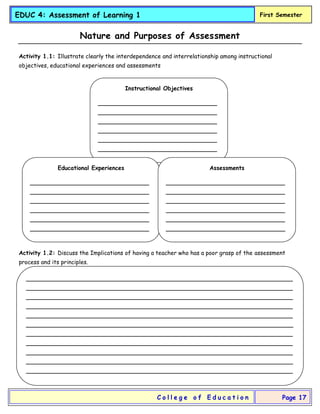
Activity 1.1: Illustrate clearly the interdependence and interrelationship among instructional
objectives, educational experiences and assessments
Activity 1.2: Discuss the Implications of having a teacher who has a poor grasp of the assessment
process and its principles.
Instructional Objectives
_________________________________
_________________________________
_________________________________
_________________________________
_________________________________
_________________________________
_________________________________
_________________________________
___
Educational Experiences
_________________________________
_________________________________
_________________________________
_________________________________
_________________________________
_________________________________
_________________________________
_________________________________
___
Assessments
_________________________________
_________________________________
_________________________________
_________________________________
_________________________________
_________________________________
_________________________________
_________________________________
___
__________________________________________________________________________
__________________________________________________________________________
__________________________________________________________________________
__________________________________________________________________________
__________________________________________________________________________
__________________________________________________________________________
__________________________________________________________________________
__________________________________________________________________________
__________________________________________________________________________
__________________________________________________________________________
__________________________________________________________________________
C o l l e g e o f E d u c a t i o n
Page 18
EDUC 4: Assessment of Learning 1 First Semester
Activity 1.4. Answer the Following:
a. How assessment of learning be essential to teachers in monitoring the learning progress of
the students?
b. Why must teachers use many different techniques of assessment?
Activity 1.3: Define Assessment in your own words.
_________________________________________________________________________
_________________________________________________________________________
_________________________________________________________________________
_________________________________________________________________________
_________________________________________________________________________
_________________________________________________________________________
_________________________________________________________________________
_______________
_________________________________________________________________________
_________________________________________________________________________
_________________________________________________________________________
_________________________________________________________________________
_________________________________________________________________________
_________________________________________________________________________
_________________________________________________________________________
_______________
EDUC 4: Assessment of Learning 1 First Semester
C o l l e g e o f E d u c a t i o n Page 19
c. What are the functions of assessment? Site examples each.
Activity 1.5: Guided with the characteristics of an effective portfolio, make a framework and
contents of an effective portfolio.
C o l l e g e o f E d u c a t i o n
Page 20
EDUC 4: Assessment of Learning 1 First Semester
Activity 1.6.: Prepare a Chart/Graphic Organizer showing the basic concepts of assessment. Show
the features of each.
Activity 1.7. Interview at least three teachers on their method of assessment of student learning.
Guide questions:
a) How can assessment help them in instructional programs?
b) How often they are using placement assessment and Diagnostic assessment?
c) What difficulties they are facing in assessing the students’ learning?
d) How can assessment help you in decision-making?
e) When are they using Norm and Criterion- reference assessment?
Exercise 3: Quiz.
Summary:
Teaching and learning include a lot of instructional decisions to enhance and increase student
learning, hence, quality of instruction is strongly connected to the structure of information on which
these instructional decisions are made therefore, the most important point is the determination of the
way in which good, valid, and reliable information about student learning can be provided (O’Neil, et.al.,
2004). Linn (2003) stated that student learning requires the use of a number of techniques for
measuring achievement. In order for effective teaching to take place, in the classroom, teachers must
use different techniques of assessment to correlate with the goals they have set for their students.
EDUC 4: Assessment of Learning 1 First Semester
C o l l e g e o f E d u c a t i o n Page 21
Principles of High Quality Assessment
Objectives:
1. Identify what constitutes high-quality assessments;
2. List down the productive and unproductive uses of tests; and
3. Classify the various types of tests
Introduction
Most of the tests the students take are teacher-made tests. It means that teachers design
them. These tests are associated with the grades on report cards. They help measure student’s
progress-telling the teacher and the student whether he/she is keeping up with the class, needs
extra help, or, is far ahead of other students. Therefore, decisions about how, when and why to
assess student learning must be thoughtful and confident. Teacher –made tests are those which
are prepared by teachers to assess their student learning. Tests scores may be used for a
portion of students’ mark (Williams and Haladyna, 1999). Some of the following suggestions can
be helpful in constructing tests:
1. Tests should be balanced
As much as possible, test questions should be given within a meaningful context.
Poor: Name the continents and oceans.
Better:
Name the continents and oceans as shown on the map.
(Provide a clear map with continents and oceans numbered)
Poor: Mark the following of true or false.
Better:
Mark the following if true or false. For the false statements, rewrite them to make
them true.
Poor: Answer the following questions:
Better:
Write two questions that you have about the following topics:
Describe how you have improved in a skill while doing this unit:,
List three things you have learned. What you enjoyed most; and the like.
2. Students should not be penalized with a low mark because they are weak in reading
or writing. These students may be assisted in one of several ways.
3. Teachers might choose to use a format different from the conventional tests.
There should be no surprises when it comes to student evaluation: (1) Students should
C o l l e g e o f E d u c a t i o n
Page 22
EDUC 4: Assessment of Learning 1 First Semester
always be aware of evaluation criteria and procedures; (2) They should have a role in evaluation
process; and (3) They should receive a regular feedback as to “how they are doing.”
CHARACTERISTICS OF HIGH-QUALITY ASSESSMENT
High quality assessments provide results that demonstrate and improve targeted student
learning. They also convey instructional decision making. To ensure the quality of any test, the
following criteria must be considered.
1. CLEAR AND APPROPRIATE LEARNING TARGETS
 When designing good assessment, start by asking if the learning targets are on the
right level of difficulty to be able to motivate students and if there is an adequate
balance among the different types of learning targets.
 A learning target is a clear description of what students know and are able to do.
 Using learning targets, teachers assess student performance throughout the year.
These frequent checks provide the teachers with information on skills and concepts
that may have to be covered again as children mature. The teacher is then able to help
each child before he/she falls behind their grade level.
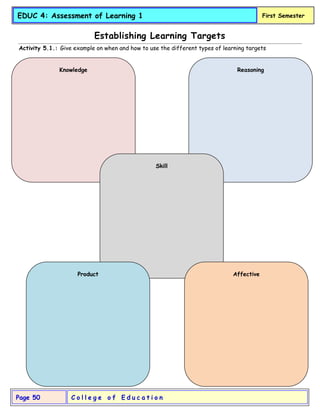
Learning targets are categorized by Stiggins and Conklin (1992) into five:
a. Knowledge Learning Target
 Is the ability of the students to master a substantive subject matter.
b. Reasoning Learning Target
 Is the ability to use knowledge and solve problems.
c. Skill Learning Target
 Is the ability to demonstrate achievement-related skills like conducting
experiments, playing basketball, and operating computers.
d. Product Learning Target
 is the ability to create achievement-related products such as written reports, oral
presentations, and art products
e. Affective Learning Target
 Is the attainment of affective traits such as attitudes, values, interests and self-
efficacy.
EDUC 4: Assessment of Learning 1 First Semester
C o l l e g e o f E d u c a t i o n Page 23
2. APPROPRIATENESS OF ASSESSMENT METHODS
 Once the learning targets have been identified, match them with their
corresponding methods by considering the strengths of various methods in
measuring different targets.
MATCHING LEARNING TARGETS WITH ASSESSMENT METHODS
Targets Objective Essay
Performance-
based
Oral
question
Observation
Self-
report
Knowledge 5 4 3 4 3 2
Reasoning 2 5 4 4 2 2
Skills 1 3 5 2 5 3
Product 1 1 5 2 4 4
Affective 1 2 4 4 4 5
3. VALIDITY
 This refers to the extent to which the test serves its purpose or the efficiency
with which it intends to measure.
 Validity is a characteristic that pertains to the appropriateness of inferences,
uses and results of the test or any other methods utilized to gather data.
 There are factors that influence the validity of the test; namely, appropriateness
of test items, directions, reading vocabulary, and sentence structures, pattern of
answers, and arrangement of items.
Types of Validity
a. Content-related Validity – determines the extent of which the assessment is the
representative of the domain of interest.
b. Criterion-related Validity – determines the relationship between an assessment and
another measure of the same trait. It provides validity by relating an assessment to
some valued measure (criterion) that can either provide an estimate of current
performance (concurrent criterion-related evidence) or predict future performance
(predictive criterion-related evidence).
c. Construct-related Validity – determines which assessment is a meaningful measure of
an observable trait or characteristics like intelligence, reading comprehension, honesty,
motivation, attitude, learning style and anxiety.
d. Face Validity – is determined on the basis of the appearance of the assessment,
whether based on the superficial examination of the test, there seems to be a
C o l l e g e o f E d u c a t i o n
Page 24
EDUC 4: Assessment of Learning 1 First Semester
reasonable measure of the objectives of a domain.
e. Instructional–related Validity – determines to what extent the domain of content in the
test is taught in class.
4. RELIABILITY
 This refers to the consistency with which a student may be expected to perform
on a given test.
 It means the extent to which a test is dependable, self-consistent and stable.
Methods in Estimating the Reliability of a Good Measuring Instrument
There are various ways of establishing test reliability. These are the length of the test,
difficulty of the test, and objectivity if the scorer. These are also four methods in estimating
the reliability of a good measuring instrument.
i. Test-Retest Method or Test of Stability – the same measuring instrument is
administered to the same group of subjects. The scores of the first and second
administrations of the test are determined by correlation coefficient.
ii. Parallel-Forms Methods or Test of Equivalence – it is a form of a test may be
administered to the group of subjects and the paired observations correlated. The
two forms of the test must be constructed in a manner that in the content, type of
item, difficulty, instructions for administration, and several others, should be similar
but not identical.
iii. Split-half Method – test in this method may only be administered once, but the test
items are divided into two halves. The common procedure is to divide a test into odd
and even items.
iv. Internal Consistency Method- this method is used with psychological tests, which are
constructed as dichotomously scored items.
5. FAIRNESS
 This pertains to the intent that each question should be made as clearly as possible to
the examinees and the test is absent of any biases. An example of a bias in an
intelligence test is an item about a person or object that has not been part of the
cultural and educational context of the test taker. In mathematical tests for instance,
the reading difficulty level of an item can be a source of unfairness. Identified elements
of fairness are the student’s knowledge of learning targets before the instruction, the
opportunity to learn, the attainment of pre-requisite knowledge and skills, unbiased
assessment tasks and procedures, and teachers who avoid stereotypes.
EDUC 4: Assessment of Learning 1 First Semester
C o l l e g e o f E d u c a t i o n Page 25
6. POSITIVE CONSEQUENCES
 These enhance the overall quality of assessment, particularly in the effect of
assessments on the students’ motivation and study habits.
7. PRACTICALITY AND EFFICIENCY
 Assessments need to take into consideration the teacher’s familiarity with the
assessment method, the time required, the complexity of administration, the ease of
scoring and interpretation, and the cost to be able to determine an assessment’s
practicality and efficiency.
PRODUCTIVE USES OF TESTS
Learning Analysis. Tests are used to identify the reasons or causes why students do not learn
and the solutions to help them learn. Ideally, a test should be designed to determine what
students do not know so that the teachers can take appropriate actions.
Improvement of Curriculum. Poor performance in a test may indicate that the teacher is not
explaining the material effectively, the textbook is not clear, the students are not
appropriately taught and the students do not see the meaningfulness of the materials. When
only a few students have difficulties, the teacher can address them separately and extend
special help. If the entire class does poorly, the curriculum needs to be revised or special units
need to be developed for the class to continue.
Improvement of Teacher. In a reliable grading system, the class average is the grade the
teacher has earned.
Improvement of Instructional Materials. Tests measure how effective instructional materials
are in bringing about extended changes.
Individualization. Effective tests always indicate differences in students’ learning. These can
serve as bases for individual help.
Selection. When enrollment opportunity or any other opportunity is limited, a test can be used
to screen those who are more qualified.
Placement. Tests can be used to determine to which category of students belongs.
Guidance and Counseling. Results from appropriate tests, particularly standardized tests, can
help teachers and counselors guide students in assessing future academic and career
possibilities.
C o l l e g e o f E d u c a t i o n
Page 26
EDUC 4: Assessment of Learning 1 First Semester
Research. Tests can be feedback tools to find effective methods of teaching and learn more
about students, their interests, goals and achievements.
Selling and Interpreting the School to the Community. Effective tests help the
community understand what the students are learning, since test items are
representative of the content of instruction. Tests can also be used to diagnose general
schoolwide weaknesses and strengths that require community or government support.
Identification of Exceptional Children. Tests can reveal exceptional students inside
the classroom. More often than not, these students are overlooked and left unattended.
Evaluation of the Learning Program. Ideally, tests should evaluate the effectiveness of
each element in a learning program, not just a blanket the information of the total
learning environment.
UNPRODUCTIVE USES OF TESTS are Grading, Labeling, Threatening, Unannounced
Testing, Ridiculing, Tracking and Allocating Funds.
Other Types of Tests
1. Mastery tests measure the level of learning of a given set of materials and the
level attained.
2. Discriminatory tests distinguish the differences between students or groups of
students. It indicates the areas where students need help.
3. Recognition tests require students to choose the right answer from a given set of
responses.
4. Recall tests require students to supply the correct answer from their memory.
5. Specific recall tests require short responses that are fairly objective.
6. Free recall tests require students to construct their own complex responses.
There are no right answers but a given answer might be better than the other.
7. Maximum performance tests require students to obtain the best score possible.
8. Typical performance tests measure the typical or usual average performance.
9. Written tests depend on the ability of the students to understand, read and
write.
10. Oral examinations depend on the examinees’ ability to speak. Logic is also
required.
EDUC 4: Assessment of Learning 1 First Semester
C o l l e g e o f E d u c a t i o n Page 27
11. Language tests require instructions and questions to be presented in words.
12. Non-language tests are administered by means of pantomime, painting or signs
and symbols, e.g., Raven’s Progressive Matrices or the Abstract Reasoning Tests.
13. Structured tests have very specific, well-defined instructions and expected
outcomes.
14. Projective tests present ambiguous stimulus or question designed to elicit highly
individualized responses.
15. Product tests emphasize only the final answer.
16. Process tests focus on how the examinees attack, solve, or work out a problem.
17. External reports are tests where a rate is evaluated by another person.
18. Internal reports are self-evaluation.
19. Open book tests depend on one’s understanding and ability to express one’s ideas
and evaluate concepts.
20. Closed book tests depend heavily on the memory of the examinees.
21. Non-learning format tests determine how much information the students know.
22. Learning format tests require the students to apply previously learned
materials.
23. Convergent format tests purposely lead the examinees to one best answer.
24. Divergent format tests lead the examinees to several possible answers.
25. Scale measurements distribute ratings along a continuum.
26. Tests measurements refer to the items being dichotomous or either right or
wrong, but not both.
27. Pretests measure how much is known about a material before it is presented.
28. Posttests measure how much has been learned after a learning material has been
given.
29. Sociometrics reveal the interrelationship among members or the social structure
of a group.
30. Anecdotal records reveal episodes of behavior that may indicate a profile of the
students.
C o l l e g e o f E d u c a t i o n
Page 28
EDUC 4: Assessment of Learning 1 First Semester
Principles of High Quality Assessment
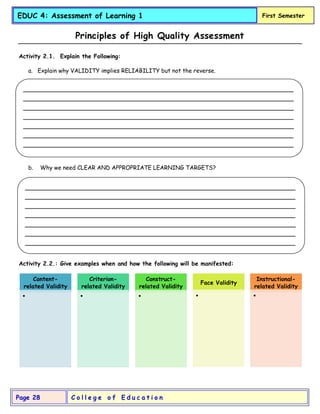
Activity 2.1. Explain the Following:
a. Explain why VALIDITY implies RELIABILITY but not the reverse.
b. Why we need CLEAR AND APPROPRIATE LEARNING TARGETS?
Activity 2.2.: Give examples when and how the following will be manifested:
Content-
related Validity
•
Criterion-
related Validity
•
Construct-
related Validity
•
Face Validity
•
Instructional-
related Validity
•
___________________________________________________________________________
___________________________________________________________________________
___________________________________________________________________________
___________________________________________________________________________
___________________________________________________________________________
___________________________________________________________________________
___________________________________________________________________________
___________________________________________________________________________
___________________________________________________________________________
___________________________________________________________________________
___________________________________________________________________________
___________________________________________________________________________
___________________________________________________________________________
___________________________________________________________________________
EDUC 4: Assessment of Learning 1 First Semester
C o l l e g e o f E d u c a t i o n Page 29
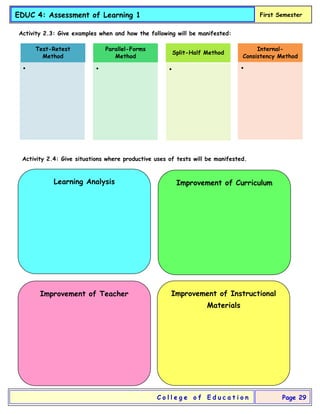
Activity 2.3: Give examples when and how the following will be manifested:
Activity 2.4: Give situations where productive uses of tests will be manifested.
Test-Retest
Method
•
Parallel-Forms
Method
•
Split-Half Method
•
Internal-
Consistency Method
•
Learning Analysis Improvement of Curriculum
Improvement of Teacher Improvement of Instructional
Materials
C o l l e g e o f E d u c a t i o n
Page 30
EDUC 4: Assessment of Learning 1 First Semester
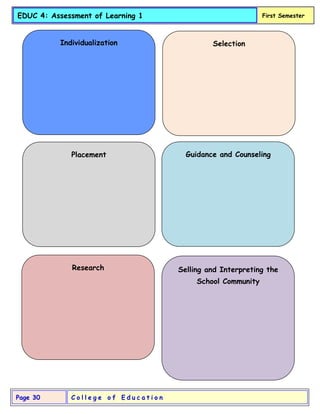
Individualization Selection
Placement Guidance and Counseling
Research Selling and Interpreting the
School Community
EDUC 4: Assessment of Learning 1 First Semester
C o l l e g e o f E d u c a t i o n Page 31
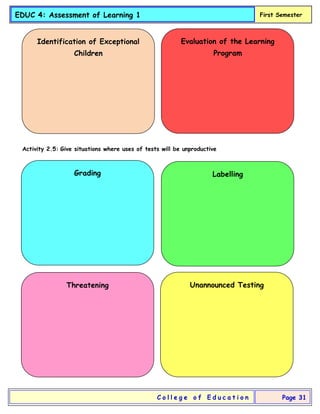
Activity 2.5: Give situations where uses of tests will be unproductive
Identification of Exceptional
Children
Evaluation of the Learning
Program
Grading Labelling
Threatening Unannounced Testing
C o l l e g e o f E d u c a t i o n
Page 32
EDUC 4: Assessment of Learning 1 First Semester
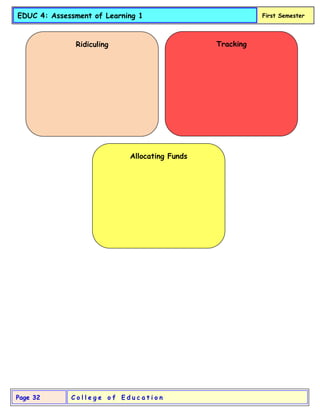
Ridiculing Tracking
Allocating Funds
EDUC 4: Assessment of Learning 1 First Semester
C o l l e g e o f E d u c a t i o n Page 33
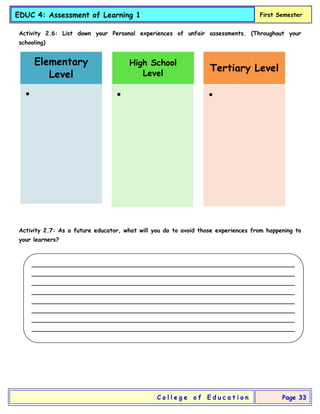
Elementary
Level
•
High School
Level
•
Tertiary Level
•
Activity 2.6: List down your Personal experiences of unfair assessments. (Throughout your
schooling)
Activity 2.7: As a future educator, what will you do to avoid those experiences from happening to
your learners?
_________________________________________________________________________
_________________________________________________________________________
_________________________________________________________________________
_________________________________________________________________________
_________________________________________________________________________
_________________________________________________________________________
_________________________________________________________________________
_________________________________________________________________________
C o l l e g e o f E d u c a t i o n
Page 34
EDUC 4: Assessment of Learning 1 First Semester
Social, Legal and Ethical Implications of Tests
Objectives:
1. Evaluate the soundness of the criticisms of testing; and
2. Cite testing principles a teacher must observe.
Criticisms of Testing
In spite of the advantages of testing, still some quarters hurl some serious allegations against its
use.
Invasion of Privacy. Whether tests represent an invasion of privacy or not depends on the part on how
they are used. For sure, there is no invasion of privacy if the subjects were told how the tests results
will be used and if the subjects volunteered. When children are involved, the invasion of privacy is
somewhat more complex. Legally, the school’s function is to act as parents, while the child is at school. In
such cases, teachers, as parent substitutes, can require the students to take tests where the objectives
are agreed upon by the school board. On the test administrators rest the responsibility of constructing
and using the test prudently.
Creation of Anxiety and Interference in Learning. Although a common criticisms of testing, this is not
true in all cases. Feldhusen’s (1964) study, for instance, revealed that 80% of his respondents stated
that tests helped them learn more. Another study by Fiske (1967) corroborates the findings of
Feldhusen. Rudman (1977) found that teachers and administrators favor giving out tests, especially
achievement tests. How tests affect students was studied by Kirkland (1971). In this study, the
following conclusions regarding tests were reached based on the relationships between anxiety and
learning:
1. Mild degree of anxiety usually facilitates learning, whereas higher level of anxiety hinders
learning in most cases.
2. The less able student incurs a higher level of anxiety form testing than capable ones.
3. Being familiar with the type of test to be administered reduces anxiety.
4. Highly anxious students do better than less anxious ones on measuring rote recall. They perform
less well, however, on tests requiring flexibility in thought.
5. Test anxiety increases in grade levels.
6. Although there appears to be no relationship between sex and anxiety among elementary school
children, junior high school girls indicate that they experience more anxiety than boys at
comparable levels.
Permanent Categorization of Students (Tracking). The notion that measurement instruments are
infallible and their performance is fixed and, therefore, unchangeable, has had serious consequences.
For instance, teachers may not give recognition for some changes in performance.
EDUC 4: Assessment of Learning 1 First Semester
C o l l e g e o f E d u c a t i o n Page 35
Penalizing Bright and Creative Students. One of the most consistent criticisms of test is that they are
insensitive to typical but defensible responses. Of course, there are some vague items, but this is an
exception rather than a rule.
Discrimination against Minority Students. Many minority students do not take tests because they have
not learned the skills, knowledge, and attitude required to succeed. In this case, it is not reasonable to
criticize tests.
Measurement of Limited and Superficial Aspect of Behavior. A commonly recurring criticism of test
is that they cannot measure important human traits, such as love or motivation.
Ethical Testing Principles
Test presume ethical, responsible attitude on the part of the examiner and a desire to cooperate on
the part of the students. As in all social interactions, mutual trust and respect must be developed.
Relevant to testing are the following ethical principles.
1. Confidentiality. Security of the test contents, the hazards of misunderstanding results and the
need of various persons to know the results influence the answer in particular situations.
2. Test Security. Tests are professional instruments and as such, their dissemination is restricted
to those with the technical competence to use them properly. No standardized tests should be
left unsecured.
3. Test Scores and Interpretations. These should only be available to individuals who are qualified
to use them. Test results should be interpreted to parents in a manner that will ensure against
misuse and misinterpretations.
4. Test Publication. Standardized tests should provide a manual or technical handbook describing
how the test can be used most effectively and who may use it. Advertisements about test results
should be factual and descriptive but not emotional or persuasive.
Ethical Testing Practices
1. It is both ethical and advantageous to inform students in advance that they are about to take a
test and to tell them something about the nature of the test. They should also be told of the
advantages of taking the test and where the results would be used.
2. Teachers should explain the mechanics of taking a test and practice the students on how to fill
out an answer sheet (i.e., making heavy marks, and erasing marks completely). It is however
essential that the teacher does not make the question available.
3. It is perfectly proper to try to motivate students to do as well as they can as long as they are not
threatened or made anxious about their performance.
4. It is essential that all testing materials and results be kept secured before, during and after
testing.
5. It is ethical to combine classes for testing as long as there are adequate proctors to safeguard
C o l l e g e o f E d u c a t i o n
Page 36
EDUC 4: Assessment of Learning 1 First Semester
the test and make sure that the students are following instructions. The ideal ratio is one proctor
to a maximum of 30 students.
6. Once an examination has been administered and scores, it is permissible for the teachers to
examine results and determine the areas of student’s weaknesses. It is proper to modify the
curriculum as a result of standardized achievement testing only if the teacher can demonstrate
that the change conforms to overall school objectives. Modifying the curriculum solely for the
purpose of increasing scores is unethical.
Unethical Testing Principles
1. To tutor students on the specific subject matter of an expected examination. This destroys the
standardized procedures of test administration and distorts the meaning provided by the scores.
Scores on standardized tests should only be interpreted when the tests are given exactly the
same way they are to the norm or comparison group. It is unethical for teachers to examine the
content of the standardized tests to determine what is to be taught in their classrooms.
2. To use of give a test item from any part of the test in which only a word or phrase has been
changed.
3. To construct or use any practice form that is similar to the actual test items to reflect the
situations, options, or conditions of the original questions.
4. To copy and/or distribute the test before the scheduled date of the test.
5. For teachers to use standardized tests or mandated testing programs for their examinations.
Similarly, it is unethical to use standardized tests as instructional materials.
6. To exclude some students from participating in tests, even though the teachers expect them to
do poorly. Nor it is unethical to exclude the whole class if they are low achievers.
7. To allow students to use false records, identification papers, unauthorized identification cards or
computer access to official school documents.
8. To neglect the instruction of one student just to increase the test scores of other pupils. The
goal of education is to maximize the achievement of each pupil, not the attainment of high-test
scores. In like manner, it is unethical to grant any advantage to one student over another to
increase score in a given test.
9. To alter directions, time limits, and scoring procedures.
10. To try to improve student performance by developing items parallel to those on standardized
tests.
11. To create anxiety and rivalry about standardized tests among students and between classes and
schools. Examinations are not contests and should not be treated as such.
12. To accept gratuities, gifts or favors that might impair or appear to influence professional
decisions or actions regarding student testing and scores.
13. To disclose information about students obtained in the course of testing, unless disclosure serves
a compelling professional purpose or is required by the school, is unethical.
EDUC 4: Assessment of Learning 1 First Semester
C o l l e g e o f E d u c a t i o n Page 37
Social, Legal and Ethical Implications of Tests
Activity 3.1. Answer the Following:
a. Justify wheter the exemption of students from taking examinations is an ethical or unethical
testing practice.
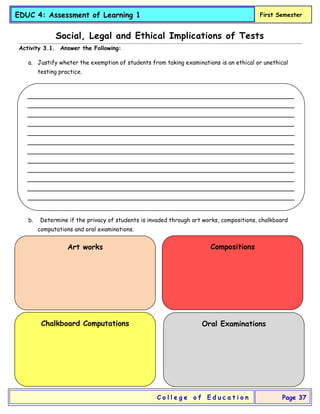
b. Determine if the privacy of students is invaded through art works, compositions, chalkboard
computations and oral examinations.
__________________________________________________________________________
__________________________________________________________________________
__________________________________________________________________________
__________________________________________________________________________
__________________________________________________________________________
__________________________________________________________________________
__________________________________________________________________________
__________________________________________________________________________
__________________________________________________________________________
__________________________________________________________________________
__________________________________________________________________________
__________________________________________________________________________
Art works Compositions
Chalkboard Computations Oral Examinations
C o l l e g e o f E d u c a t i o n
Page 38
EDUC 4: Assessment of Learning 1 First Semester
Factors Influencing Test Construction and Test Performance
Objectives:
1. Explain the Factors that influence test construction
2. Identify the extraneous factors that affect student’s performance in the cognitive type of test.
Factors that Influence Test Construction
There are several factors that influence the type of test a teacher has to construct. These are:
1. The Function of the Test in the Instructional Process
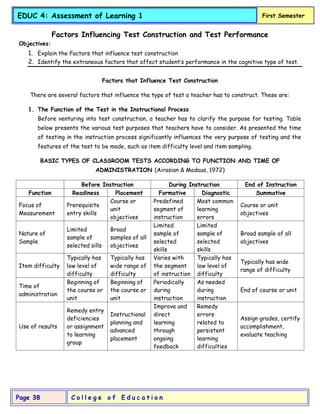
Before venturing into test construction, a teacher has to clarify the purpose for testing. Table
below presents the various test purposes that teachers have to consider. As presented the time
of testing in the instruction process significantly influences the very purpose of testing and the
features of the test to be made, such as item difficulty level and item sampling.
BASIC TYPES OF CLASSROOM TESTS ACCORDING TO FUNCTION AND TIME OF
ADMINISTRATION (Airasian & Madaus, 1972)
Before Instruction During Instruction End of Instruction
Function Readiness Placement Formative Diagnostic Summative
Focus of
Measurement
Prerequisite
entry skills
Course or
unit
objectives
Predefined
segment of
instruction
Most common
learning
errors
Course or unit
objectives
Nature of
Sample
Limited
sample of
selected sills
Broad
samples of all
objectives
Limited
sample of
selected
skills
Limited
sample of
selected
skills
Broad sample of all
objectives
Item difficulty
Typically has
low level of
difficulty
Typically has
wide range of
difficulty
Varies with
the segment
of instruction
Typically has
low level of
difficulty
Typically has wide
range of difficulty
Time of
administration
Beginning of
the course or
unit
Beginning of
the course or
unit
Periodically
during
instruction
As needed
during
instruction
End of course or unit
Use of results
Remedy entry
deficiencies
or assignment
to learning
group
Instructional
planning and
advanced
placement
Improve and
direct
learning
through
ongoing
feedback
Remedy
errors
related to
persistent
learning
difficulties
Assign grades, certify
accomplishment,
evaluate teaching
EDUC 4: Assessment of Learning 1 First Semester
C o l l e g e o f E d u c a t i o n Page 39
2. Testing Frequency
Testing frequency depends on the function the test is to serve. In most cases, single testing can
suffice for selection placement and summative evaluation decisions. For diagnosis, formative
evaluation and motivation, frequent testing is recommended and necessary. If the purpose is to
provide feedback, frequent testing can help the teacher guide and direct the students to the
right track, particularly during the early stage of learning.
Testing frequency helps the student acquire knowledge as efficiently as possible. The tests serve
as learning drills.
Frequent testing can also motivate the learners particularly those with lower abilities. Although it
has some disadvantages, the foremost of which is that it takes much of instruction time, the
decision still lies with the teacher as to which is prioritized.
3. The Use of Open-Book and Closed-Book Examination
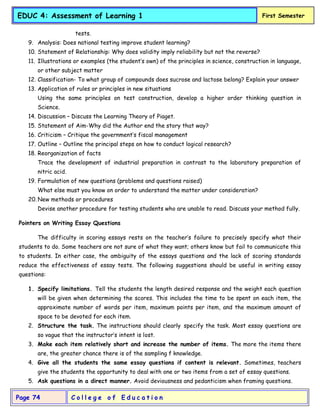
An open-book test permits the students to use books or notes during examinations. This is
advisable when the teacher emphasizes some of the higher objectives in the bloom’s taxonomy.
Rather than spend the bulk of the time memorizing, it can be devoted instead to applying formula
on information.
The value of this type of test includes having students apply rather than memorize information
and use skills in utilizing reference materials for a limited time.
A closed-book test is advisable and should be implemented when a test emphasizes recall of
information.
4. The Use of Take-Home Examination
Take-Home examinations are extensions of open-book tests. Its advantage is that the student
can work at his/her leisure and at his/her most comfortable rate of speed using whatever
reference is available. It is most useful when the student need to resort to references not found
in the classroom or even in the school. However, it has at least two disadvantages, (1) difficulty of
scoring long works objectively, and (2) the possibility of that the student might not to do his/her
own work. However, if the teacher emphasizes the exercise or teaching device to indicate
student strengths, weaknesses, and method of improvement rather than grading, the use of take-
home tests are maximized.
5. Mode of Item Presentation
Test item can be presented in various modes. Oral, written on the board, mimeographed, and
projected on the screen. Each mode has its own advantages and disadvantages.
 Oral presentation benefits those who have difficulty in reading, but those with
unrecognized hearing handicaps are at the losing end.
 Multiple Choice test is discouraged when the students have to work at the same speed but
C o l l e g e o f E d u c a t i o n
Page 40
EDUC 4: Assessment of Learning 1 First Semester
are unable to review previously answered items.
 True or False, Completion or Identification, are best suited for this mode of
presentation.
 Essay questions can be written to favor those with hearing difficulties but the teacher
also has to read aloud for those with reading impairments.
EXTRANEOUS FACTORS THAT INFLUENCE TEST PERFORMANCE
Maximum performance tests (achievement, intelligence and aptitude) require the student to obtain
the highest possible scores while typical performance tests (attitude, interest and personality
inventory) call for the students to obtain scores without exerting much effort. The goal of cognitive
measurement is to obtain an examinee’s best and highest level of performance. The purpose of affective
assessment is to assess examinee’s usual, representative and typical behavior (Hopkins & Stanley, 1981).
An examinee’s performance in any test is influenced by personal traits, knowledge, or proficiency.
Extraneous factors, often times unrecognized, likewise cause equal stronger influences. These are the
following:
1. Test Sophistication or Test-Wiseness
Test-wiseness is defined as the examinee’s ability to use the characteristics and format of the
test and/or the test-taking situation to increase his/her score. Examinees unfamiliar with testing
usually perform poorly than those who have already taken tests several times (test-
sophistication).
2. Practice
Several studies show that there is an improvement in scores when an examinee takes a
subsequent test on a particular test or its parallel form. Practice testing helps the examinee
improve his/her scores for the next time he/she takes the same test or any of its parallel forms.
3. Coaching
The effect of coaching is smaller compared to the effect brought about by practice as long as
the objective questions are reasonable.
4. Anxiety and Motivation
Motivated students score higher than those who are not. A little anxiety may be of help but over
anxiety often leads to poor performance. When the test items are not intrinsically interesting,
effects can be moderate, but if items are too ego-evolving, the examinee become over anxious,
leading to adverse effects on his/her performance.
5. Response Styles
EDUC 4: Assessment of Learning 1 First Semester
C o l l e g e o f E d u c a t i o n Page 41
According to Cronbach (1984), these are the test-taking habits that cause people with the same
abilities to score differently on a test.
a. Speed vs. Accuracy Set. Some examinees work slowly but accurately while some work
quickly but less cautiously.
b. Acquiescence Set. Allows more people to get credits, usually undeserved, for true items than
false ones.
c. Positional-Preference Set. Most students who are ignorant of the answer to an item do not
answer in a random manner, but base their answer on some patterns.
d. Option-Length Set. Most examinees choose longer options, thinking that they are more
justified, hence more correct than others.
e. Set to Gamble. The examinees resort to this test when the test is multiple choice or a
matching type.
C o l l e g e o f E d u c a t i o n
Page 42
EDUC 4: Assessment of Learning 1 First Semester
Arguments FOR
•
Arguments AGAINST
•
Factors Influencing Test Construction and Test Performance
Activity 4.1.: Answer the Following:
a. Cite Arguments FOR and AGAINST testing frequency:
b. Explain Why MODE OF ITEM PRESENTATION is neccesary to take into consideration when
constructing tests?
c. Explain why the effect sof practice in student’s learning are more pronounced than those of
coaching.
___________________________________________________________________________
___________________________________________________________________________
___________________________________________________________________________
___________________________________________________________________________
___________________________________________________________________________
___________________________________________________________________________
___________________________________________________________________________
___________________________________________________________________________
___________________________________________________________________________
___________________________________________________________________________
___________________________________________________________________________
___________________________________________________________________________
___________________________________________________________________________
___________________________________________________________________________
EDUC 4: Assessment of Learning 1 First Semester
C o l l e g e o f E d u c a t i o n Page 43
Establishing Learning Targets
Objectives:
1. Differentiate the types of learning targets;
2. Give concrete examples of the different learning targets; and
3. Discuss the taxonomies of learning objectives
Introduction
A good classroom assessment has clear, appropriate learning targets. Defining learning
targets/outcomes is the first step in good teaching. It is also essential in the assessment of student
learning.
Purposes of Instructional Goals and Objectives
Instructional goals and objectives provide direction for the instructional process by clarifying the
intended learning outcomes. They also convey instructional intent to stakeholders such as students,
parents, other personnel and the public. Most importantly, they provide a basis for assessing student
learning by describing the performance to be measured.
Instructional goals and objectives are sometimes stated in terms of action to be taken. Thus, there
is a statement saying: “demonstrate to students how to operate computers,” this statement indicates
the teaching activity. However it does not clearly specify the intended learning outcomes and does not
point very explicitly to the type of student assessment that would me most appropriate.
Educational goals are general statements of what students will know and be able to do. Goals are
essential because they reflect educational philosophies about what is important.
Instructional objectives are sometimes stated in terms of actions to be taken. Statements direct
attention to the students and the types of performance that they are expected to exhibit as a result of
instruction. Thus, the focus shift from the teacher to the students and from learning experiences to
the learning outcomes.
In stating instructional objectives, it is important to keep in mind that the concern is on the product
of learning rather than with the process of learning. The long-term instructional objective concerns the
product.
Instructional objectives are the intended learning outcomes. They should be stated in terms of
specific, observable and measurable student response.
C o l l e g e o f E d u c a t i o n
Page 44
EDUC 4: Assessment of Learning 1 First Semester
Learning Targets
Terms associated with learning targets are goal, objectives, competency, outcome, standard, and
expectation. Learning target is defined as the statement of student performance that includes both
description of what students should know or be able to do at the end of a unit of instruction and the
criteria for judging the level of performances demonstrated.
The learning targets are composed of content and criteria. Content is what students should know
and be able to do. On the other hand, criteria are dimensions of student performance used for judging
attainment.
Types of Learning Targets
 Knowledge Learning Targets. Knowledge of the subject matter is the foundation upon which
other learning is based. Teachers expect their students to master at least some content.
 Reasoning Learning Targets. Due to the advent of technology, the accessibility to information
has resulted in an increased attention to thinking skills. Such capabilities may be described by a
number of different terms, including problem solving, critical thinking, analysis, comparing,
intellectual abilities, higher-order thinking skills, and judgment.
 Skill Learning Targets. A skill is something that the student demonstrates, something done.
Skill learning targets involve a behavior in which knowledge and reasoning are used in an overt
manner.
 Product Learning Targets. Products, like skills, are dependent on the prior attainment of
knowledge and reasoning targets. Products are samples of student work that demonstrates the
ability to use knowledge and reasoning in the creation of a tangible product like term paper,
investigative report, artwork, and other projects.
 Affective Learning Targets. This includes emotions, feelings, and beliefs that are different
from cognitive learning. Affective learning targets also referred to as motivational dispositions,
values, and morals.
EDUC 4: Assessment of Learning 1 First Semester
C o l l e g e o f E d u c a t i o n Page 45
Bloom’s Taxonomy of Learning Domains
Bloom’s Taxonomy enables teachers and educators to use exact and varied terminologies for stating
specific learning outcomes.
Formulating Cognitive Learning Targets
Description of the major Categories
in the Cognitive Domain
Illustrative General
Instructional Objectives
Illustrative Behavioral Terms
for Stating Specific Learning
Outcomes
Knowledge. It is defined as the
recall of previously learned
material. This may involve the
recollection of a wide range of
materials, from specific facts to
complete theories, although
remembering the appropriate
information is the only thing
required. Knowledge represents
the lowest level of learning
outcome in the cognitive domain.
Knows common terms;
Knows specific facts;
Knows methods and
procedures;
Knows basic concepts;
Knows principles
 Defines
 Describes
 Identifies
 Labels
 Lists
 Matches
 Names
 Outlines
 Reproduces
 Select
 States
Comprehension. It is defined as
the ability to grasp the meaning of
material. This may be shown by
translating the material from one
form to another, interpreting the
material, and estimating future
trends. Learning outcomes go one
step beyond the simple
remembering of material. It
represents the lowest level of
understanding.
Understand facts and
principles;
Interprets verbal
material;
Interprets charts and
graphs;
Translates verbal formulas
to mathematical ones
estimates future
consequences;
Justifies methods and
procedures
 Converts
 Defends
 Distinguishe
s
 Estimates
 Explains
 Extends
 Infers
 Generalizes
 Gives
examples
 Paraphrases
 Predicts
 Rewrites
 Summarizes
Application. It refers to the
ability to use learned material in a
new, concrete situation. This may
include the application of things
such as rules, methods, concepts,
laws, principles, and theories.
Learning outcomes in this area
require a higher level of
understanding than those under
comprehension.
Applies concepts and
principles to new
situations;
Applies laws and theories
to practical situations;
solves mathematical
problems; demonstrates
correct usage of a
methods or procedure;
constructs charts and
graphs
 Changes
 Computes
 Demonstrates
 Discovers
 Manipulates
 Modifies
 Operates
 Predicts
 Prepares
 Uses
 Produces
 Relates
 Shows
 Solves
C o l l e g e o f E d u c a t i o n
Page 46
EDUC 4: Assessment of Learning 1 First Semester
Analysis. It refers to the ability
to break down material into its
component parts so that its
organizational structure may be
understood. This may include the
identification of parts, and the
recognition of the organizational
principles involved. Learning
outcomes here represent a higher
level than the comprehension of
both the content and structural
form of the material.
Recognizes unstated
assumptions; recognizes
logical fallacies in
reasoning; distinguishes
between facts and
opinion/inferences;
evaluates the relevance of
data; analyzes the
organizational structure
of a work
 Breaks down
 Diagrams
 Differentiate
s
 Discriminates
 Distinguishes
 Identifies
 Illustrates
 Infers
 Outlines
 Points out
 Relates
 Selects
 Separates
 Subdivides
Synthesis. It refers to the ability
to put parts together to form a
new whole. This may involve the
production of a unique
communication (theme or speech),
a plan of operations (research
proposal), or a set of abstract
relations (scheme for classifying
information). Learning outcomes in
this area stress creative
behaviors, with major emphasis on
the formulation of a new patterns
or structures.
Writes well organized
theme; gives a well
organized speech, write a
creative short story,
poem, or music; proposes a
plan for an experiment;
integrates learning from
different areas into a plan
for solving a problem;
formulates a new scheme
for classifying objects,
events or ideas
 Categorizes
 Combines
 Compiles
 Composes
 Creates
 Devises
 Designs
 Explains
 Generates
 Modifies
 Plans
 Organizes
 Rearranges
 Reconstruct
s
 Relates
 Reorganizes
 Revises
 Rewrites
 Summarizes
 Tells
 Writes
Evaluation. Evaluation is concerned
with the ability to judge the value
of a material (statement, novel,
poem, research and report) for a
given purpose. The judgments are
to be based on definite criteria or
be given to them. Learning
outcomes in this area are the
highest in the cognitive hierarchy
because they contain elements of
all the categories, plus conscious
value judgments based on clearly
defined criteria.
Judges the logical
consistency of written
material; judges the
adequacy with which
conclusions are supported
by data; judges the value
of work (art, music, and
writing) by use of internal
criteria; judges the value
of work (art, music and
writing) by use of external
standards of excellence.
 Appraises
 Compares
 Concludes
 Contrasts
 Criticizes
 Describes
 Discriminate
s
 Explains
 Justifies
 Interprets
 Relates
 Summarizes
 Supports
EDUC 4: Assessment of Learning 1 First Semester
C o l l e g e o f E d u c a t i o n Page 47
Formulating Affective Learning Targets
Category Examples and Key words
Receiving (Attending) Phenomena: awareness,
willingness to hear, selected attention.
This is the lowest category in the affective domain.
At this level, the student is aware of the existence
of a condition or problem and is willing to at least
listen attentively to what others have to say about
it. The element of commitment is not present, and
the behavior is somewhat analogous to “sitting on
the fence.” The student is aware of an issue, but has
not yet made a decision about it.
Examples:
Listens to others with respect
Listens for and remembers the name of newly
introduced people
Keywords:
 Asks
 Chooses
 Describes
 Follows
 Gives
 Holds
 Uses
 Identifies
 Locates
 Names
 Points to
 Selects
 Sits
 Erects
 Replies
Responding to Phenomena: Active participation on
the part of the learners; attends and reacts to a
particular phenomenon.
Learning outcomes may emphasize compliance in
responding, willingness to respond, or satisfaction in
responding (motivation). At this level, the student is
willing to go along with an idea or a value, such as
being willing to follow school rules, actively
volunteers to respond, and takes satisfaction in
response. The level of commitment is minimal and
the behavior is analogous to jumping off the fence,
but holding on to it and being ready to jump back at
any moment.
Examples:
Participates in class discussions;
Gives a presentation
Questions new ideals, concepts, models, etc. to fully
understand them
Knows the safety rules and practices them
Keywords:
 Answers
 Assists
 Aids
 Complies
 Labels
 Reads
 Recites
 Reports
 Conforms
 Discusses
 Greets
 Helps
 Performs
 Practices
 Presents
 Selects
 Tells
 Writes
Valuing: The worth or value a person attaches to a
particular object, phenomenon or behavior.
This ranges from simple acceptance to more complex
state of commitment. Valuing is based on the
internalization of a set of specified values. Clues to
these values are expressed in the learner’s overt
behavior and are often identifiable. Here, the
student demonstrates that an attitude has been
accepted and is constantly preferred over competing
attitude and values. The commitment is clear. The
students has walked away from the fence and is
willing to be identified as someone holding the
attitude or value.
Examples:
Demonstrates belief in the democratic process;
Is sensitive toward individual and cultural differences
(values diversity);
Shows the ability to solve problems;
Proposes a plan for social improvement and follows
through with commitment;
Informs management on matters that one feels strongly
about
Keywords:
 Completes
 Demonstrates
 Differentiates
 Explains
 Follows
 Forms
 Initiates
 Studies
 Invites
 Joins
 Justifies
 Proposes
 Reads
 Reports
 Selects
 Shares
 Works
C o l l e g e o f E d u c a t i o n
Page 48
EDUC 4: Assessment of Learning 1 First Semester
Organization: organizes values into priorities by
contrasting different values, resolving conflicts
between them and creating a unique value system;
emphasis is on comparing, relating and synthesizing
values.
The students eventually recognize that conflicts
between values arise and must be resolved by
setting priorities on values. To do so, students
should use higher-order cognitive thinking which will
enable them to resolve value conflicts in a logical and
defensible manner. They will then have greater
confidence in their decisions. This level is a direct
link between the cognitive and the affective
domains.
Examples:
Recognizes the need for balance between freedom and
responsible behavior;
Accepts responsibility for one’s behavior;
Explains the role of systematic planning in solving
problems;
Accepts professional ethical standards; creates a life
plan in harmony with abilities, interests and beliefs;
Priorities time effectively to meet the needs of the
organization, family and self
Keywords:
 Adheres
 Arranges
 Combines
 Compares
 Completes
 Defends
 Explains
 Relates
 Formulates
 Generalizes
 Identifies
 Integrates
 Modifies
 Orders
 Organizes
 Prepares
 Synthesizes
Internalizing values (Characterization): Has a value
system that controls behavior behavior is pervasive,
consistent, predictable, and most importantly, a
characteristic of the learner; instructional
objectives are concerned with the student’s general
patterns of adjustment (personal, social, emotional).
This is the highest level of an affective domain. At
this level, a person has developed and internalized a
value system to the extent that those values are
clearly reflected in the person’s behavior. When we
think of a miser or a spendthrift, we are thinking of
someone who has reached the characterization level.
That person has reason for holding particular value
structures, only a few will reach the
characterization level while in high school.
Examples:
Shows self-reliance when working independently;
Cooperates in group activities (displays teamwork);
Uses an objective approach in problem solving;
Displays a professional commitment to ethical practice
on a daily basis;
Revises judgments and changes behavior in light of new
evidence;
Values people for what they are, not how they look
Keywords:
 Acts
 Discriminates
 Displays
 Influences
 Listens
 Modifies
 Performs
 Practices
 Proposes
 Qualifies
 Questions
 Revises
 Serves
 Solves
 Verifies
EDUC 4: Assessment of Learning 1 First Semester
C o l l e g e o f E d u c a t i o n Page 49
Formulating Psychomotor Learning Targets
Descriptors of Major Categories in the Psychomotor
Domain
Illustrative Verbs
1. Imitation. Early stage ion learning a complex skill,
overtly, after the individual has indicated
readiness to take a particular type of action.
Imitation includes repeating an act that has been
demonstrated or explained. It also includes trial
and error until an appropriate response is
achieved.
 Begins
 Attempts
 Carries out
 Copies
 Calibrates
 Constructs
 Dissects
 Reproduces
 Responds
 Organizes
 Volunteers
 Assembles
 Duplicates
 Follows
 Mimics
 Moves
 Practices
 Proceeds
 Repeats
 Sketches
 Starts
 Tries
2. Manipulation. Individual continues to practice a
particular skill or sequence until it becomes
habitual and the action can be performed with
some confidence and proficiency. The response is
more complex than the previous level, but the
learner is still not “sure of himself/herself”
(same as imitation)
 Acquires
 Assembles
 Completes
 Conducts
 Does
 Executes
 Progresses
 Uses
 Improves
 Maintains
 Makes
 Manipulates
 Operates
 Paces
 Performs
 Produces
3. Precision. Skill has been attained. Proficiency is
indicated by a quick, smooth, accurate
performance, requiring minimum energy. The overt
response is complex and performed without
hesitation.
(same as imitation
and manipulation)
 Achieves
 Accomplishes
 Advances
 Automatizes
 Exceeds
 Masters
 Reaches
 Refines
 Succeeds
 Surpasses
 Transcends
 Excels
4. Articulation. Involves an even higher level of
precision. The skills are so well developed that the
individual can modify movement patterns to fit
special requirements or meet a problem situation.
 Adapts
 Alters
 Changes
 Excels
 Rearranges
 Reorganizes
 Revises
 Surpasses
 Transcends
5. Naturalization. Response is automatic. The
individual begins to experiment, creating new
motor acts or ways of manipulating materials out
of understanding, abilities, and skills developed.
One acts “without thinking”
 Arranges
 Combines
 Composes
 Constructs
 Creates
 Designs
 Refines
 Originates
 Transcends
C o l l e g e o f E d u c a t i o n
Page 50
EDUC 4: Assessment of Learning 1 First Semester
Establishing Learning Targets
Activity 5.1.: Give example on when and how to use the different types of learning targets
Knowledge Reasoning
Skill
Product Affective
EDUC 4: Assessment of Learning 1 First Semester
C o l l e g e o f E d u c a t i o n Page 51
Activity 5.2.: Differentiate Instructional Goals from Instructional Objectives
}}
Activity 5.3.: Using the Module 1.1 (NATURE AND PURPOSES OF ASSESSMENT) topic, prepare a
series of OBJECTIVES progressing from the lower-level cognitive Domain up to the appropriate
affective domain.. (USE separate sheet)
_________________________________________________________________________
_________________________________________________________________________
_________________________________________________________________________
_________________________________________________________________________
_________________________________________________________________________
_________________________________________________________________________
_________________________________________________________________________
_________________________________________________________________________
_________________________________________________________________________
_________________________________________________________________________
_________________________________________________________________________
_________________________________________________________________________
_________________________________________________________________________
__________________________________________________________________
C o l l e g e o f E d u c a t i o n
Page 52
EDUC 4: Assessment of Learning 1 First Semester
Planning
Stage
compare
performance data
with behaviorally
stated objectives
Collect
Performance
Data
Develop or
select
measurement
techniques
Find situation
in which
achievement
of objectives
can be shown
Define
objectives in
behavioral
terms
Classify goals
and objectives
Establish
broad goals
and objectives
Preparation of Classroom Assessment
Objectives:
1. List down the planning stages in preparing a classroom test;
2. Establish relationships among learning objectives, teaching and testing;
3. Cite the importance of the table of specifications in making the test more valid and reliable; and
4. Construct a sample of table of specifications.
Planning the Teacher-made Tests
Good tests do not just happen. They require adequate and extensive planning so that the goals of
instruction (objectives), the teaching strategy to be employed, the textual materials, and the evaluative
procedures are all related in some meaningful fashion. Most teachers recognize the importance of having
some systematic procedure for ascertaining the extent to which the instructional objectives have been
realized by their students.
In class, planning for each lesson and its accompanying evaluation starts as early as the
conceptualization of the curriculum. This practice has been reiterated by authorities in the field of
education particularly Ralph Tyler who, until now is considered the “Father of Educational Evaluation”
(Olivia, 2001).
Tyler’s Evaluation Framework (Olivia, 2001)
Steps in Classroom Testing and Assessment
EDUC 4: Assessment of Learning 1 First Semester
C o l l e g e o f E d u c a t i o n Page 53
Linn and Gronlund (2000) offered a logical procedure for preparing valid, reliable, useful tests.
BASIC STEPS IN CLASSROOM TESTING
During the stage of thinking about the test, the teacher must consider the relationship among
the objectives, teaching and testing. The following checklist should assist the test conductor.
 Specify the course or unit content
 List the major course or unit objectives
 Define each objectives in terms of student behavior
 Discard unrealistic objectives
 Prepare a table of specifications
 Decide on the item format to be used
 Prepare test items
Writing the Objective Short-Response Test
The objective type item was developed to overcome the criticisms leveled against essay questions
– poor content sampling, unreliable scoring, time consumed for grading and encouragement bluffing. All
objective item formats can be subdivided into two classes: the supply type (short answer) and the
select type. One of the virtues of the objective type is that it is economical; in obtaining information
from a student because, in general, it takes less time to answer than an essay question.
Suggestions on how to construct an objective type of test are summarized as follows:
1. Objective test items must be written as simply and as clearly as possible so that all the
examinees will be able to make the same interpretation of the item’s intent.
7. Using the Test
6. Appraising the Test
5. Assembling the Test
4. Preparing relevant test items
3. Selecting Appropriate Test types
2. Developing the Table of Specification
1. Determining the purpose of measurement
C o l l e g e o f E d u c a t i o n
Page 54
EDUC 4: Assessment of Learning 1 First Semester
2. Test items should be tailored to fit the age and ability level of the examinees.
3. Textbook language, technical jargon, and excessively difficult vocabulary should be avoided
whenever possible. Otherwise, the test will be one of verbal fluency or general intelligence.
4. Irrelevant clues should be avoided. Test-wise students should not have any undue advantage over
the comparably knowledgeable but non test-wise student.
5. There should only be one correct or best answer. Preferably, items should ask a question that is
difficult to obtain agreement, even among experts, on what is the “best” answer.
6. Test items must be reviewed, preferably by a fellow teacher.
7. Important ideas, rather than trivial details, should not be stressed. Otherwise, rote memory is
encouraged.
8. The short-answer item is well suited to objectives and content areas where the answer can be
provided by a word (s), symbol, number or formula.
9. For short-answer items, omit the key words and over-mutilated sentences, use a direct question
format when feasible, and avoid irrelevant clues. For numerical problems, tell the student the
degree of precision desired and indicate whether the unit of expression is expected in his
answer.
10. For matching exercises, keep the lists relatively short, perhaps only 5-12 entries in each list;
keep each list homogeneous; arrange each list in a systematic fashion, for example, order by
length of response or in an ascending or descending order for dates and numbers; have both lists
appear on the same page; and have one list shorter than the other.
11. For true or false items, avoid double-barreled items, negative questions, double negatives; have
an appropriately equal number of true or false statements to counteract the effects of the
examinee’s response set; restrict the use of items for which the answer is clearly true or false.
The Table of Specifications (TOS)
A TOS is a matrix where the rows consist of specific topics or skills and the objectives cast in
terms of Bloom’s Taxonomy. It sometimes called a test blueprint, test grid or content validity chart.
The main purpose of a TOS is to aid the test constructor in developing a balanced test, which
emphasis the proportion of items to the amount of time spent in the classroom, activities engaged in, and
topics discussed. It helps the teacher avoid the tendency to focus on materials that they are easy to
develop as test items. Such tendency limits the teacher in constructing items on knowledge.
Who should prepare table of specifications?
There is nothing wrong in involving the students in the development of TOS. In fact, whenever
feasible, teachers should encourage such student involvement, if not for any other reason than to have
students feel that they have played some role in planning the course. This attitude toward student
participation should not be interpreted as giving the students’ complete control, nor should the teachers’
remarks be regarded an abrogation of their major and final responsibility. The teacher is the decision
EDUC 4: Assessment of Learning 1 First Semester
C o l l e g e o f E d u c a t i o n Page 55
maker, not the students, although student input should still be considered by the teacher in making
decisions. However, their opinions should only be used in an advisory capacity.
When to prepare Table of Specifications
Ideally and to be of most benefit, the TOS should be prepared before the beginning of
instruction. It would be good to consider it part and parcel of the course preparation because it can help
the teacher be more effective. It helps provide for optimal learning on the part of the students and
optimal teaching efficiency on the part of the teachers. It serves as a monitoring agent and can help
keep the teacher from straying off the instructional track.
Once the course content and instructional objectives have been specified, the teacher is ready to
integrate them in some meaningful fashion so that the test, when completed, will be a valid measure of
the student’s knowledge.
The following contains numbers in certain cells under level of complexities such as knowledge (K),
Comprehension (C), Application (AP), Analysis (An), Synthesis (S) and Evaluation (E). The total of
the last column will give the desired total number of items for each level of complexities. The number 50
is the desired total number of items appropriated to different levels of complexities. The computed
values (figures) in each cell in a certain level suggest the number of items that should be constructed on
a specific topic.
Hence, the five knowledge questions by the time spent must be taken from each structure of a
topic sentence, writing a journal and editorial methods of paragraph development, different figures of
speech, and the uses of figures of speech in a sentence.
How to Determine the Weights
Potential Item (PI) is computed by the time spent in a specific content over the total number of
hours for the whole grading period multiplied by 100.
Functional Items (FI) determines the number of items to be constructed from a specific
content. They are calculated by getting the product of the PI and the desired number of items in
certain level of complexities, (e.g., 5 for knowledge) and dividing it by 100.
To compute for Potential Item (PI):
Time spent/total number of the time spend for the quarter x 100
Example: 4.5/40 = 0.1125 x 100 = 11.25
To compute for the Functional Items (FI):
PI x number of items allocated to each level of complexities/100
C o l l e g e o f E d u c a t i o n
Page 56
EDUC 4: Assessment of Learning 1 First Semester
Example: 11.25 x 5 = 56.25/100 = .5625
SAMPLE TWO-WAY TABLE OF SPECIFICATIONS
Major
Contents
Specific
Contents
Time
Spent
Potential
Items
Level of Complexities (Functional Items)
K 5 C 7 Ap 12 An 18 S 8 E 10 60
Grammar
Sentence
Parts
Subject-
Verb
Agreement
4.5
Gerund
Phrase
3.5
Prepositional
Phrase
3.0
Participial
phrase
3.25
Infinitive
Phrase
4.75
English/
British
Literature
Terms/
Concepts
4.0
Anglo-
Saxon
Literature
5.0
Medieval
Literature
5.5
Renaissance
Literature
6.5
Total 40.00
A table of specification submitted by Voltaire O. Rivera II as a course requirement at EDUM345, SLP
2006
EDUC 4: Assessment of Learning 1 First Semester
C o l l e g e o f E d u c a t i o n Page 57
Preparation of Classroom Assessment
Activity 6.1.: Based on the sample two-way TOS, make a table of Specification out of Module 1 topics.
Major
Contents
Specific
Contents
Time
Spent
Potential
Items
Level of Complexities (Functional Items)
C o l l e g e o f E d u c a t i o n
Page 58
EDUC 4: Assessment of Learning 1 First Semester
7. Using the
Test
6. Appraising
the Test
5. Assembling
the Test
4. Preparing
relevant test
items
3. Selecting
Appropriate
Test types
2. Developing
the Table of
Specification
1. Determining
the purpose of
measurement
Activity 6.2.: Give situations how teachers manifest the steps in classroom testing and assessment
EDUC 4: Assessment of Learning 1 First Semester
C o l l e g e o f E d u c a t i o n Page 59
Development of Classroom Assessment
Objectives:
1. Identify the different teacher-made tests, their advantages and disadvantages; and
2. Formulate sample questions
Introduction
The quality of test construction depends largely on the part of the classroom teacher. Every
classroom teacher is interested to know how far and wide he/she can facilitate, orient and guide his/her
students with the knowledge, ideas, abilities, skills and attitudes that he/she wishes to build up to
achieve his/her teaching objectives and make his/her students responsive to the changing needs of the
society. He/She is in the best position to ascertain the strength and weaknesses and the needs of
his/her students, and the goals he/she wants to achieve.
The classroom teacher usually gives the following types of test (item formats) in the classroom:
multiple choice, true or false, matching type, completion, cloze and essay.
MULTIPLE-CHOICE TEST
The multiple choice type of test is a form of assessment in which the students are asked to
select the correct or best answer out of the choices from a list. In this kind of test, an item consists of
two parts, the stem and a set of options or alternatives. It requires the students to select from the
options that will make the stem complete and correct. All incorrect or less appropriate responses are
called distracters or foils.
The stem is the beginning part of the item that presents the item as a problem to be solved, a
question asked of the students or incomplete statements to be completed. It can be presented in three
ways: a direct question, an incomplete statement, or a mathematical equation. If it is an incomplete
statement, all the options or the last one ends with a period. For elementary students, it is advisable to
use a direct question.
 Example of a DIRECT QUESTION: Who is the President of the Philippines after EDSA I?
 Example of a INCOMPLETE STATEMENT:
a. President Gloria Arroyo c. President Joseph Estrada
b. President Corazon Aquino d. President Fidel V. Ramos
 A stem may also be presented in the form of mathematical equation:
Example:
In the equation 2x + 3 = 4, solve for x.
a. 4 d. 1.5
b. 10 e. 8
c. 0.5
C o l l e g e o f E d u c a t i o n
Page 60
EDUC 4: Assessment of Learning 1 First Semester
The given options are the possible answers that the examinees can choose from, with the correct
answer called key. The minimum number of options is three while the maximum is five.
Advantages of the Multiple-Choice Test
1. It has great versatility in measuring objectives from the level of rote memorization to the most
complex level.
2. It often requires less time to administer than tests requiring written responses.
3. Because of this style of test does not require a teacher to interpret the answers, test-takers are
graded purely on the selection, thus creating a lower likelihood of teacher bias in the results.
Factors irrelevant to the assessed materials, such as handwriting and clarify of presentation, do
not come into play in a multiple choice assessment.
4. Because of student writing is minimized, the teacher can cover a substantial amount of course
material in a relatively short time.
5. Scoring is objective since only little interpretation is needed to count the number of correct
responses.
6. Teachers can construct options that require students to discriminate among them. These items
vary in the degree of correctness.
7. The effects of guessing are largely reduced since there are more options.
8. Items are more amenable to item analysis, and this can be used to detect areas of student
weaknesses, evidence of item ambiguity, item difficulty, and the extent to which the item can
measure individual differences.
Disadvantages of the Multiple-Choice Items
1. This type of test is more time consuming in terms of looking for options that are plausible.
2. Multiple-choice tests are ambiguous. Failing to interpret the question as the test maker intended
can result in an incorrect response, even if the test taker’s response is potentially valid. The
terms multiple guess has been used to describe this scenario because the test takers may
attempt to guess, rather than determine the correct answer.
3. In a multiple choice test, a student who is incapable of answering a particular question can simply
select a random answer and still have the chance of receiving a mark for it. It is a common
practice for students with no time left to give all remaining questions random answers in the hope
that they will get at least some of them right.
4. Test naïve students complain of more than one defensible correct answer.
Suggestions for Writing Multiple-Choice Tests
1. The stem should introduce what is expected of the examinee. The essence of the problem should
be in the stem. A poor item leaves the students dealing with four possible answers, hence making
EDUC 4: Assessment of Learning 1 First Semester
C o l l e g e o f E d u c a t i o n Page 61
the examinees anxious as what to do. All the options should measure the same objective; that is,
if the stem calls for a name of a person all the choices should be names of persons.
2. Avoid repetition of words in the options. The stem should be written so that the key words are
incorporated in the stem and will not have to be repeated in each option. This will save reading
time on the part of the students.
3. When the incomplete statement format is used, the options should come at the end of the
statement. All test items should present the problem to the student as early and clearly as
possible.
4. Avoid specific determiners. Multiple-choice test items should not contain clues on what the
correct answer is. One clue is option length; the longest option is usually the right one.
5. Use vocabulary suited to the maturity of the students. Consider the example (for Grade 4 pupils):
Poor Example: The foremost contribution of Magellan to civilization is that he was the first
person to
a. Circumnavigate the world
b. Discover the Atlantic Ocean
c. Land on American Soil
d. Look for the Fountain of Youth
Improved: Magellan was the first person to
a. Go around the world
b. Discover the Atlantic Ocean
c. Land on American Soil
d. Look for the Fountain of Youth
Although most students understand what Magellan done, very few will understand the words
foremost, civilization, and circumnavigate. The poor example measured vocabularies that most
students in the fourth grade have not yet learned.
6. Stems and options should be stated positively whenever possible. Elementary grade pupils find
negatives confusing. For older students, a negative in either the stem or option, but not both, is
permissible. If the word “not” is used in the stem, it should be underlined to ascertain that it is
not overlooked.
7. Options should be plausible and homogeneous. It is useless to include distracters that no
examinees will choose.
8. Items should have a defensible correct or best option. To avoid this pitfall, the teacher should
examine each option to make sure it is either the most defensible or clearly the wrong one. It is
important to justify the reasons for incorrect options as it is to be able to defend the correct
ones.
C o l l e g e o f E d u c a t i o n
Page 62
EDUC 4: Assessment of Learning 1 First Semester
9. Avoid items that measure opinions. All opinions are equally defensible.
10. Vary the placement of correct options.
11. Avoid overlapping options. A multiple-choice test should only have one correct option. Avoid having
options like:
a. Lady b. lass c. woman d. girl
12. Use “none of the above” as an option only if here is an absolute right answer.
13. Avoid asking students for trivial information like middle initials, specific dates or years, spellings,
among others, from the options.
Example: The first woman president of the Philippines is
a. Pres. Corazon A. Aquino b. Pre. Corazon B. Aquino c. Pres. Corazon C. Aquino d. Pres. Corazon
D. Aquino
14. Whenever possible, arrange options in a logical order of magnitude, temporal sequence, and so on.
15. The stem should be clear and grammatically correct and should contain elements common in each
option. Multiple choice tests obey the Standard English rules of punctuation and grammar.
16. Use four or five options.
Suggestions for Measuring Complex Objectives with Multiple-Choice Items
1. The objective should permit the measurement of understanding.
2. Construct items in a form different from the one originally presented.
3. Use novel pictorials to measure principles that require students to apply knowledge.
4. Use analogies to measure relationships.
5. Have students identify assumptions and analyze criteria.
6. Have students discover relationships among similar topics.
7. Have students select examples of principles or concepts.
8. Use charts and tables.
Types of Multiple-Choice Tests
Multiple-choice tests can be categorized into the following:
1. Stimulus Material-Stem-Options
The papers of course, had been full of tragedy – glaring headlines, sandwiched biographies
of every member of the household and the usual familiar tag about the police having no
clue. Nothing was spared. The war was momentarily inactive and the newspapers seized
with avidity on this crime in fashionable life: “The Mysterious Affair at Styles” was the
topic of the moment.
-From “The Mysterious Affair at Styles” by Agatha
Christie
EDUC 4: Assessment of Learning 1 First Semester
C o l l e g e o f E d u c a t i o n Page 63
Why the newspapers making The Mysterious Affair at Styles their lead story?
a. They are bored with regular news
b. The Cavendishes were fashionable
c. The war is over
How would one describe the newspapers’ coverage of the crime?
a. silly b. humorous c. thorough
2. Stem-Options
Example: Which of the following serves as an example of formative evaluation?
a. Diagnostic test b. entrance test c. periodical test d. short quizzes
3. Negative Stem
Example: The following are examples of an adjective EXCEPT
a. Albeit b. august c. gargantuan d. titanic
4. Best Answer
Example: Since there is no clear-cut or well defined policy on observing privacy in all
instances, the teacher is simply required to be
a. Anonymous b. carefree c. secretive d. sensitive
5. Contained Options
Example: Identify the Error in the sentence.
My parents was in Manila to assist my sister enroll in College. No error
a b c d e
6. Correct Answer
Example: What is the summer capital city of the Philippines?
a. Baguio City b. Cebu City c. Davao City d. Puerto Princesa
City
7. Group Options
Example: Write –
A if the item is a simple sentence
B if the item is a compound sentence
C if the item is a complex sentence
D if the item is a phrase
E if the item is a clause
8. Morse Variety
Example: Write –
A if W affects the X but X affects Y but Y affects Z
B if W does not affect X but X does not affect Y but Y does not affect Z
C if W affects X but does not affect Y but Y affects Z
D if W does not affect X but X affects Y and Y does not affect Z
C o l l e g e o f E d u c a t i o n
Page 64
EDUC 4: Assessment of Learning 1 First Semester
CHECKLIST FOR WRITING MULTIPLE–CHOICE ITEMS
Factors Yes
1. Are the item and the main problem in the stem clearly presented? 
2. Has the item been cast so that there is no repetition of key words or phrases for
each options?

3. Do the options come at the end of the stem? 
4. Have the responses been arranged in some systematic fashion, such as
alphabetically or by the length of options?

5. Are all distracters plausible? 
6. Have all irrelevant clues been avoided? 
7. Are the correct answers randomly assigned throughout the test with
approximately equal frequency?

8. Is there only one correct answer? 
9. Has “all of the above” been avoided? 
10. Has the “none of the above” option been used sparingly or only when appropriate? 
11. Have the overlapping options been avoided? 
12. Have negative statements been avoided? If used, has the negative been
underlined or written in capital letters?

Binary Item Test (True Or False Test)
This type of test requires the examinee to recognize and mark an item as true or false. Other
possible options are agree or disagree, yes or no, valid or invalid, fact or opinion, and cause or effect.
Advantages of True or False Test
1. Item Sampling. Because true or false tests/items and answers tend to be short, teachers can
examine students on more materials than they can with any other type of test. The true or false
(T-F) test can help measure an adequate sample of items when a great deal of subject matter
must be covered.
2. Ease of Construction. Teachers can construct items of this type by lifting statements from the
book and rewording some of them to make false items. However, this must be avoided since items
may become ambiguous. The said practice, although takes less time to construct, likewise
promotes rote memorization.
3. Ease of Scoring. Scoring is relatively mechanical as the student has to only agree or disagree
with the item. The difficulty lies in the penmanship of the student as some would write “T” in
longhand and be read or appear as “F”. This can be remedied by requiring students to write in
print, write the full word, or shade a circle correspondingly.
EDUC 4: Assessment of Learning 1 First Semester
C o l l e g e o f E d u c a t i o n Page 65
Disadvantages of the True or False Test
1. Emphasis on Rote Memorization. Modern educational practices tend to lessen the emphasis on
rote memorization except in gaining pre-requisite knowledge for more complex skills. It is better
for the student to apply particular skills after just having attained them. For example, how a
student can apply the rules of multiplication is better than multiplication per se. the increasing
complexity of life demands comprehension, analysis, synthesis, application, and evaluation from a
student. If examinations only test the skills of memorization, students may oversimplify questions
that require complex answers. It demands that the teacher be creative when casting T-F tests in
such a way that more complex objectives can be measured.
2. Dependence on Absolute Judgment. The T-F test presumes a dichotomous world, where things
are either a falsity or truth and the possibility of intermediate values are not easily admitted.
Although most facts are not entirely true or false, and still require qualification, it is unfair to
ask the students to guess at the teacher’s criteria for the evaluation of the truth or falsity of
any statement.
3. Likelihood of Guessing. This type of test allows a high degree of guessing. Statistically, an
examinee has always the chance of obtaining 50% correct answers. Students uncertain of their
answer can always guess and hope to answer correctly.
Pointers on Writing True or False Items
1. Construct items that measure important objectives. Requiring students to respond to new
situations is one way to increase the thought-content of T-F tests.
2. Avoid using specific determiners. Specific determiners give clues to correct answers. These
include sweeping generalizations like always, never, all and impossible.
3. Avoid using trick questions.
4. Limit each statement to the point that is being tested. Avoid equivocal items.
5. Avoid excess use of negative words and phrases.
6. Approximately half of the statements should be false. Because it is easier to construct true
item,. Teachers inadvertently include more statements that are true. The chance of getting
correct answers by guessing is higher since the students who are in doubt would tend to mark the
item as true.
7. Avoid qualitative terms like best, some, many, and several.
Modification of True or False Tests
Corrections for Guessing
Students can be penalized for guessing since guessing does not reflect learning or true
performance. Arguments in favor of corrections for guessing include, among others, the following:
a. Equate the scores of students who guess with those who work more carefully under restricted
time limits. Under severe time limits, some students may work more slowly and deliberately.
C o l l e g e o f E d u c a t i o n
Page 66
EDUC 4: Assessment of Learning 1 First Semester
b. Discourage students from guessing, thus facilitating learning. On moral grounds, guessing is a
tantamount to becoming dishonest and unjust since the students who guess take advantage of the
nature of T-F and multiple choice tests. On pedagogical grounds, chance scores may reinforce
guessing, so students may get some items right even without studying.
c. Improve the extent to which tests are capable of predicting criteria. Corrected scores correlate
highly with the criteria of scoring than incorrectness.
TYPES OF TRUE OR FALSE TESTS
1. Simple True or False
Write TRUE if the statement is correct and FALSE if otherwise
Example: Baguio City is the summer capital of the Philippines.
2. Modified True or False
Write TRUE if the statement is valid and FALSE if otherwise. If the statement is FALSE,
underline the word(s) that make it wrong.
Example: Once calendar year has thirteen months.
3. True or False with Correction
Write TRUE if the statement is correct and FALSE if otherwise. If the statement is FALSE,
rewrite or change the statement to make it right.
Example: 5 x 3 = 8 Answer: False 5 + 3 = 8 or 5 x 3 = 15
4. Cluster True or False
Circle T if the statement is TRUE and F if it is FALSE.
Example: Tests are productively used when
T F 1. It analyzes student’s learning
T F 2. It allocates funds.
T F 3. It improves Curriculum
5. True or False with Options
Example: Write
A if only the first statement is TRUE.
B if only the second statement is TRUE.
C if both statements are TRUE.
D if both statements are FALSE.
6. Fact or Opinion
Example: Identify if the statement is a FACT or an OPINION.
1. There are 12 months in a year.
2. During the month of March, it never rains.
7. Identifying Inconsistencies in a Paragraph
Example: Circle the word(s) in any party of the paragraphs that make(s) the statement(s)
wrong.
EDUC 4: Assessment of Learning 1 First Semester
C o l l e g e o f E d u c a t i o n Page 67
To a large extent, the grade a student gets may not truly reflect the authentic learning
outcome due to the flaws in the test construction and administration. There are certain qualities
a good test must possess.
Reliability implies validity but not reverse. The latter refers to the efficiency with which
the test intends to measure. One of the factors refers to the influence validity is directions,
which informs the teachers on how to score student’s responses to the items. The arrangement
of the items must begin from difficult to easy. Necessarily, test is administered with complexity,
clarity, and uniformity.
CHECKLIST FOR WRITING MULTIPLE –CHOICE ITEMS
Factors Yes
1. Was each item expressed in clear, simple language? 
2. Was lifting statements verbatim from the text avoided? 
3. Have negative statements been avoided where possible? 
4. Have specific determiners, such as all, may, and sometimes been avoided? 
5. Have double-barreled items (part true and part false) been avoided? 
6. Have trick questions been removed? 
7. Is each item clearly true or false? 
8. Is there approximately the same number of true and false items? 
9. Have the items been edited? 
MATCHING-TYPE TEST
The Matching-type test is similar to the multiple–choice test. In this kind of test, the examinee
associates an item in one column with a choice in the second column.
Advantages of Matching-Type Test
1. The matching-type test is simple to construct and score. It is well suited in measuring
associations. Like a multiple-choice test, it presents the student with questions and alternatives.
2. It reduces the effects of guessing, although the chance of guessing increases as the student
progresses in answering items. This however, is easily remedied by adding more options.
Disadvantages of the Matching-Type Test
1. It tends to ask students to associate trivial information. Unfortunately, most matching-type
tests emphasize memorization, although it is impossible to construct items that measure more
complex cognitive skills.
2. In case of commercial answer sheets, matching items can accommodate no more than five options.
C o l l e g e o f E d u c a t i o n
Page 68
EDUC 4: Assessment of Learning 1 First Semester
Pointers on Writing Matching-Type Tests
1. If possible, the response list should consist of short phrases, single words, or numbers.
2. Use homogeneous options and items.
3. Have more options that the given items. Initially, matching-item test decreases the students’
tendencies to guess but as the students progress in answering the test, the guessing tendencies
increase. This can be avoided by increasing the options.
4. Arrange the options and items alphabetically, numerically, or magnitudinally. This one way to help
the examinees since they can maximize their time by not searching for the correct answers,
especially if there are many options.
5. Limit the number of items within each set. Ideally, the minimum is five items and the maximum is
ten per set.
6. Place the shorter responses in column B. this time-saving practice allows the students to read the
longer items first in column A and then search quickly through the shorter options to locate the
correct alternative.
7. Provide complete directions. Directions should stipulate whether options can be used only once or
more than once. They should also instruct the students on how to respond. The instruction should
also clarify what columns A and B are about.
8. Place the list of options on the same page as the list of items. Time is wasted if students have to
flip pages to search through all options to locate the correct ones. Additionally, some students
may overlook that there are still some options on the next page.
9. Avoid specific determiners and trivial information that can help the students find the correct
response without any effort on their part. The use of “none of the above” as an option is
recommended if it is the only correct answer.
10. Clearly explain the basis on which the match is to be made.
Types of Matching-Type Tests
1. Perfect Matching. Happens when an option is the only answer to one of the items in column A.
Column A Column B
Provinces Tourists Destination
1. Albay a. Luneta Park
2. Bohol b. Mt. Mayon
3. Banaue c. Chocolate Hills
4. Pangasinan d. Rice Terraces
5. Manila e. Hundred Islands
f. Pagsanjan Falls
g. Malolos Church
EDUC 4: Assessment of Learning 1 First Semester
C o l l e g e o f E d u c a t i o n Page 69
2. Imperfect Matching. Happens when an option is the answer to more than one item in the column.
Column A Column B
Tourist Destination Provinces
______1. Luneta Park a. Albay
______2. Mines View Park b. Manila
______3. Chocolate Hills c. Chocolate Hills
______4. Camp John Hay d. Bohol
______5. Intramuros e. Pangasinan
f. Baguio
g. Palawan
3. Sequencing Matching. Requires the examinees to arrange things, steps or events in chronological
order.
Arrange the steps on how to conduct Historical research.
______1. Reporting
______2. Gathering the source Materials
______3. Problem Formulation
______4. Criticizing source materials
______5. Interpreting historical Data
4. Multiple Matching. Requires the examined to match the items in column A to B, then match the
answers from column B to column C and further match the answers from column C to column D.
Match the provinces listed in Column A with their capital towns in Column B and with the tourist
spots they are known for.
Column A Column B Column C
1. Bohol a. Tagaytay City I. Underground River
2. Camarines Sur b. Tagbilaran City II. Taal Volcano
3. Batangas c. Puerto Princesa III. Water Sports Complex
4. Palawan d. Pili IV. Chocolate Hills
5. Palawan e. Batangas City V. Mayon Volcano
CHECKLIST FOR WRITING MATCHING-TYPE TEST
Factors Yes
1. Have you given the student clear, explicit instruction? 
2. Are the response and the premise lists both homogeneous? 
3. Is one list shorter than the other? 
4. Are both lists between 5 to 15 entries? 
5. Are the premises longer and more complex? Are the responses simple and short? 
C o l l e g e o f E d u c a t i o n
Page 70
EDUC 4: Assessment of Learning 1 First Semester
6. Are the responses arranged in a systematic order? 
7. Are both lists relatively free of clues? 
8. Do both lists appear on the same page? 
COMPLETION OR SHORT-ANSWER TEST
This format of testing requires the students to complete a sentence with the correct word or phrase.
Advantages of the Completion Test
1. Construction of the completion tests is relatively easy. The low level of complexity typically
measures this type of test. However,. Constructing completion or short-answer tests that
measure the higher levels of Bloom’s Taxonomy is difficult.
2. Guessing is eliminated. Because this test simply requires recall, it is not possible for students to
recognize correct options. Students with incomplete information may recognize the correct
answer from the options of a multiple-choice test but not in a completion test. Since guessing is
not an option, the students may be unable to supply the correct answer.
3. Item sampling is improved. It takes less time to read and answer than do multiple-choice tests;
hence the teacher can give m ore items to measure the students’ knowledge.
Disadvantages of the Completion Test
1. Completion tests are difficult to score.
2. They typically measure rote memory. They are usually restricted to short words; items to
measure the recall of specific facts, names, places, and events and rarely measure more complex
outcomes.
Pointers on Writing Completion and Short-Item Tests
1. Write items that clearly imply the type of response desired; for example, date, place, event or a
person’s name.
2. Use only one blank per item. More than one blank is confusing.
3. Put the blank at the end of the item if possible. This helps the reader easily grasp what the task
requires. If the blank is placed at the beginning, chances are, the student has to reread.
4. To facilitate scoring, have students place all the answers in a single column. Students can be
required to write in a column since answers vary in length.
5. Avoid using statements that taken directly from the book since it defeats meaningful learning.
Likewise, items directly lifted from the books may become ambiguous if taken out of context.
6. Avoid specific determiners. This practice gives students clues.
7. A direct question is generally proffered than an incomplete statement since less ambiguity and
less confusion arise.
EDUC 4: Assessment of Learning 1 First Semester
C o l l e g e o f E d u c a t i o n Page 71
8. Structure an item so that the required response should be concise.
9. Place the blank near the end of an incomplete sentence in the margin for a direct question.
10. For an incomplete statement type of items, restrict the number of blanks to one or, at most, two.
11. Blanks provided for answers should be in equal in length.
12. Provide sufficient space for the answer.
Types of Completion Tests
1. Identification Test
It refers to the process of summing up the results of the tests, giving them some meaning based
on value judgments. ________________________
2. Enumeration
List down the three branches of Philippine government
1. _______________________
2. _______________________
3. _______________________
3. Filling the Blanks
Bayang Magiliw
Perlas ng _______________
Alab ng puso
Sa ___________ mo’y buhay.
____________ hinirang
Duyan ka ng _____________
Sa manlulupig
‘Di ka ____________
4. Analogy
Father: Son, Mother: _____________
Cloze Test
Cloze or close deletion test is an exercise, test, or assessment consisting of a portion of a text
with certain words removed (cloze test) and the students are asked to replace the missing words. The
close test requires the ability to understand the context and vocabulary to be able to identify the
correct words or the type of words that belong in the deleted passages of the text.
Words may be deleted from the text in question either mechanically (every nth word) or
selectively, depending on what aspect the test intends to give emphasis to.
Example:
Today I went to the _____________ and bought some milk and eggs. I knew it was going to rain,
but I forgot to take my ______________, and ended up getting wet on the way ___________.
C o l l e g e o f E d u c a t i o n
Page 72
EDUC 4: Assessment of Learning 1 First Semester
ESSAY TEST
This type of tests differs from the completion test in a degree rather than in kind. Essays
usually allow greater freedom of response to questions and require more writing.
Advantages of Essay Tests
1. Essays give students freedom to respond within broad limits. Essay examinations allow students
to express their ideas with relatively few restraints.
2. Guessing is eliminated. Essays involve recall and there are no options to select from. The student
is expected to supply rather than select the proper response.
3. Essay items are practical for testing a small number of students. However, as the number of
students increases, the advantage of essay tests decrease.
4. Essay tests reduce assembling time. Less time is required for typing, mimeographing, and
assembling. If only a few questions are asked, the teacher can just write them on the board.
5. They can measure divergent thinking. Divergent thinking is indicated by unconventional, creative,
relatively free responses. Because they allow great freedom in answering, the opportunity to
obtain unusual responses is increased.
Disadvantages and Limitations of Essay Tests
1. Essays are difficult to score objectively because students have greater freedom of expression.
Also, long, complex essays are more difficult to score than shorter, limited ones.
2. Extended essays measure only limited aspects of student knowledge. Because extended responses
require time to write, only a few questions can be given to the students. Thus essay tests sample
limited content and are not always a fair measure of what the student actually knows. This
problem is less serious when responses are limited and the number of items is increased.
3. Essay questions are time-consuming for teachers and students. Students often spend much time
answering only one or two extended essay questions which may severely limit sampling their
knowledge. Teachers, in the meantime, also devote much time reading lengthy responses.
However, if the time limits are kept constant, Coffman (1972) has shown that objectivity is
improved by increasing the number of items than by allowing greater freedom in responding to
fewer items.
4. Essays eliminate guessing but not bluffing. Poorly prepared students desperately attempt to get a
passing grade by answering even if their responses are not related to the questions asked.
5. Most essays require a little more than rote memory in practice, very few essays require
originality and most emphasize lengthy enumeration of memorized facts or trends.
6. Essay test place a premium on writing. Students can read much more rapidly than they can write.
Much of the time allotted to answering an essay question is devoted to the mechanics if writing
and there is relatively little time to think about the content. On more objectively coursed tests
little time is spent in writing and more time used in thinking about the responses. If the teacher
EDUC 4: Assessment of Learning 1 First Semester
C o l l e g e o f E d u c a t i o n Page 73
does not attempt to measure writing skills, a multiple choice will probably provide more
information per unit more than with an essay.
The Use of Essay Tests to Facilitate Learning
There are varied ideas for and against essay testing. Below are the favorable comments:
1. Raises the quality of writing
2. Teachers students to organize, outline and summarize assignments rather than simply look for
facts, dates and details expected in T-F or multiple-choice tests
Likewise, there are arguments against essay tests.
1. Essay tests do not allow students to revise and rewrite their work since time is limited.
2. The teachers’ over-attention to details can destroy themes of essays.
Situations that Suggests the Use of Essay Questions
1. If the test objectives specify that students have to write, recall or supply information, an essay
examination may be necessary. Objectives that suggest extended student responses also suggest
the use of essays.
2. When the class size is small, the teacher can afford to spend more time in reading essay
responses. Reading extended responses for large classes may prove to be excessively time
consuming.
3. Since multiple-choice tests are difficult to construct but easy to score, they are considered more
practical when the test can be reused. If a test can be used only once, an essay examination may
be more convenient than a multiple-choice one.
Twenty Categories of Essay Questions (Carter, 1978)
1. Selective recall (basis given) – Name the Congressmen who died while still holding office.
2. Evaluating recall (basis given) – Name the three most important senators who worked on the
improvement of quality education
3. Comparison of two things (in general) – Compare norm – and criterion-referenced evaluation
4. Comparison of two things (on a single basis) – Compare the effects of extreme scores on the
mean and the median
5. Cause or effects – Why did insurgency rapidly develop in the Philippines during Martial Law?
6. Decision (for against) – Should there be a constitution amendment? Defend your answer.
7. Explanation of the use or exact meaning of some phrase or statements in passage
“What does “be salt in the earth” mean?
8. Summary of one unit of the test or some articles that were read
Summarize, in not more than one page, the advantages and limitations of essay
C o l l e g e o f E d u c a t i o n
Page 74
EDUC 4: Assessment of Learning 1 First Semester
tests.
9. Analysis: Does national testing improve student learning?
10. Statement of Relationship: Why does validity imply reliability but not the reverse?
11. Illustrations or examples (the student’s own) of the principles in science, construction in language,
or other subject matter
12. Classification- To what group of compounds does sucrose and lactose belong? Explain your answer
13. Application of rules or principles in new situations
Using the same principles on test construction, develop a higher order thinking question in
Science.
14. Discussion – Discuss the Learning Theory of Piaget.
15. Statement of Aim-Why did the Author end the story that way?
16. Criticism – Critique the government’s fiscal management
17. Outline – Outline the principal steps on how to conduct logical research?
18. Reorganization of facts
Trace the development of industrial preparation in contrast to the laboratory preparation of
nitric acid.
19. Formulation of new questions (problems and questions raised)
What else must you know on order to understand the matter under consideration?
20. New methods or procedures
Devise another procedure for testing students who are unable to read. Discuss your method fully.
Pointers on Writing Essay Questions
The difficulty in scoring essays rests on the teacher’s failure to precisely specify what their
students to do. Some teachers are not sure of what they want; others know but fail to communicate this
to students. In either case, the ambiguity of the essays questions and the lack of scoring standards
reduce the effectiveness of essay tests. The following suggestions should be useful in writing essay
questions:
1. Specify limitations. Tell the students the length desired response and the weight each question
will be given when determining the scores. This includes the time to be spent on each item, the
approximate number of words per item, maximum points per item, and the maximum amount of
space to be devoted for each item.
2. Structure the task. The instructions should clearly specify the task. Most essay questions are
so vague that the instructor’s intent is lost.
3. Make each item relatively short and increase the number of items. The more the items there
are, the greater chance there is of the sampling f knowledge.
4. Give all the students the same essay questions if content is relevant. Sometimes, teachers
give the students the opportunity to deal with one or two items from a set of essay questions.
5. Ask questions in a direct manner. Avoid deviousness and pedanticism when framing questions.
EDUC 4: Assessment of Learning 1 First Semester
C o l l e g e o f E d u c a t i o n Page 75
Suggestions for Rating or Scoring Essay Questions
Essay tests may be scored in four ways: analytic or point system, universal or holistic approach,
sorting method and demerits.
The ANALYTIC or POINT SYSTEM is useful in scoring a large number of limited response
essay questions. Teachers using this method decide how much weight each question will gave and inform
the students of the number of point necessary for a perfect score on each question. The student’s total
score is the sum of the points awarded to each answer.
The UNIVERSAL or HOLISTIC APPROACH gives the general impressions to all the answers to
the questions. The student’s total score is based on the overall quality of all the answers to all the
questions.
The SORTING METHOD is more appropriate than the point system for rating longer essays.
Rather than examining every sentence or main idea to determine how many points the students should
receive, the best papers are placed on a pile, the worst on the other and the intermediates in between
them. After the papers are initially sorted, they are reread to ensure homogeneity. Maximizing
differences between or among groups and reducing the differences within groups should be the goal of
the teacher.
Teachers using DEMERITS deduct points for inconsistencies in the student’s answers. This
usually happens when the essay responses are expanded. As the students further discuss their answers,
they become more prone to committing contradicting statements.
In the grading of essay responses, one must observe the following suggestions:
1. Remove names from papers before grading.
2. Read and evaluate each student’s answer to the same question before going to the next.
3. Keep the scores of previously read items out of sight when evaluating remaining question.
4. Decide on a policy for dealing with irrelevant responses.
5. If possible, reread or have other teachers read papers before returning them to the students.
6. Check the scoring key against actual responses.
7. Be consistent when grading.
8. The mechanics of expression should be judged separately from what the students writes.
9. If possible, have two independent readings if the test and use the average as the final score.
10. Provide comments and correct errors.
11. Set realistic standards.
C o l l e g e o f E d u c a t i o n
Page 76
EDUC 4: Assessment of Learning 1 First Semester
Factors to Consider in Assigning Point Values
1. Time needed to response
2. Complexity of the questions
3. Emphasis placed on the content
Other Considerations in Grading Essay Responses
1. Use appropriate methods to minimize biases.
2. Pay attention only to the significant aspects of the answer.
3. Avoid letting personal idiosyncrasies affect the grading.
4. Apply uniform standards in grading all the papers.
Why are Essay Tests still popular?
1. Essay tests can directly measure attitudes, values and opinions.
2. Good essay tests are more easily prepared than good objective tests.
3. Essay tests are good learning experiences.
ORAL QUESTION
Oral questioning provides immediate feedback to both pupils and teachers. It is frequently used
by the teacher in the classroom. Every day, students are asked questions by their teachers. Although
the answers to these questions may not be used by the teacher to help assign final course grade, both
teachers and students can, if they wish, profitably use the results obtained to improve the teaching –
learning situation.
The oral question is a variation of the essay test. Although more frequently used the final
examinations of college students, than as a measurement device for schoolchildren, it deserves brief
mention because of its utility in the classroom, especially in the primary grades.
Both oral and essay examinations have some common advantages and limitations.
Advantages
1. Both permit the examiner to determine how well the student can synthesize and organize his/her
ideas and express himself/herself.
2. Both are not dependent, as the multiple – choice test, on the ability of the pupil to recognize the
correct answer; both require that the students know and are able to supply the correct answer.
3. Both permit free responses by the students.
EDUC 4: Assessment of Learning 1 First Semester
C o l l e g e o f E d u c a t i o n Page 77
Limitations
1. Both provide for a variety of limited sampling content.
2. Both have lower rate reliability.
Developing Rubrics for Essay Test
Because essay responses are constructed by students, professional judgment about their
responses is necessary. Rather than relying on unstated rules for making judgments, essay tests need to
be accompanied by scoring criteria or a rubric. A rubric is a complete package for scoring. It has
descriptions with either numbers or verbal labels to summarize levels of proficiency.
A Rubric is an evaluation tool for essay tests. It gives quantitative and qualitative descriptions
of the different qualities of essay responses. It can either be holistic or analytic. Holistic rubrics give
the overall traits of a response; Analytic rubrics describe the quality of the response in each criterion.
Setting Criteria
The following suggestions are helpful in developing rubrics for essay tests:
1. The descriptions must focus on the important aspects of an essay response.
2. The type of rating (holistic or analytic) must match the purpose of the assessment.
3. The descriptions of the criteria must be directly observable.
4. Ensure that the criteria are understood by the students, parents, and others.
5. The characteristics and traits used in the scale should be clearly and specifically defined.
6. Minimize errors in scoring. These errors may be generosity errors, central tendency errors, and
severity errors.
7. Make the scoring items feasible.
Setting Performance Levels
To be able to differentiate the levels of graduation or performance levels, a rating scale is used.
A RATING SCALE also indicates the degree to which a particular dimension is present. It provides a
way to record and communicate qualitatively different levels of performance.
Rating scales can be qualitative, and numerical and quantitative combined. A numerical and
quantitative scale uses numbers on a continuum to indicate different levels of performance. On the
other hand, a qualitative scale uses verbal descriptions to indicate student performance.
C o l l e g e o f E d u c a t i o n
Page 78
EDUC 4: Assessment of Learning 1 First Semester
SAMPLE RUBRIC FOR PERSUASIVE ESSAY
Criteria
Quality
Very Good Good Fair Poor
Claim was made
I made a claim and
explained why it
was controversial.
I made a claim but
did not explain
why it was
controversial.
I made a claim
but it was
confusing or
unclear.
I did not make a
claim.
Reasons were
given in support
of the claim
I gave clear,
accurate reasons in
support of the
claim.
I gave reasons in
support of the
claim, but
overlooked
important
reasons.
I gave one or two
reasons which did
not support the
claim well. I gave
irrelevant or
confusing
reasons.
I did not give
convincing reasons
in support of the
claim.
Reasons were
considered
against the
claim
I thoroughly
discussed the
reasons against the
claim.
I discussed
reasons against
the claim, but left
out important
reasons, and/or I
did not explain
why the claim still
stands.
I acknowledge
that there were
reasons against
but the claim but
did not explain
them.
I did not give
reasons against
the claim.
Organization
My writing was well
organized; had a
compelling opening;
had a string
informative body;
had a satisfying
conclusion; and had
an appropriate
paragraph format.
My writing had a
clear beginning,
middle and end; I
used an
appropriate
paragraph format.
My writing was
mostly organized
but got off topic
at times. I had
several paragraph
format errors.
My writing was
aimless and
disorganized.
Word choice
The words I used
were striking,
natural, varied, and
vivid.
I mostly used
routine words.
My words were
dull and
uninspired and
they sound like I
was trying too
hard to impress.
I used the same
words over and
over. Some words
were a bit
confusing.
Sentence
Fluency
My sentences were
clear, complete and
of different
lengths.
I wrote well-
constructed but
routine sentences.
My sentences
were often flat or
awkward. There
were also some
run-ons and
fragments.
I had many run-
ons, fragments
and awkward
phrasing, making
my essay hard to
read.
EDUC 4: Assessment of Learning 1 First Semester
C o l l e g e o f E d u c a t i o n Page 79
Conventions
Used the first
person. I sused
correct sentence
structure,
grammar,
punctuations and
spellings.
My spelling was
correct on
common words.
There were some
errors in grammar
and punctuations.
Frequent errors
were distancing
to the reader but
did not interfere
with by meaning
of my paper.
My errors in
grammar,
capitalization,
spelling and
punctuations made
my paper hard to
read.
CHECKLIST FOR WRITING ESSAY QUESTIONS
Factors Yes
1. Are the questions restricted to measuring objectives that would not be assessed
more efficiently by other test formats?

2. Does each question relate to some instructional objective? 
3. Do the questions establish a framework to guide the students to the expected
answer?

4. Are the questions novel? Do they challenge the student? 
5. Are the premises longer and more complex? Are the responses simple and short? 
a. Difficulty? 
b. The time allowed for the student to respond? 
c. The complexity of the task? 
6. Are all the students expected to answer the same question? 
C o l l e g e o f E d u c a t i o n
Page 80
EDUC 4: Assessment of Learning 1 First Semester
Development of Classroom Assessment
Activity 7: Do the Following: (In a separate sheet of paper)
7.1. Formulate sample items for Multiple-Choice Test
a. Stimulus Material – Stem Options
b. Contained options
c. Group options
d. Morse variety
7.2. Formulate sample items for binary Item Test (True or False Test)
a. Modified true or false
b. True or false with correction
c. Cluster true or false
d. True or false with options
e. Fact or opinion
f. Identifying inconsistencies in a paragraph
7.3. Formulate sample items for Matching-type test
a. Sequencing Matching
b. Multiple Matching
7.4. Formulate sample items for Completion test
a. Identification
b. Filling the blanks
c. Analogy
7.5. Formulate sample items for Cloze test
7.6. Formulate sample items for Essay test
a. Decision (for or against)
b. Analysis
c. Application of rules or principles in new situations
d. Criticism
7.7. Make YOUR OWN RUBRICS for Essay tests. BEWARE OF COPY PASTING FROM OTHER
SOURCE. (Plagiarism is a crime)
a. Analytic rubric/point system
b. Universal/ holistic approach
c. Sorting method
Activity 7.8.: During formulation of sample items…
a. What difficulties you have encountered?
b. What is the easiest part of formulating test items?
EDUC 4: Assessment of Learning 1 First Semester
C o l l e g e o f E d u c a t i o n Page 81
Grading and Reporting Practices
Objectives:
1. Recognize the necessity of reporting schemes and discuss how reports can be useful for
different groups of people;
2. Discuss different systems for reporting and identify the advantages and disadvantages of each;
3. Identify desirable reporting practices.
Introduction
Examinations and marks have always been closely related in both the teachers’ and students’
minds. Periodic and monthly examinations usually have a major part to play in the students’ final grades.
Students, parents, teachers, administrators, prospective employers, and student admission
officers all need information from the school to assist them in decision making. Students primarily
should receive such information through daily interaction with their teachers, although formal periodic
reports can also help students when making decisions.
Many educators and students believe that recording of grades motivates students to learn things
they would not otherwise learn.
Mars refer to those systems that use summary symbols of some type. If only a single symbol is
assigned, it should represent achievement in the subject matter, not attitude and status rather than
growth. It is also an objective judgment of one person (student) by another (teacher). Below are the
some questions regarding marking:
1. Are marks effective conveyors of information about the student’s achievement?
2. Can anyone achieve the mark he/she tries hard enough?
3. Are marks the means or an end to a student’s achievement?
4. Is there any correlation between school marks received at one level of education and marks
received at another?
5. Do marks bear any relation to success in life?
6. Do marking practices provide a justifiable introduction to competitive adult life?
Grading methods communicate to the teachers’ evaluative appraisals of the students’ academic
achievement and performance. In the process of grading, teachers convert different types of
descriptive information and various measures of the students’ academic performance into a single grade
or mark that summarizes their assessment of the students’ accomplishments (Guskey & Bailey, 2001).
Grading, on the other hand, is the process by which a teacher assesses student learning through
classroom tests and assignments, the context in which good teachers establish that process, and the
dialogue that surrounds grades and defines their meaning to various audiences (Walwood & Anderson,
1998 p.1.)
C o l l e g e o f E d u c a t i o n
Page 82
EDUC 4: Assessment of Learning 1 First Semester
Nature of Grades/Marks
Grades are the teacher’s judgment on the performance of students based on certain criteria.
Although objective, grades can be subjective from time to time and are also relative from one school to
another school, from one teacher to another teacher, and from one student to another student. Several
variables, such as periodical examinations, class standing, and projects, are considered in grading the
students.
Functions of Grades/Marks
The school can never escape relative judgments about students. Grades or marks have certain
functions to perform and these functions are served best by an unbiased grade. Such functions are as
follows:
1. To help guide the students and the parents with respect to future educational plans;
2. To help the school decide upon a student’s readiness to enroll in certain selective programs or
courses.;
3. To help higher educational level appraise an applicant’s acceptability for the program being
offered; and
4. To help a potential employer decide on the sustainability of the student for certain jobs that
depend on academic skills.
Grades or marks are necessary for guiding the student in his/her school work, understanding
his/her personal trials and tribulations, helping him/her plan his/her educational and occupational future,
and cooperating with future school officials and employers in selecting who may most suitably be
instructed or employed. Grades are, at best, the raw materials for formulating educational and
vocational plans.
Purposes of Grades/Marks
Grades may serve the following purposes:
1. Administration. Admission, selection or grouping, promotion, retention, dismissal, fit for
graduation.
2. Guidance. Diagnostic-readiness, prediction of success, remediation, validation, career-guidance,
psychological assessment.
3. Motivation. Skill mastery, goal-setting, positive mobilize
Generally, the major of grading and reporting as follows:
1. To communicate the achievement status of the students to their parents and other stakeholders;
2. To provide information that can be used by the students for self-evaluation;
3. To select, identify or group students for certain educational programs;
EDUC 4: Assessment of Learning 1 First Semester
C o l l e g e o f E d u c a t i o n Page 83
4. To provide incentives for the students to learn;
5. To evaluate the effectiveness of instructional programs; and
6. To provide evidence of the students’ lack of effort or inappropriate responsibility.
Types of Grades/Marks
1. Percentage System (75-100)
It is often used as it is easily and universally understood. It implies precision of judgment that is
hardly attainable by most measuring instruments.
2. Pass or Fail.
This is good for survey subjects or vocational courses and higher level courses in exact disciplines
like math and physics. The most common justification for the P-F system is that it encourages
students to take the courses they would otherwise not take because of a fear of lowering their
grade point average (GPA) or general average. This system also reduces student anxiety, gives
students greater control over the allocation of their study time, and shifts the students’ efforts
from grade-getting to learning.
3. Five Point Multiple Scale
This enables one to categorize students. Examples of this grading type are A, B+, C+ and C or 1,
1.25, 1.5, 1.75, 2.0, etc.
4. Dual system
(Any combination of the previous three types of grades/marks). It may be a letter grade or
percentage system for academic subjects and P-F for non-academic and vocational courses.
5. Checklist and Rating Scales.
The rating scales or checklists should include the major cognitive (Psychomotor) for each subject
area. Checklists or rating scales on affective objectives should also be developed. This type of
grading is appropriate for early elementary grades.
Advantages of Grades/Marks
Some of the advantages of marks are as follows:
1. Marks are the least time consuming and more efficient method of reporting.
2. Symbols can be converted to numbers. Thus, general average grades can be computed. General
average grades are useful in many types of selection, placement and classification. They are the
best predictors of success in future education.
3. Marks relate not only to chances of obtaining good grades in the future courses; they also relate
somewhat to achievements beyond school.
4. Marks serve as an overall summary index. Students want and need to know how they did on each
separate subject, as well as how they performed on the whole.
C o l l e g e o f E d u c a t i o n
Page 84
EDUC 4: Assessment of Learning 1 First Semester
Advantages of Grades/Marks
1. Marks are inaccurate measures of competence and are not used in a comparable way from school
to school, or even from instructor to instructor. For one teacher, B may just be an average grade,
while for another; B may already be above average.
2. Marks are not related to the important objectives of the school.
3. Marks are not enough as means of communication to the students’ homes.
4. Marks produce side effects detrimental to the welfare of the child. The side effects usually are:
a. The debilitating impact of failure;
b. Excessive competitiveness;
c. Cheating; and
d. A distortion of educational values, which makes marks, instead of learning, the important
criterion of success.
Common Grading-Related Problems
1. Grade Inflation. Many argue that more students receive failing grades not because of poor
performance but because of the grading system. To minimize failures, many teachers practice
grade inflation.
2. Questionable Grading Practices. Grading practices are clearly matters of opinion, no strong
evidence confirms their value nor the harm they cause.
Averaging Scores to Determine a Grade
If the purpose of grading is to provide an accurate description of what students have learned,
then averaging scores form the past assessments with measures of current performance is
inappropriate. Relying on data from past assessments can give the wrong information regarding the
student’s progress in the learning process.
Below are some guidelines for deciding what evidences or combination of evidence represents
the truest most appropriate summary of the students’ achievements and performance.
1. Give priority to the most recent evidence. Scores from assessments at the end of the marking
period are typically more indicative of what the students have learned than those gathered from
the beginning.
2. Give priority to the most comprehensive evidence. If certain sources of evidence represent
cumulative summaries of knowledge and skills the students have acquired, these should hold the
greatest weight in determining the students’ grades.
3. Give priority to evidence related to the most important learning goals or standards. Rank the
evidence gathered in terms of its importance to the course’s learning goals or standards.
EDUC 4: Assessment of Learning 1 First Semester
C o l l e g e o f E d u c a t i o n Page 85
Use of Zeroes
Most educators believe that zero is not an accurate reflection of the students’ learning;
instead, zeroes are typically assigned to punish students for not displaying appropriate effort or
responsibility. A single zero has a profound effect when combined with the practice of averaging as it
drastically changes the average.
Lowering Grades Because of Behavioral Infractions
Behavioral infractions cannot be considered indicators of achievement or performance since
they do not reflect product criteria.
Guidelines for Effective Grading
1. Describe the grading procedures to the students at the beginning of instruction.
2. Clarify to the students that the course will be based on achievement.
3. Explain how other factors, such as efforts, work habits and punctuality in the submission of
requirements will be treated /operated.
4. Relate the grading procedures to the learning outcomes.
5. Obtain valid evidences as bases for assigning grades.
6. Take precautions to prevent cheating on tests, reports and other types of evaluation.
7. Return and review all the test results as soon as possible.
8. Properly weigh the various types of achievements included in the grade.
9. Do not lower an achievement grade for tardiness, lack of effort, or misbehavior.
10. Avoid bias and when in doubt, review the evidences. If still in doubt, assign a higher grade.
Criteria for a Marking-Reporting System
1. Is the system based on a clear statement of educational objectives?
2. Is the system understood both by those making the reports and those to whom they are
communicated?
3. Does the system desirably affect the student’s learning?
4. Is the system detailed enough to be diagnostic but still compact enough to be operational?
5. Does the system involve two-way communication between the student’s home and the school?
6. Does the system promote desirable public relations?
7. Is the system reasonably economical in terms of teacher time?
C o l l e g e o f E d u c a t i o n
Page 86
EDUC 4: Assessment of Learning 1 First Semester
Modes of Computing Final Grades
There are two ways of computing the final grade; the averaging and the cumulative grading
systems.
The AVERAGING GRADING SYSTEM treats the students’ performance in each grading period
independently. Table below shows a student’s academic performance per quarter n English. With 78, 86,
82 and 84 in each of the four quarters, his final grade based on averaging is 82.5.
Illustration of the Averaging Grading System
Subjects
First
quarter
Second
quarter
Third
quarter
Fourth
quarter
FINAL
GRADE
English 78 86 82 84 82.5
Math 76 77 83 88 81
Science 79 85 93 87 86
Filipino 84 88 88 91 87.75
MAKABAYAN 86 89 86 93 88.5
General Average 85.15
The CUMULATIVE GRADING SYSTEM believes that the performance of students to a large
extent is affected by their past performances. Thus, the cumulative grading system gets a certain
percentage from the previous grade and adds it to the tentative present grade of a certain period. The
student’s final grade for each subject is the grade in the last grading period. Table below shows
cumulative computation in the second, third, and fourth quarters.
Illustration of the Cumulative Grading System
Subjects
First
quarter
Second
quarter
Third
quarter
Fourth
quarter
FINAL
GRADE
English 78 (83) 82 (79) 80 (83) 82 82
Math 76 (79) 78 (85) 83 (84) 84 84
Science 79 (84) 83 (81) 82 (86) 85 85
Filipino 84 (80) 81 (87) 85 (87) 86 86
MAKABAYAN 86 (92) 90 (88) 89 (91) 90 90
General Average
The tentative grade for the second quarter is 83 and the final second grade for the second quarter is
82. To compute for 82:
78 x .30 = 23.4
83 x .70 = 58.1
23.4 + 58.1 = 81.5 or 82
EDUC 4: Assessment of Learning 1 First Semester
C o l l e g e o f E d u c a t i o n Page 87
Students Parents Teachers
Administrators Potential Employers
Student Admission
Officers
Grading and Reporting Practices
Activity 8.1: Answer the Following.
a. How grade reports can be useful to:
b. Why grade-reporting schemes are necessary?
_______________________________________________________________________
_______________________________________________________________________
_______________________________________________________________________
_______________________________________________________________________
_______________________________________________________________________
_______________________________________________________________________
_______________________________________________________________________
C o l l e g e o f E d u c a t i o n
Page 88
EDUC 4: Assessment of Learning 1 First Semester
Percentage System Pass or Fail
Five point multiple
scale
Dual System
Checklist and Rating
Scale
c. Site the advantages and disadvantages of:
d. How Marks are NOT RELATED to the important objectives of the school? Explain your insight.
_______________________________________________________________________
_______________________________________________________________________
_______________________________________________________________________
_______________________________________________________________________
_______________________________________________________________________
_______________________________________________________________________
_______________________________________________________________________
_______________________________________________________________________
_______________________________________________________________________
_______________________________________________________________________
EDUC 4: Assessment of Learning 1 First Semester
C o l l e g e o f E d u c a t i o n Page 89
e. Site examples or situation where “grades or mark is a distortion of educational values, which
makes marks, instead of learning, the important criterion of success”.
f. As a future educator, what grade or mark practices will you incorporate to ensure that the
meaningful learning will not be sacrificed?
____________________________________________________________________
____________________________________________________________________
____________________________________________________________________
____________________________________________________________________
____________________________________________________________________
____________________________________________________________________
____________________________________________________________________
____________________________________________________________________
____________________________________________________________________
____________________________________________________________________
____________________________________________________________________
____________________________________________________________________
____________________________________________________________________
____________________________________________________________________
____________________________________________________________________
____________________________________________________________________
____________________________________________________________________
____________________________________________________________________
____________________________________________________________________
____________________________________________________________________
____________________________________________________________________
______________________
_______________________________________________________________________
_______________________________________________________________________
_______________________________________________________________________
_______________________________________________________________________
_______________________________________________________________________
_______________________________________________________________________
_______________________________________________________________________
_______________________________________________________________________
_______________________________________________________________________
_______________________________________________________________________
C o l l e g e o f E d u c a t i o n
Page 90
EDUC 4: Assessment of Learning 1 First Semester
For Future Teachers…
Asking students to demonstrate their understanding of the subject matter is critical
to the learning process; it is essential to evaluate whether the educational goals and
standards of the lessons are being met.
Assessment is an integral part of instruction, as it determines whethe r or not the
goals of education are being met. Assessment affects decisions about grades, placement,
advancement, instructional needs, curriculum, and, in some cases, funding. Assessment
inspire us to ask these hard questions: "Are we teaching what we think we are teaching?"
"Are students learning what they are supposed to be learning?" "Is there a way to
teach the subject better, thereby promoting better learning?"
Today's students need to know not only the basic reading and arithmetic skills, but
also skills that will allow them to face a world that is continually changing. They must be
able to think critically, to analyze, and to make inferences. Changes in th e skills base and
knowledge our students need require new learning goals; these new learning goals change the
relationship between assessment and instruction. Teachers need to take an active role in
making decisions about the purpose of assessment and the content that is being assessed.
https://www.edutopia.org/assessment-guide-importance
G E O R G E L U C A S E D U C A T I O N A L F O U N D A T I O N

Module_AssessmentinLearning_1_030844_101627.pdf

  • 1.
    Name: Course and Year Level Gmail Account Republicof the Philippines Bangsamoro Autonomous Region in Muslim Mindanao GANI L. ABPI COLLEGE, INCORPORATED Formerly Central Maguindanao Institute Buayan, Datu Piang Maguindanao, 9607 (Professional Education) LEARNING MODULE ON EDUC 4 ASSESSMENT OF LEARNING 1 Bai Sittie Norhannie S. Abpi, LPT Instructor This Learning Module belongs to:
  • 2.
    C o ll e g e o f E d u c a t i o n Page 2 EDUC 4: Assessment of Learning 1 First Semester About this Module…. This module presents the assessment of student learning, its concepts and components. This contains also the testing principles and its preparation, the instructional /classroom development, and the development of Learning Target. Educ 4: Assessment of Learning is one of the professional Education, and we can say that this is one of the most essential and important part of teaching. Assessment of learning is one of the obligations of teachers on the students. This module will help the future teachers and educators in teaching strategies, methods, understand processes of learning, and interrelationship of instructional goals and assessment. Assessing student learning is the monitoring of learning progress of the students, which is crucial to the education of the students. Enjoy the path of Teaching! - Yannie Abpi References: This Learning Module contains information that belongs to their rightful owners:  Assessment of Student Learning 1 (Cognitive Learning) Copyright © 2010 by C & E Publiching, Inc. Authors: Arnulfo Aaron R. Reganit, Ed.D. Ronaldo SP. Elicay, Ph.D. Cresencia C. Laguerta, M.S.  Assessment of Student Learning 1 Copyright © 2010 by REX BOOKSTORE Author: Flordeliza C. Buendicho, Ph.D.
  • 3.
    EDUC 4: Assessmentof Learning 1 First Semester C o l l e g e o f E d u c a t i o n Page 3 Nature and Purposes of Assessment Objectives: 1. Discuss the importance of assessment in Classroom instruction 2. Differentiate test, measurement and assessment from evaluation 3. Enumerate the sound principles of assessment in Education 4. Cite examples of norm and criterion – referenced evaluation Introduction Assessment of Learning refers to strategies designed to confirm what students know, determine whether they have met the curriculum outcomes or the goals of their individualized programs, or to certify proficiency and make decisions about students’ future programs or placements. It is designed to provide evidence of achievement to parents, other educators, the students themselves and sometimes to outside groups (e.g. employers, other educational institutions). In the most general sense, assessment is the process of making a judgment or measurement of worth of an entity (e.g., person, process or program). Educational Assessment involves gathering and evaluating data evolving from planned learning activities or programs. This form of assessment is often referred to as evaluation. Learner Assessment represents a particular type of educational Assessment normally conducted by teachers ad designed to serve several related purposes (Phye, 2004) these purposes include: Motivating and directing learning, providing feedback to student on their performance, providing feedback on instruction and /or the curriculum and Ensuring that standards of progression are met. Learner Assessment is best conceived as a form of two-way communication in which feedback on the educational process or product is provided to its key stakeholders (Cronbach, 1988). Specifically, learner assessment involves communication to: 1. Teachers - Feedback to Teaching 2. Students – Feedback to Learning 3. Curriculum Designers – Feedback on Curriculum 4. Administrators – Feedback on use of resources Classroom Assessment can help teachers answer the following specific questions: 1. To what extent are my students achieving the stated goals? 2. How should I allocate class time for the current topic? 3. Can I teach this topic n a more efficient or effective way? 4. What parts of this course/unit are my students finding most valuable? 5. How will I change this course/unit the next time I teach it? 6. Which grades do I assign my students? The aim of assessment is to improve and develop student learning not just to find out how good
  • 4.
    C o ll e g e o f E d u c a t i o n Page 4 EDUC 4: Assessment of Learning 1 First Semester students are at some kinds of examination. Assessment system should be convenient for all students and should contribute to the development and improvement of all the students’ potentials toward a higher level of learning. (Assessment of Learning 1; Flordeliza C. Buendicho, Ph.D., Rex Bookstore; Page 1: Copyright 2010) Definition of Terms In the field of Testing, the terms test, measurement, assessment and evaluation are often used interchangeably. Identifying the nuances in their meaning may aid test developers and test users to design and construct effective tests and use the results appropriately. Test – a set of items or questions measuring a sample behavior or tasks from a specific domain of knowledge or skills;  It is designed to be presented to one or more examinees under specific conditions, with definite boundaries and limits (UP Open University)  Consists of questions, exercises or other devices to measure the outcomes of learning. Measurement – establishes the characteristics of individuals through the assignment of numerals according to rules that give these numerals quantitative meaning (ASEAN Seminar-Workshop on Test Items Writing/Construction and Development 1998)  A process of obtaining a numerical description of the degree to which an individual possesses a particular characteristic Assessment – any of the variety of procedures used to obtain information about student performance (Linn & Gronlund, 2000).  Systematic, continuous process of monitoring the various pieces of learning to evaluate the student achievement and instructional effectiveness (Hewitt-Gervais & Baylen, 1998).  Answers the questions: “How much of a given skill does a student possesses BEFORE, DURING and AFTER instruction?” and “How much changed has occurred?” Evaluation – involves a broader process that includes examining several components f a whole and making instructional decisions (Gredler, 1996)  The process of delineating, obtaining and providing useful information for judging decision alternatives (Popham, 1993)  The process of summing up the results of measurements or tests and giving them some meaning based on value judgments (Hopkins & Stanley, 1981)  A holistic way of looking at the effectiveness of the learning process by considering both the learner and the learning product and applying quantitative and qualitative judgments.
  • 5.
    EDUC 4: Assessmentof Learning 1 First Semester C o l l e g e o f E d u c a t i o n Page 5 Whenever a teacher engages in instruction, he/she must always keep in mind the complete cycle of evaluation. He/she should remember that the ultimate purpose of any educational Endeavour is to improve instruction to further motivate learners in exceeding their past performance. As such, the four concepts are interrelated. MUST DO IN TEACHING The General Procedures in the Evaluation Process (Linn & Gronlund, 2000; Measurement and Evaluation in the Secondary Schools, 1990; Popham, 1993) Classroom Assessment Defined Classroom Assessment can be defined as the collection, interpretation and use of information to help teachers make better decisions. Thus, assessment is more than testing and measurement (McMillan, 1997). Four Essential Components of Implementing Classroom Assessment There are four (4) essential components of implementing classroom assessment. These are PURPOSE, MEASUREMENT, EVALUATION and USE. Regardless if assessment has already been done before, during or after instruction clarifying specific purpose of gathering information is still in need. Why is the assessment being done? Possible • Designing the test and preparing a method for Measurement • - Design a lesson and plan how to evaluate the students' learning • Gathering Data Through Testing • - Administer the test • Measurement • - George gets 13 out of 15 items wrong; Lisa gets a perfect score • Evaluating evidence and making Judgments • - George is poor in spelling; Lisa is academically able • Making Decisions • - george must be given practice exercises; Lisa should be given enrichment tasks that are more difficult than the fromer so that both of them can maximize their learning
  • 6.
    C o ll e g e o f E d u c a t i o n Page 6 EDUC 4: Assessment of Learning 1 First Semester reasons of doing assessment are: 1. To monitor student learning – measure what students have and have not learned and grade them 2. To provide feedback of students’ performance; and 3. To motivate the students by giving them positive reinforcement. Measurement as define is a systematic process of obtaining a numerical description of the degree to which an individual possesses a particular characteristic. Also, measurement is the process by which attributes, traits, behavior, or characteristics are determined and differentiated. A variety of techniques such as tests, ratings, observations and interviews can be used to measure a defined trait or learning target. After gathering information through varied techniques, value judgment on said information needs to be given. This process is called evaluation. Evaluation involves the interpretation of what has been gathered through measurement, in which value judgments are made regarding performance. The final stage of implementing assessment is the use of evaluation. The use of test scores and other information is closely tied to the decisions one must take to provide effective instructions, and to the needs of the students and parents. PURPOSES AND FUNCTIONS OF ASSESSEMENT There are four purposes of assessment according to Wyatt (1988). These are:  To inform the teacher about the student’s progress;  To inform the students about their progress;  To inform other about the students’ progress (parents and future teachers); and  To provide information for the public. These purposes can be summed up into three: ASSESSMENT FOR LEARNING, ASSESSMENT OF LEARNING and ASSESSMENT AS LEARNING (Earl, 2005). In Assessment for Learning, Teacher’s use the student’s prior knowledge as a starting point of instruction. The results of assessments are communicated clearly and immediately to the students to determine effective ways to teach. In Assessment of Learning or Summative Assessment is done after the instruction. It is used to identify what students know ad can do and the level of their proficiency of competency. Its results reveal whether or not instructions have successfully achieved the desired curriculum outcome. The information from assessment of learning is usually expressed as grades and is made known to the students, parents and other stakeholders for better decision making.
  • 7.
    EDUC 4: Assessmentof Learning 1 First Semester C o l l e g e o f E d u c a t i o n Page 7 In Assessment for Learning, is done for teachers to understand and perform well their role of assessing for and of learning. It requires teachers to undergo training on how to assess learning and be equipped with the competencies needed in performing their work as assessors. To assess for and of learning, teachers should have the needed skills in assessment. This could be made possible through the different forms of capacity building. The purposes of assessment lead to the development and improvement and accountability and confidence. In this context of assessment and accountability, Eisner (1993) listed 5 functions of assessment. 1. Temperature-taking function. Describes the educational health of the country rather than individual students or systems. 2. Gate-keeping function. Directs students along certain paths of learning based in the view that the school has a social selection function. 3. Feedback-to-Teachers function. Provides information to teachers about the quality of their work. 4. Appraisal-of-program function. Provides an indication of the quality of the program. Beyond the relationship of assessment and accountability, assessment serves valuable functions for students in the classroom.  It concentrates attention on the specific aspects of a subject.  It provides necessary feedback.  It redirects attention to particular areas to increase mastery.  It necessitates the consolidation of learning/practice of skills.  It facilitates the student’s self-assessment of his/her progress. Importance of Assessment Assessment serves specific purposes. The results of assessment are generally used to: 1. Provide essential guides for planning, implementing and improving instructional programs and techniques; 2. Monitor student progress; 3. Promote learning by providing positive information like knowledge of results, knowledge of tasks well-done, good grades and praises; 4. Measure the outcomes of instruction; and 5. Provide the parents with information on how well their children are doing in school.
  • 8.
    C o ll e g e o f E d u c a t i o n Page 8 EDUC 4: Assessment of Learning 1 First Semester Scope of Assessment The chief purpose of assessment is the improvement of the student. Specifically, it assesses the learning outcomes of instruction which are: 1. Cognitive behaviors (knowledge and information gained, intellectual abilities) 2. Affective behaviors (attitudes, interests, appreciation and values) and 3. Psychomotor behaviors (perceptual and motor skills and abilities in performing tasks) Principles of Assessment Assessment is an integrated process for determining the nature and extent of student learning and development. This process will be most effective when the following principles are taken into consideration (Gronlund, 1995): 1. Specifying clearly what is to be assessed is prioritized in an assessment. The effectiveness of an assessment depends as much on a careful description of what needs to be assessed as it does on the technical qualities of the assessment procedure that was used. Thus, the specification of the characteristics to be measured should precede the selection or development of assessment procedures. 2. An assessment procedure should be selected because of its relevance to the characteristics or performance to be measured. Assessment procedures are frequently selected on the basis of their objectivity, accuracy or convenience. These criteria are important; however, they are only secondary to the major question asked before the assessment, which is whether the chosen procedure is the most effective method of measuring the learning or development that needs to be assessed. 3. A comprehensive assessment of student achievement land development requires a variety of procedures. No single type of instrument or procedure can assess the vast array of learning and development outcomes emphasized in a school program. 4. Proper use of assessment procedures requires an awareness of their limitations for them to be used more effectively. No test or assessment is composed of purely of questions or problems that might be presented in a comprehensive coverage of the knowledge, skills and understanding relevant to the objectives of a course. On the other hand, limitations of assessment procedures do not negate the value of tests and other types of assessments. 5. Assessment is a means to an end, not an end itself. The use of assessment procedures implies that some useful purpose is being served that the user is clearly aware of this purpose. Assessment is best viewed as a process of obtaining information on which to base educational decisions. Numerous Principles for Effective Assessment have been suggested by the NEW SOUTH WALES (NSW) Board of Studies 1996; NSW Department of School Education, 1996; Brady, 1995; Eisner, 1993;
  • 9.
    EDUC 4: Assessmentof Learning 1 First Semester C o l l e g e o f E d u c a t i o n Page 9 Broadfooh, 1991; and Griffin and Nix, 1991. The following is a selection of those principles considered by the authors to have the most value: 1. Assessment should be a continuous and an integral part of teaching and learning.  Continuous assessment is necessary to provide regular feedback t the students. This information can also be used to modify the purpose of teaching. 2. Assessments should be varied to give students multiple opportunities to demonstrate what they know.  The strategies should be diverse as the scope of outcomes, and provisions should be made to assess more than a solo performance. 3. Assessment should be valid.  They should accurately assess what they are designed to assess. Problems of invalidity usually arise when assessment is based on imprecise statement of educational intent. 4. Assessment should engage the learner.  An effective assessment involves a democratic relationship between the teacher and the student. It should enhance the students’ abilities of being self-critical and taking responsibility for their own learning. 5. Assessment should be diagnostic.  The strategies used t assess students should indicate not only the result but also the processes that resulted in an acceptable performance. Thus, the assessment should show the students’ needs, strengths, and weaknesses. 6. Assessments should value teacher judgment.  Teacher judgment based on well-defined outcomes and classroom experiences is a rich form of student assessment that should not be considered secondary to formal testing. 7. Assessments should be situated.  The strategies used to assess students should be reflections of what they might encounter in the outside world. 8. Assessment should require students to display sensitivity to the “wholes” rather than discrete elements.  Methods of assessment should allow the students to see the larger picture rather than a series of small, finite steps. 9. Assessment should have the same meaning for all teachers, parents, and students.  Teachers need to compare their interpretation of student performance, and the assessment information should be communicated in such a way that it is understood by all stakeholders. Principles for Effective Classroom Assessment (Reganit, Reyes and Marquez, 2004) 1. Assessment must be based on a previously accepted set of objectives. Assessment takes place only in relation to the objectives that have been previously set up. 2. Assessment should be a continuous, cumulative process and must be operative throughout the
  • 10.
    C o ll e g e o f E d u c a t i o n Page 10 EDUC 4: Assessment of Learning 1 First Semester entire teaching and learning process. 3. Assessment must recognize that the total individual personality is involved in learning. 4. The assessment process should encourage and give opportunity to the student to become increasingly independent in self-appraisal and self-direction. 5. Assessment must be done cooperatively. 6. Assessment is positive in nature and promotes action. It includes planning for improvement and overcoming weaknesses. 7. Assessment is governed by true democratic principles. 8. Assessment should include all significant evidences from every possible source. 9. A comprehensive record of the evidences gathered in the process of assessment is necessary to ensure an intelligent interpretation of the data. 10. Assessment should take into consideration the nature of the opportunities and limitations of the educational experiences provided by the school. Recent Trends in Classroom Assessment Recent trends in classroom assessment have emerged. Heavy objective testing at the end of an instruction is being replaced by alternative assessments that may be done during the teaching process. Alternative Assessments include Authentic Assessment, Performance-Based Assessment, Portfolios, Exhibitions, Demonstrations, Journals, and other forms of assessment that allow students to construct their original responses. These recent trends of classroom assessment are summarized: TRENDS OF CLASSROOM ASSESSMENT TO FROM  Sole emphasis on outcomes  Isolated skills  Isolated facts  Paper-and-pencil tasks  Decontextualized tasks  A single correct answer  Secret standards  Secret criteria  Individuals  After instruction  Little feedback  Objective tests  Standardized tests  External evaluation  Single assessment  Sporadic  Conclusive  Assessment of processes  Integrated skills  Application of knowledge  Authentic tasks  Contextualized tasks  Several correct answers  Public standards  Public criteria  Groups  During instruction  Considerable feedback  Performance –based tests  Informal tests  Students’ self-evaluation  Multiple assessments  Continual  Recursive
  • 11.
    EDUC 4: Assessmentof Learning 1 First Semester C o l l e g e o f E d u c a t i o n Page 11 Non-Testing Non-Testing is an alternative assessment in the sense that it diverts from the paper-and-pen test. There are two major non-testing techniques: Performance-based Assessment and Portfolio Assessment. A Performance-based Assessment is a method to measure skill and product learning targets, as well as knowledge and reasoning targets. In contrast to paper-and –pen tests, a performance-based assessment requires students to construct an original response to a task through teacher judgment. Students provide explanations, and so there is no single correct answer. Authentic Assessment involves a performance-based task that approximates what students are likely to do in a real-world setting. It integrates instruction with an evaluation of student achievement and is based on the constructivist learning theory. Like the performance-based assessment, it is most frequently used with reasoning, skill, and product learning targets/ the scoring criteria are the basis for evaluating student performances. PORTFOLIO A Portfolio is a purposeful collection of student work that exhibits the student’s efforts, progress and achievements in one or more areas of the curriculum. The collection must include the following: 1. Student participation in the selection of contents; 2. Criteria for selection; 3. Criteria for judging merits; and 4. Evidence of a student’s self-reflection Purposes of Using a Portfolio 1. Encouraging self-directed learning; 2. Giving a comprehensive view of what has been learned; 3. Fostering learning about learning; 4. Demonstrating progress toward identified outcomes; 5. Creating an intersection for instruction and assessment; 6. Providing a way for students to value themselves as learners; and 7. Offering opportunities for peer-supported growth. Characteristics of an Effective Portfolio (McMillan, 1997) 1. Effective Portfolios are continuous and ongoing, providing both formative and summative opportunity for monitoring students’ progress toward achieving learning objectives. Quality portfolios will highlight growth and development overtime. In addition, portfolios should reflect
  • 12.
    C o ll e g e o f E d u c a t i o n Page 12 EDUC 4: Assessment of Learning 1 First Semester the interactive nature of learning that occurs through feedback and revision. 2. Portfolios should be multidimensional and reflect a wide variety of artifacts. The range of entries should highlight various learning processes, skills and abilities. Essentially, a good portfolio will provide a comprehensive profile of the student’s abilities. 3. Reflections are essential part of an effective portfolio. Quality reflections include insight on individual learning processes, metacognitive introspection, thoughts on problem-solving, decision- making skills, and observations on intellectual strengths and weaknesses. 4. Portfolios should clearly reflect learning objectives as identified in the course curriculum. In addition, portfolios should provide a match between instructional activities, student experiences, and assessment. 5. Effective portfolios provide evidence of performance-based learning experiences as well as students’ understanding of course-specific knowledge and skills. 6. Portfolios are targeted selection of student work; avoid haphazard collections without purpose, rationale and justification. The selection process is as important as the quality of the selected entries. 7. Quality portfolios must contain an element of self-assessment. By reflecting on their own learning experiences, students can identify their personal strengths and weaknesses. The self-assessment process can be used as a basis for forming personal improvement goals. 8. Evaluation criteria for selecting and assessing the portfolio contents, as well as the overall portfolio goal, must be clear to both the instructor and the students prior to the developing of the portfolio. 9. Portfolios should highlight the depth of the student’s knowledge and skills. In contrast to a traditional test, portfolios showcase the quality of the work that can be accomplished with adequate resources, and with adequate resources, and without pressure or time constraints. 10. While portfolios should be structured to ensure they meet the goals and purposes of the assessment, it is important to allow a degree of freedom for students to express their own individuality and personal strengths. (Assessment of Learning 1; Flordeliza C. Buendicho, Ph.D., Rex Bookstore; Page 1: Copyright 2010) TYPES OF ASSESSMENT PORTFOLIOS Portfolios can take on many forms depending on the purpose and goal of the assessment. Typically, portfolios can be divided into three different types: 1. DOCUMENTATION PORTFOLIO. The goal of documentation portfolios (also known as working portfolios) is to highlight development and improvement over time. Documentation portfolios showcase the process of learning by including the full progression of project development. Often, documentation portfolios will contain a range of artifacts from brainstormed lists to rough drafts to finished products.
  • 13.
    EDUC 4: Assessmentof Learning 1 First Semester C o l l e g e o f E d u c a t i o n Page 13 2. PROCESS PORTFOLIO. The purpose of process portfolios is to document all stages of the learning process. Like documentation portfolios, process portfolios include samples of student work from throughout the entire educational progression. The difference is that process portfolios expand on the information in a documentation portfolio by integrating reflections and higher-order cognitive activities. In addition to showcasing the students’ work, process portfolios emphasize metacognitive functioning and encourage students to become active participants in understanding their own learning. As such, process portfolios include documentation of reflection such as learning logs, journals or documented discussions. 3. PRODUCT PORTFOLIO. The goal of product portfolios (also called Showcase Portfolios) is to highlight a student’s best work by showcasing the quality and range of student accomplishments. Typically, product portfolios are utilized as a means of summative assessment to evaluate mastery of learning objectives. Since the focus is on the final product, there is no reflection on the learning process, but the students may want to include justification, explaining criteria for artifact selection. RELATIONSHIP BETWEEN INSTRUCTION AND ASSESSMENT ACCORDING TO Gronlund (1998), in preparing for any type of instructional program, the teacher’s main concern is how to effectively bring about student learning. Hence, there is a need to that learning outcomes be specified to be achieved by the students. Instruction is most effective when: 1. Directed toward a clearly defined set of intended learning outcomes. 2. The methods and materials of instruction are congruent with the outcomes to be achieved. 3. The instruction is designed to fit the characteristics and needs of the students. 4. Instructional decisions are based on the information that is meaningful, dependable and relevant. 5. Students are periodically informed concerning their learning progress. 6. Remediation is provided for students not achieving the intended learning. 7. Instructional effectiveness is periodically reviewed and the intended learning outcomes and instruction are modified as needed. Assessment is most effective when: 1. Designed to assess a clearly defined set of intended learning outcomes. 2. The nature and function of the assessment are congruent with the outcomes to be tested. 3. The assessments are designed to fit the relevant student characteristics and are fair to everyone. 4. Assessments provide information that is meaningful, dependable and relevant. 5. Provision is made for giving the students early feedback of assessment results. 6. Specific learning weaknesses are revealed by the assessment results.
  • 14.
    C o ll e g e o f E d u c a t i o n Page 14 EDUC 4: Assessment of Learning 1 First Semester 7. Assessments results provide information useful for evaluating the appropriateness of the objectives, the methods and the materials of instruction. ROLES OF ASSESSMENT IN MAKING ISNTRUCTIONAL DECISIONS Decisions about instruction are only as good as the data upon which they are based. The data obtained from the assessment of student learning are what drive The Instructional Decision Making Process. The main concern of the teacher in carrying out his/her teaching tasks is how he/she can most effectively bring about student learning. Assessment of student learning requires the use of a number of techniques for measuring achievement. Assessment is more than a collection of techniques. It is a systematic process that plays a very significant role in effective teaching and instructional decisions. It begins with the identification of learning goals and ends with a judgment concerning how well those goals have been attained. (Linn and Gronlund, 2000). Tests and other evaluative procedures can be classified in terms of their functional roles in classroom instruction. One such classification system follows the sequence on which assessment procedures are likely to be used in the classroom. These categories classify the assessment of the students’ performance in the following manner: 1. PLACEMENT ASSESSMENT. This is used to determine the students’ entry behavior and performance at the beginning of the instruction. The goal of placement evaluation is to determine the position in the instructional sequence and the mode of evaluation that is most beneficial for each student. Instructional Placement Decisions refers to what the student knows and where he/she should be in the instructional sequence – what to teach next. 2. FORMATIVE ASSESSMENT. This category determines the learning progress of the students. It is the gathering of data during the time a program is being developed for the purpose of guiding the progress. It is likewise used to monitor the learning progress during instruction, as well as provide continuous feedback to both the students and the teacher concerning learning success and failure. Formative Evaluation Decisions these are information needed in monitoring student’s learning while and instructional program is underway- how quickly progress being made, whether the instructional program is effective, and whether the change in instructional program is needed to promote the student’s learning. 3. DIAGNOSTIC ASSESSMENT. This is used to diagnose the students’ learning difficulties during instruction. It is concerned with recurring learning difficulties that are left unsolved by the standard corrective prescriptions of the formative evaluation. Diagnostic Decisions specifies difficulties which account for student’s inadequate progress so the teacher can remediate learning progress and design more effective instructional plans.
  • 15.
    EDUC 4: Assessmentof Learning 1 First Semester C o l l e g e o f E d u c a t i o n Page 15 4. SUMMATIVE ASSESSMENT. This category is used to determine mastery and achievement at the end of the course. It is the process of making an overall assessment or decisions about the program. It is designed to determine the extent to which the instructional objectives have been achieved and is used primarily for assigning course grades or certifying student mastery of the intended learning outcome. Commonly Used Assessment in the Classroom The two commonly used assessments during instruction are formative and summative assessment. COMPARISON OF FORMATIVE AND SUMMATIVE ASSESSMENT Formative Assessment Summative Assessment  Students are given the opportunity to improve their performance on the same task  The outcome of the task can neither be repeated nor improved  Students expect feedback on their performance, enabling them to improve their performance on the same task  The final grade is released on the assessment task  Although diagnostic in nature, the students’ knowledge of their strengths and weaknesses is categorized as formative  Assessment is done at the end of systematic incremental learning activities that have formative assessment tasks. NORM AND CRITERION – REFERENCED INTERPRETATION The different purposes of assessment also call for different approaches to make the process comprehensive. In general, there are two approaches useful for instructional purposes: NORM-REFERENCED ASSESSMENT – Is a type of assessment designed to provide a measure of performance that is interpretable in terms of an individual’s standing in some known group. It is the comparison of an individual’s progress with the performance of a specified group. Example: If the score of the student is interpreted by comparing his/her score to those of other individual (a norm group). The standards used for comparison are rankings and percentages derived from the performance of the class as a whole. Hence, an individual is judged as below average, average, above average, third from the top or the best in class. The norm-referenced evaluation is used in the following cases: 1. For subject matter that is not cumulative and students do not need to reach some specified level of competency; 2. For selection of purpose if the institution is constrained of enrollment; and
  • 16.
    C o ll e g e o f E d u c a t i o n Page 16 EDUC 4: Assessment of Learning 1 First Semester 3. For predicting degrees of success. CRITERION-REFERENCED ASSESSMENT – Is a type of assessment designed to provide a measure of performance that is interpretable in terms of clearly defined and delimited domain of learning tasks. It is the comparison of individual’s performance with a particular standard, usually with a mastery or competency point. This is used when subject areas that demand mastery are cumulative and progressively complex. This is also used in subjects that are included in licensure examinations. To polarize the distinction, it can be said that the focus of a normative score is on how many of a certain student’s peers do not perform as well as he/she does; the focus of a criterion-referenced score is on what a particular student can do. NATURE OF MEASUREMENT Thorndike and Hagen (1986) define measurement as “the process of quantifying observations and /or descriptions about a quality or attribute of a thing or a person.” The process of measurement involves the three steps: 1. Identifying and defining the quality r attribute that is to be measured; 2. Determining a set of operations by which the attribute mat be made manifest and perceivable; and 3. Establishing a set of procedures or definitions for translating observations into quantitative statement of degree or amount. Often, when teachers are given sets of scores of their students they have difficulty in determining the meaning of those scores. If educators are going to use data successfully in decision-making, they must have knowledge on describing or synthesizing them. Data differs in terms of what properties of the real number series (order, distance or origin) is attributed to the scores. The most common – though not the most refined – classifications of scores are nominal, ordinal, interval and ratio. Nominal scale – is the simplest scale of measurement. It involves the assignment of different numerals into categories that are quantitatively different. Ordinal scale – has the order property of real number series and gives indication of rank order. Interval scale – interprets the distance between scores. Ratio scale – the ratio of the score has meaning because there is a meaningful zero point.
  • 17.
    EDUC 4: Assessmentof Learning 1 First Semester C o l l e g e o f E d u c a t i o n Page 17 Nature and Purposes of Assessment Activity 1.1: Illustrate clearly the interdependence and interrelationship among instructional objectives, educational experiences and assessments Activity 1.2: Discuss the Implications of having a teacher who has a poor grasp of the assessment process and its principles. Instructional Objectives _________________________________ _________________________________ _________________________________ _________________________________ _________________________________ _________________________________ _________________________________ _________________________________ ___ Educational Experiences _________________________________ _________________________________ _________________________________ _________________________________ _________________________________ _________________________________ _________________________________ _________________________________ ___ Assessments _________________________________ _________________________________ _________________________________ _________________________________ _________________________________ _________________________________ _________________________________ _________________________________ ___ __________________________________________________________________________ __________________________________________________________________________ __________________________________________________________________________ __________________________________________________________________________ __________________________________________________________________________ __________________________________________________________________________ __________________________________________________________________________ __________________________________________________________________________ __________________________________________________________________________ __________________________________________________________________________ __________________________________________________________________________
  • 18.
    C o ll e g e o f E d u c a t i o n Page 18 EDUC 4: Assessment of Learning 1 First Semester Activity 1.4. Answer the Following: a. How assessment of learning be essential to teachers in monitoring the learning progress of the students? b. Why must teachers use many different techniques of assessment? Activity 1.3: Define Assessment in your own words. _________________________________________________________________________ _________________________________________________________________________ _________________________________________________________________________ _________________________________________________________________________ _________________________________________________________________________ _________________________________________________________________________ _________________________________________________________________________ _______________ _________________________________________________________________________ _________________________________________________________________________ _________________________________________________________________________ _________________________________________________________________________ _________________________________________________________________________ _________________________________________________________________________ _________________________________________________________________________ _______________
  • 19.
    EDUC 4: Assessmentof Learning 1 First Semester C o l l e g e o f E d u c a t i o n Page 19 c. What are the functions of assessment? Site examples each. Activity 1.5: Guided with the characteristics of an effective portfolio, make a framework and contents of an effective portfolio.
  • 20.
    C o ll e g e o f E d u c a t i o n Page 20 EDUC 4: Assessment of Learning 1 First Semester Activity 1.6.: Prepare a Chart/Graphic Organizer showing the basic concepts of assessment. Show the features of each. Activity 1.7. Interview at least three teachers on their method of assessment of student learning. Guide questions: a) How can assessment help them in instructional programs? b) How often they are using placement assessment and Diagnostic assessment? c) What difficulties they are facing in assessing the students’ learning? d) How can assessment help you in decision-making? e) When are they using Norm and Criterion- reference assessment? Exercise 3: Quiz. Summary: Teaching and learning include a lot of instructional decisions to enhance and increase student learning, hence, quality of instruction is strongly connected to the structure of information on which these instructional decisions are made therefore, the most important point is the determination of the way in which good, valid, and reliable information about student learning can be provided (O’Neil, et.al., 2004). Linn (2003) stated that student learning requires the use of a number of techniques for measuring achievement. In order for effective teaching to take place, in the classroom, teachers must use different techniques of assessment to correlate with the goals they have set for their students.
  • 21.
    EDUC 4: Assessmentof Learning 1 First Semester C o l l e g e o f E d u c a t i o n Page 21 Principles of High Quality Assessment Objectives: 1. Identify what constitutes high-quality assessments; 2. List down the productive and unproductive uses of tests; and 3. Classify the various types of tests Introduction Most of the tests the students take are teacher-made tests. It means that teachers design them. These tests are associated with the grades on report cards. They help measure student’s progress-telling the teacher and the student whether he/she is keeping up with the class, needs extra help, or, is far ahead of other students. Therefore, decisions about how, when and why to assess student learning must be thoughtful and confident. Teacher –made tests are those which are prepared by teachers to assess their student learning. Tests scores may be used for a portion of students’ mark (Williams and Haladyna, 1999). Some of the following suggestions can be helpful in constructing tests: 1. Tests should be balanced As much as possible, test questions should be given within a meaningful context. Poor: Name the continents and oceans. Better: Name the continents and oceans as shown on the map. (Provide a clear map with continents and oceans numbered) Poor: Mark the following of true or false. Better: Mark the following if true or false. For the false statements, rewrite them to make them true. Poor: Answer the following questions: Better: Write two questions that you have about the following topics: Describe how you have improved in a skill while doing this unit:, List three things you have learned. What you enjoyed most; and the like. 2. Students should not be penalized with a low mark because they are weak in reading or writing. These students may be assisted in one of several ways. 3. Teachers might choose to use a format different from the conventional tests. There should be no surprises when it comes to student evaluation: (1) Students should
  • 22.
    C o ll e g e o f E d u c a t i o n Page 22 EDUC 4: Assessment of Learning 1 First Semester always be aware of evaluation criteria and procedures; (2) They should have a role in evaluation process; and (3) They should receive a regular feedback as to “how they are doing.” CHARACTERISTICS OF HIGH-QUALITY ASSESSMENT High quality assessments provide results that demonstrate and improve targeted student learning. They also convey instructional decision making. To ensure the quality of any test, the following criteria must be considered. 1. CLEAR AND APPROPRIATE LEARNING TARGETS  When designing good assessment, start by asking if the learning targets are on the right level of difficulty to be able to motivate students and if there is an adequate balance among the different types of learning targets.  A learning target is a clear description of what students know and are able to do.  Using learning targets, teachers assess student performance throughout the year. These frequent checks provide the teachers with information on skills and concepts that may have to be covered again as children mature. The teacher is then able to help each child before he/she falls behind their grade level. Learning targets are categorized by Stiggins and Conklin (1992) into five: a. Knowledge Learning Target  Is the ability of the students to master a substantive subject matter. b. Reasoning Learning Target  Is the ability to use knowledge and solve problems. c. Skill Learning Target  Is the ability to demonstrate achievement-related skills like conducting experiments, playing basketball, and operating computers. d. Product Learning Target  is the ability to create achievement-related products such as written reports, oral presentations, and art products e. Affective Learning Target  Is the attainment of affective traits such as attitudes, values, interests and self- efficacy.
  • 23.
    EDUC 4: Assessmentof Learning 1 First Semester C o l l e g e o f E d u c a t i o n Page 23 2. APPROPRIATENESS OF ASSESSMENT METHODS  Once the learning targets have been identified, match them with their corresponding methods by considering the strengths of various methods in measuring different targets. MATCHING LEARNING TARGETS WITH ASSESSMENT METHODS Targets Objective Essay Performance- based Oral question Observation Self- report Knowledge 5 4 3 4 3 2 Reasoning 2 5 4 4 2 2 Skills 1 3 5 2 5 3 Product 1 1 5 2 4 4 Affective 1 2 4 4 4 5 3. VALIDITY  This refers to the extent to which the test serves its purpose or the efficiency with which it intends to measure.  Validity is a characteristic that pertains to the appropriateness of inferences, uses and results of the test or any other methods utilized to gather data.  There are factors that influence the validity of the test; namely, appropriateness of test items, directions, reading vocabulary, and sentence structures, pattern of answers, and arrangement of items. Types of Validity a. Content-related Validity – determines the extent of which the assessment is the representative of the domain of interest. b. Criterion-related Validity – determines the relationship between an assessment and another measure of the same trait. It provides validity by relating an assessment to some valued measure (criterion) that can either provide an estimate of current performance (concurrent criterion-related evidence) or predict future performance (predictive criterion-related evidence). c. Construct-related Validity – determines which assessment is a meaningful measure of an observable trait or characteristics like intelligence, reading comprehension, honesty, motivation, attitude, learning style and anxiety. d. Face Validity – is determined on the basis of the appearance of the assessment, whether based on the superficial examination of the test, there seems to be a
  • 24.
    C o ll e g e o f E d u c a t i o n Page 24 EDUC 4: Assessment of Learning 1 First Semester reasonable measure of the objectives of a domain. e. Instructional–related Validity – determines to what extent the domain of content in the test is taught in class. 4. RELIABILITY  This refers to the consistency with which a student may be expected to perform on a given test.  It means the extent to which a test is dependable, self-consistent and stable. Methods in Estimating the Reliability of a Good Measuring Instrument There are various ways of establishing test reliability. These are the length of the test, difficulty of the test, and objectivity if the scorer. These are also four methods in estimating the reliability of a good measuring instrument. i. Test-Retest Method or Test of Stability – the same measuring instrument is administered to the same group of subjects. The scores of the first and second administrations of the test are determined by correlation coefficient. ii. Parallel-Forms Methods or Test of Equivalence – it is a form of a test may be administered to the group of subjects and the paired observations correlated. The two forms of the test must be constructed in a manner that in the content, type of item, difficulty, instructions for administration, and several others, should be similar but not identical. iii. Split-half Method – test in this method may only be administered once, but the test items are divided into two halves. The common procedure is to divide a test into odd and even items. iv. Internal Consistency Method- this method is used with psychological tests, which are constructed as dichotomously scored items. 5. FAIRNESS  This pertains to the intent that each question should be made as clearly as possible to the examinees and the test is absent of any biases. An example of a bias in an intelligence test is an item about a person or object that has not been part of the cultural and educational context of the test taker. In mathematical tests for instance, the reading difficulty level of an item can be a source of unfairness. Identified elements of fairness are the student’s knowledge of learning targets before the instruction, the opportunity to learn, the attainment of pre-requisite knowledge and skills, unbiased assessment tasks and procedures, and teachers who avoid stereotypes.
  • 25.
    EDUC 4: Assessmentof Learning 1 First Semester C o l l e g e o f E d u c a t i o n Page 25 6. POSITIVE CONSEQUENCES  These enhance the overall quality of assessment, particularly in the effect of assessments on the students’ motivation and study habits. 7. PRACTICALITY AND EFFICIENCY  Assessments need to take into consideration the teacher’s familiarity with the assessment method, the time required, the complexity of administration, the ease of scoring and interpretation, and the cost to be able to determine an assessment’s practicality and efficiency. PRODUCTIVE USES OF TESTS Learning Analysis. Tests are used to identify the reasons or causes why students do not learn and the solutions to help them learn. Ideally, a test should be designed to determine what students do not know so that the teachers can take appropriate actions. Improvement of Curriculum. Poor performance in a test may indicate that the teacher is not explaining the material effectively, the textbook is not clear, the students are not appropriately taught and the students do not see the meaningfulness of the materials. When only a few students have difficulties, the teacher can address them separately and extend special help. If the entire class does poorly, the curriculum needs to be revised or special units need to be developed for the class to continue. Improvement of Teacher. In a reliable grading system, the class average is the grade the teacher has earned. Improvement of Instructional Materials. Tests measure how effective instructional materials are in bringing about extended changes. Individualization. Effective tests always indicate differences in students’ learning. These can serve as bases for individual help. Selection. When enrollment opportunity or any other opportunity is limited, a test can be used to screen those who are more qualified. Placement. Tests can be used to determine to which category of students belongs. Guidance and Counseling. Results from appropriate tests, particularly standardized tests, can help teachers and counselors guide students in assessing future academic and career possibilities.
  • 26.
    C o ll e g e o f E d u c a t i o n Page 26 EDUC 4: Assessment of Learning 1 First Semester Research. Tests can be feedback tools to find effective methods of teaching and learn more about students, their interests, goals and achievements. Selling and Interpreting the School to the Community. Effective tests help the community understand what the students are learning, since test items are representative of the content of instruction. Tests can also be used to diagnose general schoolwide weaknesses and strengths that require community or government support. Identification of Exceptional Children. Tests can reveal exceptional students inside the classroom. More often than not, these students are overlooked and left unattended. Evaluation of the Learning Program. Ideally, tests should evaluate the effectiveness of each element in a learning program, not just a blanket the information of the total learning environment. UNPRODUCTIVE USES OF TESTS are Grading, Labeling, Threatening, Unannounced Testing, Ridiculing, Tracking and Allocating Funds. Other Types of Tests 1. Mastery tests measure the level of learning of a given set of materials and the level attained. 2. Discriminatory tests distinguish the differences between students or groups of students. It indicates the areas where students need help. 3. Recognition tests require students to choose the right answer from a given set of responses. 4. Recall tests require students to supply the correct answer from their memory. 5. Specific recall tests require short responses that are fairly objective. 6. Free recall tests require students to construct their own complex responses. There are no right answers but a given answer might be better than the other. 7. Maximum performance tests require students to obtain the best score possible. 8. Typical performance tests measure the typical or usual average performance. 9. Written tests depend on the ability of the students to understand, read and write. 10. Oral examinations depend on the examinees’ ability to speak. Logic is also required.
  • 27.
    EDUC 4: Assessmentof Learning 1 First Semester C o l l e g e o f E d u c a t i o n Page 27 11. Language tests require instructions and questions to be presented in words. 12. Non-language tests are administered by means of pantomime, painting or signs and symbols, e.g., Raven’s Progressive Matrices or the Abstract Reasoning Tests. 13. Structured tests have very specific, well-defined instructions and expected outcomes. 14. Projective tests present ambiguous stimulus or question designed to elicit highly individualized responses. 15. Product tests emphasize only the final answer. 16. Process tests focus on how the examinees attack, solve, or work out a problem. 17. External reports are tests where a rate is evaluated by another person. 18. Internal reports are self-evaluation. 19. Open book tests depend on one’s understanding and ability to express one’s ideas and evaluate concepts. 20. Closed book tests depend heavily on the memory of the examinees. 21. Non-learning format tests determine how much information the students know. 22. Learning format tests require the students to apply previously learned materials. 23. Convergent format tests purposely lead the examinees to one best answer. 24. Divergent format tests lead the examinees to several possible answers. 25. Scale measurements distribute ratings along a continuum. 26. Tests measurements refer to the items being dichotomous or either right or wrong, but not both. 27. Pretests measure how much is known about a material before it is presented. 28. Posttests measure how much has been learned after a learning material has been given. 29. Sociometrics reveal the interrelationship among members or the social structure of a group. 30. Anecdotal records reveal episodes of behavior that may indicate a profile of the students.
  • 28.
    C o ll e g e o f E d u c a t i o n Page 28 EDUC 4: Assessment of Learning 1 First Semester Principles of High Quality Assessment Activity 2.1. Explain the Following: a. Explain why VALIDITY implies RELIABILITY but not the reverse. b. Why we need CLEAR AND APPROPRIATE LEARNING TARGETS? Activity 2.2.: Give examples when and how the following will be manifested: Content- related Validity • Criterion- related Validity • Construct- related Validity • Face Validity • Instructional- related Validity • ___________________________________________________________________________ ___________________________________________________________________________ ___________________________________________________________________________ ___________________________________________________________________________ ___________________________________________________________________________ ___________________________________________________________________________ ___________________________________________________________________________ ___________________________________________________________________________ ___________________________________________________________________________ ___________________________________________________________________________ ___________________________________________________________________________ ___________________________________________________________________________ ___________________________________________________________________________ ___________________________________________________________________________
  • 29.
    EDUC 4: Assessmentof Learning 1 First Semester C o l l e g e o f E d u c a t i o n Page 29 Activity 2.3: Give examples when and how the following will be manifested: Activity 2.4: Give situations where productive uses of tests will be manifested. Test-Retest Method • Parallel-Forms Method • Split-Half Method • Internal- Consistency Method • Learning Analysis Improvement of Curriculum Improvement of Teacher Improvement of Instructional Materials
  • 30.
    C o ll e g e o f E d u c a t i o n Page 30 EDUC 4: Assessment of Learning 1 First Semester Individualization Selection Placement Guidance and Counseling Research Selling and Interpreting the School Community
  • 31.
    EDUC 4: Assessmentof Learning 1 First Semester C o l l e g e o f E d u c a t i o n Page 31 Activity 2.5: Give situations where uses of tests will be unproductive Identification of Exceptional Children Evaluation of the Learning Program Grading Labelling Threatening Unannounced Testing
  • 32.
    C o ll e g e o f E d u c a t i o n Page 32 EDUC 4: Assessment of Learning 1 First Semester Ridiculing Tracking Allocating Funds
  • 33.
    EDUC 4: Assessmentof Learning 1 First Semester C o l l e g e o f E d u c a t i o n Page 33 Elementary Level • High School Level • Tertiary Level • Activity 2.6: List down your Personal experiences of unfair assessments. (Throughout your schooling) Activity 2.7: As a future educator, what will you do to avoid those experiences from happening to your learners? _________________________________________________________________________ _________________________________________________________________________ _________________________________________________________________________ _________________________________________________________________________ _________________________________________________________________________ _________________________________________________________________________ _________________________________________________________________________ _________________________________________________________________________
  • 34.
    C o ll e g e o f E d u c a t i o n Page 34 EDUC 4: Assessment of Learning 1 First Semester Social, Legal and Ethical Implications of Tests Objectives: 1. Evaluate the soundness of the criticisms of testing; and 2. Cite testing principles a teacher must observe. Criticisms of Testing In spite of the advantages of testing, still some quarters hurl some serious allegations against its use. Invasion of Privacy. Whether tests represent an invasion of privacy or not depends on the part on how they are used. For sure, there is no invasion of privacy if the subjects were told how the tests results will be used and if the subjects volunteered. When children are involved, the invasion of privacy is somewhat more complex. Legally, the school’s function is to act as parents, while the child is at school. In such cases, teachers, as parent substitutes, can require the students to take tests where the objectives are agreed upon by the school board. On the test administrators rest the responsibility of constructing and using the test prudently. Creation of Anxiety and Interference in Learning. Although a common criticisms of testing, this is not true in all cases. Feldhusen’s (1964) study, for instance, revealed that 80% of his respondents stated that tests helped them learn more. Another study by Fiske (1967) corroborates the findings of Feldhusen. Rudman (1977) found that teachers and administrators favor giving out tests, especially achievement tests. How tests affect students was studied by Kirkland (1971). In this study, the following conclusions regarding tests were reached based on the relationships between anxiety and learning: 1. Mild degree of anxiety usually facilitates learning, whereas higher level of anxiety hinders learning in most cases. 2. The less able student incurs a higher level of anxiety form testing than capable ones. 3. Being familiar with the type of test to be administered reduces anxiety. 4. Highly anxious students do better than less anxious ones on measuring rote recall. They perform less well, however, on tests requiring flexibility in thought. 5. Test anxiety increases in grade levels. 6. Although there appears to be no relationship between sex and anxiety among elementary school children, junior high school girls indicate that they experience more anxiety than boys at comparable levels. Permanent Categorization of Students (Tracking). The notion that measurement instruments are infallible and their performance is fixed and, therefore, unchangeable, has had serious consequences. For instance, teachers may not give recognition for some changes in performance.
  • 35.
    EDUC 4: Assessmentof Learning 1 First Semester C o l l e g e o f E d u c a t i o n Page 35 Penalizing Bright and Creative Students. One of the most consistent criticisms of test is that they are insensitive to typical but defensible responses. Of course, there are some vague items, but this is an exception rather than a rule. Discrimination against Minority Students. Many minority students do not take tests because they have not learned the skills, knowledge, and attitude required to succeed. In this case, it is not reasonable to criticize tests. Measurement of Limited and Superficial Aspect of Behavior. A commonly recurring criticism of test is that they cannot measure important human traits, such as love or motivation. Ethical Testing Principles Test presume ethical, responsible attitude on the part of the examiner and a desire to cooperate on the part of the students. As in all social interactions, mutual trust and respect must be developed. Relevant to testing are the following ethical principles. 1. Confidentiality. Security of the test contents, the hazards of misunderstanding results and the need of various persons to know the results influence the answer in particular situations. 2. Test Security. Tests are professional instruments and as such, their dissemination is restricted to those with the technical competence to use them properly. No standardized tests should be left unsecured. 3. Test Scores and Interpretations. These should only be available to individuals who are qualified to use them. Test results should be interpreted to parents in a manner that will ensure against misuse and misinterpretations. 4. Test Publication. Standardized tests should provide a manual or technical handbook describing how the test can be used most effectively and who may use it. Advertisements about test results should be factual and descriptive but not emotional or persuasive. Ethical Testing Practices 1. It is both ethical and advantageous to inform students in advance that they are about to take a test and to tell them something about the nature of the test. They should also be told of the advantages of taking the test and where the results would be used. 2. Teachers should explain the mechanics of taking a test and practice the students on how to fill out an answer sheet (i.e., making heavy marks, and erasing marks completely). It is however essential that the teacher does not make the question available. 3. It is perfectly proper to try to motivate students to do as well as they can as long as they are not threatened or made anxious about their performance. 4. It is essential that all testing materials and results be kept secured before, during and after testing. 5. It is ethical to combine classes for testing as long as there are adequate proctors to safeguard
  • 36.
    C o ll e g e o f E d u c a t i o n Page 36 EDUC 4: Assessment of Learning 1 First Semester the test and make sure that the students are following instructions. The ideal ratio is one proctor to a maximum of 30 students. 6. Once an examination has been administered and scores, it is permissible for the teachers to examine results and determine the areas of student’s weaknesses. It is proper to modify the curriculum as a result of standardized achievement testing only if the teacher can demonstrate that the change conforms to overall school objectives. Modifying the curriculum solely for the purpose of increasing scores is unethical. Unethical Testing Principles 1. To tutor students on the specific subject matter of an expected examination. This destroys the standardized procedures of test administration and distorts the meaning provided by the scores. Scores on standardized tests should only be interpreted when the tests are given exactly the same way they are to the norm or comparison group. It is unethical for teachers to examine the content of the standardized tests to determine what is to be taught in their classrooms. 2. To use of give a test item from any part of the test in which only a word or phrase has been changed. 3. To construct or use any practice form that is similar to the actual test items to reflect the situations, options, or conditions of the original questions. 4. To copy and/or distribute the test before the scheduled date of the test. 5. For teachers to use standardized tests or mandated testing programs for their examinations. Similarly, it is unethical to use standardized tests as instructional materials. 6. To exclude some students from participating in tests, even though the teachers expect them to do poorly. Nor it is unethical to exclude the whole class if they are low achievers. 7. To allow students to use false records, identification papers, unauthorized identification cards or computer access to official school documents. 8. To neglect the instruction of one student just to increase the test scores of other pupils. The goal of education is to maximize the achievement of each pupil, not the attainment of high-test scores. In like manner, it is unethical to grant any advantage to one student over another to increase score in a given test. 9. To alter directions, time limits, and scoring procedures. 10. To try to improve student performance by developing items parallel to those on standardized tests. 11. To create anxiety and rivalry about standardized tests among students and between classes and schools. Examinations are not contests and should not be treated as such. 12. To accept gratuities, gifts or favors that might impair or appear to influence professional decisions or actions regarding student testing and scores. 13. To disclose information about students obtained in the course of testing, unless disclosure serves a compelling professional purpose or is required by the school, is unethical.
  • 37.
    EDUC 4: Assessmentof Learning 1 First Semester C o l l e g e o f E d u c a t i o n Page 37 Social, Legal and Ethical Implications of Tests Activity 3.1. Answer the Following: a. Justify wheter the exemption of students from taking examinations is an ethical or unethical testing practice. b. Determine if the privacy of students is invaded through art works, compositions, chalkboard computations and oral examinations. __________________________________________________________________________ __________________________________________________________________________ __________________________________________________________________________ __________________________________________________________________________ __________________________________________________________________________ __________________________________________________________________________ __________________________________________________________________________ __________________________________________________________________________ __________________________________________________________________________ __________________________________________________________________________ __________________________________________________________________________ __________________________________________________________________________ Art works Compositions Chalkboard Computations Oral Examinations
  • 38.
    C o ll e g e o f E d u c a t i o n Page 38 EDUC 4: Assessment of Learning 1 First Semester Factors Influencing Test Construction and Test Performance Objectives: 1. Explain the Factors that influence test construction 2. Identify the extraneous factors that affect student’s performance in the cognitive type of test. Factors that Influence Test Construction There are several factors that influence the type of test a teacher has to construct. These are: 1. The Function of the Test in the Instructional Process Before venturing into test construction, a teacher has to clarify the purpose for testing. Table below presents the various test purposes that teachers have to consider. As presented the time of testing in the instruction process significantly influences the very purpose of testing and the features of the test to be made, such as item difficulty level and item sampling. BASIC TYPES OF CLASSROOM TESTS ACCORDING TO FUNCTION AND TIME OF ADMINISTRATION (Airasian & Madaus, 1972) Before Instruction During Instruction End of Instruction Function Readiness Placement Formative Diagnostic Summative Focus of Measurement Prerequisite entry skills Course or unit objectives Predefined segment of instruction Most common learning errors Course or unit objectives Nature of Sample Limited sample of selected sills Broad samples of all objectives Limited sample of selected skills Limited sample of selected skills Broad sample of all objectives Item difficulty Typically has low level of difficulty Typically has wide range of difficulty Varies with the segment of instruction Typically has low level of difficulty Typically has wide range of difficulty Time of administration Beginning of the course or unit Beginning of the course or unit Periodically during instruction As needed during instruction End of course or unit Use of results Remedy entry deficiencies or assignment to learning group Instructional planning and advanced placement Improve and direct learning through ongoing feedback Remedy errors related to persistent learning difficulties Assign grades, certify accomplishment, evaluate teaching
  • 39.
    EDUC 4: Assessmentof Learning 1 First Semester C o l l e g e o f E d u c a t i o n Page 39 2. Testing Frequency Testing frequency depends on the function the test is to serve. In most cases, single testing can suffice for selection placement and summative evaluation decisions. For diagnosis, formative evaluation and motivation, frequent testing is recommended and necessary. If the purpose is to provide feedback, frequent testing can help the teacher guide and direct the students to the right track, particularly during the early stage of learning. Testing frequency helps the student acquire knowledge as efficiently as possible. The tests serve as learning drills. Frequent testing can also motivate the learners particularly those with lower abilities. Although it has some disadvantages, the foremost of which is that it takes much of instruction time, the decision still lies with the teacher as to which is prioritized. 3. The Use of Open-Book and Closed-Book Examination An open-book test permits the students to use books or notes during examinations. This is advisable when the teacher emphasizes some of the higher objectives in the bloom’s taxonomy. Rather than spend the bulk of the time memorizing, it can be devoted instead to applying formula on information. The value of this type of test includes having students apply rather than memorize information and use skills in utilizing reference materials for a limited time. A closed-book test is advisable and should be implemented when a test emphasizes recall of information. 4. The Use of Take-Home Examination Take-Home examinations are extensions of open-book tests. Its advantage is that the student can work at his/her leisure and at his/her most comfortable rate of speed using whatever reference is available. It is most useful when the student need to resort to references not found in the classroom or even in the school. However, it has at least two disadvantages, (1) difficulty of scoring long works objectively, and (2) the possibility of that the student might not to do his/her own work. However, if the teacher emphasizes the exercise or teaching device to indicate student strengths, weaknesses, and method of improvement rather than grading, the use of take- home tests are maximized. 5. Mode of Item Presentation Test item can be presented in various modes. Oral, written on the board, mimeographed, and projected on the screen. Each mode has its own advantages and disadvantages.  Oral presentation benefits those who have difficulty in reading, but those with unrecognized hearing handicaps are at the losing end.  Multiple Choice test is discouraged when the students have to work at the same speed but
  • 40.
    C o ll e g e o f E d u c a t i o n Page 40 EDUC 4: Assessment of Learning 1 First Semester are unable to review previously answered items.  True or False, Completion or Identification, are best suited for this mode of presentation.  Essay questions can be written to favor those with hearing difficulties but the teacher also has to read aloud for those with reading impairments. EXTRANEOUS FACTORS THAT INFLUENCE TEST PERFORMANCE Maximum performance tests (achievement, intelligence and aptitude) require the student to obtain the highest possible scores while typical performance tests (attitude, interest and personality inventory) call for the students to obtain scores without exerting much effort. The goal of cognitive measurement is to obtain an examinee’s best and highest level of performance. The purpose of affective assessment is to assess examinee’s usual, representative and typical behavior (Hopkins & Stanley, 1981). An examinee’s performance in any test is influenced by personal traits, knowledge, or proficiency. Extraneous factors, often times unrecognized, likewise cause equal stronger influences. These are the following: 1. Test Sophistication or Test-Wiseness Test-wiseness is defined as the examinee’s ability to use the characteristics and format of the test and/or the test-taking situation to increase his/her score. Examinees unfamiliar with testing usually perform poorly than those who have already taken tests several times (test- sophistication). 2. Practice Several studies show that there is an improvement in scores when an examinee takes a subsequent test on a particular test or its parallel form. Practice testing helps the examinee improve his/her scores for the next time he/she takes the same test or any of its parallel forms. 3. Coaching The effect of coaching is smaller compared to the effect brought about by practice as long as the objective questions are reasonable. 4. Anxiety and Motivation Motivated students score higher than those who are not. A little anxiety may be of help but over anxiety often leads to poor performance. When the test items are not intrinsically interesting, effects can be moderate, but if items are too ego-evolving, the examinee become over anxious, leading to adverse effects on his/her performance. 5. Response Styles
  • 41.
    EDUC 4: Assessmentof Learning 1 First Semester C o l l e g e o f E d u c a t i o n Page 41 According to Cronbach (1984), these are the test-taking habits that cause people with the same abilities to score differently on a test. a. Speed vs. Accuracy Set. Some examinees work slowly but accurately while some work quickly but less cautiously. b. Acquiescence Set. Allows more people to get credits, usually undeserved, for true items than false ones. c. Positional-Preference Set. Most students who are ignorant of the answer to an item do not answer in a random manner, but base their answer on some patterns. d. Option-Length Set. Most examinees choose longer options, thinking that they are more justified, hence more correct than others. e. Set to Gamble. The examinees resort to this test when the test is multiple choice or a matching type.
  • 42.
    C o ll e g e o f E d u c a t i o n Page 42 EDUC 4: Assessment of Learning 1 First Semester Arguments FOR • Arguments AGAINST • Factors Influencing Test Construction and Test Performance Activity 4.1.: Answer the Following: a. Cite Arguments FOR and AGAINST testing frequency: b. Explain Why MODE OF ITEM PRESENTATION is neccesary to take into consideration when constructing tests? c. Explain why the effect sof practice in student’s learning are more pronounced than those of coaching. ___________________________________________________________________________ ___________________________________________________________________________ ___________________________________________________________________________ ___________________________________________________________________________ ___________________________________________________________________________ ___________________________________________________________________________ ___________________________________________________________________________ ___________________________________________________________________________ ___________________________________________________________________________ ___________________________________________________________________________ ___________________________________________________________________________ ___________________________________________________________________________ ___________________________________________________________________________ ___________________________________________________________________________
  • 43.
    EDUC 4: Assessmentof Learning 1 First Semester C o l l e g e o f E d u c a t i o n Page 43 Establishing Learning Targets Objectives: 1. Differentiate the types of learning targets; 2. Give concrete examples of the different learning targets; and 3. Discuss the taxonomies of learning objectives Introduction A good classroom assessment has clear, appropriate learning targets. Defining learning targets/outcomes is the first step in good teaching. It is also essential in the assessment of student learning. Purposes of Instructional Goals and Objectives Instructional goals and objectives provide direction for the instructional process by clarifying the intended learning outcomes. They also convey instructional intent to stakeholders such as students, parents, other personnel and the public. Most importantly, they provide a basis for assessing student learning by describing the performance to be measured. Instructional goals and objectives are sometimes stated in terms of action to be taken. Thus, there is a statement saying: “demonstrate to students how to operate computers,” this statement indicates the teaching activity. However it does not clearly specify the intended learning outcomes and does not point very explicitly to the type of student assessment that would me most appropriate. Educational goals are general statements of what students will know and be able to do. Goals are essential because they reflect educational philosophies about what is important. Instructional objectives are sometimes stated in terms of actions to be taken. Statements direct attention to the students and the types of performance that they are expected to exhibit as a result of instruction. Thus, the focus shift from the teacher to the students and from learning experiences to the learning outcomes. In stating instructional objectives, it is important to keep in mind that the concern is on the product of learning rather than with the process of learning. The long-term instructional objective concerns the product. Instructional objectives are the intended learning outcomes. They should be stated in terms of specific, observable and measurable student response.
  • 44.
    C o ll e g e o f E d u c a t i o n Page 44 EDUC 4: Assessment of Learning 1 First Semester Learning Targets Terms associated with learning targets are goal, objectives, competency, outcome, standard, and expectation. Learning target is defined as the statement of student performance that includes both description of what students should know or be able to do at the end of a unit of instruction and the criteria for judging the level of performances demonstrated. The learning targets are composed of content and criteria. Content is what students should know and be able to do. On the other hand, criteria are dimensions of student performance used for judging attainment. Types of Learning Targets  Knowledge Learning Targets. Knowledge of the subject matter is the foundation upon which other learning is based. Teachers expect their students to master at least some content.  Reasoning Learning Targets. Due to the advent of technology, the accessibility to information has resulted in an increased attention to thinking skills. Such capabilities may be described by a number of different terms, including problem solving, critical thinking, analysis, comparing, intellectual abilities, higher-order thinking skills, and judgment.  Skill Learning Targets. A skill is something that the student demonstrates, something done. Skill learning targets involve a behavior in which knowledge and reasoning are used in an overt manner.  Product Learning Targets. Products, like skills, are dependent on the prior attainment of knowledge and reasoning targets. Products are samples of student work that demonstrates the ability to use knowledge and reasoning in the creation of a tangible product like term paper, investigative report, artwork, and other projects.  Affective Learning Targets. This includes emotions, feelings, and beliefs that are different from cognitive learning. Affective learning targets also referred to as motivational dispositions, values, and morals.
  • 45.
    EDUC 4: Assessmentof Learning 1 First Semester C o l l e g e o f E d u c a t i o n Page 45 Bloom’s Taxonomy of Learning Domains Bloom’s Taxonomy enables teachers and educators to use exact and varied terminologies for stating specific learning outcomes. Formulating Cognitive Learning Targets Description of the major Categories in the Cognitive Domain Illustrative General Instructional Objectives Illustrative Behavioral Terms for Stating Specific Learning Outcomes Knowledge. It is defined as the recall of previously learned material. This may involve the recollection of a wide range of materials, from specific facts to complete theories, although remembering the appropriate information is the only thing required. Knowledge represents the lowest level of learning outcome in the cognitive domain. Knows common terms; Knows specific facts; Knows methods and procedures; Knows basic concepts; Knows principles  Defines  Describes  Identifies  Labels  Lists  Matches  Names  Outlines  Reproduces  Select  States Comprehension. It is defined as the ability to grasp the meaning of material. This may be shown by translating the material from one form to another, interpreting the material, and estimating future trends. Learning outcomes go one step beyond the simple remembering of material. It represents the lowest level of understanding. Understand facts and principles; Interprets verbal material; Interprets charts and graphs; Translates verbal formulas to mathematical ones estimates future consequences; Justifies methods and procedures  Converts  Defends  Distinguishe s  Estimates  Explains  Extends  Infers  Generalizes  Gives examples  Paraphrases  Predicts  Rewrites  Summarizes Application. It refers to the ability to use learned material in a new, concrete situation. This may include the application of things such as rules, methods, concepts, laws, principles, and theories. Learning outcomes in this area require a higher level of understanding than those under comprehension. Applies concepts and principles to new situations; Applies laws and theories to practical situations; solves mathematical problems; demonstrates correct usage of a methods or procedure; constructs charts and graphs  Changes  Computes  Demonstrates  Discovers  Manipulates  Modifies  Operates  Predicts  Prepares  Uses  Produces  Relates  Shows  Solves
  • 46.
    C o ll e g e o f E d u c a t i o n Page 46 EDUC 4: Assessment of Learning 1 First Semester Analysis. It refers to the ability to break down material into its component parts so that its organizational structure may be understood. This may include the identification of parts, and the recognition of the organizational principles involved. Learning outcomes here represent a higher level than the comprehension of both the content and structural form of the material. Recognizes unstated assumptions; recognizes logical fallacies in reasoning; distinguishes between facts and opinion/inferences; evaluates the relevance of data; analyzes the organizational structure of a work  Breaks down  Diagrams  Differentiate s  Discriminates  Distinguishes  Identifies  Illustrates  Infers  Outlines  Points out  Relates  Selects  Separates  Subdivides Synthesis. It refers to the ability to put parts together to form a new whole. This may involve the production of a unique communication (theme or speech), a plan of operations (research proposal), or a set of abstract relations (scheme for classifying information). Learning outcomes in this area stress creative behaviors, with major emphasis on the formulation of a new patterns or structures. Writes well organized theme; gives a well organized speech, write a creative short story, poem, or music; proposes a plan for an experiment; integrates learning from different areas into a plan for solving a problem; formulates a new scheme for classifying objects, events or ideas  Categorizes  Combines  Compiles  Composes  Creates  Devises  Designs  Explains  Generates  Modifies  Plans  Organizes  Rearranges  Reconstruct s  Relates  Reorganizes  Revises  Rewrites  Summarizes  Tells  Writes Evaluation. Evaluation is concerned with the ability to judge the value of a material (statement, novel, poem, research and report) for a given purpose. The judgments are to be based on definite criteria or be given to them. Learning outcomes in this area are the highest in the cognitive hierarchy because they contain elements of all the categories, plus conscious value judgments based on clearly defined criteria. Judges the logical consistency of written material; judges the adequacy with which conclusions are supported by data; judges the value of work (art, music, and writing) by use of internal criteria; judges the value of work (art, music and writing) by use of external standards of excellence.  Appraises  Compares  Concludes  Contrasts  Criticizes  Describes  Discriminate s  Explains  Justifies  Interprets  Relates  Summarizes  Supports
  • 47.
    EDUC 4: Assessmentof Learning 1 First Semester C o l l e g e o f E d u c a t i o n Page 47 Formulating Affective Learning Targets Category Examples and Key words Receiving (Attending) Phenomena: awareness, willingness to hear, selected attention. This is the lowest category in the affective domain. At this level, the student is aware of the existence of a condition or problem and is willing to at least listen attentively to what others have to say about it. The element of commitment is not present, and the behavior is somewhat analogous to “sitting on the fence.” The student is aware of an issue, but has not yet made a decision about it. Examples: Listens to others with respect Listens for and remembers the name of newly introduced people Keywords:  Asks  Chooses  Describes  Follows  Gives  Holds  Uses  Identifies  Locates  Names  Points to  Selects  Sits  Erects  Replies Responding to Phenomena: Active participation on the part of the learners; attends and reacts to a particular phenomenon. Learning outcomes may emphasize compliance in responding, willingness to respond, or satisfaction in responding (motivation). At this level, the student is willing to go along with an idea or a value, such as being willing to follow school rules, actively volunteers to respond, and takes satisfaction in response. The level of commitment is minimal and the behavior is analogous to jumping off the fence, but holding on to it and being ready to jump back at any moment. Examples: Participates in class discussions; Gives a presentation Questions new ideals, concepts, models, etc. to fully understand them Knows the safety rules and practices them Keywords:  Answers  Assists  Aids  Complies  Labels  Reads  Recites  Reports  Conforms  Discusses  Greets  Helps  Performs  Practices  Presents  Selects  Tells  Writes Valuing: The worth or value a person attaches to a particular object, phenomenon or behavior. This ranges from simple acceptance to more complex state of commitment. Valuing is based on the internalization of a set of specified values. Clues to these values are expressed in the learner’s overt behavior and are often identifiable. Here, the student demonstrates that an attitude has been accepted and is constantly preferred over competing attitude and values. The commitment is clear. The students has walked away from the fence and is willing to be identified as someone holding the attitude or value. Examples: Demonstrates belief in the democratic process; Is sensitive toward individual and cultural differences (values diversity); Shows the ability to solve problems; Proposes a plan for social improvement and follows through with commitment; Informs management on matters that one feels strongly about Keywords:  Completes  Demonstrates  Differentiates  Explains  Follows  Forms  Initiates  Studies  Invites  Joins  Justifies  Proposes  Reads  Reports  Selects  Shares  Works
  • 48.
    C o ll e g e o f E d u c a t i o n Page 48 EDUC 4: Assessment of Learning 1 First Semester Organization: organizes values into priorities by contrasting different values, resolving conflicts between them and creating a unique value system; emphasis is on comparing, relating and synthesizing values. The students eventually recognize that conflicts between values arise and must be resolved by setting priorities on values. To do so, students should use higher-order cognitive thinking which will enable them to resolve value conflicts in a logical and defensible manner. They will then have greater confidence in their decisions. This level is a direct link between the cognitive and the affective domains. Examples: Recognizes the need for balance between freedom and responsible behavior; Accepts responsibility for one’s behavior; Explains the role of systematic planning in solving problems; Accepts professional ethical standards; creates a life plan in harmony with abilities, interests and beliefs; Priorities time effectively to meet the needs of the organization, family and self Keywords:  Adheres  Arranges  Combines  Compares  Completes  Defends  Explains  Relates  Formulates  Generalizes  Identifies  Integrates  Modifies  Orders  Organizes  Prepares  Synthesizes Internalizing values (Characterization): Has a value system that controls behavior behavior is pervasive, consistent, predictable, and most importantly, a characteristic of the learner; instructional objectives are concerned with the student’s general patterns of adjustment (personal, social, emotional). This is the highest level of an affective domain. At this level, a person has developed and internalized a value system to the extent that those values are clearly reflected in the person’s behavior. When we think of a miser or a spendthrift, we are thinking of someone who has reached the characterization level. That person has reason for holding particular value structures, only a few will reach the characterization level while in high school. Examples: Shows self-reliance when working independently; Cooperates in group activities (displays teamwork); Uses an objective approach in problem solving; Displays a professional commitment to ethical practice on a daily basis; Revises judgments and changes behavior in light of new evidence; Values people for what they are, not how they look Keywords:  Acts  Discriminates  Displays  Influences  Listens  Modifies  Performs  Practices  Proposes  Qualifies  Questions  Revises  Serves  Solves  Verifies
  • 49.
    EDUC 4: Assessmentof Learning 1 First Semester C o l l e g e o f E d u c a t i o n Page 49 Formulating Psychomotor Learning Targets Descriptors of Major Categories in the Psychomotor Domain Illustrative Verbs 1. Imitation. Early stage ion learning a complex skill, overtly, after the individual has indicated readiness to take a particular type of action. Imitation includes repeating an act that has been demonstrated or explained. It also includes trial and error until an appropriate response is achieved.  Begins  Attempts  Carries out  Copies  Calibrates  Constructs  Dissects  Reproduces  Responds  Organizes  Volunteers  Assembles  Duplicates  Follows  Mimics  Moves  Practices  Proceeds  Repeats  Sketches  Starts  Tries 2. Manipulation. Individual continues to practice a particular skill or sequence until it becomes habitual and the action can be performed with some confidence and proficiency. The response is more complex than the previous level, but the learner is still not “sure of himself/herself” (same as imitation)  Acquires  Assembles  Completes  Conducts  Does  Executes  Progresses  Uses  Improves  Maintains  Makes  Manipulates  Operates  Paces  Performs  Produces 3. Precision. Skill has been attained. Proficiency is indicated by a quick, smooth, accurate performance, requiring minimum energy. The overt response is complex and performed without hesitation. (same as imitation and manipulation)  Achieves  Accomplishes  Advances  Automatizes  Exceeds  Masters  Reaches  Refines  Succeeds  Surpasses  Transcends  Excels 4. Articulation. Involves an even higher level of precision. The skills are so well developed that the individual can modify movement patterns to fit special requirements or meet a problem situation.  Adapts  Alters  Changes  Excels  Rearranges  Reorganizes  Revises  Surpasses  Transcends 5. Naturalization. Response is automatic. The individual begins to experiment, creating new motor acts or ways of manipulating materials out of understanding, abilities, and skills developed. One acts “without thinking”  Arranges  Combines  Composes  Constructs  Creates  Designs  Refines  Originates  Transcends
  • 50.
    C o ll e g e o f E d u c a t i o n Page 50 EDUC 4: Assessment of Learning 1 First Semester Establishing Learning Targets Activity 5.1.: Give example on when and how to use the different types of learning targets Knowledge Reasoning Skill Product Affective
  • 51.
    EDUC 4: Assessmentof Learning 1 First Semester C o l l e g e o f E d u c a t i o n Page 51 Activity 5.2.: Differentiate Instructional Goals from Instructional Objectives }} Activity 5.3.: Using the Module 1.1 (NATURE AND PURPOSES OF ASSESSMENT) topic, prepare a series of OBJECTIVES progressing from the lower-level cognitive Domain up to the appropriate affective domain.. (USE separate sheet) _________________________________________________________________________ _________________________________________________________________________ _________________________________________________________________________ _________________________________________________________________________ _________________________________________________________________________ _________________________________________________________________________ _________________________________________________________________________ _________________________________________________________________________ _________________________________________________________________________ _________________________________________________________________________ _________________________________________________________________________ _________________________________________________________________________ _________________________________________________________________________ __________________________________________________________________
  • 52.
    C o ll e g e o f E d u c a t i o n Page 52 EDUC 4: Assessment of Learning 1 First Semester Planning Stage compare performance data with behaviorally stated objectives Collect Performance Data Develop or select measurement techniques Find situation in which achievement of objectives can be shown Define objectives in behavioral terms Classify goals and objectives Establish broad goals and objectives Preparation of Classroom Assessment Objectives: 1. List down the planning stages in preparing a classroom test; 2. Establish relationships among learning objectives, teaching and testing; 3. Cite the importance of the table of specifications in making the test more valid and reliable; and 4. Construct a sample of table of specifications. Planning the Teacher-made Tests Good tests do not just happen. They require adequate and extensive planning so that the goals of instruction (objectives), the teaching strategy to be employed, the textual materials, and the evaluative procedures are all related in some meaningful fashion. Most teachers recognize the importance of having some systematic procedure for ascertaining the extent to which the instructional objectives have been realized by their students. In class, planning for each lesson and its accompanying evaluation starts as early as the conceptualization of the curriculum. This practice has been reiterated by authorities in the field of education particularly Ralph Tyler who, until now is considered the “Father of Educational Evaluation” (Olivia, 2001). Tyler’s Evaluation Framework (Olivia, 2001) Steps in Classroom Testing and Assessment
  • 53.
    EDUC 4: Assessmentof Learning 1 First Semester C o l l e g e o f E d u c a t i o n Page 53 Linn and Gronlund (2000) offered a logical procedure for preparing valid, reliable, useful tests. BASIC STEPS IN CLASSROOM TESTING During the stage of thinking about the test, the teacher must consider the relationship among the objectives, teaching and testing. The following checklist should assist the test conductor.  Specify the course or unit content  List the major course or unit objectives  Define each objectives in terms of student behavior  Discard unrealistic objectives  Prepare a table of specifications  Decide on the item format to be used  Prepare test items Writing the Objective Short-Response Test The objective type item was developed to overcome the criticisms leveled against essay questions – poor content sampling, unreliable scoring, time consumed for grading and encouragement bluffing. All objective item formats can be subdivided into two classes: the supply type (short answer) and the select type. One of the virtues of the objective type is that it is economical; in obtaining information from a student because, in general, it takes less time to answer than an essay question. Suggestions on how to construct an objective type of test are summarized as follows: 1. Objective test items must be written as simply and as clearly as possible so that all the examinees will be able to make the same interpretation of the item’s intent. 7. Using the Test 6. Appraising the Test 5. Assembling the Test 4. Preparing relevant test items 3. Selecting Appropriate Test types 2. Developing the Table of Specification 1. Determining the purpose of measurement
  • 54.
    C o ll e g e o f E d u c a t i o n Page 54 EDUC 4: Assessment of Learning 1 First Semester 2. Test items should be tailored to fit the age and ability level of the examinees. 3. Textbook language, technical jargon, and excessively difficult vocabulary should be avoided whenever possible. Otherwise, the test will be one of verbal fluency or general intelligence. 4. Irrelevant clues should be avoided. Test-wise students should not have any undue advantage over the comparably knowledgeable but non test-wise student. 5. There should only be one correct or best answer. Preferably, items should ask a question that is difficult to obtain agreement, even among experts, on what is the “best” answer. 6. Test items must be reviewed, preferably by a fellow teacher. 7. Important ideas, rather than trivial details, should not be stressed. Otherwise, rote memory is encouraged. 8. The short-answer item is well suited to objectives and content areas where the answer can be provided by a word (s), symbol, number or formula. 9. For short-answer items, omit the key words and over-mutilated sentences, use a direct question format when feasible, and avoid irrelevant clues. For numerical problems, tell the student the degree of precision desired and indicate whether the unit of expression is expected in his answer. 10. For matching exercises, keep the lists relatively short, perhaps only 5-12 entries in each list; keep each list homogeneous; arrange each list in a systematic fashion, for example, order by length of response or in an ascending or descending order for dates and numbers; have both lists appear on the same page; and have one list shorter than the other. 11. For true or false items, avoid double-barreled items, negative questions, double negatives; have an appropriately equal number of true or false statements to counteract the effects of the examinee’s response set; restrict the use of items for which the answer is clearly true or false. The Table of Specifications (TOS) A TOS is a matrix where the rows consist of specific topics or skills and the objectives cast in terms of Bloom’s Taxonomy. It sometimes called a test blueprint, test grid or content validity chart. The main purpose of a TOS is to aid the test constructor in developing a balanced test, which emphasis the proportion of items to the amount of time spent in the classroom, activities engaged in, and topics discussed. It helps the teacher avoid the tendency to focus on materials that they are easy to develop as test items. Such tendency limits the teacher in constructing items on knowledge. Who should prepare table of specifications? There is nothing wrong in involving the students in the development of TOS. In fact, whenever feasible, teachers should encourage such student involvement, if not for any other reason than to have students feel that they have played some role in planning the course. This attitude toward student participation should not be interpreted as giving the students’ complete control, nor should the teachers’ remarks be regarded an abrogation of their major and final responsibility. The teacher is the decision
  • 55.
    EDUC 4: Assessmentof Learning 1 First Semester C o l l e g e o f E d u c a t i o n Page 55 maker, not the students, although student input should still be considered by the teacher in making decisions. However, their opinions should only be used in an advisory capacity. When to prepare Table of Specifications Ideally and to be of most benefit, the TOS should be prepared before the beginning of instruction. It would be good to consider it part and parcel of the course preparation because it can help the teacher be more effective. It helps provide for optimal learning on the part of the students and optimal teaching efficiency on the part of the teachers. It serves as a monitoring agent and can help keep the teacher from straying off the instructional track. Once the course content and instructional objectives have been specified, the teacher is ready to integrate them in some meaningful fashion so that the test, when completed, will be a valid measure of the student’s knowledge. The following contains numbers in certain cells under level of complexities such as knowledge (K), Comprehension (C), Application (AP), Analysis (An), Synthesis (S) and Evaluation (E). The total of the last column will give the desired total number of items for each level of complexities. The number 50 is the desired total number of items appropriated to different levels of complexities. The computed values (figures) in each cell in a certain level suggest the number of items that should be constructed on a specific topic. Hence, the five knowledge questions by the time spent must be taken from each structure of a topic sentence, writing a journal and editorial methods of paragraph development, different figures of speech, and the uses of figures of speech in a sentence. How to Determine the Weights Potential Item (PI) is computed by the time spent in a specific content over the total number of hours for the whole grading period multiplied by 100. Functional Items (FI) determines the number of items to be constructed from a specific content. They are calculated by getting the product of the PI and the desired number of items in certain level of complexities, (e.g., 5 for knowledge) and dividing it by 100. To compute for Potential Item (PI): Time spent/total number of the time spend for the quarter x 100 Example: 4.5/40 = 0.1125 x 100 = 11.25 To compute for the Functional Items (FI): PI x number of items allocated to each level of complexities/100
  • 56.
    C o ll e g e o f E d u c a t i o n Page 56 EDUC 4: Assessment of Learning 1 First Semester Example: 11.25 x 5 = 56.25/100 = .5625 SAMPLE TWO-WAY TABLE OF SPECIFICATIONS Major Contents Specific Contents Time Spent Potential Items Level of Complexities (Functional Items) K 5 C 7 Ap 12 An 18 S 8 E 10 60 Grammar Sentence Parts Subject- Verb Agreement 4.5 Gerund Phrase 3.5 Prepositional Phrase 3.0 Participial phrase 3.25 Infinitive Phrase 4.75 English/ British Literature Terms/ Concepts 4.0 Anglo- Saxon Literature 5.0 Medieval Literature 5.5 Renaissance Literature 6.5 Total 40.00 A table of specification submitted by Voltaire O. Rivera II as a course requirement at EDUM345, SLP 2006
  • 57.
    EDUC 4: Assessmentof Learning 1 First Semester C o l l e g e o f E d u c a t i o n Page 57 Preparation of Classroom Assessment Activity 6.1.: Based on the sample two-way TOS, make a table of Specification out of Module 1 topics. Major Contents Specific Contents Time Spent Potential Items Level of Complexities (Functional Items)
  • 58.
    C o ll e g e o f E d u c a t i o n Page 58 EDUC 4: Assessment of Learning 1 First Semester 7. Using the Test 6. Appraising the Test 5. Assembling the Test 4. Preparing relevant test items 3. Selecting Appropriate Test types 2. Developing the Table of Specification 1. Determining the purpose of measurement Activity 6.2.: Give situations how teachers manifest the steps in classroom testing and assessment
  • 59.
    EDUC 4: Assessmentof Learning 1 First Semester C o l l e g e o f E d u c a t i o n Page 59 Development of Classroom Assessment Objectives: 1. Identify the different teacher-made tests, their advantages and disadvantages; and 2. Formulate sample questions Introduction The quality of test construction depends largely on the part of the classroom teacher. Every classroom teacher is interested to know how far and wide he/she can facilitate, orient and guide his/her students with the knowledge, ideas, abilities, skills and attitudes that he/she wishes to build up to achieve his/her teaching objectives and make his/her students responsive to the changing needs of the society. He/She is in the best position to ascertain the strength and weaknesses and the needs of his/her students, and the goals he/she wants to achieve. The classroom teacher usually gives the following types of test (item formats) in the classroom: multiple choice, true or false, matching type, completion, cloze and essay. MULTIPLE-CHOICE TEST The multiple choice type of test is a form of assessment in which the students are asked to select the correct or best answer out of the choices from a list. In this kind of test, an item consists of two parts, the stem and a set of options or alternatives. It requires the students to select from the options that will make the stem complete and correct. All incorrect or less appropriate responses are called distracters or foils. The stem is the beginning part of the item that presents the item as a problem to be solved, a question asked of the students or incomplete statements to be completed. It can be presented in three ways: a direct question, an incomplete statement, or a mathematical equation. If it is an incomplete statement, all the options or the last one ends with a period. For elementary students, it is advisable to use a direct question.  Example of a DIRECT QUESTION: Who is the President of the Philippines after EDSA I?  Example of a INCOMPLETE STATEMENT: a. President Gloria Arroyo c. President Joseph Estrada b. President Corazon Aquino d. President Fidel V. Ramos  A stem may also be presented in the form of mathematical equation: Example: In the equation 2x + 3 = 4, solve for x. a. 4 d. 1.5 b. 10 e. 8 c. 0.5
  • 60.
    C o ll e g e o f E d u c a t i o n Page 60 EDUC 4: Assessment of Learning 1 First Semester The given options are the possible answers that the examinees can choose from, with the correct answer called key. The minimum number of options is three while the maximum is five. Advantages of the Multiple-Choice Test 1. It has great versatility in measuring objectives from the level of rote memorization to the most complex level. 2. It often requires less time to administer than tests requiring written responses. 3. Because of this style of test does not require a teacher to interpret the answers, test-takers are graded purely on the selection, thus creating a lower likelihood of teacher bias in the results. Factors irrelevant to the assessed materials, such as handwriting and clarify of presentation, do not come into play in a multiple choice assessment. 4. Because of student writing is minimized, the teacher can cover a substantial amount of course material in a relatively short time. 5. Scoring is objective since only little interpretation is needed to count the number of correct responses. 6. Teachers can construct options that require students to discriminate among them. These items vary in the degree of correctness. 7. The effects of guessing are largely reduced since there are more options. 8. Items are more amenable to item analysis, and this can be used to detect areas of student weaknesses, evidence of item ambiguity, item difficulty, and the extent to which the item can measure individual differences. Disadvantages of the Multiple-Choice Items 1. This type of test is more time consuming in terms of looking for options that are plausible. 2. Multiple-choice tests are ambiguous. Failing to interpret the question as the test maker intended can result in an incorrect response, even if the test taker’s response is potentially valid. The terms multiple guess has been used to describe this scenario because the test takers may attempt to guess, rather than determine the correct answer. 3. In a multiple choice test, a student who is incapable of answering a particular question can simply select a random answer and still have the chance of receiving a mark for it. It is a common practice for students with no time left to give all remaining questions random answers in the hope that they will get at least some of them right. 4. Test naïve students complain of more than one defensible correct answer. Suggestions for Writing Multiple-Choice Tests 1. The stem should introduce what is expected of the examinee. The essence of the problem should be in the stem. A poor item leaves the students dealing with four possible answers, hence making
  • 61.
    EDUC 4: Assessmentof Learning 1 First Semester C o l l e g e o f E d u c a t i o n Page 61 the examinees anxious as what to do. All the options should measure the same objective; that is, if the stem calls for a name of a person all the choices should be names of persons. 2. Avoid repetition of words in the options. The stem should be written so that the key words are incorporated in the stem and will not have to be repeated in each option. This will save reading time on the part of the students. 3. When the incomplete statement format is used, the options should come at the end of the statement. All test items should present the problem to the student as early and clearly as possible. 4. Avoid specific determiners. Multiple-choice test items should not contain clues on what the correct answer is. One clue is option length; the longest option is usually the right one. 5. Use vocabulary suited to the maturity of the students. Consider the example (for Grade 4 pupils): Poor Example: The foremost contribution of Magellan to civilization is that he was the first person to a. Circumnavigate the world b. Discover the Atlantic Ocean c. Land on American Soil d. Look for the Fountain of Youth Improved: Magellan was the first person to a. Go around the world b. Discover the Atlantic Ocean c. Land on American Soil d. Look for the Fountain of Youth Although most students understand what Magellan done, very few will understand the words foremost, civilization, and circumnavigate. The poor example measured vocabularies that most students in the fourth grade have not yet learned. 6. Stems and options should be stated positively whenever possible. Elementary grade pupils find negatives confusing. For older students, a negative in either the stem or option, but not both, is permissible. If the word “not” is used in the stem, it should be underlined to ascertain that it is not overlooked. 7. Options should be plausible and homogeneous. It is useless to include distracters that no examinees will choose. 8. Items should have a defensible correct or best option. To avoid this pitfall, the teacher should examine each option to make sure it is either the most defensible or clearly the wrong one. It is important to justify the reasons for incorrect options as it is to be able to defend the correct ones.
  • 62.
    C o ll e g e o f E d u c a t i o n Page 62 EDUC 4: Assessment of Learning 1 First Semester 9. Avoid items that measure opinions. All opinions are equally defensible. 10. Vary the placement of correct options. 11. Avoid overlapping options. A multiple-choice test should only have one correct option. Avoid having options like: a. Lady b. lass c. woman d. girl 12. Use “none of the above” as an option only if here is an absolute right answer. 13. Avoid asking students for trivial information like middle initials, specific dates or years, spellings, among others, from the options. Example: The first woman president of the Philippines is a. Pres. Corazon A. Aquino b. Pre. Corazon B. Aquino c. Pres. Corazon C. Aquino d. Pres. Corazon D. Aquino 14. Whenever possible, arrange options in a logical order of magnitude, temporal sequence, and so on. 15. The stem should be clear and grammatically correct and should contain elements common in each option. Multiple choice tests obey the Standard English rules of punctuation and grammar. 16. Use four or five options. Suggestions for Measuring Complex Objectives with Multiple-Choice Items 1. The objective should permit the measurement of understanding. 2. Construct items in a form different from the one originally presented. 3. Use novel pictorials to measure principles that require students to apply knowledge. 4. Use analogies to measure relationships. 5. Have students identify assumptions and analyze criteria. 6. Have students discover relationships among similar topics. 7. Have students select examples of principles or concepts. 8. Use charts and tables. Types of Multiple-Choice Tests Multiple-choice tests can be categorized into the following: 1. Stimulus Material-Stem-Options The papers of course, had been full of tragedy – glaring headlines, sandwiched biographies of every member of the household and the usual familiar tag about the police having no clue. Nothing was spared. The war was momentarily inactive and the newspapers seized with avidity on this crime in fashionable life: “The Mysterious Affair at Styles” was the topic of the moment. -From “The Mysterious Affair at Styles” by Agatha Christie
  • 63.
    EDUC 4: Assessmentof Learning 1 First Semester C o l l e g e o f E d u c a t i o n Page 63 Why the newspapers making The Mysterious Affair at Styles their lead story? a. They are bored with regular news b. The Cavendishes were fashionable c. The war is over How would one describe the newspapers’ coverage of the crime? a. silly b. humorous c. thorough 2. Stem-Options Example: Which of the following serves as an example of formative evaluation? a. Diagnostic test b. entrance test c. periodical test d. short quizzes 3. Negative Stem Example: The following are examples of an adjective EXCEPT a. Albeit b. august c. gargantuan d. titanic 4. Best Answer Example: Since there is no clear-cut or well defined policy on observing privacy in all instances, the teacher is simply required to be a. Anonymous b. carefree c. secretive d. sensitive 5. Contained Options Example: Identify the Error in the sentence. My parents was in Manila to assist my sister enroll in College. No error a b c d e 6. Correct Answer Example: What is the summer capital city of the Philippines? a. Baguio City b. Cebu City c. Davao City d. Puerto Princesa City 7. Group Options Example: Write – A if the item is a simple sentence B if the item is a compound sentence C if the item is a complex sentence D if the item is a phrase E if the item is a clause 8. Morse Variety Example: Write – A if W affects the X but X affects Y but Y affects Z B if W does not affect X but X does not affect Y but Y does not affect Z C if W affects X but does not affect Y but Y affects Z D if W does not affect X but X affects Y and Y does not affect Z
  • 64.
    C o ll e g e o f E d u c a t i o n Page 64 EDUC 4: Assessment of Learning 1 First Semester CHECKLIST FOR WRITING MULTIPLE–CHOICE ITEMS Factors Yes 1. Are the item and the main problem in the stem clearly presented?  2. Has the item been cast so that there is no repetition of key words or phrases for each options?  3. Do the options come at the end of the stem?  4. Have the responses been arranged in some systematic fashion, such as alphabetically or by the length of options?  5. Are all distracters plausible?  6. Have all irrelevant clues been avoided?  7. Are the correct answers randomly assigned throughout the test with approximately equal frequency?  8. Is there only one correct answer?  9. Has “all of the above” been avoided?  10. Has the “none of the above” option been used sparingly or only when appropriate?  11. Have the overlapping options been avoided?  12. Have negative statements been avoided? If used, has the negative been underlined or written in capital letters?  Binary Item Test (True Or False Test) This type of test requires the examinee to recognize and mark an item as true or false. Other possible options are agree or disagree, yes or no, valid or invalid, fact or opinion, and cause or effect. Advantages of True or False Test 1. Item Sampling. Because true or false tests/items and answers tend to be short, teachers can examine students on more materials than they can with any other type of test. The true or false (T-F) test can help measure an adequate sample of items when a great deal of subject matter must be covered. 2. Ease of Construction. Teachers can construct items of this type by lifting statements from the book and rewording some of them to make false items. However, this must be avoided since items may become ambiguous. The said practice, although takes less time to construct, likewise promotes rote memorization. 3. Ease of Scoring. Scoring is relatively mechanical as the student has to only agree or disagree with the item. The difficulty lies in the penmanship of the student as some would write “T” in longhand and be read or appear as “F”. This can be remedied by requiring students to write in print, write the full word, or shade a circle correspondingly.
  • 65.
    EDUC 4: Assessmentof Learning 1 First Semester C o l l e g e o f E d u c a t i o n Page 65 Disadvantages of the True or False Test 1. Emphasis on Rote Memorization. Modern educational practices tend to lessen the emphasis on rote memorization except in gaining pre-requisite knowledge for more complex skills. It is better for the student to apply particular skills after just having attained them. For example, how a student can apply the rules of multiplication is better than multiplication per se. the increasing complexity of life demands comprehension, analysis, synthesis, application, and evaluation from a student. If examinations only test the skills of memorization, students may oversimplify questions that require complex answers. It demands that the teacher be creative when casting T-F tests in such a way that more complex objectives can be measured. 2. Dependence on Absolute Judgment. The T-F test presumes a dichotomous world, where things are either a falsity or truth and the possibility of intermediate values are not easily admitted. Although most facts are not entirely true or false, and still require qualification, it is unfair to ask the students to guess at the teacher’s criteria for the evaluation of the truth or falsity of any statement. 3. Likelihood of Guessing. This type of test allows a high degree of guessing. Statistically, an examinee has always the chance of obtaining 50% correct answers. Students uncertain of their answer can always guess and hope to answer correctly. Pointers on Writing True or False Items 1. Construct items that measure important objectives. Requiring students to respond to new situations is one way to increase the thought-content of T-F tests. 2. Avoid using specific determiners. Specific determiners give clues to correct answers. These include sweeping generalizations like always, never, all and impossible. 3. Avoid using trick questions. 4. Limit each statement to the point that is being tested. Avoid equivocal items. 5. Avoid excess use of negative words and phrases. 6. Approximately half of the statements should be false. Because it is easier to construct true item,. Teachers inadvertently include more statements that are true. The chance of getting correct answers by guessing is higher since the students who are in doubt would tend to mark the item as true. 7. Avoid qualitative terms like best, some, many, and several. Modification of True or False Tests Corrections for Guessing Students can be penalized for guessing since guessing does not reflect learning or true performance. Arguments in favor of corrections for guessing include, among others, the following: a. Equate the scores of students who guess with those who work more carefully under restricted time limits. Under severe time limits, some students may work more slowly and deliberately.
  • 66.
    C o ll e g e o f E d u c a t i o n Page 66 EDUC 4: Assessment of Learning 1 First Semester b. Discourage students from guessing, thus facilitating learning. On moral grounds, guessing is a tantamount to becoming dishonest and unjust since the students who guess take advantage of the nature of T-F and multiple choice tests. On pedagogical grounds, chance scores may reinforce guessing, so students may get some items right even without studying. c. Improve the extent to which tests are capable of predicting criteria. Corrected scores correlate highly with the criteria of scoring than incorrectness. TYPES OF TRUE OR FALSE TESTS 1. Simple True or False Write TRUE if the statement is correct and FALSE if otherwise Example: Baguio City is the summer capital of the Philippines. 2. Modified True or False Write TRUE if the statement is valid and FALSE if otherwise. If the statement is FALSE, underline the word(s) that make it wrong. Example: Once calendar year has thirteen months. 3. True or False with Correction Write TRUE if the statement is correct and FALSE if otherwise. If the statement is FALSE, rewrite or change the statement to make it right. Example: 5 x 3 = 8 Answer: False 5 + 3 = 8 or 5 x 3 = 15 4. Cluster True or False Circle T if the statement is TRUE and F if it is FALSE. Example: Tests are productively used when T F 1. It analyzes student’s learning T F 2. It allocates funds. T F 3. It improves Curriculum 5. True or False with Options Example: Write A if only the first statement is TRUE. B if only the second statement is TRUE. C if both statements are TRUE. D if both statements are FALSE. 6. Fact or Opinion Example: Identify if the statement is a FACT or an OPINION. 1. There are 12 months in a year. 2. During the month of March, it never rains. 7. Identifying Inconsistencies in a Paragraph Example: Circle the word(s) in any party of the paragraphs that make(s) the statement(s) wrong.
  • 67.
    EDUC 4: Assessmentof Learning 1 First Semester C o l l e g e o f E d u c a t i o n Page 67 To a large extent, the grade a student gets may not truly reflect the authentic learning outcome due to the flaws in the test construction and administration. There are certain qualities a good test must possess. Reliability implies validity but not reverse. The latter refers to the efficiency with which the test intends to measure. One of the factors refers to the influence validity is directions, which informs the teachers on how to score student’s responses to the items. The arrangement of the items must begin from difficult to easy. Necessarily, test is administered with complexity, clarity, and uniformity. CHECKLIST FOR WRITING MULTIPLE –CHOICE ITEMS Factors Yes 1. Was each item expressed in clear, simple language?  2. Was lifting statements verbatim from the text avoided?  3. Have negative statements been avoided where possible?  4. Have specific determiners, such as all, may, and sometimes been avoided?  5. Have double-barreled items (part true and part false) been avoided?  6. Have trick questions been removed?  7. Is each item clearly true or false?  8. Is there approximately the same number of true and false items?  9. Have the items been edited?  MATCHING-TYPE TEST The Matching-type test is similar to the multiple–choice test. In this kind of test, the examinee associates an item in one column with a choice in the second column. Advantages of Matching-Type Test 1. The matching-type test is simple to construct and score. It is well suited in measuring associations. Like a multiple-choice test, it presents the student with questions and alternatives. 2. It reduces the effects of guessing, although the chance of guessing increases as the student progresses in answering items. This however, is easily remedied by adding more options. Disadvantages of the Matching-Type Test 1. It tends to ask students to associate trivial information. Unfortunately, most matching-type tests emphasize memorization, although it is impossible to construct items that measure more complex cognitive skills. 2. In case of commercial answer sheets, matching items can accommodate no more than five options.
  • 68.
    C o ll e g e o f E d u c a t i o n Page 68 EDUC 4: Assessment of Learning 1 First Semester Pointers on Writing Matching-Type Tests 1. If possible, the response list should consist of short phrases, single words, or numbers. 2. Use homogeneous options and items. 3. Have more options that the given items. Initially, matching-item test decreases the students’ tendencies to guess but as the students progress in answering the test, the guessing tendencies increase. This can be avoided by increasing the options. 4. Arrange the options and items alphabetically, numerically, or magnitudinally. This one way to help the examinees since they can maximize their time by not searching for the correct answers, especially if there are many options. 5. Limit the number of items within each set. Ideally, the minimum is five items and the maximum is ten per set. 6. Place the shorter responses in column B. this time-saving practice allows the students to read the longer items first in column A and then search quickly through the shorter options to locate the correct alternative. 7. Provide complete directions. Directions should stipulate whether options can be used only once or more than once. They should also instruct the students on how to respond. The instruction should also clarify what columns A and B are about. 8. Place the list of options on the same page as the list of items. Time is wasted if students have to flip pages to search through all options to locate the correct ones. Additionally, some students may overlook that there are still some options on the next page. 9. Avoid specific determiners and trivial information that can help the students find the correct response without any effort on their part. The use of “none of the above” as an option is recommended if it is the only correct answer. 10. Clearly explain the basis on which the match is to be made. Types of Matching-Type Tests 1. Perfect Matching. Happens when an option is the only answer to one of the items in column A. Column A Column B Provinces Tourists Destination 1. Albay a. Luneta Park 2. Bohol b. Mt. Mayon 3. Banaue c. Chocolate Hills 4. Pangasinan d. Rice Terraces 5. Manila e. Hundred Islands f. Pagsanjan Falls g. Malolos Church
  • 69.
    EDUC 4: Assessmentof Learning 1 First Semester C o l l e g e o f E d u c a t i o n Page 69 2. Imperfect Matching. Happens when an option is the answer to more than one item in the column. Column A Column B Tourist Destination Provinces ______1. Luneta Park a. Albay ______2. Mines View Park b. Manila ______3. Chocolate Hills c. Chocolate Hills ______4. Camp John Hay d. Bohol ______5. Intramuros e. Pangasinan f. Baguio g. Palawan 3. Sequencing Matching. Requires the examinees to arrange things, steps or events in chronological order. Arrange the steps on how to conduct Historical research. ______1. Reporting ______2. Gathering the source Materials ______3. Problem Formulation ______4. Criticizing source materials ______5. Interpreting historical Data 4. Multiple Matching. Requires the examined to match the items in column A to B, then match the answers from column B to column C and further match the answers from column C to column D. Match the provinces listed in Column A with their capital towns in Column B and with the tourist spots they are known for. Column A Column B Column C 1. Bohol a. Tagaytay City I. Underground River 2. Camarines Sur b. Tagbilaran City II. Taal Volcano 3. Batangas c. Puerto Princesa III. Water Sports Complex 4. Palawan d. Pili IV. Chocolate Hills 5. Palawan e. Batangas City V. Mayon Volcano CHECKLIST FOR WRITING MATCHING-TYPE TEST Factors Yes 1. Have you given the student clear, explicit instruction?  2. Are the response and the premise lists both homogeneous?  3. Is one list shorter than the other?  4. Are both lists between 5 to 15 entries?  5. Are the premises longer and more complex? Are the responses simple and short? 
  • 70.
    C o ll e g e o f E d u c a t i o n Page 70 EDUC 4: Assessment of Learning 1 First Semester 6. Are the responses arranged in a systematic order?  7. Are both lists relatively free of clues?  8. Do both lists appear on the same page?  COMPLETION OR SHORT-ANSWER TEST This format of testing requires the students to complete a sentence with the correct word or phrase. Advantages of the Completion Test 1. Construction of the completion tests is relatively easy. The low level of complexity typically measures this type of test. However,. Constructing completion or short-answer tests that measure the higher levels of Bloom’s Taxonomy is difficult. 2. Guessing is eliminated. Because this test simply requires recall, it is not possible for students to recognize correct options. Students with incomplete information may recognize the correct answer from the options of a multiple-choice test but not in a completion test. Since guessing is not an option, the students may be unable to supply the correct answer. 3. Item sampling is improved. It takes less time to read and answer than do multiple-choice tests; hence the teacher can give m ore items to measure the students’ knowledge. Disadvantages of the Completion Test 1. Completion tests are difficult to score. 2. They typically measure rote memory. They are usually restricted to short words; items to measure the recall of specific facts, names, places, and events and rarely measure more complex outcomes. Pointers on Writing Completion and Short-Item Tests 1. Write items that clearly imply the type of response desired; for example, date, place, event or a person’s name. 2. Use only one blank per item. More than one blank is confusing. 3. Put the blank at the end of the item if possible. This helps the reader easily grasp what the task requires. If the blank is placed at the beginning, chances are, the student has to reread. 4. To facilitate scoring, have students place all the answers in a single column. Students can be required to write in a column since answers vary in length. 5. Avoid using statements that taken directly from the book since it defeats meaningful learning. Likewise, items directly lifted from the books may become ambiguous if taken out of context. 6. Avoid specific determiners. This practice gives students clues. 7. A direct question is generally proffered than an incomplete statement since less ambiguity and less confusion arise.
  • 71.
    EDUC 4: Assessmentof Learning 1 First Semester C o l l e g e o f E d u c a t i o n Page 71 8. Structure an item so that the required response should be concise. 9. Place the blank near the end of an incomplete sentence in the margin for a direct question. 10. For an incomplete statement type of items, restrict the number of blanks to one or, at most, two. 11. Blanks provided for answers should be in equal in length. 12. Provide sufficient space for the answer. Types of Completion Tests 1. Identification Test It refers to the process of summing up the results of the tests, giving them some meaning based on value judgments. ________________________ 2. Enumeration List down the three branches of Philippine government 1. _______________________ 2. _______________________ 3. _______________________ 3. Filling the Blanks Bayang Magiliw Perlas ng _______________ Alab ng puso Sa ___________ mo’y buhay. ____________ hinirang Duyan ka ng _____________ Sa manlulupig ‘Di ka ____________ 4. Analogy Father: Son, Mother: _____________ Cloze Test Cloze or close deletion test is an exercise, test, or assessment consisting of a portion of a text with certain words removed (cloze test) and the students are asked to replace the missing words. The close test requires the ability to understand the context and vocabulary to be able to identify the correct words or the type of words that belong in the deleted passages of the text. Words may be deleted from the text in question either mechanically (every nth word) or selectively, depending on what aspect the test intends to give emphasis to. Example: Today I went to the _____________ and bought some milk and eggs. I knew it was going to rain, but I forgot to take my ______________, and ended up getting wet on the way ___________.
  • 72.
    C o ll e g e o f E d u c a t i o n Page 72 EDUC 4: Assessment of Learning 1 First Semester ESSAY TEST This type of tests differs from the completion test in a degree rather than in kind. Essays usually allow greater freedom of response to questions and require more writing. Advantages of Essay Tests 1. Essays give students freedom to respond within broad limits. Essay examinations allow students to express their ideas with relatively few restraints. 2. Guessing is eliminated. Essays involve recall and there are no options to select from. The student is expected to supply rather than select the proper response. 3. Essay items are practical for testing a small number of students. However, as the number of students increases, the advantage of essay tests decrease. 4. Essay tests reduce assembling time. Less time is required for typing, mimeographing, and assembling. If only a few questions are asked, the teacher can just write them on the board. 5. They can measure divergent thinking. Divergent thinking is indicated by unconventional, creative, relatively free responses. Because they allow great freedom in answering, the opportunity to obtain unusual responses is increased. Disadvantages and Limitations of Essay Tests 1. Essays are difficult to score objectively because students have greater freedom of expression. Also, long, complex essays are more difficult to score than shorter, limited ones. 2. Extended essays measure only limited aspects of student knowledge. Because extended responses require time to write, only a few questions can be given to the students. Thus essay tests sample limited content and are not always a fair measure of what the student actually knows. This problem is less serious when responses are limited and the number of items is increased. 3. Essay questions are time-consuming for teachers and students. Students often spend much time answering only one or two extended essay questions which may severely limit sampling their knowledge. Teachers, in the meantime, also devote much time reading lengthy responses. However, if the time limits are kept constant, Coffman (1972) has shown that objectivity is improved by increasing the number of items than by allowing greater freedom in responding to fewer items. 4. Essays eliminate guessing but not bluffing. Poorly prepared students desperately attempt to get a passing grade by answering even if their responses are not related to the questions asked. 5. Most essays require a little more than rote memory in practice, very few essays require originality and most emphasize lengthy enumeration of memorized facts or trends. 6. Essay test place a premium on writing. Students can read much more rapidly than they can write. Much of the time allotted to answering an essay question is devoted to the mechanics if writing and there is relatively little time to think about the content. On more objectively coursed tests little time is spent in writing and more time used in thinking about the responses. If the teacher
  • 73.
    EDUC 4: Assessmentof Learning 1 First Semester C o l l e g e o f E d u c a t i o n Page 73 does not attempt to measure writing skills, a multiple choice will probably provide more information per unit more than with an essay. The Use of Essay Tests to Facilitate Learning There are varied ideas for and against essay testing. Below are the favorable comments: 1. Raises the quality of writing 2. Teachers students to organize, outline and summarize assignments rather than simply look for facts, dates and details expected in T-F or multiple-choice tests Likewise, there are arguments against essay tests. 1. Essay tests do not allow students to revise and rewrite their work since time is limited. 2. The teachers’ over-attention to details can destroy themes of essays. Situations that Suggests the Use of Essay Questions 1. If the test objectives specify that students have to write, recall or supply information, an essay examination may be necessary. Objectives that suggest extended student responses also suggest the use of essays. 2. When the class size is small, the teacher can afford to spend more time in reading essay responses. Reading extended responses for large classes may prove to be excessively time consuming. 3. Since multiple-choice tests are difficult to construct but easy to score, they are considered more practical when the test can be reused. If a test can be used only once, an essay examination may be more convenient than a multiple-choice one. Twenty Categories of Essay Questions (Carter, 1978) 1. Selective recall (basis given) – Name the Congressmen who died while still holding office. 2. Evaluating recall (basis given) – Name the three most important senators who worked on the improvement of quality education 3. Comparison of two things (in general) – Compare norm – and criterion-referenced evaluation 4. Comparison of two things (on a single basis) – Compare the effects of extreme scores on the mean and the median 5. Cause or effects – Why did insurgency rapidly develop in the Philippines during Martial Law? 6. Decision (for against) – Should there be a constitution amendment? Defend your answer. 7. Explanation of the use or exact meaning of some phrase or statements in passage “What does “be salt in the earth” mean? 8. Summary of one unit of the test or some articles that were read Summarize, in not more than one page, the advantages and limitations of essay
  • 74.
    C o ll e g e o f E d u c a t i o n Page 74 EDUC 4: Assessment of Learning 1 First Semester tests. 9. Analysis: Does national testing improve student learning? 10. Statement of Relationship: Why does validity imply reliability but not the reverse? 11. Illustrations or examples (the student’s own) of the principles in science, construction in language, or other subject matter 12. Classification- To what group of compounds does sucrose and lactose belong? Explain your answer 13. Application of rules or principles in new situations Using the same principles on test construction, develop a higher order thinking question in Science. 14. Discussion – Discuss the Learning Theory of Piaget. 15. Statement of Aim-Why did the Author end the story that way? 16. Criticism – Critique the government’s fiscal management 17. Outline – Outline the principal steps on how to conduct logical research? 18. Reorganization of facts Trace the development of industrial preparation in contrast to the laboratory preparation of nitric acid. 19. Formulation of new questions (problems and questions raised) What else must you know on order to understand the matter under consideration? 20. New methods or procedures Devise another procedure for testing students who are unable to read. Discuss your method fully. Pointers on Writing Essay Questions The difficulty in scoring essays rests on the teacher’s failure to precisely specify what their students to do. Some teachers are not sure of what they want; others know but fail to communicate this to students. In either case, the ambiguity of the essays questions and the lack of scoring standards reduce the effectiveness of essay tests. The following suggestions should be useful in writing essay questions: 1. Specify limitations. Tell the students the length desired response and the weight each question will be given when determining the scores. This includes the time to be spent on each item, the approximate number of words per item, maximum points per item, and the maximum amount of space to be devoted for each item. 2. Structure the task. The instructions should clearly specify the task. Most essay questions are so vague that the instructor’s intent is lost. 3. Make each item relatively short and increase the number of items. The more the items there are, the greater chance there is of the sampling f knowledge. 4. Give all the students the same essay questions if content is relevant. Sometimes, teachers give the students the opportunity to deal with one or two items from a set of essay questions. 5. Ask questions in a direct manner. Avoid deviousness and pedanticism when framing questions.
  • 75.
    EDUC 4: Assessmentof Learning 1 First Semester C o l l e g e o f E d u c a t i o n Page 75 Suggestions for Rating or Scoring Essay Questions Essay tests may be scored in four ways: analytic or point system, universal or holistic approach, sorting method and demerits. The ANALYTIC or POINT SYSTEM is useful in scoring a large number of limited response essay questions. Teachers using this method decide how much weight each question will gave and inform the students of the number of point necessary for a perfect score on each question. The student’s total score is the sum of the points awarded to each answer. The UNIVERSAL or HOLISTIC APPROACH gives the general impressions to all the answers to the questions. The student’s total score is based on the overall quality of all the answers to all the questions. The SORTING METHOD is more appropriate than the point system for rating longer essays. Rather than examining every sentence or main idea to determine how many points the students should receive, the best papers are placed on a pile, the worst on the other and the intermediates in between them. After the papers are initially sorted, they are reread to ensure homogeneity. Maximizing differences between or among groups and reducing the differences within groups should be the goal of the teacher. Teachers using DEMERITS deduct points for inconsistencies in the student’s answers. This usually happens when the essay responses are expanded. As the students further discuss their answers, they become more prone to committing contradicting statements. In the grading of essay responses, one must observe the following suggestions: 1. Remove names from papers before grading. 2. Read and evaluate each student’s answer to the same question before going to the next. 3. Keep the scores of previously read items out of sight when evaluating remaining question. 4. Decide on a policy for dealing with irrelevant responses. 5. If possible, reread or have other teachers read papers before returning them to the students. 6. Check the scoring key against actual responses. 7. Be consistent when grading. 8. The mechanics of expression should be judged separately from what the students writes. 9. If possible, have two independent readings if the test and use the average as the final score. 10. Provide comments and correct errors. 11. Set realistic standards.
  • 76.
    C o ll e g e o f E d u c a t i o n Page 76 EDUC 4: Assessment of Learning 1 First Semester Factors to Consider in Assigning Point Values 1. Time needed to response 2. Complexity of the questions 3. Emphasis placed on the content Other Considerations in Grading Essay Responses 1. Use appropriate methods to minimize biases. 2. Pay attention only to the significant aspects of the answer. 3. Avoid letting personal idiosyncrasies affect the grading. 4. Apply uniform standards in grading all the papers. Why are Essay Tests still popular? 1. Essay tests can directly measure attitudes, values and opinions. 2. Good essay tests are more easily prepared than good objective tests. 3. Essay tests are good learning experiences. ORAL QUESTION Oral questioning provides immediate feedback to both pupils and teachers. It is frequently used by the teacher in the classroom. Every day, students are asked questions by their teachers. Although the answers to these questions may not be used by the teacher to help assign final course grade, both teachers and students can, if they wish, profitably use the results obtained to improve the teaching – learning situation. The oral question is a variation of the essay test. Although more frequently used the final examinations of college students, than as a measurement device for schoolchildren, it deserves brief mention because of its utility in the classroom, especially in the primary grades. Both oral and essay examinations have some common advantages and limitations. Advantages 1. Both permit the examiner to determine how well the student can synthesize and organize his/her ideas and express himself/herself. 2. Both are not dependent, as the multiple – choice test, on the ability of the pupil to recognize the correct answer; both require that the students know and are able to supply the correct answer. 3. Both permit free responses by the students.
  • 77.
    EDUC 4: Assessmentof Learning 1 First Semester C o l l e g e o f E d u c a t i o n Page 77 Limitations 1. Both provide for a variety of limited sampling content. 2. Both have lower rate reliability. Developing Rubrics for Essay Test Because essay responses are constructed by students, professional judgment about their responses is necessary. Rather than relying on unstated rules for making judgments, essay tests need to be accompanied by scoring criteria or a rubric. A rubric is a complete package for scoring. It has descriptions with either numbers or verbal labels to summarize levels of proficiency. A Rubric is an evaluation tool for essay tests. It gives quantitative and qualitative descriptions of the different qualities of essay responses. It can either be holistic or analytic. Holistic rubrics give the overall traits of a response; Analytic rubrics describe the quality of the response in each criterion. Setting Criteria The following suggestions are helpful in developing rubrics for essay tests: 1. The descriptions must focus on the important aspects of an essay response. 2. The type of rating (holistic or analytic) must match the purpose of the assessment. 3. The descriptions of the criteria must be directly observable. 4. Ensure that the criteria are understood by the students, parents, and others. 5. The characteristics and traits used in the scale should be clearly and specifically defined. 6. Minimize errors in scoring. These errors may be generosity errors, central tendency errors, and severity errors. 7. Make the scoring items feasible. Setting Performance Levels To be able to differentiate the levels of graduation or performance levels, a rating scale is used. A RATING SCALE also indicates the degree to which a particular dimension is present. It provides a way to record and communicate qualitatively different levels of performance. Rating scales can be qualitative, and numerical and quantitative combined. A numerical and quantitative scale uses numbers on a continuum to indicate different levels of performance. On the other hand, a qualitative scale uses verbal descriptions to indicate student performance.
  • 78.
    C o ll e g e o f E d u c a t i o n Page 78 EDUC 4: Assessment of Learning 1 First Semester SAMPLE RUBRIC FOR PERSUASIVE ESSAY Criteria Quality Very Good Good Fair Poor Claim was made I made a claim and explained why it was controversial. I made a claim but did not explain why it was controversial. I made a claim but it was confusing or unclear. I did not make a claim. Reasons were given in support of the claim I gave clear, accurate reasons in support of the claim. I gave reasons in support of the claim, but overlooked important reasons. I gave one or two reasons which did not support the claim well. I gave irrelevant or confusing reasons. I did not give convincing reasons in support of the claim. Reasons were considered against the claim I thoroughly discussed the reasons against the claim. I discussed reasons against the claim, but left out important reasons, and/or I did not explain why the claim still stands. I acknowledge that there were reasons against but the claim but did not explain them. I did not give reasons against the claim. Organization My writing was well organized; had a compelling opening; had a string informative body; had a satisfying conclusion; and had an appropriate paragraph format. My writing had a clear beginning, middle and end; I used an appropriate paragraph format. My writing was mostly organized but got off topic at times. I had several paragraph format errors. My writing was aimless and disorganized. Word choice The words I used were striking, natural, varied, and vivid. I mostly used routine words. My words were dull and uninspired and they sound like I was trying too hard to impress. I used the same words over and over. Some words were a bit confusing. Sentence Fluency My sentences were clear, complete and of different lengths. I wrote well- constructed but routine sentences. My sentences were often flat or awkward. There were also some run-ons and fragments. I had many run- ons, fragments and awkward phrasing, making my essay hard to read.
  • 79.
    EDUC 4: Assessmentof Learning 1 First Semester C o l l e g e o f E d u c a t i o n Page 79 Conventions Used the first person. I sused correct sentence structure, grammar, punctuations and spellings. My spelling was correct on common words. There were some errors in grammar and punctuations. Frequent errors were distancing to the reader but did not interfere with by meaning of my paper. My errors in grammar, capitalization, spelling and punctuations made my paper hard to read. CHECKLIST FOR WRITING ESSAY QUESTIONS Factors Yes 1. Are the questions restricted to measuring objectives that would not be assessed more efficiently by other test formats?  2. Does each question relate to some instructional objective?  3. Do the questions establish a framework to guide the students to the expected answer?  4. Are the questions novel? Do they challenge the student?  5. Are the premises longer and more complex? Are the responses simple and short?  a. Difficulty?  b. The time allowed for the student to respond?  c. The complexity of the task?  6. Are all the students expected to answer the same question? 
  • 80.
    C o ll e g e o f E d u c a t i o n Page 80 EDUC 4: Assessment of Learning 1 First Semester Development of Classroom Assessment Activity 7: Do the Following: (In a separate sheet of paper) 7.1. Formulate sample items for Multiple-Choice Test a. Stimulus Material – Stem Options b. Contained options c. Group options d. Morse variety 7.2. Formulate sample items for binary Item Test (True or False Test) a. Modified true or false b. True or false with correction c. Cluster true or false d. True or false with options e. Fact or opinion f. Identifying inconsistencies in a paragraph 7.3. Formulate sample items for Matching-type test a. Sequencing Matching b. Multiple Matching 7.4. Formulate sample items for Completion test a. Identification b. Filling the blanks c. Analogy 7.5. Formulate sample items for Cloze test 7.6. Formulate sample items for Essay test a. Decision (for or against) b. Analysis c. Application of rules or principles in new situations d. Criticism 7.7. Make YOUR OWN RUBRICS for Essay tests. BEWARE OF COPY PASTING FROM OTHER SOURCE. (Plagiarism is a crime) a. Analytic rubric/point system b. Universal/ holistic approach c. Sorting method Activity 7.8.: During formulation of sample items… a. What difficulties you have encountered? b. What is the easiest part of formulating test items?
  • 81.
    EDUC 4: Assessmentof Learning 1 First Semester C o l l e g e o f E d u c a t i o n Page 81 Grading and Reporting Practices Objectives: 1. Recognize the necessity of reporting schemes and discuss how reports can be useful for different groups of people; 2. Discuss different systems for reporting and identify the advantages and disadvantages of each; 3. Identify desirable reporting practices. Introduction Examinations and marks have always been closely related in both the teachers’ and students’ minds. Periodic and monthly examinations usually have a major part to play in the students’ final grades. Students, parents, teachers, administrators, prospective employers, and student admission officers all need information from the school to assist them in decision making. Students primarily should receive such information through daily interaction with their teachers, although formal periodic reports can also help students when making decisions. Many educators and students believe that recording of grades motivates students to learn things they would not otherwise learn. Mars refer to those systems that use summary symbols of some type. If only a single symbol is assigned, it should represent achievement in the subject matter, not attitude and status rather than growth. It is also an objective judgment of one person (student) by another (teacher). Below are the some questions regarding marking: 1. Are marks effective conveyors of information about the student’s achievement? 2. Can anyone achieve the mark he/she tries hard enough? 3. Are marks the means or an end to a student’s achievement? 4. Is there any correlation between school marks received at one level of education and marks received at another? 5. Do marks bear any relation to success in life? 6. Do marking practices provide a justifiable introduction to competitive adult life? Grading methods communicate to the teachers’ evaluative appraisals of the students’ academic achievement and performance. In the process of grading, teachers convert different types of descriptive information and various measures of the students’ academic performance into a single grade or mark that summarizes their assessment of the students’ accomplishments (Guskey & Bailey, 2001). Grading, on the other hand, is the process by which a teacher assesses student learning through classroom tests and assignments, the context in which good teachers establish that process, and the dialogue that surrounds grades and defines their meaning to various audiences (Walwood & Anderson, 1998 p.1.)
  • 82.
    C o ll e g e o f E d u c a t i o n Page 82 EDUC 4: Assessment of Learning 1 First Semester Nature of Grades/Marks Grades are the teacher’s judgment on the performance of students based on certain criteria. Although objective, grades can be subjective from time to time and are also relative from one school to another school, from one teacher to another teacher, and from one student to another student. Several variables, such as periodical examinations, class standing, and projects, are considered in grading the students. Functions of Grades/Marks The school can never escape relative judgments about students. Grades or marks have certain functions to perform and these functions are served best by an unbiased grade. Such functions are as follows: 1. To help guide the students and the parents with respect to future educational plans; 2. To help the school decide upon a student’s readiness to enroll in certain selective programs or courses.; 3. To help higher educational level appraise an applicant’s acceptability for the program being offered; and 4. To help a potential employer decide on the sustainability of the student for certain jobs that depend on academic skills. Grades or marks are necessary for guiding the student in his/her school work, understanding his/her personal trials and tribulations, helping him/her plan his/her educational and occupational future, and cooperating with future school officials and employers in selecting who may most suitably be instructed or employed. Grades are, at best, the raw materials for formulating educational and vocational plans. Purposes of Grades/Marks Grades may serve the following purposes: 1. Administration. Admission, selection or grouping, promotion, retention, dismissal, fit for graduation. 2. Guidance. Diagnostic-readiness, prediction of success, remediation, validation, career-guidance, psychological assessment. 3. Motivation. Skill mastery, goal-setting, positive mobilize Generally, the major of grading and reporting as follows: 1. To communicate the achievement status of the students to their parents and other stakeholders; 2. To provide information that can be used by the students for self-evaluation; 3. To select, identify or group students for certain educational programs;
  • 83.
    EDUC 4: Assessmentof Learning 1 First Semester C o l l e g e o f E d u c a t i o n Page 83 4. To provide incentives for the students to learn; 5. To evaluate the effectiveness of instructional programs; and 6. To provide evidence of the students’ lack of effort or inappropriate responsibility. Types of Grades/Marks 1. Percentage System (75-100) It is often used as it is easily and universally understood. It implies precision of judgment that is hardly attainable by most measuring instruments. 2. Pass or Fail. This is good for survey subjects or vocational courses and higher level courses in exact disciplines like math and physics. The most common justification for the P-F system is that it encourages students to take the courses they would otherwise not take because of a fear of lowering their grade point average (GPA) or general average. This system also reduces student anxiety, gives students greater control over the allocation of their study time, and shifts the students’ efforts from grade-getting to learning. 3. Five Point Multiple Scale This enables one to categorize students. Examples of this grading type are A, B+, C+ and C or 1, 1.25, 1.5, 1.75, 2.0, etc. 4. Dual system (Any combination of the previous three types of grades/marks). It may be a letter grade or percentage system for academic subjects and P-F for non-academic and vocational courses. 5. Checklist and Rating Scales. The rating scales or checklists should include the major cognitive (Psychomotor) for each subject area. Checklists or rating scales on affective objectives should also be developed. This type of grading is appropriate for early elementary grades. Advantages of Grades/Marks Some of the advantages of marks are as follows: 1. Marks are the least time consuming and more efficient method of reporting. 2. Symbols can be converted to numbers. Thus, general average grades can be computed. General average grades are useful in many types of selection, placement and classification. They are the best predictors of success in future education. 3. Marks relate not only to chances of obtaining good grades in the future courses; they also relate somewhat to achievements beyond school. 4. Marks serve as an overall summary index. Students want and need to know how they did on each separate subject, as well as how they performed on the whole.
  • 84.
    C o ll e g e o f E d u c a t i o n Page 84 EDUC 4: Assessment of Learning 1 First Semester Advantages of Grades/Marks 1. Marks are inaccurate measures of competence and are not used in a comparable way from school to school, or even from instructor to instructor. For one teacher, B may just be an average grade, while for another; B may already be above average. 2. Marks are not related to the important objectives of the school. 3. Marks are not enough as means of communication to the students’ homes. 4. Marks produce side effects detrimental to the welfare of the child. The side effects usually are: a. The debilitating impact of failure; b. Excessive competitiveness; c. Cheating; and d. A distortion of educational values, which makes marks, instead of learning, the important criterion of success. Common Grading-Related Problems 1. Grade Inflation. Many argue that more students receive failing grades not because of poor performance but because of the grading system. To minimize failures, many teachers practice grade inflation. 2. Questionable Grading Practices. Grading practices are clearly matters of opinion, no strong evidence confirms their value nor the harm they cause. Averaging Scores to Determine a Grade If the purpose of grading is to provide an accurate description of what students have learned, then averaging scores form the past assessments with measures of current performance is inappropriate. Relying on data from past assessments can give the wrong information regarding the student’s progress in the learning process. Below are some guidelines for deciding what evidences or combination of evidence represents the truest most appropriate summary of the students’ achievements and performance. 1. Give priority to the most recent evidence. Scores from assessments at the end of the marking period are typically more indicative of what the students have learned than those gathered from the beginning. 2. Give priority to the most comprehensive evidence. If certain sources of evidence represent cumulative summaries of knowledge and skills the students have acquired, these should hold the greatest weight in determining the students’ grades. 3. Give priority to evidence related to the most important learning goals or standards. Rank the evidence gathered in terms of its importance to the course’s learning goals or standards.
  • 85.
    EDUC 4: Assessmentof Learning 1 First Semester C o l l e g e o f E d u c a t i o n Page 85 Use of Zeroes Most educators believe that zero is not an accurate reflection of the students’ learning; instead, zeroes are typically assigned to punish students for not displaying appropriate effort or responsibility. A single zero has a profound effect when combined with the practice of averaging as it drastically changes the average. Lowering Grades Because of Behavioral Infractions Behavioral infractions cannot be considered indicators of achievement or performance since they do not reflect product criteria. Guidelines for Effective Grading 1. Describe the grading procedures to the students at the beginning of instruction. 2. Clarify to the students that the course will be based on achievement. 3. Explain how other factors, such as efforts, work habits and punctuality in the submission of requirements will be treated /operated. 4. Relate the grading procedures to the learning outcomes. 5. Obtain valid evidences as bases for assigning grades. 6. Take precautions to prevent cheating on tests, reports and other types of evaluation. 7. Return and review all the test results as soon as possible. 8. Properly weigh the various types of achievements included in the grade. 9. Do not lower an achievement grade for tardiness, lack of effort, or misbehavior. 10. Avoid bias and when in doubt, review the evidences. If still in doubt, assign a higher grade. Criteria for a Marking-Reporting System 1. Is the system based on a clear statement of educational objectives? 2. Is the system understood both by those making the reports and those to whom they are communicated? 3. Does the system desirably affect the student’s learning? 4. Is the system detailed enough to be diagnostic but still compact enough to be operational? 5. Does the system involve two-way communication between the student’s home and the school? 6. Does the system promote desirable public relations? 7. Is the system reasonably economical in terms of teacher time?
  • 86.
    C o ll e g e o f E d u c a t i o n Page 86 EDUC 4: Assessment of Learning 1 First Semester Modes of Computing Final Grades There are two ways of computing the final grade; the averaging and the cumulative grading systems. The AVERAGING GRADING SYSTEM treats the students’ performance in each grading period independently. Table below shows a student’s academic performance per quarter n English. With 78, 86, 82 and 84 in each of the four quarters, his final grade based on averaging is 82.5. Illustration of the Averaging Grading System Subjects First quarter Second quarter Third quarter Fourth quarter FINAL GRADE English 78 86 82 84 82.5 Math 76 77 83 88 81 Science 79 85 93 87 86 Filipino 84 88 88 91 87.75 MAKABAYAN 86 89 86 93 88.5 General Average 85.15 The CUMULATIVE GRADING SYSTEM believes that the performance of students to a large extent is affected by their past performances. Thus, the cumulative grading system gets a certain percentage from the previous grade and adds it to the tentative present grade of a certain period. The student’s final grade for each subject is the grade in the last grading period. Table below shows cumulative computation in the second, third, and fourth quarters. Illustration of the Cumulative Grading System Subjects First quarter Second quarter Third quarter Fourth quarter FINAL GRADE English 78 (83) 82 (79) 80 (83) 82 82 Math 76 (79) 78 (85) 83 (84) 84 84 Science 79 (84) 83 (81) 82 (86) 85 85 Filipino 84 (80) 81 (87) 85 (87) 86 86 MAKABAYAN 86 (92) 90 (88) 89 (91) 90 90 General Average The tentative grade for the second quarter is 83 and the final second grade for the second quarter is 82. To compute for 82: 78 x .30 = 23.4 83 x .70 = 58.1 23.4 + 58.1 = 81.5 or 82
  • 87.
    EDUC 4: Assessmentof Learning 1 First Semester C o l l e g e o f E d u c a t i o n Page 87 Students Parents Teachers Administrators Potential Employers Student Admission Officers Grading and Reporting Practices Activity 8.1: Answer the Following. a. How grade reports can be useful to: b. Why grade-reporting schemes are necessary? _______________________________________________________________________ _______________________________________________________________________ _______________________________________________________________________ _______________________________________________________________________ _______________________________________________________________________ _______________________________________________________________________ _______________________________________________________________________
  • 88.
    C o ll e g e o f E d u c a t i o n Page 88 EDUC 4: Assessment of Learning 1 First Semester Percentage System Pass or Fail Five point multiple scale Dual System Checklist and Rating Scale c. Site the advantages and disadvantages of: d. How Marks are NOT RELATED to the important objectives of the school? Explain your insight. _______________________________________________________________________ _______________________________________________________________________ _______________________________________________________________________ _______________________________________________________________________ _______________________________________________________________________ _______________________________________________________________________ _______________________________________________________________________ _______________________________________________________________________ _______________________________________________________________________ _______________________________________________________________________
  • 89.
    EDUC 4: Assessmentof Learning 1 First Semester C o l l e g e o f E d u c a t i o n Page 89 e. Site examples or situation where “grades or mark is a distortion of educational values, which makes marks, instead of learning, the important criterion of success”. f. As a future educator, what grade or mark practices will you incorporate to ensure that the meaningful learning will not be sacrificed? ____________________________________________________________________ ____________________________________________________________________ ____________________________________________________________________ ____________________________________________________________________ ____________________________________________________________________ ____________________________________________________________________ ____________________________________________________________________ ____________________________________________________________________ ____________________________________________________________________ ____________________________________________________________________ ____________________________________________________________________ ____________________________________________________________________ ____________________________________________________________________ ____________________________________________________________________ ____________________________________________________________________ ____________________________________________________________________ ____________________________________________________________________ ____________________________________________________________________ ____________________________________________________________________ ____________________________________________________________________ ____________________________________________________________________ ______________________ _______________________________________________________________________ _______________________________________________________________________ _______________________________________________________________________ _______________________________________________________________________ _______________________________________________________________________ _______________________________________________________________________ _______________________________________________________________________ _______________________________________________________________________ _______________________________________________________________________ _______________________________________________________________________
  • 90.
    C o ll e g e o f E d u c a t i o n Page 90 EDUC 4: Assessment of Learning 1 First Semester For Future Teachers… Asking students to demonstrate their understanding of the subject matter is critical to the learning process; it is essential to evaluate whether the educational goals and standards of the lessons are being met. Assessment is an integral part of instruction, as it determines whethe r or not the goals of education are being met. Assessment affects decisions about grades, placement, advancement, instructional needs, curriculum, and, in some cases, funding. Assessment inspire us to ask these hard questions: "Are we teaching what we think we are teaching?" "Are students learning what they are supposed to be learning?" "Is there a way to teach the subject better, thereby promoting better learning?" Today's students need to know not only the basic reading and arithmetic skills, but also skills that will allow them to face a world that is continually changing. They must be able to think critically, to analyze, and to make inferences. Changes in th e skills base and knowledge our students need require new learning goals; these new learning goals change the relationship between assessment and instruction. Teachers need to take an active role in making decisions about the purpose of assessment and the content that is being assessed. https://www.edutopia.org/assessment-guide-importance G E O R G E L U C A S E D U C A T I O N A L F O U N D A T I O N