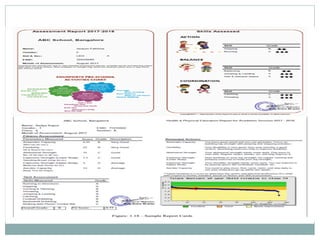
IMPORTANT TOPICS TOBE DISCUSSED:
● Introduction
● Meaning of Assessment
● Types of Assessment
● Factors influencing Assessment
● Assessment Tools
● Type of Evaluation
● Meaning and steps in qualitative assessment
● Meaning and steps in quantitative assessment
● Interaction with Parents Post Assessments
● Explanation of Performance Evaluation
● Steps for the improvement of the performance slow learners
3.
Introduction:
●Assessment is aboutlearning.
● Assessment is integral to teaching and learning activities in
school mediates the interaction between teachers and students
in the classroom.
● Assessment can be defined as all activities that teachers
and students undertake to get information that can be
used to alter teaching and learning.
● This includes teacher observation and analysis of student
work (homework, tests, essays, reports, practical
procedures and classroom discussion of issues).
4.
Meaning of Assessment:
●Assessment has two meanings , but the most suited for
physical education is “the act of making a judgment about
something” .
● The word ‘assessment’ derived from related senses of assess,
the word ‘assess’ comes from the Latin word assidere,
which means to sit beside. Literally then, to assess means to
sit beside the learner.
● Assessment is the process deployed to understand student
learning.
● Assessment is an effective tool to enhance learning.
5.
Types of Assessment:
●TeacherObservation: Teacher observation is the most common form of
assessment utilized in physical education classes. It is generally employed to assess
psychomotor performance but can be applied to the effective domain as well.
●It is highly appropriate for assessing the acquisition of critical elements of skill that
together form a more mature motor pattern.
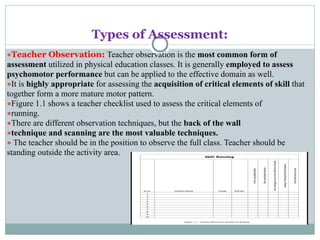
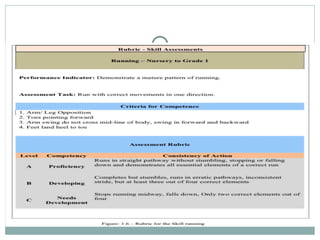
●Figure 1.1 shows a teacher checklist used to assess the critical elements of
●running.
●There are different observation techniques, but the back of the wall
●technique and scanning are the most valuable techniques.
● The teacher should be in the position to observe the full class. Teacher should be
standing outside the activity area.
6.
Types of Assessment….
●Homework:Homework is work, a student completes outside of the physical education
class it can be used to practice psychomotor skill of fitness or to enhance cognitive
understanding.
●It can include records of student progress, process and participation or writing
assignment such as report or observation of sporting events.
●Physical education homework is similar to reports of reading done at home, and we have
found work homework quite useful, especially in terms of fitness or activity participation.
●Peer observation: Peer observation is easily built into task by asking students to work
as partners and to provide each other feedback regarding performance of skill.
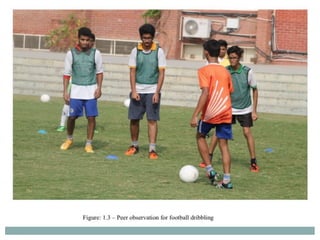
●For example, while working on dribbling with the hands, one student can be asked to
watch the other and see if the partner use the finger pads, bends the knee, and has a
staggered stance.
●Children enjoy peer observation, but the teacher need to make sure that they must define
the cues clearly enough so that the partner can observe and comment on the performance.
8.
●Self-assessment:
●Self-assessment can beused to assess psychomotor, cognitive and affective aspects
of children's work.
●self-assessment provide a unique opportunity to evaluate larger components of a
skill or the beginning use of a skill.
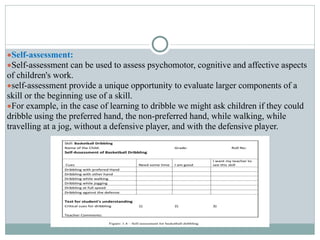
●For example, in the case of learning to dribble we might ask children if they could
dribble using the preferred hand, the non-preferred hand, while walking, while
travelling at a jog, without a defensive player, and with the defensive player.
9.
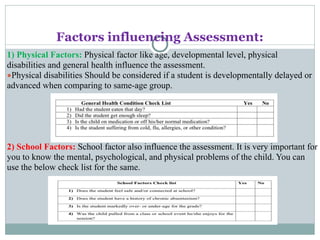
Factors influencing Assessment:
1)Physical Factors: Physical factor like age, developmental level, physical
disabilities and general health influence the assessment.
●Physical disabilities Should be considered if a student is developmentally delayed or
advanced when comparing to same-age group.
2) School Factors: School factor also influence the assessment. It is very important for
you to know the mental, psychological, and physical problems of the child. You can
use the below check list for the same.
10.
Factors influencing Assessment…
3)Teacher factors: Every teacher has different style of teaching. They are using the
same foundation of teaching, but the tools are different.
●They use different language, they have different management skills, and their
interaction with the student influences the assessments.
●Physical and mental state of the teacher and their knowledge of the test materials and
familiarity with the testing environment also impact the assessment.
11.
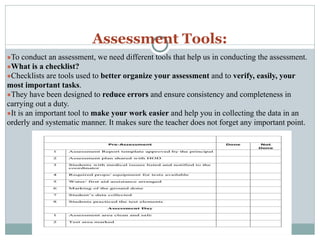
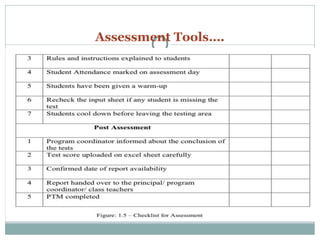
Assessment Tools:
●To conductan assessment, we need different tools that help us in conducting the assessment.
●What is a checklist?
●Checklists are tools used to better organize your assessment and to verify, easily, your
most important tasks.
●They have been designed to reduce errors and ensure consistency and completeness in
carrying out a duty.
●It is an important tool to make your work easier and help you in collecting the data in an
orderly and systematic manner. It makes sure the teacher does not forget any important point.
Assessment Tools…
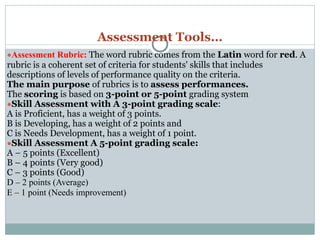
●Assessment Rubric:The word rubric comes from the Latin word for red. A
rubric is a coherent set of criteria for students' skills that includes
descriptions of levels of performance quality on the criteria.
The main purpose of rubrics is to assess performances.
The scoring is based on 3-point or 5-point grading system
●Skill Assessment with A 3-point grading scale:
A is Proficient, has a weight of 3 points.
B is Developing, has a weight of 2 points and
C is Needs Development, has a weight of 1 point.
●Skill Assessment A 5-point grading scale:
A – 5 points (Excellent)
B – 4 points (Very good)
C – 3 points (Good)
D – 2 points (Average)
E – 1 point (Needs improvement)
15.
●Benchmark: To evaluatethe performance of the student we need a certain
benchmark. There is different benchmark for different tests. And based on these
benchmarks the student gets grades.
●Every student has their own capacity and strength. It can increase with the help for
regular fitness activities. And decrease with less physical activities.
● Importance of benchmark
● In school in Delhi, the physical education teacher conducted the fitness
assessment. And based on the assessment data let say Rohan has the best
aerobic capacity in his class.
● But how can we justify that his fitness level is enough for his age group.
May be his score in 600 mtrs test is less than any other child in Himachal
Pradesh who is the least performer in his class.
● This is possible as we already discussed that physical fitness is depended on
so many different factors. So, to justify that we need a benchmark for that
particular test.
16.
Creating benchmark
●To createa benchmark, one should have the below details:
1) Data points of that particular test from different schools and from different states
2) The data should be taken for the same age group
3) Need data point for both male and female. The norm for male and female for same
test will be different.
4) More the data point more accurate will be the norms
5) After getting the data one should analyses the data and create a norms.
6) Norms will be in grading format.
7) Once the norm has been created it has to be tested for authentication with the help
of pilot testing
8) The finally based on the evaluation of all the above point the norms will be
created for the test.
17.
Evaluation & Typeof Evaluation:
●Evaluation focuses on grades.
●An evaluation can be used as a final review to gauge the quality of instruction.
It’s product oriented.
●After the Assessment, the result has been evaluated to know what the student
learned. Both assessment and evaluation require criteria, use measures and are
evidence driven.
●Difference between Assessment and Evaluation:
• Assessment is ongoing and evaluation provide closure.
• Assessment improves learning quality and evaluation judges learning level.
• Assessment upgraded and evaluation graded.
• Assessment provides feedback and evaluation shows shortfalls.
18.
Type of Evaluation…
●FormativeEvaluation: Formative evaluation is ongoing process. It
is evaluation used to monitor students learning progress during
instruction with the purpose of providing on going feedback to
students and teachers.
●Summative Evaluation: Summative evaluation evaluate the
outcome of the program. This type of evaluation is given at the end
of the course to what extent the student has mastered the intended
learning outcomes.
●Diagnostic Evaluation: Diagnostic means to find out the exact
problem. Through diagnostic evaluation the teacher can know the
student (their strength and weakness). This evaluation also helps to
find out the causes of learning problem. This can be fixed with the
remedial actions.
19.
Meaning and stepsin qualitative assessment:
●A qualitative assessment is based on the experience, judgment, and wisdom of
the teacher who knows and teaches the skills to the students.
●Qualitative methods are a good starting point when you begin your assessment.
●These methods can be useful for describing a situation and can provide insight
for your intervention approach.
●Qualitative assessment is based on cues or rubrics.
●Steps in qualitative assessment:
● Assessment Planning:
● Planning is the most important part in any assessment. Planning has different
elements. It should include such things as purpose for assessment, methods and
tools that will be used, the duration and the resources and materials.
20.
●Assessment plan outline:
•Objectives – describe the objectives for assessments from Students,
Teacher’s, School’s and Parent’s point of view.
• Techniques – indicate methods to be used for test.
• Time-Line – indicate the plan of testing, When, which students will come to
the ground, which tests would be conducted, when data will be collected and
analyzed, when reports will be available, and when inference /
recommendations will be made.
• Resources and Materials – indicate who has responsibility for seeing the
plan is carried out, who will conduct and analyze data, and who will
summarize/report results, ground and equipment conditions, first aid and
drinking water availability.
21.
Pre, During andPost assessment:
●Pre-Assessment: Preparation Phase
1. Students should know what assessments they will go through and should have practiced before
their assessments.
2. Assessment schedule should be discussed school coordinator
3. Parents should be informed of the assessment schedule and requested to provide consent. Students
having any physical/ medical issue should be identified and should not participate in the test. This
information should be provided to the school coordinator.
4. Approval for report template should be taken from the Principal.
5. Weather conditions should be checked while planning assessment as all these assessments are
outdoors.
6. Collection of the student’s data should be done through program coordinator in the school. Cross
check student’s data with class attendance register and fix the discrepancies (if any).
7. Once student’s data is collected, generation of on-ground input sheets.
8. Check the school props/equipment list for their availability for assessment. If any prop/ equipment
is damaged or not usable, inform school coordinator and get them replaced beforehand. This is to be
done simultaneously when you are working on student’s data collection.
9. Ground marking should be complete.
10. Drinking water availability and first aid assistance should be in place. If school nurse is involved
explain the process of assessments and the need for her assistance.
22.
Pre, During andPost assessment…
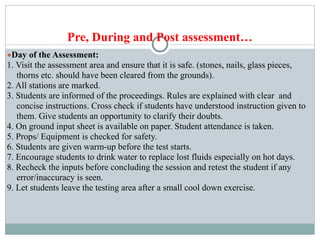
●Day of the Assessment:
1. Visit the assessment area and ensure that it is safe. (stones, nails, glass pieces,
thorns etc. should have been cleared from the grounds).
2. All stations are marked.
3. Students are informed of the proceedings. Rules are explained with clear and
concise instructions. Cross check if students have understood instruction given to
them. Give students an opportunity to clarify their doubts.
4. On ground input sheet is available on paper. Student attendance is taken.
5. Props/ Equipment is checked for safety.
6. Students are given warm-up before the test starts.
7. Encourage students to drink water to replace lost fluids especially on hot days.
8. Recheck the inputs before concluding the session and retest the student if any
error/inaccuracy is seen.
9. Let students leave the testing area after a small cool down exercise.
23.
Pre, During andPost assessment…
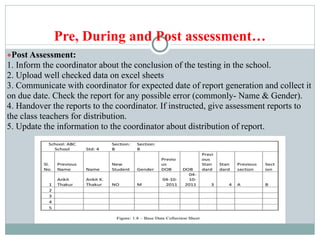
●Post Assessment:
1. Inform the coordinator about the conclusion of the testing in the school.
2. Upload well checked data on excel sheets
3. Communicate with coordinator for expected date of report generation and collect it
on due date. Check the report for any possible error (commonly- Name & Gender).
4. Handover the reports to the coordinator. If instructed, give assessment reports to
the class teachers for distribution.
5. Update the information to the coordinator about distribution of report.
24.
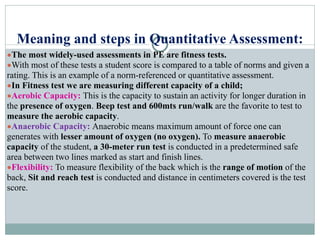
Meaning and stepsin Quantitative Assessment:
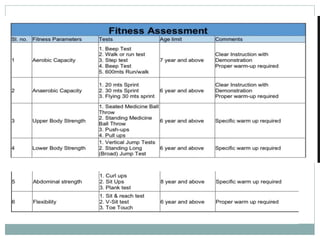
●The most widely-used assessments in PE are fitness tests.
●With most of these tests a student score is compared to a table of norms and given a
rating. This is an example of a norm-referenced or quantitative assessment.
●In Fitness test we are measuring different capacity of a child;
●Aerobic Capacity: This is the capacity to sustain an activity for longer duration in
the presence of oxygen. Beep test and 600mts run/walk are the favorite to test to
measure the aerobic capacity.
●Anaerobic Capacity: Anaerobic means maximum amount of force one can
generates with lesser amount of oxygen (no oxygen). To measure anaerobic
capacity of the student, a 30-meter run test is conducted in a predetermined safe
area between two lines marked as start and finish lines.
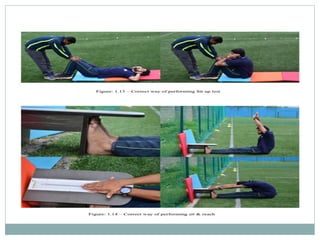
●Flexibility: To measure flexibility of the back which is the range of motion of the
back, Sit and reach test is conducted and distance in centimeters covered is the test
score.
25.
● Abdominal Strength:It is measured by conducting Sit-ups (curl-
ups) test. Total number of sit-ups in predefined time duration is the
test score.
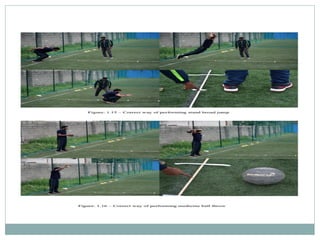
● Explosive strength (Lower body): This is measured using Standing
broad jump test. Distance covered in meters is the test score.
● Explosive strength (Upper body): The test used to measure upper
body explosive strength is Over head medicine ball throw.
Maximum distance the medicine ball covers at its first bounce after
release from the hands of the student is the test score measured in
meters.
● Height and Weight: Height and weight of the child in relation to his
age is a good indicator of his health and development.(BMI)
29.
Steps in quantitativeassessment:
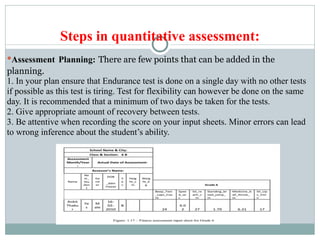
●Assessment Planning: There are few points that can be added in the
planning.
1. In your plan ensure that Endurance test is done on a single day with no other tests
if possible as this test is tiring. Test for flexibility can however be done on the same
day. It is recommended that a minimum of two days be taken for the tests.
2. Give appropriate amount of recovery between tests.
3. Be attentive when recording the score on your input sheets. Minor errors can lead
to wrong inference about the student’s ability.
30.
Parent Teacher Meeting
●Thisis the opportunity for you to interact with the parents by explaining the report. Parents
will ask a lot of questions about the performance of their children.
●Here are few tips on how to manage PTMs:
●Managing a Parent–Teacher meetings
• A two-way conversation: The parent–teacher meeting is not only a opportunity for parents to
learn from you, but for you to learn from them Nobody knows your students better than their
families. Their insights into their child’s strengths and needs, learning styles and non-school
learning opportunities can help you improve your instructional methods.
●Emphasis on learning. You can make the most of parent–teacher meetings, and other forms
of parent involvement, by “linking them to learning.” This means communication back to
discussing strategies to support student learning. You can arm parents with knowledge and
suggestions for how to help their children learn.
●Opportunities and challenges. We all need praise and constructive criticism to grow. All
parents are proud of their children and need to hear about their strengths as well as their
challenges from you. This helps show parents that you value the unique strengths of their
children and have high expectations for their ability to succeed in school and in life.
31.
Parent Teacher Meeting…
●PrePTM Preparation:
• Confirm the date and time of the PTM from the school.
• Inform your coordinator of the upcoming PTM an check for his / her availability.
• Ensure error-free report cards are delivered to the school.
• Identify a spot where the props can be showcased (preferably outside the
classroom).
• Keep parent testimonial forms ready.
● During the PTM:
• Reach the school well in advance
• Be presentable
• Display clean and usable props
• Be available outside the classroom
32.
Parent Teacher Meeting…
●Thingsto Remember
• Be on time
• Stay calm
• Communication should be polite.
• Understand the question first before you answer it.
• If parents are willing, ask them to fill the testimonial.
• Always be positive when speaking about the child, school.
● Post PTM
• Send the event completion report and testimonials to the coordinator on the
same day.
• If there are any major issues / escalations, report to the concerned authority
immediately.
33.
Explanation of PerformanceEvaluation:
●Most of the time parents are not aware of the actual performance of the child. They just see
some grading and evaluate their children based on their own understanding. Hence, it is very
important for the physical education teachers to make them understand the grading system and
also the performance of their children.
●Explaining evaluation
●Skill Assessment is qualitative assessment and based on the rubrics so the result will be in the
grading format.
●To measure the result and to convert it into numbers, we can use 2 type of grading scale:
1) A 3- point grading scale
2) A 5-point grading scale
●A 3-point grading scale with different weight
• A -3 points
• B -2 points
• C - 1 point
A is Proficient.
B is Developing.
C is Needs Development.
34.
Explanation of PerformanceEvaluation…
●A 5-point grading scale with different weight
• A – 5 points
• B – 4 points
• C – 3 points
• D – 2 points
• E – 1 point
●5-point grading scale is used to show the ratings for all fitness
parameters
A – Excellent
B – Very good
C – Good
D – Average
E – Needs improvement
35.
Steps for theimprovement of the performance
slow learners:
●Remedial measure
●Every student possesses a different level of learning abilities and fitness level.
●One cannot depend on one remedial for all the students. It should be specific to
●the different skill as well as for different fitness capacities.
●Sample remedial measure to improve the aerobic capacity
● AEROBIC CAPACITY: Aerobic capacity expressed by taking a measure
of the amount of oxygen you can use in one minute per kilogram
of body weight.
● Cardio training increases your aerobic capacity by making your body
more efficient at utilizing available oxygen and by increasing your
cardiovascular system's ability to transport oxygen.
1. Walking/Running: Walking leads to better cardiovascular fitness, stronger leg
muscles, lower blood pressure, lower risk of heart disease, diabetes, bowel cancer.
Also running is an inexpensive exercise you can do anywhere at a time that suits
you.
36.
2. Jumping Rope:Jumping rope burns up to 13 calories a minute,
and is great for a quick workout on the go and also to improve your
aerobic capacity.
3. Swimming: If it’s too hot to walk or run, swimming can be a cool way to
get fit. It’s a low-cost workout for the whole body especially the muscles of
the back, shoulder and arms and improves flexibility as well.
4. Cycling: Cycling does double duty as an aerobic workout as well as being
a low-cost, ecofriendly form of transport. It’s good exercise for improving
leg strength and toning the leg and buttock muscles.
5. Dancing: Faster styles of dancing such as Jazz, Hip hop, African and Latin
American can provide an aerobic workout and improve flexibility and bone
strength while being a lot of fun.