Chapter 6
Curriculum Design
KRISTEN WOOLDRIDGE
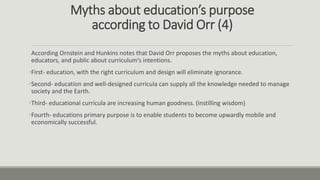
Myths about education’s purpose
according to David Orr (4)
According Ornstein and Hunkins notes that David Orr proposes the myths about education,
educators, and public about curriculum’s intentions.
•First- education, with the right curriculum and design will eliminate ignorance.
•Second- education and well-designed curricula can supply all the knowledge needed to manage
society and the Earth.
•Third- educational curricula are increasing human goodness. (instilling wisdom)
•Fourth- educations primary purpose is to enable students to become upwardly mobile and
economically successful.
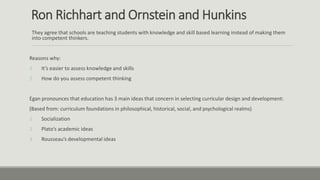
Ron Richhart and Ornstein and Hunkins
They agree that schools are teaching students with knowledge and skill based learning instead of making them
into competent thinkers.
Reasons why:
1. It’s easier to assess knowledge and skills
2. How do you assess competent thinking
Egan pronounces that education has 3 main ideas that concern in selecting curricular design and development:
(Based from: curriculum foundations in philosophical, historical, social, and psychological realms)
1. Socialization
2. Plato’s academic ideas
3. Rousseau’s developmental ideas
Social
Education wants to socialize students in order for them to become functioning members of
society.
Meanwhile, the word socialize means to foster conformity. (Ornstein & Hunkins, p. 150, 2013)
When socialization is over stressed it leads to misinterpretation.
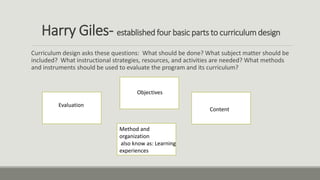
Harry Giles- established four basic parts to curriculum design
Curriculum design asks these questions: What should be done? What subject matter should be
included? What instructional strategies, resources, and activities are needed? What methods
and instruments should be used to evaluate the program and its curriculum?
Objectives
Content
Method and
organization
also know as: Learning
experiences
Evaluation
Ronald Doll’s view of curriculum design
The instructional design governs over the curriculum
Blended curriculum design and instructional design = Ronald’s views
Curriculum focuses on learning content, activities and structures through students.
Allows for measurable outcomes
Describes the foundation of the design: science, society, eternal truths, and divine will.
 Aligns with Dewey and Bode popularized by Tyler knowledge, society, and the learner. (Ornstein
& Hunkins, p. 152, 2013)
Sources of Curriculum Design
Curriculum designers must refine their philosophical, social, and political views ( of society and learners)
broken into 5 main areas:
Science as a source:
•Relies on the scientific method.
•Only observable and quantifiable elements.
•Uses problem solving and is concerned with the
“learning how to learn” (Ornstein & Hunkins, 2013, p.
152).
Society as a source:
•Society is an agent for which school should draw its
curriculum from.
•Considers the current and future society in general.
•Believe in socialization to build and reflect students as
they impact the future society.
•Political roles play a big role with added pressures.
Radical, conservative, and liberal all value uniqueness
however also stress the importance of collaboration
and cooperation to society as a whole.
•Aims to students’ individual needs for their particular
social group.
•Demonstrates emphasis towards schools giving back to
their communities.
Sources of Curriculum Design continued
Moral Doctrine as a source:
•Look to the past for direction to guide the future content.
•Values the relationship between knowledge and people’s beliefs.
•Content is analyzes a bible or religious basis (Dates back to the colonial
America)
•Design stresses value among some content areas.
•Not seen in public schools due to the separate Church and state issues.
•Seen today in parochial and private schools.
•Public schools- is making aiming towards making student aware of the
different religious background to build – acceptance of all not to teach
and learn.
•Also today according to James Moffett said that that making students
aware of people’s different backgrounds can help promote a more
empathetic and insightful student.
•William Pinar adds that this moral/ religious may give a blended
Knowledge as a source:
•Is considered to be the most important source of curriculum
•Dates back to Plato’s academic idea : who asks the question “ What
knowledge is of the most worth?” (Ornstein & Hunkins, 2013, p. 154)
•Centers on knowledge based learning. Can be disciplined to a special
focus, or undisciplined with a unique structure pattern
•The question posed: “For whom is this knowledge of value?” “What
intellectual skills must be taught to enable common and uncommon
knowledge to be utilized for individual and social good?” (Ornstein &
Hunkins, 2013, p. 154)
Sources of Curriculum Design continued
The Learner as a source:
Knowledge about our students enables students to foster their uniqueness to strengthen their abilities.
How they learn, form attitudes, generate interests, and develop values,
Goes back Rousseau’s Theory of develop for the basis of the curriculum
Uses cognitive brain research to help develop the curriculum
Design Dimensions – A curriculum should have these elements a
scope, sequence, continuity, integration, articulation, and balance. (Ornstein & Hunkins,
2013, p. 156)
Scope
According to Ornstein & Hunkins as the breadth and depth. The scope is the organized puzzle pieces of
information that once are aligned that can give you information about key topics ad activities within the domain
areas.
• It also considers the domains cognitive, affective, and psychomotor. (possibly a moral/ spiritual one)
• Is the big picture
Sequence
• The cumulative and act of continuously building upon knowledge. Many opinions are formed about building on
subject matter or the way we process information (Ornstein & Hunkins, 2013, p. 156).
• Four principles of learning outlined by Smith, Stanley, Harlan Shores in 1957 are:
• A. Simple to complex learning
• B. Prerequisite learning
• C. Whole to part learning
• D. Chronological learning
• Later in 1976 Posner and Strike developed their own types of sequencing: concept related, inquiry related, learning
related, and utilization related. (aims towards students thinking deeper on a developmental level to maximize all
capabilities. (Ornstein & Hunkins, 2013, p. 156)
Continuity
Is the vertical repetition of curriculum components.
Is the process which subject areas that are important are taught throughout the curriculum
each year. However, students should build upon what they previously learned to deepen
their thinking within the experience. (“through deeply myriad experiences in which thinking
and questioning are enriched” (Ornstein & Hunkins, 2013, p. 157)
Integration
A Horizontal approach
Is the act of knowledge and experiences within the curriculum this ables students to see a
lessons in a unified fashion.
Noted in 1960 by Taba the disadvantages of not having a integrated curriculum. That students
will have limited knowledge and prevents students seeing knowledge is a unified way.
(Ornstein & Hunkins, 2013)
Likely to have been utilized during: postmodernism, constructionism, and poststructuralism
Articulation
Implements a vertical and horizontal approach looking at the sequencing and grade level
alignments.
However this is a district based plan that needs to be established. Takes into account the
fluent movement of students through the districts and schools.
Representative Curriculum Designs
“ Most curriculum designs are modifications or interpretations of three designs” (Ornstein &
Hunkins, 2013, p. 159).
•All designs center around the mechanics of socialization, Plato
•Academic idea, and Rousseau’s developmental idea.
•They are subject centered, learner- centered, and problem centered.
Curriculum Designs
These two designs aims towards academics
Subject- centered design
•Stresses academics
•Most popular and widely used
•Uses knowledge and content for an integral approach
•Rooted from Plato’s academic ideas allows students to
gain essential knowledge of society.
•Cons: does not allow the students to construct
meaning
•Compartmentalized learning material
•Fails to foster social, psychological, and physical
development.
Discipline Design (1950’s-1960’s)
•Based from historians and what would they do- mindset
•Separate subject design format
•Understanding of conceptual structures and processes of the
disciplines
•Pros students master subject area and develop a sense of
independence to continue learning
•Accordingly to Bruner he believes that students have a sense pf
relationships between concepts and principles.
•Cons: does not account that knowledge learning can be classified
as disciplined. (Ornstein & Hunkins,2013)
Designs continued
Broad- Fields Design (1910)
This is an interdisciplinary design. It stems from
subject centered design. Focuses on students
sweeping understanding of all content areas that
integrate contents so that fit together in a logical
sense. Integration of geography, economics,
political science, anthropology, sociology and
history merged to what we know as Social Studies.
Some strengths was that students gained a focus on
curriculum webs.
Cons: People think that it is to broad and wonder
how much depth is insufficient. (Ornstein &
Hunkins, 2013)
Correlation Design (50’s – 60’s)
This design is in the middle of separate subjects and
total content integrations. They see the sense and
notation for both at times. Correlation identifies
ways to relate subjects to one another but also
establish their identities. Some areas where this
has been seen is science and math, and literature
and history. Correlation uses a creative mapping to
attract its audience.
Cons: The process is very time consuming and
would have scheduling concerns.
(Ornstein & Hunkins, 2013)
Designs Continued
Process Designs
Urges students to learn procedures and
processes of obtaining knowledge. Also looks
at “ teaching for intelligences and on the
development of intellectual character”
(Ornstein & Hunkins, 2013 p. 164).
Relies on procedures process so students can
develop meaning. Students uses higher level
of thinking by investigating and clarifying their
thinking.
(Ornstein & Hunkins, 2013)
Learner- Centered Designs
These designs were created in response to whole child. Founded in elementary
schools who stress socialization and Rousseau's developmental ideas.
Child Centered Design
The student plays an active role in their
learning environment. The design is based on
students’ lives, needs and interests not subject
matter (Ornstein & Hunkins, 2013 p. 165).
Believes that effective learning is exploratory
with hands on experiences to guide them.
Experience- Centered Design
Resembles child centered design however is
on the spot curriculum is developed. Reasons
around child interests can be undetermined or
unanticipated. Students design their own
learning and construct and revise their
knowledge through participation and active
observation. (Ornstein & Hunkins, 2013)
According to Dewey he wanted educators to
analyze children’s experiences to see how they
shaped a children’s knowledge not let the child
decide.
Designs continued
Romantic (Radical) design
This area students learn ways of engaging in a
critique of knowledge. Learning is reflective
and it is not externally imposed by someone in
power. (students are invited into learning)
Students are placed into categories of have
and have not. Radicals believe that society is
flawed and education indoctrinates students
to serve controlling groups. (Ornstein &
Hunkins, 2013p. 168)
Humanistic Design (20’s- 30s)
Gained more influences later during the 60’s-
70’s. Emphasized human potential and
empowering students by actively involving in
their personal growth. Students approach
problems with flexibility and intelligences.
According to Rogers he believes in self
directed learning where students draw on
their own resources to improve self
understanding. (Ornstein & Hunkins, 2013, p.
168).
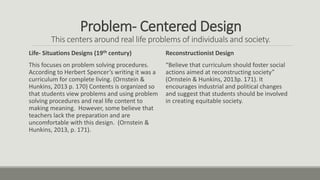
Problem- Centered Design
This centers around real life problems of individuals and society.
Life- Situations Designs (19th century)
This focuses on problem solving procedures.
According to Herbert Spencer’s writing it was a
curriculum for complete living. (Ornstein &
Hunkins, 2013 p. 170) Contents is organized so
that students view problems and using problem
solving procedures and real life content to
making meaning. However, some believe that
teachers lack the preparation and are
uncomfortable with this design. (Ornstein &
Hunkins, 2013, p. 171).
Reconstructionist Design
“Believe that curriculum should foster social
actions aimed at reconstructing society”
(Ornstein & Hunkins, 2013p. 171). It
encourages industrial and political changes
and suggest that students should be involved
in creating equitable society.
Which curriculum model: technical, scientific, or nontechnical, do you
believe has greater relevance in the 21st century? Explain.
After careful analysis of each approach It seems that Technical- Scientific Approach still has a greater
relevance in the 21st century. This approach models will specific subject matter goals with specific outputs. It
also requires using a scientific principles with constant monitoring in place for success. This model represents
our current curriculum with the increasing of rigorous standards and impact on student learning. According
to Bobbitt and Charters a curriculum is written however the builder or teacher may need do some scaffolding
to help students reach the goal or may need make it more rigorous for students. As the teacher we can
facilitate the learning environment in which to help our students succeed. After reviewing the Tyler model
and principles we can see evidence in todays curriculum with the continuous stresses on reading and math.
This model is very reflective of the model we today in education which is to ultimately better prepare our for
the 21st century. I find this to be evident through our interconnected curriculum and through our lesson plan
formats, and our continuous monitoring practices. We utilizes similar cycles to these models established such
as assess- teach- monitor- evaluate then restart the cycle over. Both approaches bring many valuable points
that are important when considering curriculum. The non-technical non-scientific approach does not reflect
test scores. I agree that the notion of test scores do not always accurately depict learning however, it still is a
concrete measure that can demonstrate understanding. Schools rely on testing and measurement to
determine students growth and development patterns. Overall, there are parts of both that seem to be more
developmentally appropriately for different grade levels but as curriculum developers and leaders that are
constructing the curriculum they look at the big picture of what is best for preparing our students in today’s
society bringing us back to the Technical-Scientific approach.
What dangers are there in equating goals and standards?
Accordingly to Ornstein and Hunkins, goals and standards seem to have melded together in the
educational lingo. Ravitch proposed that a standard is a goal as to what should be accomplished
and also measure progress in attaining that goal. For example in First our students reading
standard for the end of the year is a level J. Also standards are content and performance specific
and are a direct reflection of the standards themselves. Throughout the year we are tracking our
students through progress monitoring to ensure that students are making growth in this area.
Meanwhile, goals are terms are more general such as to become a fluent First grade reader.
What are the central criteria to consider when selecting
curriculum content? Curriculum experiences
When selecting curriculum content accordingly to Ornstein and Hunkins we must consider the
following self-sufficiency, significance, validity, interest , utility, learnability, and feasibility. Each
of these criteria elements play an important role in determining and selecting a valuable content
that will contribute to society in a positive and futuristic way. These criteria serve as a valuable
tool for not only selecting criteria for curriculum but also see this evidence towards effective
instructional planning and preplanning (lesson plans). The more I learn about curriculum and
what makes up an effective curriculum, the more Common Core makes sense to me as a teacher
and future curriculum developer.

Chapter 6 and 7

  • 1.
  • 2.
    Myths about education’spurpose according to David Orr (4) According Ornstein and Hunkins notes that David Orr proposes the myths about education, educators, and public about curriculum’s intentions. •First- education, with the right curriculum and design will eliminate ignorance. •Second- education and well-designed curricula can supply all the knowledge needed to manage society and the Earth. •Third- educational curricula are increasing human goodness. (instilling wisdom) •Fourth- educations primary purpose is to enable students to become upwardly mobile and economically successful.
  • 3.
    Ron Richhart andOrnstein and Hunkins They agree that schools are teaching students with knowledge and skill based learning instead of making them into competent thinkers. Reasons why: 1. It’s easier to assess knowledge and skills 2. How do you assess competent thinking Egan pronounces that education has 3 main ideas that concern in selecting curricular design and development: (Based from: curriculum foundations in philosophical, historical, social, and psychological realms) 1. Socialization 2. Plato’s academic ideas 3. Rousseau’s developmental ideas
  • 4.
    Social Education wants tosocialize students in order for them to become functioning members of society. Meanwhile, the word socialize means to foster conformity. (Ornstein & Hunkins, p. 150, 2013) When socialization is over stressed it leads to misinterpretation.
  • 5.
    Harry Giles- establishedfour basic parts to curriculum design Curriculum design asks these questions: What should be done? What subject matter should be included? What instructional strategies, resources, and activities are needed? What methods and instruments should be used to evaluate the program and its curriculum? Objectives Content Method and organization also know as: Learning experiences Evaluation
  • 6.
    Ronald Doll’s viewof curriculum design The instructional design governs over the curriculum Blended curriculum design and instructional design = Ronald’s views Curriculum focuses on learning content, activities and structures through students. Allows for measurable outcomes Describes the foundation of the design: science, society, eternal truths, and divine will.  Aligns with Dewey and Bode popularized by Tyler knowledge, society, and the learner. (Ornstein & Hunkins, p. 152, 2013)
  • 7.
    Sources of CurriculumDesign Curriculum designers must refine their philosophical, social, and political views ( of society and learners) broken into 5 main areas: Science as a source: •Relies on the scientific method. •Only observable and quantifiable elements. •Uses problem solving and is concerned with the “learning how to learn” (Ornstein & Hunkins, 2013, p. 152). Society as a source: •Society is an agent for which school should draw its curriculum from. •Considers the current and future society in general. •Believe in socialization to build and reflect students as they impact the future society. •Political roles play a big role with added pressures. Radical, conservative, and liberal all value uniqueness however also stress the importance of collaboration and cooperation to society as a whole. •Aims to students’ individual needs for their particular social group. •Demonstrates emphasis towards schools giving back to their communities.
  • 8.
    Sources of CurriculumDesign continued Moral Doctrine as a source: •Look to the past for direction to guide the future content. •Values the relationship between knowledge and people’s beliefs. •Content is analyzes a bible or religious basis (Dates back to the colonial America) •Design stresses value among some content areas. •Not seen in public schools due to the separate Church and state issues. •Seen today in parochial and private schools. •Public schools- is making aiming towards making student aware of the different religious background to build – acceptance of all not to teach and learn. •Also today according to James Moffett said that that making students aware of people’s different backgrounds can help promote a more empathetic and insightful student. •William Pinar adds that this moral/ religious may give a blended Knowledge as a source: •Is considered to be the most important source of curriculum •Dates back to Plato’s academic idea : who asks the question “ What knowledge is of the most worth?” (Ornstein & Hunkins, 2013, p. 154) •Centers on knowledge based learning. Can be disciplined to a special focus, or undisciplined with a unique structure pattern •The question posed: “For whom is this knowledge of value?” “What intellectual skills must be taught to enable common and uncommon knowledge to be utilized for individual and social good?” (Ornstein & Hunkins, 2013, p. 154)
  • 9.
    Sources of CurriculumDesign continued The Learner as a source: Knowledge about our students enables students to foster their uniqueness to strengthen their abilities. How they learn, form attitudes, generate interests, and develop values, Goes back Rousseau’s Theory of develop for the basis of the curriculum Uses cognitive brain research to help develop the curriculum
  • 10.
    Design Dimensions –A curriculum should have these elements a scope, sequence, continuity, integration, articulation, and balance. (Ornstein & Hunkins, 2013, p. 156) Scope According to Ornstein & Hunkins as the breadth and depth. The scope is the organized puzzle pieces of information that once are aligned that can give you information about key topics ad activities within the domain areas. • It also considers the domains cognitive, affective, and psychomotor. (possibly a moral/ spiritual one) • Is the big picture Sequence • The cumulative and act of continuously building upon knowledge. Many opinions are formed about building on subject matter or the way we process information (Ornstein & Hunkins, 2013, p. 156). • Four principles of learning outlined by Smith, Stanley, Harlan Shores in 1957 are: • A. Simple to complex learning • B. Prerequisite learning • C. Whole to part learning • D. Chronological learning • Later in 1976 Posner and Strike developed their own types of sequencing: concept related, inquiry related, learning related, and utilization related. (aims towards students thinking deeper on a developmental level to maximize all capabilities. (Ornstein & Hunkins, 2013, p. 156) Continuity Is the vertical repetition of curriculum components. Is the process which subject areas that are important are taught throughout the curriculum each year. However, students should build upon what they previously learned to deepen their thinking within the experience. (“through deeply myriad experiences in which thinking and questioning are enriched” (Ornstein & Hunkins, 2013, p. 157) Integration A Horizontal approach Is the act of knowledge and experiences within the curriculum this ables students to see a lessons in a unified fashion. Noted in 1960 by Taba the disadvantages of not having a integrated curriculum. That students will have limited knowledge and prevents students seeing knowledge is a unified way. (Ornstein & Hunkins, 2013) Likely to have been utilized during: postmodernism, constructionism, and poststructuralism Articulation Implements a vertical and horizontal approach looking at the sequencing and grade level alignments. However this is a district based plan that needs to be established. Takes into account the fluent movement of students through the districts and schools.
  • 11.
    Representative Curriculum Designs “Most curriculum designs are modifications or interpretations of three designs” (Ornstein & Hunkins, 2013, p. 159). •All designs center around the mechanics of socialization, Plato •Academic idea, and Rousseau’s developmental idea. •They are subject centered, learner- centered, and problem centered.
  • 12.
    Curriculum Designs These twodesigns aims towards academics Subject- centered design •Stresses academics •Most popular and widely used •Uses knowledge and content for an integral approach •Rooted from Plato’s academic ideas allows students to gain essential knowledge of society. •Cons: does not allow the students to construct meaning •Compartmentalized learning material •Fails to foster social, psychological, and physical development. Discipline Design (1950’s-1960’s) •Based from historians and what would they do- mindset •Separate subject design format •Understanding of conceptual structures and processes of the disciplines •Pros students master subject area and develop a sense of independence to continue learning •Accordingly to Bruner he believes that students have a sense pf relationships between concepts and principles. •Cons: does not account that knowledge learning can be classified as disciplined. (Ornstein & Hunkins,2013)
  • 13.
    Designs continued Broad- FieldsDesign (1910) This is an interdisciplinary design. It stems from subject centered design. Focuses on students sweeping understanding of all content areas that integrate contents so that fit together in a logical sense. Integration of geography, economics, political science, anthropology, sociology and history merged to what we know as Social Studies. Some strengths was that students gained a focus on curriculum webs. Cons: People think that it is to broad and wonder how much depth is insufficient. (Ornstein & Hunkins, 2013) Correlation Design (50’s – 60’s) This design is in the middle of separate subjects and total content integrations. They see the sense and notation for both at times. Correlation identifies ways to relate subjects to one another but also establish their identities. Some areas where this has been seen is science and math, and literature and history. Correlation uses a creative mapping to attract its audience. Cons: The process is very time consuming and would have scheduling concerns. (Ornstein & Hunkins, 2013)
  • 14.
    Designs Continued Process Designs Urgesstudents to learn procedures and processes of obtaining knowledge. Also looks at “ teaching for intelligences and on the development of intellectual character” (Ornstein & Hunkins, 2013 p. 164). Relies on procedures process so students can develop meaning. Students uses higher level of thinking by investigating and clarifying their thinking. (Ornstein & Hunkins, 2013)
  • 15.
    Learner- Centered Designs Thesedesigns were created in response to whole child. Founded in elementary schools who stress socialization and Rousseau's developmental ideas. Child Centered Design The student plays an active role in their learning environment. The design is based on students’ lives, needs and interests not subject matter (Ornstein & Hunkins, 2013 p. 165). Believes that effective learning is exploratory with hands on experiences to guide them. Experience- Centered Design Resembles child centered design however is on the spot curriculum is developed. Reasons around child interests can be undetermined or unanticipated. Students design their own learning and construct and revise their knowledge through participation and active observation. (Ornstein & Hunkins, 2013) According to Dewey he wanted educators to analyze children’s experiences to see how they shaped a children’s knowledge not let the child decide.
  • 16.
    Designs continued Romantic (Radical)design This area students learn ways of engaging in a critique of knowledge. Learning is reflective and it is not externally imposed by someone in power. (students are invited into learning) Students are placed into categories of have and have not. Radicals believe that society is flawed and education indoctrinates students to serve controlling groups. (Ornstein & Hunkins, 2013p. 168) Humanistic Design (20’s- 30s) Gained more influences later during the 60’s- 70’s. Emphasized human potential and empowering students by actively involving in their personal growth. Students approach problems with flexibility and intelligences. According to Rogers he believes in self directed learning where students draw on their own resources to improve self understanding. (Ornstein & Hunkins, 2013, p. 168).
  • 17.
    Problem- Centered Design Thiscenters around real life problems of individuals and society. Life- Situations Designs (19th century) This focuses on problem solving procedures. According to Herbert Spencer’s writing it was a curriculum for complete living. (Ornstein & Hunkins, 2013 p. 170) Contents is organized so that students view problems and using problem solving procedures and real life content to making meaning. However, some believe that teachers lack the preparation and are uncomfortable with this design. (Ornstein & Hunkins, 2013, p. 171). Reconstructionist Design “Believe that curriculum should foster social actions aimed at reconstructing society” (Ornstein & Hunkins, 2013p. 171). It encourages industrial and political changes and suggest that students should be involved in creating equitable society.
  • 18.
    Which curriculum model:technical, scientific, or nontechnical, do you believe has greater relevance in the 21st century? Explain. After careful analysis of each approach It seems that Technical- Scientific Approach still has a greater relevance in the 21st century. This approach models will specific subject matter goals with specific outputs. It also requires using a scientific principles with constant monitoring in place for success. This model represents our current curriculum with the increasing of rigorous standards and impact on student learning. According to Bobbitt and Charters a curriculum is written however the builder or teacher may need do some scaffolding to help students reach the goal or may need make it more rigorous for students. As the teacher we can facilitate the learning environment in which to help our students succeed. After reviewing the Tyler model and principles we can see evidence in todays curriculum with the continuous stresses on reading and math. This model is very reflective of the model we today in education which is to ultimately better prepare our for the 21st century. I find this to be evident through our interconnected curriculum and through our lesson plan formats, and our continuous monitoring practices. We utilizes similar cycles to these models established such as assess- teach- monitor- evaluate then restart the cycle over. Both approaches bring many valuable points that are important when considering curriculum. The non-technical non-scientific approach does not reflect test scores. I agree that the notion of test scores do not always accurately depict learning however, it still is a concrete measure that can demonstrate understanding. Schools rely on testing and measurement to determine students growth and development patterns. Overall, there are parts of both that seem to be more developmentally appropriately for different grade levels but as curriculum developers and leaders that are constructing the curriculum they look at the big picture of what is best for preparing our students in today’s society bringing us back to the Technical-Scientific approach.
  • 19.
    What dangers arethere in equating goals and standards? Accordingly to Ornstein and Hunkins, goals and standards seem to have melded together in the educational lingo. Ravitch proposed that a standard is a goal as to what should be accomplished and also measure progress in attaining that goal. For example in First our students reading standard for the end of the year is a level J. Also standards are content and performance specific and are a direct reflection of the standards themselves. Throughout the year we are tracking our students through progress monitoring to ensure that students are making growth in this area. Meanwhile, goals are terms are more general such as to become a fluent First grade reader.
  • 20.
    What are thecentral criteria to consider when selecting curriculum content? Curriculum experiences When selecting curriculum content accordingly to Ornstein and Hunkins we must consider the following self-sufficiency, significance, validity, interest , utility, learnability, and feasibility. Each of these criteria elements play an important role in determining and selecting a valuable content that will contribute to society in a positive and futuristic way. These criteria serve as a valuable tool for not only selecting criteria for curriculum but also see this evidence towards effective instructional planning and preplanning (lesson plans). The more I learn about curriculum and what makes up an effective curriculum, the more Common Core makes sense to me as a teacher and future curriculum developer.