1. Behaviourism – Mental states are
dispositions to behave
2. IdentityTheory – Mental States are
brain states
3. Functionalism - Mental States are
functional states that causally relate
inner states with behavioural effects.
4. Eliminative Materialism – Mental
states do not exist
• Physicalist theories about
the mind are based
around the idea that we
can explain mental states
in terms of physical
states.
• Advances in neuroscience
suggests that our mental
life is dependent on
physical processes within
our bodies – especially the
brain.
• Watch
• http://www.youtube.com/watch?v
• http://www.youtube.com/wat
ch?
v=D8S6b7Qo4Wc&feature=re
lated
• Tied to the development of psychology
• In order to learn about the mind
psychologists began to study human
behaviour
• Logical behaviourism B. F. Skinner (1904-
1990)
• He claimed we can eliminate all mental
terms like ‘pain’, ‘belief’, or ‘hope’, from our
scientific discourse into claims about
human behaviour.
• E.g. Consider ‘John loves Lucy’. This
sentence should not be considered good
scientific language since we cannot verify
the statement as true or false.
• He argued the sentence should be
translated into something more meaningful
about behaviour. E.g. John has a tendency
to bring Lucy flowers or he tells often
enough that he ‘loves her’.
• As this behaviour can be verified it
therefore provided a more reliable method
of scientific discourse.
• This then is the argument
• Logical behaviourists suggest all
mental states of mind like beliefs and
sensations can be understood as
states of mind to behave in certain
ways.
• What would an LB transform this
sentence into?
• Henry is mad with Caroline
• LB solves the mind/body problem by
explaining minds in terms of
behaviour.
• It avoids therefore the problem of
interaction that causes severe
problems for the dualists.
• One fundamental flaw to LB is
that people at times act in ways
that clearly doesn’t reflect their
mental disposition.
• Real feelings do not always
correspond to behaviour.
• E.g Pretending we like someone
in fact we can’t stand them.
• Discuss – Is there any situations
in your lives in which your
behaviour has not corresponded
to your thoughts and feelings?
• Noam Chomsky in response to
the LBs belief that all future
behaviour can be predicted as a
result of past behavioural
experiences argued that the
minds ability to write or speak
propositions or sentences that
have never been constructed
before is evidence that the
mind can think independently
of past experiences.
• The mental state needed to
create this goes against the
idea that our mental states are
patterns of behaviour.
• Few people believe their
mental life can be reduced to
talk about behaviour.
• A plausible intuitive theory
• Phineas Gage
http://video.google.com/videosea
rch?
q=phineas+gage&emb=0#q=phin
eas%20gage&emb=0&start=20
• According to IT Phineas Gage’s
brain was significantly altered by
the steal bar. His radical change
in behaviour was due to brain
damage that changed his mental
disposition. The general claim is
therefore that mental states are
ultimately brain states.
• This is central claim of identity
theory
• Neuroscience supports this view.
• Mental functions can be associated
with different parts of the brain.
• http://www.youtube.com/watch?
v=jt0B-dJANdU
• If mind and brain are the same
thing then we can understand all
mental phenomena as a physical,
chemical reaction of neurons.
• The thought that QPR are a great
football team is nothing more than
the firing of neuron 27556 to
neuron 43512.
• Depression and schizophrenia is
the result of chemical imbalances
in the brain.
• Sufferers respond to medication
reinforcing the idea mental states
and brain states are the same
thing
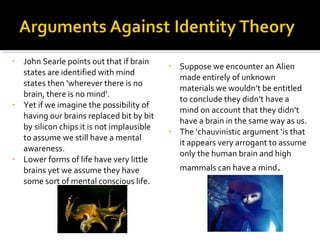
• John Searle points out that if brain
states are identified with mind
states then ‘wherever there is no
brain, there is no mind’.
• Yet if we imagine the possibility of
having our brains replaced bit by bit
by silicon chips it is not implausible
to assume we still have a mental
awareness.
• Lower forms of life have very little
brains yet we assume they have
some sort of mental conscious life.
• Suppose we encounter an Alien
made entirely of unknown
materials we wouldn’t be entitled
to conclude they didn’t have a
mind on account that they didn’t
have a brain in the same way as us.
• The ‘chauvinistic argument ‘is that
it appears very arrogant to assume
only the human brain and high
mammals can have a mind.
• A revised version of identity theory that
avoids the central weaknesses of IT.
• Mental states are functional states.
• Something is a mind if it functions
appropriately.
• This explains nicely why aliens or advanced
machines might have a mind although they
do not have a brain.
• As long as they posses a physical
mechanism that can play the same
functional role as neurons play it can be said
to have a mind.
• It can be organic, silicon, or glass fibres.
• The mind is similar to a software program
that can be run on any computer that has
the sufficient hardware to be able to run the
program .
• Similarly, a functionalist believes that any
physical system that is able to run or
recreate the functional interactions between
neurons in our brain can have a mind.
• This supports the idea of artificial
intelligence (A.I)
• If we succeed in building a machine that can
play the same functional role as our brains,
then these machines must, according to
functionalism, have a mind.
• The Turing Test
• Invented to determine whether advanced
machines could have minds.
• Questions are asked by the tester via a
computer terminal and its the job of the
tester to determine whether the responses
are from a human being or advanced
machine.
• If the machine can be passed as human then
it can be said to pass the Turing test and
have a mind.
http://www.youtube.com/watch?
v=Qc_204tXHZY&feature=related
• Or
• http://www.youtube.com/watch?
v=2zFwsmI95xw
• Functionalists would accept that if a machine
could pass the Turing Test it could be said to
have a mind.
• Functionalism supports the idea that AI is
possible.
• J. Searle famous opposition to A.I
revolves around his criticism of
the Turing Test as a valid means
of establishing whether machines
have minds.
• The Chinese Room Argument
• This states computers do not
need to understand language in
order to process information.
• Even if an advanced machine could
pass the Turing Test it wouldn’t
prove the machine had a mind
capable of understanding the
information it computes.
 He argued that computers follow
programs and thus do not act
creatively or in unpredictable ways.
In order to have a mind, one needs
to be able to act creatively and
unpredictably.
• Therefore, computers cannot have
minds.
• Computers cannot have feelings
and emotions. A thing without
emotions and feelings cannot have
a mind.
• Therefore computers cannot have
minds.
• Find out more about J. Searles
Chinese Room
 The term ‘qualia’ refers to the
phenomenal aspect of mental states.
 Frank Jackson describes as it as ‘the
itchiness of itches, the pangs of jealousy,
the characteristic experience of tasting a
lemon or smelling a rose’.
 Our mental states and sensations and
have a characteristic, phenomenal
,feeling (qualia) to them. The smell of
freshly brewed coffee or the sensation
of running my hand over sand paper
carries with it a distinct phenomenal
experience.
 It seems as if functionalism – and
perhaps any purely physicalist theory of
the min – does not provide a complete
account of what minds really are.
 Paul and Patricia Churchland offer a very
radical alternative to theory of mind.
 We should abandon the attempt to
incorporate mental states into our picture
of the world.
 Mental states do not really exist.
 They are nothing but complete illusions.
 The illusion of mental states such as
beliefs, wishes and desires is caused by our
habits of speech.
 In reality these beliefs, wishes and desires
are only neurons, synapses and
neurotransmitters.
 They believe that all talk of the mind since
the Greeks began it in 2500 years ago will
be redundant in the same way science has
proved that the world isn’t flat or that the
universe revolves around the earth.
 If this theory is accepted the mind/body
problem has been solved as the mind does
not exist.
 Arguments against Eliminative
materialism.
 The first is that it appears very difficult
to deny we have any mental states at
all.
 As I write this I am aware of the idea
that I want to clean my teeth because
the coffee I drank 10 mins ago is
starting to taste bad.
 Is that really an illusion?
 Also if it is true that nobody believes
anything (since minds do not really
exist) how are we to believe that
eliminative materialism is true?
 It appears any philosophical argument
presupposes that we have beliefs and
a mental life.

edu

  • 1.
    1. Behaviourism –Mental states are dispositions to behave 2. IdentityTheory – Mental States are brain states 3. Functionalism - Mental States are functional states that causally relate inner states with behavioural effects. 4. Eliminative Materialism – Mental states do not exist
  • 2.
    • Physicalist theoriesabout the mind are based around the idea that we can explain mental states in terms of physical states. • Advances in neuroscience suggests that our mental life is dependent on physical processes within our bodies – especially the brain. • Watch • http://www.youtube.com/watch?v • http://www.youtube.com/wat ch? v=D8S6b7Qo4Wc&feature=re lated
  • 3.
    • Tied tothe development of psychology • In order to learn about the mind psychologists began to study human behaviour • Logical behaviourism B. F. Skinner (1904- 1990) • He claimed we can eliminate all mental terms like ‘pain’, ‘belief’, or ‘hope’, from our scientific discourse into claims about human behaviour. • E.g. Consider ‘John loves Lucy’. This sentence should not be considered good scientific language since we cannot verify the statement as true or false. • He argued the sentence should be translated into something more meaningful about behaviour. E.g. John has a tendency to bring Lucy flowers or he tells often enough that he ‘loves her’. • As this behaviour can be verified it therefore provided a more reliable method of scientific discourse. • This then is the argument • Logical behaviourists suggest all mental states of mind like beliefs and sensations can be understood as states of mind to behave in certain ways. • What would an LB transform this sentence into? • Henry is mad with Caroline • LB solves the mind/body problem by explaining minds in terms of behaviour. • It avoids therefore the problem of interaction that causes severe problems for the dualists.
  • 4.
    • One fundamentalflaw to LB is that people at times act in ways that clearly doesn’t reflect their mental disposition. • Real feelings do not always correspond to behaviour. • E.g Pretending we like someone in fact we can’t stand them. • Discuss – Is there any situations in your lives in which your behaviour has not corresponded to your thoughts and feelings? • Noam Chomsky in response to the LBs belief that all future behaviour can be predicted as a result of past behavioural experiences argued that the minds ability to write or speak propositions or sentences that have never been constructed before is evidence that the mind can think independently of past experiences. • The mental state needed to create this goes against the idea that our mental states are patterns of behaviour. • Few people believe their mental life can be reduced to talk about behaviour.
  • 5.
    • A plausibleintuitive theory • Phineas Gage http://video.google.com/videosea rch? q=phineas+gage&emb=0#q=phin eas%20gage&emb=0&start=20 • According to IT Phineas Gage’s brain was significantly altered by the steal bar. His radical change in behaviour was due to brain damage that changed his mental disposition. The general claim is therefore that mental states are ultimately brain states. • This is central claim of identity theory • Neuroscience supports this view. • Mental functions can be associated with different parts of the brain. • http://www.youtube.com/watch? v=jt0B-dJANdU • If mind and brain are the same thing then we can understand all mental phenomena as a physical, chemical reaction of neurons. • The thought that QPR are a great football team is nothing more than the firing of neuron 27556 to neuron 43512. • Depression and schizophrenia is the result of chemical imbalances in the brain. • Sufferers respond to medication reinforcing the idea mental states and brain states are the same thing
  • 6.
    • John Searlepoints out that if brain states are identified with mind states then ‘wherever there is no brain, there is no mind’. • Yet if we imagine the possibility of having our brains replaced bit by bit by silicon chips it is not implausible to assume we still have a mental awareness. • Lower forms of life have very little brains yet we assume they have some sort of mental conscious life. • Suppose we encounter an Alien made entirely of unknown materials we wouldn’t be entitled to conclude they didn’t have a mind on account that they didn’t have a brain in the same way as us. • The ‘chauvinistic argument ‘is that it appears very arrogant to assume only the human brain and high mammals can have a mind.
  • 7.
    • A revisedversion of identity theory that avoids the central weaknesses of IT. • Mental states are functional states. • Something is a mind if it functions appropriately. • This explains nicely why aliens or advanced machines might have a mind although they do not have a brain. • As long as they posses a physical mechanism that can play the same functional role as neurons play it can be said to have a mind. • It can be organic, silicon, or glass fibres. • The mind is similar to a software program that can be run on any computer that has the sufficient hardware to be able to run the program . • Similarly, a functionalist believes that any physical system that is able to run or recreate the functional interactions between neurons in our brain can have a mind. • This supports the idea of artificial intelligence (A.I) • If we succeed in building a machine that can play the same functional role as our brains, then these machines must, according to functionalism, have a mind. • The Turing Test • Invented to determine whether advanced machines could have minds. • Questions are asked by the tester via a computer terminal and its the job of the tester to determine whether the responses are from a human being or advanced machine. • If the machine can be passed as human then it can be said to pass the Turing test and have a mind. http://www.youtube.com/watch? v=Qc_204tXHZY&feature=related • Or • http://www.youtube.com/watch? v=2zFwsmI95xw • Functionalists would accept that if a machine could pass the Turing Test it could be said to have a mind. • Functionalism supports the idea that AI is possible.
  • 9.
    • J. Searlefamous opposition to A.I revolves around his criticism of the Turing Test as a valid means of establishing whether machines have minds. • The Chinese Room Argument • This states computers do not need to understand language in order to process information. • Even if an advanced machine could pass the Turing Test it wouldn’t prove the machine had a mind capable of understanding the information it computes.  He argued that computers follow programs and thus do not act creatively or in unpredictable ways. In order to have a mind, one needs to be able to act creatively and unpredictably. • Therefore, computers cannot have minds. • Computers cannot have feelings and emotions. A thing without emotions and feelings cannot have a mind. • Therefore computers cannot have minds. • Find out more about J. Searles Chinese Room
  • 11.
     The term‘qualia’ refers to the phenomenal aspect of mental states.  Frank Jackson describes as it as ‘the itchiness of itches, the pangs of jealousy, the characteristic experience of tasting a lemon or smelling a rose’.  Our mental states and sensations and have a characteristic, phenomenal ,feeling (qualia) to them. The smell of freshly brewed coffee or the sensation of running my hand over sand paper carries with it a distinct phenomenal experience.  It seems as if functionalism – and perhaps any purely physicalist theory of the min – does not provide a complete account of what minds really are.
  • 12.
     Paul andPatricia Churchland offer a very radical alternative to theory of mind.  We should abandon the attempt to incorporate mental states into our picture of the world.  Mental states do not really exist.  They are nothing but complete illusions.  The illusion of mental states such as beliefs, wishes and desires is caused by our habits of speech.  In reality these beliefs, wishes and desires are only neurons, synapses and neurotransmitters.  They believe that all talk of the mind since the Greeks began it in 2500 years ago will be redundant in the same way science has proved that the world isn’t flat or that the universe revolves around the earth.  If this theory is accepted the mind/body problem has been solved as the mind does not exist.  Arguments against Eliminative materialism.  The first is that it appears very difficult to deny we have any mental states at all.  As I write this I am aware of the idea that I want to clean my teeth because the coffee I drank 10 mins ago is starting to taste bad.  Is that really an illusion?  Also if it is true that nobody believes anything (since minds do not really exist) how are we to believe that eliminative materialism is true?  It appears any philosophical argument presupposes that we have beliefs and a mental life.