

GENC3003Personal Financial PlanningAndrew Hingstonandrew.hingston@unsw.edu.auUnit 13: Other listed investments
2Listed property trusts (LPTs)Large trusts that invest in a diversified portfolio of commercial propertyOffice buildings and/or shopping centresExamples:Westfield – shopping centres in Aus and U.S.Centro – shopping centres in Aus and U.S. (recent problems!)Macquarie Office Trust – office buildings in Sydney & MelbourneReceive regular rent … so pay regular paymentsBut can be very risky if their properties have problems or they can’t refinance their loans.
3Listed investment companies (LICs)Companies that invest in other companieslisted on the stock exchangeBuying shares in that company gives youdiversified portfolio of other companiesExamples:Argo InvestmentsAustralian United InvestHuntley InvestLike a managed fund listed on stock exchangeDifferent from Exchange Traded Funds because LICs try to pick stocks and sectors rather than track an index
4Derivatives“Created” financial instrumentsie. You don’t really own anything physicalTheir values are “derived” from other “real” assetssuch as shares or commodities (gold, oil)very exotic ones are based on anything with a number!!!Normally used by large companies and financial institutions to hedge (reduce) risks that they face in the ordinary course of their businessUsed by a small number of investors to gamble on changes in share prices (and other assets)Examples include options, futures, warrants, CFDs …
5Options“Call options” give you the right, but not the obligation;To buy a certain asset (eg. 500 TLS shares)At any time until a set date (Expiry date)For a set price (eg $5.00 per share)At the cost of paying an upfront “premium”.You make money when prices go up and only lose your upfront payment if prices go down.“Put” options are similar but give you the right to sell the asset for a fixed price.You make money when prices go down and only lose your upfront payment if prices go up.
6WarrantsYou pay 50% for shares upfront and borrow the balanceYou pay interest upfront and claim it as a tax deductionThe shares are held “in trust” for you by the brokerYou receive all the dividends in the meantimeYou can pay the remaining 50% at some stage in the future at a set price (or forfeit your upfront payment!)Beware! Brokers receive a lot of commission for selling you these warrants!
7FuturesAgree to buy / sell an asset at a future time for a set priceMake money as prices rise by buying futuresMake money as prices fall by selling futuresRequires no upfront payment“Marked-to-market” daily and as prices move, you receive money or pay money from your accountSupposed to be used by companies to offset other risksGambling investors use them to make (and lose) lots of money quickly!
8Contracts for difference (CFDs)Offered by stockbrokers and derivative tradersAre similar to futures but there is no fixed termAllow you to make a profit or loss from fluctuations in share prices without actually owning the sharesInvestor pays/receives difference between the price of the share when CFD is opened and when it is closedReceive all dividends on the shares (but no franking)Only need to pay small proportion of value into accountMarked-to-market so you need to pay extra money if your position loses money
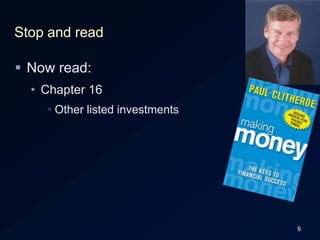
Stop and readNow read:Chapter 16Other listed investments9

Unit 13 Other Listed Investments

  • 1.
    GENC3003Personal Financial PlanningAndrewHingstonandrew.hingston@unsw.edu.auUnit 13: Other listed investments
  • 2.
    2Listed property trusts(LPTs)Large trusts that invest in a diversified portfolio of commercial propertyOffice buildings and/or shopping centresExamples:Westfield – shopping centres in Aus and U.S.Centro – shopping centres in Aus and U.S. (recent problems!)Macquarie Office Trust – office buildings in Sydney & MelbourneReceive regular rent … so pay regular paymentsBut can be very risky if their properties have problems or they can’t refinance their loans.
  • 3.
    3Listed investment companies(LICs)Companies that invest in other companieslisted on the stock exchangeBuying shares in that company gives youdiversified portfolio of other companiesExamples:Argo InvestmentsAustralian United InvestHuntley InvestLike a managed fund listed on stock exchangeDifferent from Exchange Traded Funds because LICs try to pick stocks and sectors rather than track an index
  • 4.
    4Derivatives“Created” financial instrumentsie.You don’t really own anything physicalTheir values are “derived” from other “real” assetssuch as shares or commodities (gold, oil)very exotic ones are based on anything with a number!!!Normally used by large companies and financial institutions to hedge (reduce) risks that they face in the ordinary course of their businessUsed by a small number of investors to gamble on changes in share prices (and other assets)Examples include options, futures, warrants, CFDs …
  • 5.
    5Options“Call options” giveyou the right, but not the obligation;To buy a certain asset (eg. 500 TLS shares)At any time until a set date (Expiry date)For a set price (eg $5.00 per share)At the cost of paying an upfront “premium”.You make money when prices go up and only lose your upfront payment if prices go down.“Put” options are similar but give you the right to sell the asset for a fixed price.You make money when prices go down and only lose your upfront payment if prices go up.
  • 6.
    6WarrantsYou pay 50%for shares upfront and borrow the balanceYou pay interest upfront and claim it as a tax deductionThe shares are held “in trust” for you by the brokerYou receive all the dividends in the meantimeYou can pay the remaining 50% at some stage in the future at a set price (or forfeit your upfront payment!)Beware! Brokers receive a lot of commission for selling you these warrants!
  • 7.
    7FuturesAgree to buy/ sell an asset at a future time for a set priceMake money as prices rise by buying futuresMake money as prices fall by selling futuresRequires no upfront payment“Marked-to-market” daily and as prices move, you receive money or pay money from your accountSupposed to be used by companies to offset other risksGambling investors use them to make (and lose) lots of money quickly!
  • 8.
    8Contracts for difference(CFDs)Offered by stockbrokers and derivative tradersAre similar to futures but there is no fixed termAllow you to make a profit or loss from fluctuations in share prices without actually owning the sharesInvestor pays/receives difference between the price of the share when CFD is opened and when it is closedReceive all dividends on the shares (but no franking)Only need to pay small proportion of value into accountMarked-to-market so you need to pay extra money if your position loses money
  • 9.
    Stop and readNowread:Chapter 16Other listed investments9