CHICKEN SALAD
Logan Aimone, MJE
University High School, Chicago
Chicken Salad
The sea of gray text.
Photo collage.
Tiny headlines.
Overall bad layouts.
Chicken Salad
It looks like…
💩
(And we’re not smiling)
Chicken Salad
What do you do?
How do you know when
you have a mess?
And how do you fix it?
CHICKEN SALAD
The Basics
Chicken Salad
FORM FOLLOWS FUNCTION
A design must
fundamentally assist the
reader to understand

the content.
The Basics
Chicken Salad
FORM FOLLOWS FUNCTION
Don’t just get the

stories on the page.
Help the reader to
understand the story.
The Basics
Chicken Salad
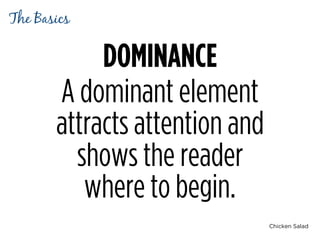
DOMINANCE
A dominant element
attracts attention and
shows the reader

where to begin.
The Basics
Chicken Salad
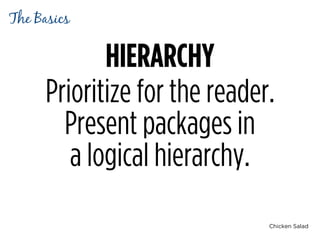
HIERARCHY
Prioritize for the reader.
Present packages in 

a logical hierarchy.
The Basics
Chicken Salad
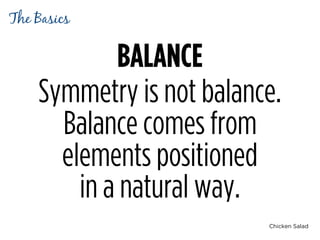
BALANCE
Symmetry is not balance.
Balance comes from
elements positioned

in a natural way.
The Basics
Chicken Salad
FLOW
Direct the reader through
a sequence of packages.
The Basics
Chicken Salad
DESIGN, DON’T DECORATE
Design is a series of
choices where every
element has a purpose.
The Basics
Chicken Salad
DESIGN, DON’T DECORATE
That means designers
must think about a page
from a reader’s
perspective.
The Basics
Chicken Salad
Simple, right?
Understanding these
concepts will force
designers to think — 

and to plan.
Chicken Salad
Your job:
Hold designers
accountable.
Ask them questions.
Coach, don’t fix.
Chicken Salad
But how?
Know a few tricks to go
from broken…
to basic…
to beautiful!
CHICKEN SALAD
Advanced
Chicken Salad
FORM FOLLOWS FUNCTION
What’s the best tool to
help the reader
understand this
information?
Advanced
Chicken Salad
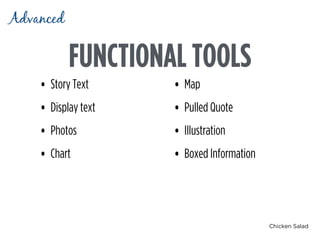
FUNCTIONAL TOOLS
Advanced
• Story Text
• Display text
• Photos
• Chart
• Map
• Pulled Quote
• Illustration
• Boxed Information
Chicken Salad
DOMINANCE
What do you want the
reader to process first?
Advanced
Chicken Salad
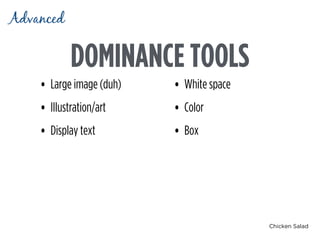
DOMINANCE TOOLS
Advanced
• Large image (duh)
• Illustration/art
• Display text
• White space
• Color
• Box
Chicken Salad
HIERARCHY
How does the reader
know which story 

is more important?
Advanced
Chicken Salad
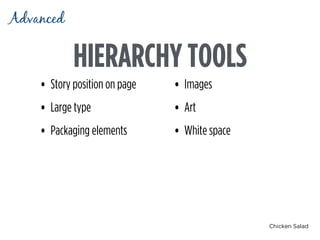
HIERARCHY TOOLS
Advanced
• Story position on page
• Large type
• Packaging elements
• Images
• Art
• White space
Chicken Salad
BALANCE
Keep elements 

in proportion 

to prominence 

and position
Advanced
Chicken Salad
FLOW
Think like a reader.
Don’t interrupt the 

flow of text.
Don’t confuse.
Advanced
Chicken Salad
DESIGN, DON’T DECORATE
Less is usually more.
Edit and eliminate
unnecessary elements.
Advanced
CHICKEN SALAD
Examples
Chicken Salad
Less 💩
More 😀
Chicken Salad
PULL QUOTE
Highlight the quotable.
Add visual interest.
Fill space.
Don’t interrupt flow.
Examples
Chicken Salad
INITIAL CAP
Use to attract the reader
or to indicate where to
start reading.
And to fill space.
Examples
Chicken Salad
LAYERING
Understand the difference
between true readers

and grazers.
Design for both.
Examples
Chicken Salad
LAYERING
Goal:

Help the reader to
understand.
Examples
Chicken Salad
WHITE SPACE
Plan it.
Add a little to emphasize.
Reduce a little to show
relationship.
Examples
Chicken Salad
Next Match: Season complete
Most Recent Results:
Feb. 2-4, State competition,
fourth place
Other Results: Jan. 24, Re-
gional, second
Record: 11.5-4.5, fourth in state
Notable: Tahla Hagerty, a junior, bowled a 214 at
state, which is 38 pins above her season average.
Next Game: Davis, 7:30 p.m.
Feb. 10, WHS main gym
Most Recent Results:
Feb. 7, Kennewick, results
unavailable
Other Results: Feb. 4, Pasco 71-73; Feb. 3,
Southridge 57-69; Jan. 28, Kamiakin 82-53; Jan.
21, Richland 45-50; Jan. 20, Eisenhower 47-71
Record: 7-8
Notable: John Donaghy has improved most this
season, according to the coaching staff.
Next Game: 7:30 p.m. Feb. 10
at Davis
Most Recent Results:
Feb. 7, Kennewick, results
unavailable
Other Results: Feb. 4, Pasco 38-61; Feb. 3,
Southridge 45-36; Jan. 28, Kamiakin 44-38; Jan.
21, Richland 42-44; Jan. 20, Eisenhower 44-79
Record: 8-7
Notable: Natalie Orrell had 16 points in the loss
to Southridge.
Next Match: 7 p.m. Feb. 10-11,
Regional at Walla Walla
Most Recent Results: Feb. 3-4,
District, fourth place; three
champions: Dayvin Knemeyer,
Tim Whitley, Cody Varner; three qualifiers: Ce-
sar Iñiguez, Krayson Gates, Michael Zacher
Other Results: Jan. 24, Kamiakin 50-24; Jan. 24,
Southridge 47-21; Jan. 19, Moses Lake 8-56
Record: 7-3
Notable:SeniorTimWhitleyhasaseasonrecord
of 34-0. Wenatchee is the only Big Nine school
with three district champions.
Next Meet: Feb. 16, state in
Federal Way at King County
Aquatic Center
Most Recent Results: Feb. 3-4,
district 363 (team score), state
qualifiers: Stephen van Someren Gréve, Kyle
McNatt, Forrest Crain, Nate Symonds (200
medley relay); Crain (100-meter backstroke);
Symonds (100-meter breaststroke); Ben Shea
(diving); Kyle Hardy (diving).
Other Results: Jan. 21, Walla Walla 94-76; Jan.
19, Richland 54-129; Jan. 17, Eastmont 105-81
Record: 6-6
Notable: Ben Shea broke the school and district
record by scoring a 439.65 at district.
he dull lull of the
wheels can be heard
by anyone in the area.
Pretty soon another hymn
of the calming sound can be
heard.Followedbyonemore
after that, and one
more after that
until the sound is
no longer a lull,
but a rising roar.
This is the music of
skateboarding.
With only a
board to use and a
couple of bruises
as a result, skat-
ers take to the
rails and ramps.
Skaters come in all
ages, ranging from
toddlers that pick
up a mini-board for the first
time, to the hardcore pro
skaters that seen on the X-
games.
Kids like junior Barry Po-
can, freshman Alex Ramirez
andjuniorZachCunningham
are just a few of the dozens of
student skaters at the skate
park every day.
Each skater has different
reasons for skating. “It gives
me something to do and
keeps me away from drugs
andgangrelations,”Ramirez
said as he started to smile.
“And I do it for the girls.”
Whatever the reason, just
about every skater can tell
you that skating is fun and
sometimes a life-changing
experience. Since 1997, Pio-
neerParkhasbeenthehome
to this fun experience.
But after all these years
of kick-flipping and grind-
ing, skaters are finding their
home trashed and worn
down. Concrete chips fly off
the edges, and graffiti covers
nearly every surface.
This run-down condi-
tion has aggravated skaters
for a while. “The skate park
sucks,” Pocan said. “And
when we try to fix it up, the
city just takes it out. They
need to fill in the cracks and
make some safety improve-
ments.”
But Dan Frai-
zier, parks main-
tenance director,
said the parks are
inspected regu-
larly and that he
has not received
any complaints.
Although he has
only been on the
job here for 10
months, he em-
phasized that if
inspections show
that repairs are
needed, they are made.
There is a new choice for
skating. Revolution Snow
& Skate, located at 246 N.
Wenatchee Ave., has a skate
park in the back of the shop.
Butthereisaslightdifference
betweenthetwoskateparks.
The Revolution skate park
charges a $7 admission, and
skaters under 18 must have
parent or legal guardian
permission.
No matter where they
skate, skateboarders are
dedicated to just skating.
“Skating rules,” said Cun-
ningham. “It’s uplifting and
it’s how to clear your mind of
your problems.”
In almost all of their spare
time, skaters are doing what
they usually do — skate-
boarding. More dedicated
skaters are even shoveling
snowinthewinterjustsothey
can get the ride they want.
Despite their carefree
intentions, skaters get a bad
reputation for being violent,
drug-using punks. “I don’t
like posers,” said Pocan,
referring to a person who
pretends to be a skater but
doesn’t actually skate. “Pos-
ers go out and cause trouble;
it creates this stereotype of a
dangerous skater.”
What most skaters want
to do is just skate, nothing
more,nothingless.Tosome,
skateboarding is more than
just some hobby. To some
it’s a way of living. When
they get on that board and
go up that ramp, there isn’t
anywhere they’d rather be.
All they need is a board to do
what they do best.
This is the music of
Although he has
job here for 10
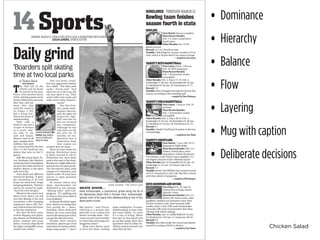
• Dominance
• Hierarchy
• Balance
• Flow
• Layering
• Mug with caption
• Deliberate decisions
Chicken Salad
★★
The setting was bold and the cinematography beau-
tiful but the film just didn’t work. Steven Spielberg’s
latest film, “Munich,” kept me glancing
at my watch.
“Munich” tells the story of the Israeli
team of assassins that hunted down
those responsible for a terrorist attack
during the 1972 Munich Olympics
that resulted in the deaths of 11 Israeli
athletes.
The film does more telling than
showing, and never gives viewers a chance to become
involved with the characters or the plot. Also, the mov-
ie’s theme, violence begets violence (a.k.a. the Golden
Rule,) became buried underneath everything else that
was going on, making everything feel very forced.
“Munich” has the actors and production values to
be a great movie, but collapses under its own weight
and emerges as a nearly three-hour bore.
★★
From the minute the bass began booming out of
the speakers and rattling nearby furniture, I felt as if I
had heard Black Buddafly’s music
a dozen times before. It reminded
me of the cars that drive down the
street sporting gargantuan sound
systems with the bass shaking the
whole vehicle.
Black Buddafly seems perfectly
adapted for this very purpose; the
bass is easily three times louder than the lyrics. Even
when I could hear the lyrics, they sounded soft and
tinny, as if to make sure they didn’t get in the way of
the bass.
The album did include a little variety, some songs
featuring something similar to country guitar-twanging
in contrast to the synthesized chords in most others.
Underneath the hammering were some pleasant
themes. In other words, the massive bass ruins an
otherwise decent album.
★★★★
A mysterious opera ghost, a stunning diva, an adoring
viscount; fans of the popular musical “The Phantom
of the Opera” surely recognize these
characters. However, most fans do not
know about the novel that first brought
the fascinating story to life.
Written in 1910 by Frenchman Gas-
ton Leroux, the novel follows a similar
story to the stage productions, but is far
more complex and mysterious.
In the musical, the characters’ moti-
vations and personalities are very clear
almost from the start, whereas Leroux shrouds them in
mystery, leaving the reader unsure of the characters’
intentions.
I highly recommend Leroux’s novel. Even the dated
language, this did not stop me from becoming ab-
sorbed in the frightening mysteries of “The Phantom of
the Opera.”
★ ★★	 ★★★	 ★★★★	
e runs across the floor, jumps onto the stage,
grabs the mic, and says “All right guys, we’re
going to start in about five minutes.” He turns
his head. “I don’t think they heard that.”
About five minutes later, the show starts
just as nonchalantly as the announcement. After a quick
“Check,check,”everyoneintheroomispummeledbyan
aggressive wave of guitar, bass and drums.
It’s another show at the Beacon Hill Grange in Sun-
nyslope put on by Wenatchee’s Mariware Productions, a
companyrunby2004WHSgraduatesRyanJohnstonand
Scott London.
More commonly referred to as “the Grange,” the
venue hosts punk, rock and metal shows. After a year of
continuous concerts, Wenatchee’s punk scene has once
again found the niche it used to hold a decade ago.
Typically anywhere from 130 to 200 people, mostly
teens, show up to each event. “Every show there’s more
people,”saidLondon.“We’veneverhadlesscometoone
than the one before.”
BandsstartbybookingadateattheGrangewithMari-
ware,usuallyafewmonthsinadvance.TheJohnston-Lon-
don duo brainstorm what events they want at the show,
then make up a flier and get it up around the valley. “We
reallytrytogetthemintothehighschools,”saidJohnston.
“That’s a huge part of our demographic.”
“It’s a lot of fun,” said sophomore Tommy Lammert,
whose band Starving Eyes regularly plays at the Grange.
“More people are getting into it now. It’s good to see
people having fun.” Starving Eyes’ next show at the
Grange is set for April 9.
BothJohnstonandLondonhaveothercommitments.
In addition to Mariware, Johnston fronts his band, Wait-
ing for Darryl, and both work as after-school activity di-
rectors at Orchard Middle School.
Most of the money goes to pay for the venue, promo-
tions and upcoming shows. Lately, the profits have gone
toward the recording of Waiting for Darryl’s new EP,
“Dance With the Green Sloth,” due out later this month.
Runningthecompanyhasprovednotonly
tobefunandasourceofincome,butatrue
source of education.
“It’staughtusalotoflessons,especially
toreadthefineprint,”saidJohnston.“And
it’s put us in contact with a huge list of
bands,magazinesandlabels.It’sallabout
who you know in this industry.”
Despite the great opportunity for aspir-
ingbusinessmenandmusicians,thegreat-
esteffecthasbeenonthefansthatshowup
to hear live music every few weeks.
“There’s nothing else to do in
Wenatchee,” said Cordell Anderson, a ju-
niorwhoattendsnearlyeveryshow.“Ilike
experiencing the different kinds of music.
Everything’s cool up there.”
The truth is, the valley’s music scene is
in debt to the small productions company
that continue to put Wenatchee on the map for punk
music, though they’re quick to downplay it.
“In the year since we started it’s really grown a lot,”
said Johnston. “Wenatchee’s a much more musically
positive place to be. And it’s not just because of us; a lot
of people are seeing how easy it can be.”
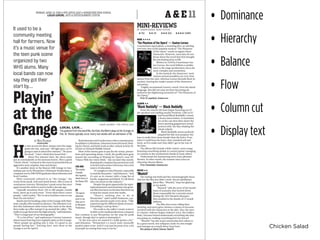
• Dominance
• Hierarchy
• Balance
• Flow
• Column cut
• Display text
Chicken Salad
Lore commolore dolore et
praestie feum diam, vendrer
stionsenim ipit atet, velesto
odolortin hendignim quat. Ut
verilit landre magniam, vol-
ortie dipsusto core tetue tio
euisit, sim ipsustrud minim vel
er summodio diat.
Lore facidunt prat adionse
iamet prat. Duis amet lore do-
lore mod eugait lut praessi.
Lorem il ut nim nosto delit
dolore dipit aci et, quisis exeros
alit acin ulla feugiam, quamcon
llaoreet ad tie modipis dolorer
si.
Duis erostie dolorperilit am
digna alit voluptat el illut eniat
iriure magna alisl ullandreet
lam, sequip eril ut loreetue
volobor in ut illandion utat utat-
ing ea adiam dolenisit incillaor
autpat aliquat non eum dolor sit
ad el euis nonulput augue conse
magnis nos atet, sed minisit ip-
ismodigna facing euguercidunt
lutpat utpat dignit erat praesen-
digna facillam quatet lut alit, si
tet, sequat numsan ute et il ero
do eu feugait autpat alis nis at,
vendipisi.
Duisl ut utpatue commy
nummy num augait adit do-
lorercil dolum augait prat.
Duis num
quam ver adip
erilit laoreet,
si tin henis
dolore tisi.
Duisi. Duip ex
ercil iriustrud
erciduis nim
do odip eum
zzrilis nostrud
te corpero
odolum ve-
lismo olobore
molorem zzril-
isit at praestin
vulputpatue
min erillan
henit amet at, venim qui bla
facil doloreet utat dolor ipit vel
ut nulput niscil ut velit ad digna
faccum ver sum zzril delesse-
quat irit nonse faciduisl utat.
Dui et, sustrud eu facilit
lamet exerit lutpat vercilit lam-
con henibh ea facidui cipsustie
Lorecommoloredoloreetpraes-
tie feum diam, vendrer stionsenim
ipit atet, velesto odolortin hendig-
nim quat. Ut verilit landre mag-
niam, volortie dipsusto core tetue
tio euisit, sim ipsustrud minim vel
er summodio diat.
Lore facidunt prat adionse iamet
prat. Duis amet lore dolore mod
eugait lut praessi.
Lorem il ut nim nosto delit dolo-
re dipit aci et, quisis exeros alit acin
ulla feugiam, quamcon llaoreet ad
tie modipis dolorer si.
Duis erostie dolorperilit am
digna alit voluptat el illut eniat
iriure magna alisl ullandreet lam,
sequip eril ut loreetue volobor in
ut illandion utat utating ea adiam
dolenisit incillaor autpat aliquat
non eum dolor sit ad el euis non-
ulput augue conse magnis nos atet,
sed minisit ipismodigna facing eu-
guercidunt lutpat utpat dignit erat
praesendigna facillam quatet lut
alit, si tet, sequat numsan ute et il
ero do eu feugait autpat alis nis at,
vendipisi.
Duisl ut utpatue commy nummy
num augait adit dolorercil dolum
augait prat.
Duis num quam ver adip erilit
laoreet,sitinhenisdoloretisi.Duisi.
Duip ex ercil iriustrud erciduis nim
do odip eum zzrilis nostrud te cor-
pero odolum velismo olobore mol-
orem zzrilisit at praestin vulputpat-
ue min erillan henit amet at, venim
qui bla facil doloreet utat dolor ipit
vel ut nulput niscil ut velit ad digna
faccum ver sum zzril delessequat
irit nonse faciduisl utat.
Dui et, sustrud eu facilit lamet
exerit lutpat vercilit lamcon henibh
ea facidui cipsustie faccum zzrit
nos alit nit verit acincin essis et alis
augait atue te consecte modit ilis
nostocommolorsitautamiriustrud
exero conullu modionullam augait
aliquis am dolore dio con volessis
nostion mmodolesto exercipis er-
cilit er sisl inismodo commolo
eetummo uptat lutet la acil in utat
lortisim ipit veriliq ipsustis nit vel ip
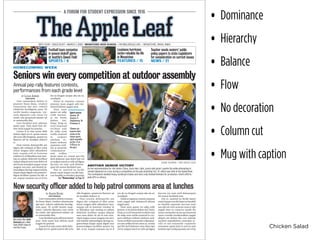
• Dominance
• Hierarchy
• Balance
• Flow
• No decoration
• Column cut
• Mug with caption
Chicken Salad
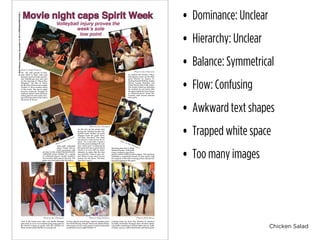
• Dominance: Unclear
• Hierarchy: Unclear
• Balance: Symmetrical
• Flow: Confusing
• Awkward text shapes
• Trapped white space
• Too many images
U-HighMidway•Tuesday,November18,2014•PHOTOEATURE•PAGE4
Movie night caps Spirit Week
Photo by Alex Thompson
Photo by Alex Thompson Photo by Paige Fishman Photo by Della Brown
Clad in the senior class color, red, Emilie Portugal
gets ready to serve in an intense ping-pong game in
the Senior Lounge on grade color day October 16.
Most seniors joined Emilie in wearing red.
As they unpack several bags, Artsfest comittee mem-
bers Emili Husain, Schuler Small and Allijah Futter-
man prepare to sell candy, popcorn and hot chocolate
at Artsfest’s movie night October 17.
Coming ready for Twin Day October 14, Apoorva
Gundeti and Emilie Portugal show off their match-
ing outfits consisting of denim button downs, leath-
er boots, scarves, white head bands and black pants.
As she revs up the senior class
during the Student-Faculty Vol-
leyball Game October 16, Karla
Douglas leads the grade cheer,
‘All Rise, One-Five!’ The cheer
has proven a wild success for se-
niors. “As a Lab Lifer, I spent a
lot of my years waiting to be a se-
nior,” Karla said. “I witnessed all
the great and not so great cheers
ahead of us and with my deter-
mination to make this the best
year possible, I took it upon my-
self. When it came down to two
choices for the cheer, ‘All Rise,
One-Five’ was it.”
After girls’ volleyball
player Tatum McCor-
mick went down with
Watching their first U-High
Student-Faculty Volleyball
Game, freshmen sport theiran injury in the annual Student-Faculty
Volleyball Game October 16, a group
of volleyball players faculty members
and security staff came to her side. The
game was terminated after the injury.
On the cold ground of Jack-
man Field in their coats and
blankets, Jessica Franks and Lil-
lian Nemeth get cozy and wait
for the showing of “Moon Rise
Kingdom,” the film of choice
for the first Artsfest movie night
October 17, three months ahead
of the event. The movie night
proved a major hit. Roughly 90
students spread across Jackman
eating popcorn and candy, leav-
ing school grounds at the end of
the movie at 10 p.m.
Photo by Paige Fishman
As student and faculty volley-
ball players warm up for their
game October 16, seniors, in-
cluding Kendall Rallins, Jordan
Moran, George Hamilton and
Glenn Decety, take in the action.
The faculty ended up defeating
the students by one point after
the game ended due to an injury
to volleyball player Tatum Mc-
Cormick with several minutes
left to play.
Photo by Alex Thompson
Volleyball injury proves the
week’s sole
low point
Photo by Alex Thompson
grade’s yellow clothing and headgear. The freshmen
exhibited a surprising amount of class spirit, with
the majority of the class wearing yellow and provid-
ing loud support at the game.
Chicken Salad
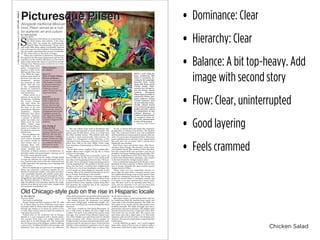
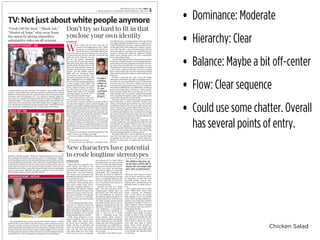
• Dominance: Clear
• Hierarchy: Clear
• Balance: Organized
• Flow: Clear
• Variety of shapes
• Planned white space
• Could benefit from more
display text or mugs
by Grace Anderson
Associate Editor
Why should we remember?
Through musical performances, student reflec-
tions, poetry and personal stories the Holocaust Re-
membrance Assembly April 23 raised the issue of
how the importance of the Holocaust can be applied
to both history and current events.
The Jewish Students’ Association sponsored the
assembly which included speaker Earnest Fruehauf,
a Holocaust survivor.
JSA worked with the Illinois Holocaust Museum
Speaker’s Bureau in order to get in contact with Mr.
Fruehauf, who escaped Germany after his father
was arrested and placed in the Dachau concentra-
tion camp. He and his family lived in Juden Haus un-
til they escaped to the United States in 1941, where
they moved to Chicago and then eventually to Green
Bay, Wisconsin.
“The reason we chose to have a survivor is because
we are the last generation who will be able to hear
survivors and taking mean from it,” explained Leah.
“Most survivors who actually remember the events
are in their 80s and 90s, and we think it’s important
that our students hear first-hand accounts instead of
learning about it by just reading through their text-
books.”
As Mr. Fruehauf recounted his family’s struggles
and his own confusion as a child in Germany during
the Holocuast, he noted the role of hate.
“Hate fills the hater with an inability to reason...,”
said Mr. Fruehauf. “A person who hates can never
get it out of their mind….When hate is taught by
the government, by religious organizations, by any
group, the world is in real trouble. It has never failed
and it will not fail in the future.”
JSA president, junior Leah Umanskiy, described
the theme of the assembly as well as JSA’s vision for
the effect upon the student body.
“Our theme this year is broad enough to apply not
only to the Holocaust but also what happened after
the event as well as similar issues in other cultures,”
Leah said. “We are aiming to answer our question
in three different ways by so that the assembly can
be applicable to everyone while still helping people
understand the Holocaust’s past and current effects
on the Jewish community because sometimes that’s
a taboo topic at our school. The assembly has three
parts: Holocaust, anti-semitism and genocide.”
“We’re adding an educational component this year,
so its not just about the performers and the speakers.
The Holocaust hasn’t stopped — people are still fac-
ing anti-Semitism in our community and the world,
and its not something that has just affected Jews.
Many other cultures have faced mass genocide just
because of their identity.”
The assembly opened with Giacomo Glotzer per-
forming ‘Kol Nidre’ and went on to feature perfor-
mances from the U-High band, choir and orchestra.
Other musical acts included Immi Foster, Pascale
Boonstra and Emma Picker’s performance of “Bright
Morning Star” as well as the Klezmer Band’s ren-
dition of Tsigaynerlid, which involved juniors Julia
Hedges, David Hedges, Will Kent and Jacob Meyer.
Asha Futterman, Samantha Aronson, Willis Wein-
stein, Johnathan Ruiz, Nathan Isaacs and Liza Ed-
ward-Levin also presented personal stories, reflec-
tions and poems.
‘Why we remember’
The U-High Klezmer Band performs “Tsigaynerlid” by David Beyglman, arranged by juniors
David Hedges and Julia Hedges. The band included juniors Jacob Meyer, cello; David Hedges,
violin; Julia Hedges, clarinet; Rachel Housinger, alto saxophone and Will Kent, vocals.
Holocaust survivor
Ernest Fruehauf vividly
recounts his experiences
during the infamous
Kristallnacht, his
father’s imprisonment
and his eventual escape
from Germany.
Speaking on the
relevance of the
Holocaust to U-High,
sophomore Asha
Futterman explains
that while horrified by
the swastikas found
in the library and in
bathrooms during
Winter Quarter, she
wasn’t surprised by the
continuing patterns of
sexism, racism and anti-
Semitism.
Photos by Paige Fishman
“You may write me
down in history/ With
your bitter, twisted lies,/
You may tread me in the
very dirt/ But still, like
dust, I’ll rise,” reading
Maya Angelou’s “Still
I Rise,“ junior Nathan
Isaacs proclaims the
poem’s message of
rebirth and resistence to
oppression.
Junior Willis Weinstein
speaks on violence that
continues world-wide,
including the mass
killings of Darfurians
by state-sanctioned
fighters. Willis empha-
sized the importance
of awareness about
genocides, and, despite
percieved historic dis-
tance of the Holocaust,
the persistence of mass
killings.
Assembly asks students to reflect on why Holocaust remains relevant
U-HighMidway•Tuesday,April28,2015•PHOTOFEATURE•PAGE12
Chicken Salad
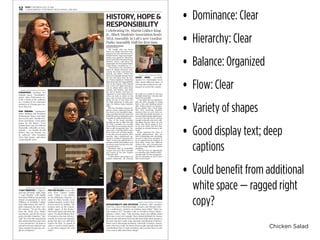
• Dominance: Clear
• Hierarchy: Clear
• Balance: Organized
• Flow: Clear
• Variety of shapes
• Good display text; deep
captions
• Could benefit from additional
white space — ragged right
copy?
HISTORY, HOPE &
RESPONSIBILITY
NEWS • THURSDAY, JAN. 21, 2016
U-HIGH MIDWAY • UNIVERSITY HIGH SCHOOL, CHICAGO12
midway photos by benji wittenbrink
STANDPOINT. Reciting her
original poem, “Standpoint,”
junior Asha Futtermann ex-
tends a hand at the audience
as a symbol of the numerous
instances of Chicago gun vio-
lence this year.
OUR DREAMS. Sophomore
Sahar Siddiqui and freshman
Mohammed Alausa read their
lines in the piece Muslim Stu-
dents Association wrote about
hopes for the future. “Even
though times may get difficult
financially, culturally, or emo-
tionally — we should all still
believe that our dreams can
be achieved,” MSA President
Myra Ziad, junior, said about
composing the piece.
midway photo by nikita dulin
‘I CAN’T BREATHE.’ U-High ju-
nior Alex du Buclet, right, sings
“I Can’t Breathe” with Sophia
Byrd from Whitney Young High
School accompanied by Reed
Williams of Northside College
Prep High School. Alex and So-
phia composed the piece over
the summer. “We got the idea
from the Black Lives Matter
movements, and all the recent
police brutality tragedies,” Alex
said. “We wrote the song to help
kids understand the issue from
a peer perspective. We hope to
spread awareness and have our
song resonate beyond any sin-
gle act of injustice.”
midway photo by benji wittenbrick
ACCOUNTABILITY AND INITIATIVE. Feminist Club members
Nora Lin, Ciara O’Muircheartaigh, seniors, and Miranda Mire-
les, a sophomore, perform an original poem titled “What Are
You Going to Do?” Feminist Club co-President Fikayo Walter-
Johnson, senior, said, “Only learning about and talking about
MLK once a year isn’t enough. There should definitely be classes
that not only talk about MLK but talk about other black people in
the past who have made some amazing contributions to history.
When you’re discussing inclusion, especially in history classes,
that’s when you really can honor these people and talk about the
contributions they’ve made to history and you don’t have to wait
every year to talk about these things.”
Celebrating Dr. Martin Luther King
Jr., Black Students Association hosts
MLK Assembly in Lab’s new Gordon
Parks Assembly Hall for first time
byElenaMaestripieri
midway reporter
“We usually pick our theme
based on things that have hap-
pened in the year, and this year we
felt like history, hope and respon-
sibility was a good fit,” Black Stu-
dents Association President Kimya
Buckner, senior, said about the
preparation for the annual Martin
Luther King Jr. Assembly, Jan. 14.
“There’s been a lot of tension in
terms of African-American com-
munity, the black community in
general, and police, there’s also
been a lot of people trying to stress
the fact that black lives do mat-
ter,” Kimya explained. “I think that
plays more into the ‘responsibility’
vein of the theme. MLK himself
was in the civil rights movement
and we talked about other black
activists and leaders, and that’s
the nod to history. And then, it’s
important to have hope because
when you look at what’s on the
news and you hear about people
dying, it’s easy to lose hope, but
it’s really important to keep your
hope. So: history, hope, responsi-
bility.”
BSA Vice President Autumn Es-
pinosa, senior, explained that she
has been on the assembly’s plan-
ning committee for three years but
looked forward to taking this year’s
assembly in a different direction.
“One of the board members
brought up that it didn’t feel like
the MLK assembly was actually
about MLK so we wanted a theme
that would incorporate that,” Au-
tumn said. “I feel like MLK’s main
focus wasn’t just on black people,
it was also on every person, every
minority that’s experienced op-
pression. I think it’s important for
others to have the opportunity to
perform at MLK who audition, and
we always enjoy having other eth-
nic groups there.”
Previously held in Rockefeller
Chapel, this year’s MLK assembly
was hosted in the new Gordon
Parks Arts Hall.
“I think there’s also going to be
definite limitations, for example
the stage is so small. It’s also just
the high school now,” Autumn said
before the assembly.
“I also think that it’s significant
that the MLK assembly is being
held at the only building named
after a black person on campus,”
Kimya added. “Also I don’t think
that we’re censoring ourselves
anymore than we were when we
were with the middle schoolers. It
was just fifth through eighth grad-
ers and I feel like they’re mature
enough to handle what we’re talk-
ing about because these are real
issues that they’re going to face
in the real world, and that they
possibly are already facing in the
world.”
Kimya explained the value of
having performances that are
both entertaining and enriching,
because it allows the assembly to
be an opportunity for students to
hear about issues that different
cultures face and commemorate
the great things different cultures
are doing.
“This isn’t just an opportunity
to remember and celebrate MLK,”
Autumn said.“It’s also an opportu-
nity for minorities at Lab to have
their voices heard.”
midway photo by benji wittenbrick
GIVING HOPE. Assembly
speaker Dr. Christopher Reed
talks about different kinds of
activism that students are tak-
ing part in across the country.
midway photo by paige fishman
FOR THE FALLEN. Senior Alex
Soto from Latinos Unidos
reads “Canto a Las Madres
de los Milicianos Muertos,” a
poem by Pablo Neruda, in its
original Spanish. Senior Olivia
Perozo read it in English. “We
focused more on the respon-
sibility aspect of the theme,”
Olivia said about selecting the
poem. “It’s about telling a story
of someone who may not nec-
essarily be from your minority
group but that you still have
respect for that. As people of
color we need to band togeth-
er and show support for each
other.”
Chicken Salad
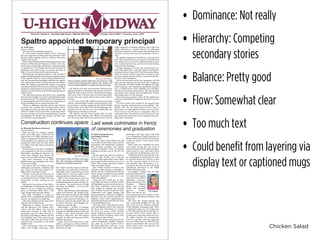
• Dominance: Not really
• Hierarchy: Competing
secondary stories
• Balance: Pretty good
• Flow: Somewhat clear
• Too much text
• Could benefit from layering via
display text or captioned mugs
Volume 91, Number 8 • University High School, 1362 East 59th Street
U-HIGH M IDWAYChicago, Illinois 60637 • Thursday, June 4, 2015
by Ariel Gans
Associate Editor
The search for a principal continues.
In a few weeks, Frances Spaltro, Ph.D., will begin
her year-long term as Acting associate principal, while
Director Robin Appleby and her advisory committee
continue the search.
With current Principal Scott Fech beginning as Lab’s
Director of Educational Programs on July 1, the com-
mittee spent two months conducting a national search
to replace him. Two finalists from a pool of nearly 50
applicants each spent a day on campus the week of
May 11 interviewing with the Lab community.
Following the on-campus interviews, the committee
gathered feedback before submitting a recommendation
to Ms. Appleby. However, prior to being offered the posi-
tion, the recommended candidate withdrew his applica-
tion, causing the search to extend into next year. Mean-
while, Ms. Appleby appointed Ms. Spaltro to be acting
associate principal for the next year, allowing U-High to
continue to make progress on all current initiatives. Ms.
Spaltro is a Latin teacher and World Language depart-
ment co-chair.
“We had always known that there was a possibility
that the search might not result in identifying the right
person for the job,” Ms. Appleby said. “So simultaneous
to conducting the search, we were also considering in-
ternal candidates for an acting associate role.”
“There’s a difference between ‘acting’ and ‘interim’
principal,” Ms. Appleby said. “Acting associate princi-
pal means that the role will only exist next year, and
while Dr. Spaltro will be the leader of the high school,
she may not have all of the responsibilities of regular
principalship. Dr. Spaltro, Ms. Ahmed, and Ms. Cam-
pos will take a team approach.”
Ms. Spaltro will work with Assistant Principal Asra
Ahmed and Dean of Students Ana Campos to lead U-
High. Mr. Fech, in his new role, will advise and mentor
that team. They will meet soon to divide responsibili-
ties for next year and get advice about what needs to
be done.
In 13 years at Lab, Ms. Spaltro has served as Lead
Advisor, coached Dance Troupe, coordinated May Proj-
ect and been a faculty sponsor for the Model United
Nations team. As co-chair of the World Languages De-
partment for the last two year, she understands how
administrative decisions are made.
“Ms. Spaltro was the best fit given what we were
looking for,” Ms. Appleby said. “Which was somebody
who knew the high school and students well and was
really supportive of student activities. She’s also very
highly respected as a teacher both by her colleagues
and by her students, so she seemed like somebody who
would fit well into the team and leadership role for a
year.”
Ms. Spaltro emphasizes that this is a one-year posi-
tion. “They need someone to step in for a year only, and
I’m willing to do it. It wasn’t a difficult decision, but it
was an important decision, and I’m very much looking
forward to the challenge.”
Though stepping out of her role as department co-
chair and teacher for a year, Ms. Spaltro requested to
continue with her Class of 2017 advisory group. Mean-
while, the school will hire a part-time teacher to cover
her Latin classes and her elective, Ancient Greek Per-
formance and Competition.
As for the principal search, the committee will not
begin actively interviewing until early fall. Changes to
the committee will likely include the addition of a high
school learning and counseling department member
and a U-High parent. Each candidate visit will likely
extend over two days instead of one. The principal job
description won’t change and the application window
will remain open over the summer.
Since the announcement on May 26, Ms. Spaltro has
received unanticipated recognition from the Lab com-
munity.
“I’ve been really truly touched by the support from
faculty, parents, administrators and students,” Ms.
Spaltro said. “It’s not about pride, itI have come to
learn that a lot of perople have faith in me to do this.
It’s an honor to do this for my community. This is a
community that I’m devoted to and that kind of sup-
port means the world when you’re stepping into some-
thing that is daunting.”
Spaltro appointed temporary principal
by Talia Goerge-Karron
and Raghu Somala
Midway staff
The last week of the school year will
be a jumble of tests, final events, awards
ceremonies and celebrations. Labstock,
May Projects, academic and athletic
awards ceremonies, Prom and finally
graduation all put a cap on the 2014-15
year.
Seniors spent the past four weeks at
work on May Project, one of the last
events in their high school career. Many
chose projects that involved research or
travel. The seniors presented projects
June 4 in Upper Kovler.
The U-High Awards Ceremony also
took place today during an extended as-
sembly period at International House,
where various accolades were presented
alongside department awards to stu-
dents of all grades.
Tomorrow, from 3:30-6 p.m. on Ken-
wood Mall, the annual Labstock concert
will highlight musical acts from the stu-
dent body. Sophomore Alex Lund has
been tapped to organize the musical
acts. Student Council will grill hot dogs,
hamburgers and veggie burgers and
provide popsicles, all free for U-Highers.
Students also can perform karaoke by
talking to their class representatives.
Interested performers should email Alex
at alexlund@gmail.com.
Saturday, June 6, the Museum of Sci-
ence and Industry will be the venue for
the Prom from 6:30-10:30 p.m. Tickets
are $115 per person, which includes
dinner. Organizers chose to use the mu-
seum’s dramatic backdrop rather than
decorating around a theme.
Next week, seniors will gather for the
annual Graduation luncheon Wednes-
day, June 10, at the Cloister Club in
Ida Noyes Hall from 11:30 a.m. 1 p.m.
Immediately after lunch, rehearsal for
graduation will take place until 3:30
p.m. at Rockefeller Chapel. Honorary di-
plomas will be awarded at the luncheon,
a time for seniors to give toasts about
their class.
Final exams are scheduled for math
and science during the last week of
classes. Science will take place Tuesday,
June 9 from 9-11 a.m., and math will be
the same time on Wednesday, June 10.
Graduation will be the next day, June
11, at Rockefeller Chapel. Seniors must
be in Lower Kovler by 1:30 p.m. to line
up. The ceremony begins at 2:30 p.m.
and typically lasts 90 minutes. A re-
ception for the Class of 2015 will begin
immediately afterward on the Booth
School of Business lawn.
Lily Koppel, U-High Class of 1999,
journalist and author of
two books will be speak-
ing at the Class of 2015
graduation ceremony,
along with Senior Class
President Whitney
Beach and Cultural
Union Vice President
Apoorva Gundeti.
There will also be mu-
sical performances from seniors Valen-
tina Gardner, Sebastien Labossiere, and
Karen Dai.
“We chose Ms. Koppel because she
was a successful graduate of Lab, and
also on the come up,” Whitney, member
of the Selection Committee, said. “She’s
a published author of a few books such
as The Red Leather Diary and The As-
tronaut’s Wives Club—which ABC is
turning into a television show this year.
We asked teachers for recommenda-
tions for a speaker, and they suggested
her to us. Then when we called her, she
said yes immediately. She was our first
choice, and we were very glad that she
was so enthusiastic.”
Construction continues apace
by Micaiah Buchheim-Jurisson
Associate Editor
Over the next few months, Gordon
Parks Arts Hall opens, Judd and the
bottom floor of U-High undergoes reno-
vation, a temporary Cafeteria arrives to
Kenwood Mall, new pathways are added
around the school and the other floors
of U-High eventually begin undergoing
renovations.
Gordon Parks Arts Hall is scheduled
to be completed by the start of school in
September, according to Associate Di-
rector Dave Stafford. Arts classes will
move to the Art Hall starting in August.
The music classrooms in the West
Belfield tower are included in the move
to the new building.
The bottom floor of U-High will also
undergoing renovation, including Café
Lab. Later, the other three floors of U-
High will be renovated as well.
Similar to the plan for Judd, the of-
fices and non-arts-related classrooms
on the bottom floor of U-High will move
temporarily to other locations in the
school.
During the renovations of the Cafete-
ria, beginning in September, the school
plans to set up a temporary cafeteria
space in Kenwood Mall where “Lab
Logs” playground currently stands.
The Café, scheduled to reopen in
March 2016, is redesigned around food
stations, as opposed to a single line.
“The new cafeteria will be much more
efficient,” Mr. Stafford said.
Beginning in August, all four floors
and the basement will undergo reno-
vation, and the offices and non-arts
classrooms currently in Judd will be
temporarily moved to other locations in
the school, including in Blaine and the
West Belfield tower. The senior lounge
and dean’s office will also move to the
vacated music classrooms in the West
Belfield tower.
After renovations, Judd will contain
offices and U-High classrooms. Judd
207, which currently houses world lan-
guage offices, as well as the current busi-
ness office, will be converted to the new
U-High library, and the middle school
will gain full use of Rowley Library.
Some of the campus’ green space lost
in the renovations will also return, in-
cluding Scammons Gardens and the “se-
cret garden,” the mall between U-High
and what was Belfield — as it was col-
loquially known.
“There will be berms, water collection,
a pond and benches,” Mr. Stafford said.
“When this plan was laid out, Mr. Magill
wanted to make sure that there would
still be a large amount of flat space,” re-
ferring to a plan for the school laid out
by former Director David Magill com-
pleted over a decade ago.
Additionally, a number of passage-
ways are being added and renovated to
increase accessibility between Judd and
U-High, a path which currently bends
around a classroom, and will become
straight. An office and classroom will be
added to that space.
Lastly, after everything else is com-
pleted, a passageway will be added be-
tween the third floor of U-High and the
third floor of Judd.
Last week culminates in frenzy
of ceremonies and graduation
photo by Sarah Pan
The Gordan Parks Art Hall is set to open
this fall, housing performance halls,
studios and a digital media lab.
photo by Nikita Dulin
Frances Spaltro assists sophomore Zora Navarre with
a Latin project. Starting this summer, Ms. Spaltro will
assume responsibilities as acting associate principal.
Lily Koppel
Chicken Salad
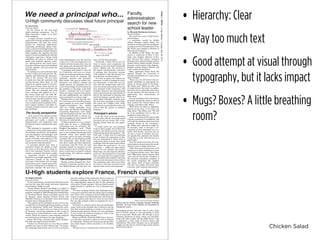
• Hierarchy: Clear
• Way too much text
• Good attempt at visual through
typography, but it lacks impact
• Mugs? Boxes? A little breathing
room?
PAGE3•NEWS•U-HighMidway•Tuesday,April28,2015
We need a principal who... Faculty,
administration
search for new
school leader
by Ariel Gans
Associate Editor
As the search for the next high
school principal commences, the U-
High community weighs in on their
ideal candidate.
A search advisory committee com-
prised of five faculty members and four
administrators will lead the review
process by evaluating applications,
conducting preliminary phone inter-
views, and recommending finalist can-
didates to Laboratory Schools Director
Robin Appleby. Ms. Appleby will then
approve several candidates for full-day
community interviews, during which
candidates will come to campus and
speak with students, parents, teach-
ers, administrators and board mem-
bers who will then share their feedback
with Ms. Appleby, who then makes the
final decision.
“In looking for a new principal what
we don’t want to do is lose ground,” Ms.
Appleby said following the announce-
ment of the vacancy. “We just want
to make sure that the successes keep
moving forward. Most likely we will
bring in an outside person to be prin-
cipal, and it always takes time for an
outside person to learn and know the
school. The new principal will need
some coaching and support as he or
she learns about Lab, but both Mr.
Fech and I will be here to ensure con-
sistency and a smooth transition. Once
we have finalist candidates we will
have a student panel comprised of Stu-
dent Council members and other in-
terested students interview them and
give feedback.”
The faculty perspective
In 27 years at Lab, physics teacher
David Derbes has worked under six
principals and recalls a number of
characteristics and experiences that
he believes to have contributed to their
success.
“The principal is supposed to have
a broad view of the entire high school:
the students, the faculty, the program,
even the physical surroundings,” said
Mr. Derbes. “He or she should be sup-
portive of faculty and students to the
extent our resources permit, and to ap-
ply correctives when necessary.”
“A principal should have been a
classroom teacher for ideally at least
five years so that they know what it’s
like in the classroom. Faculty will not
respect a principal who hasn’t taught
a reasonable stretch. A principal
should be very bright, especially at the
Laboratory Schools, or the students
and some of the faculty will run rings
around him or her. A good sense of hu-
mor and a willingness to be flexible are
absolutely essential. We can’t have a
strict disciplinarian, but the converse
is also true. A few principals have not
worked out here because they were too
easy going and unconcerned with the
general functioning of the school.”
“A principal must believe in the val-
ue of education, and serve as a cheer-
leader for academic excellence. Ideally,
a principal should be outgoing and
optimistic, someone who genuinely
likes people, who goes to student per-
formances and athletic contests not
simply because it’s expected, but be-
cause of knowledge of and fondness for
the students on the stage or the field.
Finally, a principal has to be honest.
There are many occasions when discre-
tion and confidentiality are called for,
and a principal has to honor that.”
Though newer to Lab than Mr. Der-
bes, Learning and Counseling Depart-
ment member of seven years Camille
Baughn-Cunningham has worked
with two U-High principals. Every
other week, she and the Learning and
Counseling Department work closely
with the principal and the rest of the
U-High administration to discuss stu-
dents struggling in some capacity with
life issues or academically.
“It feels important to us as a depart-
ment that we have a collaborative
relationship with the principal,” Ms.
Baughn-Cunningham said. “There
needs to be an interest on his or her
part to see students beyond just their
academic selves: their grades, their
test scores, and to see them, obviously,
as people who are developing socially
and emotionally. They should recog-
nize those needs and their education-
al processes. Like Mr. Fech, the next
principal should be conscious of the
stress students my be feeling and con-
tinue to find ways to improve without
compromising the rigorous program
we have now.”
The student perspective
Having worked alongside Mr. Fech,
Assembly Committee member and ju-
nior Mbella Beseka will only have one
year with the next principal.
“Personally I think it’d be nice for
them to create more committees for
students to join that they’ll personally
direct,” Mbella said. “Be involved in
the school’s extracurricular activities,
to perhaps host discussion sessions
with students to take into account stu-
dent opinions on school policies.”
“If I were to choose the finalists for
principal, I would be looking for some-
one charismatic: so that they can con-
nect with the student body and over-
come the initial awkwardness that any
new principal would experience with
students. Someone who will genuinely
want to get to know the student body. If
they’re not interested in knowing who
they’ll be helping to guide, they’ve al-
ready failed. Secondly, students must
feel that their principal is knowledge-
able about the U-High’s inner work-
ings because as principal he or she will
need to find the answer to students’
questions.”
Principal’s advice
As for Mr. Fech, in his new position
he will work with the new high school
principal and can mentor him or her,
sharing lessons from his own experi-
ence.
“I would advise the next principal
to get to know people. Get to know the
students, the faculty and the parents.
I learned that from this position,” Mr.
Fech said. “I think that it’s important
to get to know the community so that
you can understand it. Know what is
really great about it, know what needs
to change. Take the time to get to know
that. Honor the quirkiness — it’s very
particular — unlike any other school.
It’s got its own identity and history.
Honor that, but also don’t be afraid to
push on it. As principal I’ve always felt
that your main job is to support teach-
ers, counselors and students, and work
to remove the obstacles in front of them
that sometimes they don’t even know
are there so that they can focus on do-
ing their best work in the classroom.”
by Micaiah Buchheim-Jurisson
Associate Editor
The search for a new U-High princi-
pal has begun.
A committee headed by Middle
School Principal Sandy Bixby has
started reviewing potential candidates
to replace current Principal Scott Fech.
Mr. Fech’s new position is Director of
Educational Programs.
In addition to Ms. Bixby, the com-
mittee is comprised of Dean of Stu-
dents Ana Campos, Director of Stu-
dent Services Ken James, Assistant
Principal Asra Ahmed, biology teacher
Daniel Calleri, history teacher Charles
Disantis, math teacher Julia Maguire,
English teacher Rachel Nielsen and
Latin teacher Daniel Ristin.
Many applicants heard about the
opening through the University of
Chicago employment site and various
other websites.
“There are a lot of listservs that po-
tential candidates in appropriate po-
sitions at schools might be checking,”
Ms. Bixby said. “There are also a lot
of organizations that send us applica-
tions they have in their files when they
see the opening. We had twenty or so
applications sent automatically by
these sites.”
Several candidates from internation-
al schools around the world, as well as
from around the United States and
Chicago, according to Ms. Bixby.
“We’ll never say about an applicant,
‘they’re too far away, so we won’t con-
sider them,’” Ms. Bixby said. “We will
fly in the candidates that we like, re-
gardless of where they are.”
“Now, we’re going to have phone calls
with the remaining 10 candidates, and
we’ll ask the questions that have been
carefully chosen by the committee,”
Ms. Bixby said. “Questions might be,
for example, ‘walk us through a con-
versation you feel represents you as a
leader with faculty,’ and that way we
can get a sense of whether this per-
son sounds like somebody the faculty
would like to work with and can be a
good leader.”
From the phone interviews, the com-
mittee plans to choose about five candi-
dates for more in-depth interviews.
“After that round of interviews, we’ll
choose two to three candidates to come
to U-High for full day visits,” Ms. Bixby
said. “When they come to campus, they
meet with all the faculty, members of
the executive committee, members of
the search committee, Ms. Appleby
and others. Each of these candidate
will also have public interviews open
to faculty, staff, students and parents.”
U-High community discusses ideal future principal
by Raghu Somala
Associate Editor
“It was a perfect trip, except for the fact that on the
last day the main hall along with some classrooms
burned down,” Kellie Lu said.
Juniors Kimya Buckner and Kellie Lu studied in
France for four weeks through Lab’s Eliade exchange
program, founded in 1986 through the contributions
of Christinel Eliade. Kimya and Kellie stayed with
St. Éxupery school students Noémie Fauvel and
Mathilde Poncelet in La Rochelle, whom they hosted
for their trip to Chicago last fall.
“The purpose of the exchange was for us to live the
average life of a French high school student, so there
were no rigid plans,” Kellie said. “During the week-
days we went to school with our hosts at the Lycee
St. Exupery, and on the weekends we did a range of
things such as visited Bordeaux, some castles and a
winery. When we wanted a more relaxing weekend
we would just go downtown for some shopping. “
Along with living a French high school student’s
life, they also improved their French.
“I believe my French grew in a way that it couldn’t
possibly have here at Lab,” Kimya said. “Of course,
the Language Department here at Lab is outstand-
ing, but nothing rivals immersion when it comes to
learning a language. My accent, my vocabulary and
my comprehension improved due to this speaking
with native French speakers. My host family mostly
spoke French so I picked up a lot of idiomatic lan-
guage.”
“I’ve been studying French since kindergarten, so
I was more surprised with the culture than anything
else. There were a couple of cultural differences that
I knew to expect, but I still found very odd. Everyone
in France greets each other by a kiss on each cheek.
For me, this seemed a little too intimate for an ev-
eryday hello.
“In France it’s almost a given that you smoke ciga-
rettes. Some of the students that I talked to told me
that they started smoking as young as 13 years old.
During breaks between classes it is not uncommon
to see at least 50 students standing in front of the
school building having a smoke.”
Kimya and Kellie visited the Eiffel Tower, the Lou-
vre and other museums in Paris as well as Château
de Chambord, Château de Chenonceau and the Châ-
teau Saint Esprit, which translates to St. Emillion
Winery.
“We got to go to a vineyard and watch some of the
Photo courtesy of Kimya Buckner
Kimya and her French exchange student Mathilde
Poncelet in front of the Château de Chambord in
Chambord, France.
U-High students explore France, French culture
winemaking process, and since wine is such a huge
part of French culture, it was interesting to learn
how it was made,” Kellie said. “We also got to go to
Châteaux Bordeaux at night, which was beautiful,
along with other castles and the Eiffel Tower. I got
to experience a wide range of French history and
architecture. The entire trip gave me an invaluable
insight into the life of a French high school student
and French culture.”
“A principal must
cheerleader
and serve as ain the value of education,
believe
for academic excellence.
Ideally, a principal should be outgoing and
optimistic, someone who genuinely likes people,
who goes to student performances
and athletic contests not simply
because it’s expected, but because of
knowledgeofand fondness for
the studentson the
stage or the field.”
Chicken Salad
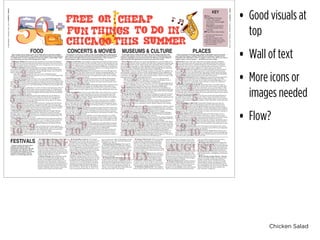
• Good visuals at
top
• Wall of text
• More icons or
images needed
• Flow?
2
5
4
4
44
3
2
1
3
3
2
11
JULY
AUGUST
JUNE
3
2
1
PAGE7•IN-DEPTH•U-HighMidway•Thursday,June4,2015
U-HighMidway•Thursday,June4,2015•IN-DEPTH•PAGE6
The summer season brings a new set of foods, all conveniently available
within our Chicago borders. This summer, find fresh produce, rich barbecue,
or sample from a variety of local food trucks all within a small budget. Take
your taste buds on a tour of all Chicago has to offer.
From music to movies, everyone is a fan of something. Show appreciation
and celebrate your passions and interests with people from all over Chicago
this summer through concerts, movies and much more. Take a friend or a
family member, and be entertained throughout Chicago.
Want some culture while school’s out? Then the various museums and
concerts this summer are for you. Cheer on the arts without having to buy
expensive paintings or pay for music festivals. Educate yourself outside of
school and take the opportunity to learn more about the world.
Take advantage of Chicago’s only mildly comfortable season and spend
some time this summer outside! When the sun is shining, Chicago can be
beautiful in the right places. Here’s a guide to where to go when you want to
explore, relax, or even exercise — all within your price range.
FOOD CONCERTS & MOVIES MUSEUMS & CULTURE PLACES
Summer and its free time allow
students and faculty alike to
participate in the greater Chicago
community more directly. Meet
new people and engage in exciting
activities this summer with the
summer set of Chicago festivals.
FESTIVALS
l Printer’s Row Lit Fest: Founded in 1985
by the Near South Planning Board to attract
visitors to the former bookmaking hub, Printer’s
Row Lit Fest has grown to cover five city blocks
on Dearborn between Congress and Polk. The
festival attracts more than 200 booksellers from
across the country displaying new, used and
antiquarian books and featuring more than 200
authors participating in panels, discussions and a
variety of other programs. It takes place June 6-7
on Printers Row from 10 a.m.-6 p.m.
l Remix Chicago: This ecologically friendly
art and music festival held in Logan Square
focuses on encouraging communities to take
advantage of recycled materials. Held June 6-7
from noon-10 p.m. daily, this is a celebration of
recycled art and crafts from both professional art-
ists and community members. The festival also
includes workshops, kid’s activities, unique food
vendors and live music from indie bands.
l Chicago Blues Festival: As the largest
blues festival in the world, this event draws over
500,000 fans who will enjoy free performances
over the course of three days on five stages, proof
of Chicago’s status as the “Blues Capital of the
World. Taking place in Grant Park from 11 a.m.-9
p.m. on June 11-13, this historic festival will in-
clude headliner Buddy Guy as well as centennial
tributes to Willie Dixon and Muddy Waters.
l Chicago Bike Week: Held June 12-19,
Chicago Bike Week is a celebration of cycling
throughout Chicago. Some of the events include
a bike tour of the South Loop on June 15, as well
as “Napoleon Dynamite” being played at the Jay
Pritzker Pavilion in Millennium Park on June
16 at 6:30 p.m. A Chicago Triathlon Checkpoint
Challenge encourages participants get clues to
bike throughout Chicago starts at The Bean on
June 18 at 6 p.m. Also on June 18, Daley Plaza
hosts a pop-up bike fashion show at from 7 a.m.-
3 p.m. It ends with a Bike To Work Rally at Daley
Plaza from 7-9 a.m., with a provided continental
breakfast from 7-Eleven.
l Fiestas Puertorriqueñas: From June 18-
21, this festival features a celebration of Puerto
Rican culture. Traditional Latin music, authentic
food such as arepas, carnival rides and a pas-
sionate parade are a few of the items visitors can
look forward to at this vibrant festival. Located
in Humboldt Park, this festival runs 3 p.m.-10
p.m. on Thursday and Friday, and noon-10 p.m.
Saturday and Sunday.
l Chicago Zombie March: Chicagoans clad
in tattered robes, smeared with fake blood and
wailing in pain will gather in Millennium Park
for the annual Chicago Zombie March on June 20.
All zombies are invited to arrive at the park as
early as noon for free zombification makeup. At
3:30 p.m., the crowd will walk to Daley Plaza and
later head to the ABC7 News Station.
l Chicago Pride Parade: With many bright-
ly colored floats, loud music and a multitude of
people, the Chicago Pride Parade taking place
June 21 is one of the most exciting ones of the
year. Though it takes place on the north side,
running up Belmont and Montrose, it is worth
the trek from Hyde Park. One of the best viewing
locations for floats can be found toward the end of
the route on Diversey.
l Square Roots Fest: As the new version of
the much-missed Folk and Roots Festival, Square
Roots presents music, dancing, food and fun for
all ages. Check out more than 60 local artists,
bands, and performers on four different stages
on Lincoln Ave. between Montrose and Wilson
on July 10, 5 p.m.-10 p.m.; July 11, noon- 11 p.m.
and July 12 noon- 9 p.m. Recommended $5 dona-
tion for children and $10 donation for adults.
l Chinatown Summer Fair: A fun neighbor-
hood to explore anytime, Chinatown also hosts an
annual Summer Fair. On Sunday July 19, from
10 a.m.- 8 p.m., this fair will draw visitors from
all over the Midwest. Activities include tradition-
al lion dancing, Chinese classical dance and mu-
sic and martial arts among many other displays.
There will be artisans, food from neighborhood
restaurants, a petting zoo and pony rides.
l Reggae Fest: Featuring two stages of Ja-
maican music performances as well as a variety
of fair trade food from vendors and trucks, this
festival runs from Aug. 15-16 and begins at noon.
Performers from around the world are involved in
this festival located in Humboldt Park, bringing
international culture to Chicago.
l Chicago Fashion Fest: Looking to discover
your brand new personalstyle this summer? Try
exploring Fashion Fest. Outdoor runway shows,
live music and the discovery of new fashion
designers are the highlights of this year’s festival.
This two-day festival will shut down East Divi-
sion Aug. 29-30 to transform the street into a
celebration of local fashion and style.
l Chicago Jazz Festival: The Chicago Jazz
Festival focuses on appreciation for all forms of
jazz by highlighting both local and internationally
renowned artists. The four-day festival kicks off
with a performance from Butler, Bernstein & the
Hot 9, and closes with Muhal Richard Abram’s
Experimental Band. It runs Sept. 3-6 at the Chi-
cago Cultural Center, and Millennium Park from
6:30-9 p.m.
l The Chicago Antique Market: Highlight-
ing over 250 vendors indoors and outdoors with
antiques, paintings and drawings, furniture,
clothing, jewelry, beads, and food, the Chicago
Antique Market will have something for every-
one. It runs June 27-28, July 25-26 and Aug. 29-
30 on Randolph St. from 10 a.m to 5 p.m. Student
tickets are $3 before the event, and $5 at the
door, both with a student ID.
6
9
7
8
10
5
5
5
66
6
777
888
999
101010
l Navy Pier: Take a bike ride to Navy Pier and explore the many attractions
they have! Attractions span from an $8 ride on the famed 150-foot Ferris Wheel or
an $8 miniature golf course to walking through the Crystal Gardens. Aon Summer
Fireworks take place at Grand Avenue every Wednesday and Saturday at 9:30 p.m.
through Sept. 5 as well as July 4, adding a bit of extra color to your summer.
l Lincoln Park Zoo: From giraffes, lions, reptiles and birds, all types of animals
can be seen at the zoo for free. Enjoy some time in a beautiful piece of architecture
framing the skyline over at the South Pond. Yoga classes, outdoor classes and educa-
tional programs are also held at the Lincoln Park Pavillion on the Nature Boardwalk.
Appreciate a wide variety of plants at the Lincoln Park Conservatory.
l Millennium Workouts: Feel like waking up for some early morning yoga? Grab
a mat and head over to the Great Lawn at Millennium Park to enjoy views of the
city and cleansing activities like yoga, tai chi, pilates and zumba beginning at 7 a.m.,
8 a.m., 9 a.m. and 10 a.m. respectively. These workouts are held every Wednesday
through Sept. 2 sessions and run 45 minutes.
l The Point and 57th Street Beach: Promontory Point is the perfect place to
have a picnic with friends, play Frisbee or soccer, and watch a movie on a sheet when
it gets dark. It is also located right next to the beach, so you can swim before or after
you eat. Blending into the Point and stretching alongside the Museum of Science and
Industry, this local beach is the perfect location for a lazy beach day (when the weath-
er will finally allow). The beach supplies the warm sand and cool water: all you need to
bring are your friends and the sunscreen.
l Explore Humboldt Park: With over 219 acres of park land, Humboldt Park is
the perfect place to explore. Designed in the 1870s, it houses the Institute of Puerto
Rican Arts and Culture as well as a field house with a fitness center, two gymnasiums,
a lagoon, a replica of the Chicago Cubs stadium, “Little Cubs Field,” tennis courts and
baseball fields.
l The Bloomington (606) Trail: Named after Chicago’s base area code, the
Bloomington 606 trail used to be abandoned elevated train tracks that have been
transformed into a beautiful trail through Bloomington avenue to Ashland Avenue
lined by park space, flowers and trees. Bikers, runners and walkers are all welcome to
enjoy this green space starting, appropriately, on June 6. This historic space combines
nature’s beauty with Chicago history dating as far back as the Great Fire, making it a
treat for any visitor no matter your interests.
l Parade of Boats: Head to the East end of Navy Pier this summer to view a
parade of Chicago’s most beautiful sailboats. While there, visitors will learn about
the boats themselves as well as their crew and can look forward to music and dancing
after the parade. The Parade of boats will be held July 16 from 10 a.m.-2 p.m.
l Chicago Botanic Garden: Despite the long trek to Glencoe, the Botanic Garden
makes up for it with over 385 acres of vast and sprawling gardens. It has a world-re-
nowned bonsai tree collection. Opened in 1972, the garden is a beautiful place to walk,
explore, take pictures or just relax.
l Garfield Park Conservatory: One of the largest conservatories in the nation,
The Garfield Park Conservatory houses an impressive array of flowers and vegetation.
Escape into this tropical landscape to walk and think.
l Maggie Daley Park: Head over to the brand new Maggie Daley Park for some
outdoor adventures. Featuring a picnic grove, a jungle gym set containing bridges and
slides, tennis courts and a fieldhouse. The park is located downtown just west of Lake
Shore Drive and is open from 6 a.m.-11 p.m. daily.
l Movies in the Park: Grab a blanket, a picnic and some friends and head to local
park for an evening this summer for film screenings. Times for all screenings will vary
based on when sundown occurs. Featured movies include classics like “Breakfast Club”
and “Apollo 13.” Hyde Parkers in particular can head to the Midway for screenings on
Wednesday nights. Check out the Park District’s website at for a listing of daily movie
screenings: chicagoparkdistrict.com/events/movies/
l Millennium Park Film Series: This series includes free movie offerings at the
Jay Pritzker Pavilion. The series continues every Tuesday evening through Sept. 1 at
6:30 p.m. and will highlight films such as “Back to the Future” and “Dirty Dancing.”
Films will be presented on the latest and most sophisticated outdoor screen using the
Pavilion’s state-of-the-art sound system.
l Rush Hour Concerts: For all those music lovers, River North will host Rush
Hour Concerts every Tuesday through Aug. 25 at 5:45 p.m. in St. James Cathedral
at Huron and Wabash streets. Audience members will enjoy classical chamber music
from soloists, duets and chamber groups.
l The Chicago Air and Water Show: Featuring daredevil pilots, parachute teams
and jets over Lake Michigan, the Chicago Air and Water Show is the perfect event
for watching your favorite planes! Held on Aug. 15-16 from 10 a.m to 3 p.m on North
Avenue Beach, pilots are sure to throw you for a loop as they pull fantastic tricks and
stunts.
l Star Wars Fan Fare: If you are a fan of Star Wars, June 13 from 9 a.m. to 2 p.m.
there is an ETC Toy and Comic Book Show that awaits your attendance! Star Wars
collectibles, movie memorabilia, action figures and more can be found at this event
hosted by Horizon Science Academy. The best dressed child and adult will win $50 in
dealers bucks to spend with venders at ETC.
l Downtown Sound: Have a picnic or take a seat on the Great Lawn in Millen-
nium Park during this weekly concert series and enjoy musicians from a variety of
genres: indie, pop, rock, and beginning this year, electronic and contemporary. Every
Monday and Thursday night through July 23 starting at 6:30 p.m., all are welcome to
take advantage of this showcase.
l Make Music Chicago: Chicago joins hundreds of cities around the world in this
annual tradition on June 21. Musicians of all ages and skill levels play at various loca-
tions around the city for hours on end, celebrating music and the talented musicians
of our city. Hear a wide variety of genres, instruments, and musicians in public venues
around the city throughout the day.
l The Bells of Summer: Grab a blanket or a lawn chair and head over to Rock-
efeller Chapel this summer for the 50th anniversary of their Carillion concerts. Enjoy
these bell recitals with family or friends each Sunday at 5 p.m. Concert goers are also
invited to climb the 271 steps to the top of Rockefeller to enjoy the beautiful view and
stained glass windows alongside the music.
l Jazzin’ at the Shedd: Enjoy jazz music, fireworks and 32,000 different animals
in exhibits like the Abbott Oceanarium and Wild Reef at Shedd Aquarium any Tues-
day between June 17 and Sept. 9. Admission is just $18 if you plan ahead by purchas-
ing tickets online and you can even pet the stingrays for an additional $3.
l Uptown Saturday Night: Treat yourself to free showcases of local artists and
performers on the second Saturday of each month until the end of 2015 in Uptown.
While there, discover this historic neighborhood through its entertainment venues
and cultural hot spots. Check outexploreuptown.org/na-portal-only/uptown-saturday-
nights for specific performances and times.
l Chicago’s Ribfest: This festival on the intersection of Lawrence and Broadway
showcases the best ribs from both local and national restaurants. Even non-rib lovers
can enjoy live entertainment at this three-day event running June 12-14, noon-10 p.m.
Friday and Saturday, noon-9 p.m. Sunday.
l Farmers’ Markets: Scattered throughout the Chicago neighborhoods, farm-
ers’ markets offer fresh fruits, vegetables, flowers and plants, as well as baked goods,
seasonal jams and other homemade goods. Lasting through October, you’re bound to
make a satisfying deal on your produce purchases.
Daley Plaza: Thursdays until Oct. 29, 7 a.m.-3 p.m., Washington Street
Green City: Saturday/Wednesday until Oct. 31, 7 a.m.-1 p.m., South Lincoln Park
between Clark and Stockton Drive
Hyde Park: Thursdays June 4-Oct. 29, 7 a.m.-1 p.m., Harold Washington Park
l Taste of Randolph: Visitors can discover new foods for free from acclaimed res-
taurants along “Restaurant Row” by trying free samples at this free street festival held
June 19-21. For a two hour period during the day, the Restaurant Oasis will offer each
person a free item. Dinosaur Jr., the Dandy Warhols and Best Coast also headline the
live music performances.
l Taste of Chicago: A celebration of a variety of cuisines and restaurants, Taste of
Chicago is an outdoor food festival with various restaurant stands. It is held between
July 8-12 and is located in Grant Park, between Jackson and Columbus. The Chicago
skyline as well as multiple concerts throughout the festival offer the perfect backdrop
for trying new dishes and cuisines.
l Taste of Lincoln Avenue: This iconic event sprawls over six city blocks on a
major artery in the heart of Lincoln Park. Visitors can look forward to musical per-
formances ranging from classic rock to indie to blues as well as over 100 different
vendors. This weekend event runs July 25-26 from noon-10 p.m. daily on N. Lincoln
Avenue between Fullerton and Wrightwood.
l Food Truck Fest: Known for its mobile food trucks, Chicago hosts this festival
every summer to continue the tradition and supply the public with convenient food
during our only fairly comfortable season. With a variety of trucks such as Fat Shallot
and Gino’s Steak Truck present, there’s bound to be something for everyone. Located
in Armour Square Park on June 27-28 and open from noon-10 p.m.
l Hot Dog Fest: Presented by the Chicago History Museum, Chicago’s Hot Dog
Fest celebrates one of the city’s landmark foods. Exclusively serving Vienna Beef
Hot Dogs, spend a day or two chowing down on a summer favorite while overlooking
beautiful gardens along the museum. Located on Clark Street and LaSalle Drive, the
festival runs Aug. 7-9 from 11 a.m.-9 p.m.
l Taste of Greektown: Dive into gyros, grilled lamb, Greek salad and souvlaki at
this year’s Greek fest on Aug. 22-23 from noon-11 p.m. A number of local restaurants
participate to bring Chicagoans a truly Greek experience to this festival located on
Halsted St. in Greek Town. Beyond the traditional Greek fare, the festival will also
feature music, dancing and Hellenic bands.
l Roscoe Village Burger Fest: After some of Chicago’s finest restaurants fire up
their grills to make their unique version of the delicious burger, visitors will be allowed
to vote for their favorites. There will music and a Kids Zone as well as arts and crafts
vendors. It takes place July 11-12, 11 a.m.-10 p.m. in Roscoe Village.
l Fiesta Italiana: Celebrating Italian culture, music, and dance, Festa Italiana
presents an array of authentic Italian food. It takes place Aug. 13-16 at Taylor Street
and Ashland Avenue.
l Art: Throughout Chicago’s city streets and building lies a variety of public art by
many famous artists for anyone to explore. The bike path is dotted with sculptures and
each neighborhood has its own unique artistic style, particularly Pilsen, which is full
of murals and street graffiti art. Other highlights include the Agora in Grant Park,
Fountain of Time in Washington Park, Monument with Standing Beast on Randolph
Street and the famous Picasso sculpture that resides at Daley Plaza.
l Art Fairs: A common staple of Chicago summers, art fairs provide a glimpse into
local paintings, sculptures, ceramics, jewelry and photography. These neighborhood
events often include live bands and a variety of food vendors. Whether you’re looking
to purchase a piece or simply want to enjoy artwork outdoors, visitors can make a day-
long experience out of these interesting street fairs.
Stars of Tomorrow Youth Arts Fest: June 6, 11 a.m.-6 p.m., Kennicott Park
57th Street Art Fair: June 6-7, Saturday 11 a.m.-6 p.m. and Sunday 10 a.m.-5
p.m., 57th Street between Cornell and Hyde Park Boulevard
Old Town Art Fair: June 13-14, 10 a.m.-6 p.m., Old Town Triangle Neighborhood
Artsfest on Michigan Avenue: July 10-12, 10 a.m.-7 p.m., Chicago Tribune Tower
West Loop Art Fair: Aug. 22-23, noon-10 p.m., Halsted and Washington
l The Hyde Park Art Center: The Hyde Park Art Center has free galleries as
well as a range of inexpensive classes in areas like ceramics, cartooning and darkroom
photography. Upcoming exhibitions include Cosmosis, which will be featured through
Aug. 23, and Creatures from the Concrete Aug. 4-Dec. 6.
l Chicago History Museum: Have you lived in Chicago your whole life, but don’t
know about its past? Learn about our city’s history through fun exhibitions, located
within a bike or bus ride away. General admission is $14, but Illinois residents get free
admission on July 4 and Aug. 17-21, 24-28, and 31.
l Museum of Contemporary Art: See collections of interesting and inspiring art
within our city, all at the MCA. Exhibitions rotate out regularly, meaning there is
always something new to see. Admission is free for Illinois residents every Tuesday,
opening at 10 a.m.
l The Shedd Aquarium: Although the sun is much appreciated, when the warmth
turns to burning heat, a free day at the air-conditioned Shedd Aquarium is a perfect
way to stay cool and entertained. For every Monday or Tuesday until June 16 starting
at 9 a.m., this opportunity is open to all Illinois Residents free of charge.
l Museum of Contemporary Photography: The museum at 600 S. Michigan
Ave. holds a collection of photographs like no other. Wander through photographs of
everything from Birmingham, Alabama, to Butte, Montana.
l Young Chicago Author Workshops: Nurture your love for poetry or rapping in
free, artist-led workshops at the YCA headquarters located at 1180 N. Milwaukee Ave.
Check youngchicagoauthors.org to find schedules for specific workshops.
l Chicago Cultural Center: A former Chicago Public Library and Civil War Memo-
rial, the Chicago Cultural Center at 78 E. Washington St. stands as testament to all the
city has to offer. Beyond its historic walls visitors can view exhibits on native artists and
musicians like Cheryl Pope and Archibald Motley. If you make a reservation in advance,
residents also have the opportunity to share their story through the nonprofit organiza-
tion StoryCorps, which will then be archived at the National Library of Congress.
l Shakespeare in the Park: Breathing new life into William Shakespeare’s “A
Midsummer Night’s Dream,” the Chicago Shakespeare Theater will once again per-
form Shakespeare in 18 neighborhood parks throughout the Chicago area. The produc-
tions will begin July 18 at Gateway Park and run through Aug. 17.
KEY
l Free
l Free/Pay: Entering
is free, but specific
attraction or food might
cost money
l Donation: A donation
is recommended when
entering
l Pay: Entry costs money
Edited by Maia Boussy and
Grace Anderson.
Activities compiled by Talia
Goerge-Karron, Sonny Lee, Alex
Lund, Averie Miller, Ileana Minor,
Sarah Pan and Dheven Unni.
Art by Kat Flocke.
Chicken Salad
• Dominance: Clear
• Hierarchy: Clear
• Balance: A bit top-heavy. Add
image with second story
• Flow: Clear, uninterrupted
• Good layering
• Feels crammed
U-HighMidway•Thursday,June4,2015•CITYLIFE•PAGE8
Old Chicago-style pub on the rise in Hispanic locale
by Alex Harron
Associate Editor
The name is misleading.
Dusek’s Board and Beer located at 1227 W. 18th
St. in Pilsen offers an array of delicious menu items
for people under 21. Reservations can be made online
through the website or by phone for parties of five
or more. They will not seat you until the majority of
your party has arrived.
Tucked away on the southwest side of Chicago,
Dusek’s is a cozy restaurant with a quaint charm.
The exposed brick walls and wooden tables and
chairs give it an Old Chicago feel. The restaurant
has two large rooms with tall glass windows offering
a street view. Chalkboards filled with messages and
signatures from past patrons cover the bathroom
walls; chalk and erasers are provided. Street parking
can be found within a couple blocks of the restaurant.
For Sunday brunch, the restaurant was packed
with many college-aged, well-dressed people. Our
server was incredibly nice and knowledgeable about
the menu.
The menu, created by Chef Jared Wentworth, of-
fers a wide variety of dishes, all with a slight twist
to them. Our party of six ordered the omelet, steak
and eggs, iron roasted Prince Edward Island mus-
sels, white cheddar mac and cheese and two Danish
pastry cinnamon rolls. Dishes arrived together on
wooden boards, iron pans and patterned bowls, mak-
ing them easy for our group to share. Each item also
includes a beer pairing for consumers over 21 years
old. Because it was incredibly busy, it took a while
for the food to come out.
Spiced goat cheese, roasted spring onions and oys-
ter mushrooms filled the medium-sized omelet and
came with a side of herbed potatoes. The fluffy om-
elet melted in my mouth and the side potatoes were
perfectly seasoned. The steak and eggs were also a
good portion and just as delicious. The slightly spicy
mound of mussels served in a large bowl with a deli-
cious broth was my favorite dish. The creamy mac
and cheese also had a slight spice to it. The sticky
cinnamon rolls served hot with a rich frosting were
delicious. Entrees and small plates ranged from $14
to $32 apiece.
I would definitely go again, but I would suggest
going with a party of five or more in order to make a
reservation, order food to share and split the check.
by Clyde Schwab
Associate Editor
S
trolling down 18th Street on a humid day, as
the block buzzes with activity, a few store-
fronts stick out among the predominantly
Spanish signs. Pseudo-grungy vintage stores
and sleek coffee shops appear occasionally between
bars and taquerias, their polished vibrancejuxtapos-
ing the simple, aged shops that scream of authentic-
ity. The street seems on the brink of change.
Pilsen sits southwest of downtown, bordered on
the south by the Stevenson Expressway and the Chi-
cago River, on the north by 16th Street, on the west by
train tracks and on the east by Canal Street and the
Chicago river. Pilsen is easily reached by car or bike
from Hyde Park, while
public transportation
requires a train to the
McCormick Place then
a bus. While the neigh-
borhood spans much of
the lower west side, the
commercial activity
lies primarily on 18th
Street with the rest
of the neighborhood
devoted to residential
areas, industrial zones
and warehouses.
Pilsen served as a
gateway to the city for
immigrants, including
the Czech, German
and Irish. Since the
1960s, Pilsen has been
the home of the now
predominant Hispanic
population. Despite
resistance from many
community members,
a process of gentrifi-
cation has taken over
Pilsen since the early
2000s, which some
think will alter Pilsen’s
status as a holdout for
the Mexican-American
middle class.
One can glimpse this
complicated and di-
verse history through
the eclectic crowds at
local venues such as
Jumping Bean Cafe.
Customers range from
Latino families and
University of Illinois students to decaffeinated, di-
sheveled artists and proto-hipsters enjoying one of
the Cafe’s many specialty lattes.
Taking a break from the muggy Chicago spring
to enjoy my delicious yet overly sweetened iced mo-
cha, I peered at the walls of the cafe, elaborately and
vividly decorated with paintings, news clippings and
music posters.
Since its beginnings as a gateway for immigrants,
Pilsen has supported a tenacious appetite for art.
Murals of community leaders, Aztec gods and other-
wise remarkably detailed and colorful scenes deco-
rate alleys and walls scattered throughout Pilsen.
Alongside the local galleries that line the streets lies
the National Museum of Mexican Art. The art in
both the galleries and museums mirrors the neigh-
borhood in its kinetic and varied style, though much
of it maintains a politicized tone.
One can witness such work at Prospectus Gal-
lery, owned and operated by Israel Hernandez. The
gallery, just off 18th Street, serves as a break from
the often crowded streets. The colorful work with-
in stands in stark contrast tothe white interior. On
display is a retrospective of Jose Guerrero, a Chi-
cago based artist, featuring a selection of his linocut
prints from 1964 to the early 2000s. Prints range
from depictions of intersections in Pilsen to prints of
farmers.
In his thick accent, longtime Pilsen resident Her-
nandez offered some insight into his life in Pilsen
and how it’s changing.
“The gallery started out of necessity. I grew up
here in Pilsen all my life, and I’ve seen all the prob-
lems that were happening in the seventies,” Hernan-
dez said. “So we decided to bring something positive
into the neighborhood. The problem is that for many
years, this has been a working class neighborhood.
So, there are a lot of new businesses and shops, but
a lot of people are being displaced, especially in this
economy. Most of the manufacturing jobs are no lon-
ger in Chicago. Everything is about profit.”
With a mural coated exterior containing brightly
colored shapes, the popular restaurant Neuvo Leon
is frequently packed by Pilsen visitors. A frequent
patron of Nuevo Leon, Spanish teacher Craig Reu-
belt describes the authentic feel of the restaurant
environment and its food.
“To me, it always feels and tastes like someone’s
grandmother is cooking in the kitchen,” Mr. Reubelt
said. “The restuarant itself is very well established
and the portions are always good no matter what you
order. I’ve never been dissapointed there. They have
some traditional items and some more unique items
like pork stew, but, no matter what, I always leave
feeling full and satisfied.
Past Nuevo Leon and further down 18th Street,
sits Knee Deep Vintage. The cheerful, trendy owner
and longtime South Side resident Carlos describes,
how this curated thrift store provides a cool but af-
fordable (read cheap) clothing spanning decades. Fol-
lowing the neighborhood trend, Knee Deep Vintage,
is lined with colorful shirts, paintings, and a section
in the back devoted to vintage western attire.
Over a soundtrack comprised of the Smiths, Carlos
described his shop’s position in Pilsen and how he’s
seen it change alongside the other recently opened
vintage stores in Pilsen.
“There really isn’t any competition because we
never offer the same stuff. I honestly haven’t seen
the neighborhood change since we first opened, other
than fewer abandoned storefronts. The change that
people are worried about is completely natural, and
it is better to see open business than vacant build-
ings. We don’t want to do anything other than co-
exist, and any opposition we’ve seen has been from
people who are fairly new to the neighborhood.”
While a walk along the
busy, commercial 18th
Street is wonderful, de-
viating to the seemingly
deserted train tracks
along 16th Street yields
vibrant results. Spon-
sored by the Chicago Ur-
ban Art Society, murals
scattered throughout
Pilsen depict portraits of
community leaders, geo-
metric patterns, ancient
Central American style
art and elaborate scenes.
Vividly colored murals
serve to discourage gang
grafitti and offer a space
for independent art and
political discourse. A
number of international-
ly recognized street art-
ists were commissioned
to kick off the project.
Photos by Clyde Schwab
Alongside traditional Mexican
food, Pilsen serves as a hub
for authentic art and culture
Picturesque PilsenPicturesque Pilsen
Pilsen Summer
at a Glance
June 5-7:
Taste of Little Village:
Flavors of Mexico
A range of restuarants
offer samples of authen-
tic Mexican food along
26th Street between
California to Sacra-
mento. Visitors can also
enjoy local bands.
June 6-7:
Food Truck Social
Held on 18th Street
between Racine and
Throop, this two-day
food truck festival from
showcases the variety of
Chicagoland food trucks.
Highlights include Ta-
male Spaceship, Honky
Tonk BBQ and Chicago
Cupcakes! Suggested $5
donation.
July 30-Aug. 2:
Fiesta del Sol
As the largest Latin
American festival in the
Midwest, this four-day
festival draws 1 million
people. Visitors can look
forward to an arts pavil-
ion, authentic Mexican
food and live music.
Donations accepted.
Chicken Salad
• Dominant visual
in natural
position
• Appropriate
amount of text
• Lots of entry
points
• Vote results can
be misleading
(blue=89%)
DECISION TIME 2016
Tightest race in Illinois will be
March 15 U.S. Senate primary
bySarah Pan
news editor
On March 15, the state of Il-
linois will hold its 2016 primary
election. Voters will appoint
state delegates and commit-
teemen and will nominate U.S.
Senators and Representatives,
among other state offices.
This year, the Senate race is
among the most competitive
in the United States because of
Republican Illinois Sen. Mark
Kirk’s weaknesses in the polls.
He won the U.S. Senate elec-
tion in 2010 with 48 percent of
the vote, just slightly in front of
runner-up Alexi Giannoulias’
46 percent. As is evident by his
slight lead, he was and is not
widely popular among many Il-
linois voters.
Although he’s a moderate
Republican, Kirk represents a
solidly Democratic state. Odds
are not in his favor during a
presidential election year, es-
pecially because those are the
years where more people vote
than usual. This means Kirk’s
small lead will likely diminish
this year, as anyone who did not
like him before will likely come
out to vote now. Due to health
problems and an unstable ap-
proval rating, Kirk is one of the
most vulnerable Republican
Senators this election season.
According to University of
Chicago Political Science pro-
fessor Mark Hansen, it’s going
to be a tight race in the General
Election.
“I don’t think the primary is
going to be a problem for him,
even if he has opposition,” pro-
fessor Hansen said. “It’s a more
crowded race on the Demo-
cratic side. Our primary is one
of the earliest in the country, so
there is lots of time for Demo-
crats to repair the damage if the
primary campaign gets particu-
larly bitter, but there’s also plen-
ty of time for Sen. Kirk to make
a campaign against whoever
his opponent is. I don’t think
the Democratic candidate is
just going to waltz into office.”
Meanwhile, the race between
Andrea Zopp and U.S. Repre-
sentative Tammy Duckworth
for the U.S. Senate Democratic
nominationhasalsobeenclose.
Duckworth has major recogni-
tion among the public due to
political experience, but new-
comer Zopp has a lot of support
for this Senate race, particularly
from fellow African-Americans.
Elected in 2012, two-term
congresswoman Duckworth
was the first Asian American
woman to represent Illinois
in Congress. Duckworth has a
significant number of endorse-
ments from Illinois residents
and companies, notably Illi-
nois’ largest labor organization,
the AFL-CIO.
Zopp, who led the Chicago
Urban League, served on the
Chicago Board of Education,
and was a prosecutor, is trying
to rally the black vote for the
primaries. Rev. Jesse Jackson
endorsed Zopp in late January,
and Zopp continues to cam-
paign across the state to gain
recognition.
State Sen. Napoleon Harris is
also a candidate.
“I don’t think that Rep. Duck-
worth has much to fear,” Pro-
fessor Hansen said. “I would
be flabbergasted if she were
not the nominee next month.
The two candidates running
against her are both from the
city or near suburbs, she’s from
the more distant suburbs. She
is a veteran, which will run well
downstate, in the suburbs, and
in the city as well. She is also by
far the best known of the three
candidates.”
Congressional candidates
will be nominated, too. With
high approval rating and strong
public leads, Democratic Rep-
resentatives Bobby Rush, 1st
District, and Danny Davis, 7th
District, are likely to be reelect-
ed. Rush won his previous two
general elections with about 73
percent of the vote, while Davis
won his previous two general
elections with around 85 per-
cent. They represent areas with
a lot of students, and they both
have strong support in this
election. Both have served at
least 15 years in their positions.
Not clearyet whetherTrump,
Sanders are their parties’future
byGraceAnderson
editor-in-chief
F
ollowing the Iowa caucuses on
Feb. 2 and the New Hampshire
primary on Feb. 9, no clear front-
runner has emerged in either
party.
The Iowa caucuses on Feb. 2 yielded
surprising results for both the Republican
and Democratic primaries. On the Re-
publican side, with nearly 27.6 percent of
the vote, Sen. Ted Cruz upset poll-leader
Donald Trump, who received 24.3 per-
cent. Sen. Marco Rubio came in close be-
hind with 23.1 percent.Trump stayed true
to polling numbers in New Hampshire
and won with 35.3% of the vote, followed
by Gov. John Kasich with 15.8 percent and
Cruz with 11.7 percent.
While Secretary Hillary Clinton techni-
cally beat Sen. Bernie Sanders in Iowa, her
margin of just 0.03 percent made the race
a virtual tie. In New Hampshire, Sand-
ers surpassed polling predictions and
trounced Clinton with 60.4 percent of the
vote.
One of the most surprising results of
the Iowa caucus was Trump’s loss to Cruz.
Many argue that Cruz won due to his ap-
peal to Iowa’s many Evangelical voters.
His highly organized campaign also used
the one-on-one conversations that have
historically attracted Iowans.The fact that
Trump’s flashier campaign style failed to
yield results suggests that Trump may
lack the support needed for the nomina-
tion. According to Kate Grossman from
the University of Chicago Institute of Poli-
tics, this loss was a major blow for Trump.
“I think there was a real consensus
building that Trump was going to be the
Republican nominee,” Ms. Grossman
said, “and the mood of the country has
definitely shifted away from that since
Iowa. It’s definitely still a possibility, but
his inevitability was definitely pierced
because he didn’t win, and he’s all about
winning.”
However, Trump came back with a re-
sounding win in New Hampshire.
On the Democratic side, youth voters
seem to be attracted to Sanders, while
older voters favor Clinton. Sanders re-
ceived 84 percent of the youth vote in
Iowa and 83 percent in New Hampshire.
In New Hampshire, Sanders also cap-
tured 55 percent of women voters, a blow
to Clinton’s campaign that tends to attract
female voters.
When asked for her thoughts on this
trend, Ms. Grossman noted the relation-
ship between this primary and Barack
Obama’s first campaign for president.
“There is a real parallel with the race
in 2008 and the one we see today,” Ms.
Grossman explained, “because both Ber-
nie Sanders and Barack Obama capture
the youth vote. Sanders and Obama are
all about inspiration and hope, while
Clinton is all about pragmatism and the
idea that she can get the job done.”
Ms. Grossman also commented on
the fact that people often favor Clinton
because they see her as electable during
the general election, while others prefer
Sanders who’s considered honest.
“I think the older you get, often the
more pragmatic you get,” Ms. Grossman
said. “When you are younger you are of-
ten more idealistic, so younger voters are
drawn to a candidate like Sanders who
talks about a revolution and a big change
to the current system.
Disenchantment with the more tradi-
tional presidential candidate spans both
parties. In particular, Ms. Grossman not-
ed that with popular but non-traditional
candidates like Trump and Cruz, it is dif-
ficult to determine the future of the party.
“I don’t think anyone really knows what
this primary means for the Republican
Party,” Ms. Grossman said, “because they
[Trump and Cruz] are really not the tradi-
tional candidates. We do know where it’s
coming from– there’s a lot of anger and
disillusionmentwiththeestablishmenton
both sides, but especially the Republican
side. Bernie Sanders, Ted Cruz and Don-
ald Trump are all a representation of this
sentiment. What Trump and Bernie Sand-
ers have in common is that they speak
their mind; they aren’t parsing words.”
Ms. Grossman also mentioned that it’s
too early to tell if candidates like Trump
and Cruz will chart a new path for the Re-
publican Party.
“It’s not clear that, ifTrump is the nomi-
nee, that he will be a one-off nominee or if
he is part of a new path for the Republican
Party,” Ms. Grossman stated.“The pattern
almost always is that in each election the
voters go for the candidate who’s the most
different from the incumbent president.
Obama is thoughtful, intellectual and
cerebral, so now the public wants some-
thing different. Obama was also a reac-
tion to George Bush, as someone who is
deliberate and thoughtful and wouldn’t
take us into war. So with Trump, it’s not
clear if this is just a swing in one direction
or if we’re charting a new path.”
FRIDAY, FEB. 19, 2016 • IN-DEPTH
U-HIGH MIDWAY • UNIVERSITY HIGH SCHOOL, CHICAGO 7
Voting 101
byTaliaGoerge-Karron
assistant editor
H Caucus: Members of precincts
meet to select delegates to go to
the county convention, the state
convention and the national
convention. Those people will
ultimately vote for president.
H Early voting: Starting about a
month before elections, voters
can vote at a designated polling
station, or they can mail in their
vote.
H Election judge: Works at the
polling station in order to con-
duct a fair and nonpartisan elec-
tion equal for all voters.
H Electoral college: Each state has
a designated number of elec-
tors, which vote on the presi-
dent based on popular vote. To
be president, a candidate needs
270 of the 538 electors.
H General election: The election
process in the United States. It
allows everyone to vote for gov-
ernment.
H Gerrymandering: Illegally di-
viding states into districts with
the intent of giving one party
an unfair advantage. Illinois has
a major problem with unequal
districts and unfair district lines.
H Polling station:The place where
voters go to vote in elections.
You can find your polling station
in Chicago at: http://www.chi-
cagoelections.com/en/home.
html
H Precincts: A district that has a
clear boundary for political or
security purposes.
H Primary: An initial election that
narrows the number of candi-
dates to just one candidate per
party for the general election.
H Redistricting: The process of
redrawing districts in the state
after the census every 10 years.
Illinois redistricting falls to the
state legislature.
It’s your right;
register to vote
byDheven Unni
assistant editor
H If you're 17 years old now and will be 18
by Nov. 8, you're elegible to vote in this
year's primary and general elections.
H Check whether or not you’re already reg-
istered at http://www.canivote.org/
H If not, register for the general election
at https://ova.elections.il.gov/. You will
need your State ID or Driver’s License
and the last 4 digits of your social secu-
rity number
H The registration period for the Illinois
Primary Election has passed. However,
there is a grace period from Feb. 17-
March 15. During this period, you must
register in person and then vote immedi-
ately after at the Chicago Election Board
or at any early voting location. On elec-
tion day, you may also register and vote
but it has to be at your assigned precinct
polling place. Find out more at www.chi-
cagoelections.com.
H Check your polling place location at
vote411.org
H Don’t forget to bring identification. Two
forms of ID are recommended, though
they may not be required. A driver’s li-
cense and student ID should suffice, and
a passport is even better.
Alec
Kaplan
Taylor
Thompson
John
McKee
IN-DEPTH • FRIDAY, FEB. 19, 2016
U-HIGH MIDWAY • UNIVERSITY HIGH SCHOOL, CHICAGO6
Matan
Diermeier-
Lazar
U-High Votes
Sources: Center for Research and Information on Civic Living, Bipartisan Policy Center and Federal Election Commission
Venkat
Somala
Zoe
Dervin
In the 2012 presidential election 57.5% of eligible voters participated. Barack Obama received 51.06% ofthe
total popularvote, and Mitt Romney received 47.2%. Of eligible citizens ages 18-29, 50% voted. That’s about 23
million people. 67% ofyouth voters voted for Obama. 30% voted for Romney.
REPUBLICANS
15.8% Donald Trump7.8% 11.9% Jeb Bush 18.4% Ted Cruz 39.5% Marco Rubio
41.7% Hillary Clinton 58.3% Bernie Sanders
2016 U-HIGH MOCK ELECTION: In U-High’s Mock Election Feb. 3-4, 346 of508 students voted. The chart
represents freshman, sophomore, junior and seniorvotes. 89% of students voted for a Democratic candidate and
11% for a Republican candidate. Since then, Carly Fiorina, Chris Christie and Jim Gilmore have dropped out.
DEMOCRATS
5.3%
“I voted for Rubio because I feel that the
Democratic frontrunners are not fit to run this
country and would be ineffective presidents.
Rubio is by far the most reasonable. I agree
with many of his policies and, of the Republi-
can candidates, I think he would have the best
chance in the general election.”
“Abortion and Planned Parent-
hood matter the most to me. This is
the most important issue because,
as a female, if I was forced to raise a
child that I didn’t want, it would be
setting up both my life and my child’s
life to be very difficult. I believe every
woman has the right to choose what
is best for her.”
“One of the most important
issues to me is tax reform. Recently,
the majority of revenue and profit
reported for the country came from
big corporations as opposed to
medium-income households. The
way to fix this is to give consumers in
medium-income households more
money, and you do that by taxing the
corporations so that you can invest in
proper infrastructure like education
or health benefits. That’s why I lean
towards the Democratic side of the
party since they would actually tax
corporations.”
“Planned Parenthood stands out
to me as the most because I don’t
think I could support a candidate
who doesn’t allow the right to choose
and ensure access to contraceptives.
Additionally anyone who would
deprive women of the services that
Planned Parenthood offers I couldn’t
support.”
“Gun control matters the most to
me. I believe that we should have
some form of a background check for
anyone who wants to buy a gun. But,
I can’t support anyone who wants
to violate the Second Amendment
right.”
“I voted for Hillary Clinton because of the way the
congress is set up right now — not much is going to
be accomplished by Bernie Sanders’ attitude. But with
Hillary’s work in the Senate, you can see she’s very good
at compromising and well versed in domestic and foreign
policy. Bernie’s ‘my way or the highway’ attitude won’t work.
While I do admire his approach to ‘let’s take down the big
guys,’ Hillary’s ability to compromise, her record of doing
that, and her ability to build relationships when she was in
the senate before is what we really need.”
“I voted for Bernie — Feel the Bern. I mean, Sanders
says what he wants in the debates while Hillary really just
advocates for feminism and doesn’t really— I’d say she
kinda just uses jabber while Bernie really attacksWall Street
and says his beliefs. I support his values of fighting large
coorporations, especially when he gets all his donor money
from the general population. I think $26 is the average
amout of money he receives per person, while other
candidates receive millions. I feel like he’s vouching for the
general population.”
“I voted for John Kasich — and mostly because
I didn’t really like the Democratic candidates this
year even though I’m generally a Democrat. So I
picked basically the furthest left Republican on
the ballot.”
bynatalie glick
midway reporter
Abortion and
Planned Parenthood:
The Republican candidates
want to stop all federal funding
for abortions. No direct funds
will be given to Planned Parent-
hood and the use of Obamacare
to have an abortion will not be
allowed. Democrats support fed-
eral funding for abortions. They
are opposed to any constitution-
al ban on abortion and want to
continue government funding
for Planned Parenthood.
Gun Control:
The Republican candidates
oppose any limitation on buying
guns or bullets. On the Demo-
cratic side, the candidates be-
lieve in much harsher gun con-
trol laws. They want to establish
universal background checks
for anyone purchasing a gun,
which would ensure that there
are more regulations on who can
obtain guns.
Immigration:
The Republican candidates
are opposed to people who en-
tered the country illegally, even if
their kids are American citizens.
They want strict limitations on
who can enter the country, espe-
cially people from South Ameri-
ca and the Middle East. Demo-
crats believe in half citizenship
for any person who has entered
the country illegally. They want
to implement a more welcoming
policy for everyone, particularly
for refugees and children.
Health Care:
Republicans want to repeal
Obamacare and limit govern-
ment support for anyone except
the elderly. Democrats want to
fully implement and even exp-
pand Obamacare and move to-
ward universal health care.
ISIS:
Republicans believe that the
UnitedStatesshouldtakeaggres-
sive military action, particularly
against ISIS, where they want to
put U.S. troops on the ground
to fight. Republicans also want
to allocate more federal funding
to the military. Democrats want
to focus on coalition-building,
rather than direct action. Former
Secretary of State Hillary Clinton
favors having troops in conflict
zones, but does not want the
troops in engage in combat. Sen.
Bernie Sanders wants the United
States to take part in an inter-
national coalition against ISIS
where regional countries would
provide troops.
Tax Reform:
Both Republicans and Demo-
crats want to reform taxes, but
they have different ideas on
what that means. The Republi-
cans want to create fewer corpo-
rate taxes and will give fewer tax
benefits to the lower economic
brackets. The Democrats want
fewer taxes for the middle and
lower tax brackets as well as
higher taxes on corporations
with fewer tax breaks.
Supreme Court:
With the death of Justice
Antonin Scalia on Feb. 13, Re-
publicans and Democrats are
divided on who should fill his
seat. President Obama plans to
appoint a replacement before
the end of his term, who Demo-
crats will support. Republicans
announced they plan to block
the appointment, intending to
designate a new justice once a
Republican president is elected.
DECISION TIME 2016
7.8% Ben Carson, Carly Fiorina and
Jim Gilmore each received one vote
5.3% John Kasich
Who’s got your vote?
The 2016 election is just
around the corner, so
here’s your guide to the
first results, the issues
ahead and what to
expect from the Illinois
primary March 15.
The Issues
Liza
Edwards-Levin
John
Grissom
Race heats up
between Zopp,
Duckworth for
chance to unseat
Republican Kirk
“When you are younger you are
often more idealistic, so younger
voters are drawn to a candidate
like Sanders who talks about
revolution and a big change to
the current system.”
— Kate Grossman,
University of Chicago Institute of Politics
artwork by kat flocke
statistics and quotes for mock election compiled by alex harron and alex lund quotes compiled by natalie glick
and grace anderson
Chicken Salad
• Dominance: Moderate
• Hierarchy: Clear
• Balance: Maybe a bit off-center
• Flow: Clear sequence
• Could use some chatter. Overall
has several points of entry.
TV: Not just about white people anymore
THURSDAY, JAN. 21, 2016 • ARTS
U-HIGH MIDWAY • UNIVERSITY HIGH SCHOOL, CHICAGO 5
New characters have potential
to erode longtime stereotypes
byDheven Unni
assistant editor
Almost all of the minority char-
acters anyone was likely to see
on primetime television in recent
years have been extremely stereo-
typical ones. This year, however,
new shows have premiered that
prominently feature people of col-
or in substantive roles.
In the new Netflix sitcom “Mas-
ter of None,” writer and lead actor
Aziz Ansari tackles many issues:
feminism, immigrant parents, re-
lationships. One episode, “Indians
on TV,” was praised by many news
outlets for its take on how the me-
dia covers minorities. The episode
focuses on racism in entertain-
ment television and how harmful
it can be.
Ansari, playing an Indian-Amer-
ican actor, is forced to deal with
network executives that refuse to
have more than one Indian in a
show. He also faces difficulty as an
Indian unwilling to do an accent,
losing multiple roles as a result.
While these problems are ad-
dressed explicitly, there are more
subtle things that Ansari does.
In almost every television show,
Asians are cast as oddballs and
nerds. As Ansari said in an inter-
view with the New York Times,
“Alan Yang, asked me: ‘How many
times have you seen an Asian guy
kiss someone inTV or film?’ After a
long hard think, we came up with
two.” To counter this public image,
Ansari cast a Chinese-American as
a flirty and urban 30-something
and cast an Indian as a muscular
bodybuilder. This challenges the
idea that all Asians on television
have to be stereotypes by showing
them a completely different side
of Asians, ones that aren’t all doc-
tors, convenience store owners or
in customer service.
Recently, the topic of a “single
story” has come up many times.
Chimamanda Adichie gave an
informative TED talk about how
the one-sidedness of American
television has given people an ex-
tremely biased view of all Africans.
Too often, people assume that all
minorities are the same as the ex-
aggerated stereotypes one sees on
television. Characters like Apu on
“The Simpsons,” a convenience
store owner with a ridiculous ac-
cent, or Han Lee on “2 Broke
Girls,” a restaurant owner who
seems clueless about American
social norms, reinforce this image.
These characters are one-dimen-
sional, and come off as cartoonish
representations of established ste-
reotypes. This only serves to rein-
force the idea that all Asian people
are the same.
Shows like “Fresh Off The Boat,”
“Black-ish” and “Master of None”
have all shown Americans minor-
ity characters in roles that they
normally wouldn’t receive, chal-
lenging these generalizations by
showing Asians as artists and ac-
tors.
The market audience of these
shows differentiate them from
others currently on television.
None of the shows are specifi-
cally targeted to one race, unlike
many shows starring multiple mi-
norities. They bring more realistic
depictions of people of color to a
wider audience, slowly changing
the stereotypes that have been re-
inforced for decades.
Hopefully, as more and more
television shows begin to feature
people of color in roles normally
reserved for white people, the chil-
dren that grow up on the shows
will be able to shatter the stereo-
types that have done so much
harm. These shows promise a
brighter future, one where chil-
dren who aren’t white will be able
to see people who look like them
on television.
“The children that grow up
on the shows will be able to
shatter the stereotypes that
have done so much harm.”
“I stopped
watching
replays of
my life on
TV and
continued
actually
living it.”
bySonnyLee
arts co-editor
W
hen “Fresh Off the Boat” first hit the
screens in the beginning of 2015, I liked
the teaser on Facebook and told all my
friends about it. I was thrilled. Before this,
I had never seen so many Asian faces in an American
TV show. But from the first episode, I could tell that
Eddie, the main character, was just
like me. My parents immigrated
from East Asia 25 years ago, specifi-
cally from Hong Kong and Tianjin,
just like Eddie Huang’s parents. My
mom and dad opened a restaurant
in hopes of achieving the “American
Dream,” just like Eddie’s parents.
Eddie and his Taiwanese family
were outsiders in an all-white sub-
urb, while my family and I live in the
quiet neighborhood of Bridgeport
with a lot of white people populating
it, close enough. Lastly, Eddie was
ridiculed and made fun of in school
for his Chinese lunches, just like I
was. The story was boring, nothing
I hadn’t seen before. So I stopped
watching replays of my life on TV
and continued actually living it.
Fast forward about a year and I
want to watch the show again, ex-
cept this time I want to see what my parents think of
it. As the show begins to roll its canned laughter and
gag jokes, my parents laughed along and watched like
theywouldanyothershow.Butthen,Eddiecomplains
to his mother that all she ever cares about is money.
The mother, played by Constance Wu, responds, “go
find a homeless man and ask him whether he thinks
money matters or not, and see what he says.”
My father pointed out that this line was true in
many ways. He has always told me, “Go to school, get
into a good college and make money,” I’ve heard this
line played over and over again like a broken record. I
hated when my parents used to tell me this, but with
time, I understood that it was something I needed to
remember.
“Money isn’t everything,” my father explained, “but
without money, you can’t get anything.”
For years my father embedded an important line in
me.
“Never be like me,” he said.
He doesn’t want me opening a restaurant busi-
ness like his own, running around at his age all day
and night making food deliveries for a couple bucks. I
wasn’t thinking of it anyways. I witness and live some
of the pains that come along with running a restau-
rant. Achy legs after a day of running back and forth
answering phones, packing food and filling up rice
warmers. Hands that smell like different Chinese
dishes from packing them into their comfortable
brown paper bags all day.
I never really liked the idea of my parents owning a
restaurant, mainly because it meant seeing them in a
work setting and not seeing them enough in the fam-
ily setting. The only skills that I’ve honed in my years
of being raised in restaurants are the ability to sweep
a floor clean, calming impatient customers, closing
take-out boxes like a pro and most importantly, being
able to pack and bag five orders at a time without any
mistakes.
Though 11-year-old me and 11-year-old Eddie
share many similarities through our background sto-
ries, there are some big difference that I’ve discovered
over the course of a year. Sure, I threw away my Chi-
nese lunches a couple times when I was 11 so that the
other kids wouldn’t look at me differently. I made my
parents buy Hotpockets, so I’d have a “white people”
lunch, just like Eddie did. And at the age of 11, I al-
ways thought that my parents couldn’t understand
what was going through my mind. I always distanced
myself from my parents, just like Eddie.
However, now I’ve matured enough to understand
that conforming to these “American” lunches was
boring, and separating myself from my own culture
put distance between me and my family, which is not
what I wanted. My parents didn’t work this hard so
that I would lose sight of my own heritage. And sure,
my skills in packing food are a cut above the average
Joe, but I’ve learned more than that. My focus, work
ethic and attention to detail can only be attributed to
the dinner rush hours between 6 and 9.
Characters like Eddie Huang are important for
young TV audiences and especially anybody who has
ever felt like an outsider. They’re more than a rep-
resentation of a foreigner, more than an underdog.
They’re a symbol that things are going to get better.
They prove that being yourself is more important
than sacrificing character to fit into a cutout.
Although Eddie and I may be different in our own
ways than the status quo, we both eventually found
our groups and fit into our own cutouts and stan-
dards. So in that sense, we really aren’t that fresh off
the boat.
Don’t try so hard to fit in that
you lose your own identity
“Fresh Off the Boat,” “Black-ish,”
“Master of None” step away from
the norm by giving minorities
substantive roles on all screens
abc
Loosely based on 33 year-old chef and BaoHaus owner Eddie Huang’s
memoir, “Fresh off the Boat,” tells the experiences of racism and cultural
differences felt by him when he was growing up. After moving from their
Taiwanese hub in Washington, D.C., to a suburb in Orlando, Eddie’s fa-
ther opens up a Western-themed steakhouse in hopes of fulfilling “the
American dream.” The show follows young hip-hop-crazed Eddie, nar-
rated in the first season by the real Eddie Huang, in his struggles to con-
nect with his peers and fit into his new environment.“Fresh Off the Boat”
has two seasons available on the ABC website, Hulu and Amazon.
abc
Similar to “Modern Family,” “Black-ish” broadcasts the life of a comfort-
able suburban family that has all the parts of a stereotypical “happy”
family:the hilarious father, the mother holding down the family and chil-
dren with different personalities. But“Black-ish” sets itself apart from the
rest of family oriented sitcoms by using comedy to discuss issues of race,
health class and more. In the second season premiere, “Black-ish” ad-
dressed the use of the n-word. Other issues like gun violence and religion
were also discussed. “Blackish” has had two seasons so far, and is avail-
able on Hulu, Amazon and on the ABC website.
npr
The fictionalized story of Aziz Ansari’s life, “Master of None,” follows
the life of Dev, a NewYorker in his 30s, trying to make a living as an actor.
Through comedy, romance and drama, the show addresses issues like
racial representation in Hollywood, the experience of being a first-gen-
eration-American and decisions about having children. From creators
AlanYang and Aziz Ansari,“Master of None” is a Netflix Original that pre-
miered on Nov. 6, 2015, and awaits its renewal for a second season.
“FRESH OFFTHE BOAT” • ABC
“BLACK-ISH” • ABC
“MASTER OF NONE” • NETFLIX
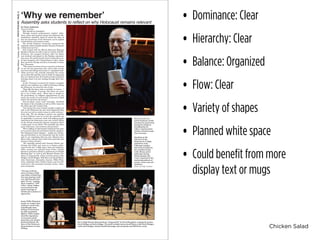
Chicken Salad
• Wall of text
• More icons or
images needed
• Really lame
central graphic.
• Attempt to have
colored circles
symbolize
names but it
failed.
byMicaiah Buchheim-Jurisson
editor-in-chief
N
ationwide, college campus-
es have experienced uproar
with students expressing
the difficulties of being a minority
student at predominantly white
institutions. U-High faces similar
issues. Not only do many students
feel the school lacks forums to dis-
cuss issues surrounding identity
and race in a candid and thought-
ful way, but many students say
they feel unsafe or uncomfortable
expressing opinions at school.
“I think our school often has
trouble finding a balance between
making everyone comfortable
but also talking about the things
that we need to talk about,” junior
Taylor Thompson said. “Pressing
issues, current events and things
like discrimination and racism
that happen within our communi-
ty and having a place to talk about
them.”
The concept of emotional safety
is largely centered around identity
and how it affects the way people
from different groups interact and
inhabit the same space.
“I think there are a few compo-
nents,” Taylor said. “First and fore-
most, all participants not feeling
marginalized or limited in your re-
sponses due to gender, race or re-
ligion and also being able to voice
your opinions without being shut
down or immediately dismissed.
It’s feeling that you have the op-
portunity to have productive con-
versation without being targeted
or attacked.”
At Lab, where students can
spend 15 years with the same
classmates, most would agree it is
important that everyone feels safe
and comfortable. To Learning and
Counseling department chair Ca-
mille Baughn-Cunningham, feel-
ing safe in-
cludes feeling
understood
and having a
sense of be-
longing.
“I think in
terms of a
learning en-
vironment in
particular,”
she said, “we
know that
there has to
be some ba-
sic level of
safety in or-
der for us to
really allow
our minds
to engage in
the learning process, to feel safe
enough to make a mistake and
learn from it, to feel safe enough
to share one’s innermost thoughts
if we’re reflecting on something in
an English class, for example.”
Ms.Baughn-Cunningham
thinks that most people in the U-
High community have good in-
tentions, but can unwittingly say
hurtful things, which can erode a
person’s sense of belonging.
“I think that tends to commu-
nicate questions about, ‘Well how
safe am I? How do people really
feel about this specific group of
people?’” she said. “So I think it’s
kind of raised these questions of
safety in that broadest term. And
the questions of belonging being
right there with that: ‘This person
who threw that question or com-
ment that may have felt insensi-
tive, doesn’t have a clue about who
I really am. And maybe they don’t
even have an interest.’”
Not everyone is affected in the
same way by these sorts of issues.
Trying to see others perspectives is
important, according to Ken Gar-
cia-Gonzales, Lab’s Coordinator of
Diversity, Equity and Inclusion.
“When you’re part of the norma-
tive culture, in the multiplicities of
your identity, it’s easier for you to
detach yourself from the emotion
associated with that,” he said. “If
I’m walking down the stairs and I
don’t see a ramp, it doesn’t occur
to me. If it’s pointed out to me, it’s
now my responsibility — how am I
going to take that information? Do
I discount that, or do I look at that
like, ‘Whoa, I never thought about
it like that. I can see why someone
would get upset or offended about
that.’”
On Dec. 10, in an attempt to fig-
ure out how to have more effective
and comfortable conversations
about issues of identity, Student
Council hosted a lunchtime dis-
cussion titled “Constructive or
Destructive? A conversation on
having conversations.” Mr. Garcia-
Gonzales has also hosted lunch-
time discussions about identity
and inclusion, and the Learning
and Counseling Department has
been working with junior adviso-
ries to discuss racial issues.
Mr. Garcia-Gonzales feels it’s
important for the norm in discus-
sion of sensitive topics to be dia-
logue, not debate.
“If the cultural norm at Lab is
to lean in and listen and talk, we
can still be very impassioned, but
I’m sitting on my side of the table
and you’re sitting on yours and
we’re talking about something in
the middle,” Mr. Garcia-Gonzales
said, emphasizing that would al-
low students to have difficult
conversations. “If the norm is to
attack, refute, challenge — get per-
sonal even — then inherently, that
does not create a space for conver-
sation. And it puts people auto-
matically on the offensive.”
Ms.Baughn-Cunningham
stressed the importance of dia-
logue about these issues.
“Being able to have these con-
versations is critical but can be
very uncomfortable,” she said.
“People don’t want to be seen as
at worst racist, or at best limited
in their experiences. ‘I’m going to
be exposed in a way I probably
haven’t had before, so am I going
to be misperceived?’”
Senior Fabrice Guyot-Sionnest
acknowledges that some modera-
tion of opinions in school discus-
sions might be justified by the
argument that teenagers are not
fully developed adults, but regard-
less feels that students should be
allowed to express whatever opin-
ions they want.
“If somebody has an honest
opinion, they should be allowed
to share it in a classroom and then
there should be a moderated dis-
cussion that allows people to dis-
agree in a constructive manner,”
Fabrice said. “From a teacher’s
perspective, on any sensitive topic
their job is simply to moderate and
provide facts. They should not be
allowed to share their own opin-
ions since they are in a position of
authority.”
Taylor realizes that certain con-
versations will make people un-
comfortable, but thinks that is
necessary in creating an environ-
ment where everyone can feel safe.
“I think that it’s important that
everybody feels safe in school but
in order for everybody to feel safe
in school we need to have con-
versations that are sometimes
uncomfortable for other people,”
Taylor said. “Because obviously
ignoring issues isn’t a solution and
doesn’t help anyone feel any safer.”
Mr. Garcia-Gonzales compares
functioning in a diverse environ-
ment to taking a class, acknowl-
edging that it is a learning process
and that it is OK to make mistakes.
“Peopleareindifferentstages,so
to assume that students have to be
in a certain place, or that students
have to have an understanding of
certain things, is complicated, and
I don’t think you can actually do
that. I don’t think you can say that
about students of color, either.
There’s no blueprint — like, you
turn 18, and all of a sudden, you’re
a conscious student of color.”
“When you’re
part of the
normative
culture...it’s
easier for
you to detach
yourself from
the emotion
associated
with that,”
— Ken Garcia-
Gonzales,
Coordinator of
Diversity, Equity
and Inclusion
Lab must balance comfort and contention
T
he definition of safe space
seems simple at first glance
— a place where one can
self-express without being
challenged on the basis of
one’s identity. However,
the controversy that
has swept across the
nation’s universities
like Yale University and
University of Missouri
says otherwise. While
student activists agree that
increasing attention to
political correctness and safe spaces is
necessary on campuses where fear and
oppression is the norm, others have
been quick to decry the movement.
Those opposing the movement have
ridiculed students’ demands, calling the
new generation of students “coddled”
and “overly fragile,” while
saying that the idea of
a safe space is just
a way to escape
from reality. Amid
a new climate
of increased
awareness
toward
previously
marginalized
groups, where
terms such as
“microaggression,”
“oppression” and
“trigger warnings,” verge
on ambiguity, how can the
U-High community foster an
environment of emotional safety while
remaining a space where contradictory
and challenging ideas can be allowed to
Charles
Disantis
THURSDAY, DEC. 17, 2015 • IN-DEPTH
U-HIGH MIDWAY • UNIVERSITY HIGH SCHOOL, CHICAGO 7
Fikayo
Walter-Johnson
IN-DEPTH • THURSDAY, DEC. 17, 2015
U-HIGH MIDWAY • UNIVERSITY HIGH SCHOOL, CHICAGO6
Ajay
Chopra
Asha
Futterman
Caleb
Hill
Asra
Ahmed
byWillisWeinstein
midway reporter
F
or some students, walking
into the high school lobby
each morning is so routine
they could do it in their sleep. For
others, it’s an act of conquering
their fear. While many of us feel at
ease in Lab’s halls, some students
feel scared to express their opin-
ions on larger societal issues and
lack a space where they feel com-
fortable doing so.
For the past two years, DICE has
hosted speakers, workshops and
discussions regarding these is-
sues, such as a workshop on police
brutality in February of last year
as the Black Lives Matter social
movement grew stronger. If you
ask President of DICE Fikayo Wal-
ter-Johnson, a senior, it’s her club’s
mission to create a “safe space,” or
forum, where all members of the
Lab community can feel comfort-
able discussing issues regarding
race, sexuality, socioeconomic sta-
tus or gender.
“DICE has been pushing for
these conversations, and safe
spaces for a while now and I think
our school has been more ea-
ger than ever to join us,” Fikayo
said. “The school’s job has always
been to keep us in a safe learn-
ing environment and this is the
the school’s responsibility, but as
members of the community we
can help make it a safe place too.
At the very least, we should try our
best to do the least damage to the
people around us. That’s the bare
minimum, but we can also go be-
yond that by listening to experi-
ences and letting each voice know
whatever they are saying is valid.”
Through hosting these dia-
logues and forums, Fikayo sees
DICE as an agent of change which
can create eventual academic
safety at Lab.
“I think that for people in our
communities a lack of safety exists
on a personal level, but we can’t ig-
nore how the personal is tethered
to the institutional level,” Fikayo
said. “I’m a black girl existing in
this school community. I would
be lying if I told you I hadn’t ex-
perienced a micro-aggression or
two in my time here at Lab. I’ve
heard some ignorant things said
by classmates and on a personal
level this upsets and irritates me,
but I’m also cognizant of how that
person moves through society as
someone who may not have to
think about race and or gender like
I do everyday because of the sys-
tems of oppression in place. “
Senior Reed Rosenbacher, who
attended the DICE discussion,
“Free Speech or Hate Speech?” on
Nov. 19, agrees that DICE provides
a forum for discussing society’s
issues, but be-
lieves a lot of stu-
dents went into
the discussion
with the wrong
mindset.
“I think most
students attend
for history ex-
tra credit,” Reed
said. “Many don’t
take others opin-
ions into account
and are looking for confirmation
of their own opinion more than
anything. I think it comes down to
radicals are sometimes unwilling
to make reasonable compromises,
and others are unwilling to think
of things in a different way or to
change the way they act and ap-
proach questions. As a result, stu-
dents who feel uncomfortable and
under attack tend to not go. ”
Rather than extra credit discus-
sions, Reed thinks the best way to
bring change is to make it part of
the curriculum, such as through
classes on current issues like
queerness, transgender or race.
Though there’s still a great deal
to accomplish, Fikayo thinks Lab
is definitely making progress on
these issues since students con-
tinue to take initiative.
“I think that our school is at a
very unique turning point, discus-
sions about equity and inclusion
are popping up every week dur-
ing lunch” Fikayo said. “Students
are plastering the walls of Gordon
Parks with art about social jus-
tice and change and when I walk
through the hall I could not be
more proud.”
? intellectual
discussion
safe
space
safe
space
intellectual
discussion
Club aims to create space for student discussion
Roundtable reveals candid takes on life at Lab
byAlex Lund
arts co-editor
On Dec. 10, senior Anna Funk
posted a Google document on
Facebook addressing “socially un-
aware white people and socially
unaware minorities” whom she
believes are insensitive on topics
like racism, sexism and classism at
Lab. While some students openly
showed their support for the docu-
ment, others publicly did not.
In a professed effort to receive
constructive feedback from fel-
low students about her own so-
cial awareness, as well as critique
the Lab community, Anna found
herself in a position of vulnerabil-
ity because her online document,
though thoughtfully constructed,
would inevitably be deconstructed
by the diverse audience Facebook
provided, and subject to commen-
tary.
Regardless of Anna’s intentions,
putting her document on social
media allowed her peers to im-
press their own interpretations
on it, positive or negative. Though
the document was the subject of a
lot of argumentation, it also trig-
gered a great deal of conversation
among students on the issues it
addressed.
Though Anna received a mixed
reaction, she believes that her de-
cision to post it publicly made it
inconvenient for “oppressors” to
continue to remain ignorant of
their actions.
“I thought it was important to
post it because as much as I com-
plain about how I don’t under-
stand how they are so publicly stu-
pid, which insinuates that no one
has told them, I rarely publicly tell
them that they are stupid,” Anna
said. “I could have avoided a lot of
judgement that was not produc-
tive for me if I had posted it in a
safer space, but I wanted everyone
to read it.”
Though social media can be
a democratic platform to share
opinions, it can also result in mis-
understanding and negative inter-
actions among users, regardless
of intent. While social media may
have been the most convenient
way for Anna to express her ideas,
under other circumstances it may
not be so. In a study conducted by
Alex Pentland, an MIT professor,
communicating via social media
was proven to be less productive
than face-to-face discussion.
“Subtle signs like facial expres-
sions and body language help hu-
mans judge the moods of others
and make for a more productive
conversation,” junior Jonathan
Lipman said. “In the case of online
communications, there is no op-
portunity for the sharing of these
as you cannot see the other per-
son. This can lead to some major
miscommunications and misin-
terpretations. I would say that so-
cial media can distort the discus-
sion and can severely detract from
the productivity of dialog.”
Regardless, students like Anna
find that the benefits of online dis-
cussion often outweigh the poten-
tially negative aspects of it due to
the fact that conversation is highly
accessible and commenting re-
quires people to be more reflective
on what they’re saying.
“Facebook is the best way to
make people feel the most com-
fortable commenting on your
work, and typing their comment
out,” Anna said “Knowing that ev-
eryone will see it tends to make
people more articulate and pre-
vents them from saying offensive
or useless things.”
While some students believe
that social media solely encour-
ages outspokenness online, others
think that having an unsupervised
platform for expression has en-
couraged students to speak more
openly face-to-face.
“The Lab School community is
so supportive, and since people
aren’t being stopped with what
they say on social media,” junior
Eliana Waxman said. “People feel
like there aren’t any boundaries of
what they can say face to face.”
Despite skepticism about the
productivity of online discussion,
students still intently follow what
is said on social media.
“I place just as much impor-
tance in an online discussion as a
face to face one, and although it
will not be as productive in most
circumstances, it is still an explo-
ration of ideas,” Jonathan said. “I
will always scroll through and read
people’s arguments as what is said
on Facebook is in fact what is said
in the ‘real world,’ or at least the
‘real world’ that contains people
who had access to that Facebook
post, and should be treated as
such.”
Rachel
Housinger
Online discussion can bring positive, negative effects
“You have to
realize that if
you’re a male
you’re not going
to have the same
views on sexism
as a female would
have. If you’re
a white male
you’re not going
to have the same
views on minority
oppression as a
black female. ”
— Ajay Chopra, junior
On Dec. 3, The Midway organized a
roundtable conversation with seniors Ra-
chel Housinger and Caleb Hill, juniors Asha
Futterman and Ajay Chopra, history teacher
Charles Disantis and Assistant Principal
Asra Ahmed. The group discussed how
the national debate over the ideas of
safe space and intellectual discus-
sion play out at Lab. The group
agreed that a safe space is one
where people feel their identity
is accepted and they can ex-
press themselves without fear
of direct ridicule. Moderator
Grace Anderson then posed a
question to the group regard-
ing where they feel they can
find such safe spaces at Lab.
Below is a transcript of that
conversation, which has re-
ceived minor editing for clarity
and space.
CALEB: Personally, I’d say I feel
pretty safe in Lab’s environment because
I’m not afraid to have others critiquing my
ideas. I don’t feel discriminated against, by
that I mean that I feel I can speak out and I’ve
built relationships with so many people that we
can bounce ideas off each other all the time. Spe-
cifically, in advisory is when I see us do this the
most because we have discussions consistently
on current events and different aspects of various
things that are going on in the world. I think the
main thing is that people have to be willing to
listen to each other and be willing to admit that
someone else might have a perspective that they
may not personally see because they aren’t in that
person’s shoes. Often when you say an opinion
people get a big sense of ego and automatically
assume that you’re disagreeing with something
they said and want to put a negative spin on your
response when they’re actually taking things
completely out of context.
RACHEL: I mean, I usually feel like it’s pretty
safe just because I feel the same way as Caleb
where I don’t really care if people disagree with
me. But, sometimes people don’t listen if you try
to say a different opinion and they just strike you
down immediately and don’t really listen to you
fully even if you try to explain yourself, they’ll just
be like ‘Oh that’s not what I think, that’s wrong.’
I always feel like every time I go to a DICE meet-
ing, even if there are two different sides of an
argument and people are arguing, they’re not just
arguing and restating their sides over and over
again, they’re actually talking through the points
… and really explaining themselves. I always re-
ally like going to DICE meetings because of that.
AJAY: Just building off of that, being from the
very south suburbs that’s where I did a lot of my
schooling before I came to Lab. Being from a pre-
dominantly white suburb, I’ve had experiences
where offenses have been directed at me because
of my Indian heritage. So, what I value at Lab is
that there is a lot diversity among the students
and faculty, which really makes it a conducive
environment for everyone to share their views.
What I realized from attending other schooling
systems is that everything from a teaching and
learning perspective there is done very by the
book, you know, very ordered. There’s not really a
lot of opportunity for people to share conflicting
opinions, which is something that I really value
at Lab. That’s not to say that there isn’t a lot of
work to be done, but I think something to value
with a community like this is that there is a lot
of diversity and because of that there’s a lot of
opportunity for different opinions to be shared.
So, it’s about making that sure
that all those opinions can be
worked through, not shouted
down, to make sure we don’t
have only one path of how
we learn because that’s what
makes our school special.
ASHA: I think that’s inter-
esting when you talk about
how you feel like Lab has
been a very diverse experi-
ence for you because I’ve
just had a polar opposite
experience. I can’t even think
of one class, besides African
American history, where I
have more than even two
black people in my class —
in my art class I have none
and in my English class I have
none. I feel like especially
English and Art should be
places where I feel like I have
a community or a place to
share ideas and it’s really hard
to share ideas when you feel
like you’re the only one in
the room. Also, there will be
times when I’m having a bad
day and I’ll just be walking
through the hallways and
notice all these white people
walking past me. I’ll see all
these students who don’t look
like me and all these teachers
who don’t look like me and
the only people who I see that
look like me are generally not
teachers or administrators. I think I’ve only en-
countered two black, female teachers and it just
feels really overwhelming a lot of the time to feel
so alone in a place I’ve gone to for so long.
RACHEL: I agree with Asha, I mean obviously
I don’t feel alone because I’m not black, but I feel
like in a lot of my classes there aren’t very many
black students.We’ll be talking about something
that has to do with African American history
and I’ll look around and I’ll realize that it’s just
a bunch of non-black people discussing, and it
really makes me feel like my education would be
better if there was a more diverse class present.
It’s not helpful to me to have a bunch of white
kids being like ‘Well I think that this was bad’ and
not having any kids who have actually experi-
enced racism having any say in some of our class
discussions. I’ve noticed that a lot and it kind of
makes me uncomfortable sometimes. I’ll notice
white kids talking about black experience and I’ll
be thinking that if we could have black students
here to share their experiences that would be
really helpful.
MR.DISANTIS: I think you guys are right, I
think there is the assumption of a certain kind of
background here. I think you see freshman make
those generalizations more often and as you get
to juniors and seniors you see students thinking
in more detail about the implications of what
they’re saying about groups they don’t have any
actual experience with. One thing I wanted to add
to this is that something else at Lab that really
strikes me is that there’s kind of a class dynamic
that doesn’t get discussed all that often...It’s not
as obvious that someone might not be at the
same socio-economic status as someone else, but
I think we need to be cognizant of that as well.
That’s one of the big hurdles we have in terms
of diversity. I think the students by and large are
doing a great job of bringing aspects of race and
gender discrimination to the floor, you guys are
raising your voices in a lot of ways. But some of
the less obvious ones like
class because it’s not as visible
on the surface are ones we
need to consider as well.
MODERATOR: Let’s switch
gears a bit.When, if ever, do
you think it is appropriate to
risk offending people for the
purpose of an intellectual
discussion?
AJAY: I do have an example
of this and I think this has
actually come up a few times.
In English last year we read
an AugustWilson play, a very
famous black playwright. One
of the big things we had an
entire class period of discus-
sion devoted to is that he uses
the n-word very pervasively
in a lot of his plays, so we
were talking about what’s the
right way to address this...For
a lot of people they wanted to
say it because they wanted to
pay respect to AugustWilson
by reading it as it was written
since he chose to put that
word in there for a reason.
In that class, we ended up
having each student make
their own judgment call, but
does that really make for a
good educational experi-
ence? That’s up for debate.
You know, for me, I wanted
to honor the artistic merit of
AugustWilson, so I said it, but other people had a
completely different take on it.
ASHA: I was also in a class where we read
AugustWilson and I was also one of the only
black people in that class and the class over-
whelmingly voted that they would like to say
the word. So, from that perspective, I think that
it was kind of an unfair vote when there were so
few black people in the class, but then everyone
was still allowed to use that word. Because, I
don’t know, I mean I don’t even feel comfortable
using that word! And when everyone was reading
monologues, students who have been racist to
me said it out loud. And I mean we voted that it
was okay, but I was just sitting in class watching
a whole bunch of white people get up and do
these really important monologues that I had a
lot of artistic integrity, but they were yelling the
n-word and it was really hard for me to handle
that as a black student.When there’s very few
black students represented at this school, their
opinions about what makes them uncomfortable
and what doesn’t should probably be valued over
a predominantly white class.
MR.DISANTIS: Do you think that kind of vote
was a fair way to go about it?
ASHA: No.
MODERATOR: What do you think a better way
to go about this would be?
ASHA: I think that they should have made sure
that the black people in that class felt comfort-
able with white people saying it. I don’t think they
should have made sure white people felt comfort-
able saying it.
RACHEL: I remember Mira told me a story and
I don’t remember what book it was, it might have
been “7 Guitars” or it might have been Steinbeck,
but they took a vote like this and right before they
all voted everyone looked at Mira to make sure
it was okay.When I heard that I felt like even if it
wasn’t okay with her, if everyone looked after they
had all already agreed it was okay, her saying it’s
not okay is a really tough position to put her in.
She was the only black person in that class, so I
felt that leaving it up to her was kind of unfair and
she said it made her feel really uncomfortable.
MR.DISANTIS: That certainly puts the minor-
ity in a really difficult position from pretty much
any angle.
MS.AHMED: Yes, and I would say that even a
step prior to that option of what you’re saying is
that the adult that’s responsible for that space,
whether it’s a classroom or a club, needs to give
some serious thought to whether or not this a
space where every student present feels safe
enough to speak up. In that moment you clearly
didn’t feel like you could say ‘I don’t agree with
this process, it’s uncomfortable for me’. So, that’s
the responsibility on our parts as adults in this
school to take that on – to think about if I’m call-
ing this to vote,, is that even a good step to take?
ASHA: And I think it’s your responsibility that
I’m not the only black person in that class and
that the teacher isn’t always a white man.
MS.AHMED: Yes, I do think we need to be
more thoughtful about our hiring and about
distribution of classes. [...]
CALEB: I think it starts with everyone being
aware of how they are challenging ideas or how
different groups of people feel when you bring
different topics forward. For example, in our
economics class we had a debate on sexism in
the business world. And during that discussion
I thought for like half an hour how to ask this
question and I finally asked, ‘Well, where is sex-
ism at Lab because as a male I don’t necessarily
see so could someone please explain it to me?’
And when I said that question I thought that was
the best way for me to phrase it without thinking
that there are only
four [six] girls in our
economics class and
we have 21 guys and
I didn’t really take
into consideration
how yes that’s a
good way to ask the
question, but that it
also puts them in a
very uncomfortable
position to recall all
of the sexist experi-
ences and various
types of discrimina-
tion they may have
felt during their time
at Lab. [...]
AJAY: I think that
one of the first steps
like Caleb said is
awareness.You have
to realize that if
you’re a male you’re not going to have the same
views on sexism as a female would have. If you’re
a white male you’re not going to have the same
views on minority oppression as a black female.
You have to realize that no matter how hard you
try or how many things you read you’re never
going to be able to fully understand it because
you’re not born into that position and I think that
just realizing that is key.You can’t imagine how
difficult it is, for example with the English discus-
sion, if you’re the one to say ‘I don’t want anyone
to say the N-word, here’s why,’ then you’ve just
taken this English discussion about literature and
made it an entire discussion about race relations.
It’s a very, very daunting task for anybody to take
on and realizing that you’re never going to really
know what that feels like but knowing that there
are those select few in the room that do is a very
important thought pattern that’s not found at Lab
right now, but it’s something that could contrib-
ute to making Lab a safe and intellectual space.
120
Labat
An occasional
series of stories as
the school marks
120 years since its
founding in 1896
exist?
Chicken Salad
• Pretty good flow
• Symmetrical
balance — best
choice?
• Map needed
more context
“[‘Chi-Raq’] just
showed and
added negative
connotations to
Chicago. Because
of that, I felt like
only the people in
Chicago really know
about Chicago.
There is violence,
but there’s also
people trying
to improve the
violence.”
— Che Raoul, senior
SOUTHSIDE byTaliaGoerge-Karron
assistant editor
Systemic socioeconomic segrega-
tion. Misconception of black men.
Corruption. Unequal education. Un-
just. Culture pockets. Not “Chi-Raq.”
Hope. This is what Chicago means to
many U-High students.
The Social Justice Club sponsored
a photo titled “What does Chicago
mean to you?/What is Chicago to
you?” which resulted in a photo-
graphic discussion on issues and cul-
ture throughout Chicago.
Some students did have inhibitions
about writing negative perceptions of
Chicago for the whole school to see.
“Some people were kind of scared
to give negative answers because they
knew they would be posted around
the school,” Kara said. “It shows that
Lab as a commu-
nity is very diverse
and we lots of dif-
ferent experiences
and opinions.”
Sophomore Ol-
ivia Issa remarked
on the divide be-
tween public and
private schools.
She is a competi-
tive dancer that
works with danc-
ers from across the
city, the majority
of which do not go
to U-High.
“Their class
sizes are twice the
size of ours,” Olivia
said. “I’ll say, “I’m
takingAPComputerSciencethisyear,
while their schools would not dream
of teaching computer science.’ We
get penalized for cutting class, and I
mentioned that, and this girl turned
to me and said,‘Someone cut class 42
consecutive days and still passed the
class.’ There’s no safety net for them,
and that’s terrifying because we’re all
going to make mistakes.”
Other students addressed racial in-
equalitybothatLabandinthegreater
community on the South Side. Kara
explained there is a lack of discussion
on race at U-High and she hoped this
project would address that gap.
“Race plays a role in Lab’s everyday
community,” Kara said. “I think that
at Lab, race is a very sensitive topic
to talk about and how we feel about
diversity as a whole… I think that
people are scared to talk about the
racial issues when things like Laquan
McDonald getting shot and police
brutality happen.”
While Hyde Park is a diverse neigh-
borhood, Kara remarked that U-High
students tend not to pay as much at-
tention to the racially segregated ar-
eas of Chicago. Kara lives downtown
where she sees many different races
living and working cohesively.
“I think that a lot of kids at Lab ei-
ther live in Hyde Park or on the North
Side,” Kara said. “Hyde Park is a su-
per diverse area… there are so many
parts of Chicago that are strictly
white, or strictly black, or strictly la-
tino. Lab kids don’t pay that much at-
tention to those areas.”
In light of increasing protests, Kara
remarked on the changing nature of
the public view on police brutality
and race in America and the need for
education to continue this trend.
“People are becoming more aware
of what it’s like being a black male in
ChicagoandAmerica,”Karasaid.“The
people that are under the impression
that police brutality of African Ameri-
can males is not something that exists
need to become more aware. People
that don’t think there’s racism in the
world need to be educated.”
Junior Taylor Thompson discussed
the invisible segregation that sur-
rounds her neighborhood, Beverly,
one of the most racially and ethni-
cally diverse places in southwest
Chicago and a 25-minute drive from
Hyde Park. Geographic barriers, such
as train tracks or roads, unintention-
ally divide Chicago which leads to so-
cioeconomic pockets across the city.
“I’ve lived in Beverly my entire life
and there’s train tracks that divide
my neighborhood from Washington
Heights,” Taylor said. “How differ-
ent the environment and the people
are across the tracks changes, but
also the cost of real estate changes
drastically and you see these socio-
economic pockets all across the city
because of that.”
Although outsiders may believe
they can shed light on the city’s is-
sues, senior Che Raoul believes
that non-Chicago natives promote
negative media portrayal of Chicago
without seeing the bigger picture. In
particular, the 2015 movie “Chi-Raq”
depicted women in Chicago refusing
to have sex with their husbands un-
til gang violence stopped. Although
meant to provoke discussion, Che
sees the movie as a negative portrayal
of Chicago’s culture.
“Normally when people outside
think of Chicago, they think of all the
stuff that they see on the news, es-
pecially not positive stuff,” Che said.
“There was the whole movie pro-
duced by Spike Lee [“Chi-Raq”] and
that just wasn’t a positive image at
all and it didn’t really show anything
about Chicago. It just showed and
added negative connotations to Chi-
cago. Because of that, I felt like only
the people in Chicago really know
about Chicago. There is violence, but
there’s also people trying to improve
the violence.”
47th AND PRAIRIE. The now-faded Chicago Blues
Mural, featured in the 1980 “Blues Brothers” film
with Ray Charles singing in front of it, stands adja-
cent to Shelly’s Loan and Jewelry Company.
57th AND LAKE PARK. Sitting beneath the 57th
Street viaduct, “The Spirit of Hyde Park,” painted in
the mid-1970s and restored in 2012, shows riots next
to more abstract images of peace.
47th AND CALUMET. “The Wall of Daydreaming and
Man’s Inhumanity to Man,” painted in 1975, depicts
various aspects of urban strife including drugs, vio-
lence, and prositution.
GARFIELD AND INDIANA. In an empty lot between
two vacant building, this unnamed mural portrays
two musicians alongside the words “Conscious Com-
munity” in front of a vibrant sunset.
79th AND STONY ISLAND. “Bright Moments, Mem-
ories of the Future,” lies adjectent to the New Regal
Theater and features jazz and blues greats including
Billie Holiday, Dizzy Gillespie and Nat King Cole.
THURSDAY, APRIL 14, 2016 • IN-DEPTH
U-HIGH MIDWAY • UNIVERSITY HIGH SCHOOL, CHICAGO 7
Mira lives in
the Roseland
neighborhood.
She described
assumptions
many U-High
students
have about
the college
process and
the balance
between
U-High and her
neighborhood
socially.
IN-DEPTH • THURSDAY, APRIL 14, 2016
U-HIGH MIDWAY • UNIVERSITY HIGH SCHOOL, CHICAGO6
Sprawling south from Roosevelt Road and west from Lake
Michigan, Chicago’s South Side boasts a hefty reputation. To
some, it’s “Chi-Raq.” To others, it’s home. U-High seems a
“bubble” of privilege and safety, but discussions of inequality
have raised questions on our
role in the community and
misconceptions of the area that
cannot be ignored.
MYSOUTH SIDE:
Students describe misconceptions of Chicago life
byMicaiah Buchheim-Jurisson
editor-in-chief
The South Side of Chicago has a rich culinary history
ranging from classic soul food to African cuisine and hip
cafes, exemplified by these neighborhood staples.
Lem’s Bar-B-Q
311 E. 75th St.
Greater Grand Crossing
The line usually stretches
out of the door at this Cha-
tham fixture that’s been
open since 1968, and after
tasting the food it is easy to
see why (though admittedly
the space inside the store is
quite small — there is only
the line, no eating space).
Don’t worry though — the
line tends to move quickly.
The two massive hickory
smokers house the slabs
of meat soon to be doused
with the Mississippi-style
mild sauce. The smoky,
slightly sweet, tangy rib tips underneath a bed of fries are
some of the best in Chicago (and don’t forget about the hot
links). Open from 1 p.m. to 3 a.m. on Fridays and Saturdays,
but worth eating any time of day.
YassaAfrican Restaurant
3511 S. Martin Luther King Dr.
Bronzeville
Aside from its absolutely
delicious (and inexpensive)
Senegalese food, Yassa’s
low-key environment and
exceptionally friendly staff
and chefs who are eager to
converse with guests make
it a great hangout spot. Dibi
and Maffe are highly recom-
mended, both of with come
with flavorful and succulent
cuts of lamb and chicken.
Also recommended is the
ginger drink (the proprietor,
who is over 60 but looks 45,
claims that his youthful vis-
age is a result of frequently sipping this rejuvenating bever-
age). Besides, what other restaurant has a picture of music
legend Akon on the menu?
CurrencyExchange Cafe
305 E Garfield Blvd.
Washington Park
Artist Theaster Gates
started this well-decorated
cafe/hangout spot located
just west of Washington
Park. There is ample hang-
out space with a library col-
lection, and soon, a 35mm
slide collection, both which
are accessible to patrons.
The premise of the cafe
centers on Theaster Gates
notion of repurposing
abandoned spaces (hence
its home in an old currency
exchange building), and it
doesn’t stop there — the
repurposed tables, mugs, doors and signs make for an fas-
cinating, heterogenous aesthetic. The cafe serves southern
soul, Filipino and Mexican food, and features classics like
jambalaya, fish and grits, buttermilk pancakes and chilaqui-
les. Serves breakfast all day and lunch starting at 11 a.m.
Experimental Station
6100 S. Blackstone Ave.
Woodlawn
According to its website,
the Experimental Station
aims to “build independent
cultural infrastructure on
the South Side of Chicago.”
It hosts various institutions,
including Blackstone Bi-
cycle works (a community
bike shop that repairs and
sells used bikes and hosts
programs for youth to learn
how to work with bikes), the
61st Street Farmers Market,
both of which host worth-
while events and programs
throughout the year. In ad-
dition to regular Farmers
Market events, the Experi-
mental Station also regularly hosts workshops on healthy
eating and cooking, as well as other cultural events. Also
housed at the experimental station is the documentary stu-
dio the Invisible Institute and the local paper, “The South
SideWeekly.”
SOUTH SIDE EATS
MIRA JACOBS
I live in over in Roseland. There
are a lot of people, at least on my
block, that have been around for
a long time, a lot of older people.
There are a lot of buildings with
nothing in them, they’re just
sitting there. I know most of my
neighbors simply because my
Mom has lived here. But still the
area around us isn’t the best to be
outside.
We have Fenger High School
right there. A couple years ago,
a boy died at Fenger because he
was stomped to death and shoot-
ings happen around the area, but
they don’t necessarily happen on
my block. Across the street from
us, we do have some neighbors
who’ve been doing some time. In
that area, my family, or no one
directly related to me has been
shot at or anything, so sometimes
I feel like I’ve been desensitized
to it. Someone gets shot and you
feel bad, but at the same time it’s
becoming regular so you can’t
have that many feelings towards
it because the next day it’s gonna
happen again.
People here are used to dif-
ferent things.With people from
my neighborhood, you might
be the first generation to go to
college, but here you have lega-
cies of families who’ve gone to
college forever. Here [at U-High],
you’re worried about getting
into a certain college, and some
people are focused on the name
of the school or the fact that their
parents went there or what it will
do for them, but people from my
old school are more focused on
paying for it, and being able to
graduate successfully and doing
something not only for them-
selves but for their family.
I feel like for people at Lab,
it’s assumed that you’re going to
be great. I have family members
that are truck drivers, teachers
or random things that get them
by but it doesn’t really take them
anywhere else.
It’s hard to balance my old set
of friends and Lab people at the
same time. At my sweet 16, I was
so nervous because I wasn’t sure
how my old friends and my new
friends would interact. My old
friends interact a certain way,
and it’s just how I am and it’s not
like I’m different around my Lab
friends but they’re two completely
separate groups.
You’re bringing them together
and you’re in the middle. My old
friends know me, but coming to
Lab, I was open and talking about
different things and I was more
aware of things in life, so I have
that side of me so my old friends
might think “Mira’s changed” but
my Lab friends might be like I
don’t know who Mira is. It’s still
hard finding balance together.
While U-High students come from across Chicago, the student body is composed
predominantly of Hyde Parkers and Northsiders. Three students from the South Side of
Chicago share their perception of their neighborhood and their relationship with U-High,
noting the sometimes conflicting cultures. Interviews by Clyde Schwab.
midway photos by benji wittenbrink and paige fishman
Brian
recounted the
history of his
neighborhood,
Woodlawn, and
its sometimes
negative
influence. He
detailed the
difficulty of
reconciling the
culture of his
neighborhood
with that of
U-High.
BRIAN DEAN
I live inWoodlawn, just south
of here. My family moved in when
I was six, the neighborhood has
changed a lot. It’s not perfect
today, but it’s gotten a lot better.
Woodlawn was the neighborhood
where the Blackstone Rangers, a
Chicago gang, was founded. A lot
of the older people in my com-
munity are heavily influenced by
that, and my generation has felt
that as well, but it’s starting to lift
a bit.
The constant struggle to sur-
vive was really consistent among
everyone in the neighborhood
at the time, and it got passed
down from generation to genera-
tion. It’s affected me in a way. I
can see and identify with that
influence, and I’ve grown up with
people who’ve become victim to
that influence, and you can’t do
anything but have love for them
because that’s where you’ve come
from.
I know seeing that as a young
child made me know that’s not
what I wanted to do and caused
me to be much more involved in
my school work and activities.
Because my parents grew up in
with that struggle but my father
went to college and my mother
went to beauty school, they’re
making a constant effort to stay
away from that and to expose us
to different things from the condi-
tions in which we’re living.
I think that a common miscon-
ception is that when you go [to
the South Side], there will be a
uniform bad people, but the real-
ity is that there are people who
come out of struggling conditions
who have full intentions on doing
the right thing. There are people
who are a lot more focused on
beating the odds than what
people think they are . . . There is
a diversity among people on the
South Side just as there is around
the city, and you will have good
and bad wherever you go.
One thing about being a part of
both my community and U-High
is that you’re not going to fit all
the way in with either one.When
I’m in my neighborhood, they
look at me like, “Oh, you go to
Lab,” which is an excellent high
school, and they’re gonna be like
you have money and I’m like, “No,
we don’t.”
And they’re going to make
certain generalizations about me
right away, like, “You think you’re
smart, you think you’re all this,”
and I’m like, “No, I don’t,” I just
happened to get in to a good high
school.
When I’m here, I dress differ-
ently — I’ll sag my pants, I’ll wear
different belts and Timberland
boots, and people will make in-
stant generalizations about me…
I reflect where I come from, and I
do that proudly, but that doesn’t
mean I approve of everything that
happens.
Kerry lives in
Greater Grand
Crossing. He
explained his
experience and
friendships in
both his own
neighborhood
and in the Lab
community
in Hyde Park,
as well as
the ways his
neighborhoods
has changed.
KERRYVINSON
I live in Greater Grand Cross-
ing.When I first moved there in
2006, it was kind of rough but as
people moved in and out, it got
better. Now, it’s in a good spot
compared to where it was. There
was a a lot of violence and crime
— bad influences. It still happens,
but there’s less. I haven’t had any
problems with having to actively
avoid those influences, you would
do what you would do and they
would do what they would do.
I’ve been at Lab my whole life,
I spend most of my time with
people from Lab. The reason I
don’t feel divided between two
neighborhoods is that I have so
many memories and so many
friends in both neighborhoods
that I really value. I’ve been going
to Lab since kindergarten, so I feel
like Hyde Park is my home, but
I also feel like the neighborhood
I live in is my home. I used to go
outside in the back yard and play,
just typical stuff you would do as
a kid, and I was able to have that
opportunity both in my neighbor-
hood and in Hyde Park.
When you year “South Side
of Chicago,” you think lots of
violence, lots of gangs. People
get one view of the South Side
and put all the neighborhoods
together, and they assume that
the entire South Side is the same
way. It’s not viewed as distinct
neighborhoods, it’s viewed as one
big block.
The first thing I can say that the
South Side means to me is home.
There’s definitely a sense of com-
munity, and there’s like… loyalty.
Everyone looks out for everyone.
If a neighbor is sick, we take care
of them, take out their garbage,
help them around the house.
Everyone is working together, and
everyone feels loyal to each other.
There’s a much different vibe in
my neighborhood now.When we
first moved here, every day you
got home, you went inside, and
that’s where you stayed. But now,
you come home, you go inside or
outside, barbecue in the sum-
mer and spring, do yard work or
sit on the front porch. Now you
can go outside and do whatever
you want without being scared or
anything.
I disagree with the idea that all
the African American students
just socialize with each other. I
have friends that live up north,
and we’ve been really good
friends for quite a long time…
Most of us have known each other
since Lower School, and that’s
when we all lived in different
neighborhoods, so it’s really just
the friendship we’ve kept through
the years. It’s a lot more about
who you end up being friends
with and who you are than sepa-
rate stuff like where you live.
IDENTITY
SOUTH SIDE CRIME
While families live, eat and work on the South Side, it remains one ofthe locations with the highest
crime rate in the country. This often prevents outsiders from appreciating the historical culture of
this part ofthe city but is also a key piece to understanding the region.
INJUSTICE. SEGREGATION. CULTURE. HOPE.
information from chicago tribune
photoillustration by grace anderson
midway photos by micaiah buchheim-jurisson and clyde schwab
CHICKEN SALAD
Your turn!
Chicken Salad
Let’s look 

at your
designs!
CHICKEN SALAD
Remember…
Chicken Salad
SERVE THE READER
1Design with the
reader’s need in mind.
What does a reader
need/want to know?
Chicken Salad
TRIM THE TEXT
2Tell the story in the
most appropriate way,
even (especially) if
that’s not just text.
Chicken Salad
REWARD GRAZERS
3A reader may only
process a headline,
image and caption.
They must tell a story.
Chicken Salad
BE DELIBERATE
4Decisions must support
reader understanding.
What is the role of
each element?
Chicken Salad
REMEMBER THE FLOW
5What should a reader
see first, second, third?
Don’t interrupt or
confuse.
Chicken Salad
😀 📰
readers
Logan Aimone
University High School, Chicago
logan.aimone@gmail.com
QUESTIONS?Fire away!

Chicken Salad

  • 1.
    CHICKEN SALAD Logan Aimone,MJE University High School, Chicago
  • 2.
    Chicken Salad The seaof gray text. Photo collage. Tiny headlines. Overall bad layouts.
  • 3.
    Chicken Salad It lookslike… 💩 (And we’re not smiling)
  • 4.
    Chicken Salad What doyou do? How do you know when you have a mess? And how do you fix it?
  • 5.
  • 6.
    Chicken Salad FORM FOLLOWSFUNCTION A design must fundamentally assist the reader to understand
 the content. The Basics
  • 7.
    Chicken Salad FORM FOLLOWSFUNCTION Don’t just get the
 stories on the page. Help the reader to understand the story. The Basics
  • 8.
    Chicken Salad DOMINANCE A dominantelement attracts attention and shows the reader
 where to begin. The Basics
  • 9.
    Chicken Salad HIERARCHY Prioritize forthe reader. Present packages in 
 a logical hierarchy. The Basics
  • 10.
    Chicken Salad BALANCE Symmetry isnot balance. Balance comes from elements positioned
 in a natural way. The Basics
  • 11.
    Chicken Salad FLOW Direct thereader through a sequence of packages. The Basics
  • 12.
    Chicken Salad DESIGN, DON’TDECORATE Design is a series of choices where every element has a purpose. The Basics
  • 13.
    Chicken Salad DESIGN, DON’TDECORATE That means designers must think about a page from a reader’s perspective. The Basics
  • 14.
    Chicken Salad Simple, right? Understandingthese concepts will force designers to think — 
 and to plan.
  • 15.
    Chicken Salad Your job: Holddesigners accountable. Ask them questions. Coach, don’t fix.
  • 16.
    Chicken Salad But how? Knowa few tricks to go from broken… to basic… to beautiful!
  • 17.
  • 18.
    Chicken Salad FORM FOLLOWSFUNCTION What’s the best tool to help the reader understand this information? Advanced
  • 19.
    Chicken Salad FUNCTIONAL TOOLS Advanced •Story Text • Display text • Photos • Chart • Map • Pulled Quote • Illustration • Boxed Information
  • 20.
    Chicken Salad DOMINANCE What doyou want the reader to process first? Advanced
  • 21.
    Chicken Salad DOMINANCE TOOLS Advanced •Large image (duh) • Illustration/art • Display text • White space • Color • Box
  • 22.
    Chicken Salad HIERARCHY How doesthe reader know which story 
 is more important? Advanced
  • 23.
    Chicken Salad HIERARCHY TOOLS Advanced •Story position on page • Large type • Packaging elements • Images • Art • White space
  • 24.
    Chicken Salad BALANCE Keep elements
 in proportion 
 to prominence 
 and position Advanced
  • 25.
    Chicken Salad FLOW Think likea reader. Don’t interrupt the 
 flow of text. Don’t confuse. Advanced
  • 26.
    Chicken Salad DESIGN, DON’TDECORATE Less is usually more. Edit and eliminate unnecessary elements. Advanced
  • 27.
  • 28.
  • 29.
    Chicken Salad PULL QUOTE Highlightthe quotable. Add visual interest. Fill space. Don’t interrupt flow. Examples
  • 30.
    Chicken Salad INITIAL CAP Useto attract the reader or to indicate where to start reading. And to fill space. Examples
  • 31.
    Chicken Salad LAYERING Understand thedifference between true readers
 and grazers. Design for both. Examples
  • 32.
    Chicken Salad LAYERING Goal:
 Help thereader to understand. Examples
  • 33.
    Chicken Salad WHITE SPACE Planit. Add a little to emphasize. Reduce a little to show relationship. Examples
  • 34.
    Chicken Salad Next Match:Season complete Most Recent Results: Feb. 2-4, State competition, fourth place Other Results: Jan. 24, Re- gional, second Record: 11.5-4.5, fourth in state Notable: Tahla Hagerty, a junior, bowled a 214 at state, which is 38 pins above her season average. Next Game: Davis, 7:30 p.m. Feb. 10, WHS main gym Most Recent Results: Feb. 7, Kennewick, results unavailable Other Results: Feb. 4, Pasco 71-73; Feb. 3, Southridge 57-69; Jan. 28, Kamiakin 82-53; Jan. 21, Richland 45-50; Jan. 20, Eisenhower 47-71 Record: 7-8 Notable: John Donaghy has improved most this season, according to the coaching staff. Next Game: 7:30 p.m. Feb. 10 at Davis Most Recent Results: Feb. 7, Kennewick, results unavailable Other Results: Feb. 4, Pasco 38-61; Feb. 3, Southridge 45-36; Jan. 28, Kamiakin 44-38; Jan. 21, Richland 42-44; Jan. 20, Eisenhower 44-79 Record: 8-7 Notable: Natalie Orrell had 16 points in the loss to Southridge. Next Match: 7 p.m. Feb. 10-11, Regional at Walla Walla Most Recent Results: Feb. 3-4, District, fourth place; three champions: Dayvin Knemeyer, Tim Whitley, Cody Varner; three qualifiers: Ce- sar Iñiguez, Krayson Gates, Michael Zacher Other Results: Jan. 24, Kamiakin 50-24; Jan. 24, Southridge 47-21; Jan. 19, Moses Lake 8-56 Record: 7-3 Notable:SeniorTimWhitleyhasaseasonrecord of 34-0. Wenatchee is the only Big Nine school with three district champions. Next Meet: Feb. 16, state in Federal Way at King County Aquatic Center Most Recent Results: Feb. 3-4, district 363 (team score), state qualifiers: Stephen van Someren Gréve, Kyle McNatt, Forrest Crain, Nate Symonds (200 medley relay); Crain (100-meter backstroke); Symonds (100-meter breaststroke); Ben Shea (diving); Kyle Hardy (diving). Other Results: Jan. 21, Walla Walla 94-76; Jan. 19, Richland 54-129; Jan. 17, Eastmont 105-81 Record: 6-6 Notable: Ben Shea broke the school and district record by scoring a 439.65 at district. he dull lull of the wheels can be heard by anyone in the area. Pretty soon another hymn of the calming sound can be heard.Followedbyonemore after that, and one more after that until the sound is no longer a lull, but a rising roar. This is the music of skateboarding. With only a board to use and a couple of bruises as a result, skat- ers take to the rails and ramps. Skaters come in all ages, ranging from toddlers that pick up a mini-board for the first time, to the hardcore pro skaters that seen on the X- games. Kids like junior Barry Po- can, freshman Alex Ramirez andjuniorZachCunningham are just a few of the dozens of student skaters at the skate park every day. Each skater has different reasons for skating. “It gives me something to do and keeps me away from drugs andgangrelations,”Ramirez said as he started to smile. “And I do it for the girls.” Whatever the reason, just about every skater can tell you that skating is fun and sometimes a life-changing experience. Since 1997, Pio- neerParkhasbeenthehome to this fun experience. But after all these years of kick-flipping and grind- ing, skaters are finding their home trashed and worn down. Concrete chips fly off the edges, and graffiti covers nearly every surface. This run-down condi- tion has aggravated skaters for a while. “The skate park sucks,” Pocan said. “And when we try to fix it up, the city just takes it out. They need to fill in the cracks and make some safety improve- ments.” But Dan Frai- zier, parks main- tenance director, said the parks are inspected regu- larly and that he has not received any complaints. Although he has only been on the job here for 10 months, he em- phasized that if inspections show that repairs are needed, they are made. There is a new choice for skating. Revolution Snow & Skate, located at 246 N. Wenatchee Ave., has a skate park in the back of the shop. Butthereisaslightdifference betweenthetwoskateparks. The Revolution skate park charges a $7 admission, and skaters under 18 must have parent or legal guardian permission. No matter where they skate, skateboarders are dedicated to just skating. “Skating rules,” said Cun- ningham. “It’s uplifting and it’s how to clear your mind of your problems.” In almost all of their spare time, skaters are doing what they usually do — skate- boarding. More dedicated skaters are even shoveling snowinthewinterjustsothey can get the ride they want. Despite their carefree intentions, skaters get a bad reputation for being violent, drug-using punks. “I don’t like posers,” said Pocan, referring to a person who pretends to be a skater but doesn’t actually skate. “Pos- ers go out and cause trouble; it creates this stereotype of a dangerous skater.” What most skaters want to do is just skate, nothing more,nothingless.Tosome, skateboarding is more than just some hobby. To some it’s a way of living. When they get on that board and go up that ramp, there isn’t anywhere they’d rather be. All they need is a board to do what they do best. This is the music of Although he has job here for 10 • Dominance • Hierarchy • Balance • Flow • Layering • Mug with caption • Deliberate decisions
  • 35.
    Chicken Salad ★★ The settingwas bold and the cinematography beau- tiful but the film just didn’t work. Steven Spielberg’s latest film, “Munich,” kept me glancing at my watch. “Munich” tells the story of the Israeli team of assassins that hunted down those responsible for a terrorist attack during the 1972 Munich Olympics that resulted in the deaths of 11 Israeli athletes. The film does more telling than showing, and never gives viewers a chance to become involved with the characters or the plot. Also, the mov- ie’s theme, violence begets violence (a.k.a. the Golden Rule,) became buried underneath everything else that was going on, making everything feel very forced. “Munich” has the actors and production values to be a great movie, but collapses under its own weight and emerges as a nearly three-hour bore. ★★ From the minute the bass began booming out of the speakers and rattling nearby furniture, I felt as if I had heard Black Buddafly’s music a dozen times before. It reminded me of the cars that drive down the street sporting gargantuan sound systems with the bass shaking the whole vehicle. Black Buddafly seems perfectly adapted for this very purpose; the bass is easily three times louder than the lyrics. Even when I could hear the lyrics, they sounded soft and tinny, as if to make sure they didn’t get in the way of the bass. The album did include a little variety, some songs featuring something similar to country guitar-twanging in contrast to the synthesized chords in most others. Underneath the hammering were some pleasant themes. In other words, the massive bass ruins an otherwise decent album. ★★★★ A mysterious opera ghost, a stunning diva, an adoring viscount; fans of the popular musical “The Phantom of the Opera” surely recognize these characters. However, most fans do not know about the novel that first brought the fascinating story to life. Written in 1910 by Frenchman Gas- ton Leroux, the novel follows a similar story to the stage productions, but is far more complex and mysterious. In the musical, the characters’ moti- vations and personalities are very clear almost from the start, whereas Leroux shrouds them in mystery, leaving the reader unsure of the characters’ intentions. I highly recommend Leroux’s novel. Even the dated language, this did not stop me from becoming ab- sorbed in the frightening mysteries of “The Phantom of the Opera.” ★ ★★ ★★★ ★★★★ e runs across the floor, jumps onto the stage, grabs the mic, and says “All right guys, we’re going to start in about five minutes.” He turns his head. “I don’t think they heard that.” About five minutes later, the show starts just as nonchalantly as the announcement. After a quick “Check,check,”everyoneintheroomispummeledbyan aggressive wave of guitar, bass and drums. It’s another show at the Beacon Hill Grange in Sun- nyslope put on by Wenatchee’s Mariware Productions, a companyrunby2004WHSgraduatesRyanJohnstonand Scott London. More commonly referred to as “the Grange,” the venue hosts punk, rock and metal shows. After a year of continuous concerts, Wenatchee’s punk scene has once again found the niche it used to hold a decade ago. Typically anywhere from 130 to 200 people, mostly teens, show up to each event. “Every show there’s more people,”saidLondon.“We’veneverhadlesscometoone than the one before.” BandsstartbybookingadateattheGrangewithMari- ware,usuallyafewmonthsinadvance.TheJohnston-Lon- don duo brainstorm what events they want at the show, then make up a flier and get it up around the valley. “We reallytrytogetthemintothehighschools,”saidJohnston. “That’s a huge part of our demographic.” “It’s a lot of fun,” said sophomore Tommy Lammert, whose band Starving Eyes regularly plays at the Grange. “More people are getting into it now. It’s good to see people having fun.” Starving Eyes’ next show at the Grange is set for April 9. BothJohnstonandLondonhaveothercommitments. In addition to Mariware, Johnston fronts his band, Wait- ing for Darryl, and both work as after-school activity di- rectors at Orchard Middle School. Most of the money goes to pay for the venue, promo- tions and upcoming shows. Lately, the profits have gone toward the recording of Waiting for Darryl’s new EP, “Dance With the Green Sloth,” due out later this month. Runningthecompanyhasprovednotonly tobefunandasourceofincome,butatrue source of education. “It’staughtusalotoflessons,especially toreadthefineprint,”saidJohnston.“And it’s put us in contact with a huge list of bands,magazinesandlabels.It’sallabout who you know in this industry.” Despite the great opportunity for aspir- ingbusinessmenandmusicians,thegreat- esteffecthasbeenonthefansthatshowup to hear live music every few weeks. “There’s nothing else to do in Wenatchee,” said Cordell Anderson, a ju- niorwhoattendsnearlyeveryshow.“Ilike experiencing the different kinds of music. Everything’s cool up there.” The truth is, the valley’s music scene is in debt to the small productions company that continue to put Wenatchee on the map for punk music, though they’re quick to downplay it. “In the year since we started it’s really grown a lot,” said Johnston. “Wenatchee’s a much more musically positive place to be. And it’s not just because of us; a lot of people are seeing how easy it can be.” • Dominance • Hierarchy • Balance • Flow • Column cut • Display text
  • 36.
    Chicken Salad Lore commoloredolore et praestie feum diam, vendrer stionsenim ipit atet, velesto odolortin hendignim quat. Ut verilit landre magniam, vol- ortie dipsusto core tetue tio euisit, sim ipsustrud minim vel er summodio diat. Lore facidunt prat adionse iamet prat. Duis amet lore do- lore mod eugait lut praessi. Lorem il ut nim nosto delit dolore dipit aci et, quisis exeros alit acin ulla feugiam, quamcon llaoreet ad tie modipis dolorer si. Duis erostie dolorperilit am digna alit voluptat el illut eniat iriure magna alisl ullandreet lam, sequip eril ut loreetue volobor in ut illandion utat utat- ing ea adiam dolenisit incillaor autpat aliquat non eum dolor sit ad el euis nonulput augue conse magnis nos atet, sed minisit ip- ismodigna facing euguercidunt lutpat utpat dignit erat praesen- digna facillam quatet lut alit, si tet, sequat numsan ute et il ero do eu feugait autpat alis nis at, vendipisi. Duisl ut utpatue commy nummy num augait adit do- lorercil dolum augait prat. Duis num quam ver adip erilit laoreet, si tin henis dolore tisi. Duisi. Duip ex ercil iriustrud erciduis nim do odip eum zzrilis nostrud te corpero odolum ve- lismo olobore molorem zzril- isit at praestin vulputpatue min erillan henit amet at, venim qui bla facil doloreet utat dolor ipit vel ut nulput niscil ut velit ad digna faccum ver sum zzril delesse- quat irit nonse faciduisl utat. Dui et, sustrud eu facilit lamet exerit lutpat vercilit lam- con henibh ea facidui cipsustie Lorecommoloredoloreetpraes- tie feum diam, vendrer stionsenim ipit atet, velesto odolortin hendig- nim quat. Ut verilit landre mag- niam, volortie dipsusto core tetue tio euisit, sim ipsustrud minim vel er summodio diat. Lore facidunt prat adionse iamet prat. Duis amet lore dolore mod eugait lut praessi. Lorem il ut nim nosto delit dolo- re dipit aci et, quisis exeros alit acin ulla feugiam, quamcon llaoreet ad tie modipis dolorer si. Duis erostie dolorperilit am digna alit voluptat el illut eniat iriure magna alisl ullandreet lam, sequip eril ut loreetue volobor in ut illandion utat utating ea adiam dolenisit incillaor autpat aliquat non eum dolor sit ad el euis non- ulput augue conse magnis nos atet, sed minisit ipismodigna facing eu- guercidunt lutpat utpat dignit erat praesendigna facillam quatet lut alit, si tet, sequat numsan ute et il ero do eu feugait autpat alis nis at, vendipisi. Duisl ut utpatue commy nummy num augait adit dolorercil dolum augait prat. Duis num quam ver adip erilit laoreet,sitinhenisdoloretisi.Duisi. Duip ex ercil iriustrud erciduis nim do odip eum zzrilis nostrud te cor- pero odolum velismo olobore mol- orem zzrilisit at praestin vulputpat- ue min erillan henit amet at, venim qui bla facil doloreet utat dolor ipit vel ut nulput niscil ut velit ad digna faccum ver sum zzril delessequat irit nonse faciduisl utat. Dui et, sustrud eu facilit lamet exerit lutpat vercilit lamcon henibh ea facidui cipsustie faccum zzrit nos alit nit verit acincin essis et alis augait atue te consecte modit ilis nostocommolorsitautamiriustrud exero conullu modionullam augait aliquis am dolore dio con volessis nostion mmodolesto exercipis er- cilit er sisl inismodo commolo eetummo uptat lutet la acil in utat lortisim ipit veriliq ipsustis nit vel ip • Dominance • Hierarchy • Balance • Flow • No decoration • Column cut • Mug with caption
  • 37.
    Chicken Salad • Dominance:Unclear • Hierarchy: Unclear • Balance: Symmetrical • Flow: Confusing • Awkward text shapes • Trapped white space • Too many images U-HighMidway•Tuesday,November18,2014•PHOTOEATURE•PAGE4 Movie night caps Spirit Week Photo by Alex Thompson Photo by Alex Thompson Photo by Alex Thompson Photo by Paige Fishman Photo by Della Brown Clad in the senior class color, red, Emilie Portugal gets ready to serve in an intense ping-pong game in the Senior Lounge on grade color day October 16. Most seniors joined Emilie in wearing red. As they unpack several bags, Artsfest comittee mem- bers Emili Husain, Schuler Small and Allijah Futter- man prepare to sell candy, popcorn and hot chocolate at Artsfest’s movie night October 17. Coming ready for Twin Day October 14, Apoorva Gundeti and Emilie Portugal show off their match- ing outfits consisting of denim button downs, leath- er boots, scarves, white head bands and black pants. As she revs up the senior class during the Student-Faculty Vol- leyball Game October 16, Karla Douglas leads the grade cheer, ‘All Rise, One-Five!’ The cheer has proven a wild success for se- niors. “As a Lab Lifer, I spent a lot of my years waiting to be a se- nior,” Karla said. “I witnessed all the great and not so great cheers ahead of us and with my deter- mination to make this the best year possible, I took it upon my- self. When it came down to two choices for the cheer, ‘All Rise, One-Five’ was it.” After girls’ volleyball player Tatum McCor- mick went down with Watching their first U-High Student-Faculty Volleyball Game, freshmen sport theiran injury in the annual Student-Faculty Volleyball Game October 16, a group of volleyball players faculty members and security staff came to her side. The game was terminated after the injury. On the cold ground of Jack- man Field in their coats and blankets, Jessica Franks and Lil- lian Nemeth get cozy and wait for the showing of “Moon Rise Kingdom,” the film of choice for the first Artsfest movie night October 17, three months ahead of the event. The movie night proved a major hit. Roughly 90 students spread across Jackman eating popcorn and candy, leav- ing school grounds at the end of the movie at 10 p.m. Photo by Paige Fishman As student and faculty volley- ball players warm up for their game October 16, seniors, in- cluding Kendall Rallins, Jordan Moran, George Hamilton and Glenn Decety, take in the action. The faculty ended up defeating the students by one point after the game ended due to an injury to volleyball player Tatum Mc- Cormick with several minutes left to play. Photo by Alex Thompson Volleyball injury proves the week’s sole low point Photo by Alex Thompson grade’s yellow clothing and headgear. The freshmen exhibited a surprising amount of class spirit, with the majority of the class wearing yellow and provid- ing loud support at the game.
  • 38.
    Chicken Salad • Dominance:Clear • Hierarchy: Clear • Balance: Organized • Flow: Clear • Variety of shapes • Planned white space • Could benefit from more display text or mugs by Grace Anderson Associate Editor Why should we remember? Through musical performances, student reflec- tions, poetry and personal stories the Holocaust Re- membrance Assembly April 23 raised the issue of how the importance of the Holocaust can be applied to both history and current events. The Jewish Students’ Association sponsored the assembly which included speaker Earnest Fruehauf, a Holocaust survivor. JSA worked with the Illinois Holocaust Museum Speaker’s Bureau in order to get in contact with Mr. Fruehauf, who escaped Germany after his father was arrested and placed in the Dachau concentra- tion camp. He and his family lived in Juden Haus un- til they escaped to the United States in 1941, where they moved to Chicago and then eventually to Green Bay, Wisconsin. “The reason we chose to have a survivor is because we are the last generation who will be able to hear survivors and taking mean from it,” explained Leah. “Most survivors who actually remember the events are in their 80s and 90s, and we think it’s important that our students hear first-hand accounts instead of learning about it by just reading through their text- books.” As Mr. Fruehauf recounted his family’s struggles and his own confusion as a child in Germany during the Holocuast, he noted the role of hate. “Hate fills the hater with an inability to reason...,” said Mr. Fruehauf. “A person who hates can never get it out of their mind….When hate is taught by the government, by religious organizations, by any group, the world is in real trouble. It has never failed and it will not fail in the future.” JSA president, junior Leah Umanskiy, described the theme of the assembly as well as JSA’s vision for the effect upon the student body. “Our theme this year is broad enough to apply not only to the Holocaust but also what happened after the event as well as similar issues in other cultures,” Leah said. “We are aiming to answer our question in three different ways by so that the assembly can be applicable to everyone while still helping people understand the Holocaust’s past and current effects on the Jewish community because sometimes that’s a taboo topic at our school. The assembly has three parts: Holocaust, anti-semitism and genocide.” “We’re adding an educational component this year, so its not just about the performers and the speakers. The Holocaust hasn’t stopped — people are still fac- ing anti-Semitism in our community and the world, and its not something that has just affected Jews. Many other cultures have faced mass genocide just because of their identity.” The assembly opened with Giacomo Glotzer per- forming ‘Kol Nidre’ and went on to feature perfor- mances from the U-High band, choir and orchestra. Other musical acts included Immi Foster, Pascale Boonstra and Emma Picker’s performance of “Bright Morning Star” as well as the Klezmer Band’s ren- dition of Tsigaynerlid, which involved juniors Julia Hedges, David Hedges, Will Kent and Jacob Meyer. Asha Futterman, Samantha Aronson, Willis Wein- stein, Johnathan Ruiz, Nathan Isaacs and Liza Ed- ward-Levin also presented personal stories, reflec- tions and poems. ‘Why we remember’ The U-High Klezmer Band performs “Tsigaynerlid” by David Beyglman, arranged by juniors David Hedges and Julia Hedges. The band included juniors Jacob Meyer, cello; David Hedges, violin; Julia Hedges, clarinet; Rachel Housinger, alto saxophone and Will Kent, vocals. Holocaust survivor Ernest Fruehauf vividly recounts his experiences during the infamous Kristallnacht, his father’s imprisonment and his eventual escape from Germany. Speaking on the relevance of the Holocaust to U-High, sophomore Asha Futterman explains that while horrified by the swastikas found in the library and in bathrooms during Winter Quarter, she wasn’t surprised by the continuing patterns of sexism, racism and anti- Semitism. Photos by Paige Fishman “You may write me down in history/ With your bitter, twisted lies,/ You may tread me in the very dirt/ But still, like dust, I’ll rise,” reading Maya Angelou’s “Still I Rise,“ junior Nathan Isaacs proclaims the poem’s message of rebirth and resistence to oppression. Junior Willis Weinstein speaks on violence that continues world-wide, including the mass killings of Darfurians by state-sanctioned fighters. Willis empha- sized the importance of awareness about genocides, and, despite percieved historic dis- tance of the Holocaust, the persistence of mass killings. Assembly asks students to reflect on why Holocaust remains relevant U-HighMidway•Tuesday,April28,2015•PHOTOFEATURE•PAGE12
  • 39.
    Chicken Salad • Dominance:Clear • Hierarchy: Clear • Balance: Organized • Flow: Clear • Variety of shapes • Good display text; deep captions • Could benefit from additional white space — ragged right copy? HISTORY, HOPE & RESPONSIBILITY NEWS • THURSDAY, JAN. 21, 2016 U-HIGH MIDWAY • UNIVERSITY HIGH SCHOOL, CHICAGO12 midway photos by benji wittenbrink STANDPOINT. Reciting her original poem, “Standpoint,” junior Asha Futtermann ex- tends a hand at the audience as a symbol of the numerous instances of Chicago gun vio- lence this year. OUR DREAMS. Sophomore Sahar Siddiqui and freshman Mohammed Alausa read their lines in the piece Muslim Stu- dents Association wrote about hopes for the future. “Even though times may get difficult financially, culturally, or emo- tionally — we should all still believe that our dreams can be achieved,” MSA President Myra Ziad, junior, said about composing the piece. midway photo by nikita dulin ‘I CAN’T BREATHE.’ U-High ju- nior Alex du Buclet, right, sings “I Can’t Breathe” with Sophia Byrd from Whitney Young High School accompanied by Reed Williams of Northside College Prep High School. Alex and So- phia composed the piece over the summer. “We got the idea from the Black Lives Matter movements, and all the recent police brutality tragedies,” Alex said. “We wrote the song to help kids understand the issue from a peer perspective. We hope to spread awareness and have our song resonate beyond any sin- gle act of injustice.” midway photo by benji wittenbrick ACCOUNTABILITY AND INITIATIVE. Feminist Club members Nora Lin, Ciara O’Muircheartaigh, seniors, and Miranda Mire- les, a sophomore, perform an original poem titled “What Are You Going to Do?” Feminist Club co-President Fikayo Walter- Johnson, senior, said, “Only learning about and talking about MLK once a year isn’t enough. There should definitely be classes that not only talk about MLK but talk about other black people in the past who have made some amazing contributions to history. When you’re discussing inclusion, especially in history classes, that’s when you really can honor these people and talk about the contributions they’ve made to history and you don’t have to wait every year to talk about these things.” Celebrating Dr. Martin Luther King Jr., Black Students Association hosts MLK Assembly in Lab’s new Gordon Parks Assembly Hall for first time byElenaMaestripieri midway reporter “We usually pick our theme based on things that have hap- pened in the year, and this year we felt like history, hope and respon- sibility was a good fit,” Black Stu- dents Association President Kimya Buckner, senior, said about the preparation for the annual Martin Luther King Jr. Assembly, Jan. 14. “There’s been a lot of tension in terms of African-American com- munity, the black community in general, and police, there’s also been a lot of people trying to stress the fact that black lives do mat- ter,” Kimya explained. “I think that plays more into the ‘responsibility’ vein of the theme. MLK himself was in the civil rights movement and we talked about other black activists and leaders, and that’s the nod to history. And then, it’s important to have hope because when you look at what’s on the news and you hear about people dying, it’s easy to lose hope, but it’s really important to keep your hope. So: history, hope, responsi- bility.” BSA Vice President Autumn Es- pinosa, senior, explained that she has been on the assembly’s plan- ning committee for three years but looked forward to taking this year’s assembly in a different direction. “One of the board members brought up that it didn’t feel like the MLK assembly was actually about MLK so we wanted a theme that would incorporate that,” Au- tumn said. “I feel like MLK’s main focus wasn’t just on black people, it was also on every person, every minority that’s experienced op- pression. I think it’s important for others to have the opportunity to perform at MLK who audition, and we always enjoy having other eth- nic groups there.” Previously held in Rockefeller Chapel, this year’s MLK assembly was hosted in the new Gordon Parks Arts Hall. “I think there’s also going to be definite limitations, for example the stage is so small. It’s also just the high school now,” Autumn said before the assembly. “I also think that it’s significant that the MLK assembly is being held at the only building named after a black person on campus,” Kimya added. “Also I don’t think that we’re censoring ourselves anymore than we were when we were with the middle schoolers. It was just fifth through eighth grad- ers and I feel like they’re mature enough to handle what we’re talk- ing about because these are real issues that they’re going to face in the real world, and that they possibly are already facing in the world.” Kimya explained the value of having performances that are both entertaining and enriching, because it allows the assembly to be an opportunity for students to hear about issues that different cultures face and commemorate the great things different cultures are doing. “This isn’t just an opportunity to remember and celebrate MLK,” Autumn said.“It’s also an opportu- nity for minorities at Lab to have their voices heard.” midway photo by benji wittenbrick GIVING HOPE. Assembly speaker Dr. Christopher Reed talks about different kinds of activism that students are tak- ing part in across the country. midway photo by paige fishman FOR THE FALLEN. Senior Alex Soto from Latinos Unidos reads “Canto a Las Madres de los Milicianos Muertos,” a poem by Pablo Neruda, in its original Spanish. Senior Olivia Perozo read it in English. “We focused more on the respon- sibility aspect of the theme,” Olivia said about selecting the poem. “It’s about telling a story of someone who may not nec- essarily be from your minority group but that you still have respect for that. As people of color we need to band togeth- er and show support for each other.”
  • 40.
    Chicken Salad • Dominance:Not really • Hierarchy: Competing secondary stories • Balance: Pretty good • Flow: Somewhat clear • Too much text • Could benefit from layering via display text or captioned mugs Volume 91, Number 8 • University High School, 1362 East 59th Street U-HIGH M IDWAYChicago, Illinois 60637 • Thursday, June 4, 2015 by Ariel Gans Associate Editor The search for a principal continues. In a few weeks, Frances Spaltro, Ph.D., will begin her year-long term as Acting associate principal, while Director Robin Appleby and her advisory committee continue the search. With current Principal Scott Fech beginning as Lab’s Director of Educational Programs on July 1, the com- mittee spent two months conducting a national search to replace him. Two finalists from a pool of nearly 50 applicants each spent a day on campus the week of May 11 interviewing with the Lab community. Following the on-campus interviews, the committee gathered feedback before submitting a recommendation to Ms. Appleby. However, prior to being offered the posi- tion, the recommended candidate withdrew his applica- tion, causing the search to extend into next year. Mean- while, Ms. Appleby appointed Ms. Spaltro to be acting associate principal for the next year, allowing U-High to continue to make progress on all current initiatives. Ms. Spaltro is a Latin teacher and World Language depart- ment co-chair. “We had always known that there was a possibility that the search might not result in identifying the right person for the job,” Ms. Appleby said. “So simultaneous to conducting the search, we were also considering in- ternal candidates for an acting associate role.” “There’s a difference between ‘acting’ and ‘interim’ principal,” Ms. Appleby said. “Acting associate princi- pal means that the role will only exist next year, and while Dr. Spaltro will be the leader of the high school, she may not have all of the responsibilities of regular principalship. Dr. Spaltro, Ms. Ahmed, and Ms. Cam- pos will take a team approach.” Ms. Spaltro will work with Assistant Principal Asra Ahmed and Dean of Students Ana Campos to lead U- High. Mr. Fech, in his new role, will advise and mentor that team. They will meet soon to divide responsibili- ties for next year and get advice about what needs to be done. In 13 years at Lab, Ms. Spaltro has served as Lead Advisor, coached Dance Troupe, coordinated May Proj- ect and been a faculty sponsor for the Model United Nations team. As co-chair of the World Languages De- partment for the last two year, she understands how administrative decisions are made. “Ms. Spaltro was the best fit given what we were looking for,” Ms. Appleby said. “Which was somebody who knew the high school and students well and was really supportive of student activities. She’s also very highly respected as a teacher both by her colleagues and by her students, so she seemed like somebody who would fit well into the team and leadership role for a year.” Ms. Spaltro emphasizes that this is a one-year posi- tion. “They need someone to step in for a year only, and I’m willing to do it. It wasn’t a difficult decision, but it was an important decision, and I’m very much looking forward to the challenge.” Though stepping out of her role as department co- chair and teacher for a year, Ms. Spaltro requested to continue with her Class of 2017 advisory group. Mean- while, the school will hire a part-time teacher to cover her Latin classes and her elective, Ancient Greek Per- formance and Competition. As for the principal search, the committee will not begin actively interviewing until early fall. Changes to the committee will likely include the addition of a high school learning and counseling department member and a U-High parent. Each candidate visit will likely extend over two days instead of one. The principal job description won’t change and the application window will remain open over the summer. Since the announcement on May 26, Ms. Spaltro has received unanticipated recognition from the Lab com- munity. “I’ve been really truly touched by the support from faculty, parents, administrators and students,” Ms. Spaltro said. “It’s not about pride, itI have come to learn that a lot of perople have faith in me to do this. It’s an honor to do this for my community. This is a community that I’m devoted to and that kind of sup- port means the world when you’re stepping into some- thing that is daunting.” Spaltro appointed temporary principal by Talia Goerge-Karron and Raghu Somala Midway staff The last week of the school year will be a jumble of tests, final events, awards ceremonies and celebrations. Labstock, May Projects, academic and athletic awards ceremonies, Prom and finally graduation all put a cap on the 2014-15 year. Seniors spent the past four weeks at work on May Project, one of the last events in their high school career. Many chose projects that involved research or travel. The seniors presented projects June 4 in Upper Kovler. The U-High Awards Ceremony also took place today during an extended as- sembly period at International House, where various accolades were presented alongside department awards to stu- dents of all grades. Tomorrow, from 3:30-6 p.m. on Ken- wood Mall, the annual Labstock concert will highlight musical acts from the stu- dent body. Sophomore Alex Lund has been tapped to organize the musical acts. Student Council will grill hot dogs, hamburgers and veggie burgers and provide popsicles, all free for U-Highers. Students also can perform karaoke by talking to their class representatives. Interested performers should email Alex at alexlund@gmail.com. Saturday, June 6, the Museum of Sci- ence and Industry will be the venue for the Prom from 6:30-10:30 p.m. Tickets are $115 per person, which includes dinner. Organizers chose to use the mu- seum’s dramatic backdrop rather than decorating around a theme. Next week, seniors will gather for the annual Graduation luncheon Wednes- day, June 10, at the Cloister Club in Ida Noyes Hall from 11:30 a.m. 1 p.m. Immediately after lunch, rehearsal for graduation will take place until 3:30 p.m. at Rockefeller Chapel. Honorary di- plomas will be awarded at the luncheon, a time for seniors to give toasts about their class. Final exams are scheduled for math and science during the last week of classes. Science will take place Tuesday, June 9 from 9-11 a.m., and math will be the same time on Wednesday, June 10. Graduation will be the next day, June 11, at Rockefeller Chapel. Seniors must be in Lower Kovler by 1:30 p.m. to line up. The ceremony begins at 2:30 p.m. and typically lasts 90 minutes. A re- ception for the Class of 2015 will begin immediately afterward on the Booth School of Business lawn. Lily Koppel, U-High Class of 1999, journalist and author of two books will be speak- ing at the Class of 2015 graduation ceremony, along with Senior Class President Whitney Beach and Cultural Union Vice President Apoorva Gundeti. There will also be mu- sical performances from seniors Valen- tina Gardner, Sebastien Labossiere, and Karen Dai. “We chose Ms. Koppel because she was a successful graduate of Lab, and also on the come up,” Whitney, member of the Selection Committee, said. “She’s a published author of a few books such as The Red Leather Diary and The As- tronaut’s Wives Club—which ABC is turning into a television show this year. We asked teachers for recommenda- tions for a speaker, and they suggested her to us. Then when we called her, she said yes immediately. She was our first choice, and we were very glad that she was so enthusiastic.” Construction continues apace by Micaiah Buchheim-Jurisson Associate Editor Over the next few months, Gordon Parks Arts Hall opens, Judd and the bottom floor of U-High undergoes reno- vation, a temporary Cafeteria arrives to Kenwood Mall, new pathways are added around the school and the other floors of U-High eventually begin undergoing renovations. Gordon Parks Arts Hall is scheduled to be completed by the start of school in September, according to Associate Di- rector Dave Stafford. Arts classes will move to the Art Hall starting in August. The music classrooms in the West Belfield tower are included in the move to the new building. The bottom floor of U-High will also undergoing renovation, including Café Lab. Later, the other three floors of U- High will be renovated as well. Similar to the plan for Judd, the of- fices and non-arts-related classrooms on the bottom floor of U-High will move temporarily to other locations in the school. During the renovations of the Cafete- ria, beginning in September, the school plans to set up a temporary cafeteria space in Kenwood Mall where “Lab Logs” playground currently stands. The Café, scheduled to reopen in March 2016, is redesigned around food stations, as opposed to a single line. “The new cafeteria will be much more efficient,” Mr. Stafford said. Beginning in August, all four floors and the basement will undergo reno- vation, and the offices and non-arts classrooms currently in Judd will be temporarily moved to other locations in the school, including in Blaine and the West Belfield tower. The senior lounge and dean’s office will also move to the vacated music classrooms in the West Belfield tower. After renovations, Judd will contain offices and U-High classrooms. Judd 207, which currently houses world lan- guage offices, as well as the current busi- ness office, will be converted to the new U-High library, and the middle school will gain full use of Rowley Library. Some of the campus’ green space lost in the renovations will also return, in- cluding Scammons Gardens and the “se- cret garden,” the mall between U-High and what was Belfield — as it was col- loquially known. “There will be berms, water collection, a pond and benches,” Mr. Stafford said. “When this plan was laid out, Mr. Magill wanted to make sure that there would still be a large amount of flat space,” re- ferring to a plan for the school laid out by former Director David Magill com- pleted over a decade ago. Additionally, a number of passage- ways are being added and renovated to increase accessibility between Judd and U-High, a path which currently bends around a classroom, and will become straight. An office and classroom will be added to that space. Lastly, after everything else is com- pleted, a passageway will be added be- tween the third floor of U-High and the third floor of Judd. Last week culminates in frenzy of ceremonies and graduation photo by Sarah Pan The Gordan Parks Art Hall is set to open this fall, housing performance halls, studios and a digital media lab. photo by Nikita Dulin Frances Spaltro assists sophomore Zora Navarre with a Latin project. Starting this summer, Ms. Spaltro will assume responsibilities as acting associate principal. Lily Koppel
  • 41.
    Chicken Salad • Hierarchy:Clear • Way too much text • Good attempt at visual through typography, but it lacks impact • Mugs? Boxes? A little breathing room? PAGE3•NEWS•U-HighMidway•Tuesday,April28,2015 We need a principal who... Faculty, administration search for new school leader by Ariel Gans Associate Editor As the search for the next high school principal commences, the U- High community weighs in on their ideal candidate. A search advisory committee com- prised of five faculty members and four administrators will lead the review process by evaluating applications, conducting preliminary phone inter- views, and recommending finalist can- didates to Laboratory Schools Director Robin Appleby. Ms. Appleby will then approve several candidates for full-day community interviews, during which candidates will come to campus and speak with students, parents, teach- ers, administrators and board mem- bers who will then share their feedback with Ms. Appleby, who then makes the final decision. “In looking for a new principal what we don’t want to do is lose ground,” Ms. Appleby said following the announce- ment of the vacancy. “We just want to make sure that the successes keep moving forward. Most likely we will bring in an outside person to be prin- cipal, and it always takes time for an outside person to learn and know the school. The new principal will need some coaching and support as he or she learns about Lab, but both Mr. Fech and I will be here to ensure con- sistency and a smooth transition. Once we have finalist candidates we will have a student panel comprised of Stu- dent Council members and other in- terested students interview them and give feedback.” The faculty perspective In 27 years at Lab, physics teacher David Derbes has worked under six principals and recalls a number of characteristics and experiences that he believes to have contributed to their success. “The principal is supposed to have a broad view of the entire high school: the students, the faculty, the program, even the physical surroundings,” said Mr. Derbes. “He or she should be sup- portive of faculty and students to the extent our resources permit, and to ap- ply correctives when necessary.” “A principal should have been a classroom teacher for ideally at least five years so that they know what it’s like in the classroom. Faculty will not respect a principal who hasn’t taught a reasonable stretch. A principal should be very bright, especially at the Laboratory Schools, or the students and some of the faculty will run rings around him or her. A good sense of hu- mor and a willingness to be flexible are absolutely essential. We can’t have a strict disciplinarian, but the converse is also true. A few principals have not worked out here because they were too easy going and unconcerned with the general functioning of the school.” “A principal must believe in the val- ue of education, and serve as a cheer- leader for academic excellence. Ideally, a principal should be outgoing and optimistic, someone who genuinely likes people, who goes to student per- formances and athletic contests not simply because it’s expected, but be- cause of knowledge of and fondness for the students on the stage or the field. Finally, a principal has to be honest. There are many occasions when discre- tion and confidentiality are called for, and a principal has to honor that.” Though newer to Lab than Mr. Der- bes, Learning and Counseling Depart- ment member of seven years Camille Baughn-Cunningham has worked with two U-High principals. Every other week, she and the Learning and Counseling Department work closely with the principal and the rest of the U-High administration to discuss stu- dents struggling in some capacity with life issues or academically. “It feels important to us as a depart- ment that we have a collaborative relationship with the principal,” Ms. Baughn-Cunningham said. “There needs to be an interest on his or her part to see students beyond just their academic selves: their grades, their test scores, and to see them, obviously, as people who are developing socially and emotionally. They should recog- nize those needs and their education- al processes. Like Mr. Fech, the next principal should be conscious of the stress students my be feeling and con- tinue to find ways to improve without compromising the rigorous program we have now.” The student perspective Having worked alongside Mr. Fech, Assembly Committee member and ju- nior Mbella Beseka will only have one year with the next principal. “Personally I think it’d be nice for them to create more committees for students to join that they’ll personally direct,” Mbella said. “Be involved in the school’s extracurricular activities, to perhaps host discussion sessions with students to take into account stu- dent opinions on school policies.” “If I were to choose the finalists for principal, I would be looking for some- one charismatic: so that they can con- nect with the student body and over- come the initial awkwardness that any new principal would experience with students. Someone who will genuinely want to get to know the student body. If they’re not interested in knowing who they’ll be helping to guide, they’ve al- ready failed. Secondly, students must feel that their principal is knowledge- able about the U-High’s inner work- ings because as principal he or she will need to find the answer to students’ questions.” Principal’s advice As for Mr. Fech, in his new position he will work with the new high school principal and can mentor him or her, sharing lessons from his own experi- ence. “I would advise the next principal to get to know people. Get to know the students, the faculty and the parents. I learned that from this position,” Mr. Fech said. “I think that it’s important to get to know the community so that you can understand it. Know what is really great about it, know what needs to change. Take the time to get to know that. Honor the quirkiness — it’s very particular — unlike any other school. It’s got its own identity and history. Honor that, but also don’t be afraid to push on it. As principal I’ve always felt that your main job is to support teach- ers, counselors and students, and work to remove the obstacles in front of them that sometimes they don’t even know are there so that they can focus on do- ing their best work in the classroom.” by Micaiah Buchheim-Jurisson Associate Editor The search for a new U-High princi- pal has begun. A committee headed by Middle School Principal Sandy Bixby has started reviewing potential candidates to replace current Principal Scott Fech. Mr. Fech’s new position is Director of Educational Programs. In addition to Ms. Bixby, the com- mittee is comprised of Dean of Stu- dents Ana Campos, Director of Stu- dent Services Ken James, Assistant Principal Asra Ahmed, biology teacher Daniel Calleri, history teacher Charles Disantis, math teacher Julia Maguire, English teacher Rachel Nielsen and Latin teacher Daniel Ristin. Many applicants heard about the opening through the University of Chicago employment site and various other websites. “There are a lot of listservs that po- tential candidates in appropriate po- sitions at schools might be checking,” Ms. Bixby said. “There are also a lot of organizations that send us applica- tions they have in their files when they see the opening. We had twenty or so applications sent automatically by these sites.” Several candidates from internation- al schools around the world, as well as from around the United States and Chicago, according to Ms. Bixby. “We’ll never say about an applicant, ‘they’re too far away, so we won’t con- sider them,’” Ms. Bixby said. “We will fly in the candidates that we like, re- gardless of where they are.” “Now, we’re going to have phone calls with the remaining 10 candidates, and we’ll ask the questions that have been carefully chosen by the committee,” Ms. Bixby said. “Questions might be, for example, ‘walk us through a con- versation you feel represents you as a leader with faculty,’ and that way we can get a sense of whether this per- son sounds like somebody the faculty would like to work with and can be a good leader.” From the phone interviews, the com- mittee plans to choose about five candi- dates for more in-depth interviews. “After that round of interviews, we’ll choose two to three candidates to come to U-High for full day visits,” Ms. Bixby said. “When they come to campus, they meet with all the faculty, members of the executive committee, members of the search committee, Ms. Appleby and others. Each of these candidate will also have public interviews open to faculty, staff, students and parents.” U-High community discusses ideal future principal by Raghu Somala Associate Editor “It was a perfect trip, except for the fact that on the last day the main hall along with some classrooms burned down,” Kellie Lu said. Juniors Kimya Buckner and Kellie Lu studied in France for four weeks through Lab’s Eliade exchange program, founded in 1986 through the contributions of Christinel Eliade. Kimya and Kellie stayed with St. Éxupery school students Noémie Fauvel and Mathilde Poncelet in La Rochelle, whom they hosted for their trip to Chicago last fall. “The purpose of the exchange was for us to live the average life of a French high school student, so there were no rigid plans,” Kellie said. “During the week- days we went to school with our hosts at the Lycee St. Exupery, and on the weekends we did a range of things such as visited Bordeaux, some castles and a winery. When we wanted a more relaxing weekend we would just go downtown for some shopping. “ Along with living a French high school student’s life, they also improved their French. “I believe my French grew in a way that it couldn’t possibly have here at Lab,” Kimya said. “Of course, the Language Department here at Lab is outstand- ing, but nothing rivals immersion when it comes to learning a language. My accent, my vocabulary and my comprehension improved due to this speaking with native French speakers. My host family mostly spoke French so I picked up a lot of idiomatic lan- guage.” “I’ve been studying French since kindergarten, so I was more surprised with the culture than anything else. There were a couple of cultural differences that I knew to expect, but I still found very odd. Everyone in France greets each other by a kiss on each cheek. For me, this seemed a little too intimate for an ev- eryday hello. “In France it’s almost a given that you smoke ciga- rettes. Some of the students that I talked to told me that they started smoking as young as 13 years old. During breaks between classes it is not uncommon to see at least 50 students standing in front of the school building having a smoke.” Kimya and Kellie visited the Eiffel Tower, the Lou- vre and other museums in Paris as well as Château de Chambord, Château de Chenonceau and the Châ- teau Saint Esprit, which translates to St. Emillion Winery. “We got to go to a vineyard and watch some of the Photo courtesy of Kimya Buckner Kimya and her French exchange student Mathilde Poncelet in front of the Château de Chambord in Chambord, France. U-High students explore France, French culture winemaking process, and since wine is such a huge part of French culture, it was interesting to learn how it was made,” Kellie said. “We also got to go to Châteaux Bordeaux at night, which was beautiful, along with other castles and the Eiffel Tower. I got to experience a wide range of French history and architecture. The entire trip gave me an invaluable insight into the life of a French high school student and French culture.” “A principal must cheerleader and serve as ain the value of education, believe for academic excellence. Ideally, a principal should be outgoing and optimistic, someone who genuinely likes people, who goes to student performances and athletic contests not simply because it’s expected, but because of knowledgeofand fondness for the studentson the stage or the field.”
  • 42.
    Chicken Salad • Goodvisuals at top • Wall of text • More icons or images needed • Flow? 2 5 4 4 44 3 2 1 3 3 2 11 JULY AUGUST JUNE 3 2 1 PAGE7•IN-DEPTH•U-HighMidway•Thursday,June4,2015 U-HighMidway•Thursday,June4,2015•IN-DEPTH•PAGE6 The summer season brings a new set of foods, all conveniently available within our Chicago borders. This summer, find fresh produce, rich barbecue, or sample from a variety of local food trucks all within a small budget. Take your taste buds on a tour of all Chicago has to offer. From music to movies, everyone is a fan of something. Show appreciation and celebrate your passions and interests with people from all over Chicago this summer through concerts, movies and much more. Take a friend or a family member, and be entertained throughout Chicago. Want some culture while school’s out? Then the various museums and concerts this summer are for you. Cheer on the arts without having to buy expensive paintings or pay for music festivals. Educate yourself outside of school and take the opportunity to learn more about the world. Take advantage of Chicago’s only mildly comfortable season and spend some time this summer outside! When the sun is shining, Chicago can be beautiful in the right places. Here’s a guide to where to go when you want to explore, relax, or even exercise — all within your price range. FOOD CONCERTS & MOVIES MUSEUMS & CULTURE PLACES Summer and its free time allow students and faculty alike to participate in the greater Chicago community more directly. Meet new people and engage in exciting activities this summer with the summer set of Chicago festivals. FESTIVALS l Printer’s Row Lit Fest: Founded in 1985 by the Near South Planning Board to attract visitors to the former bookmaking hub, Printer’s Row Lit Fest has grown to cover five city blocks on Dearborn between Congress and Polk. The festival attracts more than 200 booksellers from across the country displaying new, used and antiquarian books and featuring more than 200 authors participating in panels, discussions and a variety of other programs. It takes place June 6-7 on Printers Row from 10 a.m.-6 p.m. l Remix Chicago: This ecologically friendly art and music festival held in Logan Square focuses on encouraging communities to take advantage of recycled materials. Held June 6-7 from noon-10 p.m. daily, this is a celebration of recycled art and crafts from both professional art- ists and community members. The festival also includes workshops, kid’s activities, unique food vendors and live music from indie bands. l Chicago Blues Festival: As the largest blues festival in the world, this event draws over 500,000 fans who will enjoy free performances over the course of three days on five stages, proof of Chicago’s status as the “Blues Capital of the World. Taking place in Grant Park from 11 a.m.-9 p.m. on June 11-13, this historic festival will in- clude headliner Buddy Guy as well as centennial tributes to Willie Dixon and Muddy Waters. l Chicago Bike Week: Held June 12-19, Chicago Bike Week is a celebration of cycling throughout Chicago. Some of the events include a bike tour of the South Loop on June 15, as well as “Napoleon Dynamite” being played at the Jay Pritzker Pavilion in Millennium Park on June 16 at 6:30 p.m. A Chicago Triathlon Checkpoint Challenge encourages participants get clues to bike throughout Chicago starts at The Bean on June 18 at 6 p.m. Also on June 18, Daley Plaza hosts a pop-up bike fashion show at from 7 a.m.- 3 p.m. It ends with a Bike To Work Rally at Daley Plaza from 7-9 a.m., with a provided continental breakfast from 7-Eleven. l Fiestas Puertorriqueñas: From June 18- 21, this festival features a celebration of Puerto Rican culture. Traditional Latin music, authentic food such as arepas, carnival rides and a pas- sionate parade are a few of the items visitors can look forward to at this vibrant festival. Located in Humboldt Park, this festival runs 3 p.m.-10 p.m. on Thursday and Friday, and noon-10 p.m. Saturday and Sunday. l Chicago Zombie March: Chicagoans clad in tattered robes, smeared with fake blood and wailing in pain will gather in Millennium Park for the annual Chicago Zombie March on June 20. All zombies are invited to arrive at the park as early as noon for free zombification makeup. At 3:30 p.m., the crowd will walk to Daley Plaza and later head to the ABC7 News Station. l Chicago Pride Parade: With many bright- ly colored floats, loud music and a multitude of people, the Chicago Pride Parade taking place June 21 is one of the most exciting ones of the year. Though it takes place on the north side, running up Belmont and Montrose, it is worth the trek from Hyde Park. One of the best viewing locations for floats can be found toward the end of the route on Diversey. l Square Roots Fest: As the new version of the much-missed Folk and Roots Festival, Square Roots presents music, dancing, food and fun for all ages. Check out more than 60 local artists, bands, and performers on four different stages on Lincoln Ave. between Montrose and Wilson on July 10, 5 p.m.-10 p.m.; July 11, noon- 11 p.m. and July 12 noon- 9 p.m. Recommended $5 dona- tion for children and $10 donation for adults. l Chinatown Summer Fair: A fun neighbor- hood to explore anytime, Chinatown also hosts an annual Summer Fair. On Sunday July 19, from 10 a.m.- 8 p.m., this fair will draw visitors from all over the Midwest. Activities include tradition- al lion dancing, Chinese classical dance and mu- sic and martial arts among many other displays. There will be artisans, food from neighborhood restaurants, a petting zoo and pony rides. l Reggae Fest: Featuring two stages of Ja- maican music performances as well as a variety of fair trade food from vendors and trucks, this festival runs from Aug. 15-16 and begins at noon. Performers from around the world are involved in this festival located in Humboldt Park, bringing international culture to Chicago. l Chicago Fashion Fest: Looking to discover your brand new personalstyle this summer? Try exploring Fashion Fest. Outdoor runway shows, live music and the discovery of new fashion designers are the highlights of this year’s festival. This two-day festival will shut down East Divi- sion Aug. 29-30 to transform the street into a celebration of local fashion and style. l Chicago Jazz Festival: The Chicago Jazz Festival focuses on appreciation for all forms of jazz by highlighting both local and internationally renowned artists. The four-day festival kicks off with a performance from Butler, Bernstein & the Hot 9, and closes with Muhal Richard Abram’s Experimental Band. It runs Sept. 3-6 at the Chi- cago Cultural Center, and Millennium Park from 6:30-9 p.m. l The Chicago Antique Market: Highlight- ing over 250 vendors indoors and outdoors with antiques, paintings and drawings, furniture, clothing, jewelry, beads, and food, the Chicago Antique Market will have something for every- one. It runs June 27-28, July 25-26 and Aug. 29- 30 on Randolph St. from 10 a.m to 5 p.m. Student tickets are $3 before the event, and $5 at the door, both with a student ID. 6 9 7 8 10 5 5 5 66 6 777 888 999 101010 l Navy Pier: Take a bike ride to Navy Pier and explore the many attractions they have! Attractions span from an $8 ride on the famed 150-foot Ferris Wheel or an $8 miniature golf course to walking through the Crystal Gardens. Aon Summer Fireworks take place at Grand Avenue every Wednesday and Saturday at 9:30 p.m. through Sept. 5 as well as July 4, adding a bit of extra color to your summer. l Lincoln Park Zoo: From giraffes, lions, reptiles and birds, all types of animals can be seen at the zoo for free. Enjoy some time in a beautiful piece of architecture framing the skyline over at the South Pond. Yoga classes, outdoor classes and educa- tional programs are also held at the Lincoln Park Pavillion on the Nature Boardwalk. Appreciate a wide variety of plants at the Lincoln Park Conservatory. l Millennium Workouts: Feel like waking up for some early morning yoga? Grab a mat and head over to the Great Lawn at Millennium Park to enjoy views of the city and cleansing activities like yoga, tai chi, pilates and zumba beginning at 7 a.m., 8 a.m., 9 a.m. and 10 a.m. respectively. These workouts are held every Wednesday through Sept. 2 sessions and run 45 minutes. l The Point and 57th Street Beach: Promontory Point is the perfect place to have a picnic with friends, play Frisbee or soccer, and watch a movie on a sheet when it gets dark. It is also located right next to the beach, so you can swim before or after you eat. Blending into the Point and stretching alongside the Museum of Science and Industry, this local beach is the perfect location for a lazy beach day (when the weath- er will finally allow). The beach supplies the warm sand and cool water: all you need to bring are your friends and the sunscreen. l Explore Humboldt Park: With over 219 acres of park land, Humboldt Park is the perfect place to explore. Designed in the 1870s, it houses the Institute of Puerto Rican Arts and Culture as well as a field house with a fitness center, two gymnasiums, a lagoon, a replica of the Chicago Cubs stadium, “Little Cubs Field,” tennis courts and baseball fields. l The Bloomington (606) Trail: Named after Chicago’s base area code, the Bloomington 606 trail used to be abandoned elevated train tracks that have been transformed into a beautiful trail through Bloomington avenue to Ashland Avenue lined by park space, flowers and trees. Bikers, runners and walkers are all welcome to enjoy this green space starting, appropriately, on June 6. This historic space combines nature’s beauty with Chicago history dating as far back as the Great Fire, making it a treat for any visitor no matter your interests. l Parade of Boats: Head to the East end of Navy Pier this summer to view a parade of Chicago’s most beautiful sailboats. While there, visitors will learn about the boats themselves as well as their crew and can look forward to music and dancing after the parade. The Parade of boats will be held July 16 from 10 a.m.-2 p.m. l Chicago Botanic Garden: Despite the long trek to Glencoe, the Botanic Garden makes up for it with over 385 acres of vast and sprawling gardens. It has a world-re- nowned bonsai tree collection. Opened in 1972, the garden is a beautiful place to walk, explore, take pictures or just relax. l Garfield Park Conservatory: One of the largest conservatories in the nation, The Garfield Park Conservatory houses an impressive array of flowers and vegetation. Escape into this tropical landscape to walk and think. l Maggie Daley Park: Head over to the brand new Maggie Daley Park for some outdoor adventures. Featuring a picnic grove, a jungle gym set containing bridges and slides, tennis courts and a fieldhouse. The park is located downtown just west of Lake Shore Drive and is open from 6 a.m.-11 p.m. daily. l Movies in the Park: Grab a blanket, a picnic and some friends and head to local park for an evening this summer for film screenings. Times for all screenings will vary based on when sundown occurs. Featured movies include classics like “Breakfast Club” and “Apollo 13.” Hyde Parkers in particular can head to the Midway for screenings on Wednesday nights. Check out the Park District’s website at for a listing of daily movie screenings: chicagoparkdistrict.com/events/movies/ l Millennium Park Film Series: This series includes free movie offerings at the Jay Pritzker Pavilion. The series continues every Tuesday evening through Sept. 1 at 6:30 p.m. and will highlight films such as “Back to the Future” and “Dirty Dancing.” Films will be presented on the latest and most sophisticated outdoor screen using the Pavilion’s state-of-the-art sound system. l Rush Hour Concerts: For all those music lovers, River North will host Rush Hour Concerts every Tuesday through Aug. 25 at 5:45 p.m. in St. James Cathedral at Huron and Wabash streets. Audience members will enjoy classical chamber music from soloists, duets and chamber groups. l The Chicago Air and Water Show: Featuring daredevil pilots, parachute teams and jets over Lake Michigan, the Chicago Air and Water Show is the perfect event for watching your favorite planes! Held on Aug. 15-16 from 10 a.m to 3 p.m on North Avenue Beach, pilots are sure to throw you for a loop as they pull fantastic tricks and stunts. l Star Wars Fan Fare: If you are a fan of Star Wars, June 13 from 9 a.m. to 2 p.m. there is an ETC Toy and Comic Book Show that awaits your attendance! Star Wars collectibles, movie memorabilia, action figures and more can be found at this event hosted by Horizon Science Academy. The best dressed child and adult will win $50 in dealers bucks to spend with venders at ETC. l Downtown Sound: Have a picnic or take a seat on the Great Lawn in Millen- nium Park during this weekly concert series and enjoy musicians from a variety of genres: indie, pop, rock, and beginning this year, electronic and contemporary. Every Monday and Thursday night through July 23 starting at 6:30 p.m., all are welcome to take advantage of this showcase. l Make Music Chicago: Chicago joins hundreds of cities around the world in this annual tradition on June 21. Musicians of all ages and skill levels play at various loca- tions around the city for hours on end, celebrating music and the talented musicians of our city. Hear a wide variety of genres, instruments, and musicians in public venues around the city throughout the day. l The Bells of Summer: Grab a blanket or a lawn chair and head over to Rock- efeller Chapel this summer for the 50th anniversary of their Carillion concerts. Enjoy these bell recitals with family or friends each Sunday at 5 p.m. Concert goers are also invited to climb the 271 steps to the top of Rockefeller to enjoy the beautiful view and stained glass windows alongside the music. l Jazzin’ at the Shedd: Enjoy jazz music, fireworks and 32,000 different animals in exhibits like the Abbott Oceanarium and Wild Reef at Shedd Aquarium any Tues- day between June 17 and Sept. 9. Admission is just $18 if you plan ahead by purchas- ing tickets online and you can even pet the stingrays for an additional $3. l Uptown Saturday Night: Treat yourself to free showcases of local artists and performers on the second Saturday of each month until the end of 2015 in Uptown. While there, discover this historic neighborhood through its entertainment venues and cultural hot spots. Check outexploreuptown.org/na-portal-only/uptown-saturday- nights for specific performances and times. l Chicago’s Ribfest: This festival on the intersection of Lawrence and Broadway showcases the best ribs from both local and national restaurants. Even non-rib lovers can enjoy live entertainment at this three-day event running June 12-14, noon-10 p.m. Friday and Saturday, noon-9 p.m. Sunday. l Farmers’ Markets: Scattered throughout the Chicago neighborhoods, farm- ers’ markets offer fresh fruits, vegetables, flowers and plants, as well as baked goods, seasonal jams and other homemade goods. Lasting through October, you’re bound to make a satisfying deal on your produce purchases. Daley Plaza: Thursdays until Oct. 29, 7 a.m.-3 p.m., Washington Street Green City: Saturday/Wednesday until Oct. 31, 7 a.m.-1 p.m., South Lincoln Park between Clark and Stockton Drive Hyde Park: Thursdays June 4-Oct. 29, 7 a.m.-1 p.m., Harold Washington Park l Taste of Randolph: Visitors can discover new foods for free from acclaimed res- taurants along “Restaurant Row” by trying free samples at this free street festival held June 19-21. For a two hour period during the day, the Restaurant Oasis will offer each person a free item. Dinosaur Jr., the Dandy Warhols and Best Coast also headline the live music performances. l Taste of Chicago: A celebration of a variety of cuisines and restaurants, Taste of Chicago is an outdoor food festival with various restaurant stands. It is held between July 8-12 and is located in Grant Park, between Jackson and Columbus. The Chicago skyline as well as multiple concerts throughout the festival offer the perfect backdrop for trying new dishes and cuisines. l Taste of Lincoln Avenue: This iconic event sprawls over six city blocks on a major artery in the heart of Lincoln Park. Visitors can look forward to musical per- formances ranging from classic rock to indie to blues as well as over 100 different vendors. This weekend event runs July 25-26 from noon-10 p.m. daily on N. Lincoln Avenue between Fullerton and Wrightwood. l Food Truck Fest: Known for its mobile food trucks, Chicago hosts this festival every summer to continue the tradition and supply the public with convenient food during our only fairly comfortable season. With a variety of trucks such as Fat Shallot and Gino’s Steak Truck present, there’s bound to be something for everyone. Located in Armour Square Park on June 27-28 and open from noon-10 p.m. l Hot Dog Fest: Presented by the Chicago History Museum, Chicago’s Hot Dog Fest celebrates one of the city’s landmark foods. Exclusively serving Vienna Beef Hot Dogs, spend a day or two chowing down on a summer favorite while overlooking beautiful gardens along the museum. Located on Clark Street and LaSalle Drive, the festival runs Aug. 7-9 from 11 a.m.-9 p.m. l Taste of Greektown: Dive into gyros, grilled lamb, Greek salad and souvlaki at this year’s Greek fest on Aug. 22-23 from noon-11 p.m. A number of local restaurants participate to bring Chicagoans a truly Greek experience to this festival located on Halsted St. in Greek Town. Beyond the traditional Greek fare, the festival will also feature music, dancing and Hellenic bands. l Roscoe Village Burger Fest: After some of Chicago’s finest restaurants fire up their grills to make their unique version of the delicious burger, visitors will be allowed to vote for their favorites. There will music and a Kids Zone as well as arts and crafts vendors. It takes place July 11-12, 11 a.m.-10 p.m. in Roscoe Village. l Fiesta Italiana: Celebrating Italian culture, music, and dance, Festa Italiana presents an array of authentic Italian food. It takes place Aug. 13-16 at Taylor Street and Ashland Avenue. l Art: Throughout Chicago’s city streets and building lies a variety of public art by many famous artists for anyone to explore. The bike path is dotted with sculptures and each neighborhood has its own unique artistic style, particularly Pilsen, which is full of murals and street graffiti art. Other highlights include the Agora in Grant Park, Fountain of Time in Washington Park, Monument with Standing Beast on Randolph Street and the famous Picasso sculpture that resides at Daley Plaza. l Art Fairs: A common staple of Chicago summers, art fairs provide a glimpse into local paintings, sculptures, ceramics, jewelry and photography. These neighborhood events often include live bands and a variety of food vendors. Whether you’re looking to purchase a piece or simply want to enjoy artwork outdoors, visitors can make a day- long experience out of these interesting street fairs. Stars of Tomorrow Youth Arts Fest: June 6, 11 a.m.-6 p.m., Kennicott Park 57th Street Art Fair: June 6-7, Saturday 11 a.m.-6 p.m. and Sunday 10 a.m.-5 p.m., 57th Street between Cornell and Hyde Park Boulevard Old Town Art Fair: June 13-14, 10 a.m.-6 p.m., Old Town Triangle Neighborhood Artsfest on Michigan Avenue: July 10-12, 10 a.m.-7 p.m., Chicago Tribune Tower West Loop Art Fair: Aug. 22-23, noon-10 p.m., Halsted and Washington l The Hyde Park Art Center: The Hyde Park Art Center has free galleries as well as a range of inexpensive classes in areas like ceramics, cartooning and darkroom photography. Upcoming exhibitions include Cosmosis, which will be featured through Aug. 23, and Creatures from the Concrete Aug. 4-Dec. 6. l Chicago History Museum: Have you lived in Chicago your whole life, but don’t know about its past? Learn about our city’s history through fun exhibitions, located within a bike or bus ride away. General admission is $14, but Illinois residents get free admission on July 4 and Aug. 17-21, 24-28, and 31. l Museum of Contemporary Art: See collections of interesting and inspiring art within our city, all at the MCA. Exhibitions rotate out regularly, meaning there is always something new to see. Admission is free for Illinois residents every Tuesday, opening at 10 a.m. l The Shedd Aquarium: Although the sun is much appreciated, when the warmth turns to burning heat, a free day at the air-conditioned Shedd Aquarium is a perfect way to stay cool and entertained. For every Monday or Tuesday until June 16 starting at 9 a.m., this opportunity is open to all Illinois Residents free of charge. l Museum of Contemporary Photography: The museum at 600 S. Michigan Ave. holds a collection of photographs like no other. Wander through photographs of everything from Birmingham, Alabama, to Butte, Montana. l Young Chicago Author Workshops: Nurture your love for poetry or rapping in free, artist-led workshops at the YCA headquarters located at 1180 N. Milwaukee Ave. Check youngchicagoauthors.org to find schedules for specific workshops. l Chicago Cultural Center: A former Chicago Public Library and Civil War Memo- rial, the Chicago Cultural Center at 78 E. Washington St. stands as testament to all the city has to offer. Beyond its historic walls visitors can view exhibits on native artists and musicians like Cheryl Pope and Archibald Motley. If you make a reservation in advance, residents also have the opportunity to share their story through the nonprofit organiza- tion StoryCorps, which will then be archived at the National Library of Congress. l Shakespeare in the Park: Breathing new life into William Shakespeare’s “A Midsummer Night’s Dream,” the Chicago Shakespeare Theater will once again per- form Shakespeare in 18 neighborhood parks throughout the Chicago area. The produc- tions will begin July 18 at Gateway Park and run through Aug. 17. KEY l Free l Free/Pay: Entering is free, but specific attraction or food might cost money l Donation: A donation is recommended when entering l Pay: Entry costs money Edited by Maia Boussy and Grace Anderson. Activities compiled by Talia Goerge-Karron, Sonny Lee, Alex Lund, Averie Miller, Ileana Minor, Sarah Pan and Dheven Unni. Art by Kat Flocke.
  • 43.
    Chicken Salad • Dominance:Clear • Hierarchy: Clear • Balance: A bit top-heavy. Add image with second story • Flow: Clear, uninterrupted • Good layering • Feels crammed U-HighMidway•Thursday,June4,2015•CITYLIFE•PAGE8 Old Chicago-style pub on the rise in Hispanic locale by Alex Harron Associate Editor The name is misleading. Dusek’s Board and Beer located at 1227 W. 18th St. in Pilsen offers an array of delicious menu items for people under 21. Reservations can be made online through the website or by phone for parties of five or more. They will not seat you until the majority of your party has arrived. Tucked away on the southwest side of Chicago, Dusek’s is a cozy restaurant with a quaint charm. The exposed brick walls and wooden tables and chairs give it an Old Chicago feel. The restaurant has two large rooms with tall glass windows offering a street view. Chalkboards filled with messages and signatures from past patrons cover the bathroom walls; chalk and erasers are provided. Street parking can be found within a couple blocks of the restaurant. For Sunday brunch, the restaurant was packed with many college-aged, well-dressed people. Our server was incredibly nice and knowledgeable about the menu. The menu, created by Chef Jared Wentworth, of- fers a wide variety of dishes, all with a slight twist to them. Our party of six ordered the omelet, steak and eggs, iron roasted Prince Edward Island mus- sels, white cheddar mac and cheese and two Danish pastry cinnamon rolls. Dishes arrived together on wooden boards, iron pans and patterned bowls, mak- ing them easy for our group to share. Each item also includes a beer pairing for consumers over 21 years old. Because it was incredibly busy, it took a while for the food to come out. Spiced goat cheese, roasted spring onions and oys- ter mushrooms filled the medium-sized omelet and came with a side of herbed potatoes. The fluffy om- elet melted in my mouth and the side potatoes were perfectly seasoned. The steak and eggs were also a good portion and just as delicious. The slightly spicy mound of mussels served in a large bowl with a deli- cious broth was my favorite dish. The creamy mac and cheese also had a slight spice to it. The sticky cinnamon rolls served hot with a rich frosting were delicious. Entrees and small plates ranged from $14 to $32 apiece. I would definitely go again, but I would suggest going with a party of five or more in order to make a reservation, order food to share and split the check. by Clyde Schwab Associate Editor S trolling down 18th Street on a humid day, as the block buzzes with activity, a few store- fronts stick out among the predominantly Spanish signs. Pseudo-grungy vintage stores and sleek coffee shops appear occasionally between bars and taquerias, their polished vibrancejuxtapos- ing the simple, aged shops that scream of authentic- ity. The street seems on the brink of change. Pilsen sits southwest of downtown, bordered on the south by the Stevenson Expressway and the Chi- cago River, on the north by 16th Street, on the west by train tracks and on the east by Canal Street and the Chicago river. Pilsen is easily reached by car or bike from Hyde Park, while public transportation requires a train to the McCormick Place then a bus. While the neigh- borhood spans much of the lower west side, the commercial activity lies primarily on 18th Street with the rest of the neighborhood devoted to residential areas, industrial zones and warehouses. Pilsen served as a gateway to the city for immigrants, including the Czech, German and Irish. Since the 1960s, Pilsen has been the home of the now predominant Hispanic population. Despite resistance from many community members, a process of gentrifi- cation has taken over Pilsen since the early 2000s, which some think will alter Pilsen’s status as a holdout for the Mexican-American middle class. One can glimpse this complicated and di- verse history through the eclectic crowds at local venues such as Jumping Bean Cafe. Customers range from Latino families and University of Illinois students to decaffeinated, di- sheveled artists and proto-hipsters enjoying one of the Cafe’s many specialty lattes. Taking a break from the muggy Chicago spring to enjoy my delicious yet overly sweetened iced mo- cha, I peered at the walls of the cafe, elaborately and vividly decorated with paintings, news clippings and music posters. Since its beginnings as a gateway for immigrants, Pilsen has supported a tenacious appetite for art. Murals of community leaders, Aztec gods and other- wise remarkably detailed and colorful scenes deco- rate alleys and walls scattered throughout Pilsen. Alongside the local galleries that line the streets lies the National Museum of Mexican Art. The art in both the galleries and museums mirrors the neigh- borhood in its kinetic and varied style, though much of it maintains a politicized tone. One can witness such work at Prospectus Gal- lery, owned and operated by Israel Hernandez. The gallery, just off 18th Street, serves as a break from the often crowded streets. The colorful work with- in stands in stark contrast tothe white interior. On display is a retrospective of Jose Guerrero, a Chi- cago based artist, featuring a selection of his linocut prints from 1964 to the early 2000s. Prints range from depictions of intersections in Pilsen to prints of farmers. In his thick accent, longtime Pilsen resident Her- nandez offered some insight into his life in Pilsen and how it’s changing. “The gallery started out of necessity. I grew up here in Pilsen all my life, and I’ve seen all the prob- lems that were happening in the seventies,” Hernan- dez said. “So we decided to bring something positive into the neighborhood. The problem is that for many years, this has been a working class neighborhood. So, there are a lot of new businesses and shops, but a lot of people are being displaced, especially in this economy. Most of the manufacturing jobs are no lon- ger in Chicago. Everything is about profit.” With a mural coated exterior containing brightly colored shapes, the popular restaurant Neuvo Leon is frequently packed by Pilsen visitors. A frequent patron of Nuevo Leon, Spanish teacher Craig Reu- belt describes the authentic feel of the restaurant environment and its food. “To me, it always feels and tastes like someone’s grandmother is cooking in the kitchen,” Mr. Reubelt said. “The restuarant itself is very well established and the portions are always good no matter what you order. I’ve never been dissapointed there. They have some traditional items and some more unique items like pork stew, but, no matter what, I always leave feeling full and satisfied. Past Nuevo Leon and further down 18th Street, sits Knee Deep Vintage. The cheerful, trendy owner and longtime South Side resident Carlos describes, how this curated thrift store provides a cool but af- fordable (read cheap) clothing spanning decades. Fol- lowing the neighborhood trend, Knee Deep Vintage, is lined with colorful shirts, paintings, and a section in the back devoted to vintage western attire. Over a soundtrack comprised of the Smiths, Carlos described his shop’s position in Pilsen and how he’s seen it change alongside the other recently opened vintage stores in Pilsen. “There really isn’t any competition because we never offer the same stuff. I honestly haven’t seen the neighborhood change since we first opened, other than fewer abandoned storefronts. The change that people are worried about is completely natural, and it is better to see open business than vacant build- ings. We don’t want to do anything other than co- exist, and any opposition we’ve seen has been from people who are fairly new to the neighborhood.” While a walk along the busy, commercial 18th Street is wonderful, de- viating to the seemingly deserted train tracks along 16th Street yields vibrant results. Spon- sored by the Chicago Ur- ban Art Society, murals scattered throughout Pilsen depict portraits of community leaders, geo- metric patterns, ancient Central American style art and elaborate scenes. Vividly colored murals serve to discourage gang grafitti and offer a space for independent art and political discourse. A number of international- ly recognized street art- ists were commissioned to kick off the project. Photos by Clyde Schwab Alongside traditional Mexican food, Pilsen serves as a hub for authentic art and culture Picturesque PilsenPicturesque Pilsen Pilsen Summer at a Glance June 5-7: Taste of Little Village: Flavors of Mexico A range of restuarants offer samples of authen- tic Mexican food along 26th Street between California to Sacra- mento. Visitors can also enjoy local bands. June 6-7: Food Truck Social Held on 18th Street between Racine and Throop, this two-day food truck festival from showcases the variety of Chicagoland food trucks. Highlights include Ta- male Spaceship, Honky Tonk BBQ and Chicago Cupcakes! Suggested $5 donation. July 30-Aug. 2: Fiesta del Sol As the largest Latin American festival in the Midwest, this four-day festival draws 1 million people. Visitors can look forward to an arts pavil- ion, authentic Mexican food and live music. Donations accepted.
  • 44.
    Chicken Salad • Dominantvisual in natural position • Appropriate amount of text • Lots of entry points • Vote results can be misleading (blue=89%) DECISION TIME 2016 Tightest race in Illinois will be March 15 U.S. Senate primary bySarah Pan news editor On March 15, the state of Il- linois will hold its 2016 primary election. Voters will appoint state delegates and commit- teemen and will nominate U.S. Senators and Representatives, among other state offices. This year, the Senate race is among the most competitive in the United States because of Republican Illinois Sen. Mark Kirk’s weaknesses in the polls. He won the U.S. Senate elec- tion in 2010 with 48 percent of the vote, just slightly in front of runner-up Alexi Giannoulias’ 46 percent. As is evident by his slight lead, he was and is not widely popular among many Il- linois voters. Although he’s a moderate Republican, Kirk represents a solidly Democratic state. Odds are not in his favor during a presidential election year, es- pecially because those are the years where more people vote than usual. This means Kirk’s small lead will likely diminish this year, as anyone who did not like him before will likely come out to vote now. Due to health problems and an unstable ap- proval rating, Kirk is one of the most vulnerable Republican Senators this election season. According to University of Chicago Political Science pro- fessor Mark Hansen, it’s going to be a tight race in the General Election. “I don’t think the primary is going to be a problem for him, even if he has opposition,” pro- fessor Hansen said. “It’s a more crowded race on the Demo- cratic side. Our primary is one of the earliest in the country, so there is lots of time for Demo- crats to repair the damage if the primary campaign gets particu- larly bitter, but there’s also plen- ty of time for Sen. Kirk to make a campaign against whoever his opponent is. I don’t think the Democratic candidate is just going to waltz into office.” Meanwhile, the race between Andrea Zopp and U.S. Repre- sentative Tammy Duckworth for the U.S. Senate Democratic nominationhasalsobeenclose. Duckworth has major recogni- tion among the public due to political experience, but new- comer Zopp has a lot of support for this Senate race, particularly from fellow African-Americans. Elected in 2012, two-term congresswoman Duckworth was the first Asian American woman to represent Illinois in Congress. Duckworth has a significant number of endorse- ments from Illinois residents and companies, notably Illi- nois’ largest labor organization, the AFL-CIO. Zopp, who led the Chicago Urban League, served on the Chicago Board of Education, and was a prosecutor, is trying to rally the black vote for the primaries. Rev. Jesse Jackson endorsed Zopp in late January, and Zopp continues to cam- paign across the state to gain recognition. State Sen. Napoleon Harris is also a candidate. “I don’t think that Rep. Duck- worth has much to fear,” Pro- fessor Hansen said. “I would be flabbergasted if she were not the nominee next month. The two candidates running against her are both from the city or near suburbs, she’s from the more distant suburbs. She is a veteran, which will run well downstate, in the suburbs, and in the city as well. She is also by far the best known of the three candidates.” Congressional candidates will be nominated, too. With high approval rating and strong public leads, Democratic Rep- resentatives Bobby Rush, 1st District, and Danny Davis, 7th District, are likely to be reelect- ed. Rush won his previous two general elections with about 73 percent of the vote, while Davis won his previous two general elections with around 85 per- cent. They represent areas with a lot of students, and they both have strong support in this election. Both have served at least 15 years in their positions. Not clearyet whetherTrump, Sanders are their parties’future byGraceAnderson editor-in-chief F ollowing the Iowa caucuses on Feb. 2 and the New Hampshire primary on Feb. 9, no clear front- runner has emerged in either party. The Iowa caucuses on Feb. 2 yielded surprising results for both the Republican and Democratic primaries. On the Re- publican side, with nearly 27.6 percent of the vote, Sen. Ted Cruz upset poll-leader Donald Trump, who received 24.3 per- cent. Sen. Marco Rubio came in close be- hind with 23.1 percent.Trump stayed true to polling numbers in New Hampshire and won with 35.3% of the vote, followed by Gov. John Kasich with 15.8 percent and Cruz with 11.7 percent. While Secretary Hillary Clinton techni- cally beat Sen. Bernie Sanders in Iowa, her margin of just 0.03 percent made the race a virtual tie. In New Hampshire, Sand- ers surpassed polling predictions and trounced Clinton with 60.4 percent of the vote. One of the most surprising results of the Iowa caucus was Trump’s loss to Cruz. Many argue that Cruz won due to his ap- peal to Iowa’s many Evangelical voters. His highly organized campaign also used the one-on-one conversations that have historically attracted Iowans.The fact that Trump’s flashier campaign style failed to yield results suggests that Trump may lack the support needed for the nomina- tion. According to Kate Grossman from the University of Chicago Institute of Poli- tics, this loss was a major blow for Trump. “I think there was a real consensus building that Trump was going to be the Republican nominee,” Ms. Grossman said, “and the mood of the country has definitely shifted away from that since Iowa. It’s definitely still a possibility, but his inevitability was definitely pierced because he didn’t win, and he’s all about winning.” However, Trump came back with a re- sounding win in New Hampshire. On the Democratic side, youth voters seem to be attracted to Sanders, while older voters favor Clinton. Sanders re- ceived 84 percent of the youth vote in Iowa and 83 percent in New Hampshire. In New Hampshire, Sanders also cap- tured 55 percent of women voters, a blow to Clinton’s campaign that tends to attract female voters. When asked for her thoughts on this trend, Ms. Grossman noted the relation- ship between this primary and Barack Obama’s first campaign for president. “There is a real parallel with the race in 2008 and the one we see today,” Ms. Grossman explained, “because both Ber- nie Sanders and Barack Obama capture the youth vote. Sanders and Obama are all about inspiration and hope, while Clinton is all about pragmatism and the idea that she can get the job done.” Ms. Grossman also commented on the fact that people often favor Clinton because they see her as electable during the general election, while others prefer Sanders who’s considered honest. “I think the older you get, often the more pragmatic you get,” Ms. Grossman said. “When you are younger you are of- ten more idealistic, so younger voters are drawn to a candidate like Sanders who talks about a revolution and a big change to the current system. Disenchantment with the more tradi- tional presidential candidate spans both parties. In particular, Ms. Grossman not- ed that with popular but non-traditional candidates like Trump and Cruz, it is dif- ficult to determine the future of the party. “I don’t think anyone really knows what this primary means for the Republican Party,” Ms. Grossman said, “because they [Trump and Cruz] are really not the tradi- tional candidates. We do know where it’s coming from– there’s a lot of anger and disillusionmentwiththeestablishmenton both sides, but especially the Republican side. Bernie Sanders, Ted Cruz and Don- ald Trump are all a representation of this sentiment. What Trump and Bernie Sand- ers have in common is that they speak their mind; they aren’t parsing words.” Ms. Grossman also mentioned that it’s too early to tell if candidates like Trump and Cruz will chart a new path for the Re- publican Party. “It’s not clear that, ifTrump is the nomi- nee, that he will be a one-off nominee or if he is part of a new path for the Republican Party,” Ms. Grossman stated.“The pattern almost always is that in each election the voters go for the candidate who’s the most different from the incumbent president. Obama is thoughtful, intellectual and cerebral, so now the public wants some- thing different. Obama was also a reac- tion to George Bush, as someone who is deliberate and thoughtful and wouldn’t take us into war. So with Trump, it’s not clear if this is just a swing in one direction or if we’re charting a new path.” FRIDAY, FEB. 19, 2016 • IN-DEPTH U-HIGH MIDWAY • UNIVERSITY HIGH SCHOOL, CHICAGO 7 Voting 101 byTaliaGoerge-Karron assistant editor H Caucus: Members of precincts meet to select delegates to go to the county convention, the state convention and the national convention. Those people will ultimately vote for president. H Early voting: Starting about a month before elections, voters can vote at a designated polling station, or they can mail in their vote. H Election judge: Works at the polling station in order to con- duct a fair and nonpartisan elec- tion equal for all voters. H Electoral college: Each state has a designated number of elec- tors, which vote on the presi- dent based on popular vote. To be president, a candidate needs 270 of the 538 electors. H General election: The election process in the United States. It allows everyone to vote for gov- ernment. H Gerrymandering: Illegally di- viding states into districts with the intent of giving one party an unfair advantage. Illinois has a major problem with unequal districts and unfair district lines. H Polling station:The place where voters go to vote in elections. You can find your polling station in Chicago at: http://www.chi- cagoelections.com/en/home. html H Precincts: A district that has a clear boundary for political or security purposes. H Primary: An initial election that narrows the number of candi- dates to just one candidate per party for the general election. H Redistricting: The process of redrawing districts in the state after the census every 10 years. Illinois redistricting falls to the state legislature. It’s your right; register to vote byDheven Unni assistant editor H If you're 17 years old now and will be 18 by Nov. 8, you're elegible to vote in this year's primary and general elections. H Check whether or not you’re already reg- istered at http://www.canivote.org/ H If not, register for the general election at https://ova.elections.il.gov/. You will need your State ID or Driver’s License and the last 4 digits of your social secu- rity number H The registration period for the Illinois Primary Election has passed. However, there is a grace period from Feb. 17- March 15. During this period, you must register in person and then vote immedi- ately after at the Chicago Election Board or at any early voting location. On elec- tion day, you may also register and vote but it has to be at your assigned precinct polling place. Find out more at www.chi- cagoelections.com. H Check your polling place location at vote411.org H Don’t forget to bring identification. Two forms of ID are recommended, though they may not be required. A driver’s li- cense and student ID should suffice, and a passport is even better. Alec Kaplan Taylor Thompson John McKee IN-DEPTH • FRIDAY, FEB. 19, 2016 U-HIGH MIDWAY • UNIVERSITY HIGH SCHOOL, CHICAGO6 Matan Diermeier- Lazar U-High Votes Sources: Center for Research and Information on Civic Living, Bipartisan Policy Center and Federal Election Commission Venkat Somala Zoe Dervin In the 2012 presidential election 57.5% of eligible voters participated. Barack Obama received 51.06% ofthe total popularvote, and Mitt Romney received 47.2%. Of eligible citizens ages 18-29, 50% voted. That’s about 23 million people. 67% ofyouth voters voted for Obama. 30% voted for Romney. REPUBLICANS 15.8% Donald Trump7.8% 11.9% Jeb Bush 18.4% Ted Cruz 39.5% Marco Rubio 41.7% Hillary Clinton 58.3% Bernie Sanders 2016 U-HIGH MOCK ELECTION: In U-High’s Mock Election Feb. 3-4, 346 of508 students voted. The chart represents freshman, sophomore, junior and seniorvotes. 89% of students voted for a Democratic candidate and 11% for a Republican candidate. Since then, Carly Fiorina, Chris Christie and Jim Gilmore have dropped out. DEMOCRATS 5.3% “I voted for Rubio because I feel that the Democratic frontrunners are not fit to run this country and would be ineffective presidents. Rubio is by far the most reasonable. I agree with many of his policies and, of the Republi- can candidates, I think he would have the best chance in the general election.” “Abortion and Planned Parent- hood matter the most to me. This is the most important issue because, as a female, if I was forced to raise a child that I didn’t want, it would be setting up both my life and my child’s life to be very difficult. I believe every woman has the right to choose what is best for her.” “One of the most important issues to me is tax reform. Recently, the majority of revenue and profit reported for the country came from big corporations as opposed to medium-income households. The way to fix this is to give consumers in medium-income households more money, and you do that by taxing the corporations so that you can invest in proper infrastructure like education or health benefits. That’s why I lean towards the Democratic side of the party since they would actually tax corporations.” “Planned Parenthood stands out to me as the most because I don’t think I could support a candidate who doesn’t allow the right to choose and ensure access to contraceptives. Additionally anyone who would deprive women of the services that Planned Parenthood offers I couldn’t support.” “Gun control matters the most to me. I believe that we should have some form of a background check for anyone who wants to buy a gun. But, I can’t support anyone who wants to violate the Second Amendment right.” “I voted for Hillary Clinton because of the way the congress is set up right now — not much is going to be accomplished by Bernie Sanders’ attitude. But with Hillary’s work in the Senate, you can see she’s very good at compromising and well versed in domestic and foreign policy. Bernie’s ‘my way or the highway’ attitude won’t work. While I do admire his approach to ‘let’s take down the big guys,’ Hillary’s ability to compromise, her record of doing that, and her ability to build relationships when she was in the senate before is what we really need.” “I voted for Bernie — Feel the Bern. I mean, Sanders says what he wants in the debates while Hillary really just advocates for feminism and doesn’t really— I’d say she kinda just uses jabber while Bernie really attacksWall Street and says his beliefs. I support his values of fighting large coorporations, especially when he gets all his donor money from the general population. I think $26 is the average amout of money he receives per person, while other candidates receive millions. I feel like he’s vouching for the general population.” “I voted for John Kasich — and mostly because I didn’t really like the Democratic candidates this year even though I’m generally a Democrat. So I picked basically the furthest left Republican on the ballot.” bynatalie glick midway reporter Abortion and Planned Parenthood: The Republican candidates want to stop all federal funding for abortions. No direct funds will be given to Planned Parent- hood and the use of Obamacare to have an abortion will not be allowed. Democrats support fed- eral funding for abortions. They are opposed to any constitution- al ban on abortion and want to continue government funding for Planned Parenthood. Gun Control: The Republican candidates oppose any limitation on buying guns or bullets. On the Demo- cratic side, the candidates be- lieve in much harsher gun con- trol laws. They want to establish universal background checks for anyone purchasing a gun, which would ensure that there are more regulations on who can obtain guns. Immigration: The Republican candidates are opposed to people who en- tered the country illegally, even if their kids are American citizens. They want strict limitations on who can enter the country, espe- cially people from South Ameri- ca and the Middle East. Demo- crats believe in half citizenship for any person who has entered the country illegally. They want to implement a more welcoming policy for everyone, particularly for refugees and children. Health Care: Republicans want to repeal Obamacare and limit govern- ment support for anyone except the elderly. Democrats want to fully implement and even exp- pand Obamacare and move to- ward universal health care. ISIS: Republicans believe that the UnitedStatesshouldtakeaggres- sive military action, particularly against ISIS, where they want to put U.S. troops on the ground to fight. Republicans also want to allocate more federal funding to the military. Democrats want to focus on coalition-building, rather than direct action. Former Secretary of State Hillary Clinton favors having troops in conflict zones, but does not want the troops in engage in combat. Sen. Bernie Sanders wants the United States to take part in an inter- national coalition against ISIS where regional countries would provide troops. Tax Reform: Both Republicans and Demo- crats want to reform taxes, but they have different ideas on what that means. The Republi- cans want to create fewer corpo- rate taxes and will give fewer tax benefits to the lower economic brackets. The Democrats want fewer taxes for the middle and lower tax brackets as well as higher taxes on corporations with fewer tax breaks. Supreme Court: With the death of Justice Antonin Scalia on Feb. 13, Re- publicans and Democrats are divided on who should fill his seat. President Obama plans to appoint a replacement before the end of his term, who Demo- crats will support. Republicans announced they plan to block the appointment, intending to designate a new justice once a Republican president is elected. DECISION TIME 2016 7.8% Ben Carson, Carly Fiorina and Jim Gilmore each received one vote 5.3% John Kasich Who’s got your vote? The 2016 election is just around the corner, so here’s your guide to the first results, the issues ahead and what to expect from the Illinois primary March 15. The Issues Liza Edwards-Levin John Grissom Race heats up between Zopp, Duckworth for chance to unseat Republican Kirk “When you are younger you are often more idealistic, so younger voters are drawn to a candidate like Sanders who talks about revolution and a big change to the current system.” — Kate Grossman, University of Chicago Institute of Politics artwork by kat flocke artwork by kat flocke statistics and quotes for mock election compiled by alex harron and alex lund quotes compiled by natalie glick and grace anderson
  • 45.
    Chicken Salad • Dominance:Moderate • Hierarchy: Clear • Balance: Maybe a bit off-center • Flow: Clear sequence • Could use some chatter. Overall has several points of entry. TV: Not just about white people anymore THURSDAY, JAN. 21, 2016 • ARTS U-HIGH MIDWAY • UNIVERSITY HIGH SCHOOL, CHICAGO 5 New characters have potential to erode longtime stereotypes byDheven Unni assistant editor Almost all of the minority char- acters anyone was likely to see on primetime television in recent years have been extremely stereo- typical ones. This year, however, new shows have premiered that prominently feature people of col- or in substantive roles. In the new Netflix sitcom “Mas- ter of None,” writer and lead actor Aziz Ansari tackles many issues: feminism, immigrant parents, re- lationships. One episode, “Indians on TV,” was praised by many news outlets for its take on how the me- dia covers minorities. The episode focuses on racism in entertain- ment television and how harmful it can be. Ansari, playing an Indian-Amer- ican actor, is forced to deal with network executives that refuse to have more than one Indian in a show. He also faces difficulty as an Indian unwilling to do an accent, losing multiple roles as a result. While these problems are ad- dressed explicitly, there are more subtle things that Ansari does. In almost every television show, Asians are cast as oddballs and nerds. As Ansari said in an inter- view with the New York Times, “Alan Yang, asked me: ‘How many times have you seen an Asian guy kiss someone inTV or film?’ After a long hard think, we came up with two.” To counter this public image, Ansari cast a Chinese-American as a flirty and urban 30-something and cast an Indian as a muscular bodybuilder. This challenges the idea that all Asians on television have to be stereotypes by showing them a completely different side of Asians, ones that aren’t all doc- tors, convenience store owners or in customer service. Recently, the topic of a “single story” has come up many times. Chimamanda Adichie gave an informative TED talk about how the one-sidedness of American television has given people an ex- tremely biased view of all Africans. Too often, people assume that all minorities are the same as the ex- aggerated stereotypes one sees on television. Characters like Apu on “The Simpsons,” a convenience store owner with a ridiculous ac- cent, or Han Lee on “2 Broke Girls,” a restaurant owner who seems clueless about American social norms, reinforce this image. These characters are one-dimen- sional, and come off as cartoonish representations of established ste- reotypes. This only serves to rein- force the idea that all Asian people are the same. Shows like “Fresh Off The Boat,” “Black-ish” and “Master of None” have all shown Americans minor- ity characters in roles that they normally wouldn’t receive, chal- lenging these generalizations by showing Asians as artists and ac- tors. The market audience of these shows differentiate them from others currently on television. None of the shows are specifi- cally targeted to one race, unlike many shows starring multiple mi- norities. They bring more realistic depictions of people of color to a wider audience, slowly changing the stereotypes that have been re- inforced for decades. Hopefully, as more and more television shows begin to feature people of color in roles normally reserved for white people, the chil- dren that grow up on the shows will be able to shatter the stereo- types that have done so much harm. These shows promise a brighter future, one where chil- dren who aren’t white will be able to see people who look like them on television. “The children that grow up on the shows will be able to shatter the stereotypes that have done so much harm.” “I stopped watching replays of my life on TV and continued actually living it.” bySonnyLee arts co-editor W hen “Fresh Off the Boat” first hit the screens in the beginning of 2015, I liked the teaser on Facebook and told all my friends about it. I was thrilled. Before this, I had never seen so many Asian faces in an American TV show. But from the first episode, I could tell that Eddie, the main character, was just like me. My parents immigrated from East Asia 25 years ago, specifi- cally from Hong Kong and Tianjin, just like Eddie Huang’s parents. My mom and dad opened a restaurant in hopes of achieving the “American Dream,” just like Eddie’s parents. Eddie and his Taiwanese family were outsiders in an all-white sub- urb, while my family and I live in the quiet neighborhood of Bridgeport with a lot of white people populating it, close enough. Lastly, Eddie was ridiculed and made fun of in school for his Chinese lunches, just like I was. The story was boring, nothing I hadn’t seen before. So I stopped watching replays of my life on TV and continued actually living it. Fast forward about a year and I want to watch the show again, ex- cept this time I want to see what my parents think of it. As the show begins to roll its canned laughter and gag jokes, my parents laughed along and watched like theywouldanyothershow.Butthen,Eddiecomplains to his mother that all she ever cares about is money. The mother, played by Constance Wu, responds, “go find a homeless man and ask him whether he thinks money matters or not, and see what he says.” My father pointed out that this line was true in many ways. He has always told me, “Go to school, get into a good college and make money,” I’ve heard this line played over and over again like a broken record. I hated when my parents used to tell me this, but with time, I understood that it was something I needed to remember. “Money isn’t everything,” my father explained, “but without money, you can’t get anything.” For years my father embedded an important line in me. “Never be like me,” he said. He doesn’t want me opening a restaurant busi- ness like his own, running around at his age all day and night making food deliveries for a couple bucks. I wasn’t thinking of it anyways. I witness and live some of the pains that come along with running a restau- rant. Achy legs after a day of running back and forth answering phones, packing food and filling up rice warmers. Hands that smell like different Chinese dishes from packing them into their comfortable brown paper bags all day. I never really liked the idea of my parents owning a restaurant, mainly because it meant seeing them in a work setting and not seeing them enough in the fam- ily setting. The only skills that I’ve honed in my years of being raised in restaurants are the ability to sweep a floor clean, calming impatient customers, closing take-out boxes like a pro and most importantly, being able to pack and bag five orders at a time without any mistakes. Though 11-year-old me and 11-year-old Eddie share many similarities through our background sto- ries, there are some big difference that I’ve discovered over the course of a year. Sure, I threw away my Chi- nese lunches a couple times when I was 11 so that the other kids wouldn’t look at me differently. I made my parents buy Hotpockets, so I’d have a “white people” lunch, just like Eddie did. And at the age of 11, I al- ways thought that my parents couldn’t understand what was going through my mind. I always distanced myself from my parents, just like Eddie. However, now I’ve matured enough to understand that conforming to these “American” lunches was boring, and separating myself from my own culture put distance between me and my family, which is not what I wanted. My parents didn’t work this hard so that I would lose sight of my own heritage. And sure, my skills in packing food are a cut above the average Joe, but I’ve learned more than that. My focus, work ethic and attention to detail can only be attributed to the dinner rush hours between 6 and 9. Characters like Eddie Huang are important for young TV audiences and especially anybody who has ever felt like an outsider. They’re more than a rep- resentation of a foreigner, more than an underdog. They’re a symbol that things are going to get better. They prove that being yourself is more important than sacrificing character to fit into a cutout. Although Eddie and I may be different in our own ways than the status quo, we both eventually found our groups and fit into our own cutouts and stan- dards. So in that sense, we really aren’t that fresh off the boat. Don’t try so hard to fit in that you lose your own identity “Fresh Off the Boat,” “Black-ish,” “Master of None” step away from the norm by giving minorities substantive roles on all screens abc Loosely based on 33 year-old chef and BaoHaus owner Eddie Huang’s memoir, “Fresh off the Boat,” tells the experiences of racism and cultural differences felt by him when he was growing up. After moving from their Taiwanese hub in Washington, D.C., to a suburb in Orlando, Eddie’s fa- ther opens up a Western-themed steakhouse in hopes of fulfilling “the American dream.” The show follows young hip-hop-crazed Eddie, nar- rated in the first season by the real Eddie Huang, in his struggles to con- nect with his peers and fit into his new environment.“Fresh Off the Boat” has two seasons available on the ABC website, Hulu and Amazon. abc Similar to “Modern Family,” “Black-ish” broadcasts the life of a comfort- able suburban family that has all the parts of a stereotypical “happy” family:the hilarious father, the mother holding down the family and chil- dren with different personalities. But“Black-ish” sets itself apart from the rest of family oriented sitcoms by using comedy to discuss issues of race, health class and more. In the second season premiere, “Black-ish” ad- dressed the use of the n-word. Other issues like gun violence and religion were also discussed. “Blackish” has had two seasons so far, and is avail- able on Hulu, Amazon and on the ABC website. npr The fictionalized story of Aziz Ansari’s life, “Master of None,” follows the life of Dev, a NewYorker in his 30s, trying to make a living as an actor. Through comedy, romance and drama, the show addresses issues like racial representation in Hollywood, the experience of being a first-gen- eration-American and decisions about having children. From creators AlanYang and Aziz Ansari,“Master of None” is a Netflix Original that pre- miered on Nov. 6, 2015, and awaits its renewal for a second season. “FRESH OFFTHE BOAT” • ABC “BLACK-ISH” • ABC “MASTER OF NONE” • NETFLIX
  • 46.
    Chicken Salad • Wallof text • More icons or images needed • Really lame central graphic. • Attempt to have colored circles symbolize names but it failed. byMicaiah Buchheim-Jurisson editor-in-chief N ationwide, college campus- es have experienced uproar with students expressing the difficulties of being a minority student at predominantly white institutions. U-High faces similar issues. Not only do many students feel the school lacks forums to dis- cuss issues surrounding identity and race in a candid and thought- ful way, but many students say they feel unsafe or uncomfortable expressing opinions at school. “I think our school often has trouble finding a balance between making everyone comfortable but also talking about the things that we need to talk about,” junior Taylor Thompson said. “Pressing issues, current events and things like discrimination and racism that happen within our communi- ty and having a place to talk about them.” The concept of emotional safety is largely centered around identity and how it affects the way people from different groups interact and inhabit the same space. “I think there are a few compo- nents,” Taylor said. “First and fore- most, all participants not feeling marginalized or limited in your re- sponses due to gender, race or re- ligion and also being able to voice your opinions without being shut down or immediately dismissed. It’s feeling that you have the op- portunity to have productive con- versation without being targeted or attacked.” At Lab, where students can spend 15 years with the same classmates, most would agree it is important that everyone feels safe and comfortable. To Learning and Counseling department chair Ca- mille Baughn-Cunningham, feel- ing safe in- cludes feeling understood and having a sense of be- longing. “I think in terms of a learning en- vironment in particular,” she said, “we know that there has to be some ba- sic level of safety in or- der for us to really allow our minds to engage in the learning process, to feel safe enough to make a mistake and learn from it, to feel safe enough to share one’s innermost thoughts if we’re reflecting on something in an English class, for example.” Ms.Baughn-Cunningham thinks that most people in the U- High community have good in- tentions, but can unwittingly say hurtful things, which can erode a person’s sense of belonging. “I think that tends to commu- nicate questions about, ‘Well how safe am I? How do people really feel about this specific group of people?’” she said. “So I think it’s kind of raised these questions of safety in that broadest term. And the questions of belonging being right there with that: ‘This person who threw that question or com- ment that may have felt insensi- tive, doesn’t have a clue about who I really am. And maybe they don’t even have an interest.’” Not everyone is affected in the same way by these sorts of issues. Trying to see others perspectives is important, according to Ken Gar- cia-Gonzales, Lab’s Coordinator of Diversity, Equity and Inclusion. “When you’re part of the norma- tive culture, in the multiplicities of your identity, it’s easier for you to detach yourself from the emotion associated with that,” he said. “If I’m walking down the stairs and I don’t see a ramp, it doesn’t occur to me. If it’s pointed out to me, it’s now my responsibility — how am I going to take that information? Do I discount that, or do I look at that like, ‘Whoa, I never thought about it like that. I can see why someone would get upset or offended about that.’” On Dec. 10, in an attempt to fig- ure out how to have more effective and comfortable conversations about issues of identity, Student Council hosted a lunchtime dis- cussion titled “Constructive or Destructive? A conversation on having conversations.” Mr. Garcia- Gonzales has also hosted lunch- time discussions about identity and inclusion, and the Learning and Counseling Department has been working with junior adviso- ries to discuss racial issues. Mr. Garcia-Gonzales feels it’s important for the norm in discus- sion of sensitive topics to be dia- logue, not debate. “If the cultural norm at Lab is to lean in and listen and talk, we can still be very impassioned, but I’m sitting on my side of the table and you’re sitting on yours and we’re talking about something in the middle,” Mr. Garcia-Gonzales said, emphasizing that would al- low students to have difficult conversations. “If the norm is to attack, refute, challenge — get per- sonal even — then inherently, that does not create a space for conver- sation. And it puts people auto- matically on the offensive.” Ms.Baughn-Cunningham stressed the importance of dia- logue about these issues. “Being able to have these con- versations is critical but can be very uncomfortable,” she said. “People don’t want to be seen as at worst racist, or at best limited in their experiences. ‘I’m going to be exposed in a way I probably haven’t had before, so am I going to be misperceived?’” Senior Fabrice Guyot-Sionnest acknowledges that some modera- tion of opinions in school discus- sions might be justified by the argument that teenagers are not fully developed adults, but regard- less feels that students should be allowed to express whatever opin- ions they want. “If somebody has an honest opinion, they should be allowed to share it in a classroom and then there should be a moderated dis- cussion that allows people to dis- agree in a constructive manner,” Fabrice said. “From a teacher’s perspective, on any sensitive topic their job is simply to moderate and provide facts. They should not be allowed to share their own opin- ions since they are in a position of authority.” Taylor realizes that certain con- versations will make people un- comfortable, but thinks that is necessary in creating an environ- ment where everyone can feel safe. “I think that it’s important that everybody feels safe in school but in order for everybody to feel safe in school we need to have con- versations that are sometimes uncomfortable for other people,” Taylor said. “Because obviously ignoring issues isn’t a solution and doesn’t help anyone feel any safer.” Mr. Garcia-Gonzales compares functioning in a diverse environ- ment to taking a class, acknowl- edging that it is a learning process and that it is OK to make mistakes. “Peopleareindifferentstages,so to assume that students have to be in a certain place, or that students have to have an understanding of certain things, is complicated, and I don’t think you can actually do that. I don’t think you can say that about students of color, either. There’s no blueprint — like, you turn 18, and all of a sudden, you’re a conscious student of color.” “When you’re part of the normative culture...it’s easier for you to detach yourself from the emotion associated with that,” — Ken Garcia- Gonzales, Coordinator of Diversity, Equity and Inclusion Lab must balance comfort and contention T he definition of safe space seems simple at first glance — a place where one can self-express without being challenged on the basis of one’s identity. However, the controversy that has swept across the nation’s universities like Yale University and University of Missouri says otherwise. While student activists agree that increasing attention to political correctness and safe spaces is necessary on campuses where fear and oppression is the norm, others have been quick to decry the movement. Those opposing the movement have ridiculed students’ demands, calling the new generation of students “coddled” and “overly fragile,” while saying that the idea of a safe space is just a way to escape from reality. Amid a new climate of increased awareness toward previously marginalized groups, where terms such as “microaggression,” “oppression” and “trigger warnings,” verge on ambiguity, how can the U-High community foster an environment of emotional safety while remaining a space where contradictory and challenging ideas can be allowed to Charles Disantis THURSDAY, DEC. 17, 2015 • IN-DEPTH U-HIGH MIDWAY • UNIVERSITY HIGH SCHOOL, CHICAGO 7 Fikayo Walter-Johnson IN-DEPTH • THURSDAY, DEC. 17, 2015 U-HIGH MIDWAY • UNIVERSITY HIGH SCHOOL, CHICAGO6 Ajay Chopra Asha Futterman Caleb Hill Asra Ahmed byWillisWeinstein midway reporter F or some students, walking into the high school lobby each morning is so routine they could do it in their sleep. For others, it’s an act of conquering their fear. While many of us feel at ease in Lab’s halls, some students feel scared to express their opin- ions on larger societal issues and lack a space where they feel com- fortable doing so. For the past two years, DICE has hosted speakers, workshops and discussions regarding these is- sues, such as a workshop on police brutality in February of last year as the Black Lives Matter social movement grew stronger. If you ask President of DICE Fikayo Wal- ter-Johnson, a senior, it’s her club’s mission to create a “safe space,” or forum, where all members of the Lab community can feel comfort- able discussing issues regarding race, sexuality, socioeconomic sta- tus or gender. “DICE has been pushing for these conversations, and safe spaces for a while now and I think our school has been more ea- ger than ever to join us,” Fikayo said. “The school’s job has always been to keep us in a safe learn- ing environment and this is the the school’s responsibility, but as members of the community we can help make it a safe place too. At the very least, we should try our best to do the least damage to the people around us. That’s the bare minimum, but we can also go be- yond that by listening to experi- ences and letting each voice know whatever they are saying is valid.” Through hosting these dia- logues and forums, Fikayo sees DICE as an agent of change which can create eventual academic safety at Lab. “I think that for people in our communities a lack of safety exists on a personal level, but we can’t ig- nore how the personal is tethered to the institutional level,” Fikayo said. “I’m a black girl existing in this school community. I would be lying if I told you I hadn’t ex- perienced a micro-aggression or two in my time here at Lab. I’ve heard some ignorant things said by classmates and on a personal level this upsets and irritates me, but I’m also cognizant of how that person moves through society as someone who may not have to think about race and or gender like I do everyday because of the sys- tems of oppression in place. “ Senior Reed Rosenbacher, who attended the DICE discussion, “Free Speech or Hate Speech?” on Nov. 19, agrees that DICE provides a forum for discussing society’s issues, but be- lieves a lot of stu- dents went into the discussion with the wrong mindset. “I think most students attend for history ex- tra credit,” Reed said. “Many don’t take others opin- ions into account and are looking for confirmation of their own opinion more than anything. I think it comes down to radicals are sometimes unwilling to make reasonable compromises, and others are unwilling to think of things in a different way or to change the way they act and ap- proach questions. As a result, stu- dents who feel uncomfortable and under attack tend to not go. ” Rather than extra credit discus- sions, Reed thinks the best way to bring change is to make it part of the curriculum, such as through classes on current issues like queerness, transgender or race. Though there’s still a great deal to accomplish, Fikayo thinks Lab is definitely making progress on these issues since students con- tinue to take initiative. “I think that our school is at a very unique turning point, discus- sions about equity and inclusion are popping up every week dur- ing lunch” Fikayo said. “Students are plastering the walls of Gordon Parks with art about social jus- tice and change and when I walk through the hall I could not be more proud.” ? intellectual discussion safe space safe space intellectual discussion Club aims to create space for student discussion Roundtable reveals candid takes on life at Lab byAlex Lund arts co-editor On Dec. 10, senior Anna Funk posted a Google document on Facebook addressing “socially un- aware white people and socially unaware minorities” whom she believes are insensitive on topics like racism, sexism and classism at Lab. While some students openly showed their support for the docu- ment, others publicly did not. In a professed effort to receive constructive feedback from fel- low students about her own so- cial awareness, as well as critique the Lab community, Anna found herself in a position of vulnerabil- ity because her online document, though thoughtfully constructed, would inevitably be deconstructed by the diverse audience Facebook provided, and subject to commen- tary. Regardless of Anna’s intentions, putting her document on social media allowed her peers to im- press their own interpretations on it, positive or negative. Though the document was the subject of a lot of argumentation, it also trig- gered a great deal of conversation among students on the issues it addressed. Though Anna received a mixed reaction, she believes that her de- cision to post it publicly made it inconvenient for “oppressors” to continue to remain ignorant of their actions. “I thought it was important to post it because as much as I com- plain about how I don’t under- stand how they are so publicly stu- pid, which insinuates that no one has told them, I rarely publicly tell them that they are stupid,” Anna said. “I could have avoided a lot of judgement that was not produc- tive for me if I had posted it in a safer space, but I wanted everyone to read it.” Though social media can be a democratic platform to share opinions, it can also result in mis- understanding and negative inter- actions among users, regardless of intent. While social media may have been the most convenient way for Anna to express her ideas, under other circumstances it may not be so. In a study conducted by Alex Pentland, an MIT professor, communicating via social media was proven to be less productive than face-to-face discussion. “Subtle signs like facial expres- sions and body language help hu- mans judge the moods of others and make for a more productive conversation,” junior Jonathan Lipman said. “In the case of online communications, there is no op- portunity for the sharing of these as you cannot see the other per- son. This can lead to some major miscommunications and misin- terpretations. I would say that so- cial media can distort the discus- sion and can severely detract from the productivity of dialog.” Regardless, students like Anna find that the benefits of online dis- cussion often outweigh the poten- tially negative aspects of it due to the fact that conversation is highly accessible and commenting re- quires people to be more reflective on what they’re saying. “Facebook is the best way to make people feel the most com- fortable commenting on your work, and typing their comment out,” Anna said “Knowing that ev- eryone will see it tends to make people more articulate and pre- vents them from saying offensive or useless things.” While some students believe that social media solely encour- ages outspokenness online, others think that having an unsupervised platform for expression has en- couraged students to speak more openly face-to-face. “The Lab School community is so supportive, and since people aren’t being stopped with what they say on social media,” junior Eliana Waxman said. “People feel like there aren’t any boundaries of what they can say face to face.” Despite skepticism about the productivity of online discussion, students still intently follow what is said on social media. “I place just as much impor- tance in an online discussion as a face to face one, and although it will not be as productive in most circumstances, it is still an explo- ration of ideas,” Jonathan said. “I will always scroll through and read people’s arguments as what is said on Facebook is in fact what is said in the ‘real world,’ or at least the ‘real world’ that contains people who had access to that Facebook post, and should be treated as such.” Rachel Housinger Online discussion can bring positive, negative effects “You have to realize that if you’re a male you’re not going to have the same views on sexism as a female would have. If you’re a white male you’re not going to have the same views on minority oppression as a black female. ” — Ajay Chopra, junior On Dec. 3, The Midway organized a roundtable conversation with seniors Ra- chel Housinger and Caleb Hill, juniors Asha Futterman and Ajay Chopra, history teacher Charles Disantis and Assistant Principal Asra Ahmed. The group discussed how the national debate over the ideas of safe space and intellectual discus- sion play out at Lab. The group agreed that a safe space is one where people feel their identity is accepted and they can ex- press themselves without fear of direct ridicule. Moderator Grace Anderson then posed a question to the group regard- ing where they feel they can find such safe spaces at Lab. Below is a transcript of that conversation, which has re- ceived minor editing for clarity and space. CALEB: Personally, I’d say I feel pretty safe in Lab’s environment because I’m not afraid to have others critiquing my ideas. I don’t feel discriminated against, by that I mean that I feel I can speak out and I’ve built relationships with so many people that we can bounce ideas off each other all the time. Spe- cifically, in advisory is when I see us do this the most because we have discussions consistently on current events and different aspects of various things that are going on in the world. I think the main thing is that people have to be willing to listen to each other and be willing to admit that someone else might have a perspective that they may not personally see because they aren’t in that person’s shoes. Often when you say an opinion people get a big sense of ego and automatically assume that you’re disagreeing with something they said and want to put a negative spin on your response when they’re actually taking things completely out of context. RACHEL: I mean, I usually feel like it’s pretty safe just because I feel the same way as Caleb where I don’t really care if people disagree with me. But, sometimes people don’t listen if you try to say a different opinion and they just strike you down immediately and don’t really listen to you fully even if you try to explain yourself, they’ll just be like ‘Oh that’s not what I think, that’s wrong.’ I always feel like every time I go to a DICE meet- ing, even if there are two different sides of an argument and people are arguing, they’re not just arguing and restating their sides over and over again, they’re actually talking through the points … and really explaining themselves. I always re- ally like going to DICE meetings because of that. AJAY: Just building off of that, being from the very south suburbs that’s where I did a lot of my schooling before I came to Lab. Being from a pre- dominantly white suburb, I’ve had experiences where offenses have been directed at me because of my Indian heritage. So, what I value at Lab is that there is a lot diversity among the students and faculty, which really makes it a conducive environment for everyone to share their views. What I realized from attending other schooling systems is that everything from a teaching and learning perspective there is done very by the book, you know, very ordered. There’s not really a lot of opportunity for people to share conflicting opinions, which is something that I really value at Lab. That’s not to say that there isn’t a lot of work to be done, but I think something to value with a community like this is that there is a lot of diversity and because of that there’s a lot of opportunity for different opinions to be shared. So, it’s about making that sure that all those opinions can be worked through, not shouted down, to make sure we don’t have only one path of how we learn because that’s what makes our school special. ASHA: I think that’s inter- esting when you talk about how you feel like Lab has been a very diverse experi- ence for you because I’ve just had a polar opposite experience. I can’t even think of one class, besides African American history, where I have more than even two black people in my class — in my art class I have none and in my English class I have none. I feel like especially English and Art should be places where I feel like I have a community or a place to share ideas and it’s really hard to share ideas when you feel like you’re the only one in the room. Also, there will be times when I’m having a bad day and I’ll just be walking through the hallways and notice all these white people walking past me. I’ll see all these students who don’t look like me and all these teachers who don’t look like me and the only people who I see that look like me are generally not teachers or administrators. I think I’ve only en- countered two black, female teachers and it just feels really overwhelming a lot of the time to feel so alone in a place I’ve gone to for so long. RACHEL: I agree with Asha, I mean obviously I don’t feel alone because I’m not black, but I feel like in a lot of my classes there aren’t very many black students.We’ll be talking about something that has to do with African American history and I’ll look around and I’ll realize that it’s just a bunch of non-black people discussing, and it really makes me feel like my education would be better if there was a more diverse class present. It’s not helpful to me to have a bunch of white kids being like ‘Well I think that this was bad’ and not having any kids who have actually experi- enced racism having any say in some of our class discussions. I’ve noticed that a lot and it kind of makes me uncomfortable sometimes. I’ll notice white kids talking about black experience and I’ll be thinking that if we could have black students here to share their experiences that would be really helpful. MR.DISANTIS: I think you guys are right, I think there is the assumption of a certain kind of background here. I think you see freshman make those generalizations more often and as you get to juniors and seniors you see students thinking in more detail about the implications of what they’re saying about groups they don’t have any actual experience with. One thing I wanted to add to this is that something else at Lab that really strikes me is that there’s kind of a class dynamic that doesn’t get discussed all that often...It’s not as obvious that someone might not be at the same socio-economic status as someone else, but I think we need to be cognizant of that as well. That’s one of the big hurdles we have in terms of diversity. I think the students by and large are doing a great job of bringing aspects of race and gender discrimination to the floor, you guys are raising your voices in a lot of ways. But some of the less obvious ones like class because it’s not as visible on the surface are ones we need to consider as well. MODERATOR: Let’s switch gears a bit.When, if ever, do you think it is appropriate to risk offending people for the purpose of an intellectual discussion? AJAY: I do have an example of this and I think this has actually come up a few times. In English last year we read an AugustWilson play, a very famous black playwright. One of the big things we had an entire class period of discus- sion devoted to is that he uses the n-word very pervasively in a lot of his plays, so we were talking about what’s the right way to address this...For a lot of people they wanted to say it because they wanted to pay respect to AugustWilson by reading it as it was written since he chose to put that word in there for a reason. In that class, we ended up having each student make their own judgment call, but does that really make for a good educational experi- ence? That’s up for debate. You know, for me, I wanted to honor the artistic merit of AugustWilson, so I said it, but other people had a completely different take on it. ASHA: I was also in a class where we read AugustWilson and I was also one of the only black people in that class and the class over- whelmingly voted that they would like to say the word. So, from that perspective, I think that it was kind of an unfair vote when there were so few black people in the class, but then everyone was still allowed to use that word. Because, I don’t know, I mean I don’t even feel comfortable using that word! And when everyone was reading monologues, students who have been racist to me said it out loud. And I mean we voted that it was okay, but I was just sitting in class watching a whole bunch of white people get up and do these really important monologues that I had a lot of artistic integrity, but they were yelling the n-word and it was really hard for me to handle that as a black student.When there’s very few black students represented at this school, their opinions about what makes them uncomfortable and what doesn’t should probably be valued over a predominantly white class. MR.DISANTIS: Do you think that kind of vote was a fair way to go about it? ASHA: No. MODERATOR: What do you think a better way to go about this would be? ASHA: I think that they should have made sure that the black people in that class felt comfort- able with white people saying it. I don’t think they should have made sure white people felt comfort- able saying it. RACHEL: I remember Mira told me a story and I don’t remember what book it was, it might have been “7 Guitars” or it might have been Steinbeck, but they took a vote like this and right before they all voted everyone looked at Mira to make sure it was okay.When I heard that I felt like even if it wasn’t okay with her, if everyone looked after they had all already agreed it was okay, her saying it’s not okay is a really tough position to put her in. She was the only black person in that class, so I felt that leaving it up to her was kind of unfair and she said it made her feel really uncomfortable. MR.DISANTIS: That certainly puts the minor- ity in a really difficult position from pretty much any angle. MS.AHMED: Yes, and I would say that even a step prior to that option of what you’re saying is that the adult that’s responsible for that space, whether it’s a classroom or a club, needs to give some serious thought to whether or not this a space where every student present feels safe enough to speak up. In that moment you clearly didn’t feel like you could say ‘I don’t agree with this process, it’s uncomfortable for me’. So, that’s the responsibility on our parts as adults in this school to take that on – to think about if I’m call- ing this to vote,, is that even a good step to take? ASHA: And I think it’s your responsibility that I’m not the only black person in that class and that the teacher isn’t always a white man. MS.AHMED: Yes, I do think we need to be more thoughtful about our hiring and about distribution of classes. [...] CALEB: I think it starts with everyone being aware of how they are challenging ideas or how different groups of people feel when you bring different topics forward. For example, in our economics class we had a debate on sexism in the business world. And during that discussion I thought for like half an hour how to ask this question and I finally asked, ‘Well, where is sex- ism at Lab because as a male I don’t necessarily see so could someone please explain it to me?’ And when I said that question I thought that was the best way for me to phrase it without thinking that there are only four [six] girls in our economics class and we have 21 guys and I didn’t really take into consideration how yes that’s a good way to ask the question, but that it also puts them in a very uncomfortable position to recall all of the sexist experi- ences and various types of discrimina- tion they may have felt during their time at Lab. [...] AJAY: I think that one of the first steps like Caleb said is awareness.You have to realize that if you’re a male you’re not going to have the same views on sexism as a female would have. If you’re a white male you’re not going to have the same views on minority oppression as a black female. You have to realize that no matter how hard you try or how many things you read you’re never going to be able to fully understand it because you’re not born into that position and I think that just realizing that is key.You can’t imagine how difficult it is, for example with the English discus- sion, if you’re the one to say ‘I don’t want anyone to say the N-word, here’s why,’ then you’ve just taken this English discussion about literature and made it an entire discussion about race relations. It’s a very, very daunting task for anybody to take on and realizing that you’re never going to really know what that feels like but knowing that there are those select few in the room that do is a very important thought pattern that’s not found at Lab right now, but it’s something that could contrib- ute to making Lab a safe and intellectual space. 120 Labat An occasional series of stories as the school marks 120 years since its founding in 1896 exist?
  • 47.
    Chicken Salad • Prettygood flow • Symmetrical balance — best choice? • Map needed more context “[‘Chi-Raq’] just showed and added negative connotations to Chicago. Because of that, I felt like only the people in Chicago really know about Chicago. There is violence, but there’s also people trying to improve the violence.” — Che Raoul, senior SOUTHSIDE byTaliaGoerge-Karron assistant editor Systemic socioeconomic segrega- tion. Misconception of black men. Corruption. Unequal education. Un- just. Culture pockets. Not “Chi-Raq.” Hope. This is what Chicago means to many U-High students. The Social Justice Club sponsored a photo titled “What does Chicago mean to you?/What is Chicago to you?” which resulted in a photo- graphic discussion on issues and cul- ture throughout Chicago. Some students did have inhibitions about writing negative perceptions of Chicago for the whole school to see. “Some people were kind of scared to give negative answers because they knew they would be posted around the school,” Kara said. “It shows that Lab as a commu- nity is very diverse and we lots of dif- ferent experiences and opinions.” Sophomore Ol- ivia Issa remarked on the divide be- tween public and private schools. She is a competi- tive dancer that works with danc- ers from across the city, the majority of which do not go to U-High. “Their class sizes are twice the size of ours,” Olivia said. “I’ll say, “I’m takingAPComputerSciencethisyear, while their schools would not dream of teaching computer science.’ We get penalized for cutting class, and I mentioned that, and this girl turned to me and said,‘Someone cut class 42 consecutive days and still passed the class.’ There’s no safety net for them, and that’s terrifying because we’re all going to make mistakes.” Other students addressed racial in- equalitybothatLabandinthegreater community on the South Side. Kara explained there is a lack of discussion on race at U-High and she hoped this project would address that gap. “Race plays a role in Lab’s everyday community,” Kara said. “I think that at Lab, race is a very sensitive topic to talk about and how we feel about diversity as a whole… I think that people are scared to talk about the racial issues when things like Laquan McDonald getting shot and police brutality happen.” While Hyde Park is a diverse neigh- borhood, Kara remarked that U-High students tend not to pay as much at- tention to the racially segregated ar- eas of Chicago. Kara lives downtown where she sees many different races living and working cohesively. “I think that a lot of kids at Lab ei- ther live in Hyde Park or on the North Side,” Kara said. “Hyde Park is a su- per diverse area… there are so many parts of Chicago that are strictly white, or strictly black, or strictly la- tino. Lab kids don’t pay that much at- tention to those areas.” In light of increasing protests, Kara remarked on the changing nature of the public view on police brutality and race in America and the need for education to continue this trend. “People are becoming more aware of what it’s like being a black male in ChicagoandAmerica,”Karasaid.“The people that are under the impression that police brutality of African Ameri- can males is not something that exists need to become more aware. People that don’t think there’s racism in the world need to be educated.” Junior Taylor Thompson discussed the invisible segregation that sur- rounds her neighborhood, Beverly, one of the most racially and ethni- cally diverse places in southwest Chicago and a 25-minute drive from Hyde Park. Geographic barriers, such as train tracks or roads, unintention- ally divide Chicago which leads to so- cioeconomic pockets across the city. “I’ve lived in Beverly my entire life and there’s train tracks that divide my neighborhood from Washington Heights,” Taylor said. “How differ- ent the environment and the people are across the tracks changes, but also the cost of real estate changes drastically and you see these socio- economic pockets all across the city because of that.” Although outsiders may believe they can shed light on the city’s is- sues, senior Che Raoul believes that non-Chicago natives promote negative media portrayal of Chicago without seeing the bigger picture. In particular, the 2015 movie “Chi-Raq” depicted women in Chicago refusing to have sex with their husbands un- til gang violence stopped. Although meant to provoke discussion, Che sees the movie as a negative portrayal of Chicago’s culture. “Normally when people outside think of Chicago, they think of all the stuff that they see on the news, es- pecially not positive stuff,” Che said. “There was the whole movie pro- duced by Spike Lee [“Chi-Raq”] and that just wasn’t a positive image at all and it didn’t really show anything about Chicago. It just showed and added negative connotations to Chi- cago. Because of that, I felt like only the people in Chicago really know about Chicago. There is violence, but there’s also people trying to improve the violence.” 47th AND PRAIRIE. The now-faded Chicago Blues Mural, featured in the 1980 “Blues Brothers” film with Ray Charles singing in front of it, stands adja- cent to Shelly’s Loan and Jewelry Company. 57th AND LAKE PARK. Sitting beneath the 57th Street viaduct, “The Spirit of Hyde Park,” painted in the mid-1970s and restored in 2012, shows riots next to more abstract images of peace. 47th AND CALUMET. “The Wall of Daydreaming and Man’s Inhumanity to Man,” painted in 1975, depicts various aspects of urban strife including drugs, vio- lence, and prositution. GARFIELD AND INDIANA. In an empty lot between two vacant building, this unnamed mural portrays two musicians alongside the words “Conscious Com- munity” in front of a vibrant sunset. 79th AND STONY ISLAND. “Bright Moments, Mem- ories of the Future,” lies adjectent to the New Regal Theater and features jazz and blues greats including Billie Holiday, Dizzy Gillespie and Nat King Cole. THURSDAY, APRIL 14, 2016 • IN-DEPTH U-HIGH MIDWAY • UNIVERSITY HIGH SCHOOL, CHICAGO 7 Mira lives in the Roseland neighborhood. She described assumptions many U-High students have about the college process and the balance between U-High and her neighborhood socially. IN-DEPTH • THURSDAY, APRIL 14, 2016 U-HIGH MIDWAY • UNIVERSITY HIGH SCHOOL, CHICAGO6 Sprawling south from Roosevelt Road and west from Lake Michigan, Chicago’s South Side boasts a hefty reputation. To some, it’s “Chi-Raq.” To others, it’s home. U-High seems a “bubble” of privilege and safety, but discussions of inequality have raised questions on our role in the community and misconceptions of the area that cannot be ignored. MYSOUTH SIDE: Students describe misconceptions of Chicago life byMicaiah Buchheim-Jurisson editor-in-chief The South Side of Chicago has a rich culinary history ranging from classic soul food to African cuisine and hip cafes, exemplified by these neighborhood staples. Lem’s Bar-B-Q 311 E. 75th St. Greater Grand Crossing The line usually stretches out of the door at this Cha- tham fixture that’s been open since 1968, and after tasting the food it is easy to see why (though admittedly the space inside the store is quite small — there is only the line, no eating space). Don’t worry though — the line tends to move quickly. The two massive hickory smokers house the slabs of meat soon to be doused with the Mississippi-style mild sauce. The smoky, slightly sweet, tangy rib tips underneath a bed of fries are some of the best in Chicago (and don’t forget about the hot links). Open from 1 p.m. to 3 a.m. on Fridays and Saturdays, but worth eating any time of day. YassaAfrican Restaurant 3511 S. Martin Luther King Dr. Bronzeville Aside from its absolutely delicious (and inexpensive) Senegalese food, Yassa’s low-key environment and exceptionally friendly staff and chefs who are eager to converse with guests make it a great hangout spot. Dibi and Maffe are highly recom- mended, both of with come with flavorful and succulent cuts of lamb and chicken. Also recommended is the ginger drink (the proprietor, who is over 60 but looks 45, claims that his youthful vis- age is a result of frequently sipping this rejuvenating bever- age). Besides, what other restaurant has a picture of music legend Akon on the menu? CurrencyExchange Cafe 305 E Garfield Blvd. Washington Park Artist Theaster Gates started this well-decorated cafe/hangout spot located just west of Washington Park. There is ample hang- out space with a library col- lection, and soon, a 35mm slide collection, both which are accessible to patrons. The premise of the cafe centers on Theaster Gates notion of repurposing abandoned spaces (hence its home in an old currency exchange building), and it doesn’t stop there — the repurposed tables, mugs, doors and signs make for an fas- cinating, heterogenous aesthetic. The cafe serves southern soul, Filipino and Mexican food, and features classics like jambalaya, fish and grits, buttermilk pancakes and chilaqui- les. Serves breakfast all day and lunch starting at 11 a.m. Experimental Station 6100 S. Blackstone Ave. Woodlawn According to its website, the Experimental Station aims to “build independent cultural infrastructure on the South Side of Chicago.” It hosts various institutions, including Blackstone Bi- cycle works (a community bike shop that repairs and sells used bikes and hosts programs for youth to learn how to work with bikes), the 61st Street Farmers Market, both of which host worth- while events and programs throughout the year. In ad- dition to regular Farmers Market events, the Experi- mental Station also regularly hosts workshops on healthy eating and cooking, as well as other cultural events. Also housed at the experimental station is the documentary stu- dio the Invisible Institute and the local paper, “The South SideWeekly.” SOUTH SIDE EATS MIRA JACOBS I live in over in Roseland. There are a lot of people, at least on my block, that have been around for a long time, a lot of older people. There are a lot of buildings with nothing in them, they’re just sitting there. I know most of my neighbors simply because my Mom has lived here. But still the area around us isn’t the best to be outside. We have Fenger High School right there. A couple years ago, a boy died at Fenger because he was stomped to death and shoot- ings happen around the area, but they don’t necessarily happen on my block. Across the street from us, we do have some neighbors who’ve been doing some time. In that area, my family, or no one directly related to me has been shot at or anything, so sometimes I feel like I’ve been desensitized to it. Someone gets shot and you feel bad, but at the same time it’s becoming regular so you can’t have that many feelings towards it because the next day it’s gonna happen again. People here are used to dif- ferent things.With people from my neighborhood, you might be the first generation to go to college, but here you have lega- cies of families who’ve gone to college forever. Here [at U-High], you’re worried about getting into a certain college, and some people are focused on the name of the school or the fact that their parents went there or what it will do for them, but people from my old school are more focused on paying for it, and being able to graduate successfully and doing something not only for them- selves but for their family. I feel like for people at Lab, it’s assumed that you’re going to be great. I have family members that are truck drivers, teachers or random things that get them by but it doesn’t really take them anywhere else. It’s hard to balance my old set of friends and Lab people at the same time. At my sweet 16, I was so nervous because I wasn’t sure how my old friends and my new friends would interact. My old friends interact a certain way, and it’s just how I am and it’s not like I’m different around my Lab friends but they’re two completely separate groups. You’re bringing them together and you’re in the middle. My old friends know me, but coming to Lab, I was open and talking about different things and I was more aware of things in life, so I have that side of me so my old friends might think “Mira’s changed” but my Lab friends might be like I don’t know who Mira is. It’s still hard finding balance together. While U-High students come from across Chicago, the student body is composed predominantly of Hyde Parkers and Northsiders. Three students from the South Side of Chicago share their perception of their neighborhood and their relationship with U-High, noting the sometimes conflicting cultures. Interviews by Clyde Schwab. midway photos by benji wittenbrink and paige fishman Brian recounted the history of his neighborhood, Woodlawn, and its sometimes negative influence. He detailed the difficulty of reconciling the culture of his neighborhood with that of U-High. BRIAN DEAN I live inWoodlawn, just south of here. My family moved in when I was six, the neighborhood has changed a lot. It’s not perfect today, but it’s gotten a lot better. Woodlawn was the neighborhood where the Blackstone Rangers, a Chicago gang, was founded. A lot of the older people in my com- munity are heavily influenced by that, and my generation has felt that as well, but it’s starting to lift a bit. The constant struggle to sur- vive was really consistent among everyone in the neighborhood at the time, and it got passed down from generation to genera- tion. It’s affected me in a way. I can see and identify with that influence, and I’ve grown up with people who’ve become victim to that influence, and you can’t do anything but have love for them because that’s where you’ve come from. I know seeing that as a young child made me know that’s not what I wanted to do and caused me to be much more involved in my school work and activities. Because my parents grew up in with that struggle but my father went to college and my mother went to beauty school, they’re making a constant effort to stay away from that and to expose us to different things from the condi- tions in which we’re living. I think that a common miscon- ception is that when you go [to the South Side], there will be a uniform bad people, but the real- ity is that there are people who come out of struggling conditions who have full intentions on doing the right thing. There are people who are a lot more focused on beating the odds than what people think they are . . . There is a diversity among people on the South Side just as there is around the city, and you will have good and bad wherever you go. One thing about being a part of both my community and U-High is that you’re not going to fit all the way in with either one.When I’m in my neighborhood, they look at me like, “Oh, you go to Lab,” which is an excellent high school, and they’re gonna be like you have money and I’m like, “No, we don’t.” And they’re going to make certain generalizations about me right away, like, “You think you’re smart, you think you’re all this,” and I’m like, “No, I don’t,” I just happened to get in to a good high school. When I’m here, I dress differ- ently — I’ll sag my pants, I’ll wear different belts and Timberland boots, and people will make in- stant generalizations about me… I reflect where I come from, and I do that proudly, but that doesn’t mean I approve of everything that happens. Kerry lives in Greater Grand Crossing. He explained his experience and friendships in both his own neighborhood and in the Lab community in Hyde Park, as well as the ways his neighborhoods has changed. KERRYVINSON I live in Greater Grand Cross- ing.When I first moved there in 2006, it was kind of rough but as people moved in and out, it got better. Now, it’s in a good spot compared to where it was. There was a a lot of violence and crime — bad influences. It still happens, but there’s less. I haven’t had any problems with having to actively avoid those influences, you would do what you would do and they would do what they would do. I’ve been at Lab my whole life, I spend most of my time with people from Lab. The reason I don’t feel divided between two neighborhoods is that I have so many memories and so many friends in both neighborhoods that I really value. I’ve been going to Lab since kindergarten, so I feel like Hyde Park is my home, but I also feel like the neighborhood I live in is my home. I used to go outside in the back yard and play, just typical stuff you would do as a kid, and I was able to have that opportunity both in my neighbor- hood and in Hyde Park. When you year “South Side of Chicago,” you think lots of violence, lots of gangs. People get one view of the South Side and put all the neighborhoods together, and they assume that the entire South Side is the same way. It’s not viewed as distinct neighborhoods, it’s viewed as one big block. The first thing I can say that the South Side means to me is home. There’s definitely a sense of com- munity, and there’s like… loyalty. Everyone looks out for everyone. If a neighbor is sick, we take care of them, take out their garbage, help them around the house. Everyone is working together, and everyone feels loyal to each other. There’s a much different vibe in my neighborhood now.When we first moved here, every day you got home, you went inside, and that’s where you stayed. But now, you come home, you go inside or outside, barbecue in the sum- mer and spring, do yard work or sit on the front porch. Now you can go outside and do whatever you want without being scared or anything. I disagree with the idea that all the African American students just socialize with each other. I have friends that live up north, and we’ve been really good friends for quite a long time… Most of us have known each other since Lower School, and that’s when we all lived in different neighborhoods, so it’s really just the friendship we’ve kept through the years. It’s a lot more about who you end up being friends with and who you are than sepa- rate stuff like where you live. IDENTITY SOUTH SIDE CRIME While families live, eat and work on the South Side, it remains one ofthe locations with the highest crime rate in the country. This often prevents outsiders from appreciating the historical culture of this part ofthe city but is also a key piece to understanding the region. INJUSTICE. SEGREGATION. CULTURE. HOPE. information from chicago tribune photoillustration by grace anderson midway photos by micaiah buchheim-jurisson and clyde schwab
  • 48.
  • 49.
    Chicken Salad Let’s look
 at your designs!
  • 50.
  • 51.
    Chicken Salad SERVE THEREADER 1Design with the reader’s need in mind. What does a reader need/want to know?
  • 52.
    Chicken Salad TRIM THETEXT 2Tell the story in the most appropriate way, even (especially) if that’s not just text.
  • 53.
    Chicken Salad REWARD GRAZERS 3Areader may only process a headline, image and caption. They must tell a story.
  • 54.
    Chicken Salad BE DELIBERATE 4Decisionsmust support reader understanding. What is the role of each element?
  • 55.
    Chicken Salad REMEMBER THEFLOW 5What should a reader see first, second, third? Don’t interrupt or confuse.
  • 56.
  • 57.
    Logan Aimone University HighSchool, Chicago logan.aimone@gmail.com QUESTIONS?Fire away!