Column
Writing
What is Column?
A column is a recurring piece or
article in a newspaper, magazine or
other publication, where a writer
expresses their own opinion in few
columns allotted to them by the
newspaper organization. People who
write columns are described as
columnists.
Key Elements of a
Good Column
Strong columns have
a compelling headline,
a clear introduction,
well-developed body
paragraphs, and a
satisfying conclusion.
Key Elements of a
Good Column
Headline
Catchy and
informative,
grabbing the
reader's attention
and setting the tone.
1
Headline
 Be Clear & Direct
- The title should give readers
a clear idea of the topic or
argument of your column. Avoid
complex language.
Ex. Instead of “Thoughts on
Education”, a more direct title
could be, “ Why Our Education
System Needs Urgent Reform”
Headline
 Use Action Words
-- strong verbs or action words
make your title more dynamic and
engaging.
Ex. “How Social Media is
Reshaping Modern
Communication “ is more
compelling than “Social Media and
Communication”.
Headline
 Use Humor or Wit (if
appropriate)
- a witty or humorous title can
grab attention, but make sure
aligns with the tone of your
column.
Ex. “Why Your Cat Knows More
About Relaxation Than You Do”
Headline
 Include a Question
- a question in the title
can draw readers in, making
them want to discover the
answer.
Ex. “Can Technology Really
Solve the Climate Crisis?”
Headline
 Keep It Concise
- column titles should be
short and to the point. Aim
for not more than 8-10
words, as long titles may
lose reader interest
Key Elements of a
Good Column
2
Introduction
Hooks the reader
with a relevant
anecdote, question, or
statement, providing
context for the topic.
Introduction
 Start with a Hook
 a striking fact or statistic: start with a
surprising or shocking piece of information.
 a provocative question: ask a question that
challenges conventional thinking.
Ex. “Millions of children still go to bed hungry
every night-how did we let it get this bad?”
Introduction
 Set the Context
 after hooking the reader, give a little
background or context to your topic. This helps
ground the reader in the issue you’re addressing
without overwhelming them with details right
away.
Ex. “In recent years , the gap between the wealthy
and the poor has widened dramatically, leading to
more families struggling to meet their basic needs.”
Introduction
 Present Your Opinion or Main
Point
 in a column, your opinion is the central
focus, so make it clear early on what you’re
arguing. Be direct about your stance without
over-explaining.
Ex. “It’s time for us to address income inequality,
head-on, before it tears our society apart.”
Introduction
 Keep it Concise
- An introduction should be brief,
clear, and to the point. It sets up
the rest of your argument, so don’t
dwell too long on background
information.
Introduction
 Engage Emotionally
- appeal to your reader’s emotions by using
language that evokes empathy, outrage, or
inspiration. Emotional engagement often draws
people into your piece.
Ex. “Imagine trying to raise a family on a minimum
wage salary that barely covers rent, let alone food or
healthcare.”
Introduction
 Establish Your Voice
- your voice is key in a column, so your
introduction should reflect your personality or
style- whether it’s witty, serious, conversational,
or bold.
Ex. “Let’s be honest: the system isn’t just broken-
its rigged. And we’re the ones who need to fix it.
Introduction
 Preview What’s to Come
- without giving everything away, hint at the main
arguments or points you will discuss in the body of
the column. This sets expectations for the reader.
Ex. “ In this column, I’ll explore why our current
policies are failing and what practical steps we can
take to ensure a more equitable future.”
Key Elements of a
Good Column
3
Body Paragraphs
Develop the main
points with supporting
facts, examples, and
personal experiences,
using transitions to
ensure smooth flow.
Body Paragraphs
 Topic Sentence
- start with a clear sentence that introduces
the main idea or argument of the paragraph. It
should directly connect to your overall thesis or
opinion.
Ex. One key issue affecting education today is
the lack of adequate resources for teachers.
Body Paragraphs
 Support/Explanation
- Provide an explanation or elaboration on
your point. This could involve discussing why
the issue is important, its causes, or its impact.
Ex. Many public schools struggle with outdated
textbooks and insufficient classroom supplies,
which hinder both teaching and learning.
Body Paragraphs
 Evidence/Examples
- Use examples, statistics, or real-world situations
to back up your point. This adds credibility and helps
illustrate your argument.
Ex. A study conducted by the Department of Education
found that over 40% of teachers report spending their
own money on classroom materials.
Body Paragraphs
 Link to the next paragraph or
reinforce the point
- Wrap up the paragraph by reinforcing the idea or
by leading into the next topic.
Ex. If this trend continues, teachers will be unable to
provide the quality education students deserve,
leading to long-term consequences.
Key Elements of a
Good Column
4
Conclusion
Summarizes key
points, restates the
main idea, and leaves
the reader with
something to ponder.
Conclusion
 Restate the Main Idea
- Summarize your overall argument or the key
point you’ve made without simply repeating your
thesis word-for-word.
Ex. In the face of growing educational challenges, it’s
clear that we must prioritize supporting teachers and
students with better resources.
Conclusion
 Highlight Key Takeaways:
- briefly recap the most important points or
evidence from your column, focusing on what you
want readers to remember.
Ex. As public schools continue to face resources
shortages, the gap in educational quality only widens,
putting many students at a disadvantage.

Conclusion
 Call to Action or Thoughtful
Insight
- End with a call to action, a suggestion for future
actions, or a final thought that provokes further
thinking.
Ex. It’s time for both the government and
communities to step up, ensuring that every child has
access to the tools needed for success.
Conclusion
 End with a Strong Closing
Sentence
- Your final sentence should leave an impact,
making the reader reflect on the topic or encouraging
them to take action.
Ex. The future of our education system depends on
what we do today-let’s not wait until it’s too late.
Effective Research and
Information Gathering
1
Identify Reliable Sources
Seek out reputable
sources, such as books,
academic journals, or
government websites, to
ensure the information is
accurate and trustworthy.
Effective Research and
Information Gathering
Fact-Check Information
3 Verify the accuracy
of the information
obtained by cross-
referencing sources
and seeking
confirmation from
reliable sources.
Developing a Compelling
Writing Style
Writers should strive to
write in a clear, concise,
and engaging style. They
can use vivid language,
strong verbs, and sensory
details to bring their
writing to life.
Developing a Compelling
Writing Style
Vivid Language
Use descriptive
words and phrases to
paint a picture in the
reader's mind.
Developing a Compelling
Writing Style
Strong Verbs
Choose verbs that
convey action and energy,
creating a more dynamic
and engaging reading
experience.
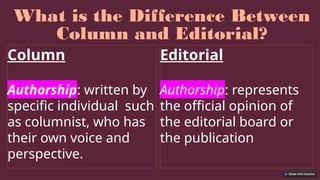
What is the Difference Between
Column and Editorial?
Column
Authorship: written by
specific individual such
as columnist, who has
their own voice and
perspective.
Editorial
Authorship: represents
the official opinion of
the editorial board or
the publication
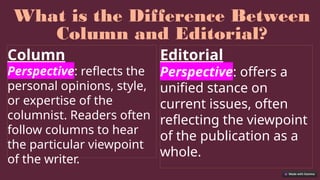
What is the Difference Between
Column and Editorial?
Column
Perspective: reflects the
personal opinions, style,
or expertise of the
columnist. Readers often
follow columns to hear
the particular viewpoint
of the writer.
Editorial
Perspective: offers a
unified stance on
current issues, often
reflecting the viewpoint
of the publication as a
whole.
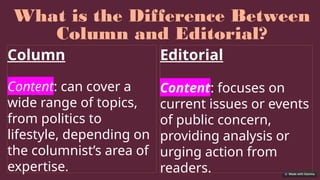
What is the Difference Between
Column and Editorial?
Column
Content: can cover a
wide range of topics,
from politics to
lifestyle, depending on
the columnist’s area of
expertise.
Editorial
Content: focuses on
current issues or events
of public concern,
providing analysis or
urging action from
readers.
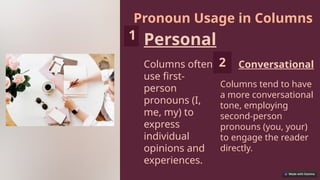
Pronoun Usage in Columns
Personal
Columns often
use first-
person
pronouns (I,
me, my) to
express
individual
opinions and
experiences.
2 Conversational
Columns tend to have
a more conversational
tone, employing
second-person
pronouns (you, your)
to engage the reader
directly.
1
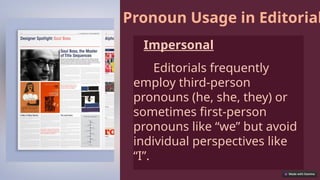
Pronoun Usage in Editorial
Impersonal
Editorials frequently
employ third-person
pronouns (he, she, they) or
sometimes first-person
pronouns like “we” but avoid
individual perspectives like
“I”.
Write an article on the
topic below:
Digital Responsibility: The
importance of being
responsible online, using
social media wisely, and
understanding cyber safety.

How to write a column? Column-Writing.pptx

  • 1.
  • 2.
    What is Column? Acolumn is a recurring piece or article in a newspaper, magazine or other publication, where a writer expresses their own opinion in few columns allotted to them by the newspaper organization. People who write columns are described as columnists.
  • 3.
    Key Elements ofa Good Column Strong columns have a compelling headline, a clear introduction, well-developed body paragraphs, and a satisfying conclusion.
  • 4.
    Key Elements ofa Good Column Headline Catchy and informative, grabbing the reader's attention and setting the tone. 1
  • 5.
    Headline  Be Clear& Direct - The title should give readers a clear idea of the topic or argument of your column. Avoid complex language. Ex. Instead of “Thoughts on Education”, a more direct title could be, “ Why Our Education System Needs Urgent Reform”
  • 6.
    Headline  Use ActionWords -- strong verbs or action words make your title more dynamic and engaging. Ex. “How Social Media is Reshaping Modern Communication “ is more compelling than “Social Media and Communication”.
  • 7.
    Headline  Use Humoror Wit (if appropriate) - a witty or humorous title can grab attention, but make sure aligns with the tone of your column. Ex. “Why Your Cat Knows More About Relaxation Than You Do”
  • 8.
    Headline  Include aQuestion - a question in the title can draw readers in, making them want to discover the answer. Ex. “Can Technology Really Solve the Climate Crisis?”
  • 9.
    Headline  Keep ItConcise - column titles should be short and to the point. Aim for not more than 8-10 words, as long titles may lose reader interest
  • 10.
    Key Elements ofa Good Column 2 Introduction Hooks the reader with a relevant anecdote, question, or statement, providing context for the topic.
  • 11.
    Introduction  Start witha Hook  a striking fact or statistic: start with a surprising or shocking piece of information.  a provocative question: ask a question that challenges conventional thinking. Ex. “Millions of children still go to bed hungry every night-how did we let it get this bad?”
  • 12.
    Introduction  Set theContext  after hooking the reader, give a little background or context to your topic. This helps ground the reader in the issue you’re addressing without overwhelming them with details right away. Ex. “In recent years , the gap between the wealthy and the poor has widened dramatically, leading to more families struggling to meet their basic needs.”
  • 13.
    Introduction  Present YourOpinion or Main Point  in a column, your opinion is the central focus, so make it clear early on what you’re arguing. Be direct about your stance without over-explaining. Ex. “It’s time for us to address income inequality, head-on, before it tears our society apart.”
  • 14.
    Introduction  Keep itConcise - An introduction should be brief, clear, and to the point. It sets up the rest of your argument, so don’t dwell too long on background information.
  • 15.
    Introduction  Engage Emotionally -appeal to your reader’s emotions by using language that evokes empathy, outrage, or inspiration. Emotional engagement often draws people into your piece. Ex. “Imagine trying to raise a family on a minimum wage salary that barely covers rent, let alone food or healthcare.”
  • 16.
    Introduction  Establish YourVoice - your voice is key in a column, so your introduction should reflect your personality or style- whether it’s witty, serious, conversational, or bold. Ex. “Let’s be honest: the system isn’t just broken- its rigged. And we’re the ones who need to fix it.
  • 17.
    Introduction  Preview What’sto Come - without giving everything away, hint at the main arguments or points you will discuss in the body of the column. This sets expectations for the reader. Ex. “ In this column, I’ll explore why our current policies are failing and what practical steps we can take to ensure a more equitable future.”
  • 18.
    Key Elements ofa Good Column 3 Body Paragraphs Develop the main points with supporting facts, examples, and personal experiences, using transitions to ensure smooth flow.
  • 19.
    Body Paragraphs  TopicSentence - start with a clear sentence that introduces the main idea or argument of the paragraph. It should directly connect to your overall thesis or opinion. Ex. One key issue affecting education today is the lack of adequate resources for teachers.
  • 20.
    Body Paragraphs  Support/Explanation -Provide an explanation or elaboration on your point. This could involve discussing why the issue is important, its causes, or its impact. Ex. Many public schools struggle with outdated textbooks and insufficient classroom supplies, which hinder both teaching and learning.
  • 21.
    Body Paragraphs  Evidence/Examples -Use examples, statistics, or real-world situations to back up your point. This adds credibility and helps illustrate your argument. Ex. A study conducted by the Department of Education found that over 40% of teachers report spending their own money on classroom materials.
  • 22.
    Body Paragraphs  Linkto the next paragraph or reinforce the point - Wrap up the paragraph by reinforcing the idea or by leading into the next topic. Ex. If this trend continues, teachers will be unable to provide the quality education students deserve, leading to long-term consequences.
  • 23.
    Key Elements ofa Good Column 4 Conclusion Summarizes key points, restates the main idea, and leaves the reader with something to ponder.
  • 24.
    Conclusion  Restate theMain Idea - Summarize your overall argument or the key point you’ve made without simply repeating your thesis word-for-word. Ex. In the face of growing educational challenges, it’s clear that we must prioritize supporting teachers and students with better resources.
  • 25.
    Conclusion  Highlight KeyTakeaways: - briefly recap the most important points or evidence from your column, focusing on what you want readers to remember. Ex. As public schools continue to face resources shortages, the gap in educational quality only widens, putting many students at a disadvantage.
  • 26.
    Conclusion  Call toAction or Thoughtful Insight - End with a call to action, a suggestion for future actions, or a final thought that provokes further thinking. Ex. It’s time for both the government and communities to step up, ensuring that every child has access to the tools needed for success.
  • 27.
    Conclusion  End witha Strong Closing Sentence - Your final sentence should leave an impact, making the reader reflect on the topic or encouraging them to take action. Ex. The future of our education system depends on what we do today-let’s not wait until it’s too late.
  • 28.
    Effective Research and InformationGathering 1 Identify Reliable Sources Seek out reputable sources, such as books, academic journals, or government websites, to ensure the information is accurate and trustworthy.
  • 29.
    Effective Research and InformationGathering Fact-Check Information 3 Verify the accuracy of the information obtained by cross- referencing sources and seeking confirmation from reliable sources.
  • 30.
    Developing a Compelling WritingStyle Writers should strive to write in a clear, concise, and engaging style. They can use vivid language, strong verbs, and sensory details to bring their writing to life.
  • 31.
    Developing a Compelling WritingStyle Vivid Language Use descriptive words and phrases to paint a picture in the reader's mind.
  • 32.
    Developing a Compelling WritingStyle Strong Verbs Choose verbs that convey action and energy, creating a more dynamic and engaging reading experience.
  • 33.
    What is theDifference Between Column and Editorial? Column Authorship: written by specific individual such as columnist, who has their own voice and perspective. Editorial Authorship: represents the official opinion of the editorial board or the publication
  • 34.
    What is theDifference Between Column and Editorial? Column Perspective: reflects the personal opinions, style, or expertise of the columnist. Readers often follow columns to hear the particular viewpoint of the writer. Editorial Perspective: offers a unified stance on current issues, often reflecting the viewpoint of the publication as a whole.
  • 35.
    What is theDifference Between Column and Editorial? Column Content: can cover a wide range of topics, from politics to lifestyle, depending on the columnist’s area of expertise. Editorial Content: focuses on current issues or events of public concern, providing analysis or urging action from readers.
  • 36.
    Pronoun Usage inColumns Personal Columns often use first- person pronouns (I, me, my) to express individual opinions and experiences. 2 Conversational Columns tend to have a more conversational tone, employing second-person pronouns (you, your) to engage the reader directly. 1
  • 37.
    Pronoun Usage inEditorial Impersonal Editorials frequently employ third-person pronouns (he, she, they) or sometimes first-person pronouns like “we” but avoid individual perspectives like “I”.
  • 38.
    Write an articleon the topic below: Digital Responsibility: The importance of being responsible online, using social media wisely, and understanding cyber safety.