Optimizing HANS Color Separation:
Meet the CMY Metamers
Peter Morovič, Ján Morovič, Juan Manuel García–Reyero
Hewlett Packard Company
Barcelona, Spain
Outline
•Trichromatic color reproduction
•HANS refresher
•Optimization framework
•Metamer examples
•Ink-use results
•Conclusions
Trichromatic color reproduction
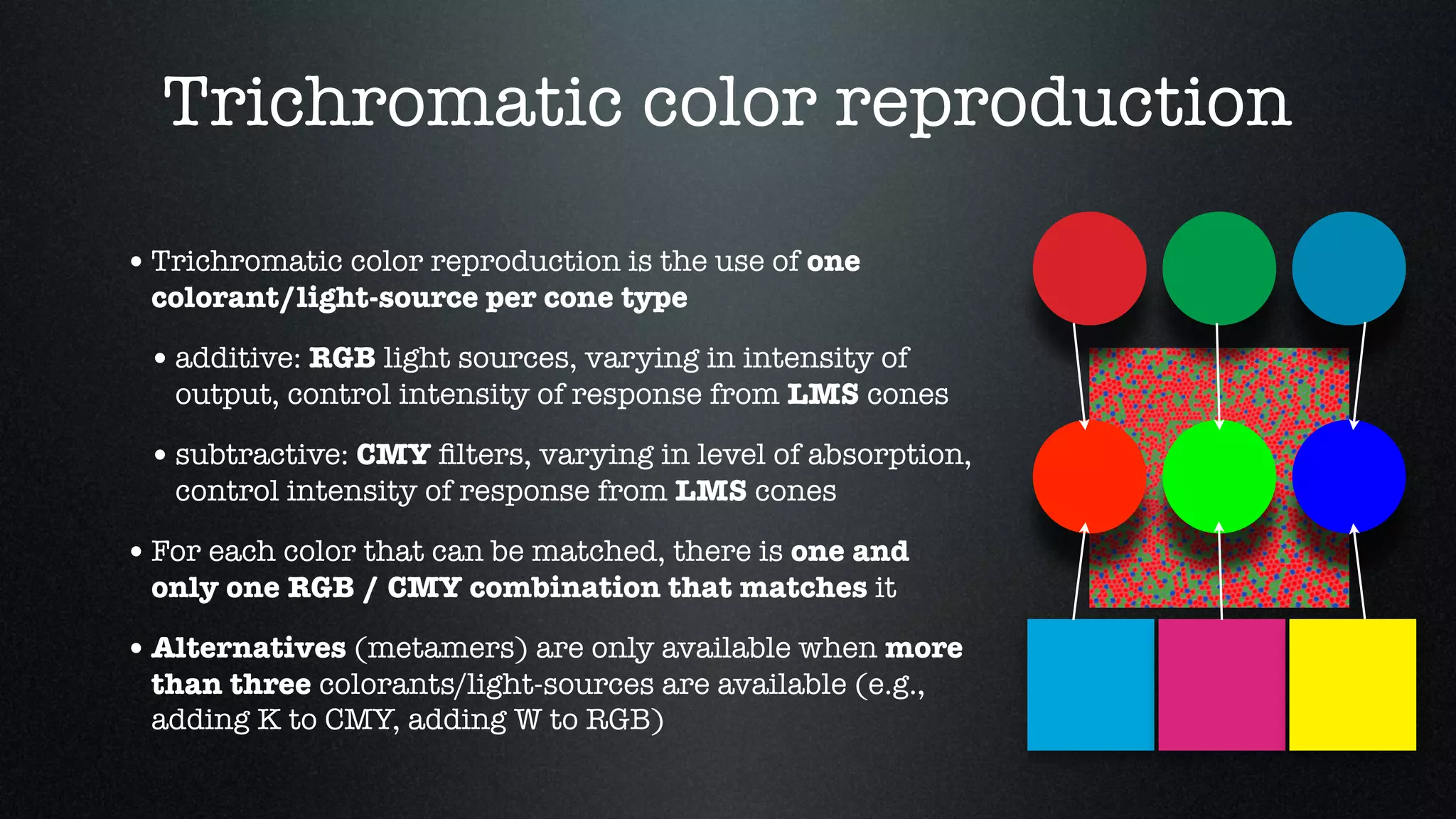
•Trichromatic color reproduction is the use of one
colorant/light-source per cone type
•additive: RGB light sources, varying in intensity of
output, control intensity of response from LMS cones
•subtractive: CMY filters, varying in level of absorption,
control intensity of response from LMS cones
•For each color that can be matched, there is one and
only one RGB / CMY combination that matches it
•Alternatives (metamers) are only available when more
than three colorants/light-sources are available (e.g.,
adding K to CMY, adding W to RGB)
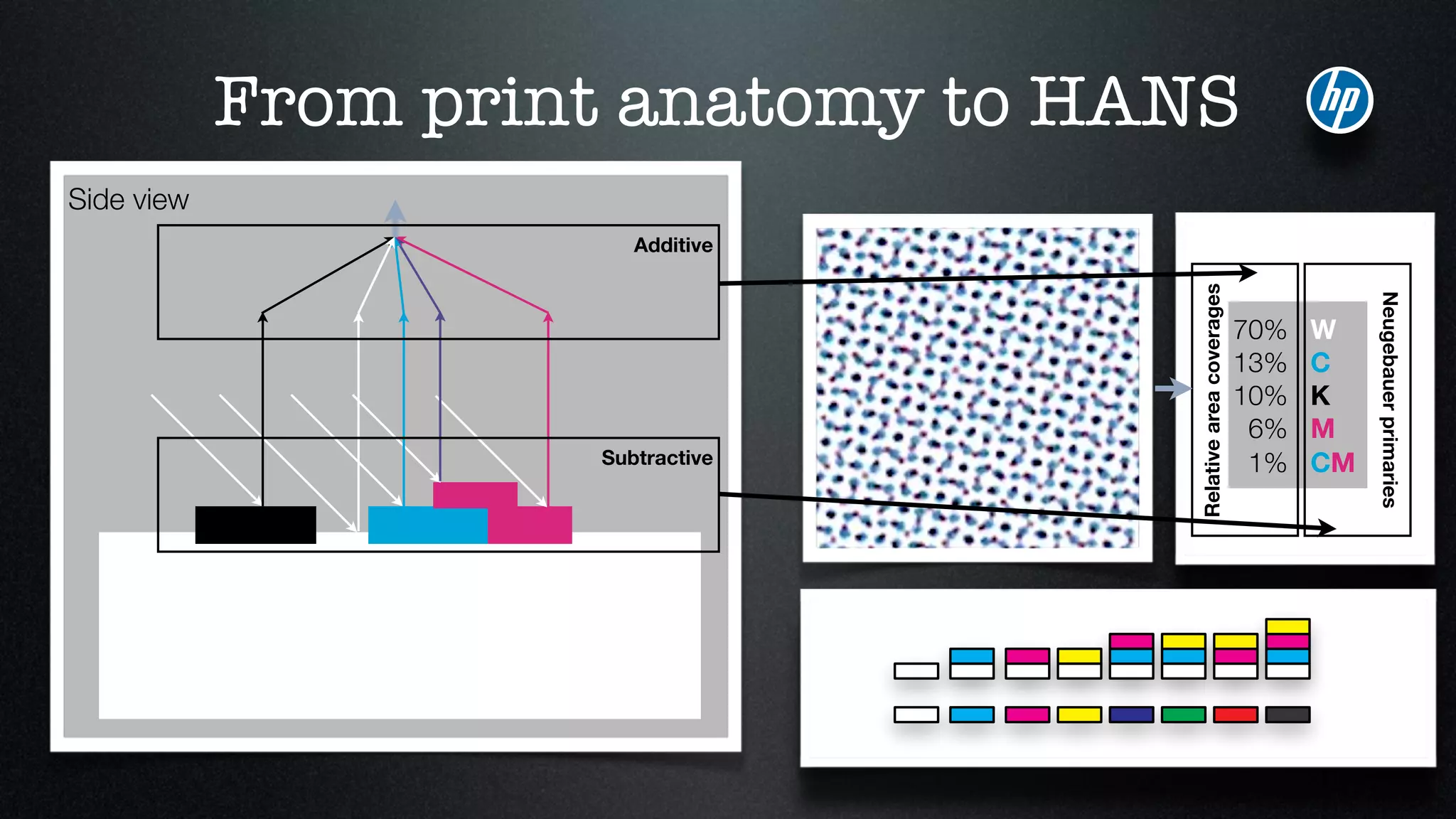
From print anatomy to HANS
Side view
70% W
13% C
10% K
6% M
1% CM
Neugebauerprimaries
Relativeareacoverages
Subtractive
Additive
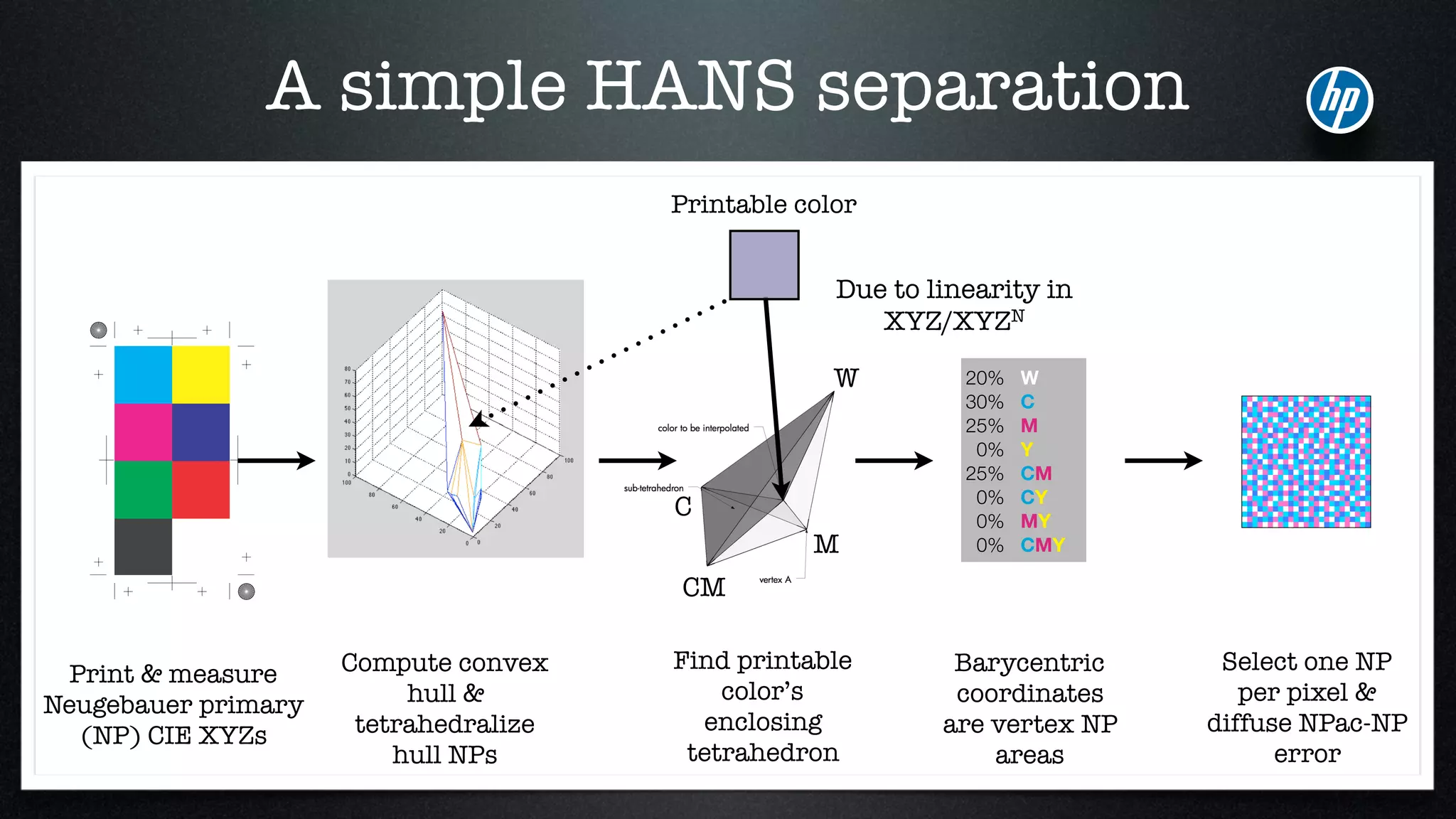
A simple HANS separation
Print & measure
Neugebauer primary
(NP) CIE XYZs
Compute convex
hull &
tetrahedralize 

hull NPs
Find printable
color’s
enclosing
tetrahedron
Printable color
20% W
30% C
25% M
0% Y
25% CM
0% CY
0% MY
0% CMY
Barycentric
coordinates
are vertex NP
areas
Select one NP
per pixel &
diffuse NPac-NP
error
Due to linearity in
XYZ/XYZN
W
C
CM
M
Tessellations
Points (NP colorimetries) Convex Hull Example Tessellations
[triangular/rectangular/...]
42 possible polygons if we allow overlapping
• Tessellating NPs can be done in
different ways - not a unique solution
• A given XYZ (within the convex hull) is
contained in many tessella
• Each tessella gives rise to a new NP area
coverage vector – NPac – a new metamer
NP1
NP2
NP3
NP4
NP5
NP6
NP7
?
Combinatorial Solution
•Given a set N NPs and their
measured XYZs there are

∑[ p=4 to N](N over p) polyhedra
•In the case of CMY, there are 70
tetrahedra, 56 pentahedra, 28
hexahedra, etc... = 163 polyhedra
Tetrahedra All polyhedra
CMYK@1dpp 1,820 64,839
CMYK@2dpp 1,663,740 ~1024
CMYKcm@2dpp A lot!
Even in CMY (8 NPs) there are many
polyhedra, leading to metamerism.
Barycentric Coordinates
Given a polyhedron, how do we determine if an XYZ is
inside and what convex weights correspond?
b1
b2
b3
b4
!
"
#
#
#
#
#
$
%
&
&
&
&
&
T
=
SX
SY
SZ
1
!
"
#
#
#
#
#
$
%
&
&
&
&
&
T
×
V1X V2X V3X V4X
V1Y V2Y V3Y V4Y
V1Z V2Z V3Z V4Z
1 1 1 1
!
"
#
#
#
#
#
$
%
&
&
&
&
&
T!
"
#
#
#
#
##
$
%
&
&
&
&
&&
−1 b1
b2
b3
b4

bp
!
"
#
#
#
#
#
#
#
##
$
%
&
&
&
&
&
&
&
&&
T
=
SX
SY
SZ
1
!
"
#
#
#
#
#
$
%
&
&
&
&
&
T
×
V1X V2X V3X V4X
V1Y V2Y V3Y V4Y
V1Z V2Z V3Z V4Z
1 1 1 1




VpX
VpY
VpZ
1
!
"
#
#
#
#
#
$
%
&
&
&
&
&
T!
"
#
#
#
#
#
#
$
%
&
&
&
&
&
&
−1
Tetrahedron
(direct inverse)
General p-vertex polyhedron
(via pseudo inverse)
If S is in Polyhedron defined by [V1 … Vp] then

(b1, b2, b3, ..., bp) are convex: bi∈[0,1] ⋀ ∑bi = 1
+
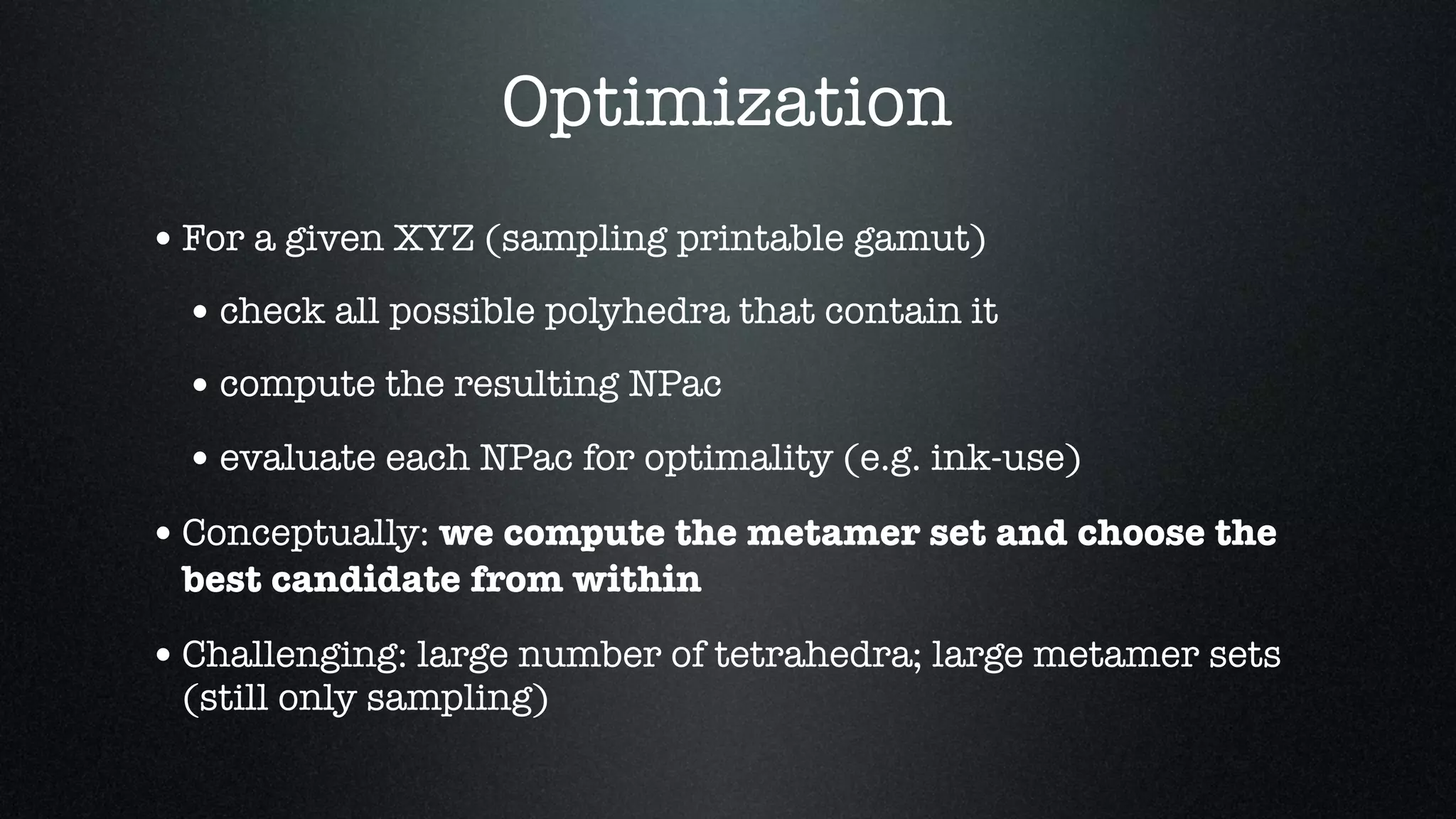
Optimization
•For a given XYZ (sampling printable gamut)
•check all possible polyhedra that contain it
•compute the resulting NPac
•evaluate each NPac for optimality (e.g. ink-use)
•Conceptually: we compute the metamer set and choose the
best candidate from within
•Challenging: large number of tetrahedra; large metamer sets
(still only sampling)
The CMY pipeline
•Not all NPs can be printed and measured, we create a base NPac set: [within
ink-limit NPs; out-of-ink-limit NPs mapped to ink-limit; convex hull of ink-limit]
•# base NPacs ≥ # NPs
•HP DesignJet Z3200 using CMY inks only (ink/no-ink) on Plain Paper:
•14 base NPacs
•15,914 possible polyhedra
•Their colorimetries:
+W +W +W +W
W Y M MY C CY CM CMY ...
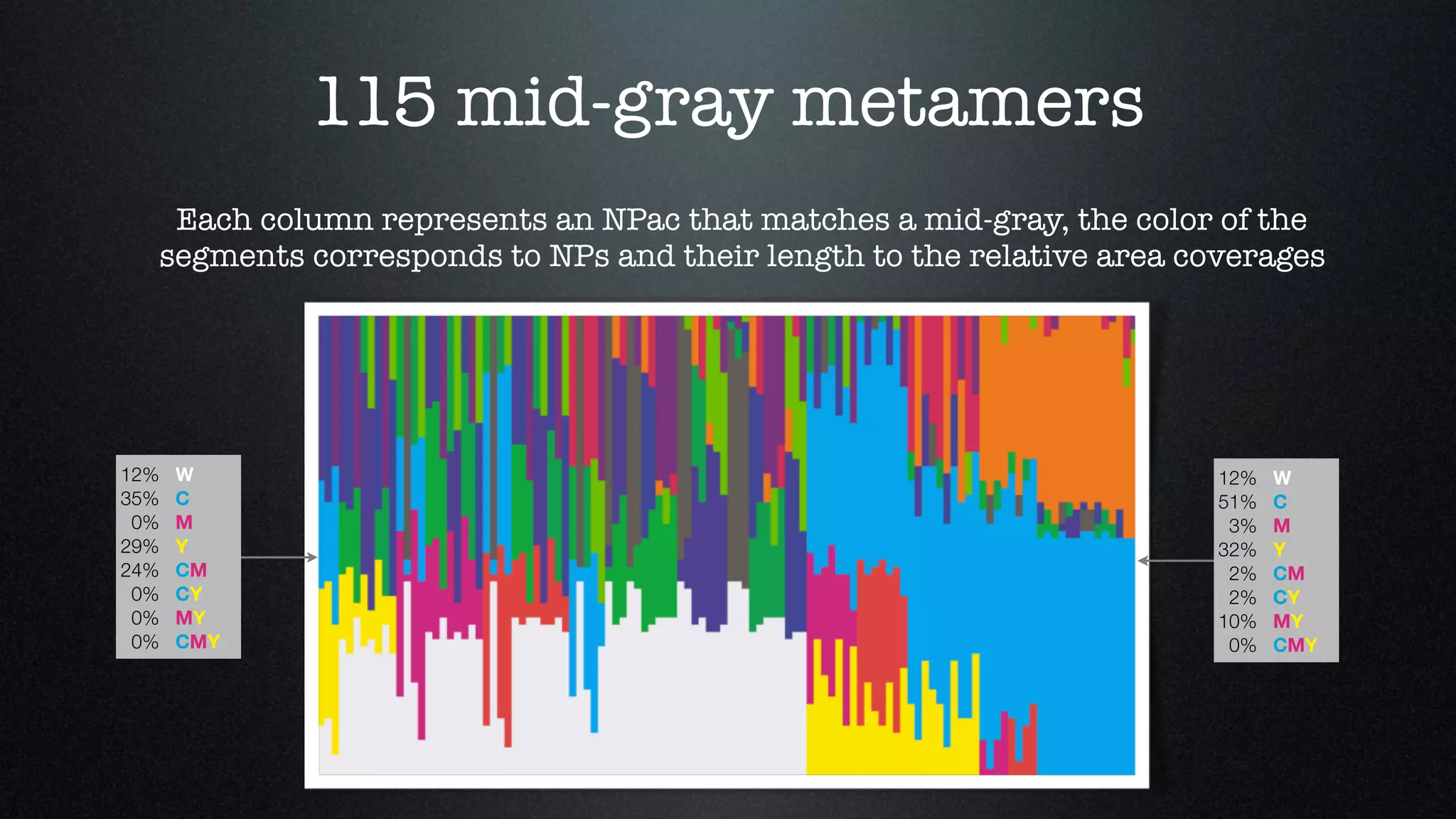
115 mid-gray metamers
Each column represents an NPac that matches a mid-gray, the color of the
segments corresponds to NPs and their length to the relative area coverages
12% W
35% C
0% M
29% Y
24% CM
0% CY
0% MY
0% CMY
12% W
51% C
3% M
32% Y
2% CM
2% CY
10% MY
0% CMY
Two examples halftoned
Two out of 115 metamers: left patch uses 11 base NPacs (out of
14) – right patch uses 5 base NPacs [shown in pseudo-color]
Target LAB
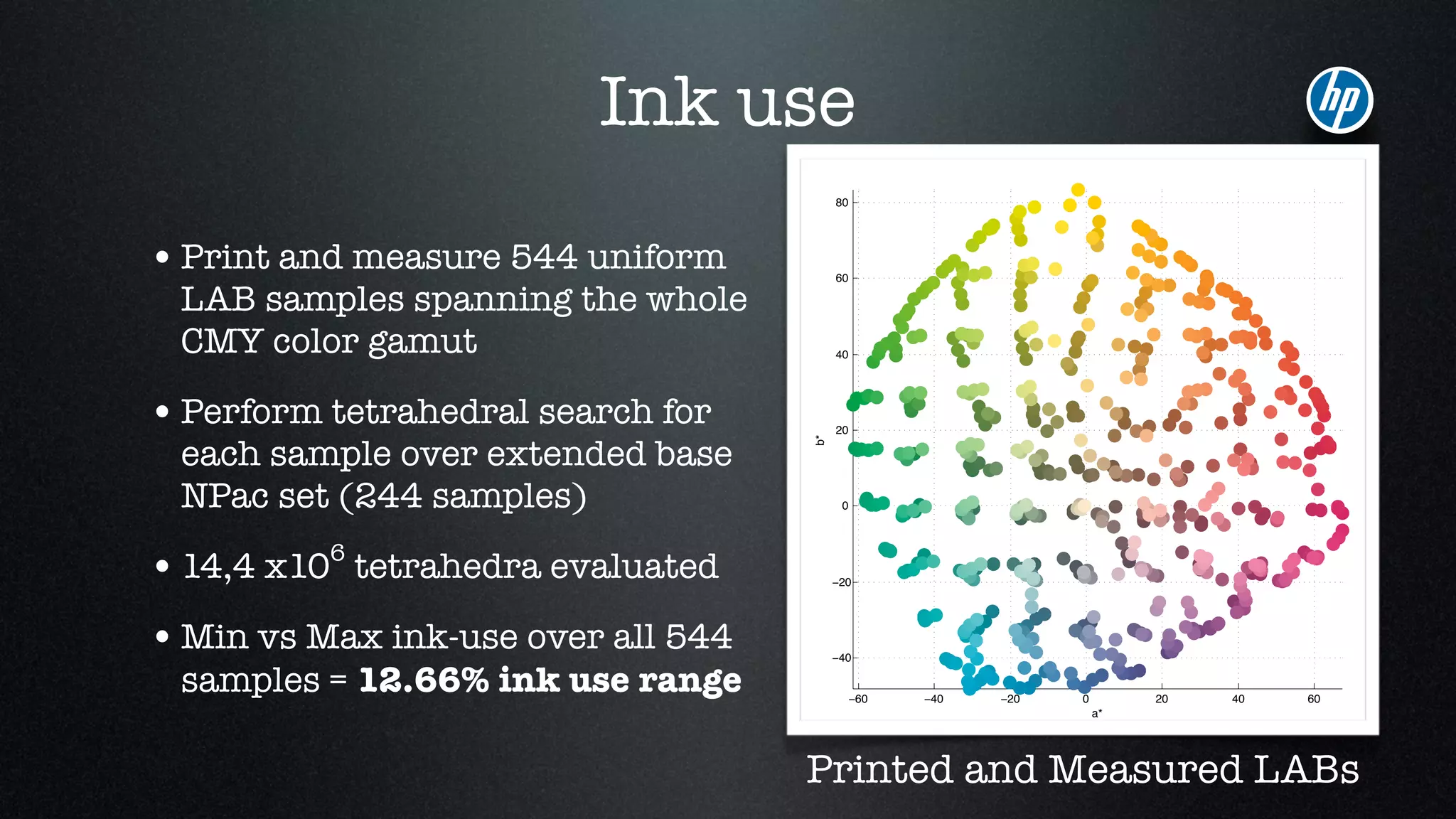
Ink use
•Print and measure 544 uniform
LAB samples spanning the whole
CMY color gamut
•Perform tetrahedral search for
each sample over extended base
NPac set (244 samples)
•14,4 x10⁶
tetrahedra evaluated
•Min vs Max ink-use over all 544
samples = 12.66% ink use range −60 −40 −20 0 20 40 60
−40
−20
0
20
40
60
80
a*
b*
Printed and Measured LABs
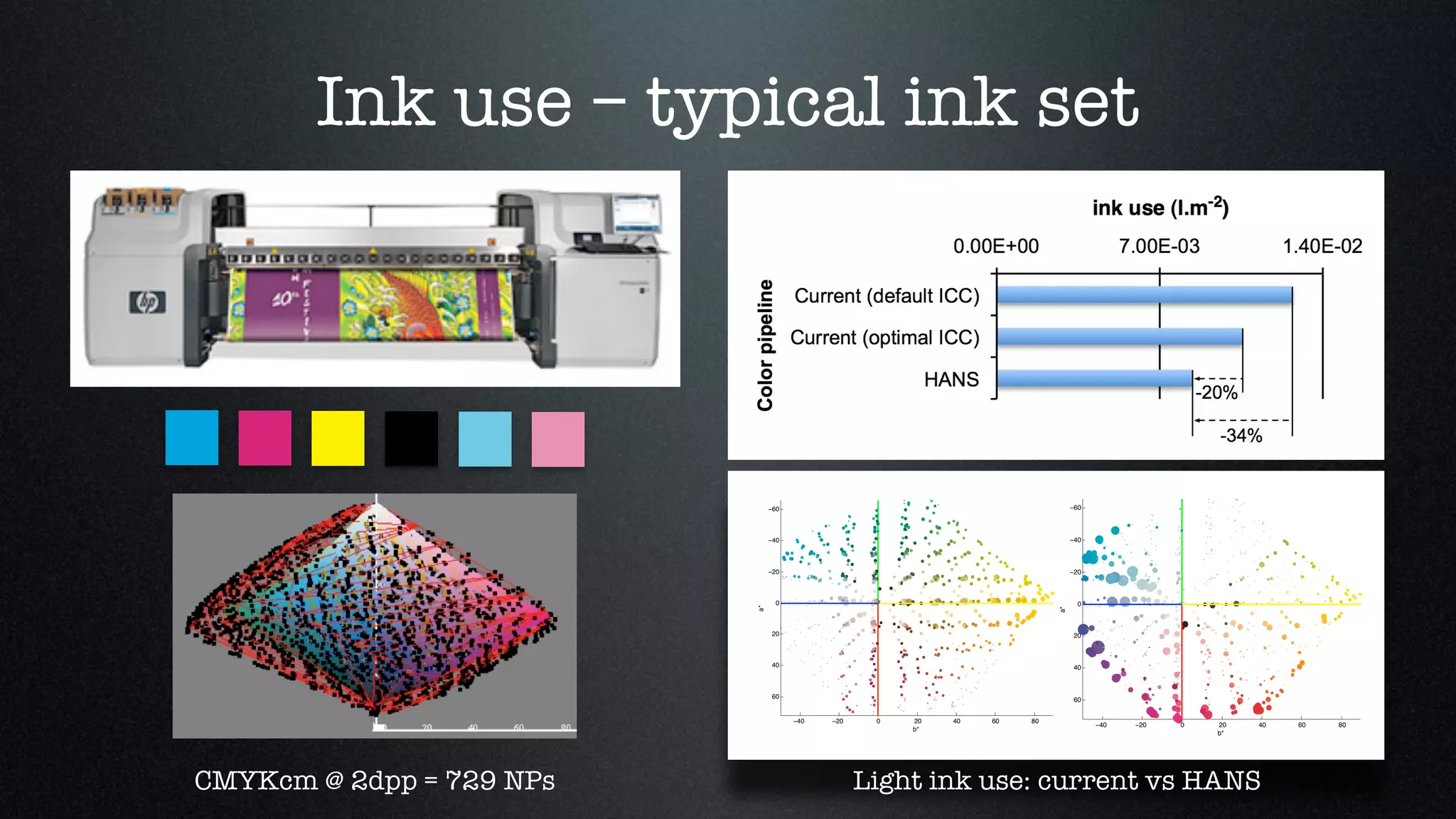
Ink use – typical ink set
CMYKcm @ 2dpp = 729 NPs
!60
!40
!20
0
20
40
60
!40 !20 0 20 40 60 80
b*
a*
!60
!40
!20
0
20
40
60
!40 !20 0 20 40 60 80
b*
a*
Light ink use: current vs HANS
Conclusions
•A 3 ink system no longer means there is no choice in
color separation – not a 3D (XYZ) to 3D (CMY)
mapping, but a 3D to k3D (CMY NPs) mapping
•HANS has a vast amount of choice for each colorimetry
•Even in CMY case we can find 2 color separations that
differ in >12% of ink used to print same content
•All of this applies directly to spectral printing…
Acknowledgements
Lluis Abello, Jordi Arnabat, Carlos Amselem, Xavier
Bruch, Patrick Chase, Gary Dispoto, Michel Encrenaz,
Eduard Garcia, Rafael Gimenez, Josep Giralt, Johan
Lammens, Lahav Langboim, I-Jong Lin, Alan Lobban,
Shay Maoz, Óscar Martinez, Scott Norum, Aleix Oriol,
Ramon Pastor, John Recker, Yvan Richard, Marc
Rossinyol, Albert Serra, Jep Tarradas, Ingeborg Tastl,
Jordi Vilar and Igor Yakubov.
Thank you!

Optimizing HANS Color Separation: Meet the CMY Metamers

  • 1.
    Optimizing HANS ColorSeparation: Meet the CMY Metamers Peter Morovič, Ján Morovič, Juan Manuel García–Reyero Hewlett Packard Company Barcelona, Spain
  • 2.
    Outline •Trichromatic color reproduction •HANSrefresher •Optimization framework •Metamer examples •Ink-use results •Conclusions
  • 3.
    Trichromatic color reproduction •Trichromaticcolor reproduction is the use of one colorant/light-source per cone type •additive: RGB light sources, varying in intensity of output, control intensity of response from LMS cones •subtractive: CMY filters, varying in level of absorption, control intensity of response from LMS cones •For each color that can be matched, there is one and only one RGB / CMY combination that matches it •Alternatives (metamers) are only available when more than three colorants/light-sources are available (e.g., adding K to CMY, adding W to RGB)
  • 4.
    From print anatomyto HANS Side view 70% W 13% C 10% K 6% M 1% CM Neugebauerprimaries Relativeareacoverages Subtractive Additive
  • 5.
    A simple HANSseparation Print & measure Neugebauer primary (NP) CIE XYZs Compute convex hull & tetrahedralize 
 hull NPs Find printable color’s enclosing tetrahedron Printable color 20% W 30% C 25% M 0% Y 25% CM 0% CY 0% MY 0% CMY Barycentric coordinates are vertex NP areas Select one NP per pixel & diffuse NPac-NP error Due to linearity in XYZ/XYZN W C CM M
  • 6.
    Tessellations Points (NP colorimetries)Convex Hull Example Tessellations [triangular/rectangular/...] 42 possible polygons if we allow overlapping • Tessellating NPs can be done in different ways - not a unique solution • A given XYZ (within the convex hull) is contained in many tessella • Each tessella gives rise to a new NP area coverage vector – NPac – a new metamer NP1 NP2 NP3 NP4 NP5 NP6 NP7 ?
  • 7.
    Combinatorial Solution •Given aset N NPs and their measured XYZs there are
 ∑[ p=4 to N](N over p) polyhedra •In the case of CMY, there are 70 tetrahedra, 56 pentahedra, 28 hexahedra, etc... = 163 polyhedra Tetrahedra All polyhedra CMYK@1dpp 1,820 64,839 CMYK@2dpp 1,663,740 ~1024 CMYKcm@2dpp A lot! Even in CMY (8 NPs) there are many polyhedra, leading to metamerism.
  • 8.
    Barycentric Coordinates Given apolyhedron, how do we determine if an XYZ is inside and what convex weights correspond? b1 b2 b3 b4 ! " # # # # # $ % & & & & & T = SX SY SZ 1 ! " # # # # # $ % & & & & & T × V1X V2X V3X V4X V1Y V2Y V3Y V4Y V1Z V2Z V3Z V4Z 1 1 1 1 ! " # # # # # $ % & & & & & T! " # # # # ## $ % & & & & && −1 b1 b2 b3 b4  bp ! " # # # # # # # ## $ % & & & & & & & && T = SX SY SZ 1 ! " # # # # # $ % & & & & & T × V1X V2X V3X V4X V1Y V2Y V3Y V4Y V1Z V2Z V3Z V4Z 1 1 1 1     VpX VpY VpZ 1 ! " # # # # # $ % & & & & & T! " # # # # # # $ % & & & & & & −1 Tetrahedron (direct inverse) General p-vertex polyhedron (via pseudo inverse) If S is in Polyhedron defined by [V1 … Vp] then
 (b1, b2, b3, ..., bp) are convex: bi∈[0,1] ⋀ ∑bi = 1 +
  • 9.
    Optimization •For a givenXYZ (sampling printable gamut) •check all possible polyhedra that contain it •compute the resulting NPac •evaluate each NPac for optimality (e.g. ink-use) •Conceptually: we compute the metamer set and choose the best candidate from within •Challenging: large number of tetrahedra; large metamer sets (still only sampling)
  • 10.
    The CMY pipeline •Notall NPs can be printed and measured, we create a base NPac set: [within ink-limit NPs; out-of-ink-limit NPs mapped to ink-limit; convex hull of ink-limit] •# base NPacs ≥ # NPs •HP DesignJet Z3200 using CMY inks only (ink/no-ink) on Plain Paper: •14 base NPacs •15,914 possible polyhedra •Their colorimetries: +W +W +W +W W Y M MY C CY CM CMY ...
  • 11.
    115 mid-gray metamers Eachcolumn represents an NPac that matches a mid-gray, the color of the segments corresponds to NPs and their length to the relative area coverages 12% W 35% C 0% M 29% Y 24% CM 0% CY 0% MY 0% CMY 12% W 51% C 3% M 32% Y 2% CM 2% CY 10% MY 0% CMY
  • 12.
    Two examples halftoned Twoout of 115 metamers: left patch uses 11 base NPacs (out of 14) – right patch uses 5 base NPacs [shown in pseudo-color] Target LAB
  • 13.
    Ink use •Print andmeasure 544 uniform LAB samples spanning the whole CMY color gamut •Perform tetrahedral search for each sample over extended base NPac set (244 samples) •14,4 x10⁶ tetrahedra evaluated •Min vs Max ink-use over all 544 samples = 12.66% ink use range −60 −40 −20 0 20 40 60 −40 −20 0 20 40 60 80 a* b* Printed and Measured LABs
  • 14.
    Ink use –typical ink set CMYKcm @ 2dpp = 729 NPs !60 !40 !20 0 20 40 60 !40 !20 0 20 40 60 80 b* a* !60 !40 !20 0 20 40 60 !40 !20 0 20 40 60 80 b* a* Light ink use: current vs HANS
  • 15.
    Conclusions •A 3 inksystem no longer means there is no choice in color separation – not a 3D (XYZ) to 3D (CMY) mapping, but a 3D to k3D (CMY NPs) mapping •HANS has a vast amount of choice for each colorimetry •Even in CMY case we can find 2 color separations that differ in >12% of ink used to print same content •All of this applies directly to spectral printing…
  • 16.
    Acknowledgements Lluis Abello, JordiArnabat, Carlos Amselem, Xavier Bruch, Patrick Chase, Gary Dispoto, Michel Encrenaz, Eduard Garcia, Rafael Gimenez, Josep Giralt, Johan Lammens, Lahav Langboim, I-Jong Lin, Alan Lobban, Shay Maoz, Óscar Martinez, Scott Norum, Aleix Oriol, Ramon Pastor, John Recker, Yvan Richard, Marc Rossinyol, Albert Serra, Jep Tarradas, Ingeborg Tastl, Jordi Vilar and Igor Yakubov.
  • 17.