EDUCATIONPLAZA
TEACHERS’ PROFESSIONAL DEVELOPMENT
Purpose of the study
In this study we explore teachers’ professional development in online
communities of practice using social media and digital habitats to create
dynamic learning environments.
In particular we address the following questions:
• What is the appropriate role of tech stewards/community coaches in
community building?
• How does active technology stewarding affect community participation?
•What activities contribute the most to CoPs’ goals?
Rationale
New skills and literacies are needed in education to meet the challenges of
rapid technological change. Existing models of in-service training for
teachers do not provide an adequate means of reskilling teachers in a timely
enough manner to address these challenges. In Iceland teachers have
formed their own CoPs to address their professional development needs.
Recent studies provide insights into how social networking can impact
cooperation, learning and development among students and educators.
There has, however, been little research on the impacts of digital habitats on
teachers’ professional development.
Method
In the study we use an action research approach to evaluate ongoing activities
within the CoPs involved and to provide tech stewards/community coaches
with useful data for coordinating participants’ interactions. Action research
incorporates participants’ ongoing internal reflections in purposive research so
that issues, practices and objectives can be tweaked to remain consistent with
the constantly evolving dynamics within the community (Carr & Kemmis, 2002;
McNiff & Whitehead, 2011). Data collection methods include qualitative and
quantitative methods, ex.:
•Document analysis
•Discourse analysis
•Network analysis
•Surveys
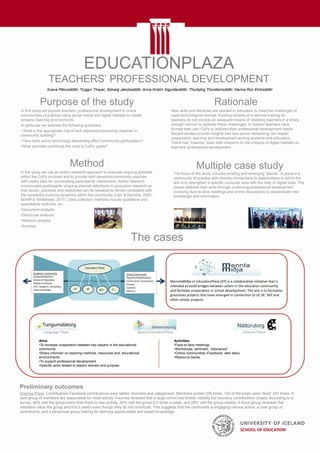
MenntaMiðja or EducationPlaza (EP) is a collaborative initiative that is
intended to build bridges between actors in the education community
and facilitate cooperation in school development. The aim is to formalise
grassroots projects that have emerged in connection to LP, SP, SEP and
other similar projects.
The cases
Language Plaza Special EducationPlaza Science Plaza
Aims:
•To increase cooperation between key players in the educational
community.
•Share informari on teaching methods, resources and educational
environments.
•To support professional development.
•Specific aims related to plaza’s domain and purpose.
Activities:
•Face-to-face meetings.
•Workshops, seminars, “educamps”
•Online communities (Facebook, web sites)
•Resource banks.
Multiple case study
The focus of the study includes existing and emerging “plazas”. A plaza is a
community of practice with diverse connections to stakeholders in which the
aim is to strengthen a specific curricular area with the help of digital tools. The
plazas address their aims through continuing professional development
involving face-to-face meetings and online discussions to disseminate new
knowledge and information.
Preliminary outcomes
Science Plaza: Contributions Facebook contributions were tallied, recorded and categorised. Members posted 226 times, 103 of the posts were “liked” 251 times. A
core group of members are responsible for most activity. A survey revealed that a large cohort has limited visibility but monitors contributions closely. According to a
survey, 48% visit the group every time there is new activity, 24% visit the group 2-5 times a week, and 28% visit the group weekly. A focus group revealed that
members value the group and find it useful even though they do not contribute. This suggests that the community is engaging various actors; a core group of
contributors, and a peripheral group looking for learning opportunities and expert knowledge.
Svava Pétursdóttir, Tryggvi Thayer, Sólveig Jakobsdóttir, Anna Kristín Sigurdardóttir, Thorbjörg Thorsteinsdóttir, Hanna Rún Eiríksdóttir

Eden poster June 2013

  • 1.
    EDUCATIONPLAZA TEACHERS’ PROFESSIONAL DEVELOPMENT Purposeof the study In this study we explore teachers’ professional development in online communities of practice using social media and digital habitats to create dynamic learning environments. In particular we address the following questions: • What is the appropriate role of tech stewards/community coaches in community building? • How does active technology stewarding affect community participation? •What activities contribute the most to CoPs’ goals? Rationale New skills and literacies are needed in education to meet the challenges of rapid technological change. Existing models of in-service training for teachers do not provide an adequate means of reskilling teachers in a timely enough manner to address these challenges. In Iceland teachers have formed their own CoPs to address their professional development needs. Recent studies provide insights into how social networking can impact cooperation, learning and development among students and educators. There has, however, been little research on the impacts of digital habitats on teachers’ professional development. Method In the study we use an action research approach to evaluate ongoing activities within the CoPs involved and to provide tech stewards/community coaches with useful data for coordinating participants’ interactions. Action research incorporates participants’ ongoing internal reflections in purposive research so that issues, practices and objectives can be tweaked to remain consistent with the constantly evolving dynamics within the community (Carr & Kemmis, 2002; McNiff & Whitehead, 2011). Data collection methods include qualitative and quantitative methods, ex.: •Document analysis •Discourse analysis •Network analysis •Surveys MenntaMiðja or EducationPlaza (EP) is a collaborative initiative that is intended to build bridges between actors in the education community and facilitate cooperation in school development. The aim is to formalise grassroots projects that have emerged in connection to LP, SP, SEP and other similar projects. The cases Language Plaza Special EducationPlaza Science Plaza Aims: •To increase cooperation between key players in the educational community. •Share informari on teaching methods, resources and educational environments. •To support professional development. •Specific aims related to plaza’s domain and purpose. Activities: •Face-to-face meetings. •Workshops, seminars, “educamps” •Online communities (Facebook, web sites) •Resource banks. Multiple case study The focus of the study includes existing and emerging “plazas”. A plaza is a community of practice with diverse connections to stakeholders in which the aim is to strengthen a specific curricular area with the help of digital tools. The plazas address their aims through continuing professional development involving face-to-face meetings and online discussions to disseminate new knowledge and information. Preliminary outcomes Science Plaza: Contributions Facebook contributions were tallied, recorded and categorised. Members posted 226 times, 103 of the posts were “liked” 251 times. A core group of members are responsible for most activity. A survey revealed that a large cohort has limited visibility but monitors contributions closely. According to a survey, 48% visit the group every time there is new activity, 24% visit the group 2-5 times a week, and 28% visit the group weekly. A focus group revealed that members value the group and find it useful even though they do not contribute. This suggests that the community is engaging various actors; a core group of contributors, and a peripheral group looking for learning opportunities and expert knowledge. Svava Pétursdóttir, Tryggvi Thayer, Sólveig Jakobsdóttir, Anna Kristín Sigurdardóttir, Thorbjörg Thorsteinsdóttir, Hanna Rún Eiríksdóttir