Capacity Mapping:
A Framework for Re-Imagining
Undergraduate Business Education
NITLE Seminar Series
This work funded by the Mellon Foundation
May 6, 2014
Dr. Mary Grace Neville
This document emerges from a 7 year programmatic study that began locally in 2005, extended to a national
dialogue in 2006, has was then deepened by extensive reading and study on liberal arts education , business
education, and philosophies of learning and development in 2008. In Fall 2011, a new task force convened to
update and operationalize the early thinking given the university’s new reality – increasing enrollments and
constrained resources. Capacities were tested and refined in 2012 and 2013. The concept evolution continues.
Neville, marygrace.neville@gmail.com
Southwestern University
College curricula vary widely,
the half-life of information is staggering, and
18-22 year olds grow up fast.
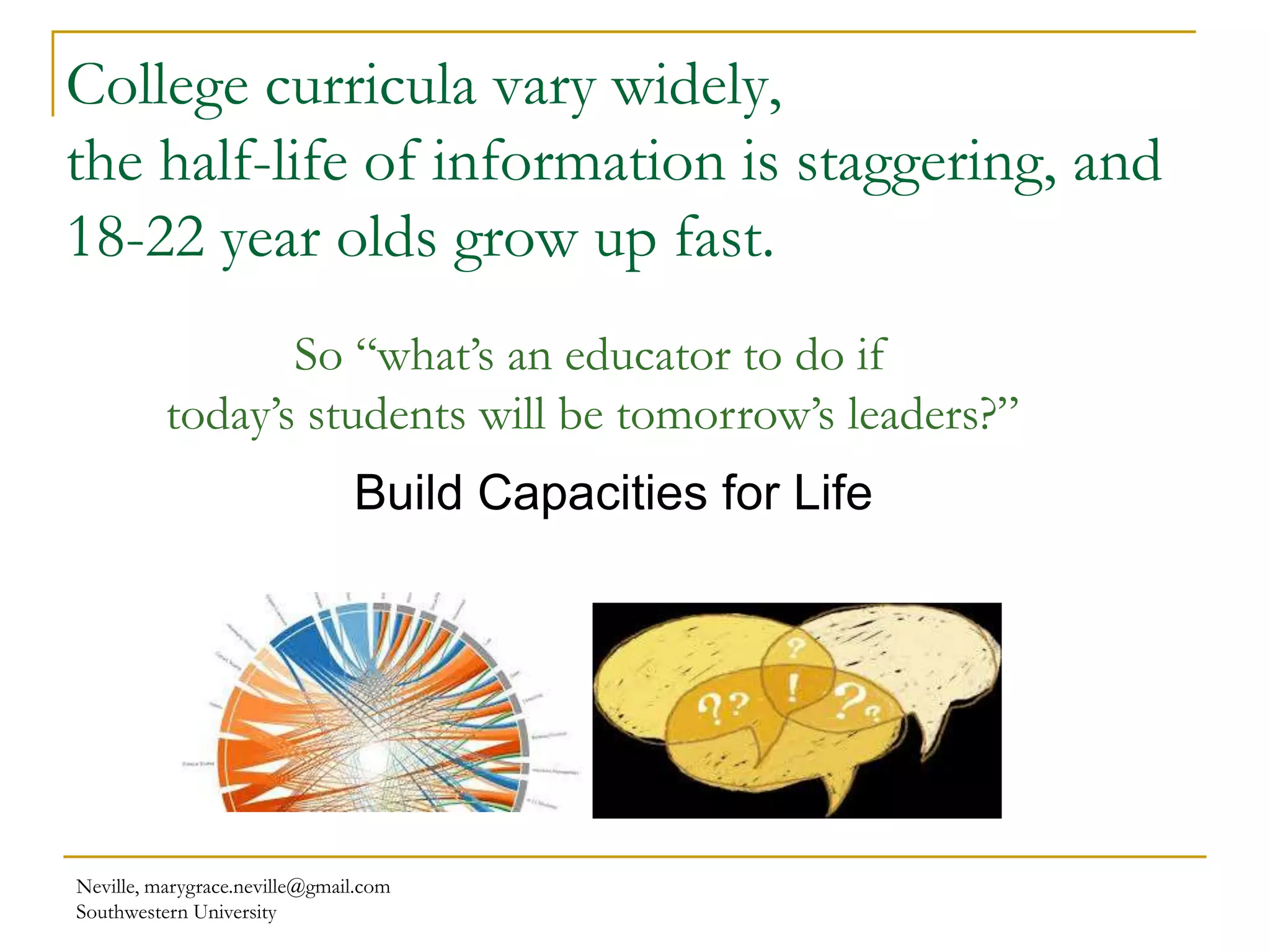
Build Capacities for Life
So “what’s an educator to do if
today’s students will be tomorrow’s leaders?”
Neville, marygrace.neville@gmail.com
Southwestern University
Which ones?(Neville, et. al. 2007)Why?(Neville & Godwin, 2013)
How? (Neville, in progress) (Colby, Ehrlich, Sullivan, Dolle, 2011)
…and What about QuickBooks proficiency?!(Colby, Ehrlich, Sullivan, Dolle, 2011)
 Inquire
 Reflect
 Experiment
 Theorize
Neville, marygrace.neville@gmail.com
Southwestern University
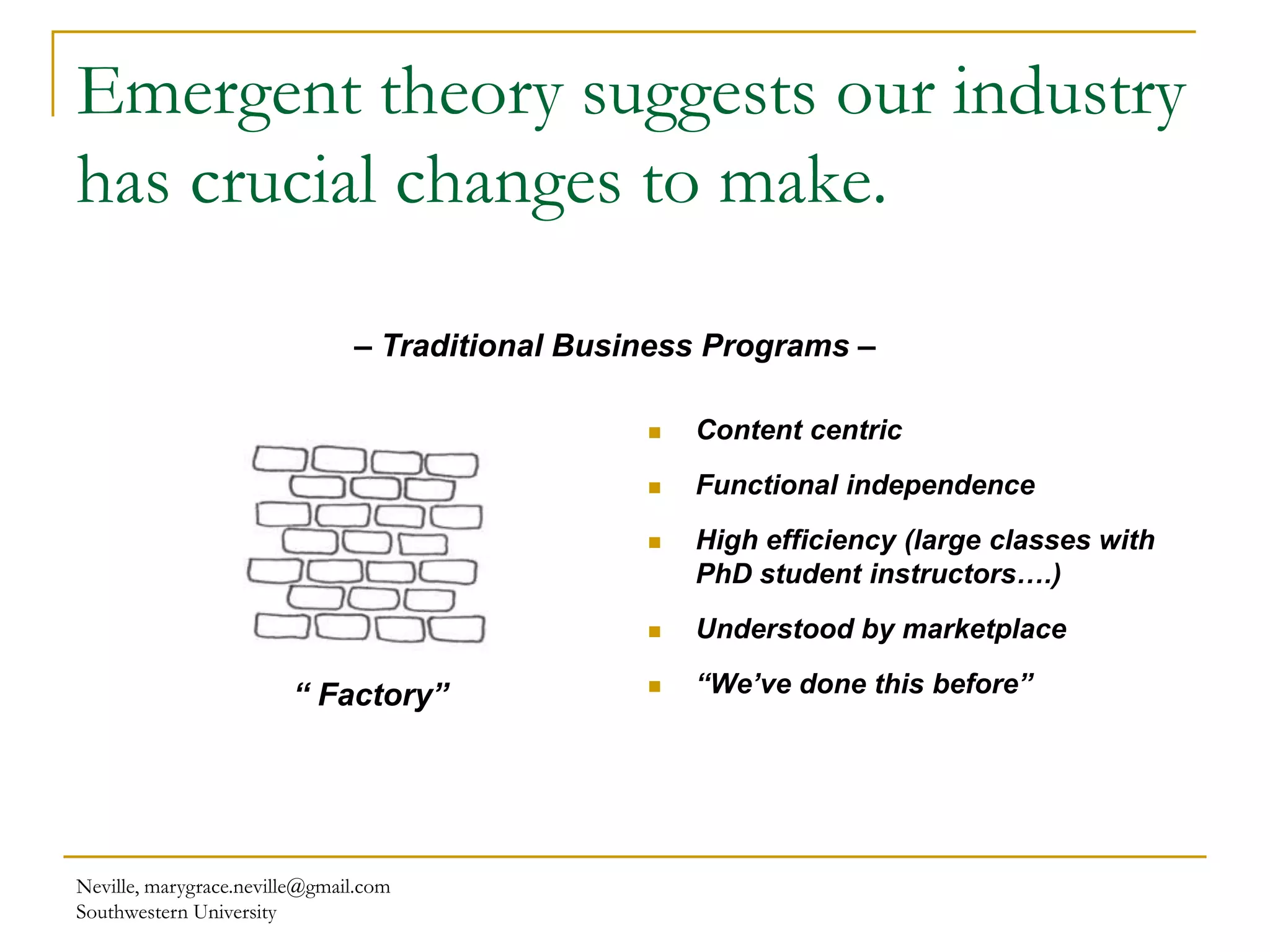
Emergent theory suggests our industry
has crucial changes to make.
 Content centric
 Functional independence
 High efficiency (large classes with
PhD student instructors….)
 Understood by marketplace
 “We’ve done this before”“ Factory”
– Traditional Business Programs –
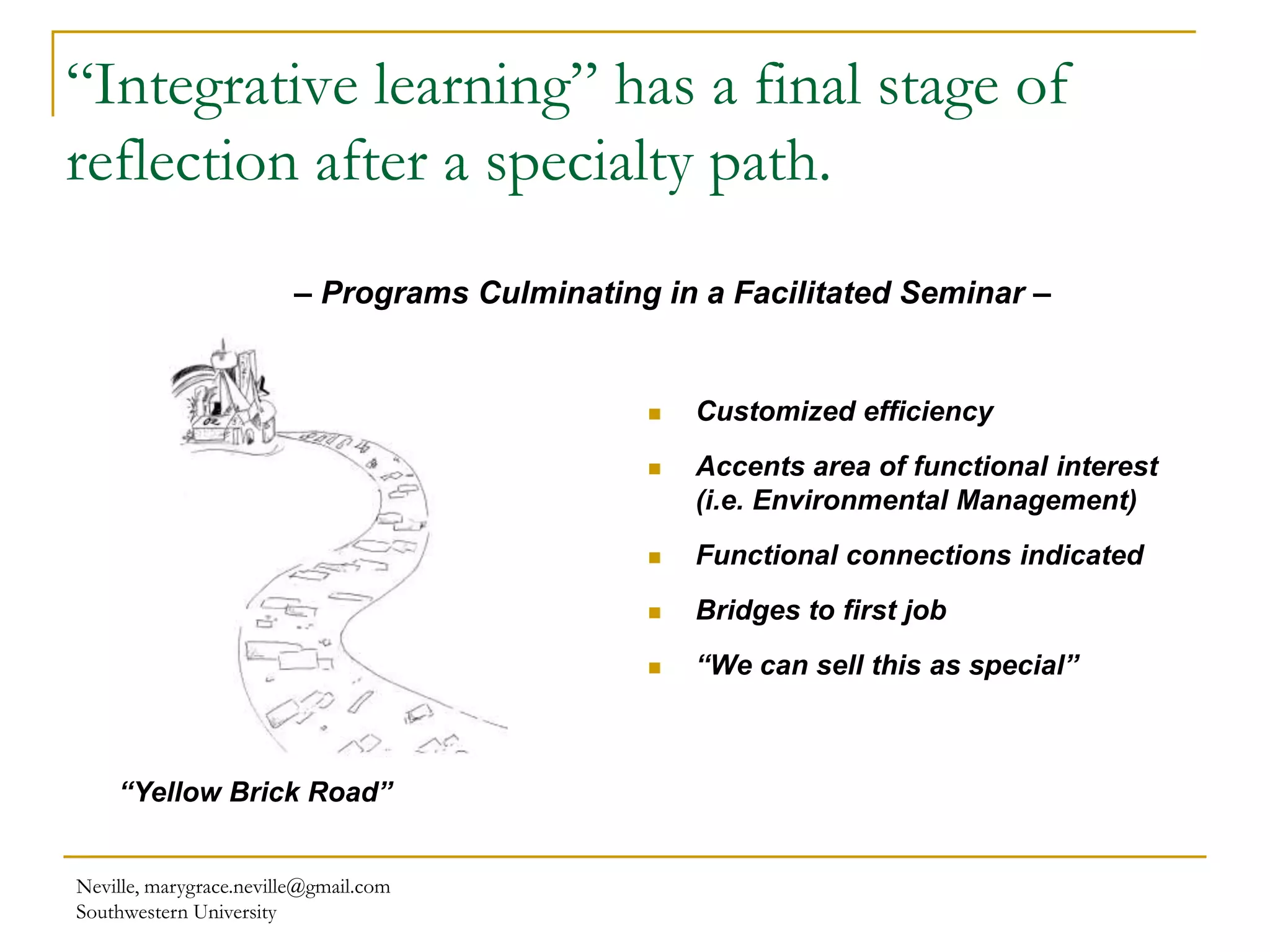
“Integrative learning” has a final stage of
reflection after a specialty path.
Neville, marygrace.neville@gmail.com
Southwestern University
 Customized efficiency
 Accents area of functional interest
(i.e. Environmental Management)
 Functional connections indicated
 Bridges to first job
 “We can sell this as special”
“Yellow Brick Road”
– Programs Culminating in a Facilitated Seminar –
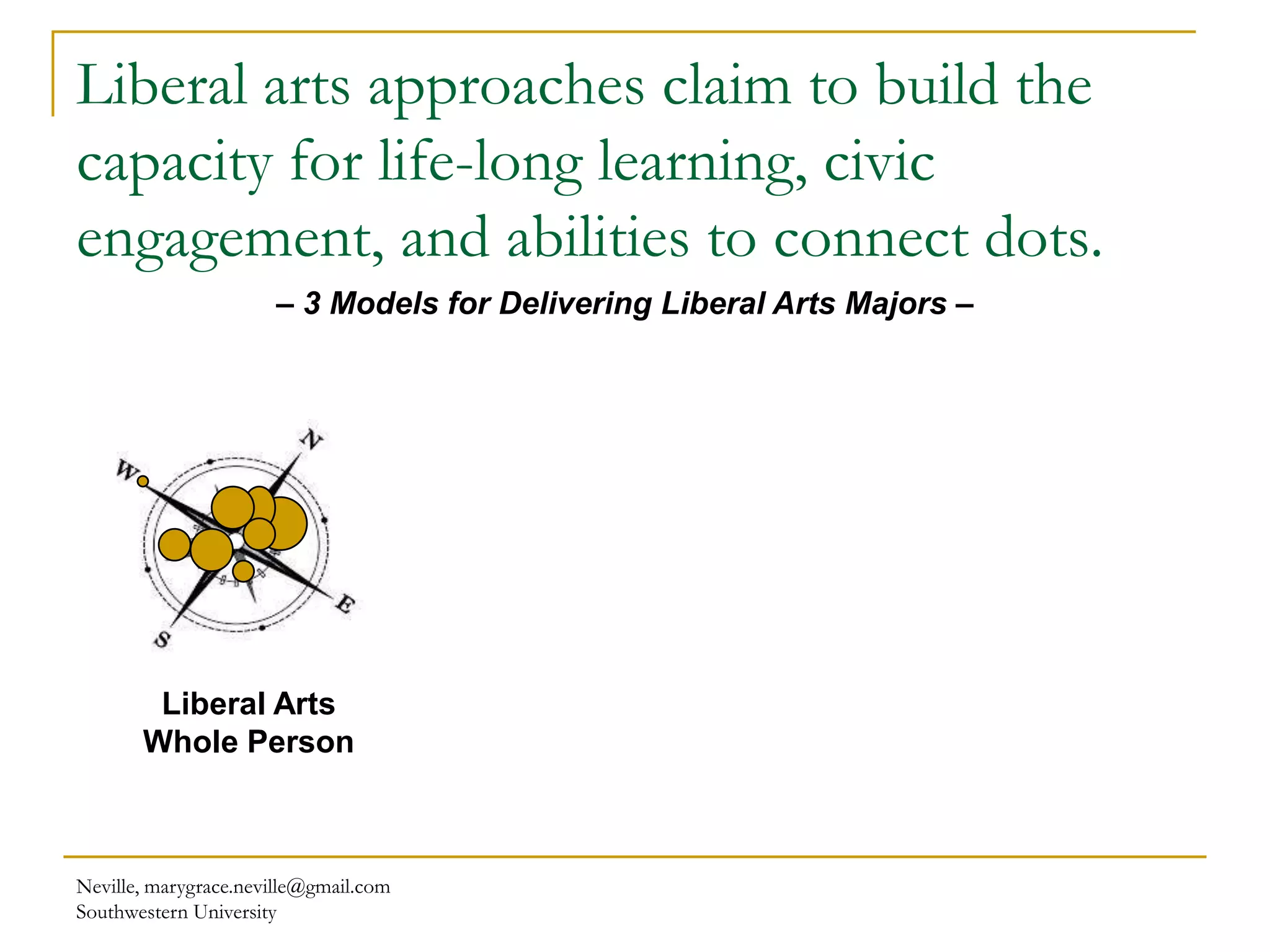
Liberal arts approaches claim to build the
capacity for life-long learning, civic
engagement, and abilities to connect dots.
Neville, marygrace.neville@gmail.com
Southwestern University
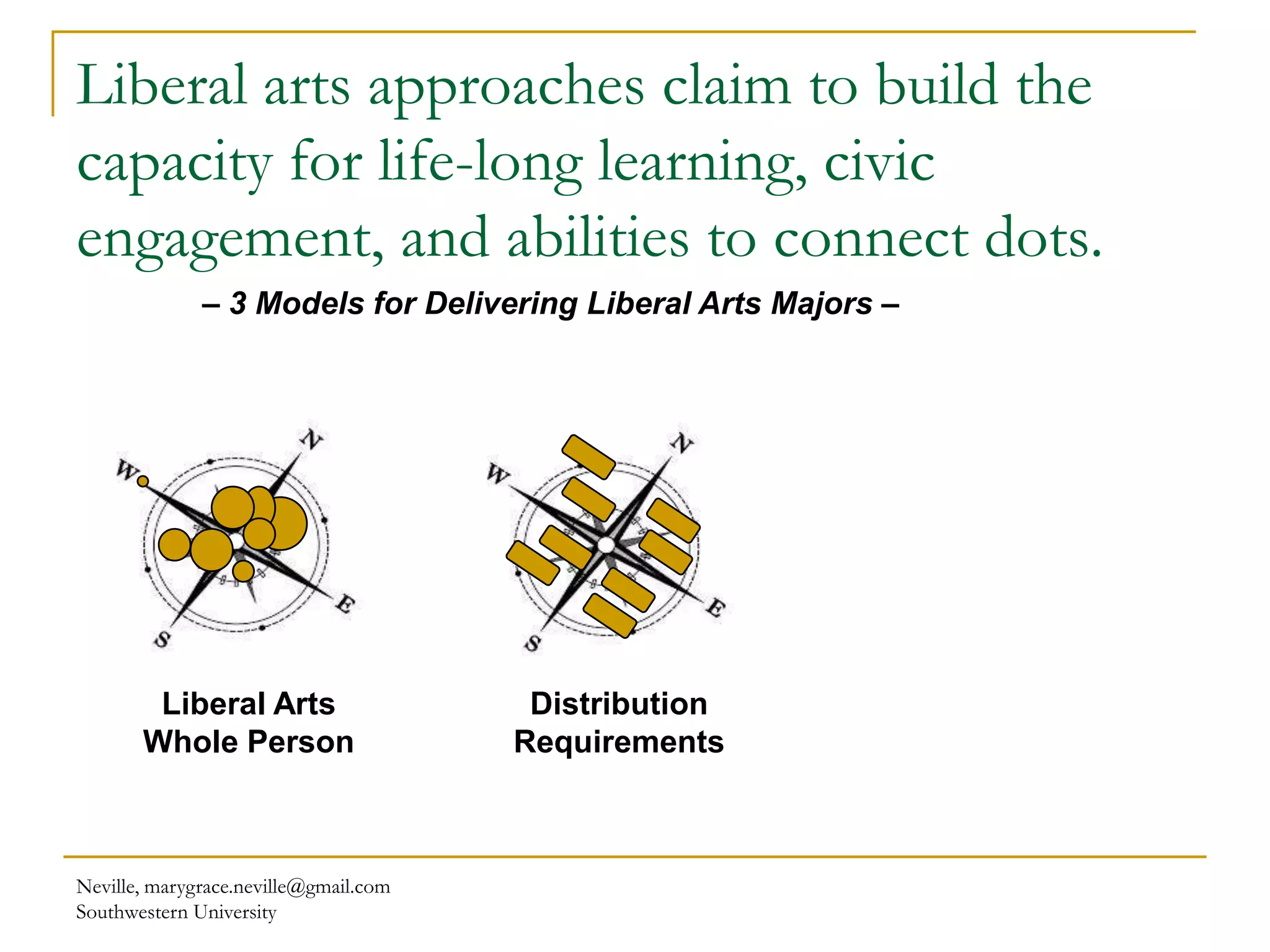
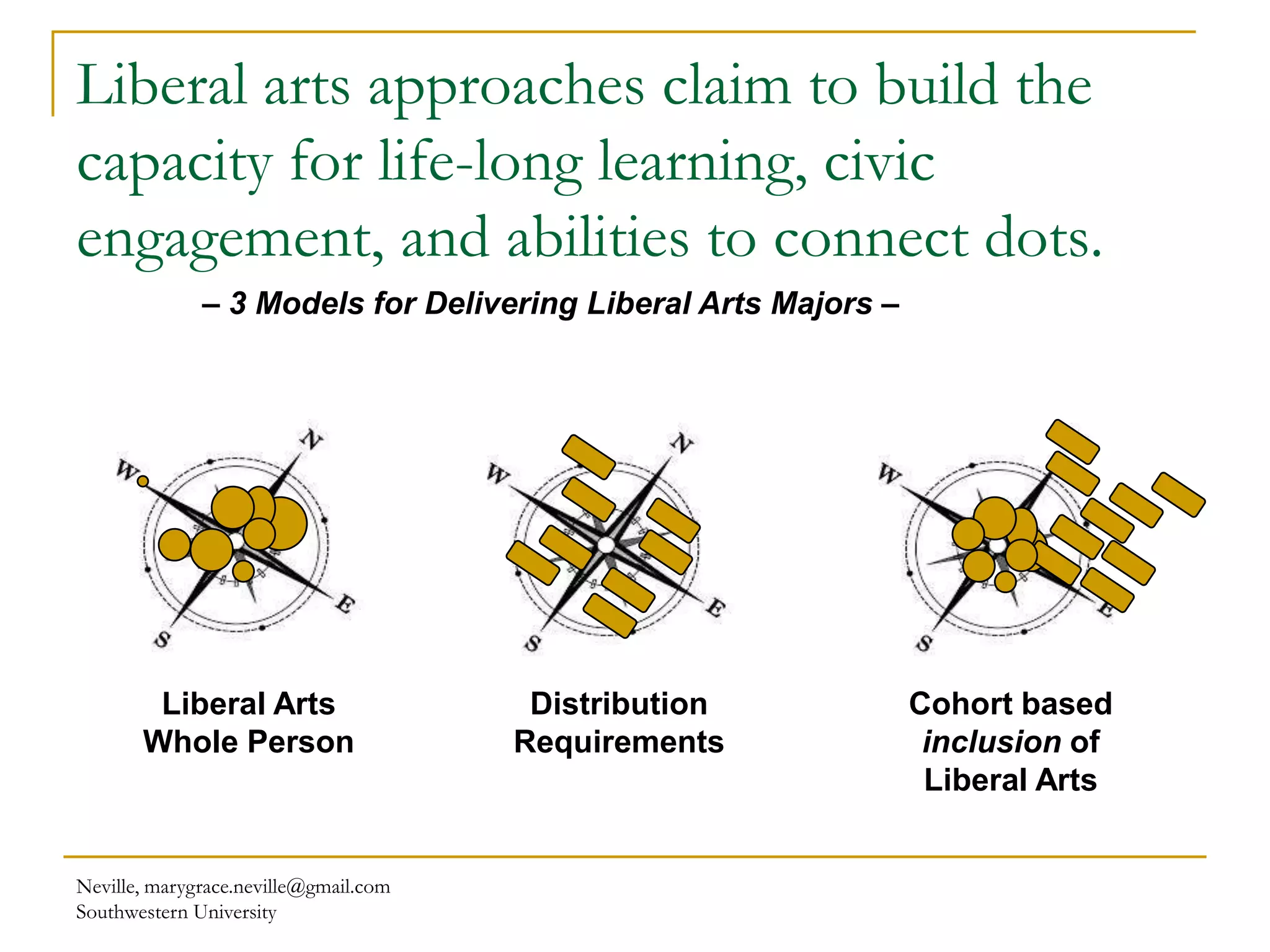
– 3 Models for Delivering Liberal Arts Majors –
Liberal Arts
Whole Person
Liberal arts approaches claim to build the
capacity for life-long learning, civic
engagement, and abilities to connect dots.
Neville, marygrace.neville@gmail.com
Southwestern University
– 3 Models for Delivering Liberal Arts Majors –
Liberal Arts
Whole Person
Distribution
Requirements
Liberal arts approaches claim to build the
capacity for life-long learning, civic
engagement, and abilities to connect dots.
Neville, marygrace.neville@gmail.com
Southwestern University
– 3 Models for Delivering Liberal Arts Majors –
Liberal Arts
Whole Person
Distribution
Requirements
Cohort based
inclusion of
Liberal Arts
Neville, marygrace.neville@gmail.com
Southwestern University
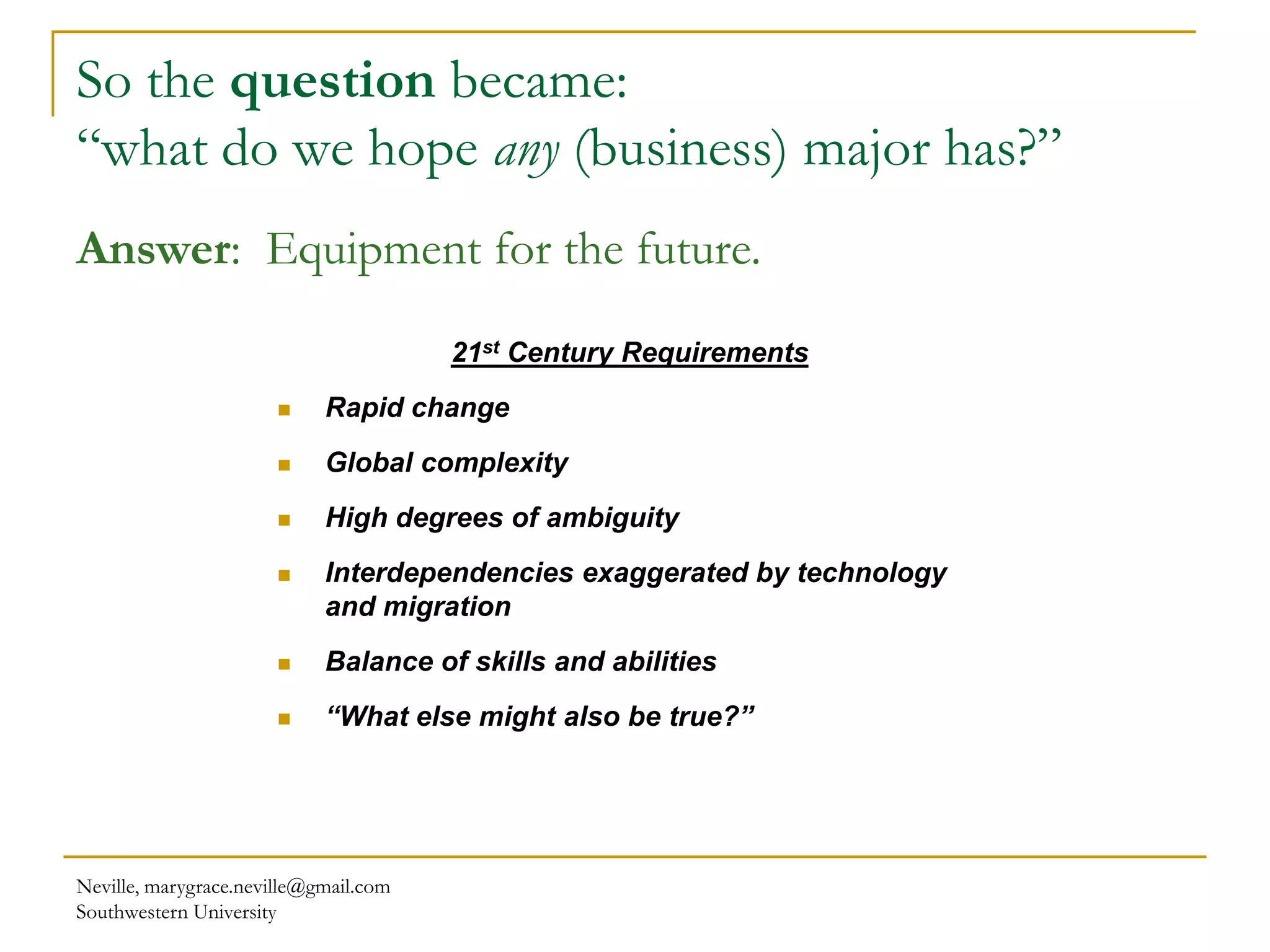
So the question became:
“what do we hope any (business) major has?”
21st Century Requirements
 Rapid change
 Global complexity
 High degrees of ambiguity
 Interdependencies exaggerated by technology
and migration
 Balance of skills and abilities
 “What else might also be true?”
Answer: Equipment for the future.
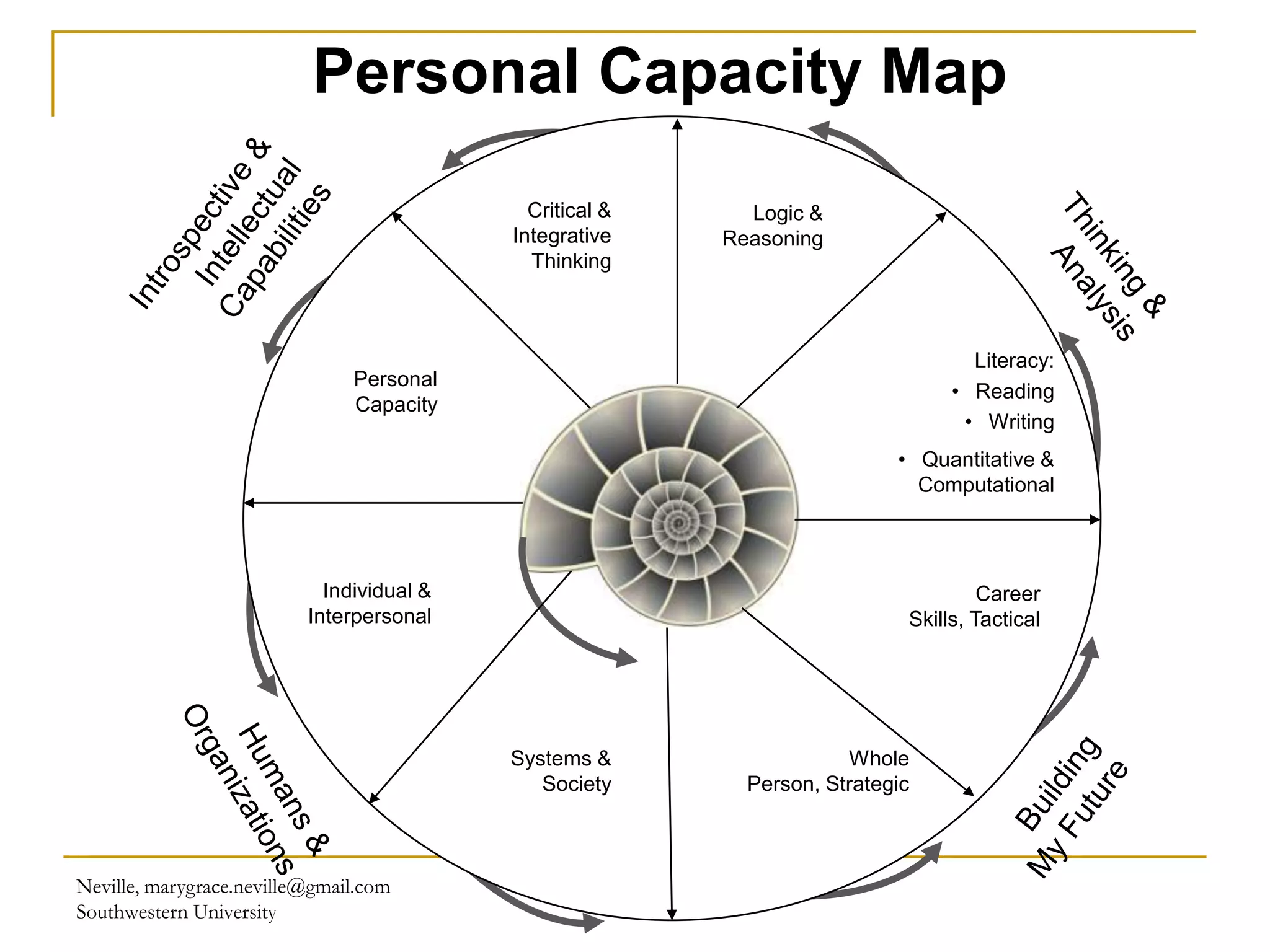
Individual &
Interpersonal
Personal
Capacity
Critical &
Integrative
Thinking
Logic &
Reasoning
Systems &
Society
Whole
Person, Strategic
Career
Skills, Tactical
Literacy:
• Reading
• Writing
• Quantitative &
Computational
Personal Capacity Map
Neville, marygrace.neville@gmail.com
Southwestern University
Neville, marygrace.neville@gmail.com
Southwestern University
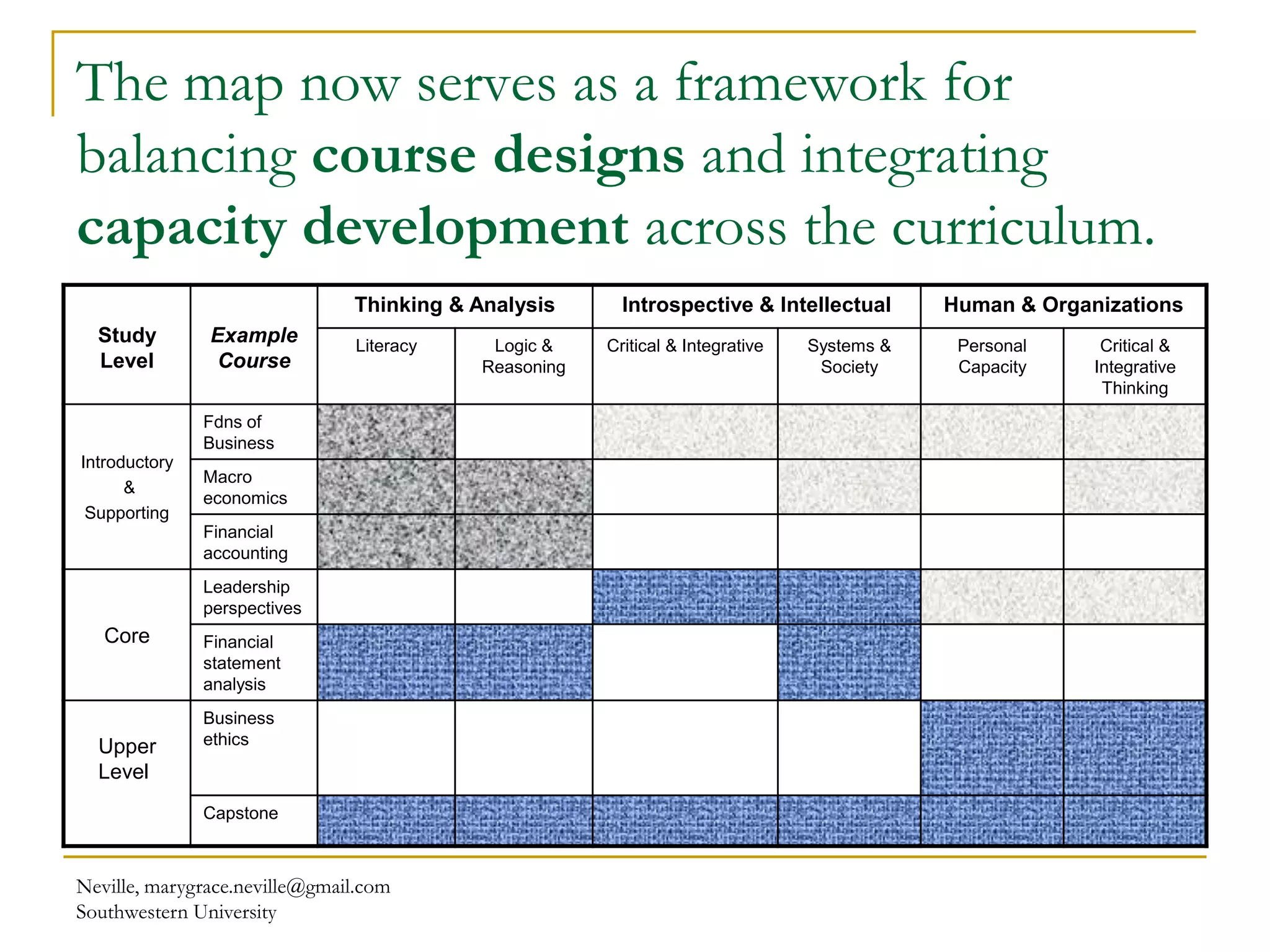
The map now serves as a framework for
balancing course designs and integrating
capacity development across the curriculum.
Study
Level
Example
Course
Thinking & Analysis Introspective & Intellectual Human & Organizations
Literacy Logic &
Reasoning
Critical & Integrative Systems &
Society
Personal
Capacity
Critical &
Integrative
Thinking
Introductory
&
Supporting
Fdns of
Business
Macro
economics
Financial
accounting
Core
Leadership
perspectives
Financial
statement
analysis
Upper
Level
Business
ethics
Capstone
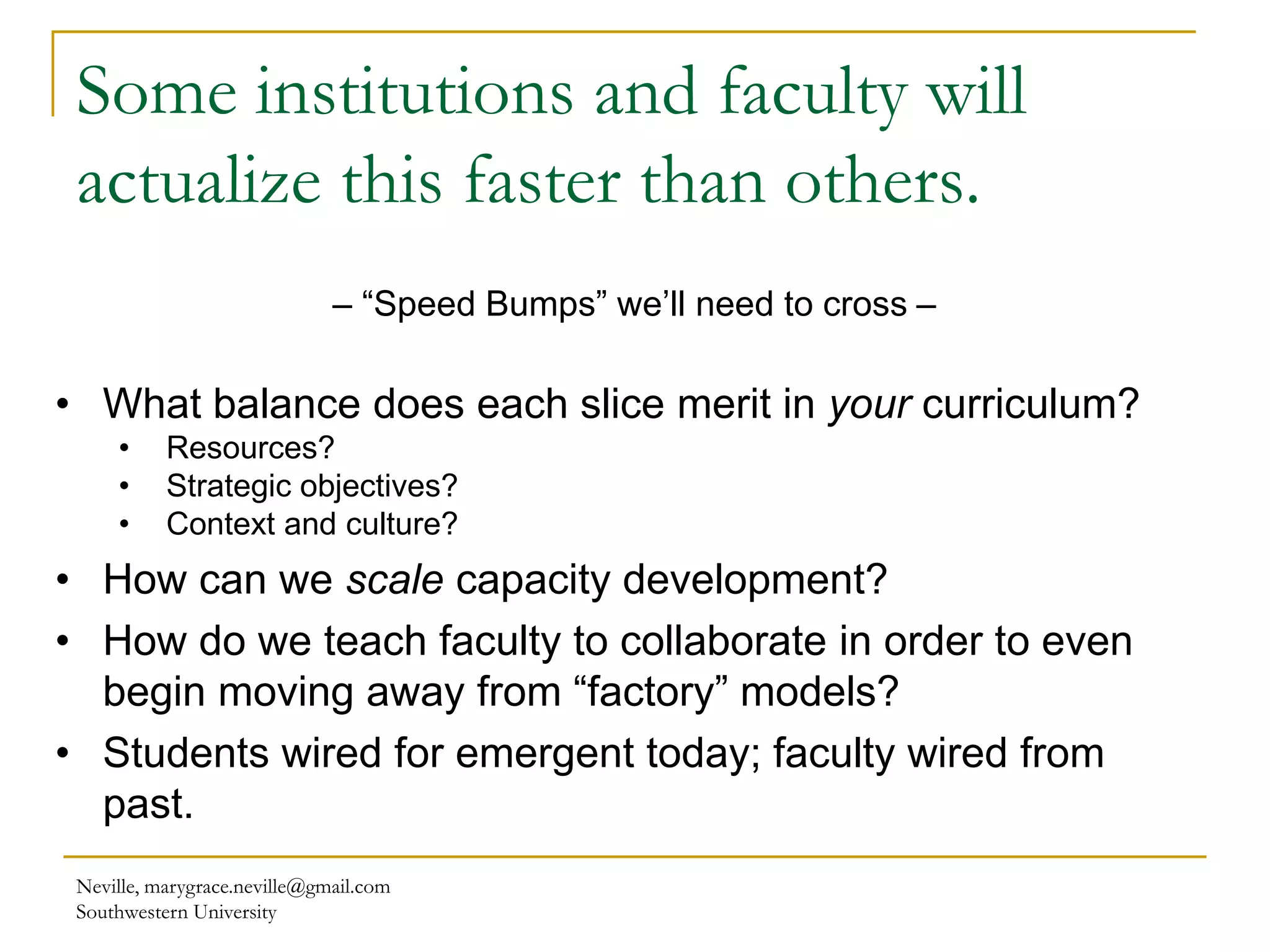
Some institutions and faculty will
actualize this faster than others.
Neville, marygrace.neville@gmail.com
Southwestern University
– “Speed Bumps” we’ll need to cross –
• What balance does each slice merit in your curriculum?
• Resources?
• Strategic objectives?
• Context and culture?
• How can we scale capacity development?
• How do we teach faculty to collaborate in order to even
begin moving away from “factory” models?
• Students wired for emergent today; faculty wired from
past.
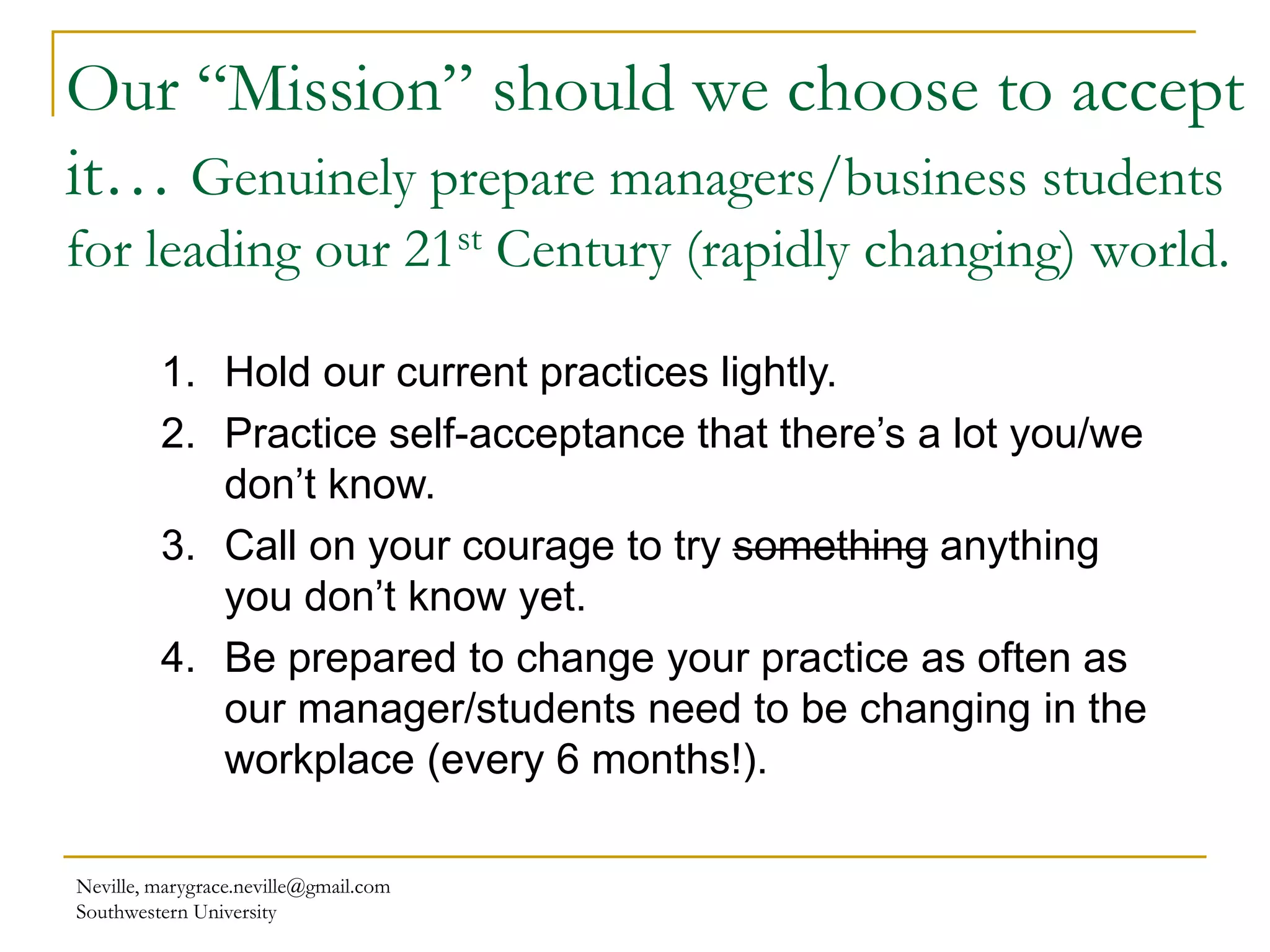
Our “Mission” should we choose to accept
it… Genuinely prepare managers/business students
for leading our 21st Century (rapidly changing) world.
Neville, marygrace.neville@gmail.com
Southwestern University
1. Hold our current practices lightly.
2. Practice self-acceptance that there’s a lot you/we
don’t know.
3. Call on your courage to try something anything
you don’t know yet.
4. Be prepared to change your practice as often as
our manager/students need to be changing in the
workplace (every 6 months!).
Additional information and shared
resources are available.
Neville, marygrace.neville@gmail.com
Southwestern University
• Dr. Mary Grace
Neville, marygrace.neville@gmail.com
• NITLE Academic
Commons, http://www.academiccoms.org
• Southwestern University’s institutional
repository, SU Scholars (available fall 2014; will include
slides, supporting manuscript, and extended annotated
bibliography)

Capacity Mapping: Re-imagining Undergraduate Business Education

  • 1.
    Capacity Mapping: A Frameworkfor Re-Imagining Undergraduate Business Education NITLE Seminar Series This work funded by the Mellon Foundation May 6, 2014 Dr. Mary Grace Neville This document emerges from a 7 year programmatic study that began locally in 2005, extended to a national dialogue in 2006, has was then deepened by extensive reading and study on liberal arts education , business education, and philosophies of learning and development in 2008. In Fall 2011, a new task force convened to update and operationalize the early thinking given the university’s new reality – increasing enrollments and constrained resources. Capacities were tested and refined in 2012 and 2013. The concept evolution continues.
  • 2.
    Neville, marygrace.neville@gmail.com Southwestern University Collegecurricula vary widely, the half-life of information is staggering, and 18-22 year olds grow up fast. Build Capacities for Life So “what’s an educator to do if today’s students will be tomorrow’s leaders?”
  • 3.
    Neville, marygrace.neville@gmail.com Southwestern University Whichones?(Neville, et. al. 2007)Why?(Neville & Godwin, 2013) How? (Neville, in progress) (Colby, Ehrlich, Sullivan, Dolle, 2011) …and What about QuickBooks proficiency?!(Colby, Ehrlich, Sullivan, Dolle, 2011)  Inquire  Reflect  Experiment  Theorize
  • 4.
    Neville, marygrace.neville@gmail.com Southwestern University Emergenttheory suggests our industry has crucial changes to make.  Content centric  Functional independence  High efficiency (large classes with PhD student instructors….)  Understood by marketplace  “We’ve done this before”“ Factory” – Traditional Business Programs –
  • 5.
    “Integrative learning” hasa final stage of reflection after a specialty path. Neville, marygrace.neville@gmail.com Southwestern University  Customized efficiency  Accents area of functional interest (i.e. Environmental Management)  Functional connections indicated  Bridges to first job  “We can sell this as special” “Yellow Brick Road” – Programs Culminating in a Facilitated Seminar –
  • 6.
    Liberal arts approachesclaim to build the capacity for life-long learning, civic engagement, and abilities to connect dots. Neville, marygrace.neville@gmail.com Southwestern University – 3 Models for Delivering Liberal Arts Majors – Liberal Arts Whole Person
  • 7.
    Liberal arts approachesclaim to build the capacity for life-long learning, civic engagement, and abilities to connect dots. Neville, marygrace.neville@gmail.com Southwestern University – 3 Models for Delivering Liberal Arts Majors – Liberal Arts Whole Person Distribution Requirements
  • 8.
    Liberal arts approachesclaim to build the capacity for life-long learning, civic engagement, and abilities to connect dots. Neville, marygrace.neville@gmail.com Southwestern University – 3 Models for Delivering Liberal Arts Majors – Liberal Arts Whole Person Distribution Requirements Cohort based inclusion of Liberal Arts
  • 9.
    Neville, marygrace.neville@gmail.com Southwestern University Sothe question became: “what do we hope any (business) major has?” 21st Century Requirements  Rapid change  Global complexity  High degrees of ambiguity  Interdependencies exaggerated by technology and migration  Balance of skills and abilities  “What else might also be true?” Answer: Equipment for the future.
  • 10.
    Individual & Interpersonal Personal Capacity Critical & Integrative Thinking Logic& Reasoning Systems & Society Whole Person, Strategic Career Skills, Tactical Literacy: • Reading • Writing • Quantitative & Computational Personal Capacity Map Neville, marygrace.neville@gmail.com Southwestern University
  • 11.
    Neville, marygrace.neville@gmail.com Southwestern University Themap now serves as a framework for balancing course designs and integrating capacity development across the curriculum. Study Level Example Course Thinking & Analysis Introspective & Intellectual Human & Organizations Literacy Logic & Reasoning Critical & Integrative Systems & Society Personal Capacity Critical & Integrative Thinking Introductory & Supporting Fdns of Business Macro economics Financial accounting Core Leadership perspectives Financial statement analysis Upper Level Business ethics Capstone
  • 12.
    Some institutions andfaculty will actualize this faster than others. Neville, marygrace.neville@gmail.com Southwestern University – “Speed Bumps” we’ll need to cross – • What balance does each slice merit in your curriculum? • Resources? • Strategic objectives? • Context and culture? • How can we scale capacity development? • How do we teach faculty to collaborate in order to even begin moving away from “factory” models? • Students wired for emergent today; faculty wired from past.
  • 13.
    Our “Mission” shouldwe choose to accept it… Genuinely prepare managers/business students for leading our 21st Century (rapidly changing) world. Neville, marygrace.neville@gmail.com Southwestern University 1. Hold our current practices lightly. 2. Practice self-acceptance that there’s a lot you/we don’t know. 3. Call on your courage to try something anything you don’t know yet. 4. Be prepared to change your practice as often as our manager/students need to be changing in the workplace (every 6 months!).
  • 14.
    Additional information andshared resources are available. Neville, marygrace.neville@gmail.com Southwestern University • Dr. Mary Grace Neville, marygrace.neville@gmail.com • NITLE Academic Commons, http://www.academiccoms.org • Southwestern University’s institutional repository, SU Scholars (available fall 2014; will include slides, supporting manuscript, and extended annotated bibliography)