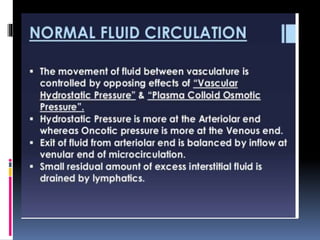
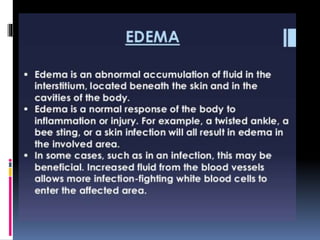
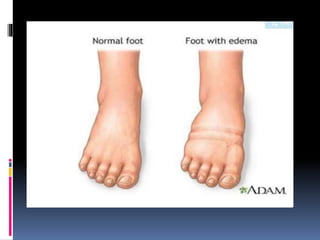
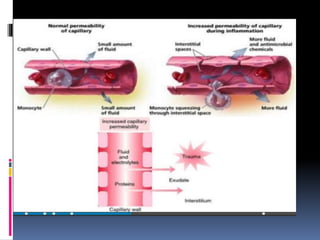
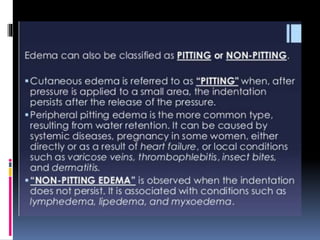
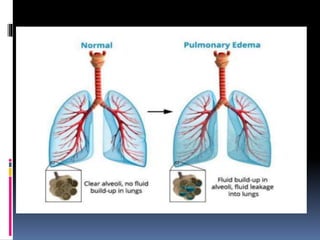
Edema can be caused by either a transudate or an exudate. A transudate occurs when hydrostatic pressure in the blood vessels increases or colloid oncotic pressure decreases, forcing fluid through the vessel walls and into tissues. This can be due to conditions like heart failure or cirrhosis. An exudate forms when fluid leaks from blood vessels into tissues due to inflammation or injury, containing serum, fibrin and white blood cells. Exudates are caused by issues like pneumonia, cancer or pulmonary embolism.














![causes of transudate
Increasing the hydrostatic pressure in vessels
Left ventricular heart failure
Decrease colloid oncotic pressure in blood
vessels
Cirrhosis, [cirrhosis lead to hypoalbuminism
and decrease of colloid oncotic pressure in
plasma that causes edema ]](https://image.slidesharecdn.com/edema-190817173022/85/Edema-34-320.jpg)

![Causes of exudates
Bacterial pneumonia
Cancer [lung cancer, breast cancer and
lymphoma causing approximately 75percect
of all malignant pleural effusion ]
Viral infection
Pulmonary embolism](https://image.slidesharecdn.com/edema-190817173022/85/Edema-36-320.jpg)


