PRESENTED BY
DIKSHA SHARMA
MSc(N) 2nd year
OUTLINE
a) Introduction
b) Definition
c) Classification
d) Risk factors
e) Etiology
f) Sign and symptoms
g) Assessment and diagnosis
h) Management
i) complication
INTRODUCTION
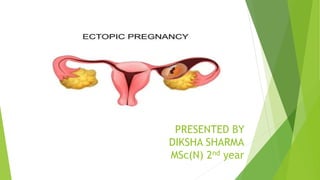
Derived from the Greek word Ektopos,
meaning out of place. An ectopic pregnancy
is when a fertilised egg implants itself outside
of the womb, usually in one of the fallopian
tubes.
DEFINITION
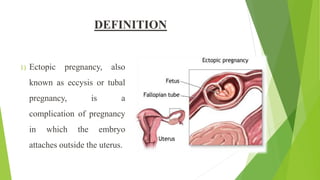
1) Ectopic pregnancy, also
known as eccysis or tubal
pregnancy, is a
complication of pregnancy
in which the embryo
attaches outside the uterus.
Cont…..
2) Ectopic pregnancy is one in which the fertilized
ovum is implanted and develop outside the normal
endometrial cavity.
Cont….
3) Ectopic Pregnancy occurs when the site of
implantation is outside of the uterine cavity either
in the tubes, ovaries or abdominal cavity, with rare
exceptions, ectopic pregnancies are not viable,
pregnancy can even occur in both the womb and
the tube at the same time (heterotopic pregnancy).
CLASSIFICATION
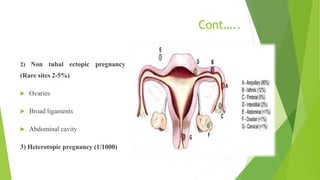
1) Tubal pregnancy (95-98%)
 Ampulla 80%
 Isthmus 12%
 Interstitial 2%
 Infundibulum 2%
Cont…..
2) Non tubal ectopic pregnancy
(Rare sites 2-5%)
 Ovaries
 Broad ligaments
 Abdominal cavity
3) Heterotopic pregnancy (1/1000)
RISK FACTORS
a) Maternal age of 35 years or older
b) History of pelvic surgery, abdominal surgery, or multiple
abortions
c) History of pelvic inflammatory disease
d) History of endometriosis
e) Conception occurred despite tubal ligation or intrauterine
devices (IUD)
Cont…..
f) Conception aided by fertility drugs or procedure
g) Smoking
h) History of ectopic pregnancy
i) History of sexual transmitted diseases such as gonorrhea and chlamydia
j) Having structural abnormalities in the fallopian tubes that make it hard
for egg to travel.
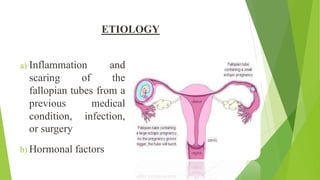
ETIOLOGY
a) Inflammation and
scaring of the
fallopian tubes from a
previous medical
condition, infection,
or surgery
b) Hormonal factors
Cont….
c) Genetic abnormalities or congenital
abnormalities, medical conditions that affect
the shape and condition of the fallopian tubes
and reproductive organs.
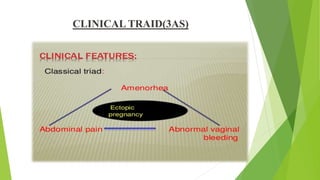
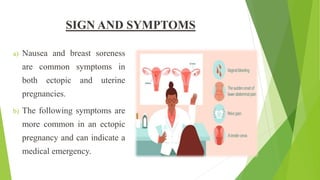
CLINICAL TRAID(3AS)
SIGN AND SYMPTOMS
a) Nausea and breast soreness
are common symptoms in
both ectopic and uterine
pregnancies.
b) The following symptoms are
more common in an ectopic
pregnancy and can indicate a
medical emergency.
SIGN AND SYMPTOMS
d) Sharp waves of pain in the abdomen, pelvis, shoulder or neck
e) severe pain that occurs on one side of the abdomen
f) light to heavy vaginal spotting or bleeding
g) dizziness or fainting
h) rectal pressure
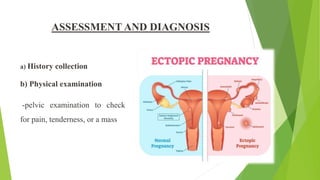
ASSESSMENT AND DIAGNOSIS
a) History collection
b) Physical examination
-pelvic examination to check
for pain, tenderness, or a mass
Cont…..
c) hCG (human chorionic gonadotropins) level
The level of hCG double in early normal pregnancy every 3 days but
are reduced in abnormal or ectopic pregnancy.
d) Serum progesterone level
Level less than 5ng/ml are considered abnormal, levels Greater than
25ng/ml are associated with a normally developing pregnancy.
Cont….
e) Transvaginal ultrasonography
 A positive beta- hCG (above 2000mlu/ml) test with empty
uterus by sonar adnexial mass indicates ectopic pregnancy
f) Laparoscopy
 Allows to see the fallopian tubes and other organs.
MEDICAL MANAGEMENT
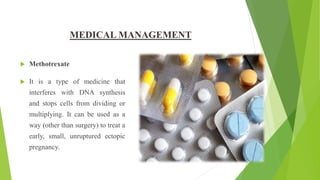
 Methotrexate
 It is a type of medicine that
interferes with DNA synthesis
and stops cells from dividing or
multiplying. It can be used as a
way (other than surgery) to treat a
early, small, unruptured ectopic
pregnancy.
SURGICAL MANAGEMENT
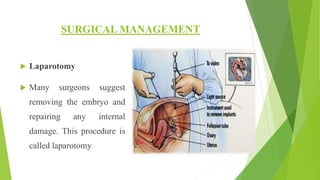
 Laparotomy
 Many surgeons suggest
removing the embryo and
repairing any internal
damage. This procedure is
called laparotomy.
Cont……
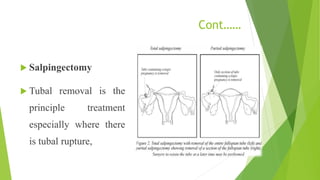
 Salpingectomy
 Tubal removal is the
principle treatment
especially where there
is tubal rupture,
Cont…..
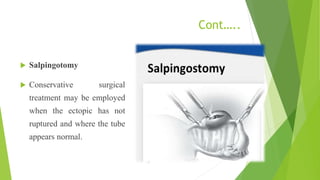
 Salpingotomy
 Conservative surgical
treatment may be employed
when the ectopic has not
ruptured and where the tube
appears normal.
COMPLICATION
a) The most common complication is rupture
with internal bleeding which may lead to
hypovolemic shock. Death from rupture is
still the leading cause of death in the first
trimester of the pregnancy
SUMMARIZATION
Ectopic pregnancy
a)Introduction
b)Definition
c)Classification
d)Risk factors
e)Etiology
Cont…..
a) Sign and symptoms
b)Assessment and diagnosis
c) Management
d)complication
RECAPTUALIZATION
a) Define ectopic pregnancy?
b) Classify ectopic pregnancy?
c) Etiology of ectopic pregnancy?
d) Explain the sign and symptoms of ectopic pregnancy?
e) Describe the management of ectopic pregnancy?
ASSIGNMENT
Nursing Management of Ectopic Pregnancy
CONCLUSION
a) Ectopic pregnancy is still the leading cause of death
in the first trimester of pregnancy
b) A high index of suspicion is required for an early
diagnosis because sign and symptoms are not
specific.
c) Expectant management is suitable in a limited
number of cases.
BIBLIOGRAPHY
1. Bradly WG, Fiske CE, fily RA: the double sac
sign of early intrauterine pregnancy exclusion of
ectopic pregnancy. Radiology 143.1982.
2. Jacob Annamma. A comprehensive textbook of
Midwifery and Gynecological nursing. Jaypee
publishers. Ed. 5th.Pp 220-222
3. Konar Hiralal. D C Dutta textvook of
gynecology.jaypee publishers.Ed,6th. Pp 177-185.
ECTOPIC PREGNANCY ppt

ECTOPIC PREGNANCY ppt

  • 2.
  • 3.
    OUTLINE a) Introduction b) Definition c)Classification d) Risk factors e) Etiology f) Sign and symptoms g) Assessment and diagnosis h) Management i) complication
  • 4.
    INTRODUCTION Derived from theGreek word Ektopos, meaning out of place. An ectopic pregnancy is when a fertilised egg implants itself outside of the womb, usually in one of the fallopian tubes.
  • 5.
    DEFINITION 1) Ectopic pregnancy,also known as eccysis or tubal pregnancy, is a complication of pregnancy in which the embryo attaches outside the uterus.
  • 6.
    Cont….. 2) Ectopic pregnancyis one in which the fertilized ovum is implanted and develop outside the normal endometrial cavity.
  • 7.
    Cont…. 3) Ectopic Pregnancyoccurs when the site of implantation is outside of the uterine cavity either in the tubes, ovaries or abdominal cavity, with rare exceptions, ectopic pregnancies are not viable, pregnancy can even occur in both the womb and the tube at the same time (heterotopic pregnancy).
  • 8.
    CLASSIFICATION 1) Tubal pregnancy(95-98%)  Ampulla 80%  Isthmus 12%  Interstitial 2%  Infundibulum 2%
  • 9.
    Cont….. 2) Non tubalectopic pregnancy (Rare sites 2-5%)  Ovaries  Broad ligaments  Abdominal cavity 3) Heterotopic pregnancy (1/1000)
  • 10.
    RISK FACTORS a) Maternalage of 35 years or older b) History of pelvic surgery, abdominal surgery, or multiple abortions c) History of pelvic inflammatory disease d) History of endometriosis e) Conception occurred despite tubal ligation or intrauterine devices (IUD)
  • 11.
    Cont….. f) Conception aidedby fertility drugs or procedure g) Smoking h) History of ectopic pregnancy i) History of sexual transmitted diseases such as gonorrhea and chlamydia j) Having structural abnormalities in the fallopian tubes that make it hard for egg to travel.
  • 12.
    ETIOLOGY a) Inflammation and scaringof the fallopian tubes from a previous medical condition, infection, or surgery b) Hormonal factors
  • 13.
    Cont…. c) Genetic abnormalitiesor congenital abnormalities, medical conditions that affect the shape and condition of the fallopian tubes and reproductive organs.
  • 14.
  • 15.
    SIGN AND SYMPTOMS a)Nausea and breast soreness are common symptoms in both ectopic and uterine pregnancies. b) The following symptoms are more common in an ectopic pregnancy and can indicate a medical emergency.
  • 16.
    SIGN AND SYMPTOMS d)Sharp waves of pain in the abdomen, pelvis, shoulder or neck e) severe pain that occurs on one side of the abdomen f) light to heavy vaginal spotting or bleeding g) dizziness or fainting h) rectal pressure
  • 17.
    ASSESSMENT AND DIAGNOSIS a)History collection b) Physical examination -pelvic examination to check for pain, tenderness, or a mass
  • 18.
    Cont….. c) hCG (humanchorionic gonadotropins) level The level of hCG double in early normal pregnancy every 3 days but are reduced in abnormal or ectopic pregnancy. d) Serum progesterone level Level less than 5ng/ml are considered abnormal, levels Greater than 25ng/ml are associated with a normally developing pregnancy.
  • 19.
    Cont…. e) Transvaginal ultrasonography A positive beta- hCG (above 2000mlu/ml) test with empty uterus by sonar adnexial mass indicates ectopic pregnancy f) Laparoscopy  Allows to see the fallopian tubes and other organs.
  • 20.
    MEDICAL MANAGEMENT  Methotrexate It is a type of medicine that interferes with DNA synthesis and stops cells from dividing or multiplying. It can be used as a way (other than surgery) to treat a early, small, unruptured ectopic pregnancy.
  • 21.
    SURGICAL MANAGEMENT  Laparotomy Many surgeons suggest removing the embryo and repairing any internal damage. This procedure is called laparotomy.
  • 22.
    Cont……  Salpingectomy  Tubalremoval is the principle treatment especially where there is tubal rupture,
  • 23.
    Cont…..  Salpingotomy  Conservativesurgical treatment may be employed when the ectopic has not ruptured and where the tube appears normal.
  • 24.
    COMPLICATION a) The mostcommon complication is rupture with internal bleeding which may lead to hypovolemic shock. Death from rupture is still the leading cause of death in the first trimester of the pregnancy
  • 25.
  • 26.
    Cont….. a) Sign andsymptoms b)Assessment and diagnosis c) Management d)complication
  • 27.
    RECAPTUALIZATION a) Define ectopicpregnancy? b) Classify ectopic pregnancy? c) Etiology of ectopic pregnancy? d) Explain the sign and symptoms of ectopic pregnancy? e) Describe the management of ectopic pregnancy?
  • 28.
  • 29.
    CONCLUSION a) Ectopic pregnancyis still the leading cause of death in the first trimester of pregnancy b) A high index of suspicion is required for an early diagnosis because sign and symptoms are not specific. c) Expectant management is suitable in a limited number of cases.
  • 30.
    BIBLIOGRAPHY 1. Bradly WG,Fiske CE, fily RA: the double sac sign of early intrauterine pregnancy exclusion of ectopic pregnancy. Radiology 143.1982. 2. Jacob Annamma. A comprehensive textbook of Midwifery and Gynecological nursing. Jaypee publishers. Ed. 5th.Pp 220-222 3. Konar Hiralal. D C Dutta textvook of gynecology.jaypee publishers.Ed,6th. Pp 177-185.