ECONOMICS
Economics as a science
Short revision
series
2
 Economics is the social science that aims to
describe the factors which determine the
production, distribution and consumption of
goods and services
What is economics?
3
 Adam Smith is considered to be the father of
economics
 Is a social science
 Studies human behavior
 Teaches how to take rational decisions
 Society is the laboratory concerned with any
test related to economics
 Can be basically divided into two branches as
micro and macro economics
Micro-economics
4
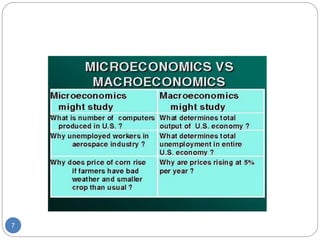
 Is a study of individual parts
 Study how individual parts known as micro
economic agents takes decisions in the dynamic
environment
 Look at one economic agent at once and come
up with informational phrases or economic
statements
 Ex; market demand for SOAP
Rashain Perera CIMA Advanced dip.BA
UOR(mgt)5
Macro-economics
Rashain Perera CIMA Advanced dip.BA
UOR(mgt)6
 Studies the economy in aggregate
 Look at the entire economy as a whole and
come up with economic statements.
 Ex; inflation rate
7
8
9
Economic statements
10
 There are two types of economic statements
 They are positive and normative economic
statements
Positive economic statements
11
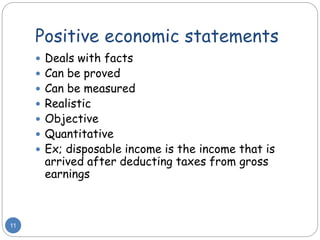
 Deals with facts
 Can be proved
 Can be measured
 Realistic
 Objective
 Quantitative
 Ex; disposable income is the income that is
arrived after deducting taxes from gross
earnings
Normative economic statements
12
 Can not be measured
 Is only a judgment
 Subjective
 Qualitative
 Words such as aught to and should to are used
 Ex; minimum wage should be increased in an
effort to increase standards of living
What gave birth to the subject
economics?
13
 Scarcity
14
15
What is scarcity?
16
 Amal wants to buy an iphone ..hmm a macbook.
.and…an.ipod…ipad..and ……….
 What?
 But has Amal got enough money to buy them
all?
 No 
Scarcity……….
17
 The gap between unlimited wants and limited
resources could be simply known as scarcity
 In the previous example Amal had lot of wants
but he didn’t have enough money to buy them
all
 So he should make a choice
 This is simply called economizing
What is “Economizing”?
18
 Economizing simply means avoiding wastes or
reducing expenditures.
 Economics teaches how to economize
 To economize, we have to take rational
decisions
Rational decisions? What is that?
19
 A method for systematically selecting among
possible choices that is based on reasons and
facts.
 In a rational decision making process, a
business manager will often employ a series of
analytical steps to review relevant facts,
observations and possible outcomes before
choosing a particular course of action.
So u say to make a choice?
20
 We cant have all what we want.
 We have to make choice among alternative
options available
 This is simply known as “choice”.
So what about other options?
21
 As mentioned before we cant have all what we
want.
 Its due to scarcity.
 So we have to make a choice
 Choice involves an opportunity cost
Opportunity cost?
22
 The cost of the next best alternative forgone
when making a choice can be simply known as
opportunity cost
 Opportunity cost can be measured by dividing
forgone production by increased production.
23
24
Scarcity, alternative options, choice
and opportunity cost??? All inter-
related??
25
 Yes it is
 Scarcity -> alternative options  choice ->
opportunity cost
26
Needs and wants
27
 Definitions
 Inter- relationship
 Differences 8
What are the solutions for needs and
wants?
28
 Goods and services
 In economics the term goods refers to both goods
and services
 Goods are the final outcome of production
process
 Hence studying on production process is vital
Production process
29
 Input -> process -> output
 What are economic inputs?
 Economic inputs are:
 Factors of production
 Factors of productivity
Factors of production
30
 Property resources
 Land
 Labour
 Human resources
 Capital
 Entrepreneurship
 Time
 Knowledge
 Skills
 Experiences
Factors of productivity
31
 Human capital
 Technological developments
 Specialization and division of labour
 Management and administration
Resources? Economic input?
32
 Yes
 Factors of production and productivity
together stands for “RESOURCES”
 Resources are inputs that can be used up in
production
 Anything that can be used in production is a
resource.
Classification of resources
33
 Economic resources Vs non economic resources
 Renewable resources Vs non renewable
resources
 Finite and infinite resources
What are the economic outputs?
34
 Goods and services
 Anything that satisfies a want for a need can
be known as a good or a service
 What is a need?
 What is a want?
Classification of goods
35
 Economic goods Vs non economic goods
 Consumer goods Vs producer goods
production = productivity????
36
 No!!!!!
 Productivity is the relationship between output
and the input
 Production is the conversion of input into
outputs.
What is economic efficiency?
37
 “Doing the thing right”
 Can be divided in to 2
 Allocative efficiency; Allocative efficiency
occurs when MB=MC. In other words if resources
are allocated optimally is said that Allocative
efficiency exists.
 Productive efficiency; productive efficiency can
be defined as producing goods and services for
the lower cost
What is effectiveness?
38
 “Doing the right thing”
Productivity = effectiveness / efficiency
39

EconomicS PREPWALK

  • 1.
    ECONOMICS Economics as ascience Short revision series
  • 2.
    2  Economics isthe social science that aims to describe the factors which determine the production, distribution and consumption of goods and services
  • 3.
    What is economics? 3 Adam Smith is considered to be the father of economics  Is a social science  Studies human behavior  Teaches how to take rational decisions  Society is the laboratory concerned with any test related to economics  Can be basically divided into two branches as micro and macro economics
  • 4.
    Micro-economics 4  Is astudy of individual parts  Study how individual parts known as micro economic agents takes decisions in the dynamic environment  Look at one economic agent at once and come up with informational phrases or economic statements  Ex; market demand for SOAP
  • 5.
    Rashain Perera CIMAAdvanced dip.BA UOR(mgt)5
  • 6.
    Macro-economics Rashain Perera CIMAAdvanced dip.BA UOR(mgt)6  Studies the economy in aggregate  Look at the entire economy as a whole and come up with economic statements.  Ex; inflation rate
  • 7.
  • 8.
  • 9.
  • 10.
    Economic statements 10  Thereare two types of economic statements  They are positive and normative economic statements
  • 11.
    Positive economic statements 11 Deals with facts  Can be proved  Can be measured  Realistic  Objective  Quantitative  Ex; disposable income is the income that is arrived after deducting taxes from gross earnings
  • 12.
    Normative economic statements 12 Can not be measured  Is only a judgment  Subjective  Qualitative  Words such as aught to and should to are used  Ex; minimum wage should be increased in an effort to increase standards of living
  • 13.
    What gave birthto the subject economics? 13  Scarcity
  • 14.
  • 15.
  • 16.
    What is scarcity? 16 Amal wants to buy an iphone ..hmm a macbook. .and…an.ipod…ipad..and ……….  What?  But has Amal got enough money to buy them all?  No 
  • 17.
    Scarcity………. 17  The gapbetween unlimited wants and limited resources could be simply known as scarcity  In the previous example Amal had lot of wants but he didn’t have enough money to buy them all  So he should make a choice  This is simply called economizing
  • 18.
    What is “Economizing”? 18 Economizing simply means avoiding wastes or reducing expenditures.  Economics teaches how to economize  To economize, we have to take rational decisions
  • 19.
    Rational decisions? Whatis that? 19  A method for systematically selecting among possible choices that is based on reasons and facts.  In a rational decision making process, a business manager will often employ a series of analytical steps to review relevant facts, observations and possible outcomes before choosing a particular course of action.
  • 20.
    So u sayto make a choice? 20  We cant have all what we want.  We have to make choice among alternative options available  This is simply known as “choice”.
  • 21.
    So what aboutother options? 21  As mentioned before we cant have all what we want.  Its due to scarcity.  So we have to make a choice  Choice involves an opportunity cost
  • 22.
    Opportunity cost? 22  Thecost of the next best alternative forgone when making a choice can be simply known as opportunity cost  Opportunity cost can be measured by dividing forgone production by increased production.
  • 23.
  • 24.
  • 25.
    Scarcity, alternative options,choice and opportunity cost??? All inter- related?? 25  Yes it is  Scarcity -> alternative options  choice -> opportunity cost
  • 26.
  • 27.
    Needs and wants 27 Definitions  Inter- relationship  Differences 8
  • 28.
    What are thesolutions for needs and wants? 28  Goods and services  In economics the term goods refers to both goods and services  Goods are the final outcome of production process  Hence studying on production process is vital
  • 29.
    Production process 29  Input-> process -> output  What are economic inputs?  Economic inputs are:  Factors of production  Factors of productivity
  • 30.
    Factors of production 30 Property resources  Land  Labour  Human resources  Capital  Entrepreneurship  Time  Knowledge  Skills  Experiences
  • 31.
    Factors of productivity 31 Human capital  Technological developments  Specialization and division of labour  Management and administration
  • 32.
    Resources? Economic input? 32 Yes  Factors of production and productivity together stands for “RESOURCES”  Resources are inputs that can be used up in production  Anything that can be used in production is a resource.
  • 33.
    Classification of resources 33 Economic resources Vs non economic resources  Renewable resources Vs non renewable resources  Finite and infinite resources
  • 34.
    What are theeconomic outputs? 34  Goods and services  Anything that satisfies a want for a need can be known as a good or a service  What is a need?  What is a want?
  • 35.
    Classification of goods 35 Economic goods Vs non economic goods  Consumer goods Vs producer goods
  • 36.
    production = productivity???? 36 No!!!!!  Productivity is the relationship between output and the input  Production is the conversion of input into outputs.
  • 37.
    What is economicefficiency? 37  “Doing the thing right”  Can be divided in to 2  Allocative efficiency; Allocative efficiency occurs when MB=MC. In other words if resources are allocated optimally is said that Allocative efficiency exists.  Productive efficiency; productive efficiency can be defined as producing goods and services for the lower cost
  • 38.
    What is effectiveness? 38 “Doing the right thing”
  • 39.