Micro & Managerial Economics
(ECO404)
Basic Concept of Economics
“A field of study that deals with how individual and collective
entities efficiently allocate scarce rources to satisfy their
unlimited wants is called economics.”
Individual Entities:
A person, firm, producer, consumer, product etc.
Collective Entities:
An Industry or group of firms, group of producers, group of
products, group of consumer, a society, a state etc.
Different Definitions of Economics
Three basic school of thoughts.
• Classical Economics:
“Economics is a science of wealth”

• Neo-Classical Economics:
• “Economics is a science of material welfare”

• Modern Economics:
“Economics is a human science”
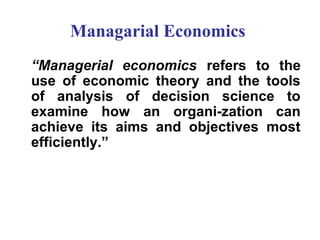
Managarial Economics
“Managerial economics refers to the
use of economic theory and the tools
of analysis of decision science to
examine how an organi­zation can
achieve its aims and objectives most
efficiently.”
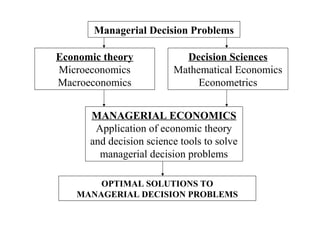
Managerial Decision Problems
Economic theory
Microeconomics
Macroeconomics

Decision Sciences
Mathematical Economics
Econometrics

MANAGERIAL ECONOMICS
Application of economic theory
and decision science tools to solve
managerial decision problems
OPTIMAL SOLUTIONS TO
MANAGERIAL DECISION PROBLEMS
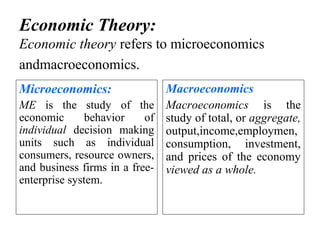
Economic Theory:
Economic theory refers to microeconomics
andmacroeconomics.
Microeconomics:
ME is the study of the
economic
behavior
of
individual decision making
units such as individual
consumers, resource owners,
and business firms in a freeenterprise system.

Macroeconomics
Macroeconomics is the
study of total, or aggregate,
output,income,employmen,
consumption, investment,
and prices of the economy
viewed as a whole.
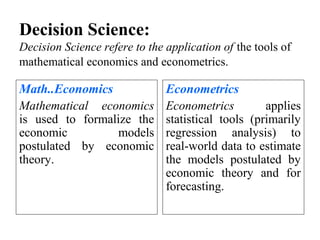
Decision Science:
Decision Science refere to the application of the tools of
mathematical economics and econometrics.

Math..Economics
Mathematical economics
is used to formalize the
economic
models
postulated by economic
theory.

Econometrics
Econometrics
applies
statistical tools (primarily
regression analysis) to
real-world data to estimate
the models postulated by
economic theory and for
forecasting.
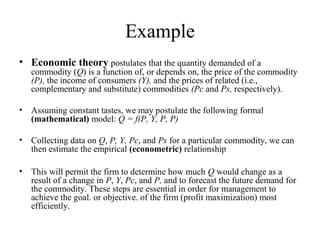
Example
• Economic theory postulates that the quantity demanded of a

commodity (Q) is a function of, or depends on, the price of the commodity
(P), the income of consumers (Y), and the prices of related (i.e.,
complementary and substitute) commodities (Pc and Ps, respectively).

•

Assuming constant tastes, we may postulate the following formal
(mathematical) model: Q = f(P, Y, P, P)

•

Collecting data on Q, P, Y, Pc, and Ps for a particular commodity, we can
then estimate the empirical (econometric) relationship

•

This will permit the firm to determine how much Q would change as a
result of a change in P, Y, Pc, and P, and to forecast the future demand for
the commodity. These steps are essential in order for management to
achieve the goal. or objective. of the firm (profit maximization) most
efficiently.
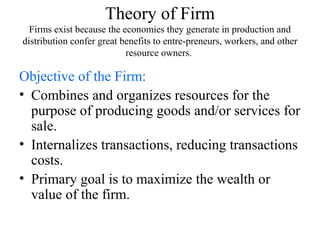
Theory of Firm
Firms exist because the economies they generate in production and
distribution confer great benefits to entre-preneurs, workers, and other
resource owners.

Objective of the Firm:
• Combines and organizes resources for the
purpose of producing goods and/or services for
sale.
• Internalizes transactions, reducing transactions
costs.
• Primary goal is to maximize the wealth or
value of the firm.
Theory of Firm (Cont…
The theory of the firm postulates that the primary goal, or
objective, of the firm is to maximize wealth or the value of the
firm. This is given by the present value of the expected future
profits of the firm. Formally,
The present value of all expected future profits
n
π1
π2
πn
πt
PV =
+
+L+
=∑
1
2
n
(1 + r ) (1 + r )
(1 + r )
(1 + r )t
t =1
n
πt
TRt − TCt
Value of Firm = ∑
=∑
t
(1 + r ) t =1 (1 + r )t
t =1
n
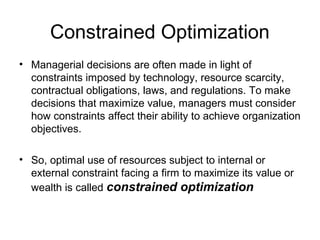
Constrained Optimization
• Managerial decisions are often made in light of
constraints imposed by technology, resource scarcity,
contractual obligations, laws, and regulations. To make
decisions that maximize value, managers must consider
how constraints affect their ability to achieve organization
objectives.
• So, optimal use of resources subject to internal or
external constraint facing a firm to maximize its value or
wealth is called constrained optimization
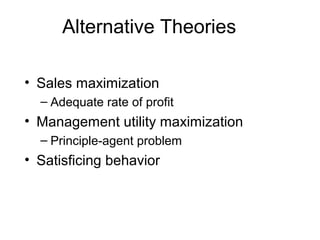
Alternative Theories
• Sales maximization
– Adequate rate of profit

• Management utility maximization
– Principle-agent problem

• Satisficing behavior
Definitions of Profit
• Business Profit: Total revenue minus the explicit or
accounting costs of production.
• Economic Profit: Total revenue minus the explicit
and implicit costs of production.
• Explicit costs are the actual out-of-pocket
expenditures of the firm to hire labor, borrow capital,
rent land and buildings, and purchase raw materials.
• Implicit costs are the money values of the inputs
owned and used by the firm in its own production
processes.
Theories of Profit
•
•
•
•
•

Risk-Bearing Theories of Profit
Frictional Theory of Profit
Monopoly Theory of Profit
Innovation Theory of Profit
Managerial Efficiency Theory of Profit
Function of Profit
• Profit is a signal that guides the allocation
of society’s resources.
• High profits in an industry are a signal that
buyers want more of what the industry
produces.
• Low (or negative) profits in an industry are
a signal that buyers want less of what the
industry produces.
Business Ethics
• Identifies types of behavior that
businesses and their employees should
not engage in.
• Source of guidance that goes beyond
enforceable laws.
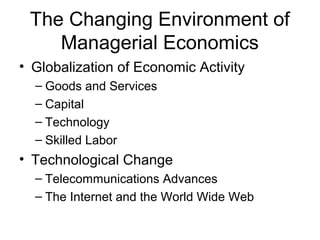
The Changing Environment of
Managerial Economics
• Globalization of Economic Activity
– Goods and Services
– Capital
– Technology
– Skilled Labor

• Technological Change
– Telecommunications Advances
– The Internet and the World Wide Web

Micro & managerial economics (eco404)

  • 1.
    Micro & ManagerialEconomics (ECO404)
  • 2.
    Basic Concept ofEconomics “A field of study that deals with how individual and collective entities efficiently allocate scarce rources to satisfy their unlimited wants is called economics.” Individual Entities: A person, firm, producer, consumer, product etc. Collective Entities: An Industry or group of firms, group of producers, group of products, group of consumer, a society, a state etc.
  • 3.
    Different Definitions ofEconomics Three basic school of thoughts. • Classical Economics: “Economics is a science of wealth” • Neo-Classical Economics: • “Economics is a science of material welfare” • Modern Economics: “Economics is a human science”
  • 4.
    Managarial Economics “Managerial economicsrefers to the use of economic theory and the tools of analysis of decision science to examine how an organi­zation can achieve its aims and objectives most efficiently.”
  • 5.
    Managerial Decision Problems Economictheory Microeconomics Macroeconomics Decision Sciences Mathematical Economics Econometrics MANAGERIAL ECONOMICS Application of economic theory and decision science tools to solve managerial decision problems OPTIMAL SOLUTIONS TO MANAGERIAL DECISION PROBLEMS
  • 6.
    Economic Theory: Economic theoryrefers to microeconomics andmacroeconomics. Microeconomics: ME is the study of the economic behavior of individual decision making units such as individual consumers, resource owners, and business firms in a freeenterprise system. Macroeconomics Macroeconomics is the study of total, or aggregate, output,income,employmen, consumption, investment, and prices of the economy viewed as a whole.
  • 7.
    Decision Science: Decision Sciencerefere to the application of the tools of mathematical economics and econometrics. Math..Economics Mathematical economics is used to formalize the economic models postulated by economic theory. Econometrics Econometrics applies statistical tools (primarily regression analysis) to real-world data to estimate the models postulated by economic theory and for forecasting.
  • 8.
    Example • Economic theorypostulates that the quantity demanded of a commodity (Q) is a function of, or depends on, the price of the commodity (P), the income of consumers (Y), and the prices of related (i.e., complementary and substitute) commodities (Pc and Ps, respectively). • Assuming constant tastes, we may postulate the following formal (mathematical) model: Q = f(P, Y, P, P) • Collecting data on Q, P, Y, Pc, and Ps for a particular commodity, we can then estimate the empirical (econometric) relationship • This will permit the firm to determine how much Q would change as a result of a change in P, Y, Pc, and P, and to forecast the future demand for the commodity. These steps are essential in order for management to achieve the goal. or objective. of the firm (profit maximization) most efficiently.
  • 9.
    Theory of Firm Firmsexist because the economies they generate in production and distribution confer great benefits to entre-preneurs, workers, and other resource owners. Objective of the Firm: • Combines and organizes resources for the purpose of producing goods and/or services for sale. • Internalizes transactions, reducing transactions costs. • Primary goal is to maximize the wealth or value of the firm.
  • 10.
    Theory of Firm(Cont… The theory of the firm postulates that the primary goal, or objective, of the firm is to maximize wealth or the value of the firm. This is given by the present value of the expected future profits of the firm. Formally, The present value of all expected future profits n π1 π2 πn πt PV = + +L+ =∑ 1 2 n (1 + r ) (1 + r ) (1 + r ) (1 + r )t t =1 n πt TRt − TCt Value of Firm = ∑ =∑ t (1 + r ) t =1 (1 + r )t t =1 n
  • 11.
    Constrained Optimization • Managerialdecisions are often made in light of constraints imposed by technology, resource scarcity, contractual obligations, laws, and regulations. To make decisions that maximize value, managers must consider how constraints affect their ability to achieve organization objectives. • So, optimal use of resources subject to internal or external constraint facing a firm to maximize its value or wealth is called constrained optimization
  • 12.
    Alternative Theories • Salesmaximization – Adequate rate of profit • Management utility maximization – Principle-agent problem • Satisficing behavior
  • 13.
    Definitions of Profit •Business Profit: Total revenue minus the explicit or accounting costs of production. • Economic Profit: Total revenue minus the explicit and implicit costs of production. • Explicit costs are the actual out-of-pocket expenditures of the firm to hire labor, borrow capital, rent land and buildings, and purchase raw materials. • Implicit costs are the money values of the inputs owned and used by the firm in its own production processes.
  • 14.
    Theories of Profit • • • • • Risk-BearingTheories of Profit Frictional Theory of Profit Monopoly Theory of Profit Innovation Theory of Profit Managerial Efficiency Theory of Profit
  • 15.
    Function of Profit •Profit is a signal that guides the allocation of society’s resources. • High profits in an industry are a signal that buyers want more of what the industry produces. • Low (or negative) profits in an industry are a signal that buyers want less of what the industry produces.
  • 16.
    Business Ethics • Identifiestypes of behavior that businesses and their employees should not engage in. • Source of guidance that goes beyond enforceable laws.
  • 17.
    The Changing Environmentof Managerial Economics • Globalization of Economic Activity – Goods and Services – Capital – Technology – Skilled Labor • Technological Change – Telecommunications Advances – The Internet and the World Wide Web