Study Guide: Social Studies Test on
2/03/2012
Chapter 1:
Economics in
this world
Economics: What is it?
   Economics is about producing and
    consuming goods and services
   Also about buying these goods and services
   Making choices
   If you buy food, that is involved in economics;
    if you go to the doctor, that is involved in
    economics as well
   Economics is a part of almost everything that
    you do.
Goods and Services
 Goods-  Products; things you can touch
  and use
 Services- Things people do for someone
  else
 Example: You bought gas at the gas
  station
 Gas- a good
 Gas station attendants serving oil- a
  service
Examples of goods and
  services
Goods           Services
       Goods
 Computers       Services
                 Check-up from doctor
 Bicycles       Waiter serving food
 Apples         Musicians
 Books          Teachers
 Dolls          Clerks
 Jackets        Truck drivers to carry
 Telephones      your mail
 Socks          People who take your

 Shoes
                  money at the resister
                 Etc.
 Etc.
Economic Choices
A  basic economic question is, “ How will
 we use our scarce resources to satisfy our
 needs and wants?”
 This is a question that a lot of groups and
 individuals use everyday.
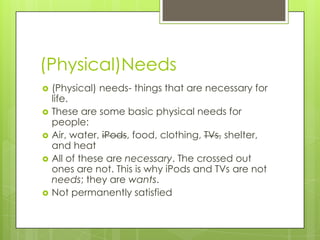
(Physical)Needs
   (Physical) needs- things that are necessary for
    life.
   These are some basic physical needs for
    people:
   Air, water, iPods, food, clothing, TVs, shelter,
    and heat
   All of these are necessary. The crossed out
    ones are not. This is why iPods and TVs are not
    needs; they are wants.
   Not permanently satisfied
Psychological Wants

 Wants  are NOT necessary for life. They are things
  that people want to make them happy.
 Every person has different wants.
 Wants are based on where and when people
  live.
 Ex) iPads were not people’s wants in the 1910s.
  Now they are.
 Ice cream, pair of boots, dolls, etc.
 Not permanently satisfied
Resources

 Resources-   what people use to make the things
  to satisfy their needs and wants.
 These are the three basic types of resources:

  Natural Resources- things found in nature

  People- Made Resources- things made by people and used to
  make more
  Human Resources- labor
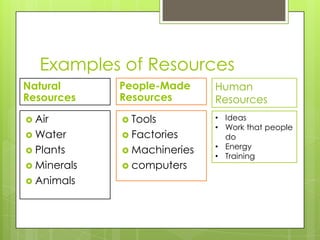
Examples of Resources
Natural      People-Made     Human
Resources    Resources       Resources
 Air         Tools         • Ideas
                             • Work that people
 Water       Factories       do
                             • Energy
 Plants      Machineries
                             • Training
 Minerals    computers
 Animals
Scarcity
 Scarcity- when there is a gap between
  needs and wants on one hand and
  available resources, goods, services on
  the other hand.
 Scarcity exists when needs or wants are
  greater than available resources, goods,
  or services.
Chapter 2:Four
economic
questions
The four basic economic
questions
 1.What…?
 2.How…?
 3.How many/How much…?
 4.Who…?
1. What…?
 Thistype of question deals with what
  outputs will be produced or consumed
 Examples:
    -What will the farmer grow?
    -What will the factories make?
    -What will the tax money be spent for?
2. How…?
 Thistype of question deals with how
  outputs are produced and how resources
  are used.
 Examples:
       -How will the factories make a table?
       -How will the farmer grow apples?
       -How will they make clothes?
3. How Much/How Many…?
 Thistype of question deals with how much
  or how many resources will be used. It also
  deals with how fast resources will be used
  up.
 Examples:
       -How many trees will be cut? For how
long can we use them?
       -How many tables will be made?
4. Who…?
 This type of question deals with the
  distribution of output. These questions are
  affected by the costs of goods and
  services.
 Examples:
       -Who will make the desks?
       -Who will be the gas-station
attendant?
Alternative Cost
 Alternative Costs- what is given up when
  a scarce resource is used in a certain
  way.
 Example: You wanted to get 2 video
  games. However, you only had the
  money to get one. You decide to get the
  1st game. The other video game is an
  alternative cost.
Economic Conflict
 Economic   conflicts are based on values,
  beliefs, and opinions. The decision
  depends on who makes the decision.
 Example: Workers want to get more
  money for their work but their bosses
  doesn’t wants to.
Ways to settle Economic
Conflicts
These are two ways that an economic
conflict can be settled:
• Market Bargaining
• Government Actions
Chapter 2:
Economic
Systems
Economic System
 Economic  Systems- a way of making
  economic choices and decisions.
 Three basic types of economic systems:
         -Traditional Economies
         -Command Economies
         -Market Economies
Traditional Economies
In a traditional economy, economic
decisions are based on tradition and
custom.
 Children learn skills from their parents.
 The same goods and services are
  produced generation after generation.
Advantages and
Disadvantages of a Traditional
Economy
Advantages:
 It is very stable. People know what to
  expect.
 No one is left out.
Disadvantages:
 Individuals don’t have much choice of
  what they do.
 Changes come very slowly.
Command Economies
Command Economies- Economies in which
a central authority makes all of the
decisions.
Central authority:
☀ A king, dictator, powerful politician party,
  etc.
Advantages of Command
Economies
Advantages:
 Changes in what and how things are
  produced. It is also produced fairly
  quickly.
 The needs of the entire country can be
  considered by the central authority.
Disadvantages of Command
Economies
   Individuals are not encouraged to make
    new ideas.
   Individuals do not see why they should
    work hard.
   Individuals do not always get their needs
    and wants.
   Power is kept by very few people- who
    often abuses the power for their benefit.
Market Economies
Market economies-the result of millions of
buying and selling decisions made by
millions of individuals.
 The U.S. economy is basically a market
  economy.
Advantages of Market
Economies
   A lot of people are involved in making
    economical decisions.
   Individuals can work on whatever they want
    to and are encouraged to develop new
    ideas.
   Producers can produce whatever they wish.
   The economy is flexible.
   Consumers are free to buy the goods and
    services they choose.
Disadvantages of Market
Economies
 Individuals   have no way of meeting their
  needs.
 There is no guarantee that individuals will
  succeed in their work.
 The needs of society as a whole is
  overlooked; often not the needs of a
  individual.
 The economy goes through ups and
  downs called business cycles.
Bibliography
 Our Economic System
By: Clairece Fegin

 Mr.   Schiff

Econ123by smk

  • 1.
    Study Guide: SocialStudies Test on 2/03/2012
  • 2.
  • 3.
    Economics: What isit?  Economics is about producing and consuming goods and services  Also about buying these goods and services  Making choices  If you buy food, that is involved in economics; if you go to the doctor, that is involved in economics as well  Economics is a part of almost everything that you do.
  • 4.
    Goods and Services Goods- Products; things you can touch and use  Services- Things people do for someone else  Example: You bought gas at the gas station  Gas- a good  Gas station attendants serving oil- a service
  • 5.
    Examples of goodsand services Goods Services Goods  Computers Services  Check-up from doctor  Bicycles  Waiter serving food  Apples  Musicians  Books  Teachers  Dolls  Clerks  Jackets  Truck drivers to carry  Telephones your mail  Socks  People who take your  Shoes money at the resister  Etc.  Etc.
  • 6.
    Economic Choices A basic economic question is, “ How will we use our scarce resources to satisfy our needs and wants?”  This is a question that a lot of groups and individuals use everyday.
  • 7.
    (Physical)Needs  (Physical) needs- things that are necessary for life.  These are some basic physical needs for people:  Air, water, iPods, food, clothing, TVs, shelter, and heat  All of these are necessary. The crossed out ones are not. This is why iPods and TVs are not needs; they are wants.  Not permanently satisfied
  • 8.
    Psychological Wants  Wants are NOT necessary for life. They are things that people want to make them happy.  Every person has different wants.  Wants are based on where and when people live.  Ex) iPads were not people’s wants in the 1910s. Now they are.  Ice cream, pair of boots, dolls, etc.  Not permanently satisfied
  • 9.
    Resources  Resources- what people use to make the things to satisfy their needs and wants.  These are the three basic types of resources: Natural Resources- things found in nature People- Made Resources- things made by people and used to make more Human Resources- labor
  • 10.
    Examples of Resources Natural People-Made Human Resources Resources Resources  Air  Tools • Ideas • Work that people  Water  Factories do • Energy  Plants  Machineries • Training  Minerals  computers  Animals
  • 11.
    Scarcity  Scarcity- whenthere is a gap between needs and wants on one hand and available resources, goods, services on the other hand.  Scarcity exists when needs or wants are greater than available resources, goods, or services.
  • 12.
  • 13.
    The four basiceconomic questions  1.What…?  2.How…?  3.How many/How much…?  4.Who…?
  • 14.
    1. What…?  Thistypeof question deals with what outputs will be produced or consumed  Examples: -What will the farmer grow? -What will the factories make? -What will the tax money be spent for?
  • 15.
    2. How…?  Thistypeof question deals with how outputs are produced and how resources are used.  Examples: -How will the factories make a table? -How will the farmer grow apples? -How will they make clothes?
  • 16.
    3. How Much/HowMany…?  Thistype of question deals with how much or how many resources will be used. It also deals with how fast resources will be used up.  Examples: -How many trees will be cut? For how long can we use them? -How many tables will be made?
  • 17.
    4. Who…?  Thistype of question deals with the distribution of output. These questions are affected by the costs of goods and services.  Examples: -Who will make the desks? -Who will be the gas-station attendant?
  • 18.
    Alternative Cost  AlternativeCosts- what is given up when a scarce resource is used in a certain way.  Example: You wanted to get 2 video games. However, you only had the money to get one. You decide to get the 1st game. The other video game is an alternative cost.
  • 19.
    Economic Conflict  Economic conflicts are based on values, beliefs, and opinions. The decision depends on who makes the decision.  Example: Workers want to get more money for their work but their bosses doesn’t wants to.
  • 20.
    Ways to settleEconomic Conflicts These are two ways that an economic conflict can be settled: • Market Bargaining • Government Actions
  • 21.
  • 22.
    Economic System  Economic Systems- a way of making economic choices and decisions.  Three basic types of economic systems: -Traditional Economies -Command Economies -Market Economies
  • 23.
    Traditional Economies In atraditional economy, economic decisions are based on tradition and custom.  Children learn skills from their parents.  The same goods and services are produced generation after generation.
  • 24.
    Advantages and Disadvantages ofa Traditional Economy Advantages:  It is very stable. People know what to expect.  No one is left out. Disadvantages:  Individuals don’t have much choice of what they do.  Changes come very slowly.
  • 25.
    Command Economies Command Economies-Economies in which a central authority makes all of the decisions. Central authority: ☀ A king, dictator, powerful politician party, etc.
  • 26.
    Advantages of Command Economies Advantages: Changes in what and how things are produced. It is also produced fairly quickly.  The needs of the entire country can be considered by the central authority.
  • 27.
    Disadvantages of Command Economies  Individuals are not encouraged to make new ideas.  Individuals do not see why they should work hard.  Individuals do not always get their needs and wants.  Power is kept by very few people- who often abuses the power for their benefit.
  • 28.
    Market Economies Market economies-theresult of millions of buying and selling decisions made by millions of individuals.  The U.S. economy is basically a market economy.
  • 29.
    Advantages of Market Economies  A lot of people are involved in making economical decisions.  Individuals can work on whatever they want to and are encouraged to develop new ideas.  Producers can produce whatever they wish.  The economy is flexible.  Consumers are free to buy the goods and services they choose.
  • 30.
    Disadvantages of Market Economies Individuals have no way of meeting their needs.  There is no guarantee that individuals will succeed in their work.  The needs of society as a whole is overlooked; often not the needs of a individual.  The economy goes through ups and downs called business cycles.
  • 31.
    Bibliography  Our EconomicSystem By: Clairece Fegin  Mr. Schiff