Economic policy refers to the
actions that governments take in the
economic field. Such policies are
often influence by international
institutions like international
monetary fund or world bank.
Monetary policy means policy of the
government to stabilize economic
system, price level, monetary
policy, etc with the help of
monetary authority of the country
(RMA).
a.Full employment of all available resources
b.Price Stability
c.Economic growth
A situation in which all available labor
resources are being used in the most
economically efficient way. Full
employment embodies the highest
amount of skilled and unskilled labor that
could be employed within an economy at
any given time.
The situation whereby the prices of
goods and services offered in the
marketplace either change very
slowly or do not change at all.
Factors affecting this include
employment and inflation.
Continuous increases in a country’s
productive capacity, as measured by
comparing gross national product (GNP) in
a year with the GNP in the previous year.
1.Cash Reserve Ratio
2.Open market Operations
3.Bank Rate Policy
The percentage of a bank’s total
monetary holdings that must be kept
on hand in the form of actual
currency. Under fractional-reserve
banking, a bank may lend out any
money deposited there, but must
maintain on site the amount
mandated by the cash reserve ratio.
The buying and selling of government
securities by a central bank, such as the
Royal Monetary of Authority in the
Bhutan, in order to control the money
supply.
It is same as rate of interest. Money
supply can be stabilized by increasing
and decreasing interest rate.
Usually relating to taxation and
government spending, with the
goals of full employment, price
stability, and economic growth. By
changing tax laws, the government
can effectively modify the amount
of disposable income available to
its taxpayers.
1.Taxation
2.Public Borrowing
3.Public Expenditures
The compulsory payment made
by the people to the government
authority for the service render
by the latter (government)
During the inflation period that
is when there is excess of money
supply in the economy, the
government borrows excess
money from the public.
In order to stabilize the
economy, the public expenditure
need to be increases and
decreases.
IS
IS1
LM
r
r1
0 Y Y
E
E
National Incomes
RateofInterest
X-axis
Y-axis
IS
LM
LM1
r
r1
0 YY
E
E
National Incomes
RateofInterest
X-axis
Y-axis
Economic policy

Economic policy

  • 1.
    Economic policy refersto the actions that governments take in the economic field. Such policies are often influence by international institutions like international monetary fund or world bank.
  • 2.
    Monetary policy meanspolicy of the government to stabilize economic system, price level, monetary policy, etc with the help of monetary authority of the country (RMA).
  • 3.
    a.Full employment ofall available resources b.Price Stability c.Economic growth
  • 4.
    A situation inwhich all available labor resources are being used in the most economically efficient way. Full employment embodies the highest amount of skilled and unskilled labor that could be employed within an economy at any given time.
  • 5.
    The situation wherebythe prices of goods and services offered in the marketplace either change very slowly or do not change at all. Factors affecting this include employment and inflation.
  • 6.
    Continuous increases ina country’s productive capacity, as measured by comparing gross national product (GNP) in a year with the GNP in the previous year.
  • 7.
    1.Cash Reserve Ratio 2.Openmarket Operations 3.Bank Rate Policy
  • 8.
    The percentage ofa bank’s total monetary holdings that must be kept on hand in the form of actual currency. Under fractional-reserve banking, a bank may lend out any money deposited there, but must maintain on site the amount mandated by the cash reserve ratio.
  • 9.
    The buying andselling of government securities by a central bank, such as the Royal Monetary of Authority in the Bhutan, in order to control the money supply.
  • 10.
    It is sameas rate of interest. Money supply can be stabilized by increasing and decreasing interest rate.
  • 11.
    Usually relating totaxation and government spending, with the goals of full employment, price stability, and economic growth. By changing tax laws, the government can effectively modify the amount of disposable income available to its taxpayers.
  • 12.
  • 13.
    The compulsory paymentmade by the people to the government authority for the service render by the latter (government)
  • 14.
    During the inflationperiod that is when there is excess of money supply in the economy, the government borrows excess money from the public.
  • 15.
    In order tostabilize the economy, the public expenditure need to be increases and decreases.
  • 16.
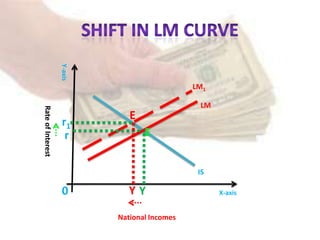
    IS IS1 LM r r1 0 Y Y E E NationalIncomes RateofInterest X-axis Y-axis
  • 17.