* The process by which people acquire knowledge, skills, habits, values or
attitudes.
*It is also used to describe the results of the educational process.
*It should help people become useful members of society and help them
develop an appreciation of their cultural heritage and live more satisfying
lives.
*It is both LEARNING and TEACHING.
The World Book Encyclopedia. Vol. 6 © 1986 USA. p. 56.
*
*It is a social institution.
*It includes all the experiences from which one learns and which bring
about changes in him.
*It is a mirror of ourselves as a people.
Psychological, Anthropological and Sociological Foundations of Education
(Foundations of Education 1). Revised Edition II. © 1996. Katha Publishing
Co., Inc.
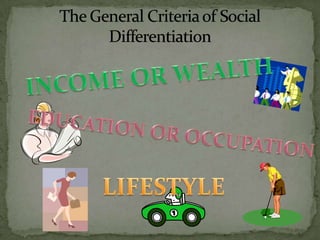
 Widely known as Socioeconomic status, it is often
measured as a combination of education, income, and
occupation.
 It is commonly conceptualized as the social standing
or class of an individual or group.
 It is commonly conceptualized as the social standing
or class of an individual or group.
http://www.apa.org/pi/ses/ resources/publications/fact-sheet-references.aspx.
Through a social class lens, is:
The Economic
Order
and
Education
Includes the wealthy
persons with
substantial property
and investments.
Includes the
professionals, managers, and small
business owners (upper middle), as well as
technical workers, technicians, sales
personnel, and clerical workers (lower
middle class)
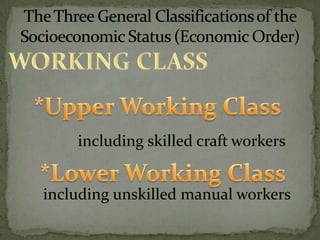
including skilled craft workers
including unskilled manual workers
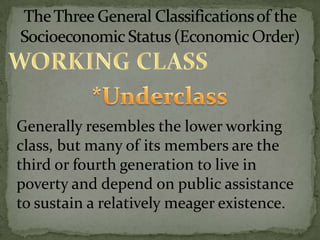
Generally resembles the lower working
class, but many of its members are the
third or fourth generation to live in
poverty and depend on public assistance
to sustain a relatively meager existence.
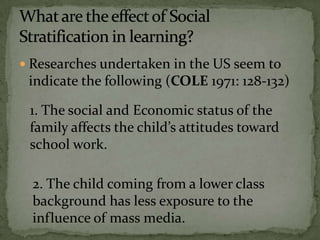
 Researches undertaken in the US seem to
indicate the following (COLE 1971: 128-132)
1. The social and Economic status of the
family affects the child’s attitudes toward
school work.
2. The child coming from a lower class
background has less exposure to the
influence of mass media.
 Researches undertaken in the US seem to
indicate the following (COLE 1971: 128-132)
3. In most cases, the educational attainment
of the child matches the socioeconomic
attainment of his family.
 Education, especially one earned inside the SCHOOL
(small community/society), is beneficial to the society.
 Society, which is the “bigger school”, can help in the
development of the education of the people.
Van Scotter 1979:124
With the rise of mass education the school functions as
an integral part of the process of status allocation in
four ways:
(1)By providing a context in which the individual can
demonstrate his abilities;
(2) by channelling individuals into parts that lead in
the direction of different occupations or class
occupations;
(3) by providing the particular skills needed to fulfill
the requirements of various positions; and finally
(4) by transferring to the individual the differential
prestige of the school itself.
 Psychological, Anthropological, and Social Foundations of
Education (Foundation of Education 1). Revised Edition II.
Alicia Bustos, Ed. D. & Socorro C. Espiritu, Ph. D. ©1996.
Katha Publishing Co., Inc. pp. 99-101
 The World Book Encyclopedia. Vol. 6 © 1986 USA. p. 56.
 http://www.apa.org/pi/ses/ resources/publications/fact-
sheet-references.aspx.
 Foundation of Education. Ornstein, Levin, Gutch. Pp. 319-
333
 Foundations of Meaningful Educational Assessment. Pp.
57-60

Economic order and education presentation

  • 2.
    * The processby which people acquire knowledge, skills, habits, values or attitudes. *It is also used to describe the results of the educational process. *It should help people become useful members of society and help them develop an appreciation of their cultural heritage and live more satisfying lives. *It is both LEARNING and TEACHING. The World Book Encyclopedia. Vol. 6 © 1986 USA. p. 56.
  • 3.
    * *It is asocial institution. *It includes all the experiences from which one learns and which bring about changes in him. *It is a mirror of ourselves as a people. Psychological, Anthropological and Sociological Foundations of Education (Foundations of Education 1). Revised Edition II. © 1996. Katha Publishing Co., Inc.
  • 4.
     Widely knownas Socioeconomic status, it is often measured as a combination of education, income, and occupation.  It is commonly conceptualized as the social standing or class of an individual or group.  It is commonly conceptualized as the social standing or class of an individual or group.
  • 5.
  • 7.
  • 8.
    Includes the wealthy personswith substantial property and investments.
  • 9.
    Includes the professionals, managers,and small business owners (upper middle), as well as technical workers, technicians, sales personnel, and clerical workers (lower middle class)
  • 10.
    including skilled craftworkers including unskilled manual workers
  • 11.
    Generally resembles thelower working class, but many of its members are the third or fourth generation to live in poverty and depend on public assistance to sustain a relatively meager existence.
  • 13.
     Researches undertakenin the US seem to indicate the following (COLE 1971: 128-132) 1. The social and Economic status of the family affects the child’s attitudes toward school work. 2. The child coming from a lower class background has less exposure to the influence of mass media.
  • 14.
     Researches undertakenin the US seem to indicate the following (COLE 1971: 128-132) 3. In most cases, the educational attainment of the child matches the socioeconomic attainment of his family.
  • 17.
     Education, especiallyone earned inside the SCHOOL (small community/society), is beneficial to the society.  Society, which is the “bigger school”, can help in the development of the education of the people.
  • 18.
    Van Scotter 1979:124 Withthe rise of mass education the school functions as an integral part of the process of status allocation in four ways: (1)By providing a context in which the individual can demonstrate his abilities; (2) by channelling individuals into parts that lead in the direction of different occupations or class occupations; (3) by providing the particular skills needed to fulfill the requirements of various positions; and finally (4) by transferring to the individual the differential prestige of the school itself.
  • 19.
     Psychological, Anthropological,and Social Foundations of Education (Foundation of Education 1). Revised Edition II. Alicia Bustos, Ed. D. & Socorro C. Espiritu, Ph. D. ©1996. Katha Publishing Co., Inc. pp. 99-101  The World Book Encyclopedia. Vol. 6 © 1986 USA. p. 56.  http://www.apa.org/pi/ses/ resources/publications/fact- sheet-references.aspx.  Foundation of Education. Ornstein, Levin, Gutch. Pp. 319- 333  Foundations of Meaningful Educational Assessment. Pp. 57-60