Economic Activities and the Environment
The Impact of Burning Fossil Fuels (p140-153 in Economic Book)
Economic activities are dependent on the use of fossil fuels but the burning of fossil fuels
causes:
a) Global Warming
b) Acid Rain
c) Air Pollution/Smog
GLOBAL WARMING
CAUSES:
i. Overuse of fossil fuels
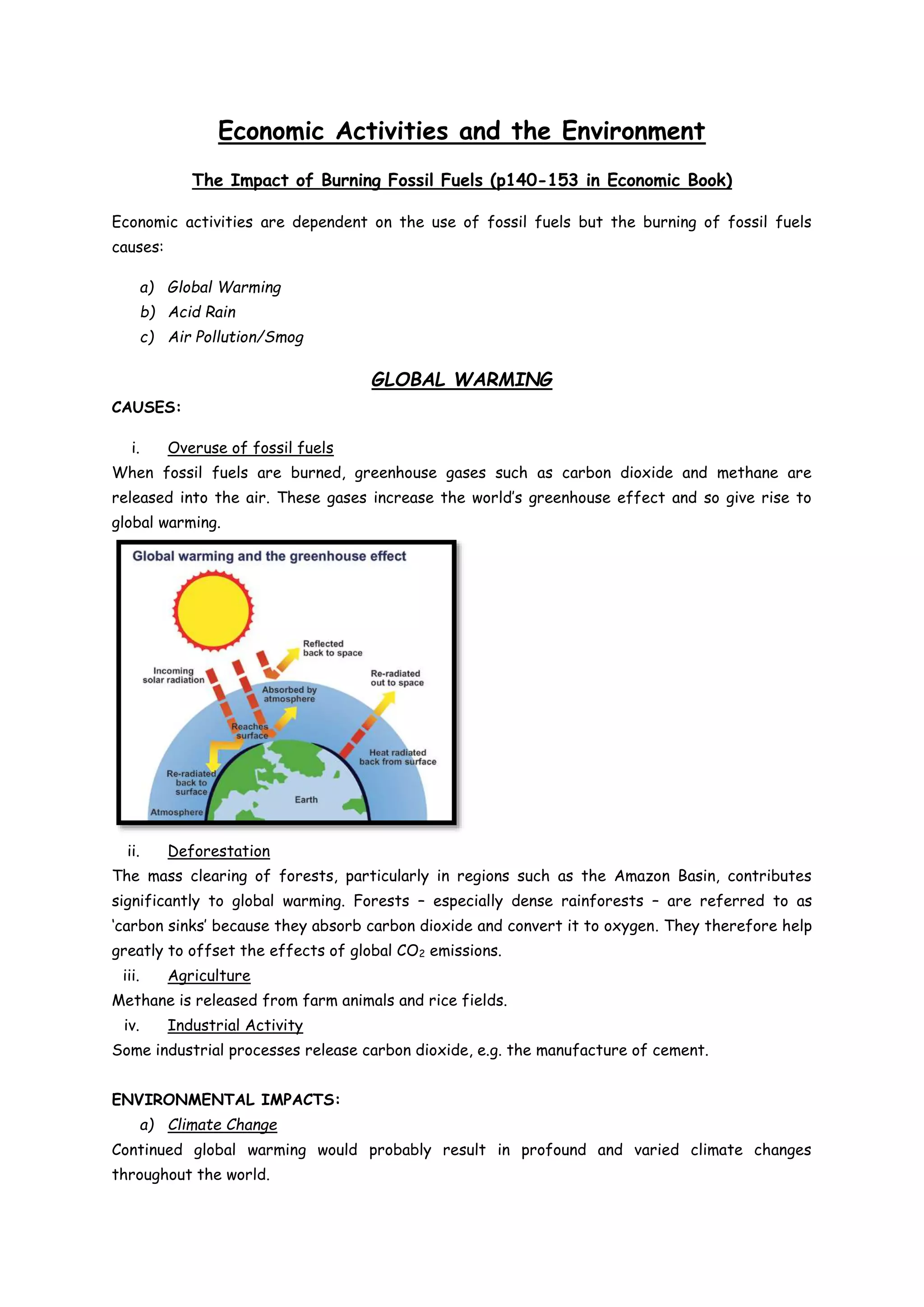
When fossil fuels are burned, greenhouse gases such as carbon dioxide and methane are
released into the air. These gases increase the world’s greenhouse effect and so give rise to
global warming.
ii. Deforestation
The mass clearing of forests, particularly in regions such as the Amazon Basin, contributes
significantly to global warming. Forests – especially dense rainforests – are referred to as
‘carbon sinks’ because they absorb carbon dioxide and convert it to oxygen. They therefore help
greatly to offset the effects of global CO2 emissions.
iii. Agriculture
Methane is released from farm animals and rice fields.
iv. Industrial Activity
Some industrial processes release carbon dioxide, e.g. the manufacture of cement.
ENVIRONMENTAL IMPACTS:
a) Climate Change
Continued global warming would probably result in profound and varied climate changes
throughout the world.
 Temperature increases in the range of 1.5 to 5.8°C are predicted.
 Less rain and longer periods of drought are expected in many parts of Africa. Water
shortages, crop failures and resultant food shortages could affect up to 250 million
Africans by 2050.
 Southern Europe is predicted to become even drier and regular droughts are predicted
to increase.
 Ireland might experience more extreme weather conditions, such as wetter winters and
drier summers.
b) Rising Sea Levels
Global Warming is leading to rising sea levels.
 The melting of ice caps and polar sea ice – which has already begun – will cause sea levels
to rise.
 During the 20th
century, sea levels rose about 15-20cm.
 It is estimated that a global temperature increase of 2°C could cause our oceans to rise
by anything up to 1.4 metres. This would cause disastrous flooding in many coastal and
low-lying parts of the world.
ECONOMIC IMPACTS
1. Displacement of People
 It is predicted that over 100 million people in coastal areas around the world could lose
their homes through flooding and storms by 2080.
2. Tourism
 World tourism could be radically altered. While warmer summers might entice more
people to Ireland, many Mediterranean tourist resorts are likely to suffer serious
decline. It is estimated that by 2050, Greek islands such as Crete may be too hot for
tourism during the current peak months of July and August.
 The Maldives are an Indian Ocean island country near the equator just 1.5 metres above
sea level. The Maldives are at risk of disappearing completely if sea levels continue to
rise according to predictions. This will threaten the tourism industry which accounts for
35% of the country’s annual GDP of €600 million.
3. Diseases
 Some tropical diseases might spread to temperate countries such as Ireland. Malaria is
one of the world’s biggest killers. Global warming could enable the malaria-bearing
mosquito to survive in countries such as Ireland by 2050. The UK’s Department of
Health has already instructed doctors to look out for possible outbreaks of malaria in
Southern England.
 Hotter summers would result in more cases of sunburn and associated skin cancers
throughout much of Europe.
RESPONDING TO GLOBAL WARMING
 The only long-term solution to the problems of global warming is to reduce the use of
fossil fuels.
 We can reduce our CO2 emissions by using less electricity, using public transport where
possible, fitting energy-efficient light-bulbs and by not leaving electrical equipment on
standby mode.
 Reducing deforestation and planting more trees would also help to combat global
warming as forests are natural ‘carbon sinks’ that absorb carbon dioxide from the
atmosphere.
FAILED ATTEMPTS AT INTERNATIONAL ACTION
o An international conference held in the Japanese city of Kyoto in 1997 gave rise to the
Kyoto Protocol. This international agreement that aimed to reduce global emissions of
greenhouse gases by 5% below their 1990 levels by the year 2012. But the agreement
never achieved its goal. This was partly because the USA (one of the world’s biggest
greenhouse gas producers) abandoned the agreement on the grounds that it might ‘harm
the American economy’.
o It was hoped that the Copenhagen Summit of 2009 would provide a widely accepted and
legally binding international agreement to replace the Kyoto Protocol. No such agreement
was achieved. Some major CO2 producing countries, such as the USA, China and India,
did agree on further efforts to reduce greenhouse gas emissions. But even this ‘accord’
was non-binding.
ACID RAIN
Acid rain is any precipitation that has a pH lower than 5.6. It is an international problem caused
by the burning of fossil fuels. It is caused by two kinds of air pollutants, sulphur dioxide and
nitrogen oxide, which are produced by power stations burning fossil fuels and by car, truck,
train and bus exhausts.
EFFECTS OF ACID RAIN
A. ON WOODLANDS
Acid rain affects trees in several ways. It leaches the soil heavily, so that valuable plant
nutrients are washed out of the soil, making it too infertile to nourish trees. Acid water also
damages trees when plant roots soak it up. Trees – especially conifers – suffer greatly. Their
immunity to disease is weakened. They lose their foliage, their growth is stunted, their branches
become distorted, their twigs drop off, their barks split and many trees die.
B. ON WATER SUPPLIES AND LAKES
Acid rain can cause toxic metals such as aluminium to be leached out of the soil and into
groundwater. Contaminated groundwater may then enter water supplies and endanger human
health. Acid rain has also caused widespread damage to fish and plant life in European lakes.
Fish usually die when water pH values fall below 4.3. About 35,000 lakes in Norway and Sweden
have been affected by acid rain.
C. ON BUILDINGS
Buildings and monuments are damaged by acid rain which speeds up the chemical weathering
process. Many old buildings in Europe are made of limestone or granite and they have been
damaged over time by the ravages of acid rain. The very structure of some buildings has been
endangered. The most famous building in Greece – the Parthenon of Athens – has decayed more
in the past 50 years than in the previous 2,400.
WAYS OF REDUCING THE EFFECTS OF ACID RAIN
Short-Term Methods:
Boats, light aircraft and helicopters have been used to scatter lime on Swedish lakes that are
affected by acid rain. This is called liming. Lime neutralises acidity in the water and can be used
to ‘nurse’ the lakes back to health. But liming is an expensive practice and provides only a
temporary solution to acid rain pollution.
Long-Term Methods:
The only effective long-term solution to the problems of acid rain is to reduce or prevent the
pollution associated with it:
o Some useful technologies have been developed for this purpose. Filter systems or
‘scrubbers’ can be used in factories and power stations to extract sulphur from chimney
emissions. Catalytic converters reduce nitrogen oxides emissions from all motor vehicles
in the EU.
o The best long-term solution is to reduce out use of fossil fuels. Practices ranging from
better house insulation to the increased use of public transport are effective energy
conservation methods. An increased use of renewable energy sources would also reduce
our use of fossil fuels.
SMOG
 Smog is a more localised form of pollution that results from the use of fossil fuels. It is
associated especially with the burning of bituminous coal, which releases huge amounts
of tiny solid particles or smoke into the atmosphere. When these particles combine with
natural fog they form a smoke/fog mixture referred to as smog.
 Smog is very harmful to human health, especially to people who already suffer from lung
complaints such as asthma and bronchitis. Poor air quality as a result of smog in many
cities across the world has led to laws being passed to protect the health of urban
residents and workers, e.g. The Irish Air Pollution Act. This Act banned the use of
bituminous coal in Dublin after 1990.
Higher Level – 2012 Q7 A & 2010 Q7 A & Questions 1 & 2 below:
1. Examine the economic and environmental impact of our world’s continued reliance on
fossil fuels. (30 marks)
2. Examine the environmental impact of burning fossil fuels. (30 marks)
Ordinary Level
1. (a) Explain how acid rain occurs. (b) Name and describe two effects of acid rain. (c)
Suggest two actions that could be taken to reduce these effects. (40 marks)
2. (a) Explain how global warming is caused. (b) Describe two effects of global warming. (c)
Describe two measures that could be taken to reduce the effects of global warming. (40
marks)

Economic Activities and the Environment

  • 1.
    Economic Activities andthe Environment The Impact of Burning Fossil Fuels (p140-153 in Economic Book) Economic activities are dependent on the use of fossil fuels but the burning of fossil fuels causes: a) Global Warming b) Acid Rain c) Air Pollution/Smog GLOBAL WARMING CAUSES: i. Overuse of fossil fuels When fossil fuels are burned, greenhouse gases such as carbon dioxide and methane are released into the air. These gases increase the world’s greenhouse effect and so give rise to global warming. ii. Deforestation The mass clearing of forests, particularly in regions such as the Amazon Basin, contributes significantly to global warming. Forests – especially dense rainforests – are referred to as ‘carbon sinks’ because they absorb carbon dioxide and convert it to oxygen. They therefore help greatly to offset the effects of global CO2 emissions. iii. Agriculture Methane is released from farm animals and rice fields. iv. Industrial Activity Some industrial processes release carbon dioxide, e.g. the manufacture of cement. ENVIRONMENTAL IMPACTS: a) Climate Change Continued global warming would probably result in profound and varied climate changes throughout the world.
  • 2.
     Temperature increasesin the range of 1.5 to 5.8°C are predicted.  Less rain and longer periods of drought are expected in many parts of Africa. Water shortages, crop failures and resultant food shortages could affect up to 250 million Africans by 2050.  Southern Europe is predicted to become even drier and regular droughts are predicted to increase.  Ireland might experience more extreme weather conditions, such as wetter winters and drier summers. b) Rising Sea Levels Global Warming is leading to rising sea levels.  The melting of ice caps and polar sea ice – which has already begun – will cause sea levels to rise.  During the 20th century, sea levels rose about 15-20cm.  It is estimated that a global temperature increase of 2°C could cause our oceans to rise by anything up to 1.4 metres. This would cause disastrous flooding in many coastal and low-lying parts of the world. ECONOMIC IMPACTS 1. Displacement of People  It is predicted that over 100 million people in coastal areas around the world could lose their homes through flooding and storms by 2080. 2. Tourism  World tourism could be radically altered. While warmer summers might entice more people to Ireland, many Mediterranean tourist resorts are likely to suffer serious decline. It is estimated that by 2050, Greek islands such as Crete may be too hot for tourism during the current peak months of July and August.  The Maldives are an Indian Ocean island country near the equator just 1.5 metres above sea level. The Maldives are at risk of disappearing completely if sea levels continue to rise according to predictions. This will threaten the tourism industry which accounts for 35% of the country’s annual GDP of €600 million. 3. Diseases  Some tropical diseases might spread to temperate countries such as Ireland. Malaria is one of the world’s biggest killers. Global warming could enable the malaria-bearing mosquito to survive in countries such as Ireland by 2050. The UK’s Department of Health has already instructed doctors to look out for possible outbreaks of malaria in Southern England.  Hotter summers would result in more cases of sunburn and associated skin cancers throughout much of Europe. RESPONDING TO GLOBAL WARMING  The only long-term solution to the problems of global warming is to reduce the use of fossil fuels.
  • 3.
     We canreduce our CO2 emissions by using less electricity, using public transport where possible, fitting energy-efficient light-bulbs and by not leaving electrical equipment on standby mode.  Reducing deforestation and planting more trees would also help to combat global warming as forests are natural ‘carbon sinks’ that absorb carbon dioxide from the atmosphere. FAILED ATTEMPTS AT INTERNATIONAL ACTION o An international conference held in the Japanese city of Kyoto in 1997 gave rise to the Kyoto Protocol. This international agreement that aimed to reduce global emissions of greenhouse gases by 5% below their 1990 levels by the year 2012. But the agreement never achieved its goal. This was partly because the USA (one of the world’s biggest greenhouse gas producers) abandoned the agreement on the grounds that it might ‘harm the American economy’. o It was hoped that the Copenhagen Summit of 2009 would provide a widely accepted and legally binding international agreement to replace the Kyoto Protocol. No such agreement was achieved. Some major CO2 producing countries, such as the USA, China and India, did agree on further efforts to reduce greenhouse gas emissions. But even this ‘accord’ was non-binding. ACID RAIN Acid rain is any precipitation that has a pH lower than 5.6. It is an international problem caused by the burning of fossil fuels. It is caused by two kinds of air pollutants, sulphur dioxide and nitrogen oxide, which are produced by power stations burning fossil fuels and by car, truck, train and bus exhausts. EFFECTS OF ACID RAIN A. ON WOODLANDS Acid rain affects trees in several ways. It leaches the soil heavily, so that valuable plant nutrients are washed out of the soil, making it too infertile to nourish trees. Acid water also damages trees when plant roots soak it up. Trees – especially conifers – suffer greatly. Their immunity to disease is weakened. They lose their foliage, their growth is stunted, their branches become distorted, their twigs drop off, their barks split and many trees die. B. ON WATER SUPPLIES AND LAKES Acid rain can cause toxic metals such as aluminium to be leached out of the soil and into groundwater. Contaminated groundwater may then enter water supplies and endanger human health. Acid rain has also caused widespread damage to fish and plant life in European lakes. Fish usually die when water pH values fall below 4.3. About 35,000 lakes in Norway and Sweden have been affected by acid rain. C. ON BUILDINGS Buildings and monuments are damaged by acid rain which speeds up the chemical weathering process. Many old buildings in Europe are made of limestone or granite and they have been damaged over time by the ravages of acid rain. The very structure of some buildings has been
  • 4.
    endangered. The mostfamous building in Greece – the Parthenon of Athens – has decayed more in the past 50 years than in the previous 2,400. WAYS OF REDUCING THE EFFECTS OF ACID RAIN Short-Term Methods: Boats, light aircraft and helicopters have been used to scatter lime on Swedish lakes that are affected by acid rain. This is called liming. Lime neutralises acidity in the water and can be used to ‘nurse’ the lakes back to health. But liming is an expensive practice and provides only a temporary solution to acid rain pollution. Long-Term Methods: The only effective long-term solution to the problems of acid rain is to reduce or prevent the pollution associated with it: o Some useful technologies have been developed for this purpose. Filter systems or ‘scrubbers’ can be used in factories and power stations to extract sulphur from chimney emissions. Catalytic converters reduce nitrogen oxides emissions from all motor vehicles in the EU. o The best long-term solution is to reduce out use of fossil fuels. Practices ranging from better house insulation to the increased use of public transport are effective energy conservation methods. An increased use of renewable energy sources would also reduce our use of fossil fuels. SMOG  Smog is a more localised form of pollution that results from the use of fossil fuels. It is associated especially with the burning of bituminous coal, which releases huge amounts of tiny solid particles or smoke into the atmosphere. When these particles combine with natural fog they form a smoke/fog mixture referred to as smog.  Smog is very harmful to human health, especially to people who already suffer from lung complaints such as asthma and bronchitis. Poor air quality as a result of smog in many cities across the world has led to laws being passed to protect the health of urban residents and workers, e.g. The Irish Air Pollution Act. This Act banned the use of bituminous coal in Dublin after 1990. Higher Level – 2012 Q7 A & 2010 Q7 A & Questions 1 & 2 below: 1. Examine the economic and environmental impact of our world’s continued reliance on fossil fuels. (30 marks) 2. Examine the environmental impact of burning fossil fuels. (30 marks) Ordinary Level 1. (a) Explain how acid rain occurs. (b) Name and describe two effects of acid rain. (c) Suggest two actions that could be taken to reduce these effects. (40 marks) 2. (a) Explain how global warming is caused. (b) Describe two effects of global warming. (c) Describe two measures that could be taken to reduce the effects of global warming. (40 marks)