Environmental Science
Environmental issues and solutions
• A variety of environmental problems now affect our entire world. As
globalization continues and the earth's natural processes transform local
problems into international issues, few societies are being left untouched
by major environmental problems.
Some of the largest problems now affecting the world are:
• Acid Rain
• Air Pollution
• Water Pollution
• Plastic pollution
• Global Warming
• Deforestation
• Ozone Depletion
• Smog
• Overpopulation
• Rain Forest Destruction
• Melting Ice Caps and Sea Level Rise
• Ocean Acidification
• Soil Degradation
• Global warming
• Natural Resource Depletion
ACID RAIN
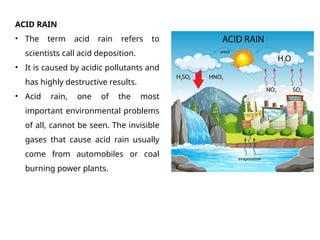
• The term acid rain refers to
scientists call acid deposition.
• It is caused by acidic pollutants and
has highly destructive results.
• Acid rain, one of the most
important environmental problems
of all, cannot be seen. The invisible
gases that cause acid rain usually
come from automobiles or coal
burning power plants.
ACID RAIN CAUSES
• The primary causes of acid rain are sulphur dioxide and nitrogen
oxides. These chemicals are released by certain industrial processes,
and as a result, the more industrialized nations of Europe as well as
the US suffer severely from acid rain.
• Most sulphur dioxide comes from power plants that use coal as their
fuel. These plants emit 100 million tons of sulphur dioxide, 70% of
that in the world. Automobiles produce about half of the world's
nitrogen oxide.
• As the number of automobiles in use increases, so does the amount
of acid rain.
• Power plants that burn fossil fuels also contribute significantly to
nitrogen oxide emission.
• Though human causes are primarily responsible for acid rain, natural
causes exist as well.
• Fires, volcanic eruptions, bacterial decomposition, and lightening also
greatly increase the amount of nitrogen oxide on the planet.
• Once the tiny pollutant molecules have entered the atmosphere, they can
travel for thousands of miles. Eventually the particles will combine with
other compounds to produce new, often harmful, chemicals.
• Acid rain comes down to earth in the form of rain, snow, hail, fog, frost, or
dew.
• Once it reaches the ground, the acidity in the substance can harm and
even destroy both natural ecosystems and man made products, such as
car finishes.
ACID RAIN EFFECTS
• Acid rain is having harmful effects both on people and on the natural
ecosystems of the world.
• Scientists today are convinced that acid rain is severe in many areas, and
that it is having an adverse effect on the environments of those locations.
• Acid Rain Affect Aquatic Ecosystem Many ecosystems are affected by acid
rain. Bodies of water, such as lakes and rivers, see many of their
inhabitants die off due to rising acidity levels.
Acid Rain Effect on Trees and Plants
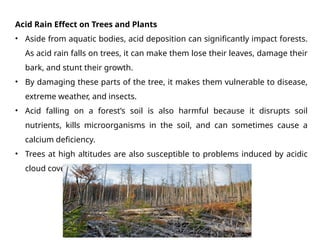
• Aside from aquatic bodies, acid deposition can significantly impact forests.
As acid rain falls on trees, it can make them lose their leaves, damage their
bark, and stunt their growth.
• By damaging these parts of the tree, it makes them vulnerable to disease,
extreme weather, and insects.
• Acid falling on a forest’s soil is also harmful because it disrupts soil
nutrients, kills microorganisms in the soil, and can sometimes cause a
calcium deficiency.
• Trees at high altitudes are also susceptible to problems induced by acidic
cloud cover as the moisture in the clouds blankets them.
Acid rain effect on Buildings
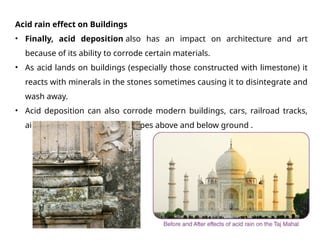
• Finally, acid deposition also has an impact on architecture and art
because of its ability to corrode certain materials.
• As acid lands on buildings (especially those constructed with limestone) it
reacts with minerals in the stones sometimes causing it to disintegrate and
wash away.
• Acid deposition can also corrode modern buildings, cars, railroad tracks,
airplanes, steel bridges, and pipes above and below ground .
Acid Rain – Solutions
• Modern science has proven that acid rain is a dangerous and highly
destructive problem.
• As a result, various ways to limit acid rain have been invented, and some
are now being used.
• There are many ways that power plant companies like Northern States can
reduce acid rain creation.
• They can use coal with a low sulphur content, they can remove the sulphur
from smoke their plants release, and they can limit processes known to
generate high levels of acid rain.
• Policy makers and environmental experts are now looking into the best
methods to limit acid rain.
• Environmentalists advocate the installation of sulphur cleaning scrubbers
in factories, washing sulphur out of coal, and finding new methods of
burning coal. Power plant operators are looking for less expensive
solutions to the problem. Individuals can help by conserving energy or
driving their cars less.
• Governments can pass laws restricting pollution levels, or can use a variety
of methods such as tradable emission permits to reduce acid rain.
Whatever way it is done, acid rain will certainly have to be limited in the
future .
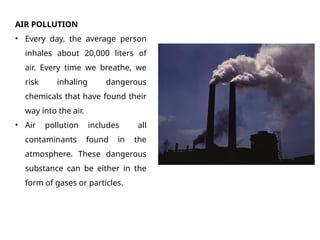
AIR POLLUTION
• Every day, the average person
inhales about 20,000 liters of
air. Every time we breathe, we
risk inhaling dangerous
chemicals that have found their
way into the air.
• Air pollution includes all
contaminants found in the
atmosphere. These dangerous
substance can be either in the
form of gases or particles.
• Air pollution can be found both outdoors and indoors. Pollutants can be
trapped inside buildings, causing indoor pollution that lasts for a long time.
• The sources of air pollution are both natural and human based. As one
might expect, humans have been producing increasing amounts of
pollution as time has progressed, and they now account for the majority of
pollutants released into the air.
Fundamental Causes of Air Pollution
• Industrialization set in motion the widespread use of fossil fuels which are
now the main drivers of pollution as we know it.
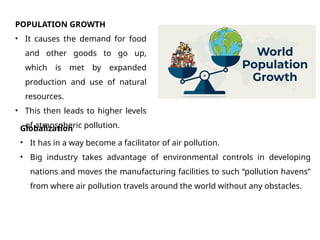
POPULATION GROWTH
• It causes the demand for food
and other goods to go up,
which is met by expanded
production and use of natural
resources.
• This then leads to higher levels
of atmospheric pollution.
Globalization
• It has in a way become a facilitator of air pollution.
• Big industry takes advantage of environmental controls in developing
nations and moves the manufacturing facilities to such “pollution havens”
from where air pollution travels around the world without any obstacles.
AIR POLLUTION – EFFECTS
• Of course, atmospheric pollution would not be such a big problem if it
weren’t for its harmful effects on humans, animals, trees and the wider
environment.
• We can distinguish between short-term acute effects and long-term
chronic effects of air pollution.
• Air pollutants enter the body primarily through the respiratory system
which thus becomes their main victim.
• Each air pollutant exerts their own specific adverse impacts, ranging from
mild to really damaging.
AIR POLLUTION – SOLUTIONS
• Air pollution has many disastrous effects that need to be curbed. In order
to accomplish this, governments, scientists and environmentalists are
using or testing a variety of methods aimed at reducing pollution.
• There are two main types of pollution control.
• Input control involves preventing a problem before it occurs, or at least
limiting the effects the process will produce.
• Five major input control methods exist.
• People may try to restrict population growth use less energy, improve
energy efficiency, reduce waste, and move to non-polluting renewable
forms of energy production. Also, automobile-produced pollution can be
decreased with highly beneficial results.
• Output control, the opposite method, seeks to fix the problems caused by
air pollution.
• This usually means cleaning up an area that has been damaged by
pollution. Input controls are usually more effective than output controls.
• Output controls are also more expensive, making them less desirable to tax
payers and polluting industries.
• Current air pollution control efforts are not all highly effective. In wealthier
countries, industries are often able to shift to methods that decrease air
pollution.
• In the United States, for example, air pollution control laws have been
successful in stopping air pollution levels from rising.
• However, in developing countries and even in countries where pollution is
strictly regulated, much more needs to be done.
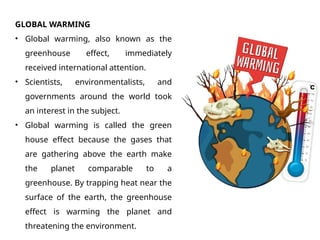
GLOBAL WARMING
• Global warming, also known as the
greenhouse effect, immediately
received international attention.
• Scientists, environmentalists, and
governments around the world took
an interest in the subject.
• Global warming is called the green
house effect because the gases that
are gathering above the earth make
the planet comparable to a
greenhouse. By trapping heat near the
surface of the earth, the greenhouse
effect is warming the planet and
threatening the environment.
GLOBAL WARMING - CAUSES
• Global warming has a variety of causes. One of the largest factors
contributing to global warming is the general problem of overpopulation
and its many effects.
• Many different gases can increase the planets temperature. The number of
different products and human activities that contribute to global warming
are so numerous that finding solutions to the problem is very difficult.
• Using a refrigerator releases dangerous gases, turning on the lights
requires energy from a power plant, and driving to work causes gas
emissions from the car.
• Though having an atmosphere is important, the greenhouses effect may be
making it excessively thick. The levels of gases covering the Earth have
soared with industrialization and developed countries now produce about
75% of greenhouse gases.
WHAT ARE THE EFFECTS OF GLOBAL WARMING ON EARTH?
• The effects could be enormous. Relative to the hectic pace of your daily life,
global warming is a slow moving problem. Unstoppable climatic shift could
have devastating impacts in years to come.
• Changing the temperature will likely have some effect on the planet’s
weather, but just what that effect will be nearly impossible to predict.
• Some portion of the polar icecaps would melt, raising global sea levels.
GLOBAL WARMING - SOLUTIONS
• Certain laws and treaties are aimed at reducing the emission of pollutants
that result in global warming. In 1988, the international conference on the
changing atmosphere drew scientists and decision makers from 48
countries.
• Raising fossil fuels, taxing emissions, and encouraging people to take
environment friendly action through such activities as planting trees will all
help.
• Because many problems leading to global warming are caused or
contributed to by overpopulation, people are beginning to work to reduce
family sizes. Family planning services actually help in the fight against
global warming.
• Education is a key method of reducing the greenhouse effect. By teaching
people about such things as deforestation, environmental activists hope to
prevent the problems that ultimately lead to global warming.
RAIN FOREST DESTRUCTION
• The atmosphere and oceans are not the only parts of the environment
being damaged. Rain forests are being quickly destroyed.
• Amazon’s rain forest, and many more are being cut down.
• According to some estimates, 50 million acres of rain forest are cut down
every year.
• The world’s growing population has been a primary cause of rain forest
destruction. More people need land to live on and wood products to
consume.
Solutions:
• For all purposes for which tropical timber is used, other woods or materials
could be substituted.
• We can stop using tropical timber and urge others to do the same. As long
as there is a market for tropical timbers, trees will continue to be cut down.
Importance of mass awareness
in Environmental studies
• Environmental awareness is important because our earth provides resources that
are essential to our well-being and quality of life.
• These resources include clean air, water, and soil, as well as a wide range of plants and
animals that contribute to the richness and diversity of our planet.
• Another reason why environmental awareness is so crucial is that it can help people
live healthier lives. People can protect themselves and their families from health risks
by learning about the dangers of air pollution, water contamination, and toxic
chemicals.
• Human activities such as pollution, deforestation, and over consumption can have
negative impacts on the environment.
• These activities can lead to environmental degradation, resulting in serious
consequences for humans and the environment, such as climate change, habitat loss,
and resource depletion. It is for this reason that environmental awareness is so
important.
• Most people are unaware of the various ways in which they can help the environment.
• It is important to be environmentally aware so we can do our part in preserving our
planet. There are many things we can do to be more environmentally conscious, such
as recycling, using less water, and using energy-efficient appliances.
• Human activities such as pollution, deforestation, and over consumption can have
negative impacts on the environment.
• These activities can lead to environmental degradation, resulting in serious
consequences for humans and the environment, such as climate change, habitat loss,
and resource depletion. It is for this reason that environmental awareness is so
important.
• Most people are unaware of the various ways in which they can help the environment.
• It is important to be environmentally aware so we can do our part in preserving our
planet. There are many things we can do to be more environmentally conscious, such
as recycling, using less water, and using energy-efficient appliances.
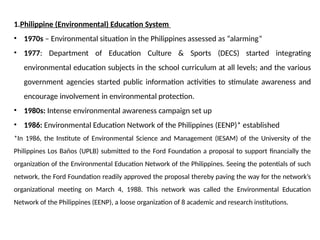
1.Philippine (Environmental) Education System
• 1970s – Environmental situation in the Philippines assessed as “alarming”
• 1977: Department of Education Culture & Sports (DECS) started integrating
environmental education subjects in the school curriculum at all levels; and the various
government agencies started public information activities to stimulate awareness and
encourage involvement in environmental protection.
• 1980s: Intense environmental awareness campaign set up
• 1986: Environmental Education Network of the Philippines (EENP)* established
*In 1986, the Institute of Environmental Science and Management (IESAM) of the University of the
Philippines Los Baños (UPLB) submitted to the Ford Foundation a proposal to support financially the
organization of the Environmental Education Network of the Philippines. Seeing the potentials of such
network, the Ford Foundation readily approved the proposal thereby paving the way for the network’s
organizational meeting on March 4, 1988. This network was called the Environmental Education
Network of the Philippines (EENP), a loose organization of 8 academic and research institutions.
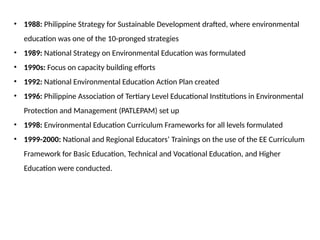
• 1988: Philippine Strategy for Sustainable Development drafted, where environmental
education was one of the 10-pronged strategies
• 1989: National Strategy on Environmental Education was formulated
• 1990s: Focus on capacity building efforts
• 1992: National Environmental Education Action Plan created
• 1996: Philippine Association of Tertiary Level Educational Institutions in Environmental
Protection and Management (PATLEPAM) set up
• 1998: Environmental Education Curriculum Frameworks for all levels formulated
• 1999-2000: National and Regional Educators’ Trainings on the use of the EE Curriculum
Framework for Basic Education, Technical and Vocational Education, and Higher
Education were conducted.
THANK YOU

environment chapter 1 interior design.pptx

  • 1.
  • 2.
  • 3.
    • A varietyof environmental problems now affect our entire world. As globalization continues and the earth's natural processes transform local problems into international issues, few societies are being left untouched by major environmental problems. Some of the largest problems now affecting the world are:
  • 4.
    • Acid Rain •Air Pollution • Water Pollution • Plastic pollution • Global Warming • Deforestation • Ozone Depletion • Smog • Overpopulation • Rain Forest Destruction • Melting Ice Caps and Sea Level Rise • Ocean Acidification • Soil Degradation • Global warming • Natural Resource Depletion
  • 5.
    ACID RAIN • Theterm acid rain refers to scientists call acid deposition. • It is caused by acidic pollutants and has highly destructive results. • Acid rain, one of the most important environmental problems of all, cannot be seen. The invisible gases that cause acid rain usually come from automobiles or coal burning power plants.
  • 6.
    ACID RAIN CAUSES •The primary causes of acid rain are sulphur dioxide and nitrogen oxides. These chemicals are released by certain industrial processes, and as a result, the more industrialized nations of Europe as well as the US suffer severely from acid rain. • Most sulphur dioxide comes from power plants that use coal as their fuel. These plants emit 100 million tons of sulphur dioxide, 70% of that in the world. Automobiles produce about half of the world's nitrogen oxide. • As the number of automobiles in use increases, so does the amount of acid rain. • Power plants that burn fossil fuels also contribute significantly to nitrogen oxide emission.
  • 7.
    • Though humancauses are primarily responsible for acid rain, natural causes exist as well. • Fires, volcanic eruptions, bacterial decomposition, and lightening also greatly increase the amount of nitrogen oxide on the planet. • Once the tiny pollutant molecules have entered the atmosphere, they can travel for thousands of miles. Eventually the particles will combine with other compounds to produce new, often harmful, chemicals. • Acid rain comes down to earth in the form of rain, snow, hail, fog, frost, or dew. • Once it reaches the ground, the acidity in the substance can harm and even destroy both natural ecosystems and man made products, such as car finishes.
  • 8.
    ACID RAIN EFFECTS •Acid rain is having harmful effects both on people and on the natural ecosystems of the world. • Scientists today are convinced that acid rain is severe in many areas, and that it is having an adverse effect on the environments of those locations. • Acid Rain Affect Aquatic Ecosystem Many ecosystems are affected by acid rain. Bodies of water, such as lakes and rivers, see many of their inhabitants die off due to rising acidity levels.
  • 9.
    Acid Rain Effecton Trees and Plants • Aside from aquatic bodies, acid deposition can significantly impact forests. As acid rain falls on trees, it can make them lose their leaves, damage their bark, and stunt their growth. • By damaging these parts of the tree, it makes them vulnerable to disease, extreme weather, and insects. • Acid falling on a forest’s soil is also harmful because it disrupts soil nutrients, kills microorganisms in the soil, and can sometimes cause a calcium deficiency. • Trees at high altitudes are also susceptible to problems induced by acidic cloud cover as the moisture in the clouds blankets them.
  • 10.
    Acid rain effecton Buildings • Finally, acid deposition also has an impact on architecture and art because of its ability to corrode certain materials. • As acid lands on buildings (especially those constructed with limestone) it reacts with minerals in the stones sometimes causing it to disintegrate and wash away. • Acid deposition can also corrode modern buildings, cars, railroad tracks, airplanes, steel bridges, and pipes above and below ground .
  • 11.
    Acid Rain –Solutions • Modern science has proven that acid rain is a dangerous and highly destructive problem. • As a result, various ways to limit acid rain have been invented, and some are now being used. • There are many ways that power plant companies like Northern States can reduce acid rain creation. • They can use coal with a low sulphur content, they can remove the sulphur from smoke their plants release, and they can limit processes known to generate high levels of acid rain. • Policy makers and environmental experts are now looking into the best methods to limit acid rain.
  • 12.
    • Environmentalists advocatethe installation of sulphur cleaning scrubbers in factories, washing sulphur out of coal, and finding new methods of burning coal. Power plant operators are looking for less expensive solutions to the problem. Individuals can help by conserving energy or driving their cars less. • Governments can pass laws restricting pollution levels, or can use a variety of methods such as tradable emission permits to reduce acid rain. Whatever way it is done, acid rain will certainly have to be limited in the future .
  • 13.
    AIR POLLUTION • Everyday, the average person inhales about 20,000 liters of air. Every time we breathe, we risk inhaling dangerous chemicals that have found their way into the air. • Air pollution includes all contaminants found in the atmosphere. These dangerous substance can be either in the form of gases or particles.
  • 14.
    • Air pollutioncan be found both outdoors and indoors. Pollutants can be trapped inside buildings, causing indoor pollution that lasts for a long time. • The sources of air pollution are both natural and human based. As one might expect, humans have been producing increasing amounts of pollution as time has progressed, and they now account for the majority of pollutants released into the air. Fundamental Causes of Air Pollution • Industrialization set in motion the widespread use of fossil fuels which are now the main drivers of pollution as we know it.
  • 15.
    POPULATION GROWTH • Itcauses the demand for food and other goods to go up, which is met by expanded production and use of natural resources. • This then leads to higher levels of atmospheric pollution. Globalization • It has in a way become a facilitator of air pollution. • Big industry takes advantage of environmental controls in developing nations and moves the manufacturing facilities to such “pollution havens” from where air pollution travels around the world without any obstacles.
  • 16.
    AIR POLLUTION –EFFECTS • Of course, atmospheric pollution would not be such a big problem if it weren’t for its harmful effects on humans, animals, trees and the wider environment. • We can distinguish between short-term acute effects and long-term chronic effects of air pollution. • Air pollutants enter the body primarily through the respiratory system which thus becomes their main victim. • Each air pollutant exerts their own specific adverse impacts, ranging from mild to really damaging.
  • 17.
    AIR POLLUTION –SOLUTIONS • Air pollution has many disastrous effects that need to be curbed. In order to accomplish this, governments, scientists and environmentalists are using or testing a variety of methods aimed at reducing pollution. • There are two main types of pollution control. • Input control involves preventing a problem before it occurs, or at least limiting the effects the process will produce. • Five major input control methods exist. • People may try to restrict population growth use less energy, improve energy efficiency, reduce waste, and move to non-polluting renewable forms of energy production. Also, automobile-produced pollution can be decreased with highly beneficial results.
  • 18.
    • Output control,the opposite method, seeks to fix the problems caused by air pollution. • This usually means cleaning up an area that has been damaged by pollution. Input controls are usually more effective than output controls. • Output controls are also more expensive, making them less desirable to tax payers and polluting industries. • Current air pollution control efforts are not all highly effective. In wealthier countries, industries are often able to shift to methods that decrease air pollution. • In the United States, for example, air pollution control laws have been successful in stopping air pollution levels from rising. • However, in developing countries and even in countries where pollution is strictly regulated, much more needs to be done.
  • 19.
    GLOBAL WARMING • Globalwarming, also known as the greenhouse effect, immediately received international attention. • Scientists, environmentalists, and governments around the world took an interest in the subject. • Global warming is called the green house effect because the gases that are gathering above the earth make the planet comparable to a greenhouse. By trapping heat near the surface of the earth, the greenhouse effect is warming the planet and threatening the environment.
  • 20.
    GLOBAL WARMING -CAUSES • Global warming has a variety of causes. One of the largest factors contributing to global warming is the general problem of overpopulation and its many effects. • Many different gases can increase the planets temperature. The number of different products and human activities that contribute to global warming are so numerous that finding solutions to the problem is very difficult. • Using a refrigerator releases dangerous gases, turning on the lights requires energy from a power plant, and driving to work causes gas emissions from the car. • Though having an atmosphere is important, the greenhouses effect may be making it excessively thick. The levels of gases covering the Earth have soared with industrialization and developed countries now produce about 75% of greenhouse gases.
  • 21.
    WHAT ARE THEEFFECTS OF GLOBAL WARMING ON EARTH? • The effects could be enormous. Relative to the hectic pace of your daily life, global warming is a slow moving problem. Unstoppable climatic shift could have devastating impacts in years to come. • Changing the temperature will likely have some effect on the planet’s weather, but just what that effect will be nearly impossible to predict. • Some portion of the polar icecaps would melt, raising global sea levels.
  • 22.
    GLOBAL WARMING -SOLUTIONS • Certain laws and treaties are aimed at reducing the emission of pollutants that result in global warming. In 1988, the international conference on the changing atmosphere drew scientists and decision makers from 48 countries. • Raising fossil fuels, taxing emissions, and encouraging people to take environment friendly action through such activities as planting trees will all help. • Because many problems leading to global warming are caused or contributed to by overpopulation, people are beginning to work to reduce family sizes. Family planning services actually help in the fight against global warming. • Education is a key method of reducing the greenhouse effect. By teaching people about such things as deforestation, environmental activists hope to prevent the problems that ultimately lead to global warming.
  • 23.
    RAIN FOREST DESTRUCTION •The atmosphere and oceans are not the only parts of the environment being damaged. Rain forests are being quickly destroyed. • Amazon’s rain forest, and many more are being cut down. • According to some estimates, 50 million acres of rain forest are cut down every year. • The world’s growing population has been a primary cause of rain forest destruction. More people need land to live on and wood products to consume. Solutions: • For all purposes for which tropical timber is used, other woods or materials could be substituted. • We can stop using tropical timber and urge others to do the same. As long as there is a market for tropical timbers, trees will continue to be cut down.
  • 33.
    Importance of massawareness in Environmental studies
  • 34.
    • Environmental awarenessis important because our earth provides resources that are essential to our well-being and quality of life. • These resources include clean air, water, and soil, as well as a wide range of plants and animals that contribute to the richness and diversity of our planet. • Another reason why environmental awareness is so crucial is that it can help people live healthier lives. People can protect themselves and their families from health risks by learning about the dangers of air pollution, water contamination, and toxic chemicals.
  • 35.
    • Human activitiessuch as pollution, deforestation, and over consumption can have negative impacts on the environment. • These activities can lead to environmental degradation, resulting in serious consequences for humans and the environment, such as climate change, habitat loss, and resource depletion. It is for this reason that environmental awareness is so important. • Most people are unaware of the various ways in which they can help the environment. • It is important to be environmentally aware so we can do our part in preserving our planet. There are many things we can do to be more environmentally conscious, such as recycling, using less water, and using energy-efficient appliances.
  • 36.
    • Human activitiessuch as pollution, deforestation, and over consumption can have negative impacts on the environment. • These activities can lead to environmental degradation, resulting in serious consequences for humans and the environment, such as climate change, habitat loss, and resource depletion. It is for this reason that environmental awareness is so important. • Most people are unaware of the various ways in which they can help the environment. • It is important to be environmentally aware so we can do our part in preserving our planet. There are many things we can do to be more environmentally conscious, such as recycling, using less water, and using energy-efficient appliances.
  • 37.
    1.Philippine (Environmental) EducationSystem • 1970s – Environmental situation in the Philippines assessed as “alarming” • 1977: Department of Education Culture & Sports (DECS) started integrating environmental education subjects in the school curriculum at all levels; and the various government agencies started public information activities to stimulate awareness and encourage involvement in environmental protection. • 1980s: Intense environmental awareness campaign set up • 1986: Environmental Education Network of the Philippines (EENP)* established *In 1986, the Institute of Environmental Science and Management (IESAM) of the University of the Philippines Los Baños (UPLB) submitted to the Ford Foundation a proposal to support financially the organization of the Environmental Education Network of the Philippines. Seeing the potentials of such network, the Ford Foundation readily approved the proposal thereby paving the way for the network’s organizational meeting on March 4, 1988. This network was called the Environmental Education Network of the Philippines (EENP), a loose organization of 8 academic and research institutions.
  • 38.
    • 1988: PhilippineStrategy for Sustainable Development drafted, where environmental education was one of the 10-pronged strategies • 1989: National Strategy on Environmental Education was formulated • 1990s: Focus on capacity building efforts • 1992: National Environmental Education Action Plan created • 1996: Philippine Association of Tertiary Level Educational Institutions in Environmental Protection and Management (PATLEPAM) set up • 1998: Environmental Education Curriculum Frameworks for all levels formulated • 1999-2000: National and Regional Educators’ Trainings on the use of the EE Curriculum Framework for Basic Education, Technical and Vocational Education, and Higher Education were conducted.

  • 39.