Chapter
                      2
 Relationship Marketing:
Where Personal Selling Fits
Chapter
2


          2-2
Main Topics
 What Is the Purpose of Business?
 What Is Marketing?
 Customer Orientation’s Evolution
 Marketing’s Importance in the Firm
 Essentials of a Firm’s Marketing Effort
 Relationship Marketing
 Relationship Marketing and the Sales Force
 Levels of Relationship Marketing
                      2-3
Main Topics
 Partnering with Customers
 The New Consultative Selling
 E-Selling: Technology and Information Build
  Relationships
 What’s a Salesperson Worth?
 The Key to Success


                      2-4
In Chapter 2 We Will See What is
       Meant by the Terms...
 Business
 Marketing
 Product, Price, Place, Promotion
 Personal Selling


                      2-5
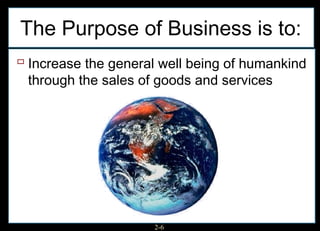
The Purpose of Business is to:
 Increase the general well being of humankind
 through the sales of goods and services


                     2-6
This Requires
 Making a profit in order to operate the
 business and to provide beneficial products
 to the marketplace


                       2-7
Profit is a Means to an End
 Profit is needed to serve humankind
 Profit is needed to operate the business
 Profit is needed to provide products to the
 marketplace


                       2-8
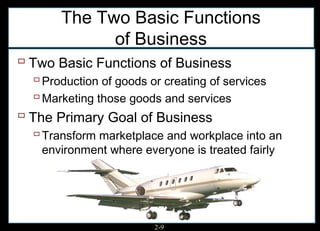
The Two Basic Functions
             of Business
 Two Basic Functions of Business
    Production of goods or creating of services
    Marketing those goods and services
 The Primary Goal of Business
    Transform marketplace and workplace into an
    environment where everyone is treated fairly


                         2-9
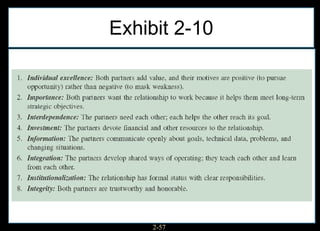
What is Marketing?
 Marketing is a process of planning:
   The conception, pricing, promotion, and
    distribution of goods, services, and ideas
   To create exchanges that satisfy individual and
    organizational objectives


                        2-10
Customer Orientation’s
            Evolution
 The production concept
 The selling concept
 The marketing concept


                     2-11
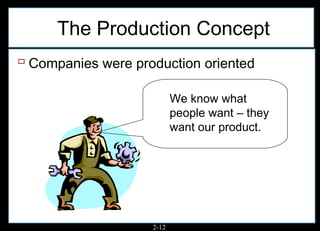
The Production Concept
 Companies were production oriented

                           We know what
                           people want – they
                           want our product.


                    2-12
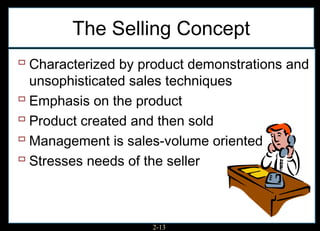
The Selling Concept
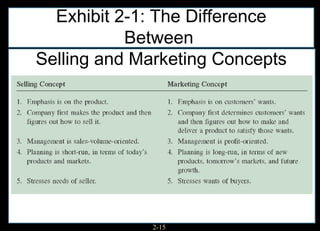
 Characterized by product demonstrations and
  unsophisticated sales techniques
 Emphasis on the product
 Product created and then sold
 Management is sales-volume oriented
 Stresses needs of the seller


                    2-13
The Marketing Concept
 Emphasis is on customer’s wants
 Customer’s wants drive production
 Management is profit-oriented
 Planning is long-term
 Stresses wants of buyers


                     2-14
Exhibit 2-1: The Difference
           Between
Selling and Marketing Concepts


             2-15
Marketing’s Importance in the
               Firm
 Marketers have four main objectives:
   Maximize the sales for existing products in
    existing markets
   Develop and sell new products
   Develop new markets for existing or new products
   Provide quality service to ensure repeat business


                        2-16
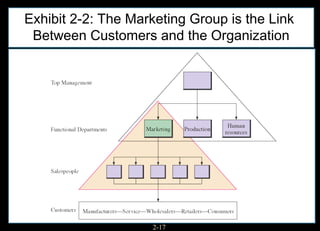
Exhibit 2-2: The Marketing Group is the Link
 Between Customers and the Organization


                    2-17
Product: It’s More Than You Think
 A good is a physical object that can be
  purchased
 A service is an action or activity performed
  for a fee
 Value-added refers to benefits received that
  are not included in the purchase price of a
  good or service


                      2-18
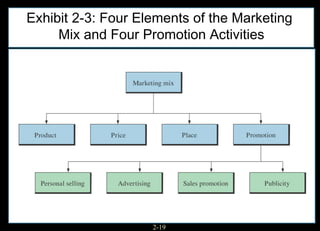
Exhibit 2-3: Four Elements of the Marketing
     Mix and Four Promotion Activities


                    2-19
Exhibit 2-4: Examples of
    Business-To-Business Value-
               Adding
 Help customer reduce process costs
   Improve yields
   Reduce waste (through recycling, etc.)
   Reduce rework
   Reduce direct labor
   Reduce indirect labor (inspection, handling)
   Reduce energy costs


                        2-20
Exhibit 2-4: Examples of
    Business-To-Business Value-
               Adding
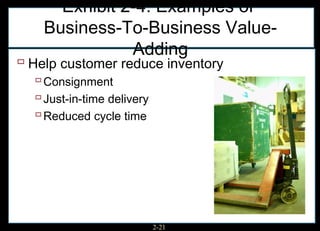
 Help customer reduce inventory
   Consignment
   Just-in-time delivery
   Reduced cycle time


                            2-21
Exhibit 2-4: Examples of
    Business-To-Business Value-
               Adding
 Help customer reduce administrative costs
   Simplify billing
   Improve tractability
   Use electronic data interchange


                        2-22
Exhibit 2-4: Examples of
    Business-To-Business Value-
               Adding
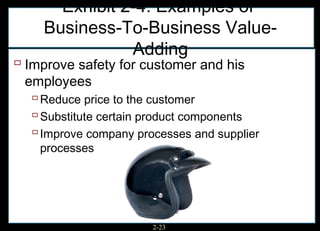
 Improve safety for customer and his
 employees
   Reduce price to the customer
   Substitute certain product components
   Improve company processes and supplier
    processes


                       2-23
What is Meant by the Term
            “Product?”
 A product is a bundle of tangible and
 intangible attributes, including package, color,
 and brand, plus the services and even the
 reputation of the seller


                      2-24
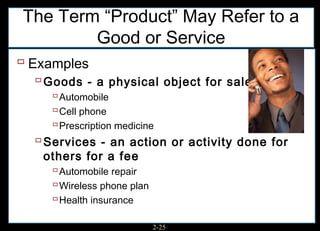
The Term “Product” May Refer to a
        Good or Service
 Examples
   Goods - a physical object for sale
      Automobile
      Cell phone
      Prescription medicine
   Services - an action or activity done for
    others for a fee
      Automobile repair
      Wireless phone plan
      Health insurance

                      2-25
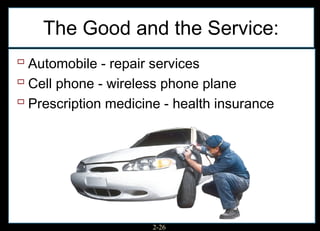
The Good and the Service:
 Automobile - repair services
 Cell phone - wireless phone plane
 Prescription medicine - health insurance


                      2-26
We Will Use the Terms Follow-up and
   Service. What do They Mean?*
 Follow-up refers to maintaining contact with
 a customer in order to evaluate the
 effectiveness of the product and the
 satisfaction of the customer (More on this in
 Chapter 14)


                      2-27
The Term “Service” May Refer to A:
 Product, as insurance and advertise which is
  sold by someone
 Service, as customer service which is an
  activity offered by a seller in conjunction with
  the purchase of a product, such as delivery,
  repair, credit cards accepted, 800 telephone
  number, web site, salesperson available to
  help customer (More on this in Chapter 14)


                        2-28
Customer Service by the
        Salesperson Include:
 Salesperson goes to customer’s business to
 help:
   Resell products
   Customer use product
   Handling complaints
   Return damaged products
   Provide samples
   Suggest further business opportunities

  (Above discussed in Chapter 1)
                        2-29
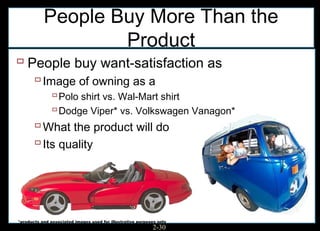
People Buy More Than the
                   Product
 People buy want-satisfaction as
        Image of owning as a
            Polo shirt vs. Wal-Mart shirt
            Dodge Viper* vs. Volkswagen Vanagon*
        What the product will do
        Its quality


*products and associated images used for illustrative purposes only
                                                            2-30
There Are Two General Types of Products -
     Consumer and Industrial Products
 What is a consumer product?
 A consumer product is produced for, and
  purchased by, households or end consumers
  for their personal use
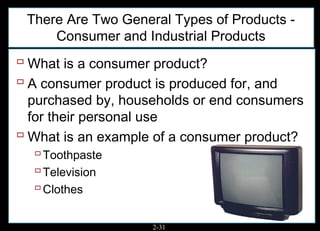
 What is an example of a consumer product?
    Toothpaste
    Television
    Clothes

                     2-31
There Are Two General Types of Products-
  Consumer and Industrial Products Cont…
 What is industrial product?
 An industrial product is sold primarily for use
 in producing other products. Industrial users
 are profit nonprofit organizations that buy
 good and services for one of three purposes*
  1.To make other goods and services
  2.To sell to consumer or other industrial users
  3.To conduct the organization’s operations*

                       2-32
The Key Phrases That Differentiate Between
   Consumer and Industrial Products are:
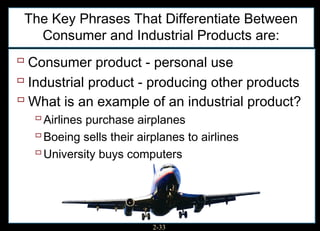
 Consumer product - personal use
 Industrial product - producing other products
 What is an example of an industrial product?
    Airlines purchase airplanes
    Boeing sells their airplanes to airlines
    University buys computers


                           2-33
What Is Another Name for an
       Industrial Product?*
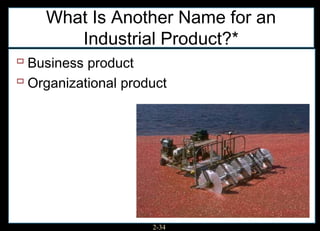
 Business product
 Organizational product


                     2-34
Price: It’s Important to Success
 Price refers to the value or worth of a product
 that attracts the buyer to exchange money or
 something of value for the product


                       2-35
Distribution Moves
         Products to Customers
 Three Customer Groups
   A household refers to a decision-making unit that
    buys for personal use
   A firm is an organization that produces goods and
    services
   A government is an organization that has two
    functions:
       The provision of goods and services to households and
       firms
      The redistribution of income and wealth

                            2-36
Consumer and Industrial Products are
  Often Distributed Through Resellers
 What are Resellers?
 Resellers, such as wholesalers or retailers,
 purchase products and then sell to
 organizations and/or individuals


                      2-37
What Is a Wholesaler? The Wholesaler
  (May Be Referred to as a Distributor)
 Primarily engaged in buying, taking title to,
 usually storing and physically handling goods
 in large quantities, and reselling the goods,
 usually in smaller quantities to
   Retailers
   Wholesalers
   Manufacturers


                       2-38
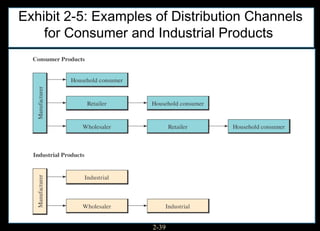
Exhibit 2-5: Examples of Distribution Channels
    for Consumer and Industrial Products


                     2-39
Promotion Tells People
 Promotion increases sales by communicating
  product information to potential customers
 The four basic components of a firm’s
  promotional effort are: (PAPS)
    Personal selling
    Advertising
    Publicity
    Sales promotion

                      2-40
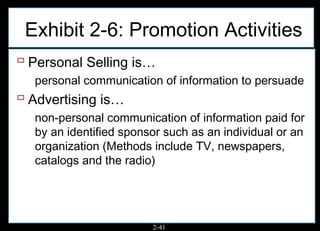
Exhibit 2-6: Promotion Activities
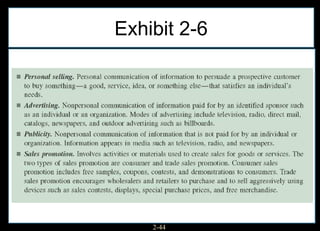
 Personal Selling is…
  personal communication of information to persuade
 Advertising is…
  non-personal communication of information paid for
  by an identified sponsor such as an individual or an
  organization (Methods include TV, newspapers,
  catalogs and the radio)


                        2-41
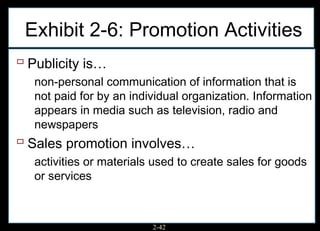
Exhibit 2-6: Promotion Activities
 Publicity is…
  non-personal communication of information that is
  not paid for by an individual organization. Information
  appears in media such as television, radio and
  newspapers
 Sales promotion involves…
  activities or materials used to create sales for goods
  or services


                         2-42
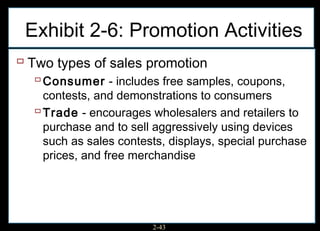
Exhibit 2-6: Promotion Activities
 Two types of sales promotion
   Consumer - includes free samples, coupons,
    contests, and demonstrations to consumers
   Trade - encourages wholesalers and retailers to
    purchase and to sell aggressively using devices
    such as sales contests, displays, special purchase
    prices, and free merchandise


                        2-43
Exhibit 2-6


    2-44
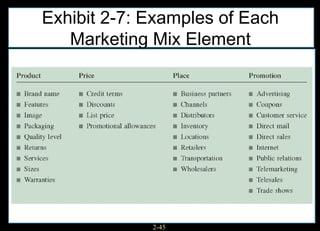
Exhibit 2-7: Examples of Each
   Marketing Mix Element


             2-45
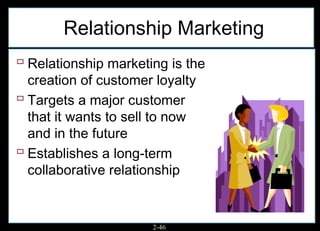
Relationship Marketing
 Relationship marketing is the
  creation of customer loyalty
 Targets a major customer
  that it wants to sell to now
  and in the future
 Establishes a long-term
  collaborative relationship


                      2-46
Relationship Marketing and
           the Sales Force
 Four basic questions used as guidelines in
 defining the role of the sales force:
  1.How much selling effort is necessary to gain and
    hold customers?
  2.Is the sales force the best marketing tool?
  3.What type of sales activity will be necessary?
  4.Can the firm gain strength relative to its
    competition with its sales force?


                        2-47
Relationship Marketing and
            the Sales Force
 Personal selling builds relationships!
 Two main functions of personal selling are to:
    Generate revenue
    Provide services to satisfy customers
 Flexible in operation
 Focused on prospective customers
 Results in actual sales

                         2-48
Relationship Marketing and
      the Sales Force


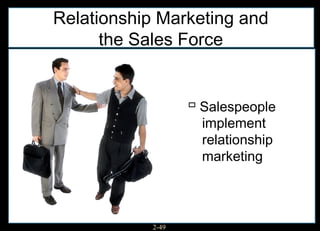
                    Salespeople
                     implement
                     relationship
                     marketing


            2-49
Summary of Relationship Marketing
     and the Sales Force
 What is the role of the sales force in the
  marketing effort?
 Personal selling builds relationships
 Salespeople implement relationship marketing


                       2-50
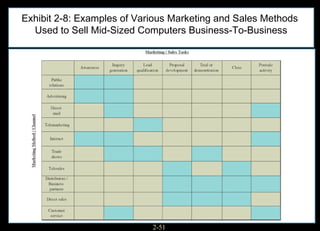
Exhibit 2-8: Examples of Various Marketing and Sales Methods
  Used to Sell Mid-Sized Computers Business-To-Business


                            2-51
Three Levels of Relationship
             Marketing
 Transaction selling
 Relationship selling
 Partnering


                         2-52
Three Levels of Relationship
             Marketing
 Transaction selling : customers are sold to
  and not contacted again
 Relationship selling : the seller contacts
  customers after the purchase to determine if
  they are satisfied and have future needs
 Partnering: the seller works continually to
  improve its customers’ operations, sales, and
  profits

                      2-53
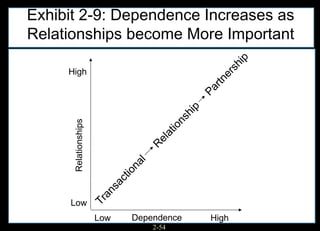
Exhibit 2-9: Dependence Increases as
Relationships become More Important


                                                                 p
                                                              hi
     High


                                                           rse
                                                         rtn
                                                      Pa
                                                  p
                                               hi
                                            ns
      Relationships


                                         io
                                       at
                                      el
                                     R
                                 l
                               na
                              io
                            ct
                          sa
                        an


     Low
                      Tr


                      Low      Dependence               High
                                     2-54
Partnering with Customers
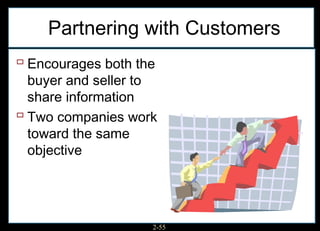
 Encourages both the
  buyer and seller to
  share information
 Two companies work
  toward the same
  objective


                    2-55
Partnering, cont…
 Components of partnering include:
   Individual excellence
   Importance
   Interdependence
   Investment
   Information
   Integration
   Institutionalization
   Integrity
                            2-56
Exhibit 2-10


     2-57
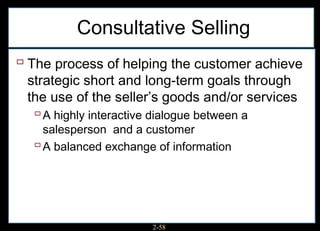
Consultative Selling
 The process of helping the customer achieve
 strategic short and long-term goals through
 the use of the seller’s goods and/or services
   A highly interactive dialogue between a
    salesperson and a customer
   A balanced exchange of information


                       2-58
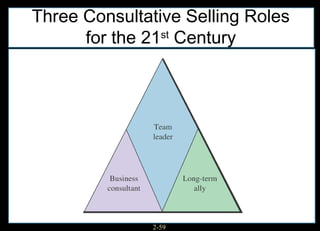
Three Consultative Selling Roles
      for the 21st Century


               2-59
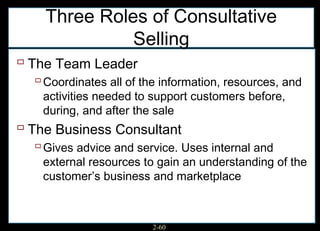
Three Roles of Consultative
              Selling
 The Team Leader
   Coordinates all of the information, resources, and
    activities needed to support customers before,
    during, and after the sale
 The Business Consultant
   Gives advice and service. Uses internal and
    external resources to gain an understanding of the
    customer’s business and marketplace


                         2-60
Three Roles of Consultative
              Selling
 The Long-Term Ally
   Creates a “win–win” situation. As the customer’s
    sales and profits grow, so do the salesperson’s
   The ability of a salesperson to fulfill the role of
    long-term ally is a pivotal factor in determining
    whether a sales transaction is just a transaction
    or the beginning of a relationship


                         2-61
The Customer-Seller Relationship
             Gap
 May occur when the salesperson’s interest in
  the customer declines
 Usually after the sale
 Yet the customer’s interest increases after
  the sale
 This is one reason why service after the
  sales is so important


                      2-62
What’s a Salesperson Worth?
 “Worth” is dependent upon at least three
  factors:
    What the salesperson costs
    How much he/she sells
    The profit margin
 Salespeople make a valuable contribution to
  the success of their employer
 Selling closes deals and generates the
  revenue to keep the organization in business
                      2-63
The Key to Success
 Knowing and satisfying target customers with
  competitively superior products and service
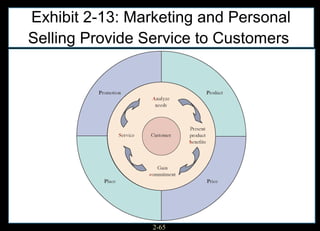
 Marketing is the company function that
  defines customer targets and the best way to
  satisfy their needs and wants competitively
  and profitably
 Marketing’s main customer contacts are
  salespeople

                     2-64
Exhibit 2-13: Marketing and Personal
Selling Provide Service to Customers


                 2-65
Summary
 Selling is only one part of the overall
  marketing activities of the firm
 Marketing is an exchange process between
  buyers and sellers
 The marketing concept is based upon a
  firm’s desire to increase sales while
  anticipating and satisfying consumer needs


                       2-66
Summary, cont…
 The marketing mix is comprised of four
  variables:
    Product
    Price
    Distribution
    Promotion
 The role of the salesperson is considered
  carefully in the firm’s determination of the
  promotional aspect of its marketing mix
                       2-67
Summary, cont…
 Consultative selling focuses on the
 salesperson’s ability to provide customer
 satisfaction by adding value to the sales
 transaction


                      2-68

sales

  • 1.
    Chapter 2 Relationship Marketing: Where Personal Selling Fits
  • 2.
  • 3.
    Main Topics  WhatIs the Purpose of Business?  What Is Marketing?  Customer Orientation’s Evolution  Marketing’s Importance in the Firm  Essentials of a Firm’s Marketing Effort  Relationship Marketing  Relationship Marketing and the Sales Force  Levels of Relationship Marketing 2-3
  • 4.
    Main Topics  Partneringwith Customers  The New Consultative Selling  E-Selling: Technology and Information Build Relationships  What’s a Salesperson Worth?  The Key to Success 2-4
  • 5.
    In Chapter 2We Will See What is Meant by the Terms...  Business  Marketing  Product, Price, Place, Promotion  Personal Selling 2-5
  • 6.
    The Purpose ofBusiness is to:  Increase the general well being of humankind through the sales of goods and services 2-6
  • 7.
    This Requires  Makinga profit in order to operate the business and to provide beneficial products to the marketplace 2-7
  • 8.
    Profit is aMeans to an End  Profit is needed to serve humankind  Profit is needed to operate the business  Profit is needed to provide products to the marketplace 2-8
  • 9.
    The Two BasicFunctions of Business  Two Basic Functions of Business  Production of goods or creating of services  Marketing those goods and services  The Primary Goal of Business  Transform marketplace and workplace into an environment where everyone is treated fairly 2-9
  • 10.
    What is Marketing? Marketing is a process of planning:  The conception, pricing, promotion, and distribution of goods, services, and ideas  To create exchanges that satisfy individual and organizational objectives 2-10
  • 11.
    Customer Orientation’s Evolution  The production concept  The selling concept  The marketing concept 2-11
  • 12.
    The Production Concept Companies were production oriented We know what people want – they want our product. 2-12
  • 13.
    The Selling Concept Characterized by product demonstrations and unsophisticated sales techniques  Emphasis on the product  Product created and then sold  Management is sales-volume oriented  Stresses needs of the seller 2-13
  • 14.
    The Marketing Concept Emphasis is on customer’s wants  Customer’s wants drive production  Management is profit-oriented  Planning is long-term  Stresses wants of buyers 2-14
  • 15.
    Exhibit 2-1: TheDifference Between Selling and Marketing Concepts 2-15
  • 16.
    Marketing’s Importance inthe Firm  Marketers have four main objectives:  Maximize the sales for existing products in existing markets  Develop and sell new products  Develop new markets for existing or new products  Provide quality service to ensure repeat business 2-16
  • 17.
    Exhibit 2-2: TheMarketing Group is the Link Between Customers and the Organization 2-17
  • 18.
    Product: It’s MoreThan You Think  A good is a physical object that can be purchased  A service is an action or activity performed for a fee  Value-added refers to benefits received that are not included in the purchase price of a good or service 2-18
  • 19.
    Exhibit 2-3: FourElements of the Marketing Mix and Four Promotion Activities 2-19
  • 20.
    Exhibit 2-4: Examplesof Business-To-Business Value- Adding  Help customer reduce process costs  Improve yields  Reduce waste (through recycling, etc.)  Reduce rework  Reduce direct labor  Reduce indirect labor (inspection, handling)  Reduce energy costs 2-20
  • 21.
    Exhibit 2-4: Examplesof Business-To-Business Value- Adding  Help customer reduce inventory  Consignment  Just-in-time delivery  Reduced cycle time 2-21
  • 22.
    Exhibit 2-4: Examplesof Business-To-Business Value- Adding  Help customer reduce administrative costs  Simplify billing  Improve tractability  Use electronic data interchange 2-22
  • 23.
    Exhibit 2-4: Examplesof Business-To-Business Value- Adding  Improve safety for customer and his employees  Reduce price to the customer  Substitute certain product components  Improve company processes and supplier processes 2-23
  • 24.
    What is Meantby the Term “Product?”  A product is a bundle of tangible and intangible attributes, including package, color, and brand, plus the services and even the reputation of the seller 2-24
  • 25.
    The Term “Product”May Refer to a Good or Service  Examples  Goods - a physical object for sale  Automobile  Cell phone  Prescription medicine  Services - an action or activity done for others for a fee  Automobile repair  Wireless phone plan  Health insurance 2-25
  • 26.
    The Good andthe Service:  Automobile - repair services  Cell phone - wireless phone plane  Prescription medicine - health insurance 2-26
  • 27.
    We Will Usethe Terms Follow-up and Service. What do They Mean?*  Follow-up refers to maintaining contact with a customer in order to evaluate the effectiveness of the product and the satisfaction of the customer (More on this in Chapter 14) 2-27
  • 28.
    The Term “Service”May Refer to A:  Product, as insurance and advertise which is sold by someone  Service, as customer service which is an activity offered by a seller in conjunction with the purchase of a product, such as delivery, repair, credit cards accepted, 800 telephone number, web site, salesperson available to help customer (More on this in Chapter 14) 2-28
  • 29.
    Customer Service bythe Salesperson Include:  Salesperson goes to customer’s business to help:  Resell products  Customer use product  Handling complaints  Return damaged products  Provide samples  Suggest further business opportunities (Above discussed in Chapter 1) 2-29
  • 30.
    People Buy MoreThan the Product  People buy want-satisfaction as  Image of owning as a  Polo shirt vs. Wal-Mart shirt  Dodge Viper* vs. Volkswagen Vanagon*  What the product will do  Its quality *products and associated images used for illustrative purposes only 2-30
  • 31.
    There Are TwoGeneral Types of Products - Consumer and Industrial Products  What is a consumer product?  A consumer product is produced for, and purchased by, households or end consumers for their personal use  What is an example of a consumer product?  Toothpaste  Television  Clothes 2-31
  • 32.
    There Are TwoGeneral Types of Products- Consumer and Industrial Products Cont…  What is industrial product?  An industrial product is sold primarily for use in producing other products. Industrial users are profit nonprofit organizations that buy good and services for one of three purposes* 1.To make other goods and services 2.To sell to consumer or other industrial users 3.To conduct the organization’s operations* 2-32
  • 33.
    The Key PhrasesThat Differentiate Between Consumer and Industrial Products are:  Consumer product - personal use  Industrial product - producing other products  What is an example of an industrial product?  Airlines purchase airplanes  Boeing sells their airplanes to airlines  University buys computers 2-33
  • 34.
    What Is AnotherName for an Industrial Product?*  Business product  Organizational product 2-34
  • 35.
    Price: It’s Importantto Success  Price refers to the value or worth of a product that attracts the buyer to exchange money or something of value for the product 2-35
  • 36.
    Distribution Moves Products to Customers  Three Customer Groups  A household refers to a decision-making unit that buys for personal use  A firm is an organization that produces goods and services  A government is an organization that has two functions:  The provision of goods and services to households and firms  The redistribution of income and wealth 2-36
  • 37.
    Consumer and IndustrialProducts are Often Distributed Through Resellers  What are Resellers?  Resellers, such as wholesalers or retailers, purchase products and then sell to organizations and/or individuals 2-37
  • 38.
    What Is aWholesaler? The Wholesaler (May Be Referred to as a Distributor)  Primarily engaged in buying, taking title to, usually storing and physically handling goods in large quantities, and reselling the goods, usually in smaller quantities to  Retailers  Wholesalers  Manufacturers 2-38
  • 39.
    Exhibit 2-5: Examplesof Distribution Channels for Consumer and Industrial Products 2-39
  • 40.
    Promotion Tells People Promotion increases sales by communicating product information to potential customers  The four basic components of a firm’s promotional effort are: (PAPS)  Personal selling  Advertising  Publicity  Sales promotion 2-40
  • 41.
    Exhibit 2-6: PromotionActivities  Personal Selling is… personal communication of information to persuade  Advertising is… non-personal communication of information paid for by an identified sponsor such as an individual or an organization (Methods include TV, newspapers, catalogs and the radio) 2-41
  • 42.
    Exhibit 2-6: PromotionActivities  Publicity is… non-personal communication of information that is not paid for by an individual organization. Information appears in media such as television, radio and newspapers  Sales promotion involves… activities or materials used to create sales for goods or services 2-42
  • 43.
    Exhibit 2-6: PromotionActivities  Two types of sales promotion  Consumer - includes free samples, coupons, contests, and demonstrations to consumers  Trade - encourages wholesalers and retailers to purchase and to sell aggressively using devices such as sales contests, displays, special purchase prices, and free merchandise 2-43
  • 44.
  • 45.
    Exhibit 2-7: Examplesof Each Marketing Mix Element 2-45
  • 46.
    Relationship Marketing  Relationshipmarketing is the creation of customer loyalty  Targets a major customer that it wants to sell to now and in the future  Establishes a long-term collaborative relationship 2-46
  • 47.
    Relationship Marketing and the Sales Force  Four basic questions used as guidelines in defining the role of the sales force: 1.How much selling effort is necessary to gain and hold customers? 2.Is the sales force the best marketing tool? 3.What type of sales activity will be necessary? 4.Can the firm gain strength relative to its competition with its sales force? 2-47
  • 48.
    Relationship Marketing and the Sales Force  Personal selling builds relationships!  Two main functions of personal selling are to:  Generate revenue  Provide services to satisfy customers  Flexible in operation  Focused on prospective customers  Results in actual sales 2-48
  • 49.
    Relationship Marketing and the Sales Force  Salespeople implement relationship marketing 2-49
  • 50.
    Summary of RelationshipMarketing and the Sales Force  What is the role of the sales force in the marketing effort?  Personal selling builds relationships  Salespeople implement relationship marketing 2-50
  • 51.
    Exhibit 2-8: Examplesof Various Marketing and Sales Methods Used to Sell Mid-Sized Computers Business-To-Business 2-51
  • 52.
    Three Levels ofRelationship Marketing  Transaction selling  Relationship selling  Partnering 2-52
  • 53.
    Three Levels ofRelationship Marketing  Transaction selling : customers are sold to and not contacted again  Relationship selling : the seller contacts customers after the purchase to determine if they are satisfied and have future needs  Partnering: the seller works continually to improve its customers’ operations, sales, and profits 2-53
  • 54.
    Exhibit 2-9: DependenceIncreases as Relationships become More Important p hi High rse rtn Pa p hi ns Relationships io at el R l na io ct sa an Low Tr Low Dependence High 2-54
  • 55.
    Partnering with Customers Encourages both the buyer and seller to share information  Two companies work toward the same objective 2-55
  • 56.
    Partnering, cont…  Componentsof partnering include:  Individual excellence  Importance  Interdependence  Investment  Information  Integration  Institutionalization  Integrity 2-56
  • 57.
  • 58.
    Consultative Selling  Theprocess of helping the customer achieve strategic short and long-term goals through the use of the seller’s goods and/or services  A highly interactive dialogue between a salesperson and a customer  A balanced exchange of information 2-58
  • 59.
    Three Consultative SellingRoles for the 21st Century 2-59
  • 60.
    Three Roles ofConsultative Selling  The Team Leader  Coordinates all of the information, resources, and activities needed to support customers before, during, and after the sale  The Business Consultant  Gives advice and service. Uses internal and external resources to gain an understanding of the customer’s business and marketplace 2-60
  • 61.
    Three Roles ofConsultative Selling  The Long-Term Ally  Creates a “win–win” situation. As the customer’s sales and profits grow, so do the salesperson’s  The ability of a salesperson to fulfill the role of long-term ally is a pivotal factor in determining whether a sales transaction is just a transaction or the beginning of a relationship 2-61
  • 62.
    The Customer-Seller Relationship Gap  May occur when the salesperson’s interest in the customer declines  Usually after the sale  Yet the customer’s interest increases after the sale  This is one reason why service after the sales is so important 2-62
  • 63.
    What’s a SalespersonWorth?  “Worth” is dependent upon at least three factors:  What the salesperson costs  How much he/she sells  The profit margin  Salespeople make a valuable contribution to the success of their employer  Selling closes deals and generates the revenue to keep the organization in business 2-63
  • 64.
    The Key toSuccess  Knowing and satisfying target customers with competitively superior products and service  Marketing is the company function that defines customer targets and the best way to satisfy their needs and wants competitively and profitably  Marketing’s main customer contacts are salespeople 2-64
  • 65.
    Exhibit 2-13: Marketingand Personal Selling Provide Service to Customers 2-65
  • 66.
    Summary  Selling isonly one part of the overall marketing activities of the firm  Marketing is an exchange process between buyers and sellers  The marketing concept is based upon a firm’s desire to increase sales while anticipating and satisfying consumer needs 2-66
  • 67.
    Summary, cont…  Themarketing mix is comprised of four variables:  Product  Price  Distribution  Promotion  The role of the salesperson is considered carefully in the firm’s determination of the promotional aspect of its marketing mix 2-67
  • 68.
    Summary, cont…  Consultativeselling focuses on the salesperson’s ability to provide customer satisfaction by adding value to the sales transaction 2-68