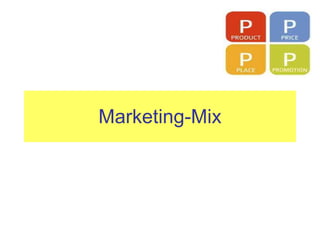
Marketing-Mix
Marketing mix refers to the primary elements that must be attended to in order to properly market a product or service.  Marketing mix is the combination four elements:  Product, Place, Price and Promotion.  They are called the “ Four Ps  of the marketing mix”. Marketing Mix is a term describing the key elements used by an organization to help meet its marketing objectives
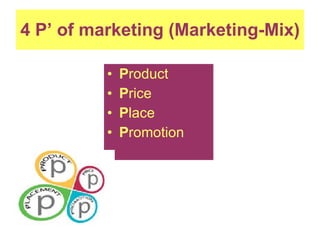
4 P’ of marketing (Marketing-Mix) P roduct P rice P lace P romotion
The  product   has to have the right features – e.g. it should look good and work well. The  price  should be right.  The goods must be in the right  place   at the right time. Making sure that the goods arrive when and where they are wanted is an important operation. The target group needs to be made aware of the existence and availability of the product through  promotion . Successful promotion helps a firm to spread costs over a larger output. To create the right marketing mix, businesses have to meet the following conditions:
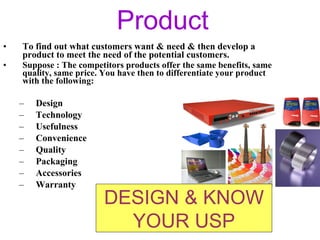
Product To find out what customers want & need & then develop a product to meet the need of the potential customers. Suppose : The competitors products offer the same benefits, same quality, same price. You have then to differentiate your product with the following: Design Technology Usefulness Convenience  Quality Packaging Accessories Warranty DESIGN & KNOW YOUR USP
U nique  S elling  P oint DESIGN & KNOW YOUR USP
The value of goods and services  expressed  in terms of money , we  called as   PRICE. It is the value which a firm receiving in result of exchange goods and services to consumers. There are different types of pricing strategy is existing. A firm normally choose four types of  pricing that are:-  Premium price skimmed price penetrating price competitive price, Price
Premium Pricing. Use of high pricing  where there is a  uniqueness about the product or service . This approach is used where a a substantial competitive advantage exists. Such high prices are charge for luxuries such as Cruises, Luxury Hotel rooms, Designer products. Penetration Pricing. It is the strategy of  entering the market  with a  low initial price  to  capture greater market share. Price Skimming .  The practice of ‘price skimming’ involves charging a  relatively high price for a short time where a new, innovative, or much-improved product is launched into a market .The prices are set high in order to attract least price sensitive customers to generate high profits. Competitive pricing :  If your product is sold at the  lowest price regarding all your competitors,  you are practicing competitive pricing. Sometimes, competitive pricing is essential. For instance, when the products are basically the same, this strategy will usually succeed.
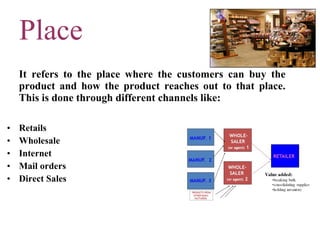
Place It refers to the place where the customers can buy the product and how the product reaches out to that place. This is done through different channels like: Retails Wholesale Internet Mail orders Direct Sales
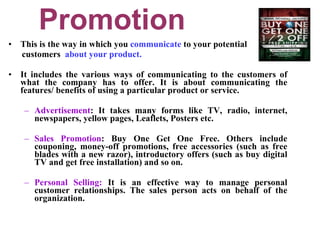
Promotion This is the way in which you  communicate  to your potential  customers  about your product. It includes the various ways of communicating to the customers of what the company has to offer. It is about communicating the features/ benefits of using a particular product or service. Advertisement : It takes many forms like TV, radio, internet, newspapers, yellow pages, Leaflets, Posters etc. Sales Promotion : Buy One Get One Free. Others include couponing, money-off promotions, free accessories (such as free blades with a new razor), introductory offers (such as buy digital TV and get free installation) and so on.  Personal Selling:  It is an effective way to manage personal customer relationships. The sales person acts on behalf of the organization.
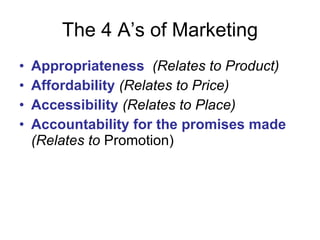
The 4 A’s of Marketing Appropriateness  (Relates to Product) Affordability   (Relates to Price) Accessibility   (Relates to Place) Accountability for the promises made   (Relates to  Promotion)
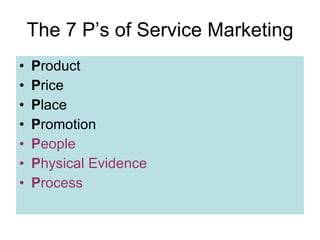
The 7 P’s of Service Marketing P roduct P rice P lace P romotion P eople P hysical Evidence P rocess
Service-Mix : 4 + 3 Extra P’s P roduct P rice P lace P romotion P eople P hysical Evidence P rocess Charu Bharti Asst. Professor APIM
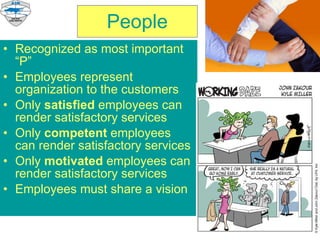
People Recognized as most important “P” Employees represent organization to the customers Only  satisfied  employees can render satisfactory services Only  competent  employees can render satisfactory services Only  motivated  employees can render satisfactory services Employees must share a vision Charu Bharti Asst. Professor APIM
Physical Evidence A physical object is tangible, possess search qualities and is self-defining Unfortunately, Services are not… So a Corporate identity need to be created Architecture Aroma Area Aesthetics Charu Bharti Asst. Professor APIM
Process Process of creating and delivering the service How easily the service is accessible? How fast the service is created? Where the service is delivered? Whether the service is customized? What is the role of customer in service production? What is the level of complexity in creating the service? Charu Bharti Asst. Professor APIM
Queries???
 

Marketing mix

  • 1.
  • 2.
    Marketing mix refersto the primary elements that must be attended to in order to properly market a product or service. Marketing mix is the combination four elements: Product, Place, Price and Promotion. They are called the “ Four Ps of the marketing mix”. Marketing Mix is a term describing the key elements used by an organization to help meet its marketing objectives
  • 3.
    4 P’ ofmarketing (Marketing-Mix) P roduct P rice P lace P romotion
  • 4.
    The product has to have the right features – e.g. it should look good and work well. The price should be right. The goods must be in the right place at the right time. Making sure that the goods arrive when and where they are wanted is an important operation. The target group needs to be made aware of the existence and availability of the product through promotion . Successful promotion helps a firm to spread costs over a larger output. To create the right marketing mix, businesses have to meet the following conditions:
  • 5.
    Product To findout what customers want & need & then develop a product to meet the need of the potential customers. Suppose : The competitors products offer the same benefits, same quality, same price. You have then to differentiate your product with the following: Design Technology Usefulness Convenience Quality Packaging Accessories Warranty DESIGN & KNOW YOUR USP
  • 6.
    U nique S elling P oint DESIGN & KNOW YOUR USP
  • 7.
    The value ofgoods and services expressed in terms of money , we called as PRICE. It is the value which a firm receiving in result of exchange goods and services to consumers. There are different types of pricing strategy is existing. A firm normally choose four types of pricing that are:- Premium price skimmed price penetrating price competitive price, Price
  • 8.
    Premium Pricing. Useof high pricing where there is a uniqueness about the product or service . This approach is used where a a substantial competitive advantage exists. Such high prices are charge for luxuries such as Cruises, Luxury Hotel rooms, Designer products. Penetration Pricing. It is the strategy of entering the market with a low initial price to capture greater market share. Price Skimming . The practice of ‘price skimming’ involves charging a relatively high price for a short time where a new, innovative, or much-improved product is launched into a market .The prices are set high in order to attract least price sensitive customers to generate high profits. Competitive pricing : If your product is sold at the lowest price regarding all your competitors, you are practicing competitive pricing. Sometimes, competitive pricing is essential. For instance, when the products are basically the same, this strategy will usually succeed.
  • 9.
    Place It refersto the place where the customers can buy the product and how the product reaches out to that place. This is done through different channels like: Retails Wholesale Internet Mail orders Direct Sales
  • 10.
    Promotion This isthe way in which you communicate to your potential customers about your product. It includes the various ways of communicating to the customers of what the company has to offer. It is about communicating the features/ benefits of using a particular product or service. Advertisement : It takes many forms like TV, radio, internet, newspapers, yellow pages, Leaflets, Posters etc. Sales Promotion : Buy One Get One Free. Others include couponing, money-off promotions, free accessories (such as free blades with a new razor), introductory offers (such as buy digital TV and get free installation) and so on. Personal Selling: It is an effective way to manage personal customer relationships. The sales person acts on behalf of the organization.
  • 11.
    The 4 A’sof Marketing Appropriateness (Relates to Product) Affordability (Relates to Price) Accessibility (Relates to Place) Accountability for the promises made (Relates to Promotion)
  • 12.
    The 7 P’sof Service Marketing P roduct P rice P lace P romotion P eople P hysical Evidence P rocess
  • 13.
    Service-Mix : 4+ 3 Extra P’s P roduct P rice P lace P romotion P eople P hysical Evidence P rocess Charu Bharti Asst. Professor APIM
  • 14.
    People Recognized asmost important “P” Employees represent organization to the customers Only satisfied employees can render satisfactory services Only competent employees can render satisfactory services Only motivated employees can render satisfactory services Employees must share a vision Charu Bharti Asst. Professor APIM
  • 15.
    Physical Evidence Aphysical object is tangible, possess search qualities and is self-defining Unfortunately, Services are not… So a Corporate identity need to be created Architecture Aroma Area Aesthetics Charu Bharti Asst. Professor APIM
  • 16.
    Process Process ofcreating and delivering the service How easily the service is accessible? How fast the service is created? Where the service is delivered? Whether the service is customized? What is the role of customer in service production? What is the level of complexity in creating the service? Charu Bharti Asst. Professor APIM
  • 17.
  • 18.