COMPETITION ACT, 2002
PRESENTED BY:
BABITA
KHANDWAL
M.COM 3rd
Sem
TRINITY COLLEGE
OUTLINE
Introduction
Types of Competition
Ways of Competition
Benefits of Competition
Competition act
Objective of Act
Competition Authority
Dimensions of act
Amendments of act
Challenges of India
Conclusion
– The process of rivalry between firms striving to gain sales and
make profits
– Motive: self-interest, but outcome mostly beneficial for the
society
– Competition is not just an event, but a process
– It is not automatic – needs to be nurtured
TYPES OF
COMPETITION
 Price Competition: Winning customers by lowering price
 Non-price Competition: Winning customers by advertising,
offering after-sales-services, using sale promotion tools, etc.
WAYS OF
COMPETITION
 Fair Competition: Fair means such as producing quality goods,
becoming cost-efficient, optimizing the use of resources, best
technology, research & Development, etc.
 Unfair Competition: Unfair means such as fixing price with the
rivals, predatory pricing, disparaging or misleading advertisements,
etc.
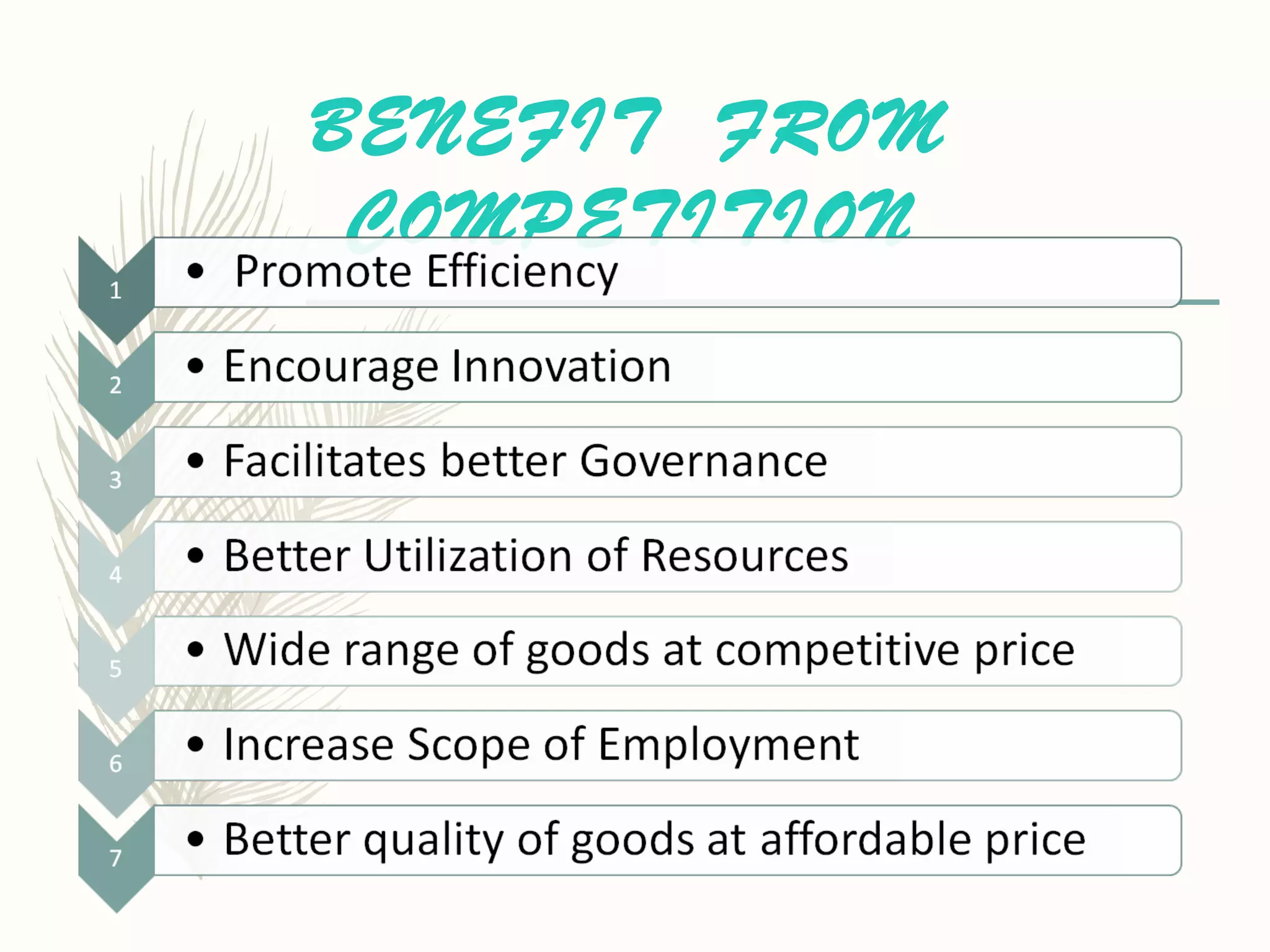
BENEFIT FROM
COMPETITION
COMPETITION ACT
 It extends to the whole of India except the State of
Jammu and Kashmir.
 An Act to provide, keeping in view of the economic development of
the country, for the establishment of a Commission to prevent
practices having adverse effect on competition, to promote and sustain
competition in markets, to protect the interests of consumers and to
ensure freedom of trade carried on by other participants in markets, in
India, and for matters connected therewith or incidental thereto.
SCHEME OF THE
ACTThe Scheme of the Act has been split into 9 chapters indicated hereunder:
• Chapter I - preliminary provisions viz. Short title, extent and Definition clauses;
• Chapter II -substantive laws i.e. Anti Competitive Agreements, Abuse of Dominance and Regulation of
Combinations;
• Chapter III - provisions relating to Establishment of Commission, Composition of Commission, Selection of
Committee for Chairperson and other Members, Term of Office of Chairperson etc.
• Chapter IV - Duties, Powers and Functions of the Commission;
• Chapter V - for the Duties of Director General;
• Chapter VI - Penalties for Contravention of Orders of Commission, Failure to Comply with Directions of
Commission and Director-General, Making False Statement or Omission to Furnish Material Information
etc;
• Chapter VII - Competition Advocacy;
• Chapter VIII - provisions relating to Finance, Accounts and Audit,
• Chapter VIII A - provisions relating to “Competition Appellate Tribunal” [inserted by the Competition
(Amendment) Act, 2007] and
• Chapter IX - Miscellaneous provisions.
OBJECTIVES OF ACT
 Competition act, 2002 notified in Jan, 2003. Stated objective in
preamble is to provide ‘for establishment of commission.’
 To prevent practices having adverse effect on competition .
 To promote & sustain competition in market.
 To protect the interest of the consumers.
 To ensure freedom of trade caries on by other participants in
markets, in India.
COMPETITION
AUTHORITY
 Two tier agency created as per the provisions of the
Competition Act, 2002
– Competition Commission of India (CCI)
– Competition Appellate Tribunal (COMPAT)
 CCI assisted by the Director General
 COMPAT hears appeals and can also provide
compensation
 Ultimate appeal at the Supreme Court
COMPETITION COMMISSION OF
INDIA
Competition Commission of India is a body of the Government
of India responsible for enforcing The Competition Act, 2002
throughout India and to prevent activities that have an
adverse effect on competition in India. It was established on 14
October, 2003.
OTHER FUNCTIONS OF
CCI
 Perform the function of competition advocacy effectively and
promote competition culture
E.g. RBI favoring public sector banks
 Cooperation with other regulatory agencies
E.g. With sector regulators on competition issues
 Cooperation with other competition agencies
E.g. With competition agencies abroad
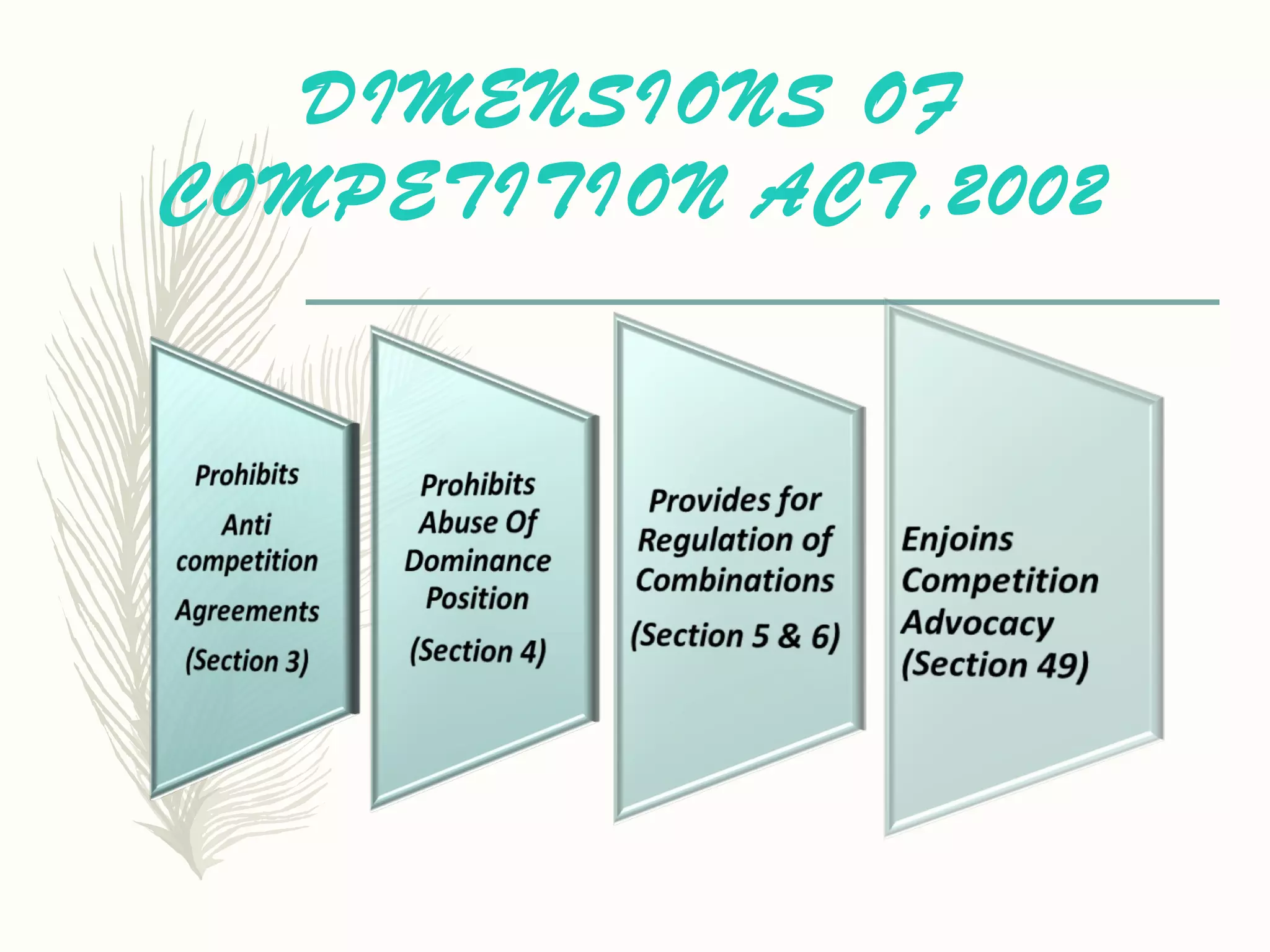
DIMENSIONS OF
COMPETITION ACT,2002
ANTI COMPETITION AGREEMENT
SECTION 3
ANTI COMPETITION AGREEMENT
SECTION 3
 Agreements in which two or more companies operating
together in the same market make an agreement to do
something together.
 They mainly involves fix prices or limit production which has the
result of reducing the competition on that particular market.
 They negatively impact the process of Competition in the
market.
 Thus any agreement between the organisation which doesn’t
allow to flourish the competition in market are considered to be
anti competitive in nature.
PROHIBITION OF ABUSE OF
DOMINANT POSITION
16
PROHIBITION OF Abuse of dominant
position (section 4)
 Section 4 of the competition act prohibits any enterprise or group from
abusing its dominant position
 Section 4 of the competition act concludes 'Dominant Position' as a position
which includes a position of strength, enjoyed by an enterprise or group, in
relevant market
 Which enable the organisation :
• Operate independently of competition forces prevailing in
the relevant market
• Affect its competitors or consumers or the relevant market
in its own favour.
• Indulges in such activity which only favours dominant
organisation in market
PROVIDES FOR REGULATION OF
COMBINATIONS
18
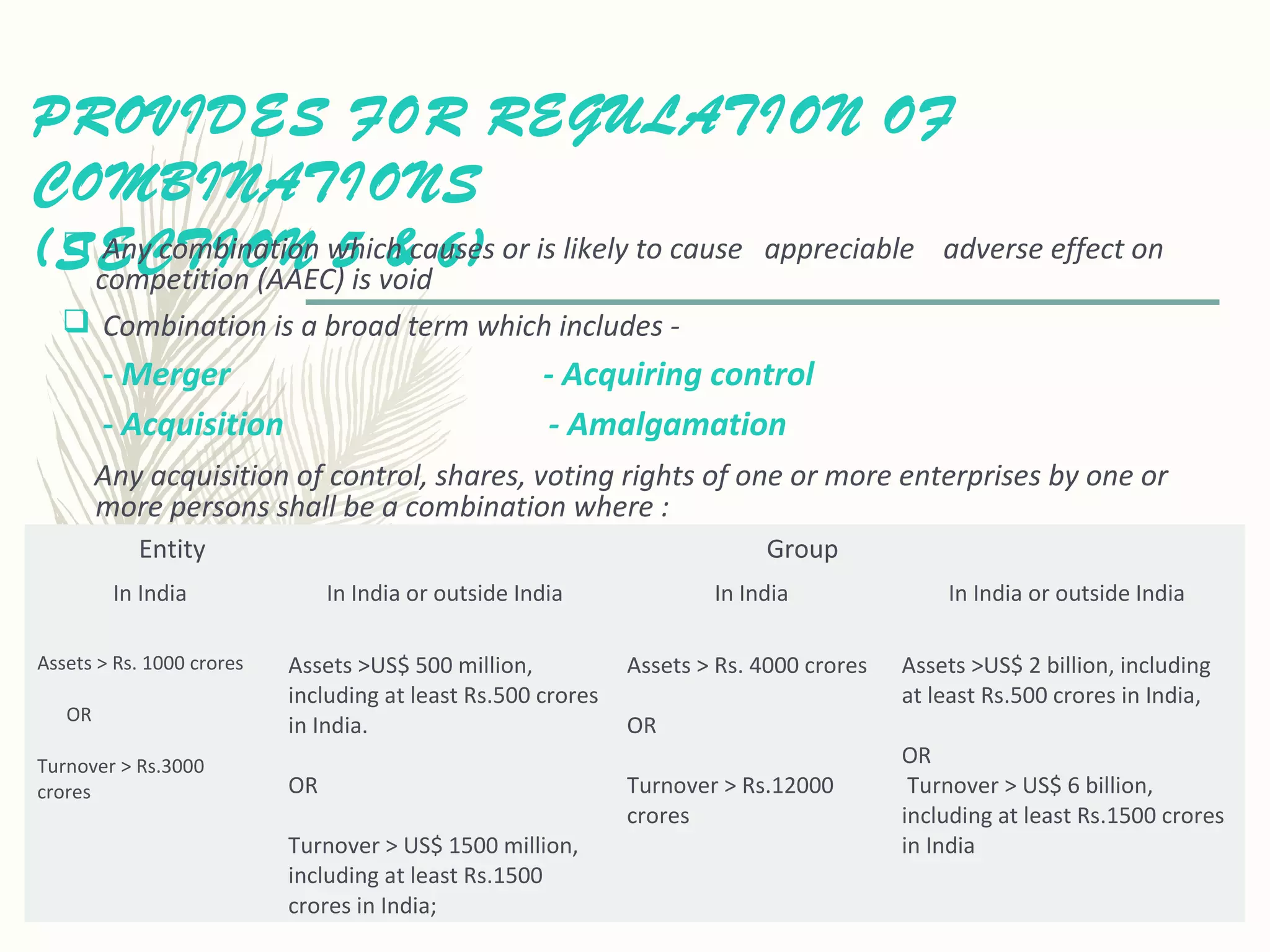
PROVIDES FOR REGULATION OF
COMBINATIONS
(SECTION 5 & 6) Any combination which causes or is likely to cause appreciable adverse effect on
competition (AAEC) is void
 Combination is a broad term which includes -
- Merger - Acquiring control
- Acquisition - Amalgamation
Any acquisition of control, shares, voting rights of one or more enterprises by one or
more persons shall be a combination where :
Entity Group
In India In India or outside India In India In India or outside India
Assets > Rs. 1000 crores
OR
Turnover > Rs.3000
crores
Assets >US$ 500 million,
including at least Rs.500 crores
in India.
OR
Turnover > US$ 1500 million,
including at least Rs.1500
crores in India;
Assets > Rs. 4000 crores
OR
Turnover > Rs.12000
crores
Assets >US$ 2 billion, including
at least Rs.500 crores in India,
OR
Turnover > US$ 6 billion,
including at least Rs.1500 crores
in India
COMPETITION ADVOCACY
(SEC 49) A commonly accepted definition of competition advocacy is that it includes all activities of
a competition agency that are intended to promote competition apart from those that
involve enforcement of the competition law.
Benefits of healthy competition advocacy can be viewed in terms of the following:
• CCI develop relationship with the Ministries and Departments of
the Government
• CCI encourage debate on competition and promote a better and
more informed economic decision making
• Competition advocacy to be open and transparent to safeguard
the integrity and capability of the CCI
• Competition advocacy enhanced by the CCI establishing good
media relations and explaining the role and importance of
Competition Policy / Law as an integral part of the
Government’s economic framework.
CONTD…..
 Advocacy means compensation promotion through non-
enforcement measures.
 For promotion competition of competition advocacy and
creation of awareness about compensation issues, the
commission may:-
i) Undertake appropriate programs/activities etc.
ii) Encourage and interact with the organization of stakeholders,
academic community etc. to undertake activities, programs,
studies, research work, etc. on competition issues;
AMENDMENTS IN THE
COMPETITION ACT, 2002
 The Competition Act, 2002 after its enactment has been amended with a view to
fine tune the provisions of the Act and to meet the present day needs in the field
of competition, in light of the experiences gained in the actual working of the
Competition Commission of India over the last few years.
• The Competition (Amendment) Bill, 2006
• The Competition (Amendment) Bill, 2007
• The Competition (Amendment) Bill, 2009
• The Competition (Amendment) Bill, 2012
CHALLENGES FOR
INDIA Absence of competition culture
 Lack of competent and experienced staff
 Government support is not always assured
 Vested interests (political-economy aspects)
 Lack of clarity on overlap between the competition
authority and sector regulators
 Role of consumers/civil society
 Weakness in dissemination/communication
CONCLUSIONS
 Competition enforcement leads to consumer welfare
directly and indirectly
 Stakeholders need to recognize their role in promoting
competition
 Policymakers/Government need to priorities competition
reforms
 CCI to remain independent
 CCI to create a public buy in
 Consumer movement: natural allies of a competition
regime
26

Competition act 2002

  • 1.
    COMPETITION ACT, 2002 PRESENTEDBY: BABITA KHANDWAL M.COM 3rd Sem TRINITY COLLEGE
  • 2.
    OUTLINE Introduction Types of Competition Waysof Competition Benefits of Competition Competition act Objective of Act Competition Authority Dimensions of act Amendments of act Challenges of India Conclusion
  • 3.
    – The processof rivalry between firms striving to gain sales and make profits – Motive: self-interest, but outcome mostly beneficial for the society – Competition is not just an event, but a process – It is not automatic – needs to be nurtured
  • 4.
    TYPES OF COMPETITION  PriceCompetition: Winning customers by lowering price  Non-price Competition: Winning customers by advertising, offering after-sales-services, using sale promotion tools, etc.
  • 5.
    WAYS OF COMPETITION  FairCompetition: Fair means such as producing quality goods, becoming cost-efficient, optimizing the use of resources, best technology, research & Development, etc.  Unfair Competition: Unfair means such as fixing price with the rivals, predatory pricing, disparaging or misleading advertisements, etc.
  • 6.
  • 7.
    COMPETITION ACT  Itextends to the whole of India except the State of Jammu and Kashmir.  An Act to provide, keeping in view of the economic development of the country, for the establishment of a Commission to prevent practices having adverse effect on competition, to promote and sustain competition in markets, to protect the interests of consumers and to ensure freedom of trade carried on by other participants in markets, in India, and for matters connected therewith or incidental thereto.
  • 8.
    SCHEME OF THE ACTTheScheme of the Act has been split into 9 chapters indicated hereunder: • Chapter I - preliminary provisions viz. Short title, extent and Definition clauses; • Chapter II -substantive laws i.e. Anti Competitive Agreements, Abuse of Dominance and Regulation of Combinations; • Chapter III - provisions relating to Establishment of Commission, Composition of Commission, Selection of Committee for Chairperson and other Members, Term of Office of Chairperson etc. • Chapter IV - Duties, Powers and Functions of the Commission; • Chapter V - for the Duties of Director General; • Chapter VI - Penalties for Contravention of Orders of Commission, Failure to Comply with Directions of Commission and Director-General, Making False Statement or Omission to Furnish Material Information etc; • Chapter VII - Competition Advocacy; • Chapter VIII - provisions relating to Finance, Accounts and Audit, • Chapter VIII A - provisions relating to “Competition Appellate Tribunal” [inserted by the Competition (Amendment) Act, 2007] and • Chapter IX - Miscellaneous provisions.
  • 9.
    OBJECTIVES OF ACT Competition act, 2002 notified in Jan, 2003. Stated objective in preamble is to provide ‘for establishment of commission.’  To prevent practices having adverse effect on competition .  To promote & sustain competition in market.  To protect the interest of the consumers.  To ensure freedom of trade caries on by other participants in markets, in India.
  • 10.
    COMPETITION AUTHORITY  Two tieragency created as per the provisions of the Competition Act, 2002 – Competition Commission of India (CCI) – Competition Appellate Tribunal (COMPAT)  CCI assisted by the Director General  COMPAT hears appeals and can also provide compensation  Ultimate appeal at the Supreme Court
  • 11.
    COMPETITION COMMISSION OF INDIA CompetitionCommission of India is a body of the Government of India responsible for enforcing The Competition Act, 2002 throughout India and to prevent activities that have an adverse effect on competition in India. It was established on 14 October, 2003.
  • 12.
    OTHER FUNCTIONS OF CCI Perform the function of competition advocacy effectively and promote competition culture E.g. RBI favoring public sector banks  Cooperation with other regulatory agencies E.g. With sector regulators on competition issues  Cooperation with other competition agencies E.g. With competition agencies abroad
  • 13.
  • 14.
  • 15.
    ANTI COMPETITION AGREEMENT SECTION3  Agreements in which two or more companies operating together in the same market make an agreement to do something together.  They mainly involves fix prices or limit production which has the result of reducing the competition on that particular market.  They negatively impact the process of Competition in the market.  Thus any agreement between the organisation which doesn’t allow to flourish the competition in market are considered to be anti competitive in nature.
  • 16.
    PROHIBITION OF ABUSEOF DOMINANT POSITION 16
  • 17.
    PROHIBITION OF Abuseof dominant position (section 4)  Section 4 of the competition act prohibits any enterprise or group from abusing its dominant position  Section 4 of the competition act concludes 'Dominant Position' as a position which includes a position of strength, enjoyed by an enterprise or group, in relevant market  Which enable the organisation : • Operate independently of competition forces prevailing in the relevant market • Affect its competitors or consumers or the relevant market in its own favour. • Indulges in such activity which only favours dominant organisation in market
  • 18.
    PROVIDES FOR REGULATIONOF COMBINATIONS 18
  • 19.
    PROVIDES FOR REGULATIONOF COMBINATIONS (SECTION 5 & 6) Any combination which causes or is likely to cause appreciable adverse effect on competition (AAEC) is void  Combination is a broad term which includes - - Merger - Acquiring control - Acquisition - Amalgamation Any acquisition of control, shares, voting rights of one or more enterprises by one or more persons shall be a combination where : Entity Group In India In India or outside India In India In India or outside India Assets > Rs. 1000 crores OR Turnover > Rs.3000 crores Assets >US$ 500 million, including at least Rs.500 crores in India. OR Turnover > US$ 1500 million, including at least Rs.1500 crores in India; Assets > Rs. 4000 crores OR Turnover > Rs.12000 crores Assets >US$ 2 billion, including at least Rs.500 crores in India, OR Turnover > US$ 6 billion, including at least Rs.1500 crores in India
  • 20.
  • 21.
    COMPETITION ADVOCACY (SEC 49)A commonly accepted definition of competition advocacy is that it includes all activities of a competition agency that are intended to promote competition apart from those that involve enforcement of the competition law. Benefits of healthy competition advocacy can be viewed in terms of the following: • CCI develop relationship with the Ministries and Departments of the Government • CCI encourage debate on competition and promote a better and more informed economic decision making • Competition advocacy to be open and transparent to safeguard the integrity and capability of the CCI • Competition advocacy enhanced by the CCI establishing good media relations and explaining the role and importance of Competition Policy / Law as an integral part of the Government’s economic framework.
  • 22.
    CONTD…..  Advocacy meanscompensation promotion through non- enforcement measures.  For promotion competition of competition advocacy and creation of awareness about compensation issues, the commission may:- i) Undertake appropriate programs/activities etc. ii) Encourage and interact with the organization of stakeholders, academic community etc. to undertake activities, programs, studies, research work, etc. on competition issues;
  • 23.
    AMENDMENTS IN THE COMPETITIONACT, 2002  The Competition Act, 2002 after its enactment has been amended with a view to fine tune the provisions of the Act and to meet the present day needs in the field of competition, in light of the experiences gained in the actual working of the Competition Commission of India over the last few years. • The Competition (Amendment) Bill, 2006 • The Competition (Amendment) Bill, 2007 • The Competition (Amendment) Bill, 2009 • The Competition (Amendment) Bill, 2012
  • 24.
    CHALLENGES FOR INDIA Absenceof competition culture  Lack of competent and experienced staff  Government support is not always assured  Vested interests (political-economy aspects)  Lack of clarity on overlap between the competition authority and sector regulators  Role of consumers/civil society  Weakness in dissemination/communication
  • 25.
    CONCLUSIONS  Competition enforcementleads to consumer welfare directly and indirectly  Stakeholders need to recognize their role in promoting competition  Policymakers/Government need to priorities competition reforms  CCI to remain independent  CCI to create a public buy in  Consumer movement: natural allies of a competition regime
  • 26.