A Unified Approach for Representing Metametadata


                  A Unified Approach for
                Representing Metametadata


                                   Kai Eckert
                             University of Mannheim


                                  Dublin Core 2009
                                 Seoul, South Korea
                                  October 14th 2009


Kai Eckert       Dublin Core 2009, Seoul, South Korea, October 14th 2009   1/22
A Unified Approach for Representing Metametadata


                                       People               Hel
                                                                lo   , my
                                                                            nam

                                                             Kai
                                                                               e is
     Kai Eckert
     Mannheim University
     kai@informatik.uni-mannheim.de


     Magnus Pfeffer
     Mannheim University Library
     pfeffer@bib.uni-mannheim.de


     Heiner Stuckenschmidt
     Mannheim University
     heiner@informatik.uni-mannheim.de


Kai Eckert         Dublin Core 2009, Seoul, South Korea, October 14th 2009            2/22
A Unified Approach for Representing Metametadata


              What is this presentation about?


  ●
      Proposal for „statements about statements“ or
      „metametadata“ or „provenance on statement
      level“.
  ●
      That was done before!
  ●
      Implementation of metametadata by means of RDF
      Reification.
  ●
      That was done before! (That's what Reification was
      made for.)


Kai Eckert       Dublin Core 2009, Seoul, South Korea, October 14th 2009   3/22
A Unified Approach for Representing Metametadata


                              Anything new?


  ●
      Practical examples based on two scenarios and
      several use-cases.
  ●
      Both scenarios show (again) the need for
      metametadata.
  ●
      Easy implementation based on RDF and SPARQL.
  ●
      Standardization?


Kai Eckert       Dublin Core 2009, Seoul, South Korea, October 14th 2009   4/22
A Unified Approach for Representing Metametadata


                                   RDF Reification
   ●
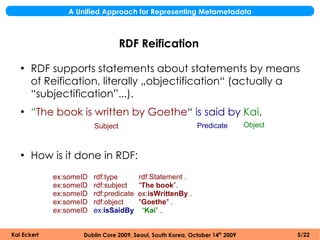
       RDF supports statements about statements by means
       of Reification, literally „objectification“ (actually a
       “subjectification”...).
   ●
       “The book is written by Goethe“ is said by Kai.
                         Subject                             Predicate         Object


   ●
       How is it done in RDF:
             ex:someID   rdf:type        rdf:Statement .
             ex:someID   rdf:subject     “The book”.
             ex:someID   rdf:predicate   ex:isWrittenBy .
             ex:someID   rdf:object      "Goethe" .
             ex:someID   ex:isSaidBy      “Kai” .


Kai Eckert           Dublin Core 2009, Seoul, South Korea, October 14th 2009            5/22
A Unified Approach for Representing Metametadata


                           Simplified Presentation

  ●
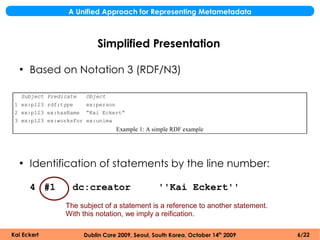
      Based on Notation 3 (RDF/N3)

   Subject Predicate   Object
 1 ex:p123 rdf:type    ex:person
 2 ex:p123 ex:hasName “Kai Eckert”
 3 ex:p123 ex:worksFor ex:unima
                                  Example 1: A simple RDF example


  ●
      Identification of statements by the line number:

      4 #1        dc:creator                     ''Kai Eckert''
                The subject of a statement is a reference to another statement.
                With this notation, we imply a reification.

Kai Eckert             Dublin Core 2009, Seoul, South Korea, October 14th 2009    6/22
A Unified Approach for Representing Metametadata


                         Need for Metametadata


  ●
      Metadata are also data, so we need additional data
      about them.         Metametadata
  ●
      Metadata about a whole metadata record, not for
      single statements:
             –   Who created this metadata record?
             –   When was this record created?
             –   …
  ●
      This exists:                         Metadata Provenance


Kai Eckert            Dublin Core 2009, Seoul, South Korea, October 14th 2009   7/22
A Unified Approach for Representing Metametadata


             Statements about (single) statements


  ●
      Often proposed, but only vague instructions how to
      implement it.
  ●
      Needed, if metadata records are created by the
      combination of single statements from different
      sources.
  ●
      Needed for the storage of arbitrary additional
      information for single statements, that can not be
      represented in the metadata format easily.


Kai Eckert        Dublin Core 2009, Seoul, South Korea, October 14th 2009   8/22
A Unified Approach for Representing Metametadata


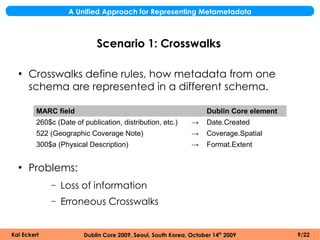
                             Scenario 1: Crosswalks

  ●
      Crosswalks define rules, how metadata from one
      schema are represented in a different schema.

         MARC field                                                 Dublin Core element
         260$c (Date of publication, distribution, etc.)      →     Date.Created
         522 (Geographic Coverage Note)                       →     Coverage.Spatial
         300$a (Physical Description)                         →     Format.Extent


  ●
      Problems:
              –   Loss of information
              –   Erroneous Crosswalks


Kai Eckert              Dublin Core 2009, Seoul, South Korea, October 14th 2009           9/22
A Unified Approach for Representing Metametadata


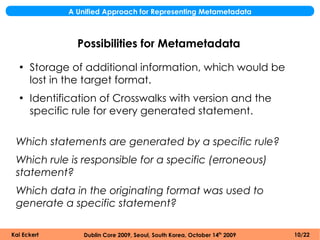
               Possibilities for Metametadata
  ●
      Storage of additional information, which would be
      lost in the target format.
  ●
      Identification of Crosswalks with version and the
      specific rule for every generated statement.

 Which statements are generated by a specific rule?
 Which rule is responsible for a specific (erroneous)
 statement?
 Which data in the originating format was used to
 generate a specific statement?

Kai Eckert       Dublin Core 2009, Seoul, South Korea, October 14th 2009   10/22
A Unified Approach for Representing Metametadata


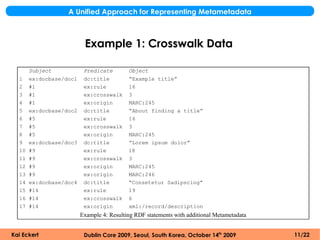
                          Example 1: Crosswalk Data

       Subject            Predicate        Object
  1    ex:docbase/doc1    dc:title         “Example title”
  2    #1                 ex:rule          16
  3    #1                 ex:crosswalk     3
  4    #1                 ex:origin        MARC:245
  5    ex:docbase/doc2    dc:title         “About finding a title”
  6    #5                 ex:rule          16
  7    #5                 ex:crosswalk     3
  8    #5                 ex:origin        MARC:245
  9    ex:docbase/doc3    dc:title         “Lorem ipsum dolor”
  10   #9                 ex:rule          18
  11   #9                 ex:crosswalk     3
  12   #9                 ex:origin        MARC:245
  13   #9                 ex:origin        MARC:246
  14   ex:docbase/doc4    dc:title         “Consetetur Sadipscing”
  15   #14                ex:rule          19
  16   #14                ex:crosswalk     6
  17   #14                ex:origin        xml:/record/description
                         Example 4: Resulting RDF statements with additional Metametadata


Kai Eckert                Dublin Core 2009, Seoul, South Korea, October 14th 2009           11/22
A Unified Approach for Representing Metametadata


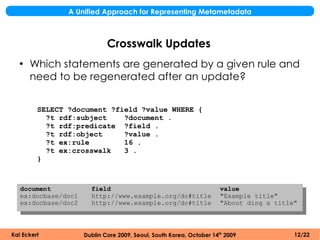
                             Crosswalk Updates
  ●
      Which statements are generated by a given rule and
      need to be regenerated after an update?


         SELECT ?document ?field ?value WHERE {
           ?t rdf:subject    ?document .
           ?t rdf:predicate ?field .
           ?t rdf:object     ?value .
           ?t ex:rule        16 .
           ?t ex:crosswalk   3 .
         }


   document            field                                          value
   ex:docbase/doc1     http://www.example.org/dc#title                "Example title"
   ex:docbase/doc2     http://www.example.org/dc#title                "About ding a title"


Kai Eckert           Dublin Core 2009, Seoul, South Korea, October 14th 2009             12/22
A Unified Approach for Representing Metametadata


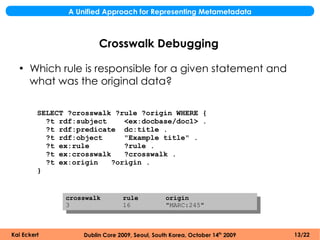
                         Crosswalk Debugging
  ●
      Which rule is responsible for a given statement and
      what was the original data?

         SELECT ?crosswalk ?rule ?origin WHERE {
           ?t rdf:subject     <ex:docbase/doc1> .
           ?t rdf:predicate dc:title .
           ?t rdf:object      "Example title" .
           ?t ex:rule         ?rule .
           ?t ex:crosswalk    ?crosswalk .
           ?t ex:origin    ?origin .
         }


               crosswalk          rule           origin
               3                  16             "MARC:245"


Kai Eckert          Dublin Core 2009, Seoul, South Korea, October 14th 2009   13/22
A Unified Approach for Representing Metametadata


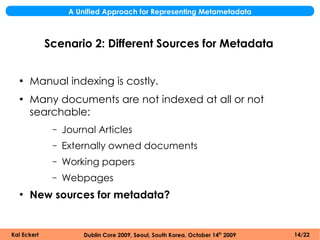
             Scenario 2: Different Sources for Metadata


  ●
      Manual indexing is costly.
  ●
      Many documents are not indexed at all or not
      searchable:
              –   Journal Articles
              –   Externally owned documents
              –   Working papers
              –   Webpages
  ●
      New sources for metadata?


Kai Eckert             Dublin Core 2009, Seoul, South Korea, October 14th 2009   14/22
A Unified Approach for Representing Metametadata


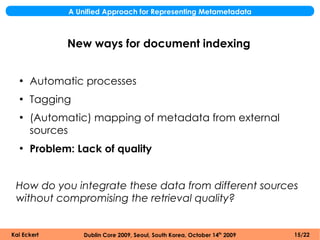
             New ways for document indexing


  ●
      Automatic processes
  ●
      Tagging
  ●
      (Automatic) mapping of metadata from external
      sources
  ●
      Problem: Lack of quality


 How do you integrate these data from different sources
 without compromising the retrieval quality?


Kai Eckert       Dublin Core 2009, Seoul, South Korea, October 14th 2009   15/22
A Unified Approach for Representing Metametadata


                    Possibilities for Metametadata

  ●
      Storage of the source of single statements.
  ●
      Storage of further source-specific information:
             –   Weighting for automatically generated subject
                  headings.
             –   Number of users who tagged a document with a
                  given tag.
             –   The original subject heading in case of an
                   automatic translation or mapping.

 Can we use these additional information to improve
 document retrieval?
Kai Eckert            Dublin Core 2009, Seoul, South Korea, October 14th 2009   16/22
A Unified Approach for Representing Metametadata


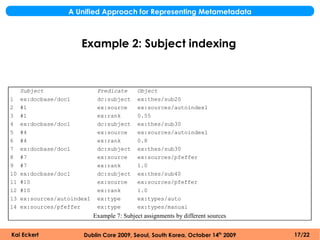
                       Example 2: Subject indexing


     Subject                  Predicate      Object
1    ex:docbase/doc1          dc:subject     ex:thes/sub20
2    #1                       ex:source      ex:sources/autoindex1
3    #1                       ex:rank        0.55
4    ex:docbase/doc1          dc:subject     ex:thes/sub30
5    #4                       ex:source      ex:sources/autoindex1
6    #4                       ex:rank        0.8
7    ex:docbase/doc1          dc:subject     ex:thes/sub30
8    #7                       ex:source      ex:sources/pfeffer
9    #7                       ex:rank        1.0
10   ex:docbase/doc1          dc:subject     ex:thes/sub40
11   #10                      ex:source      ex:sources/pfeffer
12   #10                      ex:rank        1.0
13   ex:sources/autoindex1    ex:type        ex:types/auto
14   ex:sources/pfeffer       ex:type        ex:types/manual
                             Example 7: Subject assignments by different sources


Kai Eckert              Dublin Core 2009, Seoul, South Korea, October 14th 2009    17/22
A Unified Approach for Representing Metametadata


                    Backward compatibility

  ●
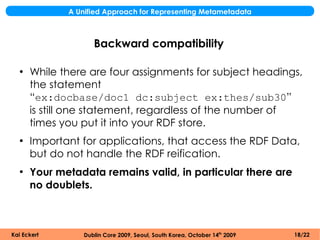
      While there are four assignments for subject headings,
      the statement
      “ex:docbase/doc1 dc:subject ex:thes/sub30”
      is still one statement, regardless of the number of
      times you put it into your RDF store.
  ●
      Important for applications, that access the RDF Data,
      but do not handle the RDF reification.
  ●
      Your metadata remains valid, in particular there are
      no doublets.


Kai Eckert       Dublin Core 2009, Seoul, South Korea, October 14th 2009   18/22
A Unified Approach for Representing Metametadata


                       Separating the sources

  ●
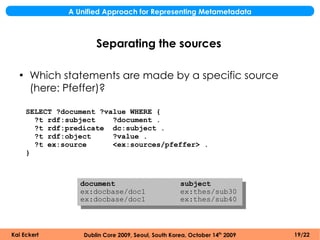
      Which statements are made by a specific source
      (here: Pfeffer)?

      SELECT ?document ?value WHERE {
        ?t rdf:subject    ?document .
        ?t rdf:predicate dc:subject .
        ?t rdf:object     ?value .
        ?t ex:source      <ex:sources/pfeffer> .
      }


                  document                           subject
                  ex:docbase/doc1                    ex:thes/sub30
                  ex:docbase/doc1                    ex:thes/sub40


Kai Eckert         Dublin Core 2009, Seoul, South Korea, October 14th 2009   19/22
A Unified Approach for Representing Metametadata


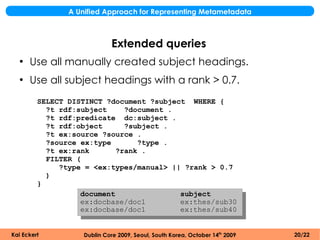
                             Extended queries
  ●
      Use all manually created subject headings.
  ●
      Use all subject headings with a rank > 0.7.
         SELECT DISTINCT ?document ?subject WHERE {
           ?t rdf:subject     ?document .
           ?t rdf:predicate dc:subject .
           ?t rdf:object      ?subject .
           ?t ex:source ?source .
           ?source ex:type       ?type .
           ?t ex:rank       ?rank .
           FILTER (
              ?type = <ex:types/manual> || ?rank > 0.7
           )
         }
                   document               subject
                   ex:docbase/doc1        ex:thes/sub30
                   ex:docbase/doc1        ex:thes/sub40


Kai Eckert          Dublin Core 2009, Seoul, South Korea, October 14th 2009   20/22
A Unified Approach for Representing Metametadata


                                 Conclusion


  ●
      Many applications of metametadata in the library
      fields can be realized with RDF Reification.
  ●
      No need for the reinvention of the wheel, based on
      existing standards and recommendations.
  ●
      With SPARQL and SeRQL you can access and make
      use of the additional information.
  ●
      Lot of mature products - developed by the semantic
      web community or commercial ones.


Kai Eckert       Dublin Core 2009, Seoul, South Korea, October 14th 2009   21/22
A Unified Approach for Representing Metametadata


                                Standardization?
  ●
      Would be great for generally accepted use-cases.
  ●
      What are “generally accepted use-cases”?
  ●
      Metametadata we used so far:
             –   A rank for subject headings
             –   Qualifications for sources (automatic, manual,
                  expert, layman, …)
             –   Link to further information about a specific indexing
                   process
             –   Link to original data source
             –   Debugging information

Kai Eckert            Dublin Core 2009, Seoul, South Korea, October 14th 2009   22/22

A Unified Approach for Representing Metametadata

  • 1.
    A Unified Approachfor Representing Metametadata A Unified Approach for Representing Metametadata Kai Eckert University of Mannheim Dublin Core 2009 Seoul, South Korea October 14th 2009 Kai Eckert Dublin Core 2009, Seoul, South Korea, October 14th 2009 1/22
  • 2.
    A Unified Approachfor Representing Metametadata People Hel lo , my nam Kai e is Kai Eckert Mannheim University kai@informatik.uni-mannheim.de Magnus Pfeffer Mannheim University Library pfeffer@bib.uni-mannheim.de Heiner Stuckenschmidt Mannheim University heiner@informatik.uni-mannheim.de Kai Eckert Dublin Core 2009, Seoul, South Korea, October 14th 2009 2/22
  • 3.
    A Unified Approachfor Representing Metametadata What is this presentation about? ● Proposal for „statements about statements“ or „metametadata“ or „provenance on statement level“. ● That was done before! ● Implementation of metametadata by means of RDF Reification. ● That was done before! (That's what Reification was made for.) Kai Eckert Dublin Core 2009, Seoul, South Korea, October 14th 2009 3/22
  • 4.
    A Unified Approachfor Representing Metametadata Anything new? ● Practical examples based on two scenarios and several use-cases. ● Both scenarios show (again) the need for metametadata. ● Easy implementation based on RDF and SPARQL. ● Standardization? Kai Eckert Dublin Core 2009, Seoul, South Korea, October 14th 2009 4/22
  • 5.
    A Unified Approachfor Representing Metametadata RDF Reification ● RDF supports statements about statements by means of Reification, literally „objectification“ (actually a “subjectification”...). ● “The book is written by Goethe“ is said by Kai. Subject Predicate Object ● How is it done in RDF: ex:someID rdf:type rdf:Statement . ex:someID rdf:subject “The book”. ex:someID rdf:predicate ex:isWrittenBy . ex:someID rdf:object "Goethe" . ex:someID ex:isSaidBy “Kai” . Kai Eckert Dublin Core 2009, Seoul, South Korea, October 14th 2009 5/22
  • 6.
    A Unified Approachfor Representing Metametadata Simplified Presentation ● Based on Notation 3 (RDF/N3) Subject Predicate Object 1 ex:p123 rdf:type ex:person 2 ex:p123 ex:hasName “Kai Eckert” 3 ex:p123 ex:worksFor ex:unima Example 1: A simple RDF example ● Identification of statements by the line number: 4 #1 dc:creator ''Kai Eckert'' The subject of a statement is a reference to another statement. With this notation, we imply a reification. Kai Eckert Dublin Core 2009, Seoul, South Korea, October 14th 2009 6/22
  • 7.
    A Unified Approachfor Representing Metametadata Need for Metametadata ● Metadata are also data, so we need additional data about them. Metametadata ● Metadata about a whole metadata record, not for single statements: – Who created this metadata record? – When was this record created? – … ● This exists: Metadata Provenance Kai Eckert Dublin Core 2009, Seoul, South Korea, October 14th 2009 7/22
  • 8.
    A Unified Approachfor Representing Metametadata Statements about (single) statements ● Often proposed, but only vague instructions how to implement it. ● Needed, if metadata records are created by the combination of single statements from different sources. ● Needed for the storage of arbitrary additional information for single statements, that can not be represented in the metadata format easily. Kai Eckert Dublin Core 2009, Seoul, South Korea, October 14th 2009 8/22
  • 9.
    A Unified Approachfor Representing Metametadata Scenario 1: Crosswalks ● Crosswalks define rules, how metadata from one schema are represented in a different schema. MARC field Dublin Core element 260$c (Date of publication, distribution, etc.) → Date.Created 522 (Geographic Coverage Note) → Coverage.Spatial 300$a (Physical Description) → Format.Extent ● Problems: – Loss of information – Erroneous Crosswalks Kai Eckert Dublin Core 2009, Seoul, South Korea, October 14th 2009 9/22
  • 10.
    A Unified Approachfor Representing Metametadata Possibilities for Metametadata ● Storage of additional information, which would be lost in the target format. ● Identification of Crosswalks with version and the specific rule for every generated statement. Which statements are generated by a specific rule? Which rule is responsible for a specific (erroneous) statement? Which data in the originating format was used to generate a specific statement? Kai Eckert Dublin Core 2009, Seoul, South Korea, October 14th 2009 10/22
  • 11.
    A Unified Approachfor Representing Metametadata Example 1: Crosswalk Data Subject Predicate Object 1 ex:docbase/doc1 dc:title “Example title” 2 #1 ex:rule 16 3 #1 ex:crosswalk 3 4 #1 ex:origin MARC:245 5 ex:docbase/doc2 dc:title “About finding a title” 6 #5 ex:rule 16 7 #5 ex:crosswalk 3 8 #5 ex:origin MARC:245 9 ex:docbase/doc3 dc:title “Lorem ipsum dolor” 10 #9 ex:rule 18 11 #9 ex:crosswalk 3 12 #9 ex:origin MARC:245 13 #9 ex:origin MARC:246 14 ex:docbase/doc4 dc:title “Consetetur Sadipscing” 15 #14 ex:rule 19 16 #14 ex:crosswalk 6 17 #14 ex:origin xml:/record/description Example 4: Resulting RDF statements with additional Metametadata Kai Eckert Dublin Core 2009, Seoul, South Korea, October 14th 2009 11/22
  • 12.
    A Unified Approachfor Representing Metametadata Crosswalk Updates ● Which statements are generated by a given rule and need to be regenerated after an update? SELECT ?document ?field ?value WHERE { ?t rdf:subject ?document . ?t rdf:predicate ?field . ?t rdf:object ?value . ?t ex:rule 16 . ?t ex:crosswalk 3 . } document field value ex:docbase/doc1 http://www.example.org/dc#title "Example title" ex:docbase/doc2 http://www.example.org/dc#title "About ding a title" Kai Eckert Dublin Core 2009, Seoul, South Korea, October 14th 2009 12/22
  • 13.
    A Unified Approachfor Representing Metametadata Crosswalk Debugging ● Which rule is responsible for a given statement and what was the original data? SELECT ?crosswalk ?rule ?origin WHERE { ?t rdf:subject <ex:docbase/doc1> . ?t rdf:predicate dc:title . ?t rdf:object "Example title" . ?t ex:rule ?rule . ?t ex:crosswalk ?crosswalk . ?t ex:origin ?origin . } crosswalk rule origin 3 16 "MARC:245" Kai Eckert Dublin Core 2009, Seoul, South Korea, October 14th 2009 13/22
  • 14.
    A Unified Approachfor Representing Metametadata Scenario 2: Different Sources for Metadata ● Manual indexing is costly. ● Many documents are not indexed at all or not searchable: – Journal Articles – Externally owned documents – Working papers – Webpages ● New sources for metadata? Kai Eckert Dublin Core 2009, Seoul, South Korea, October 14th 2009 14/22
  • 15.
    A Unified Approachfor Representing Metametadata New ways for document indexing ● Automatic processes ● Tagging ● (Automatic) mapping of metadata from external sources ● Problem: Lack of quality How do you integrate these data from different sources without compromising the retrieval quality? Kai Eckert Dublin Core 2009, Seoul, South Korea, October 14th 2009 15/22
  • 16.
    A Unified Approachfor Representing Metametadata Possibilities for Metametadata ● Storage of the source of single statements. ● Storage of further source-specific information: – Weighting for automatically generated subject headings. – Number of users who tagged a document with a given tag. – The original subject heading in case of an automatic translation or mapping. Can we use these additional information to improve document retrieval? Kai Eckert Dublin Core 2009, Seoul, South Korea, October 14th 2009 16/22
  • 17.
    A Unified Approachfor Representing Metametadata Example 2: Subject indexing Subject Predicate Object 1 ex:docbase/doc1 dc:subject ex:thes/sub20 2 #1 ex:source ex:sources/autoindex1 3 #1 ex:rank 0.55 4 ex:docbase/doc1 dc:subject ex:thes/sub30 5 #4 ex:source ex:sources/autoindex1 6 #4 ex:rank 0.8 7 ex:docbase/doc1 dc:subject ex:thes/sub30 8 #7 ex:source ex:sources/pfeffer 9 #7 ex:rank 1.0 10 ex:docbase/doc1 dc:subject ex:thes/sub40 11 #10 ex:source ex:sources/pfeffer 12 #10 ex:rank 1.0 13 ex:sources/autoindex1 ex:type ex:types/auto 14 ex:sources/pfeffer ex:type ex:types/manual Example 7: Subject assignments by different sources Kai Eckert Dublin Core 2009, Seoul, South Korea, October 14th 2009 17/22
  • 18.
    A Unified Approachfor Representing Metametadata Backward compatibility ● While there are four assignments for subject headings, the statement “ex:docbase/doc1 dc:subject ex:thes/sub30” is still one statement, regardless of the number of times you put it into your RDF store. ● Important for applications, that access the RDF Data, but do not handle the RDF reification. ● Your metadata remains valid, in particular there are no doublets. Kai Eckert Dublin Core 2009, Seoul, South Korea, October 14th 2009 18/22
  • 19.
    A Unified Approachfor Representing Metametadata Separating the sources ● Which statements are made by a specific source (here: Pfeffer)? SELECT ?document ?value WHERE { ?t rdf:subject ?document . ?t rdf:predicate dc:subject . ?t rdf:object ?value . ?t ex:source <ex:sources/pfeffer> . } document subject ex:docbase/doc1 ex:thes/sub30 ex:docbase/doc1 ex:thes/sub40 Kai Eckert Dublin Core 2009, Seoul, South Korea, October 14th 2009 19/22
  • 20.
    A Unified Approachfor Representing Metametadata Extended queries ● Use all manually created subject headings. ● Use all subject headings with a rank > 0.7. SELECT DISTINCT ?document ?subject WHERE { ?t rdf:subject ?document . ?t rdf:predicate dc:subject . ?t rdf:object ?subject . ?t ex:source ?source . ?source ex:type ?type . ?t ex:rank ?rank . FILTER ( ?type = <ex:types/manual> || ?rank > 0.7 ) } document subject ex:docbase/doc1 ex:thes/sub30 ex:docbase/doc1 ex:thes/sub40 Kai Eckert Dublin Core 2009, Seoul, South Korea, October 14th 2009 20/22
  • 21.
    A Unified Approachfor Representing Metametadata Conclusion ● Many applications of metametadata in the library fields can be realized with RDF Reification. ● No need for the reinvention of the wheel, based on existing standards and recommendations. ● With SPARQL and SeRQL you can access and make use of the additional information. ● Lot of mature products - developed by the semantic web community or commercial ones. Kai Eckert Dublin Core 2009, Seoul, South Korea, October 14th 2009 21/22
  • 22.
    A Unified Approachfor Representing Metametadata Standardization? ● Would be great for generally accepted use-cases. ● What are “generally accepted use-cases”? ● Metametadata we used so far: – A rank for subject headings – Qualifications for sources (automatic, manual, expert, layman, …) – Link to further information about a specific indexing process – Link to original data source – Debugging information Kai Eckert Dublin Core 2009, Seoul, South Korea, October 14th 2009 22/22