'Dublin Core:
            What is left to do?'


      (old questions / new answers)


                             Dan Brickley <danbri@danbri.org>


Wednesday, September 5, 12
Preview
                   •         Dublin Core 'Ancient History'

                         •     DC's two personalities: 'Framework' & 'Element Set'

                         •     Myth: DC was almost completed in the 1st Workshop in '95

                         •     Myth: Dublin Core 'vs' the commercial/industry Web

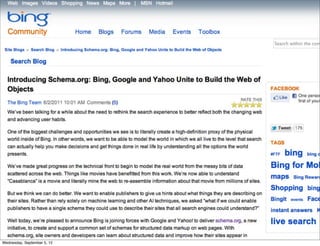
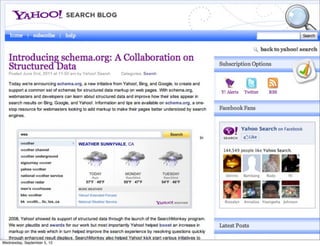
                   •         Schema.org and the 'commercial Web'

                   •         Linked Data, the Semantic Web and Libraries

                   •         Putting it all together: new challenges for DCMI


Wednesday, September 5, 12
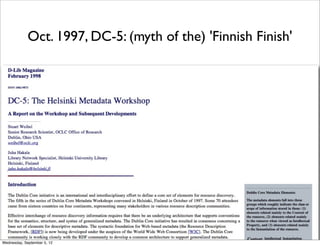
Oct. 1997, DC-5: (myth of the) 'Finnish Finish'


Wednesday, September 5, 12
Dublin Core in the '90s
                • Buzzing with the energy of the early Web community
                • A community with 1000 opinions
                • A community improving a 'product', the Dublin Core
                • A community who didn't realiseproduct community
                  mattered much more than their
                                                  that the


                • ...that the Dublin Core is a journey not a destination


Wednesday, September 5, 12
Dublin Core in 2012
              •      Custodian of the "Dublin Core" terms, a.k.a. elements

              •      Earliest, most famous & most used non-W3C RDF schema

              •      Early customer for W3C RDF, Linked Data, Semantic
                     Web, and contributor to RDF, RDFa, SKOS, Linked
                     Library Data, ...

              •      Less a product, and more a 'community crossroads'

              •      A critical link from digital libraries, cultural heritage and
                     professional metadata world to more global industry
                     initiatives around structured Web data.


Wednesday, September 5, 12
DC, RDF & the
                        Warwick Framework
                   •         From 1996, two important strands of thought in DC:

                         •     1) Defining simple, widely useful semantics for terms

                         •     2) Packaging mechanisms for mixing metadata

                   •         The first gave us the 'Famous Fifteen' - the element set.

                   •         The second fed requirements and contributors into W3C's
                             early RDF work.


Wednesday, September 5, 12
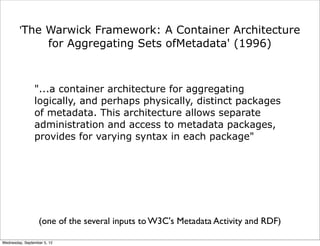
'The Warwick Framework: A Container Architecture
             for Aggregating Sets ofMetadata' (1996)


                "...a container architecture for aggregating
                logically, and perhaps physically, distinct packages
                of metadata. This architecture allows separate
                administration and access to metadata packages,
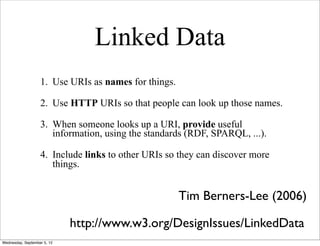
                provides for varying syntax in each package"


                  (one of the several inputs to W3C's Metadata Activity and RDF)

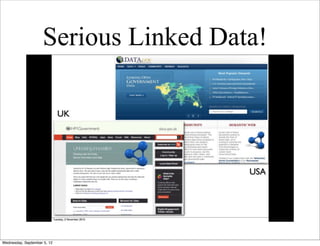
Wednesday, September 5, 12
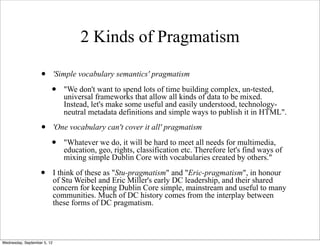
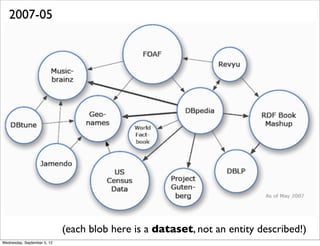
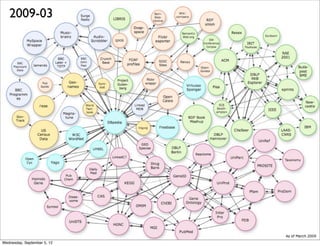
2 Kinds of Pragmatism

                   •         'Simple vocabulary semantics' pragmatism

                         •      "We don't want to spend lots of time building complex, un-tested,
                                universal frameworks that allow all kinds of data to be mixed.
                                Instead, let's make some useful and easily understood, technology-
                                neutral metadata definitions and simple ways to publish it in HTML".

                   •         'One vocabulary can't cover it all' pragmatism

                         •      "Whatever we do, it will be hard to meet all needs for multimedia,
                                education, geo, rights, classification etc. Therefore let's find ways of
                                mixing simple Dublin Core with vocabularies created by others."

                   •         I think of these as "Stu-pragmatism" and "Eric-pragmatism", in honour
                             of Stu Weibel and Eric Miller's early DC leadership, and their shared
                             concern for keeping Dublin Core simple, mainstream and useful to many
                             communities. Much of DC history comes from the interplay between
                             these forms of DC pragmatism.


Wednesday, September 5, 12
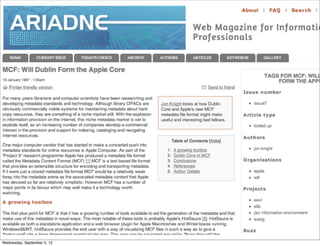
Oct 1997: World Wide Web Consortium Publishes Public Draft
                             of Resource Description Framework (RDF)
                             Key Industry Players Collaborate to Develop Interoperable Metadata for the Web


     CAMBRIDGE, MASS., USA -- October 3, 1997 -- The World Wide Web Consortium
     (W3C) today announced the first public draft of a work-in-progress of the Resource
     Description Framework (RDF), providing interoperability between applications that
     exchange machine-understandable information on the Web. "The development of RDF
     illustrates the power of the collaborative process within W3C Working Groups" said Ralph
     Swick, W3C Metadata Project Manager. "Beginning with a functional requirement from an
     end-user Member, the RDF Working Group brought together additional Members to work to
     achieve a solution of which everyone can be proud." The W3C RDF Working Group has key
     industry players including DVL, Grif, IBM, KnowledgeCite, LANL, Microsoft, Netscape,
     Nokia, OCLC, Reuters, SoftQuad and University of Michigan.
     The RDF Working Group is one of the earliest phases of a major effort by the Consortium to
     build a vendor-neutral and operating system- independent system of metadata. The
     collaborative design effort on RDF originated as an extension on the PICS content
     description technology, and draws upon the XML design as well as recent W3C Submissions
     by Microsoft [XML Web Collections] and Netscape [XML/MCF]. In addition, documents
     such as Microsoft's XML-Data and Site Map proposals, and the Dublin Core/Warwick
     Framework have also influenced the RDF design.

Wednesday, September 5, 12
That was then...


Wednesday, September 5, 12
This is now.


Wednesday, September 5, 12
And where are we now?
                   •         15, 16, ... 17 years later...?

                   •         Is Dublin Core still a bridge between mainstream Web
                             structured data standards and the world of professional
                             bibliographic metadata, digital libraries and MARC
                             cataloguing?

                   •         What else has changed?

                   •         Are we done yet?


Wednesday, September 5, 12
Myth of the 'Finnish Finish'
                   •         The Myth that we were almost finished in October 1997

                   •         The real work was just beginning -

                         •      learning from deployment experience

                         •      talking with nearby communities - education, multimedia,
                                rights, classification, thesauri, ...

                         •      supporting W3C's RDF, RDFa, SKOS work

                         •      joining a growing 'open data' movement, of which Linked
                                Data is a part, working alongside Open Access / Open
                                Archives, E-Govt transparency, Open Source, Creative
                                Commons, etc.


Wednesday, September 5, 12
Today's Landscape
                   •         I want to talk about two things (chosen from many...)

                         •     Schema.org from Google, Bing, Yahoo, Yandex

                               •   (this is my day job...)

                         •     Linked Data


Wednesday, September 5, 12
Schema.org


                               A quick look.


Wednesday, September 5, 12
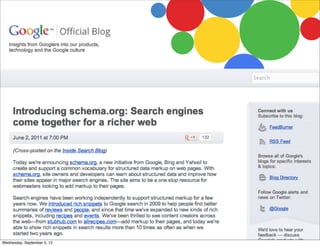
Schema.org
                   • Search engine collaboration:
                    • Google, Bing, Yahoo! & Yandex
                   • Simple factual data for better search
                   • Launched June 2011, schema.org schema
                    • 300 classes, 261 properties & growing
                    • discussions: W3C WebSchemas group
Wednesday, September 5, 12
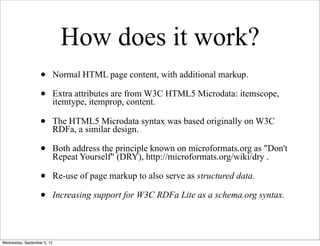
How does it work?
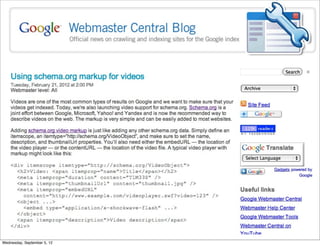
                   •         Normal HTML page content, with additional markup.

                   •         Extra attributes are from W3C HTML5 Microdata: itemscope,
                             itemtype, itemprop, content.

                   •         The HTML5 Microdata syntax was based originally on W3C
                             RDFa, a similar design.

                   •         Both address the principle known on microformats.org as "Don't
                             Repeat Yourself" (DRY), http://microformats.org/wiki/dry .

                   •         Re-use of page markup to also serve as structured data.

                   •         Increasing support for W3C RDFa Lite as a schema.org syntax.


Wednesday, September 5, 12
For example?


Wednesday, September 5, 12
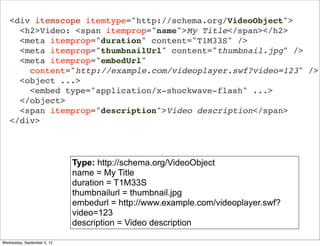
<div itemscope itemtype="http://schema.org/VideoObject">
     <h2>Video: <span itemprop="name">My Title</span></h2>
     <meta itemprop="duration" content="T1M33S" />
     <meta itemprop="thumbnailUrl" content="thumbnail.jpg" />
     <meta itemprop="embedUrl"
       content="http://example.com/videoplayer.swf?video=123" />
     <object ...>
       <embed type="application/x-shockwave-flash" ...>
     </object>
     <span itemprop="description">Video description</span>
   </div>


                             Type: http://schema.org/VideoObject
                             name = My Title
                             duration = T1M33S
                             thumbnailurl = thumbnail.jpg
                             embedurl = http://www.example.com/videoplayer.swf?
                             video=123
                             description = Video description

Wednesday, September 5, 12
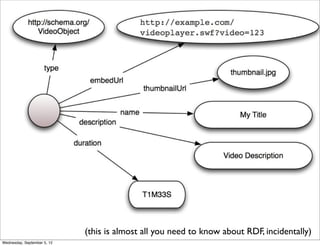
(this is almost all you need to know about RDF, incidentally)
Wednesday, September 5, 12
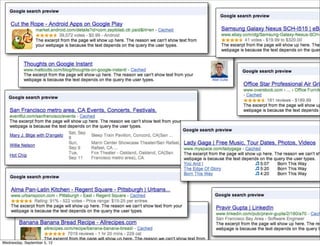
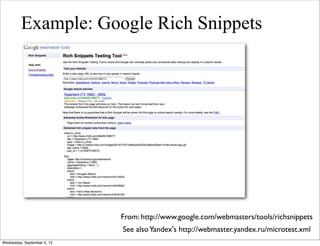
Example: Google Rich Snippets


                             From: http://www.google.com/webmasters/tools/richsnippets
                             See also Yandex's http://webmaster.yandex.ru/microtest.xml
Wednesday, September 5, 12
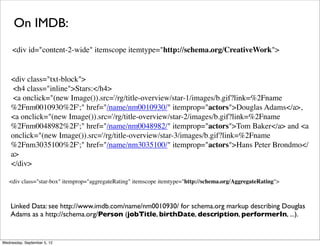
On IMDB:
     <div id="content-2-wide" itemscope itemtype="http://schema.org/CreativeWork">


    <div class="txt-block">
     <h4 class="inline">Stars:</h4>
     <a onclick="(new Image()).src='/rg/title-overview/star-1/images/b.gif?link=%2Fname
    %2Fnm0010930%2F';" href="/name/nm0010930/" itemprop="actors">Douglas Adams</a>,
    <a onclick="(new Image()).src='/rg/title-overview/star-2/images/b.gif?link=%2Fname
    %2Fnm0048982%2F';" href="/name/nm0048982/" itemprop="actors">Tom Baker</a> and <a
    onclick="(new Image()).src='/rg/title-overview/star-3/images/b.gif?link=%2Fname
    %2Fnm3035100%2F';" href="/name/nm3035100/" itemprop="actors">Hans Peter Brondmo</
    a>
    </div>

   <div class="star-box" itemprop="aggregateRating" itemscope itemtype="http://schema.org/AggregateRating">


    Linked Data: see http://www.imdb.com/name/nm0010930/ for schema.org markup describing Douglas
    Adams as a http://schema.org/Person (jobTitle, birthDate, description, performerIn, ...).


Wednesday, September 5, 12
What’s in the schema?

                   •         Classes (types) e.g. LocalBusiness, Person,
                             Organization, VideoObject, TVSeries...
                   • Properties (attributes) e.g. openingHours,
                             transcript, productionCompany, streetAddress
                   • That’s all - a dictionary of terms, used for
                             annotating data within normal Web pages


Wednesday, September 5, 12
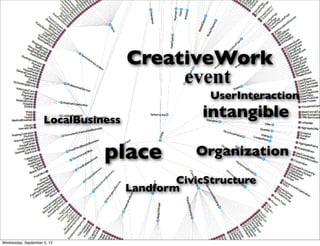
CreativeWork
                                          event
                                                   UserInteraction

                     LocalBusiness
                                                  intangible

                               place            Organization

                                             CivicStructure
                                     Landform


Wednesday, September 5, 12
Another example:


Wednesday, September 5, 12
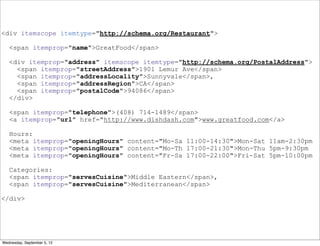
<div itemscope itemtype="http://schema.org/Restaurant">

   <span itemprop="name">GreatFood</span>

   <div itemprop="address" itemscope itemtype="http://schema.org/PostalAddress">
     <span itemprop="streetAddress">1901 Lemur Ave</span>
     <span itemprop="addressLocality">Sunnyvale</span>,
     <span itemprop="addressRegion">CA</span>
     <span itemprop="postalCode">94086</span>
   </div>

   <span itemprop="telephone">(408) 714-1489</span>
   <a itemprop="url" href="http://www.dishdash.com">www.greatfood.com</a>

   Hours:
   <meta itemprop="openingHours" content="Mo-Sa 11:00-14:30">Mon-Sat 11am-2:30pm
   <meta itemprop="openingHours" content="Mo-Th 17:00-21:30">Mon-Thu 5pm-9:30pm
   <meta itemprop="openingHours" content="Fr-Sa 17:00-22:00">Fri-Sat 5pm-10:00pm

   Categories:
   <span itemprop="servesCuisine">Middle Eastern</span>,
   <span itemprop="servesCuisine">Mediterranean</span>

</div>


Wednesday, September 5, 12
Schema.org scope
            • In-page structured data for search
            • Not asking an unconstrained “so, how do we
                   describe cars?”, but “how can we improve
                   markup on existing pages that describe
                   cars?” (or Comics, SoftwareApps, Sports, ...)
            • Simplify publisher/webmaster experience
            • Record agreements between search engines
            • Central use case: augmented search results
Wednesday, September 5, 12
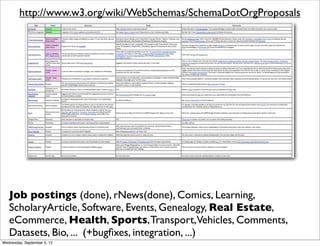
http://www.w3.org/wiki/WebSchemas/SchemaDotOrgProposals


   Job postings (done), rNews(done), Comics, Learning,
   ScholaryArticle, Software, Events, Genealogy, Real Estate,
   eCommerce, Health, Sports, Transport,Vehicles, Comments,
   Datasets, Bio, ... (+bugfixes, integration, ...)
Wednesday, September 5, 12
Everything overlaps
                                                                    *


                 • We added JobPosting; what if the job was
                        sports-related?
                 • We're adding educational markup; does it
                        help describe sports education, training?
                 • Is there a sports perspective on the health/
                        medical vocabulary we're working on?
                 • Can't coordinate everything! Pragmatism...
                                                                        * 'intertwingularity'

Wednesday, September 5, 12
Practicalities
                   • Delegation to external sources for enumerations
                             and detail
                         • e.g. country codes from UN FAO or
                               Wikipedia/DBpedia/Wikidata
                   • We don’t want to create big enumerations
                    • all the countries? sports? things that go on
                               maps?
                   • Decentralised subclassing & property values
Wednesday, September 5, 12
Process
                 • Search partners retain ultimate oversight
                 • W3C hosts community group, discussion,
                        wiki and proposal tracking
                 • Web Schemas group - planning monthly
                        telecons at W3C, based around proposals
                 • Evolving, pragmatic, collaborative

Wednesday, September 5, 12
What should DCMI think?
                   •         When schema.org was launched, ... what should the DC
                             think about it?

                         •     Is this a failing of DC, since schema.org uses its own
                               metadata terms instead of DC's?

                         •     Is it a success, ... finally the original vision goes
                               mainstream?

                         •     Is it something in the middle? An opportunity to
                               collaborate?

                   •         Different strands of DC thought give different answers.


Wednesday, September 5, 12
DC Terms /
                             DCMI Community
                  •      If Dublin Core is a PRODUCT

                        •    ...just a static set of metadata terms

                        •    then schema.org not using them may be disappointing.

                  •      If Dublin Core is a COMMUNITY

                        •    ...a forum that people, groups, projects turn to for
                             collaboration

                        •    then schema.org is a huge opportunity


Wednesday, September 5, 12
1. Schema.org is RDF
                   •         Schema.org chose to launch using Microdata, a simplified
                             subset of RDFa

                         •     since launch, we've been busy helping RDFa Lite

                         •     RDFa Lite is the 'best of both worlds'

                               •   a simple microdata-like profile for mainstream use

                               •   but fully RDF, with built in support for Dublin Core:

                                      <span property="name dc:title">
                                      We can mix schema.org and DC terms
                                      </span>

Wednesday, September 5, 12
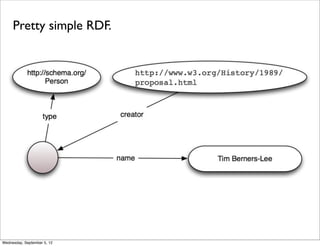
Pretty simple RDF.


Wednesday, September 5, 12
2. Collaborations begin
                   •         There is already a DC/schema.org task force on mappings
                             between the two schemas

                   •         Schema.org's vocabulary around bibliographic metadata
                             (http://schema.org/Book, http://schema.org/ScholarlyArticle)
                             is far from complete

                   •         Schema.org team have a 'library' proposal from OCLC that
                             defines 'Carrier', 'BlurayDisk', 'CassetteTape'

                         •     ...and a request from LMRI.net (upcoming schema.org
                               educational extensions) for similar 'carrier' vocabulary

                         •     ...which DCMI's Stuart Sutton is already helping with

                   Why? Because we're a community, not a product.
Wednesday, September 5, 12
3. One Big Namespace?
                   •         Schema.org is a collaboration amongst busy teams from companies that
                             are in heavy competition with each other.

                         •      It was important to have a clear 'object' of collaboration;

                         •      Something engineers can adopt, implement, understand;

                         •      And that publishers/webmasters can easily adopt.

                   •         Don't expect short-term collective adoption of multiple RDF namespaces;
                             but each company also consumes various non-schema formats. And
                             schema.org uses external lists too.

                   •         The 1995-7 conversations are back in the mainstream again.

                         •      Even if schema.org doesn't "adopt" DC terms, it can adopt DC as a
                                place to go to explore hard bibliographic metadata issues.


Wednesday, September 5, 12
</schema>


Wednesday, September 5, 12
Linked Data
                   •         The Linked Data scene has several aspects

                         •     A practical 'hypertext RDF' community in the DC, RSS,
                               FOAF tradition (often but not always skeptical of heavier
                               knowledge representation approaches like OWL).

                         •     An expression in the RDF world of enthusiasm for wider
                               trend towards open data, transparency, 'creative
                               commons' and 'data science'.

                         •     An expression via shared datasets of our community's
                               passion for sharing and linking information in the Web; a
                               "back to basics" attitude to the potential for improving
                               the Web itself through structured data.


Wednesday, September 5, 12
Linked Data and DCMI
                   •         Since TimBL's influential note, <http://www.w3.org/
                             DesignIssues/LinkedData> in 2006, Linked Data has been
                             growing very impressively.

                         •     Much Linked (Open) Data, 'LOD' uses DC terms heavily

                         •     How does this fit into DCMI's workplans?

                         •     How does DC get combined with other RDF vocabularies?

                               •   we don't know yet, but we're starting to find out

                               •   patterns found in LOD data can feed into DC (and
                                   schema.org), and guide their management and evolution.

                               •   This is closely related to long-term DC work around
                                   Application Profiles, Patterns and the Abstract Model.

Wednesday, September 5, 12
Linked Data
                   1. Use URIs as names for things.

                   2. Use HTTP URIs so that people can look up those names.

                   3. When someone looks up a URI, provide useful
                      information, using the standards (RDF, SPARQL, ...).

                   4. Include links to other URIs so they can discover more
                      things.


                                                      Tim Berners-Lee (2006)

                             http://www.w3.org/DesignIssues/LinkedData
Wednesday, September 5, 12
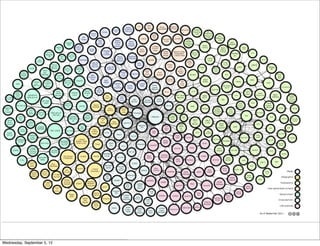
Serious Linked Data!


Wednesday, September 5, 12
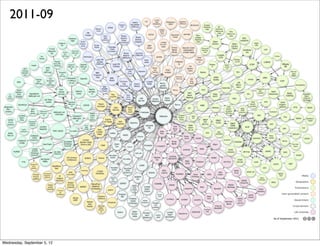
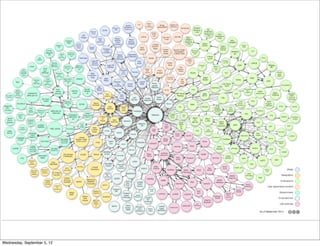
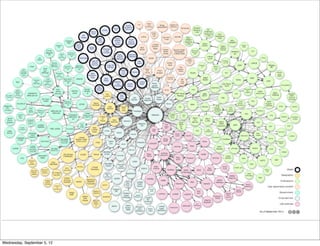
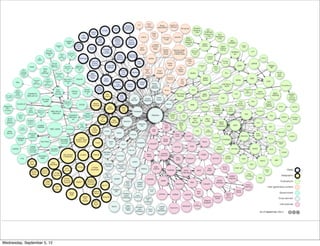
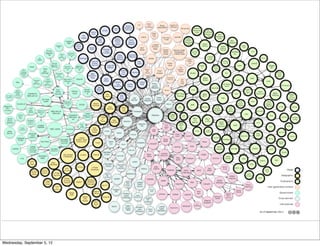
2007-05


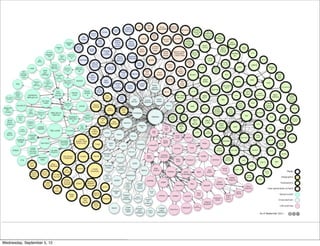
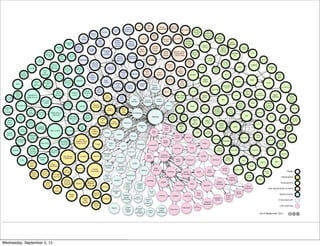
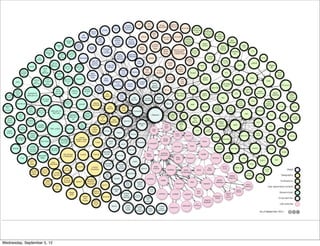
                             (each blob here is a dataset, not an entity described!)
Wednesday, September 5, 12
2009-03


Wednesday, September 5, 12
2011-09


Wednesday, September 5, 12
Deeper into LOD?
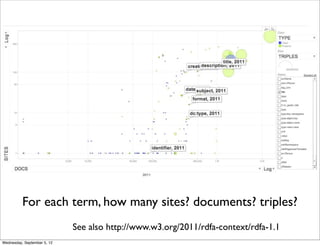
                 • Basic stats from Billion Triples Challenge
                        (thanks to Aidan Hogan & others)
                 • What's out there? Which vocabularies?
                 • What should we count? Triples?
                        Documents? Sites? Which dataset?
                 • A billion triples was a lot in 2006; it is
                        considered small now...


Wednesday, September 5, 12
For each term, how many sites? documents? triples?
                             See also http://www.w3.org/2011/rdfa-context/rdfa-1.1
Wednesday, September 5, 12
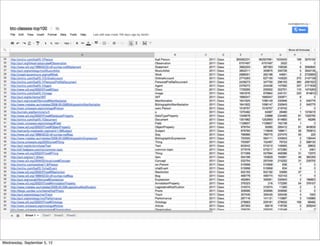
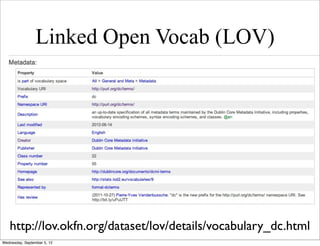
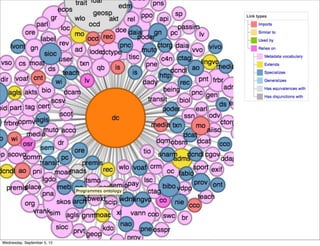
Linked Open Vocab (LOV)


   http://lov.okfn.org/dataset/lov/details/vocabulary_dc.html
Wednesday, September 5, 12
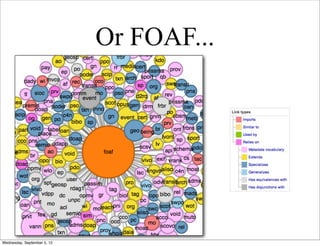
Or FOAF...


Wednesday, September 5, 12
What's out there?
                 • Growing by the day...
                  • Linked Data sites; e-gov datasets, cultural
                             heritage, public sector collections
                      • Typically using several independent RDF
                             vocabularies
                 • Alongside schema.org, growing very fast
                 • How can we track the metadata landscape?
Wednesday, September 5, 12
What's left to do?

                 • If this is where we are today, what could /
                        should / might Dublin Core become?
                 • Where can we be most useful? What might
                        we do better than anyone else?


Wednesday, September 5, 12
"The Intended Niche"
                 • DC '95, between Web indexes and libraries
                  • This was the right territory
                  • It was a long wait! But we kept busy.
                  • Libraries today are looking to Linked
                             Data and RDF
                      • Mainstream search has also turned to
                             RDF and structured data


Wednesday, September 5, 12
Our Niche?

                 • The DC community has a special link to
                        digital (and 'classic') libraries; to public
                        sector datasets; to cultural heritage, to
                        museums, to e-govt and to controlled
                        vocabularies.
                      • We should build on this!

Wednesday, September 5, 12
Vocabularies
                 • Mapping them; preserving them!
                 • Documenting what's out there, and what's
                        being used, in several ways:
                      • data-driven: stats and analysis over LOD
                      • community driven: conferences,
                             workshops, events
                      • format driven: application profiles
Wednesday, September 5, 12
Education

                 • Many in the DC world are educators
                 • Close links to library and information
                        science schools (e.g. iSchools), universities
                 • Professional education and outreach to
                        webmasters and publishers - common
                        shared core of 'structured data' skills


Wednesday, September 5, 12
Technology
                 • We are a great technology customer; we are
                        less well placed to create new core
                        technologies.
                 • Links with W3C have paid off well: RDF,
                        RDFa, SKOS and the Linked Library work
                 • App Profiles tech work, perhaps also W3C?
                        e.g. <http://www.w3.org/Submission/spin-overview/>


Wednesday, September 5, 12
Bibliographic data?
                 • Our core business, even if "The Dublin
                        Core" is not the One True Answer for all
                        applications.
                 • Library world is moving into the Web -
                        various "Life after MARC" initiatives to
                        modernise cataloguing and open up data.
                 • Huge opportunities around controlled
                        vocabularies - classification, thesauri,
                        people/places/things.
Wednesday, September 5, 12
DC 2012 Work streams
                 • A good fit -
                  • Vocabulary preservation (FOAF/DCMI)
                  • Vocabulary mapping (Schema/DC)
                  • Patterns (Abstract Model)
                 • Possible new work: bibliographic metadata
                        revisited?


Wednesday, September 5, 12
Closing thoughts
                 • DC is 'in the middle' in many ways
                  • DC never forgot the value of RDF as
                             metadata; the value of books, articles,
                             videos alongside triples and raw facts.
                      • DC championed simple Web metadata for
                             discovery for 15 years, and is now
                             perfectly placed to help libraries and
                             search biblio vocabularies interoperate


Wednesday, September 5, 12
Core of Dublin Core?
                 • DCMI can, should, and will rediscover
                        itself as a community for metadata
                        collaboration.
                 • This is reflected in data (collaborating
                        vocabularies), individually (people bridging
                        organizations), and organizationally (joint
                        events and projects with other initiatives).


Wednesday, September 5, 12
So - what's left to do?

                 • Take the original vision into the mainstream
                 • Get back in touch with that '90s sense of a
                        shared mission to improve the Web
                 • Keep mapping the metadata landscape,
                        keep learning, and keep teaching...


Wednesday, September 5, 12
Questions?


Wednesday, September 5, 12

"What is left to do?", Dublin Core 2012 Keynote

  • 1.
    'Dublin Core: What is left to do?' (old questions / new answers) Dan Brickley <danbri@danbri.org> Wednesday, September 5, 12
  • 2.
    Preview • Dublin Core 'Ancient History' • DC's two personalities: 'Framework' & 'Element Set' • Myth: DC was almost completed in the 1st Workshop in '95 • Myth: Dublin Core 'vs' the commercial/industry Web • Schema.org and the 'commercial Web' • Linked Data, the Semantic Web and Libraries • Putting it all together: new challenges for DCMI Wednesday, September 5, 12
  • 3.
  • 4.
    Oct. 1997, DC-5:(myth of the) 'Finnish Finish' Wednesday, September 5, 12
  • 5.
    Dublin Core inthe '90s • Buzzing with the energy of the early Web community • A community with 1000 opinions • A community improving a 'product', the Dublin Core • A community who didn't realiseproduct community mattered much more than their that the • ...that the Dublin Core is a journey not a destination Wednesday, September 5, 12
  • 6.
    Dublin Core in2012 • Custodian of the "Dublin Core" terms, a.k.a. elements • Earliest, most famous & most used non-W3C RDF schema • Early customer for W3C RDF, Linked Data, Semantic Web, and contributor to RDF, RDFa, SKOS, Linked Library Data, ... • Less a product, and more a 'community crossroads' • A critical link from digital libraries, cultural heritage and professional metadata world to more global industry initiatives around structured Web data. Wednesday, September 5, 12
  • 7.
    DC, RDF &the Warwick Framework • From 1996, two important strands of thought in DC: • 1) Defining simple, widely useful semantics for terms • 2) Packaging mechanisms for mixing metadata • The first gave us the 'Famous Fifteen' - the element set. • The second fed requirements and contributors into W3C's early RDF work. Wednesday, September 5, 12
  • 8.
    'The Warwick Framework:A Container Architecture for Aggregating Sets ofMetadata' (1996) "...a container architecture for aggregating logically, and perhaps physically, distinct packages of metadata. This architecture allows separate administration and access to metadata packages, provides for varying syntax in each package" (one of the several inputs to W3C's Metadata Activity and RDF) Wednesday, September 5, 12
  • 9.
    2 Kinds ofPragmatism • 'Simple vocabulary semantics' pragmatism • "We don't want to spend lots of time building complex, un-tested, universal frameworks that allow all kinds of data to be mixed. Instead, let's make some useful and easily understood, technology- neutral metadata definitions and simple ways to publish it in HTML". • 'One vocabulary can't cover it all' pragmatism • "Whatever we do, it will be hard to meet all needs for multimedia, education, geo, rights, classification etc. Therefore let's find ways of mixing simple Dublin Core with vocabularies created by others." • I think of these as "Stu-pragmatism" and "Eric-pragmatism", in honour of Stu Weibel and Eric Miller's early DC leadership, and their shared concern for keeping Dublin Core simple, mainstream and useful to many communities. Much of DC history comes from the interplay between these forms of DC pragmatism. Wednesday, September 5, 12
  • 10.
    Oct 1997: WorldWide Web Consortium Publishes Public Draft of Resource Description Framework (RDF) Key Industry Players Collaborate to Develop Interoperable Metadata for the Web CAMBRIDGE, MASS., USA -- October 3, 1997 -- The World Wide Web Consortium (W3C) today announced the first public draft of a work-in-progress of the Resource Description Framework (RDF), providing interoperability between applications that exchange machine-understandable information on the Web. "The development of RDF illustrates the power of the collaborative process within W3C Working Groups" said Ralph Swick, W3C Metadata Project Manager. "Beginning with a functional requirement from an end-user Member, the RDF Working Group brought together additional Members to work to achieve a solution of which everyone can be proud." The W3C RDF Working Group has key industry players including DVL, Grif, IBM, KnowledgeCite, LANL, Microsoft, Netscape, Nokia, OCLC, Reuters, SoftQuad and University of Michigan. The RDF Working Group is one of the earliest phases of a major effort by the Consortium to build a vendor-neutral and operating system- independent system of metadata. The collaborative design effort on RDF originated as an extension on the PICS content description technology, and draws upon the XML design as well as recent W3C Submissions by Microsoft [XML Web Collections] and Netscape [XML/MCF]. In addition, documents such as Microsoft's XML-Data and Site Map proposals, and the Dublin Core/Warwick Framework have also influenced the RDF design. Wednesday, September 5, 12
  • 11.
  • 12.
  • 13.
    This is now. Wednesday,September 5, 12
  • 14.
    And where arewe now? • 15, 16, ... 17 years later...? • Is Dublin Core still a bridge between mainstream Web structured data standards and the world of professional bibliographic metadata, digital libraries and MARC cataloguing? • What else has changed? • Are we done yet? Wednesday, September 5, 12
  • 15.
    Myth of the'Finnish Finish' • The Myth that we were almost finished in October 1997 • The real work was just beginning - • learning from deployment experience • talking with nearby communities - education, multimedia, rights, classification, thesauri, ... • supporting W3C's RDF, RDFa, SKOS work • joining a growing 'open data' movement, of which Linked Data is a part, working alongside Open Access / Open Archives, E-Govt transparency, Open Source, Creative Commons, etc. Wednesday, September 5, 12
  • 16.
  • 17.
    Today's Landscape • I want to talk about two things (chosen from many...) • Schema.org from Google, Bing, Yahoo, Yandex • (this is my day job...) • Linked Data Wednesday, September 5, 12
  • 18.
  • 19.
    Schema.org A quick look. Wednesday, September 5, 12
  • 20.
    Schema.org • Search engine collaboration: • Google, Bing, Yahoo! & Yandex • Simple factual data for better search • Launched June 2011, schema.org schema • 300 classes, 261 properties & growing • discussions: W3C WebSchemas group Wednesday, September 5, 12
  • 21.
  • 22.
  • 23.
  • 24.
    How does itwork? • Normal HTML page content, with additional markup. • Extra attributes are from W3C HTML5 Microdata: itemscope, itemtype, itemprop, content. • The HTML5 Microdata syntax was based originally on W3C RDFa, a similar design. • Both address the principle known on microformats.org as "Don't Repeat Yourself" (DRY), http://microformats.org/wiki/dry . • Re-use of page markup to also serve as structured data. • Increasing support for W3C RDFa Lite as a schema.org syntax. Wednesday, September 5, 12
  • 25.
  • 26.
  • 27.
  • 28.
    <div itemscope itemtype="http://schema.org/VideoObject">   <h2>Video: <span itemprop="name">My Title</span></h2>   <meta itemprop="duration" content="T1M33S" />   <meta itemprop="thumbnailUrl" content="thumbnail.jpg" />   <meta itemprop="embedUrl"     content="http://example.com/videoplayer.swf?video=123" />   <object ...>     <embed type="application/x-shockwave-flash" ...>   </object>   <span itemprop="description">Video description</span> </div> Type: http://schema.org/VideoObject name = My Title duration = T1M33S thumbnailurl = thumbnail.jpg embedurl = http://www.example.com/videoplayer.swf? video=123 description = Video description Wednesday, September 5, 12
  • 29.
    (this is almostall you need to know about RDF, incidentally) Wednesday, September 5, 12
  • 30.
    Example: Google RichSnippets From: http://www.google.com/webmasters/tools/richsnippets See also Yandex's http://webmaster.yandex.ru/microtest.xml Wednesday, September 5, 12
  • 31.
    On IMDB: <div id="content-2-wide" itemscope itemtype="http://schema.org/CreativeWork"> <div class="txt-block"> <h4 class="inline">Stars:</h4> <a onclick="(new Image()).src='/rg/title-overview/star-1/images/b.gif?link=%2Fname %2Fnm0010930%2F';" href="/name/nm0010930/" itemprop="actors">Douglas Adams</a>, <a onclick="(new Image()).src='/rg/title-overview/star-2/images/b.gif?link=%2Fname %2Fnm0048982%2F';" href="/name/nm0048982/" itemprop="actors">Tom Baker</a> and <a onclick="(new Image()).src='/rg/title-overview/star-3/images/b.gif?link=%2Fname %2Fnm3035100%2F';" href="/name/nm3035100/" itemprop="actors">Hans Peter Brondmo</ a> </div> <div class="star-box" itemprop="aggregateRating" itemscope itemtype="http://schema.org/AggregateRating"> Linked Data: see http://www.imdb.com/name/nm0010930/ for schema.org markup describing Douglas Adams as a http://schema.org/Person (jobTitle, birthDate, description, performerIn, ...). Wednesday, September 5, 12
  • 32.
    What’s in theschema? • Classes (types) e.g. LocalBusiness, Person, Organization, VideoObject, TVSeries... • Properties (attributes) e.g. openingHours, transcript, productionCompany, streetAddress • That’s all - a dictionary of terms, used for annotating data within normal Web pages Wednesday, September 5, 12
  • 33.
    CreativeWork event UserInteraction LocalBusiness intangible place Organization CivicStructure Landform Wednesday, September 5, 12
  • 34.
  • 35.
    <div itemscope itemtype="http://schema.org/Restaurant"> <span itemprop="name">GreatFood</span> <div itemprop="address" itemscope itemtype="http://schema.org/PostalAddress"> <span itemprop="streetAddress">1901 Lemur Ave</span> <span itemprop="addressLocality">Sunnyvale</span>, <span itemprop="addressRegion">CA</span> <span itemprop="postalCode">94086</span> </div> <span itemprop="telephone">(408) 714-1489</span> <a itemprop="url" href="http://www.dishdash.com">www.greatfood.com</a> Hours: <meta itemprop="openingHours" content="Mo-Sa 11:00-14:30">Mon-Sat 11am-2:30pm <meta itemprop="openingHours" content="Mo-Th 17:00-21:30">Mon-Thu 5pm-9:30pm <meta itemprop="openingHours" content="Fr-Sa 17:00-22:00">Fri-Sat 5pm-10:00pm Categories: <span itemprop="servesCuisine">Middle Eastern</span>, <span itemprop="servesCuisine">Mediterranean</span> </div> Wednesday, September 5, 12
  • 36.
    Schema.org scope • In-page structured data for search • Not asking an unconstrained “so, how do we describe cars?”, but “how can we improve markup on existing pages that describe cars?” (or Comics, SoftwareApps, Sports, ...) • Simplify publisher/webmaster experience • Record agreements between search engines • Central use case: augmented search results Wednesday, September 5, 12
  • 37.
    http://www.w3.org/wiki/WebSchemas/SchemaDotOrgProposals Job postings (done), rNews(done), Comics, Learning, ScholaryArticle, Software, Events, Genealogy, Real Estate, eCommerce, Health, Sports, Transport,Vehicles, Comments, Datasets, Bio, ... (+bugfixes, integration, ...) Wednesday, September 5, 12
  • 38.
    Everything overlaps * • We added JobPosting; what if the job was sports-related? • We're adding educational markup; does it help describe sports education, training? • Is there a sports perspective on the health/ medical vocabulary we're working on? • Can't coordinate everything! Pragmatism... * 'intertwingularity' Wednesday, September 5, 12
  • 39.
    Practicalities • Delegation to external sources for enumerations and detail • e.g. country codes from UN FAO or Wikipedia/DBpedia/Wikidata • We don’t want to create big enumerations • all the countries? sports? things that go on maps? • Decentralised subclassing & property values Wednesday, September 5, 12
  • 40.
    Process • Search partners retain ultimate oversight • W3C hosts community group, discussion, wiki and proposal tracking • Web Schemas group - planning monthly telecons at W3C, based around proposals • Evolving, pragmatic, collaborative Wednesday, September 5, 12
  • 41.
  • 42.
    What should DCMIthink? • When schema.org was launched, ... what should the DC think about it? • Is this a failing of DC, since schema.org uses its own metadata terms instead of DC's? • Is it a success, ... finally the original vision goes mainstream? • Is it something in the middle? An opportunity to collaborate? • Different strands of DC thought give different answers. Wednesday, September 5, 12
  • 43.
    DC Terms / DCMI Community • If Dublin Core is a PRODUCT • ...just a static set of metadata terms • then schema.org not using them may be disappointing. • If Dublin Core is a COMMUNITY • ...a forum that people, groups, projects turn to for collaboration • then schema.org is a huge opportunity Wednesday, September 5, 12
  • 44.
    1. Schema.org isRDF • Schema.org chose to launch using Microdata, a simplified subset of RDFa • since launch, we've been busy helping RDFa Lite • RDFa Lite is the 'best of both worlds' • a simple microdata-like profile for mainstream use • but fully RDF, with built in support for Dublin Core: <span property="name dc:title"> We can mix schema.org and DC terms </span> Wednesday, September 5, 12
  • 45.
  • 46.
    2. Collaborations begin • There is already a DC/schema.org task force on mappings between the two schemas • Schema.org's vocabulary around bibliographic metadata (http://schema.org/Book, http://schema.org/ScholarlyArticle) is far from complete • Schema.org team have a 'library' proposal from OCLC that defines 'Carrier', 'BlurayDisk', 'CassetteTape' • ...and a request from LMRI.net (upcoming schema.org educational extensions) for similar 'carrier' vocabulary • ...which DCMI's Stuart Sutton is already helping with Why? Because we're a community, not a product. Wednesday, September 5, 12
  • 47.
    3. One BigNamespace? • Schema.org is a collaboration amongst busy teams from companies that are in heavy competition with each other. • It was important to have a clear 'object' of collaboration; • Something engineers can adopt, implement, understand; • And that publishers/webmasters can easily adopt. • Don't expect short-term collective adoption of multiple RDF namespaces; but each company also consumes various non-schema formats. And schema.org uses external lists too. • The 1995-7 conversations are back in the mainstream again. • Even if schema.org doesn't "adopt" DC terms, it can adopt DC as a place to go to explore hard bibliographic metadata issues. Wednesday, September 5, 12
  • 48.
  • 49.
  • 50.
    Linked Data • The Linked Data scene has several aspects • A practical 'hypertext RDF' community in the DC, RSS, FOAF tradition (often but not always skeptical of heavier knowledge representation approaches like OWL). • An expression in the RDF world of enthusiasm for wider trend towards open data, transparency, 'creative commons' and 'data science'. • An expression via shared datasets of our community's passion for sharing and linking information in the Web; a "back to basics" attitude to the potential for improving the Web itself through structured data. Wednesday, September 5, 12
  • 51.
    Linked Data andDCMI • Since TimBL's influential note, <http://www.w3.org/ DesignIssues/LinkedData> in 2006, Linked Data has been growing very impressively. • Much Linked (Open) Data, 'LOD' uses DC terms heavily • How does this fit into DCMI's workplans? • How does DC get combined with other RDF vocabularies? • we don't know yet, but we're starting to find out • patterns found in LOD data can feed into DC (and schema.org), and guide their management and evolution. • This is closely related to long-term DC work around Application Profiles, Patterns and the Abstract Model. Wednesday, September 5, 12
  • 52.
    Linked Data 1. Use URIs as names for things. 2. Use HTTP URIs so that people can look up those names. 3. When someone looks up a URI, provide useful information, using the standards (RDF, SPARQL, ...). 4. Include links to other URIs so they can discover more things. Tim Berners-Lee (2006) http://www.w3.org/DesignIssues/LinkedData Wednesday, September 5, 12
  • 53.
  • 54.
    2007-05 (each blob here is a dataset, not an entity described!) Wednesday, September 5, 12
  • 55.
  • 56.
  • 57.
  • 58.
  • 59.
  • 60.
  • 61.
  • 62.
  • 63.
  • 64.
  • 65.
    Deeper into LOD? • Basic stats from Billion Triples Challenge (thanks to Aidan Hogan & others) • What's out there? Which vocabularies? • What should we count? Triples? Documents? Sites? Which dataset? • A billion triples was a lot in 2006; it is considered small now... Wednesday, September 5, 12
  • 66.
  • 67.
    For each term,how many sites? documents? triples? See also http://www.w3.org/2011/rdfa-context/rdfa-1.1 Wednesday, September 5, 12
  • 68.
  • 69.
    Linked Open Vocab(LOV) http://lov.okfn.org/dataset/lov/details/vocabulary_dc.html Wednesday, September 5, 12
  • 70.
  • 71.
  • 72.
    What's out there? • Growing by the day... • Linked Data sites; e-gov datasets, cultural heritage, public sector collections • Typically using several independent RDF vocabularies • Alongside schema.org, growing very fast • How can we track the metadata landscape? Wednesday, September 5, 12
  • 73.
    What's left todo? • If this is where we are today, what could / should / might Dublin Core become? • Where can we be most useful? What might we do better than anyone else? Wednesday, September 5, 12
  • 74.
    "The Intended Niche" • DC '95, between Web indexes and libraries • This was the right territory • It was a long wait! But we kept busy. • Libraries today are looking to Linked Data and RDF • Mainstream search has also turned to RDF and structured data Wednesday, September 5, 12
  • 75.
    Our Niche? • The DC community has a special link to digital (and 'classic') libraries; to public sector datasets; to cultural heritage, to museums, to e-govt and to controlled vocabularies. • We should build on this! Wednesday, September 5, 12
  • 76.
    Vocabularies • Mapping them; preserving them! • Documenting what's out there, and what's being used, in several ways: • data-driven: stats and analysis over LOD • community driven: conferences, workshops, events • format driven: application profiles Wednesday, September 5, 12
  • 77.
    Education • Many in the DC world are educators • Close links to library and information science schools (e.g. iSchools), universities • Professional education and outreach to webmasters and publishers - common shared core of 'structured data' skills Wednesday, September 5, 12
  • 78.
    Technology • We are a great technology customer; we are less well placed to create new core technologies. • Links with W3C have paid off well: RDF, RDFa, SKOS and the Linked Library work • App Profiles tech work, perhaps also W3C? e.g. <http://www.w3.org/Submission/spin-overview/> Wednesday, September 5, 12
  • 79.
    Bibliographic data? • Our core business, even if "The Dublin Core" is not the One True Answer for all applications. • Library world is moving into the Web - various "Life after MARC" initiatives to modernise cataloguing and open up data. • Huge opportunities around controlled vocabularies - classification, thesauri, people/places/things. Wednesday, September 5, 12
  • 80.
    DC 2012 Workstreams • A good fit - • Vocabulary preservation (FOAF/DCMI) • Vocabulary mapping (Schema/DC) • Patterns (Abstract Model) • Possible new work: bibliographic metadata revisited? Wednesday, September 5, 12
  • 81.
    Closing thoughts • DC is 'in the middle' in many ways • DC never forgot the value of RDF as metadata; the value of books, articles, videos alongside triples and raw facts. • DC championed simple Web metadata for discovery for 15 years, and is now perfectly placed to help libraries and search biblio vocabularies interoperate Wednesday, September 5, 12
  • 82.
    Core of DublinCore? • DCMI can, should, and will rediscover itself as a community for metadata collaboration. • This is reflected in data (collaborating vocabularies), individually (people bridging organizations), and organizationally (joint events and projects with other initiatives). Wednesday, September 5, 12
  • 83.
    So - what'sleft to do? • Take the original vision into the mainstream • Get back in touch with that '90s sense of a shared mission to improve the Web • Keep mapping the metadata landscape, keep learning, and keep teaching... Wednesday, September 5, 12
  • 84.
  • 85.