MetaL MetaCASE Tools &
                         Possibilities


                         Fahad Rafique Golra


19/03/2012   Département Informatique
Table of Contents


                        1.    MetaL1
                        2.    MetaL2
                        3.    Examples
                        4.    Benefits
                        5.    Discussion
page 1   Département Informatique          Fahad R. Golra
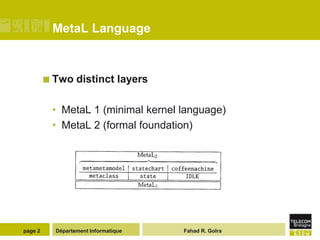
MetaL Language


          Two    distinct layers

          • MetaL 1 (minimal kernel language)
          • MetaL 2 (formal foundation)


page 2     Département Informatique   Fahad R. Golra
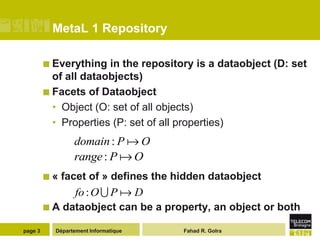
MetaL 1 Repository

          Everything  in the repository is a dataobject (D: set
           of all dataobjects)
          Facets of Dataobject
           • Object (O: set of all objects)
           • Properties (P: set of all properties)
                 domain : P  O
                 range : P  O
         «   facet of » defines the hidden dataobject
                  fo : O  P  D
         A   dataobject can be a property, an object or both

page 3     Département Informatique   Fahad R. Golra
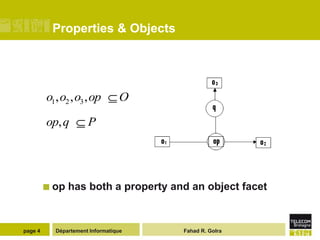
Properties & Objects


         o1, o2 , o3 , op        O

         op, q        P


          op   has both a property and an object facet


page 4     Département Informatique   Fahad R. Golra
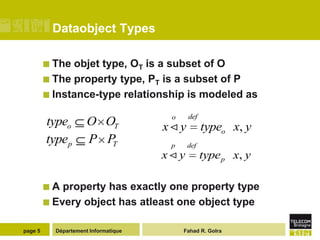
Dataobject Types

          The objet type, OT is a subset of O
          The property type, PT is a subset of P
          Instance-type relationship is modeled as

                                       o     def
         typeo        O OT            x y         typeo x, y
         typep        P PT             p     def
                                      x y         type p x, y

         A  property has exactly one property type
          Every object has atleast one object type


page 5     Département Informatique        Fahad R. Golra
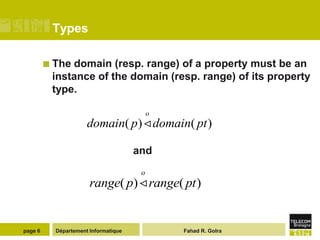
Types

          Thedomain (resp. range) of a property must be an
          instance of the domain (resp. range) of its property
          type.

                                           o
                      domain( p)  domain( pt )

                                      and
                                       o
                       range( p)  range( pt )


page 6     Département Informatique            Fahad R. Golra
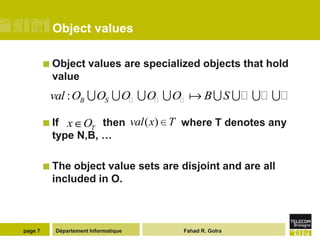
Object values

          Object      values are specialized objects that hold
           value
          val : OB  OS  O  O  O  B  S      

          If   x OT then val ( x) T where T denotes any
           type N,B, …

          The  object value sets are disjoint and are all
           included in O.


page 7      Département Informatique      Fahad R. Golra
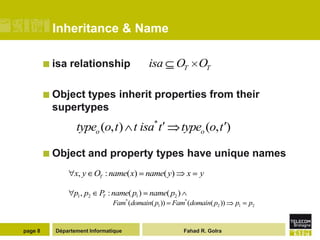
Inheritance & Name

          isa   relationship              isa       OT OT

          Objecttypes inherit properties from their
          supertypes
                  typeo (o, t ) t isa* t               typeo (o, t )

          Object     and property types have unique names
                 x, y OT : name( x) name( y)            x    y

                 p1 , p2   P : name( p1 ) name( p2 )
                            T
                               Fam* (domain( p1 )) Fam* (domain( p2 ))   p1   p2


page 8     Département Informatique                    Fahad R. Golra
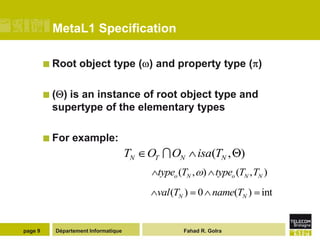
MetaL1 Specification

          Root    object type ( ) and property type ( )

         ( ) is an instance of root object type and
          supertype of the elementary types

          For   example:
                                      TN   OT  ON      isa(TN , )
                                            typeo (TN , ) typeo (TN , TN )
                                            val (TN ) 0 name(TN ) int


page 9     Département Informatique                Fahad R. Golra
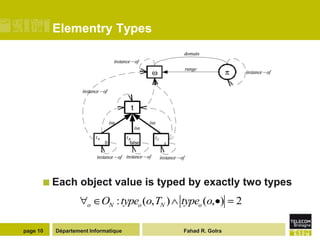
Elementry Types


       Each       object value is typed by exactly two types

                     o    ON : typeo (o, TN )   typeo (o, )      2

page 10   Département Informatique              Fahad R. Golra
Example

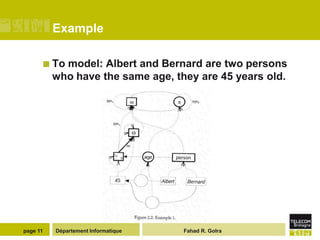
       To  model: Albert and Bernard are two persons
          who have the same age, they are 45 years old.


page 11   Département Informatique   Fahad R. Golra
Integrity

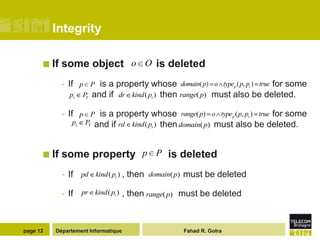
       If   some object o O is deleted
             - If p P is a property whose domain( p) o typep ( p, pt ) true for some
                pt P and if dr kind ( pt ) then range( p) must also be deleted.
                    T


             - If p P is a property whose range( p) o typep ( p, pt ) true for some
                 pt P and if rd kind ( p ) then domain( p) must also be deleted.
                     T                  t


       If   some property p P is deleted
             - If   pd   kind ( pt ) ,   then domain( p) must be deleted

             - If   pr kind ( pt )   , then range( p) must be deleted


page 12   Département Informatique                     Fahad R. Golra
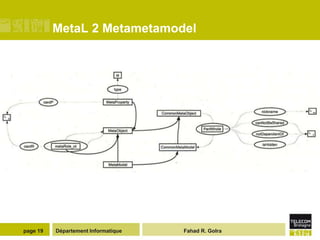
MetaL 2 Metametamodel

       CommonMetaObject

            - Default supertype of all other metaclasses
       CommonMetaModel

            - Default supertype of all constructs denoting metamodels

            - Inherits from CommonMetaObject
       MetaObject

            - Key metaclass as main concept

            - Generalizes MetaRole, MetaProperty, MetaModel

            - Has a unique name

page 13   Département Informatique         Fahad R. Golra
MetaL 2 Metametamodel

       MetaProperty

            - Adds slots to metaobjects

            - Inherits from MetaObject

            - Domain of cardP property which limits the number of concrete
              properties

            - Cardinality -1 is considered infinite, otherwise ≥ 1

            - Must have exactly one cardinality and one type

            - Cardinality is the range of exactly one metaproperty


page 14   Département Informatique           Fahad R. Golra
MetaL 2 Metametamodel

       MetaRole

            - Both object type and property type

            - As object type, subtype of MetaObject

            - As property type, has MetaObject object type as domain and
              range

            - Domain of cardR property, where cardR denotes one-to-
              one(0), one-to-many(1), many-to-one(4), many-to-many(5),
              manys-to-manys(10).

            - Cardinality is the range of exactly one metarole


page 15   Département Informatique         Fahad R. Golra
MetaL 2 Metametamodel

       MetaModel

            - Aggregate concept defined by a set of metaobjects

            - Inherits from CommonMetaModel

            - PartWhole metaRole has CommonMetaObject as domain
              and CommonMetaModel as range.

            - PartWhole is domain of
                –   nickname:optional, unicity of name inside a metamodel
                –   canNotBeShared: allows sharing in metamodels
                –   isNotDependentOn: dependency of object on metamodel
                –   isHidden: hiding technical details


page 16   Département Informatique            Fahad R. Golra
Example


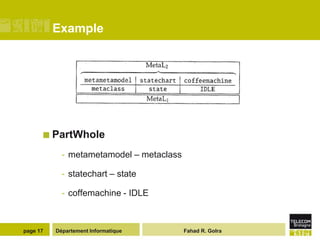
       PartWhole

            - metametamodel – metaclass

            - statechart – state

            - coffemachine - IDLE


page 17   Département Informatique        Fahad R. Golra
MetaL 2 Metametamodel

       Inheritence

            - MetaObjects can inherit from other MetaObjects

            - Multiple inheritance is allowed

            - Cycles are forbidden in the generalization graph

            - Inheritance between metamodels is allowed

                               MM    typeo ( , MetaModel)


page 18   Département Informatique             Fahad R. Golra
MetaL 2 Metametamodel


page 19   Département Informatique   Fahad R. Golra
MetaL 2 Concrete Layer

       ConcreteObjects

            - Instance of metaobject which is instance of MetaObject

            - Can belong to several concrete models

            - Can not live outside the definition of atleast one concrete
              model
       Concrete          Property
            - Valued slot attached to concrete object

            - Can be shared by multiple concrete objects

            - As its a metaobject so it can own properties, roles etc

page 20   Département Informatique          Fahad R. Golra
MetaL 2 Concrete Layer

       Concrete          Roles
            - Has property and object facets

            - Links two objects and can be a domain/range of property

            - Respects cardinality


       Concrete          Models
            - Instance of metamodel which is an instance of MetaModel

            - Composed of concrete objects that are instance of
              metaobjects in metamodel definition.

page 21   Département Informatique        Fahad R. Golra
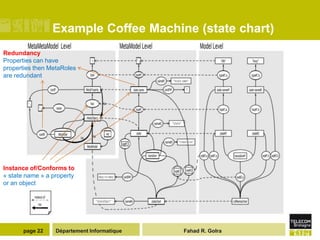
Example Coffee Machine (state chart)
Redundancy
Properties can have
properties then MetaRoles
are redundant


Instance of/Conforms to
« state name » a property
or an object


       page 22    Département Informatique   Fahad R. Golra
General Benefits

            - Meta(models) can overlap

            - Sharing between (meta)models is fine-grained: (meta)objects,
              (meta)models, …

            - Multiple instantiation

            - Free from instance/type delimitation in modeling layers

            - Granularity: meta(models) are meta(objects)

            - Metamodel refinement: As metamodels can be extended
              further and refined.


page 23   Département Informatique         Fahad R. Golra
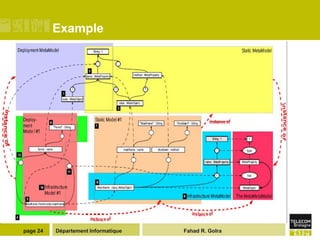
Example


page 24   Département Informatique   Fahad R. Golra
Points for discussion

          • Having shared objects can help transformations, as
            some part of the (meta)model remains constant in
            transformation

          • Maintaining metamodel families by transformations
            without referential redundancies

          • As other terminal languages can be defined on top
            MetaL1, so a complete family of of DSLs can exist
            e.g. for Component Oriented Programming.


page 25   Département Informatique   Fahad R. Golra
References

                1. V. Englebert. MetaL1: a formal specification. Technical Report,
                   University of Namur – PRECISE Research Centre, Belgique,
                   May 2010.

                2. V. Englebert. MetaL2: a formal specification. Technical Report,
                   University of Namur – PRECISE Research Centre, Belgique,
                   May 2010.

                3. V. Englebert, P. Heymans, “Towards More Extensive
                   MetaCASE Tools”, In: Proceedings of CAiSE 2007, Springer-
                   Verlag Berlin Heidelberg, pp 454–468, 2007.


page 26   Département Informatique            Fahad R. Golra

Meta l metacase tools & possibilities

  • 1.
    MetaL MetaCASE Tools& Possibilities Fahad Rafique Golra 19/03/2012 Département Informatique
  • 2.
    Table of Contents 1. MetaL1 2. MetaL2 3. Examples 4. Benefits 5. Discussion page 1 Département Informatique Fahad R. Golra
  • 3.
    MetaL Language  Two distinct layers • MetaL 1 (minimal kernel language) • MetaL 2 (formal foundation) page 2 Département Informatique Fahad R. Golra
  • 4.
    MetaL 1 Repository  Everything in the repository is a dataobject (D: set of all dataobjects)  Facets of Dataobject • Object (O: set of all objects) • Properties (P: set of all properties) domain : P  O range : P  O « facet of » defines the hidden dataobject fo : O  P  D A dataobject can be a property, an object or both page 3 Département Informatique Fahad R. Golra
  • 5.
    Properties & Objects o1, o2 , o3 , op O op, q P  op has both a property and an object facet page 4 Département Informatique Fahad R. Golra
  • 6.
    Dataobject Types  The objet type, OT is a subset of O  The property type, PT is a subset of P  Instance-type relationship is modeled as o def typeo O OT x y typeo x, y typep P PT p def x y type p x, y A property has exactly one property type  Every object has atleast one object type page 5 Département Informatique Fahad R. Golra
  • 7.
    Types  Thedomain (resp. range) of a property must be an instance of the domain (resp. range) of its property type. o domain( p)  domain( pt ) and o range( p)  range( pt ) page 6 Département Informatique Fahad R. Golra
  • 8.
    Object values  Object values are specialized objects that hold value val : OB  OS  O  O  O  B  S        If x OT then val ( x) T where T denotes any type N,B, …  The object value sets are disjoint and are all included in O. page 7 Département Informatique Fahad R. Golra
  • 9.
    Inheritance & Name  isa relationship isa OT OT  Objecttypes inherit properties from their supertypes typeo (o, t ) t isa* t typeo (o, t )  Object and property types have unique names x, y OT : name( x) name( y) x y p1 , p2 P : name( p1 ) name( p2 ) T Fam* (domain( p1 )) Fam* (domain( p2 )) p1 p2 page 8 Département Informatique Fahad R. Golra
  • 10.
    MetaL1 Specification  Root object type ( ) and property type ( ) ( ) is an instance of root object type and supertype of the elementary types  For example: TN OT  ON isa(TN , ) typeo (TN , ) typeo (TN , TN ) val (TN ) 0 name(TN ) int page 9 Département Informatique Fahad R. Golra
  • 11.
    Elementry Types  Each object value is typed by exactly two types o ON : typeo (o, TN ) typeo (o, ) 2 page 10 Département Informatique Fahad R. Golra
  • 12.
    Example  To model: Albert and Bernard are two persons who have the same age, they are 45 years old. page 11 Département Informatique Fahad R. Golra
  • 13.
    Integrity  If some object o O is deleted - If p P is a property whose domain( p) o typep ( p, pt ) true for some pt P and if dr kind ( pt ) then range( p) must also be deleted. T - If p P is a property whose range( p) o typep ( p, pt ) true for some pt P and if rd kind ( p ) then domain( p) must also be deleted. T t  If some property p P is deleted - If pd kind ( pt ) , then domain( p) must be deleted - If pr kind ( pt ) , then range( p) must be deleted page 12 Département Informatique Fahad R. Golra
  • 14.
    MetaL 2 Metametamodel  CommonMetaObject - Default supertype of all other metaclasses  CommonMetaModel - Default supertype of all constructs denoting metamodels - Inherits from CommonMetaObject  MetaObject - Key metaclass as main concept - Generalizes MetaRole, MetaProperty, MetaModel - Has a unique name page 13 Département Informatique Fahad R. Golra
  • 15.
    MetaL 2 Metametamodel  MetaProperty - Adds slots to metaobjects - Inherits from MetaObject - Domain of cardP property which limits the number of concrete properties - Cardinality -1 is considered infinite, otherwise ≥ 1 - Must have exactly one cardinality and one type - Cardinality is the range of exactly one metaproperty page 14 Département Informatique Fahad R. Golra
  • 16.
    MetaL 2 Metametamodel  MetaRole - Both object type and property type - As object type, subtype of MetaObject - As property type, has MetaObject object type as domain and range - Domain of cardR property, where cardR denotes one-to- one(0), one-to-many(1), many-to-one(4), many-to-many(5), manys-to-manys(10). - Cardinality is the range of exactly one metarole page 15 Département Informatique Fahad R. Golra
  • 17.
    MetaL 2 Metametamodel  MetaModel - Aggregate concept defined by a set of metaobjects - Inherits from CommonMetaModel - PartWhole metaRole has CommonMetaObject as domain and CommonMetaModel as range. - PartWhole is domain of – nickname:optional, unicity of name inside a metamodel – canNotBeShared: allows sharing in metamodels – isNotDependentOn: dependency of object on metamodel – isHidden: hiding technical details page 16 Département Informatique Fahad R. Golra
  • 18.
    Example  PartWhole - metametamodel – metaclass - statechart – state - coffemachine - IDLE page 17 Département Informatique Fahad R. Golra
  • 19.
    MetaL 2 Metametamodel  Inheritence - MetaObjects can inherit from other MetaObjects - Multiple inheritance is allowed - Cycles are forbidden in the generalization graph - Inheritance between metamodels is allowed MM typeo ( , MetaModel) page 18 Département Informatique Fahad R. Golra
  • 20.
    MetaL 2 Metametamodel page19 Département Informatique Fahad R. Golra
  • 21.
    MetaL 2 ConcreteLayer  ConcreteObjects - Instance of metaobject which is instance of MetaObject - Can belong to several concrete models - Can not live outside the definition of atleast one concrete model  Concrete Property - Valued slot attached to concrete object - Can be shared by multiple concrete objects - As its a metaobject so it can own properties, roles etc page 20 Département Informatique Fahad R. Golra
  • 22.
    MetaL 2 ConcreteLayer  Concrete Roles - Has property and object facets - Links two objects and can be a domain/range of property - Respects cardinality  Concrete Models - Instance of metamodel which is an instance of MetaModel - Composed of concrete objects that are instance of metaobjects in metamodel definition. page 21 Département Informatique Fahad R. Golra
  • 23.
    Example Coffee Machine(state chart) Redundancy Properties can have properties then MetaRoles are redundant Instance of/Conforms to « state name » a property or an object page 22 Département Informatique Fahad R. Golra
  • 24.
    General Benefits - Meta(models) can overlap - Sharing between (meta)models is fine-grained: (meta)objects, (meta)models, … - Multiple instantiation - Free from instance/type delimitation in modeling layers - Granularity: meta(models) are meta(objects) - Metamodel refinement: As metamodels can be extended further and refined. page 23 Département Informatique Fahad R. Golra
  • 25.
    Example page 24 Département Informatique Fahad R. Golra
  • 26.
    Points for discussion • Having shared objects can help transformations, as some part of the (meta)model remains constant in transformation • Maintaining metamodel families by transformations without referential redundancies • As other terminal languages can be defined on top MetaL1, so a complete family of of DSLs can exist e.g. for Component Oriented Programming. page 25 Département Informatique Fahad R. Golra
  • 27.
    References 1. V. Englebert. MetaL1: a formal specification. Technical Report, University of Namur – PRECISE Research Centre, Belgique, May 2010. 2. V. Englebert. MetaL2: a formal specification. Technical Report, University of Namur – PRECISE Research Centre, Belgique, May 2010. 3. V. Englebert, P. Heymans, “Towards More Extensive MetaCASE Tools”, In: Proceedings of CAiSE 2007, Springer- Verlag Berlin Heidelberg, pp 454–468, 2007. page 26 Département Informatique Fahad R. Golra