Basic ECG
Objectives
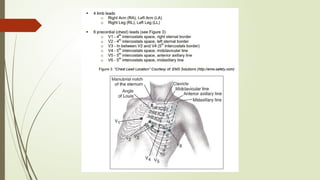
1. Identify current electrode placement for performance of a 12 lead
electrocardiogram
2. Identify the characteristics used to determine a cardiac rhythm
3. Recognize the characteristics of normal sinus rhythm
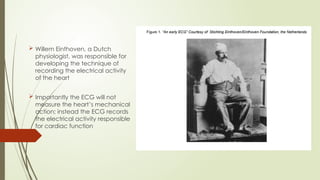
 Willem Einthoven, a Dutch
physiologist, was responsible for
developing the technique of
recording the electrical activity
of the heart
 Importantly the ECG will not
measure the heart’s mechanical
action; instead the ECG records
the electrical activity responsible
for cardiac function
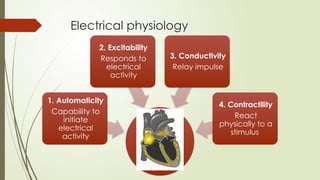
Electrical physiology
1. Automaticity
Capability to
initiate
electrical
activity
2. Excitability
Responds to
electrical
activity
3. Conductivity
Relay impulse
4. Contractility
React
physically to a
stimulus
Electrical physiology
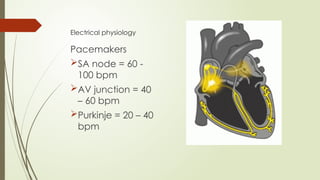
Pacemakers
SA node = 60 -
100 bpm
AV junction = 40
– 60 bpm
Purkinje = 20 – 40
bpm
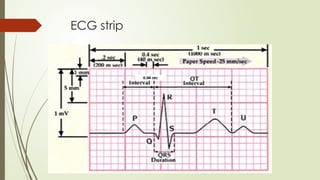
ECG strip
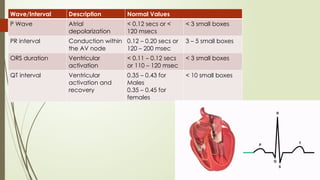
Wave/Interval Description Normal Values
P Wave Atrial
depolarization
< 0.12 secs or <
120 msecs
< 3 small boxes
PR interval Conduction within
the AV node
0.12 – 0.20 secs or
120 – 200 msec
3 – 5 small boxes
ORS duration Ventricular
activation
< 0.11 – 0.12 secs
or 110 – 120 msec
< 3 small boxes
QT interval Ventricular
activation and
recovery
0.35 – 0.43 for
Males
0.35 – 0.45 for
females
< 10 small boxes
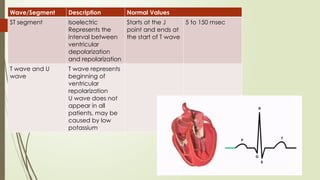
Wave/Segment Description Normal Values
ST segment Isoelectric
Represents the
interval between
ventricular
depolarization
and repolarization
Starts at the J
point and ends at
the start of T wave
5 to 150 msec
T wave and U
wave
T wave represents
beginning of
ventricular
repolarization
U wave does not
appear in all
patients, may be
caused by low
potassium
Basic ECG reading
“R-A-H-I-M”
 R – Rate, Rhythm
 A – Axis Deviation
 H – Hypertrophy
 I – Ischemia, Infarction
 M – Miscellaneous: other abnormalities
Rate
 What is the heart rate?
 R-R intervals are equal/regular?
 300 / (# of large boxes)
 1500 / (# of small boxes)
 If Irregular:
 Count the number of cardiac cycles
in 6 seconds and multiple by 10
 Bradycardia
 < 60 bpm
 Tachycardia
 > 100 bpm
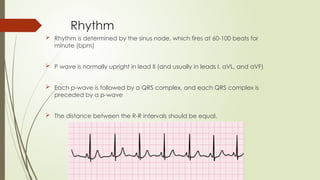
Rhythm
 Rhythm is determined by the sinus node, which fires at 60-100 beats for
minute (bpm)
 P wave is normally upright in lead II (and usually in leads I, aVL, and aVF)
 Each p-wave is followed by a QRS complex, and each QRS complex is
preceded by a p-wave
 The distance between the R-R intervals should be equal.
Axis
 Normally, the QRS axis ranges from –30° to +100°
 Computation of frontal axis
 Deduct negative deflections from positive deflections in QRS complexes to
derive the values for leads I and aVF
 If lead I is a negative integer, subtract the computed axis from 180 to get
the final axis
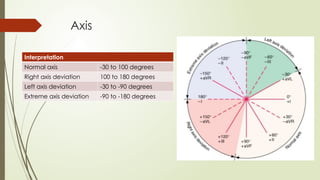
Axis
Interpretation
Normal axis -30 to 100 degrees
Right axis deviation 100 to 180 degrees
Left axis deviation -30 to -90 degrees
Extreme axis deviation -90 to -180 degrees
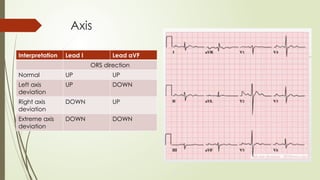
Axis
Interpretation Lead I Lead aVF
ORS direction
Normal UP UP
Left axis
deviation
UP DOWN
Right axis
deviation
DOWN UP
Extreme axis
deviation
DOWN DOWN
Left Axis Deviation
 left ventricular hypertrophy
 a block in the anterior fascicle of
the left bundle system (left
anterior fascicular block or
hemiblock)
 inferior myocardial infarction.
Right Axis Deviation
 reversal of the left and right arm
electrodes
 in conditions such as right
ventricular overload (acute or
chronic)
 infarction of the lateral wall of the
left ventricle
 Dextrocardia
 left pneumothorax
 left posterior fascicular bloc
Hypertrophy
 Left Ventricular hypertrophy
 Sokolow-Lyon Criteria:
 [S in V1] + [R in V5 or V6] > 35mm (>35 small
boxes)
 R in aVL > 11 mm
 Cornell Criteria
 S in V3 + R in aVL:
 Female >= 20mm
 Male>=28m
Hypertrophy
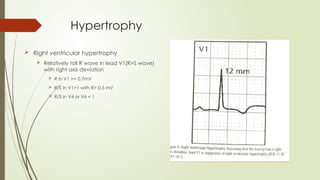
 Right ventricular hypertrophy
 Relatively tall R wave in lead V1(R>S wave)
with right axis deviation
 R in V1 >= 0.7mV
 R/S in V1>1 with R> 0.5 mV
 R/S in V4 or V6 < 1
Infarction
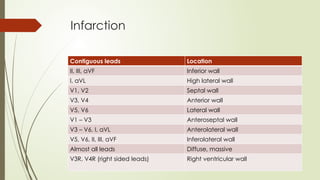
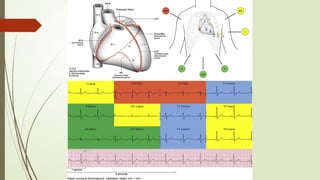
Contiguous leads Location
II, III, aVF Inferior wall
I, aVL High lateral wall
V1, V2 Septal wall
V3, V4 Anterior wall
V5, V6 Lateral wall
V1 – V3 Anteroseptal wall
V3 – V6, I, aVL Anterolateral wall
V5, V6, II, III, aVF Inferolateral wall
Almost all leads Diffuse, massive
V3R, V4R (right sided leads) Right ventricular wall
Ischemia
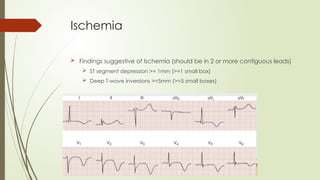
 Findings suggestive of Ischemia (should be in 2 or more contiguous leads)
 ST segment depression >= 1mm (>=1 small box)
 Deep T-wave inversions >=5mm (>=5 small boxes)
Infarction
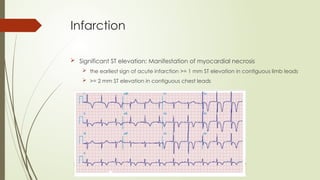
 Significant ST elevation: Manifestation of myocardial necrosis
 the earliest sign of acute infarction >= 1 mm ST elevation in contiguous limb leads
 >= 2 mm ST elevation in contiguous chest leads
Miscellaneous
Atrial Dysrhythmias
 Sinus bradycardia
 Regular rhythm with a rate below 60 bpm with normal wave morphology and
normal intervals
 Sinus tachycardia
 a regular rhythm rating between 100-160 bpm with a normal wave morphology
and normal intervals
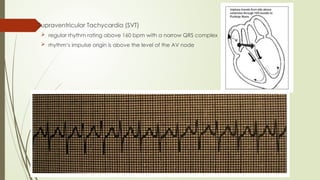
 Supraventricular Tachycardia (SVT)
 regular rhythm rating above 160 bpm with a narrow QRS complex
 rhythm’s impulse origin is above the level of the AV node
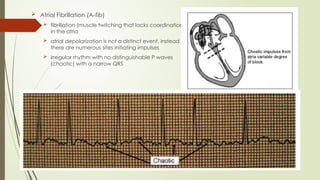
 Atrial Fibrillation (A-fib)
 fibrillation (muscle twitching that lacks coordination)
in the atria
 atrial depolarization is not a distinct event, instead
there are numerous sites initiating impulses
 irregular rhythm with no distinguishable P waves
(chaotic) with a narrow QRS
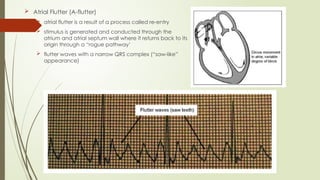
 Atrial Flutter (A-flutter)
 atrial flutter is a result of a process called re-entry
 stimulus is generated and conducted through the
atrium and atrial septum wall where it returns back to its
origin through a “rogue pathway’
 flutter waves with a narrow QRS complex (“saw-like”
appearance)
Miscellaneous
Ventricular Dysrhythmias
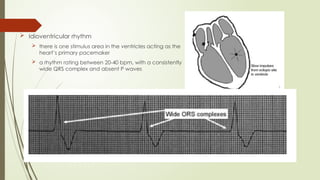
 Idioventricular rhythm
 there is one stimulus area in the ventricles acting as the
heart’s primary pacemaker
 a rhythm rating between 20-40 bpm, with a consistently
wide QRS complex and absent P waves
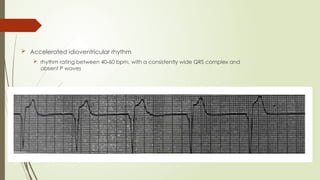
 Accelerated idioventricular rhythm
 rhythm rating between 40-60 bpm, with a consistently wide QRS complex and
absent P waves
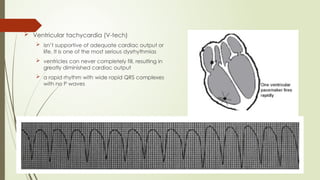
 Ventricular tachycardia (V-tech)
 isn’t supportive of adequate cardiac output or
life. It is one of the most serious dysrhythmias
 ventricles can never completely fill, resulting in
greatly diminished cardiac output
 a rapid rhythm with wide rapid QRS complexes
with no P waves
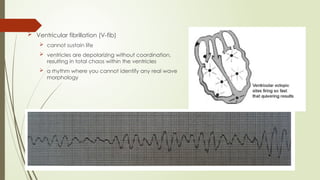
 Ventricular fibrillation (V-fib)
 cannot sustain life
 ventricles are depolarizing without coordination,
resulting in total chaos within the ventricles
 a rhythm where you cannot identify any real wave
morphology
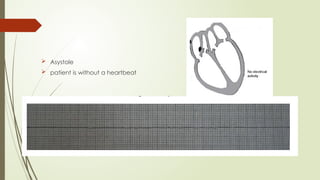
 Asystole
 patient is without a heartbeat
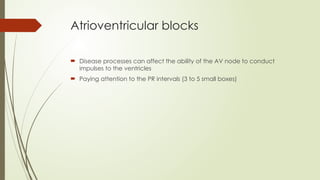
Atrioventricular blocks
 Disease processes can affect the ability of the AV node to conduct
impulses to the ventricles
 Paying attention to the PR intervals (3 to 5 small boxes)
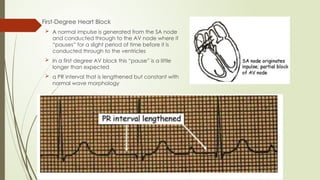
 First-Degree Heart Block
 A normal impulse is generated from the SA node
and conducted through to the AV node where it
“pauses” for a slight period of time before it is
conducted through to the ventricles
 In a first degree AV block this “pause” is a little
longer than expected
 a PR interval that is lengthened but constant with
normal wave morphology
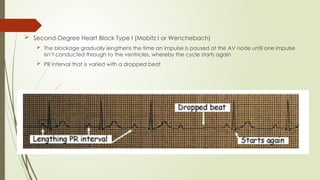
 Second-Degree Heart Block Type I (Mobitz I or Wenchebach)
 The blockage gradually lengthens the time an impulse is paused at the AV node until one impulse
isn’t conducted through to the ventricles, whereby the cycle starts again
 PR interval that is varied with a dropped beat
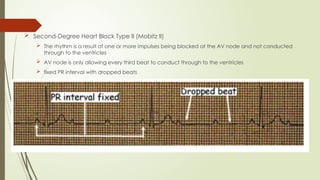
 Second-Degree Heart Block Type II (Mobitz II)
 The rhythm is a result of one or more impulses being blocked at the AV node and not conducted
through to the ventricles
 AV node is only allowing every third beat to conduct through to the ventricles
 fixed PR interval with dropped beats
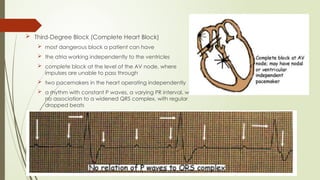
 Third-Degree Block (Complete Heart Block)
 most dangerous block a patient can have
 the atria working independently to the ventricles
 complete block at the level of the AV node, where
impulses are unable to pass through
 two pacemakers in the heart operating independently
 a rhythm with constant P waves, a varying PR interval, with
no association to a widened QRS complex, with regular
dropped beats
Thank you

ECG reading and interpretation for beginners.pptx

  • 1.
  • 2.
    Objectives 1. Identify currentelectrode placement for performance of a 12 lead electrocardiogram 2. Identify the characteristics used to determine a cardiac rhythm 3. Recognize the characteristics of normal sinus rhythm
  • 3.
     Willem Einthoven,a Dutch physiologist, was responsible for developing the technique of recording the electrical activity of the heart  Importantly the ECG will not measure the heart’s mechanical action; instead the ECG records the electrical activity responsible for cardiac function
  • 4.
    Electrical physiology 1. Automaticity Capabilityto initiate electrical activity 2. Excitability Responds to electrical activity 3. Conductivity Relay impulse 4. Contractility React physically to a stimulus
  • 6.
    Electrical physiology Pacemakers SA node= 60 - 100 bpm AV junction = 40 – 60 bpm Purkinje = 20 – 40 bpm
  • 7.
  • 8.
    Wave/Interval Description NormalValues P Wave Atrial depolarization < 0.12 secs or < 120 msecs < 3 small boxes PR interval Conduction within the AV node 0.12 – 0.20 secs or 120 – 200 msec 3 – 5 small boxes ORS duration Ventricular activation < 0.11 – 0.12 secs or 110 – 120 msec < 3 small boxes QT interval Ventricular activation and recovery 0.35 – 0.43 for Males 0.35 – 0.45 for females < 10 small boxes
  • 9.
    Wave/Segment Description NormalValues ST segment Isoelectric Represents the interval between ventricular depolarization and repolarization Starts at the J point and ends at the start of T wave 5 to 150 msec T wave and U wave T wave represents beginning of ventricular repolarization U wave does not appear in all patients, may be caused by low potassium
  • 10.
    Basic ECG reading “R-A-H-I-M” R – Rate, Rhythm  A – Axis Deviation  H – Hypertrophy  I – Ischemia, Infarction  M – Miscellaneous: other abnormalities
  • 11.
    Rate  What isthe heart rate?  R-R intervals are equal/regular?  300 / (# of large boxes)  1500 / (# of small boxes)  If Irregular:  Count the number of cardiac cycles in 6 seconds and multiple by 10  Bradycardia  < 60 bpm  Tachycardia  > 100 bpm
  • 12.
    Rhythm  Rhythm isdetermined by the sinus node, which fires at 60-100 beats for minute (bpm)  P wave is normally upright in lead II (and usually in leads I, aVL, and aVF)  Each p-wave is followed by a QRS complex, and each QRS complex is preceded by a p-wave  The distance between the R-R intervals should be equal.
  • 13.
    Axis  Normally, theQRS axis ranges from –30° to +100°  Computation of frontal axis  Deduct negative deflections from positive deflections in QRS complexes to derive the values for leads I and aVF  If lead I is a negative integer, subtract the computed axis from 180 to get the final axis
  • 14.
    Axis Interpretation Normal axis -30to 100 degrees Right axis deviation 100 to 180 degrees Left axis deviation -30 to -90 degrees Extreme axis deviation -90 to -180 degrees
  • 15.
    Axis Interpretation Lead ILead aVF ORS direction Normal UP UP Left axis deviation UP DOWN Right axis deviation DOWN UP Extreme axis deviation DOWN DOWN
  • 16.
    Left Axis Deviation left ventricular hypertrophy  a block in the anterior fascicle of the left bundle system (left anterior fascicular block or hemiblock)  inferior myocardial infarction. Right Axis Deviation  reversal of the left and right arm electrodes  in conditions such as right ventricular overload (acute or chronic)  infarction of the lateral wall of the left ventricle  Dextrocardia  left pneumothorax  left posterior fascicular bloc
  • 17.
    Hypertrophy  Left Ventricularhypertrophy  Sokolow-Lyon Criteria:  [S in V1] + [R in V5 or V6] > 35mm (>35 small boxes)  R in aVL > 11 mm  Cornell Criteria  S in V3 + R in aVL:  Female >= 20mm  Male>=28m
  • 18.
    Hypertrophy  Right ventricularhypertrophy  Relatively tall R wave in lead V1(R>S wave) with right axis deviation  R in V1 >= 0.7mV  R/S in V1>1 with R> 0.5 mV  R/S in V4 or V6 < 1
  • 19.
    Infarction Contiguous leads Location II,III, aVF Inferior wall I, aVL High lateral wall V1, V2 Septal wall V3, V4 Anterior wall V5, V6 Lateral wall V1 – V3 Anteroseptal wall V3 – V6, I, aVL Anterolateral wall V5, V6, II, III, aVF Inferolateral wall Almost all leads Diffuse, massive V3R, V4R (right sided leads) Right ventricular wall
  • 21.
    Ischemia  Findings suggestiveof Ischemia (should be in 2 or more contiguous leads)  ST segment depression >= 1mm (>=1 small box)  Deep T-wave inversions >=5mm (>=5 small boxes)
  • 22.
    Infarction  Significant STelevation: Manifestation of myocardial necrosis  the earliest sign of acute infarction >= 1 mm ST elevation in contiguous limb leads  >= 2 mm ST elevation in contiguous chest leads
  • 23.
  • 24.
     Sinus bradycardia Regular rhythm with a rate below 60 bpm with normal wave morphology and normal intervals  Sinus tachycardia  a regular rhythm rating between 100-160 bpm with a normal wave morphology and normal intervals
  • 25.
     Supraventricular Tachycardia(SVT)  regular rhythm rating above 160 bpm with a narrow QRS complex  rhythm’s impulse origin is above the level of the AV node
  • 26.
     Atrial Fibrillation(A-fib)  fibrillation (muscle twitching that lacks coordination) in the atria  atrial depolarization is not a distinct event, instead there are numerous sites initiating impulses  irregular rhythm with no distinguishable P waves (chaotic) with a narrow QRS
  • 27.
     Atrial Flutter(A-flutter)  atrial flutter is a result of a process called re-entry  stimulus is generated and conducted through the atrium and atrial septum wall where it returns back to its origin through a “rogue pathway’  flutter waves with a narrow QRS complex (“saw-like” appearance)
  • 28.
  • 29.
     Idioventricular rhythm there is one stimulus area in the ventricles acting as the heart’s primary pacemaker  a rhythm rating between 20-40 bpm, with a consistently wide QRS complex and absent P waves
  • 30.
     Accelerated idioventricularrhythm  rhythm rating between 40-60 bpm, with a consistently wide QRS complex and absent P waves
  • 31.
     Ventricular tachycardia(V-tech)  isn’t supportive of adequate cardiac output or life. It is one of the most serious dysrhythmias  ventricles can never completely fill, resulting in greatly diminished cardiac output  a rapid rhythm with wide rapid QRS complexes with no P waves
  • 32.
     Ventricular fibrillation(V-fib)  cannot sustain life  ventricles are depolarizing without coordination, resulting in total chaos within the ventricles  a rhythm where you cannot identify any real wave morphology
  • 33.
     Asystole  patientis without a heartbeat
  • 34.
    Atrioventricular blocks  Diseaseprocesses can affect the ability of the AV node to conduct impulses to the ventricles  Paying attention to the PR intervals (3 to 5 small boxes)
  • 35.
     First-Degree HeartBlock  A normal impulse is generated from the SA node and conducted through to the AV node where it “pauses” for a slight period of time before it is conducted through to the ventricles  In a first degree AV block this “pause” is a little longer than expected  a PR interval that is lengthened but constant with normal wave morphology
  • 36.
     Second-Degree HeartBlock Type I (Mobitz I or Wenchebach)  The blockage gradually lengthens the time an impulse is paused at the AV node until one impulse isn’t conducted through to the ventricles, whereby the cycle starts again  PR interval that is varied with a dropped beat
  • 37.
     Second-Degree HeartBlock Type II (Mobitz II)  The rhythm is a result of one or more impulses being blocked at the AV node and not conducted through to the ventricles  AV node is only allowing every third beat to conduct through to the ventricles  fixed PR interval with dropped beats
  • 38.
     Third-Degree Block(Complete Heart Block)  most dangerous block a patient can have  the atria working independently to the ventricles  complete block at the level of the AV node, where impulses are unable to pass through  two pacemakers in the heart operating independently  a rhythm with constant P waves, a varying PR interval, with no association to a widened QRS complex, with regular dropped beats
  • 39.

Editor's Notes

  • #4 Automaticity Excitability Conductivity Contractility
  • #6 For the heart to perform a beat, a signal must be sent through the heart telling its muscle to work (contract).