ECG
HARINI.V
2ND MSC ZOOLOGY
We are probably familiar with this scene from a typical hospital
television shows ; a patient is hooked up to a monitoring machine
that shows voltage traces on a screen and makes the sound
‘…pip…pip…pip….peeeeeeeeeeeee’ as the patient goes into cardiac
arrest. This type of machine (electro-cardiograph)is used to obtain
an electrocardiogram (ECG)
ECG - ELECTROCARDIOGRAM
ELECTRO – ELECTRICITY
CARDIO- HEART
GRAM- VISUALIZE
A medical device which is used to measure and monitor the rate and
regularity of heartbeats.
The heart is made to beat by an electrical impulse orginating in the
sinus auricular node.
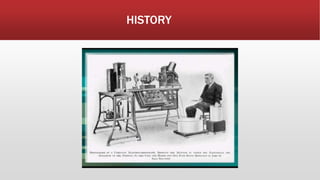
EINTHEN WILLEM is the FATHER OF ECG
HISTORY
HISTORY
▪ 1842- Italian scientist Carlo Matteucci realizes that electricity is
associated with the heart beat.
▪ 1876- Irish scientist Marey analyses the electric pattern of frog’s
heart.
▪ 1895- William Einthoven , credited for the invention of EKG
▪ 1906- using the string electrometer EKG, William Einthoven
diagnoses some heart problem.
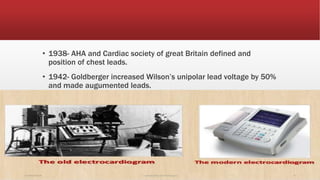
• 1938- AHA and Cardiac society of great Britain defined and
position of chest leads.
• 1942- Goldberger increased Wilson’s unipolar lead voltage by 50%
and made augumented leads.
INDICATIONS
▪ Myocardial infarction & other types of CAD such as angina
▪ Cardiac dysrhythmias
▪ Cardiac enlargement
▪ Inflammatory diseases of the heart
▪ Effects on the heart by drugs, such as antiarrythmics.
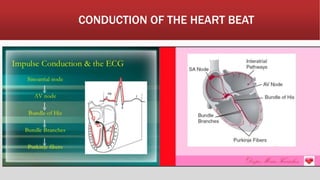
CONDUCTION OF THE HEART BEAT
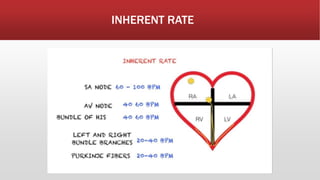
INHERENT RATE
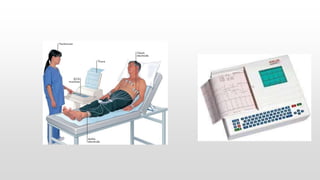
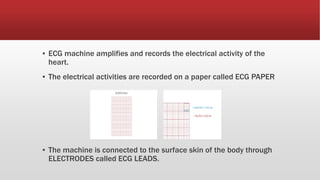
▪ ECG machine amplifies and records the electrical activity of the
heart.
▪ The electrical activities are recorded on a paper called ECG PAPER
▪ The machine is connected to the surface skin of the body through
ELECTRODES called ECG LEADS.
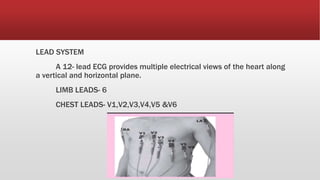
LEAD SYSTEM
A 12- lead ECG provides multiple electrical views of the heart along
a vertical and horizontal plane.
LIMB LEADS- 6
CHEST LEADS- V1,V2,V3,V4,V5 &V6
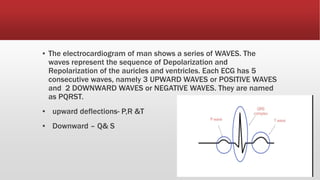
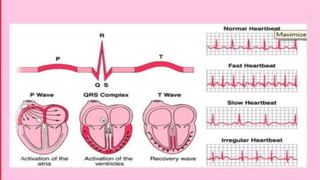
▪ The electrocardiogram of man shows a series of WAVES. The
waves represent the sequence of Depolarization and
Repolarization of the auricles and ventricles. Each ECG has 5
consecutive waves, namely 3 UPWARD WAVES or POSITIVE WAVES
and 2 DOWNWARD WAVES or NEGATIVE WAVES. They are named
as PQRST.
▪ upward deflections- P,R &T
▪ Downward – Q& S
Add a Slide Title - 2
P WAVE
▪ Positive wave
▪ It is also called as ATRIAL COMPLEX
▪ FIRST WAVE
▪ It represents the wave of DEPOLARISATION that spreads from
SINOAURICULAR NODE throughout auricles.
▪ It is a small wave with a rounded top.
▪ It takes place when the impulse spreads over the atrial chambers.
▪ Average duration- 0.1 second
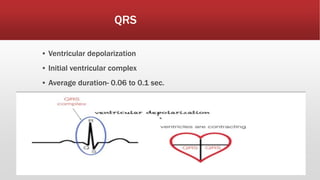
QRS
▪ Ventricular depolarization
▪ Initial ventricular complex
▪ Average duration- 0.06 to 0.1 sec.
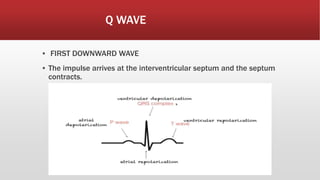
Q WAVE
▪ FIRST DOWNWARD WAVE
▪ The impulse arrives at the interventricular septum and the septum
contracts.
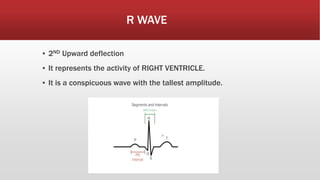
R WAVE
▪ 2ND Upward deflection
▪ It represents the activity of RIGHT VENTRICLE.
▪ It is a conspicuous wave with the tallest amplitude.
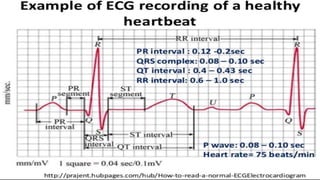
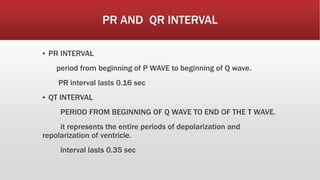
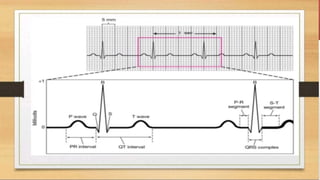
PR AND QR INTERVAL
▪ PR INTERVAL
period from beginning of P WAVE to beginning of Q wave.
PR interval lasts 0.16 sec
▪ QT INTERVAL
PERIOD FROM BEGINNING OF Q WAVE TO END OF THE T WAVE.
it represents the entire periods of depolarization and
repolarization of ventricle.
interval lasts 0.35 sec
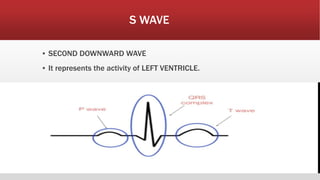
S WAVE
▪ SECOND DOWNWARD WAVE
▪ It represents the activity of LEFT VENTRICLE.
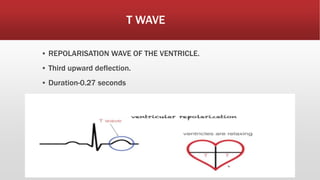
T WAVE
▪ REPOLARISATION WAVE OF THE VENTRICLE.
▪ Third upward deflection.
▪ Duration-0.27 seconds
USES OF ECG
▪ Heart beat rate
▪ Heart rhythm
▪ Abnormal electrical conduction
▪ Poor blood flow to heart muscles
▪ Heart attack
▪ Position of chambers
▪ Coronary artery disease
▪ Effect of drugs
THANK YOU

ECG

  • 1.
  • 2.
    We are probablyfamiliar with this scene from a typical hospital television shows ; a patient is hooked up to a monitoring machine that shows voltage traces on a screen and makes the sound ‘…pip…pip…pip….peeeeeeeeeeeee’ as the patient goes into cardiac arrest. This type of machine (electro-cardiograph)is used to obtain an electrocardiogram (ECG)
  • 3.
    ECG - ELECTROCARDIOGRAM ELECTRO– ELECTRICITY CARDIO- HEART GRAM- VISUALIZE A medical device which is used to measure and monitor the rate and regularity of heartbeats. The heart is made to beat by an electrical impulse orginating in the sinus auricular node. EINTHEN WILLEM is the FATHER OF ECG
  • 4.
  • 5.
    HISTORY ▪ 1842- Italianscientist Carlo Matteucci realizes that electricity is associated with the heart beat. ▪ 1876- Irish scientist Marey analyses the electric pattern of frog’s heart. ▪ 1895- William Einthoven , credited for the invention of EKG ▪ 1906- using the string electrometer EKG, William Einthoven diagnoses some heart problem.
  • 7.
    • 1938- AHAand Cardiac society of great Britain defined and position of chest leads. • 1942- Goldberger increased Wilson’s unipolar lead voltage by 50% and made augumented leads.
  • 9.
    INDICATIONS ▪ Myocardial infarction& other types of CAD such as angina ▪ Cardiac dysrhythmias ▪ Cardiac enlargement ▪ Inflammatory diseases of the heart ▪ Effects on the heart by drugs, such as antiarrythmics.
  • 10.
  • 11.
  • 12.
    ▪ ECG machineamplifies and records the electrical activity of the heart. ▪ The electrical activities are recorded on a paper called ECG PAPER ▪ The machine is connected to the surface skin of the body through ELECTRODES called ECG LEADS.
  • 13.
    LEAD SYSTEM A 12-lead ECG provides multiple electrical views of the heart along a vertical and horizontal plane. LIMB LEADS- 6 CHEST LEADS- V1,V2,V3,V4,V5 &V6
  • 14.
    ▪ The electrocardiogramof man shows a series of WAVES. The waves represent the sequence of Depolarization and Repolarization of the auricles and ventricles. Each ECG has 5 consecutive waves, namely 3 UPWARD WAVES or POSITIVE WAVES and 2 DOWNWARD WAVES or NEGATIVE WAVES. They are named as PQRST. ▪ upward deflections- P,R &T ▪ Downward – Q& S
  • 15.
    Add a SlideTitle - 2
  • 16.
    P WAVE ▪ Positivewave ▪ It is also called as ATRIAL COMPLEX ▪ FIRST WAVE ▪ It represents the wave of DEPOLARISATION that spreads from SINOAURICULAR NODE throughout auricles. ▪ It is a small wave with a rounded top. ▪ It takes place when the impulse spreads over the atrial chambers. ▪ Average duration- 0.1 second
  • 17.
    QRS ▪ Ventricular depolarization ▪Initial ventricular complex ▪ Average duration- 0.06 to 0.1 sec.
  • 18.
    Q WAVE ▪ FIRSTDOWNWARD WAVE ▪ The impulse arrives at the interventricular septum and the septum contracts.
  • 19.
    R WAVE ▪ 2NDUpward deflection ▪ It represents the activity of RIGHT VENTRICLE. ▪ It is a conspicuous wave with the tallest amplitude.
  • 20.
    PR AND QRINTERVAL ▪ PR INTERVAL period from beginning of P WAVE to beginning of Q wave. PR interval lasts 0.16 sec ▪ QT INTERVAL PERIOD FROM BEGINNING OF Q WAVE TO END OF THE T WAVE. it represents the entire periods of depolarization and repolarization of ventricle. interval lasts 0.35 sec
  • 21.
    S WAVE ▪ SECONDDOWNWARD WAVE ▪ It represents the activity of LEFT VENTRICLE.
  • 22.
    T WAVE ▪ REPOLARISATIONWAVE OF THE VENTRICLE. ▪ Third upward deflection. ▪ Duration-0.27 seconds
  • 23.
    USES OF ECG ▪Heart beat rate ▪ Heart rhythm ▪ Abnormal electrical conduction ▪ Poor blood flow to heart muscles ▪ Heart attack ▪ Position of chambers ▪ Coronary artery disease ▪ Effect of drugs
  • 26.