https://www.netcomlearning.com/
EC-Council
Certification RoadMap
&
Course Catalog
Call to register: 888-563-8266
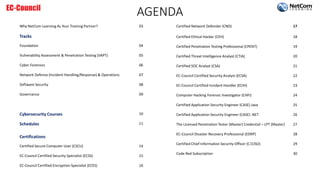
AGENDA
Why NetCom Learning As Your Training Partner? 03
Tracks
Foundation 04
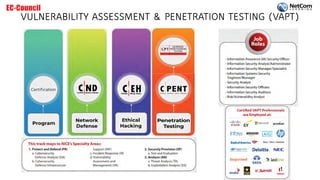
Vulnerability Assessment & Penetration Testing (VAPT) 05
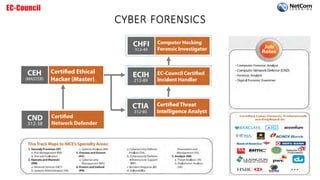
Cyber Forensics 06
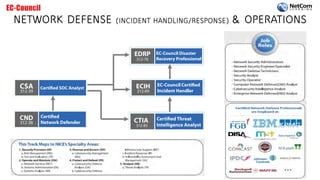
Network Defense (Incident Handling/Response) & Operations 07
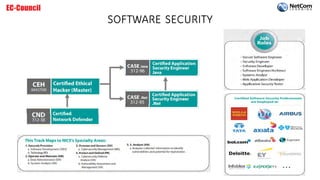
Software Security 08
Governance 09
Cybersecurity Courses 10
Schedules 11
Certifications
Certified Secure Computer User (CSCU) 14
EC-Council Certified Security Specialist (ECSS) 15
EC-Council Certified Encryption Specialist (ECES) 16
Certified Network Defender (CND) 17
Certified Ethical Hacker (CEH) 18
Certified Penetration Testing Professional (CPENT) 19
Certified Threat Intelligence Analyst (CTIA) 20
Certified SOC Analyst (CSA) 21
EC-Council Certified Security Analyst (ECSA) 22
EC-Council Certified Incident Handler (ECIH) 23
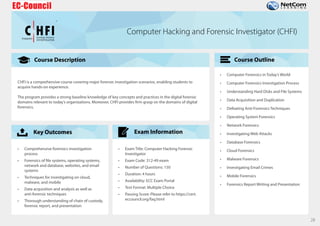
Computer Hacking Forensic Investigator (CHFI) 24
Certified Application Security Engineer (CASE) Java 25
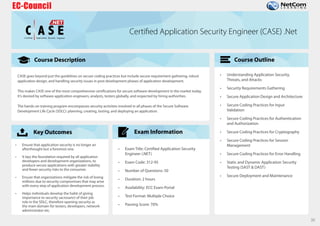
Certified Application Security Engineer (CASE) .NET 26
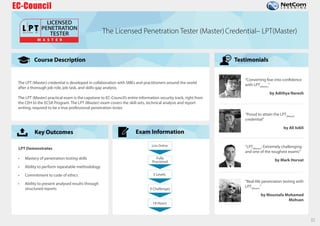
The Licensed Penetration Tester (Master) Credential – LPT (Master) 27
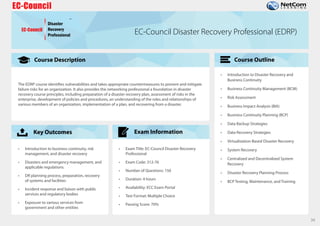
EC-Council Disaster Recovery Professional (EDRP) 28
Certified Chief Information Security Officer (C|CISO) 29
Code Red Subscription 30
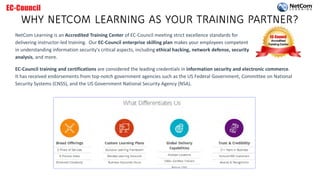
WHY NETCOM LEARNING AS YOUR TRAINING PARTNER?
NetCom Learning is an Accredited Training Center of EC-Council meeting strict excellence standards for
delivering instructor-led training. Our EC-Council enterprise skilling plan makes your employees competent
in understanding information security's critical aspects, including ethical hacking, network defense, security
analysis, and more.
EC-Council training and certifications are considered the leading credentials in information security and electronic commerce.
It has received endorsements from top-notch government agencies such as the US Federal Government, Committee on National
Security Systems (CNSS), and the US Government National Security Agency (NSA).
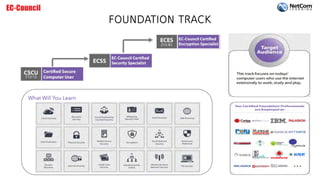
FOUNDATION TRACK
What Will You Learn
VULNERABILITY ASSESSMENT & PENETRATION TESTING (VAPT)
CYBER FORENSICS
NETWORK DEFENSE (INCIDENT HANDLING/RESPONSE) & OPERATIONS
SOFTWARE SECURITY
GOVERNANCE
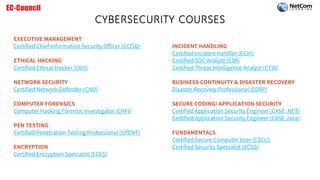
CYBERSECURITY COURSES
EXECUTIVE MANAGEMENT
Certified Chief Information Security Officer (CCISO)
ETHICAL HACKING
Certified Ethical Hacker (CEH)
NETWORK SECURITY
Certified Network Defender (CND)
COMPUTER FORENSICS
Computer Hacking Forensic Investigator (CHFI)
PEN TESTING
Certified Penetration Testing Professional (CPENT)
ENCRYPTION
Certified Encryption Specialist (ECES)
INCIDENT HANDLING
Certified Incident Handler (ECIH)
Certified SOC Analyst (CSA)
Certified Threat Intelligence Analyst (CTIA)
BUSINESS CONTINUITY & DISASTER RECOVERY
Disaster Recovery Professional (EDRP)
SECURE CODING/ APPLICATION SECURITY
Certified Application Security Engineer (CASE .NET)
Certified Application Security Engineer (CASE Java)
FUNDAMENTALS
Certified Secure Computer User (CSCU)
Certified Security Specialist (ECSS)
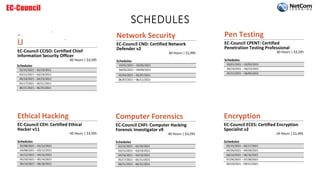
SCHEDULES
džĞĐƵƚŝǀĞ
DĂŶĂŐĞŵĞŶƚ
EC-Council CCISO: Certified Chief
Information Security Officer
40 Hours | $3,595
Ethical Hacking
EC-Council CEH: Certified Ethical
Hacker v11
40 Hours | $3,595
Schedules
02/08/2021 – 02/12/2021
03/08/2021 – 03/12/2021
04/12/2021 – 04/16/2021
05/10/2021 – 05/14/2021
06/14/2021 – 06/18/2021
Network Security
EC-Council CND: Certified Network
Defender v2
40 Hours | $2,995
Schedules
03/01/2021 – 03/05/2021
04/05/2021 – 04/09/2021
05/03/2021 – 05/07/2021
06/07/2021 – 06/11/2021
Computer Forensics
EC-Council CHFI: Computer Hacking
Forensic Investigator v9
40 Hours | $3,295
Schedules
02/22/2021 – 02/26/2021
03/15/2021 – 03/19/2021
04/19/2021 – 04/23/2021
05/17/2021 – 05/21/2021
06/21/2021 – 06/25/2021
Pen Testing
EC-Council CPENT: Certified
Penetration Testing Professional
40 Hours | $3,595
Schedules
03/01/2021 – 03/05/2021
04/19/2021 – 04/23/2021
05/31/2021 – 06/04/2021
Encryption
EC-Council ECES: Certified Encryption
Specialist v2
24 Hours | $1,495
Schedules
03/15/2021 – 03/17/2021
04/26/2021 – 04/28/2021
06/14/2021 – 06/16/2021
07/26/2021 – 07/28/2021
09/20/2021 – 09/22/2021
Schedules
02/15/2021 – 02/19/2021
03/15/2021 – 03/19/2021
04/19/2021 – 04/23/2021
05/17/2021 – 05/21/2021
06/21/2021 – 06/25/2021
SCHEDULES
Incident Handling
EC-Council ECIH: Certified Incident
Handler
24 Hours | $2,995
Schedules
04/12/2021 – 04/14/2021
05/24/2021 – 05/26/2021
06/28/2021 – 06/30/2021
EC-Council CSA: Certified SOC Analyst
24 Hours | $2,495
Schedules
03/08/2021 – 03/10/2021
04/12/2021 – 04/14/2021
05/10/2021 – 05/12/2021
06/14/2021 – 06/16/2021
EC-Council CTIA: Certified Threat
Intelligence Analyst
24 Hours | $2,995
Schedules
03/01/2021 – 03/03/2021
04/26/2021 – 04/28/2021
06/07/2021 – 06/09/2021
Disaster Recovery
EC-Council EDRP: Disaster Recovery
Professional v3
40 Hours | $3,595
Schedules
03/15/2021 – 03/19/2021
05/03/2021 – 05/07/2021
06/21/2021 – 06/25/2021
Secure Coding/
Application Security
EC-Council CASE .NET: Certified
Application Security Engineer
24 Hours | $1,495
Schedules
03/15/2021 – 03/17/2021
04/19/2021 – 04/21/2021
05/17/2021 – 05/19/2021
06/21/2021 – 06/23/2021
EC-Council CASE JAVA: Certified
Application Security Engineer
24 Hours | $1,495
Schedules
03/22/2021 – 03/24/2021
04/26/2021 – 04/28/2021
05/24/2021 – 05/26/2021
06/28/2021 – 06/30/2021
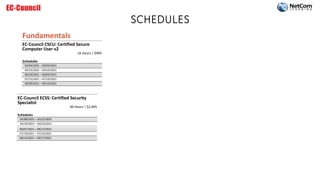
SCHEDULES
Fundamentals
EC-Council CSCU: Certified Secure
Computer User v2
16 Hours | $995
Schedules
03/04/2021 – 03/05/2021
04/15/2021 – 04/16/2021
06/03/2021 – 06/04/2021
07/15/2021 – 07/16/2021
09/09/2021 – 09/10/2021
EC-Council ECSS: Certified Security
Specialist
40 Hours | $2,495
Schedules
03/08/2021 – 03/12/2021
04/19/2021 – 04/23/2021
06/07/2021 – 06/11/2021
07/19/2021 – 07/23/2021
09/13/2021 – 09/17/2021
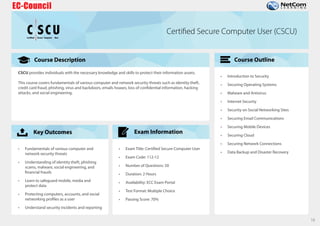
Course Description
Key Outcomes
Course Outline
Exam Information
16
C
Certified Secure Computer User
CU
S Certified Secure Computer User (CSCU)
CSCU provides individuals with the necessary knowledge and skills to protect their information assets.
This course covers fundamentals of various computer and network security threats such as identity theft,
credit card fraud, phishing, virus and backdoors, emails hoaxes, loss of confidential information, hacking
attacks, and social engineering.
• Fundamentals of various computer and
network security threats
• Understanding of identity theft, phishing
scams, malware, social engineering, and
financial frauds
• Learn to safeguard mobile, media and
protect data
• Protecting computers, accounts, and social
networking profiles as a user
• Understand security incidents and reporting
• Exam Title: Certified Secure Computer User
• Exam Code: 112-12
• Number of Questions: 50
• Duration: 2 Hours
• Availability: ECC Exam Portal
• Test Format: Multiple Choice
• Passing Score: 70%
• Introduction to Security
• Securing Operating Systems
• Malware and Antivirus
• Internet Security
• Security on Social Networking Sites
• Securing Email Communications
• Securing Mobile Devices
• Securing Cloud
• Securing Network Connections
• Data Backup and Disaster Recovery
Course Description
Key Outcomes
Course Outline
Exam Information
17
E C S S
EC-Council Certified Security Specialist
T M
EC-Council Certified Security Specialist (ECSS)
EC-Council Certified Security Specialist (ECSS) is an entry level security program covering the fundamental
concepts of information security, computer forensics, and network security. It enables students to identify
information security threats which reflect on the security posture of the organization and implement
general security controls.
This program will give a holistic overview of the key components of information security, computer
forensics, and network security. This program provides a solid fundamental knowledge required for a career
in information security.
• It facilitates your entry into the world of
Information Security
• It provides professional understanding
about the concepts of Information Security,
Network Security, and Computer Forensics
• It provides best practices to improve
organizational security posture
• It enhances your skills as a Security Specialist
and increases your employability
• Exam Title: EC-Council Certified Security
Specialist
• Exam Code: ECSS
• Number of Questions: 50
• Duration: 2 hours
• Availability: ECC Exam Portal
• Test Format: Multiple Choice
• Passing Score: 70%
• Information Security Fundamentals
• Networking Fundamentals
• Secure Network Protocols
• Information Security Threats and Attacks
• Social Engineering
• Hacking Cycle
• Identification, Authentication, and
Authorization
• Cryptography
• Firewalls
• Intrusion Detection System
• Data Backup
• Virtual Private Network
• Wireless Network Security
• Web Security
• Ethical Hacking and Pen Testing
• Incident Response
• Computer Forensics Fundamentals
• Digital Evidence
• Understanding File Systems
• Windows Forensics
• Network Forensics and Investigating
Network Traffic
• Steganography
• Analyzing Logs
• E-mail Crime and Computer Forensics
• Writing Investigative Report
Course Description
Key Outcomes
Course Outline
Exam Information
18
EC-Council Certified Encryption Specialist (ECES)
The EC-Council Certified Encryption Specialist (ECES) program introduces professionals and students
to the field of cryptography. The participants will learn the foundations of modern symmetric and key
cryptography including the details of algorithms such as Feistel Functions, DES, and AES.
• Develop skills to protect critical data in
organizations with encryption
• Develop a deep understanding of essential
cryptography algorithms and their
applications
• Make informed decisions about applying
encryption technologies
• Save time and cost by avoiding common
mistakes in implementing encryption
technologies effectively
• Develop working knowledge of cryptanalysis
• Exam Title: EC-Council Certified Encryption
Specialist
• Exam Code: 212-81
• Number of Questions: 50
• Duration: 2 hours
• Availability: ECC Exam Portal
• Test Format: Multiple Choice
• Passing Score: 70%
• Introduction and History of Cryptography
• Symmetric Cryptography and Hashes
• Number Theory and Asymmetric
Cryptography
• Applications of Cryptography
• Cryptanalysis
Course Description
Key Outcomes
Course Outline
Exam Information
19
Certified
D
Network Defender
N
C Certified Network Defender (CND)
The CND certification program focuses on training Network Administrators to protect, detect, respond
to, and predict threats on the network. This builds upon the typical knowledge and skills of Network
Administrators in network components, traffic, performance and utilization, network topology, system
locations, and security policies.
• Exam Title: Certified Network Defender
• Exam Code: 312-38
• Number of Questions: 100
• Duration: 4 hours
• Availability: ECC Exam Portal
• Test Format: Multiple Choice
• Passing Score: Please refer to
https://cert.eccouncil.org/faq.html
• Adaptive Security Strategy - Protect,
Detect, Respond, and Predict.
• IoT Security - challenges and measures to
mitigate.
• Implementing and managing the security
of virtualization technologies.
• Mobile security measures and enterprise
mobile device security.
• Cloud security with enterprise cloud
security.
• Threat intelligence concepts
Module 01: Network Attacks and Defense
Strategies
Module 02: Administrative Network Security
Module 03: Technical Network Security
Module 04: Network Perimeter Security
Module 05: Endpoint Security-Windows
Systems
Module 06: Endpoint Security-Linux Systems
Module 07: Endpoint Security- Mobile Devices
Module 08: Endpoint Security-IoT Devices
Module 09: Administrative Application Security
Module 10: Data Security
Module 11: Enterprise Virtual Network Security
Module 12: Enterprise Cloud Network Security
Module 13: Enterprise Wireless Network
Security
Module 14: Network Traffic Monitoring and
Analysis
Module 15: Network Logs Monitoring and
Analysis
Module 16: Incident Response and Forensic
Investigation
Module 17: Business Continuity and Disaster
Recovery
Module 18: Risk Anticipation with Risk
Management
Module 19: Threat Assessment with Attack
Surface Analysis
Module 20: Threat Prediction with Cyber Threat
Intelligence
Course Description
Key Outcomes
Course Outline
Exam Information
20
C EH
TM
Certified Ethical Hacker
Certified Ethical Hacker (C|EH)
CEH is the leading ethical hacking training and certification program in cybersecurity. Students audit a
system for weaknesses and vulnerabilities using the same tools and exploits as malicious hackers, but
under proper legal circumstances and in the best interest of assessing the security posture of a target
system and organization. It teaches how hackers think and act maliciously so you can learn to better
position your organization’s security infrastructure and defend against future attacks.
• Thorough introduction to ethical hacking
• Exposure to threat vectors and
countermeasures
• Addresses emerging areas of IoT, cloud and
mobile hacking
• Prepares you to combat Trojans, malware,
backdoors, and more
• Enables you to hack using mobile
• Exam Title: Certified Ethical Hacker (ANSI)
• Exam Code: 312-50 (ECC EXAM), 312-50
(VUE)
• Number of Questions: 125
• Duration: 4 hours
• Availability: ECC Exam Portal, VUE
• Test Format: Multiple Choice
• Passing Score: Please refer to
https://cert.eccouncil.org/faq.html
• Introduction to Ethical Hacking
• Footprinting and Reconnaissance
• Scanning Networks
• Enumeration
• Vulnerability Analysis
• System Hacking
• Malware Threats
• Sniffing
• Social Engineering
• Denial-of-Service
• Session Hijacking
• Evading IDS, Firewalls, and Honeypots
• Hacking Web Servers
• Hacking Web Applications
• SQL Injection
• Hacking Wireless Networks
• Hacking Mobile Platforms
• IoT Hacking
• Cloud Computing
• Cryptography
Course Description
Key Outcomes
Course Outline
Exam Information
22
Certified Penetration Testing Professional (CPENT)
Rewriting the standards of penetration testing skill development with the Certified Penetration Testing
Professional or the CPENT certification program, for short. What makes this program unique is our approach
that provides you a chance to attain 2 certifications with just one exam. The key philosophy behind the
CPENT is simple – a penetration tester is as good as their skills, that’s why we urge you to go beyond kali,
and go beyond tools. Not that we don’t believe in the OS or tools. Candidates with an over-reliance on Kali
tools, will find it incredibly difficult to adapt to the multi-disciplinary approach of the real-world penetration
testing engagements. We urge you to still go beyond and explore the vast horizons of penetration testing
that differentiate the great from the good.
• 100% mapped with the NICE framework.
• Comes Blended with both manual and automated
penetration testing approach
• Maps to the job role of a penetration tester and
security analyst, based on major job portals.
• Gives a real-world experience through an Advanced
Penetration Testing Range.
• 100% methodology-based penetration testing
program.
• Is designed based on the most common
penetration testing services offered by the best
service providers in the market.
• Provides strong reporting writing guidance.
• Offers standard templates that can help during a
penetration test.
A Hands-On Exam Like No Other.
The 24 hours that will define your career
CPENT is a fully online, remotely proctored practical
exam, which challenges candidates through a
gruelling 24-hour performance-based, hands-on
exam, categorized into 2 practical exams of 12-hours
each, which will test your perseverance and focus by
forcing you to outdo yourself with each new challenge.
Candidates have the option to choose either 2 12-
hour exams or one 24-hour exam depending on how
straining they would want the exam to be.
Candidates who score more than 90%, will establish
themselves as Penetration Testing Masters and will
therefore win a chance to attain the prestigious LPT
(Master) credential!
• Module 01: Introduction to Penetration
Testing
• Module 02: Penetration Testing Scoping and
Engagement
• Module 03: Open Source Intelligence
(OSINT)
• Module 04: Social Engineering Penetration
Testing
• Module 05: Network Penetration Testing –
External
• Module 06: Network Penetration Testing–
Internal
• Module 07: Network Penetration Testing –
Perimeter Devices
• Module 08: Web Application Penetration
Testing
• Module 09: Wireless Penetration Testing
• Module 10: IoT Penetration Testing
• Module 11: OT/SCADA Penetration Testing
• Module 12: Cloud Penetration Testing
• Module 13: Binary Analysis and Exploitation
• Module 14: Report Writing and Post Testing
Actions
Course Description
Key Outcomes
Course Outline
Exam Information
23
Certified
IA
Threat Intelligence Analyst
C T Certified Threat Intelligence Analyst (CTIA)
C|TIA is a method-driven program that uses a holistic approach, covering concepts from planning the
threat intelligence project to building a report to disseminating threat intelligence. These concepts
are highly essential while building effective threat intelligence and, when used properly, can secure
organizations from future threats or attacks.
This program addresses all the stages involved in the Threat Intelligence Life Cycle. This attention to
a realistic and futuristic approach makes C|TIA one of the most comprehensive threat intelligence
certifications on the market today.
• Enable individuals and organizations with the ability
to prepare and run a threat intelligence program
that allows evidence-based knowledge and provides
actionable advice about existing and unknown threats
• Ensure that organizations have predictive capabilities
rather than just proactive measures beyond active
defense mechanism
• Empower information security professionals with
the skills to develop a professional, systematic, and
repeatable real-life threat intelligence program
• Differentiate threat intelligence professionals from
other information security professionals
• Provide an invaluable ability of structured threat
intelligence to enhance skills and boost their
employability
• Exam Title: Certified Threat Intelligence
Analyst
• Exam Code: 312-85
• Number of Questions: 50
• Duration: 2 hours
• Availability: EC-Council Exam Portal
• Test Format: Multiple Choice
• Passing Score: 70%
• Introduction to Threat Intelligence
• Cyber Threats and Kill Chain Methodology
• Requirements, Planning, Direction, and
Review
• Data Collection and Processing
• Data Analysis
• Intelligence Reporting and Dissemination
Course Description
Key Outcomes
Course Outline
Exam Information
24
Certified SOC Analyst (CSA)
The Certified SOC Analyst (CSA) program is the first step to joining a security operations center (SOC). It is engineered
for current and aspiring Tier I and Tier II SOC analysts to achieve proficiency in performing entrylevel and intermediate-
level operations. CSA is a training and credentialing program that helps the candidate acquire trending and in-demand
technical skills through instruction by some of the most experienced trainers in the industry. The program focuses
on creating new career opportunities through extensive, meticulous knowledge with enhanced level capabilities for
dynamically contributing to a SOC team. Being an intense 3-day program, it thoroughly covers the fundamentals of
SOC operations, before relaying the knowledge of log management and correlation, SIEM deployment, advanced
incident detection, and incident response. Additionally, the candidate will learn to manage various SOC processes and
collaborate with CSIRT at the time of need.
• Gain Knowledge of SOC processes, procedures, technologies,
and workflows.
• Able to recognize attacker tools, tactics, and procedures to
identify indicators of compromise (IOCs) that can be utilized
during active and future investigations.
• Gain experience and extensive knowledge of Security
Information and Event Management.
• Able to develop threat cases (correlation rules), create reports,
etc.
• Plan, organize, and perform threat monitoring and analysis in
the enterprise.
• Able to prepare briefings and reports of analysis methodology
and results.
• Gain understating of SOC and IRT collaboration for better
incident response.
• Exam Title: Certified SOC Analyst
• Exam Code: 312-39
• Number of Questions: 100
• Duration: 3 hours
• Availability: EC-Council Exam Portal (please
visit https://www. eccexam.com)
• Test Format: Multiple Choice
• Passing Score: 70%
• Module 1: Security Operations and
Management
• Module 2: Understanding Cyber Threats,
IoCs, and Attack Methodology
• Module 3: Incidents, Events, and Logging
• Module 4: Incident Detection with Security
Information and Event Management (SIEM)
• Module 5: Enhanced Incident Detection
with Threat Intelligence
• Module 6: Incident Response
Course Description
Key Outcomes
Course Outline
Exam Information
25
Certified
EC-Council
A
Security Analyst
TM
C
E S EC-Council Certified Security Analyst (ECSA)
ECSA is a globally accepted hacking and penetration testing program that covers the testing of modern
infrastructures, operating systems, and application environments while teaching the students how to
document and write a penetration testing report.
This program takes the tools and techniques covered in C|EH to next level by utilizing EC-Council’s
published penetration testing methodology.
• Introduction to security analysis and
penetration testing methodologies
• In-depth vulnerability analysis, network
penetration testing from external and
internal evading firewalls and IDS
• Learn to own web applications and
databases, and take over cloud services
• Analyze security of mobile devices and
wireless networks
• Present findings in a structured actionable
report
• Exam Title: EC-Council Certified Security
Analyst
• Exam Code: 412-79
• Number of Questions: 150
• Duration: 4 hours
• Availability: ECC Exam Portal
• Test Format: Multiple Choice
• Passing Score: 70%
• Penetration Testing Essential Concepts
(Student Introduction)
• Introduction to Penetration Testing and
Methodologies
• Penetration Testing Scoping and
Engagement Methodology
• Open-Source Intelligence (OSINT)
Methodology
• Social Engineering Penetration Testing
Methodology
• Network Penetration Testing Methodology
– External
• Network Penetration Testing Methodology
– Internal
• Network Penetration Testing Methodology
– Perimeter Devices
• Web Application Penetration Testing
Methodology
• Database Penetration Testing Methodology
• Wireless Penetration Testing Methodology
• Cloud Penetration Testing Methodology
• Report Writing and Post Testing Actions
Course Description
Key Outcomes
Course Outline
Exam Information
27
E C I H
EC-Council Certified Incident Handler
TM
EC-Council Certified Incident Handler (ECIH)
The ECIH program is designed to provide the fundamental skills to handle and respond to the computer
security incidents in an information system. The course addresses various underlying principles and
techniques for detecting and responding to current and emerging computer security threats.
The comprehensive training program will make students proficient in handling as well as responding to
various security incidents such as network security incidents, malicious code incidents, and insider attack
threats.
• Principals, processes and techniques for
detecting and responding to security threats/
breaches
• Liaison with legal and regulatory bodies
• Learn to handle incidents and conduct
assessments
• Cover various incidents like malicious code,
network attacks, and insider attacks
• Exam Title: EC-Council Certified Incident
Handler
• Exam Code: 212-89
• Number of Questions: 50
• Duration: 2 hours
• Availability: ECC Exam Portal
• Test Format: Multiple Choice
• Passing Score: 70%
• Introduction to Incident Response and
Handling
• Risk Assessment
• Incident Response and Handling Steps
• CSIRT
• Handling Network Security Incidents
• Handling Malicious Code Incidents
• Handling Insider Threats
• Forensic Analysis and Incident Response
• Incident Reporting
• Incident Recovery
• Security Policies and Laws
Course Description
Key Outcomes
Course Outline
Exam Information
28
C HFI
Computer Hacking Forensic
INVESTIGATOR
TM
Computer Hacking and Forensic Investigator (CHFI)
CHFI is a comprehensive course covering major forensic investigation scenarios, enabling students to
acquire hands-on experience.
The program provides a strong baseline knowledge of key concepts and practices in the digital forensic
domains relevant to today’s organizations. Moreover, CHFI provides firm grasp on the domains of digital
forensics.
• Comprehensive forensics investigation
process
• Forensics of file systems, operating systems,
network and database, websites, and email
systems
• Techniques for investigating on cloud,
malware, and mobile
• Data acquisition and analysis as well as
anti-forensic techniques
• Thorough understanding of chain of custody,
forensic report, and presentation
• Exam Title: Computer Hacking Forensic
Investigator
• Exam Code: 312-49 exam
• Number of Questions: 150
• Duration: 4 hours
• Availability: ECC Exam Portal
• Test Format: Multiple Choice
• Passing Score: Please refer to https://cert.
eccouncil.org/faq.html
• Computer Forensics in Today’s World
• Computer Forensics Investigation Process
• Understanding Hard Disks and File Systems
• Data Acquisition and Duplication
• Defeating Anti-Forensics Techniques
• Operating System Forensics
• Network Forensics
• Investigating Web Attacks
• Database Forensics
• Cloud Forensics
• Malware Forensics
• Investigating Email Crimes
• Mobile Forensics
• Forensics Report Writing and Presentation
Course Description
Key Outcomes
Course Outline
Exam Information
29
Certified Application Security Engineer (CASE) Java
The CASE Java program is designed to be a hands-on, comprehensive application security training course
that will help software professionals create secure applications. It trains software developers on the critical
security skills and knowledge required throughout a typical software development life cycle (SDLC),
focusing on the importance of the implementation of secure methodologies and practices required in
today’s insecure operating environment.
• Security Beyond Secure Coding - Challenging
the traditional mindset where secure application
means secure coding
• Testing and credentialing secure application
development across all phases of the SDLC
• CASE Program maps to many Specialty Areas
under“Securely Provision category”in the NICE
2.0 Framework
• Covers techniques such as Input Validation
techniques, Defense Coding Practices,
Authentications and Authorizations,
Cryptographic Attacks, Error Handling techniques,
and Session Management techniques, among
many others
• Exam Title: Certified Application Security
Engineer (Java)
• Exam Code: 312-96
• Number of Questions: 50
• Duration: 2 hours
• Availability: ECC Exam Portal
• Test Format: Multiple Choice
• Passing Score: 70%
• Understanding Application Security, Threats,
and Attacks
• Security Requirements Gathering
• Secure Application Design and Architecture
• Secure Coding Practices for Input Validation
• Secure Coding Practices for Authentication and
Authorization
• Secure Coding Practices for Cryptography
• Secure Coding Practices for Session
Management
• Secure Coding Practices for Error Handling
• Static and Dynamic Application Security Testing
(SAST  DAST)
• Secure Deployment and Maintenance
Certified
C A S E
Security
Application Engineer
JAVA
Course Description
Key Outcomes
Course Outline
Exam Information
30
Certified
C A S E
Security
Application Engineer
.NET
Certified Application Security Engineer (CASE) .Net
CASE goes beyond just the guidelines on secure coding practices but include secure requirement gathering, robust
application design, and handling security issues in post development phases of application development.
This makes CASE one of the most comprehensive certifications for secure software development in the market today.
It’s desired by software application engineers, analysts, testers globally, and respected by hiring authorities.
The hands-on training program encompasses security activities involved in all phases of the Secure Software
Development Life Cycle (SDLC): planning, creating, testing, and deploying an application.
• Ensure that application security is no longer an
afterthought but a foremost one.
• It lays the foundation required by all application
developers and development organizations, to
produce secure applications with greater stability
and fewer security risks to the consumer.
• Ensure that organizations mitigate the risk of losing
millions due to security compromises that may arise
with every step of application development process.
• Helps individuals develop the habit of giving
importance to security sacrosanct of their job
role in the SDLC, therefore opening security as
the main domain for testers, developers, network
administrator etc.
• Exam Title: Certified Application Security
Engineer (.NET)
• Exam Code: 312-95
• Number of Questions: 50
• Duration: 2 hours
• Availability: ECC Exam Portal
• Test Format: Multiple Choice
• Passing Score: 70%
• Understanding Application Security,
Threats, and Attacks
• Security Requirements Gathering
• Secure Application Design and Architecture
• Secure Coding Practices for Input
Validation
• Secure Coding Practices for Authentication
and Authorization
• Secure Coding Practices for Cryptography
• Secure Coding Practices for Session
Management
• Secure Coding Practices for Error Handling
• Static and Dynamic Application Security
Testing (SAST  DAST)
• Secure Deployment and Maintenance
Course Description
Key Outcomes
Course Outline
Exam Information
32
Course Description
Key Outcomes
Testimonials
Exam Information
The Licensed Penetration Tester (Master)Credential– LPT(Master)
The LPT (Master) credential is developed in collaboration with SMEs and practitioners around the world
after a thorough job role, job task, and skills-gap analysis.
The LPT (Master) practical exam is the capstone to EC-Council’s entire information security track, right from
the CEH to the ECSA Program. The LPT (Master) exam covers the skill-sets, technical analysis and report
writing, required to be a true professional penetration tester.
• Mastery of penetration testing skills
• Ability to perform repeatable methodology
• Commitment to code of ethics
• Ability to present analysed results through
structured reports
32
“Converting fear into confidence
with LPT(Master)
”
by Adithya Naresh
“Proud to attain the LPT(Master)
credential”
by Ali Isikli
“LPT(Master)
: Extremely challenging
and one of the toughest exams”
by Mark Horvat
“Real-life penetration testing with
LPT(Master)
”
by Moustafa Mohamed
Mohsen
LPT Demonstrates
18 Hours
3 Levels
9 Challenges
Fully
Proctored
Live Online
Course Description
Key Outcomes
Course Outline
Exam Information
34
EC-Council
Disaster
Recovery
Professional
TM
EC-Council Disaster Recovery Professional (EDRP)
The EDRP course identifies vulnerabilities and takes appropriate countermeasures to prevent and mitigate
failure risks for an organization. It also provides the networking professional a foundation in disaster
recovery course principles, including preparation of a disaster recovery plan, assessment of risks in the
enterprise, development of policies and procedures, an understanding of the roles and relationships of
various members of an organization, implementation of a plan, and recovering from a disaster.
• Introduction to business continuity, risk
management, and disaster recovery
• Disasters and emergency management, and
applicable regulations
• DR planning process, preparation, recovery
of systems and facilities
• Incident response and liaison with public
services and regulatory bodies
• Exposure to various services from
government and other entities
• Exam Title: EC-Council Disaster Recovery
Professional
• Exam Code: 312-76
• Number of Questions: 150
• Duration: 4 hours
• Availability: ECC Exam Portal
• Test Format: Multiple Choice
• Passing Score: 70%
• Introduction to Disaster Recovery and
Business Continuity
• Business Continuity Management (BCM)
• Risk Assessment
• Business Impact Analysis (BIA)
• Business Continuity Planning (BCP)
• Data Backup Strategies
• Data Recovery Strategies
• Virtualization-Based Disaster Recovery
• System Recovery
• Centralized and Decentralized System
Recovery
• Disaster Recovery Planning Process
• BCP Testing, Maintenance, and Training
Course Description
Key Outcomes
Course Outline
Exam Information
35
Course Description
Key Outcomes
Domains
Exam Information
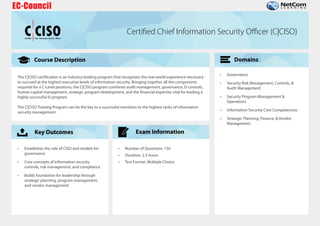
Certified Chief Information Security Officer (C|CISO)
The C|CISO certification is an industry-leading program that recognizes the real-world experience necessary
to succeed at the highest executive levels of information security. Bringing together all the components
required for a C-Level positions, the C|CISO program combines audit management, governance, IS controls,
human capital management, strategic program development, and the financial expertise vital for leading a
highly successful IS program.
The C|CISO Training Program can be the key to a successful transition to the highest ranks of information
security management.
• Establishes the role of CISO and models for
governance
• Core concepts of information security
controls, risk management, and compliance
• Builds foundation for leadership through
strategic planning, program management,
and vendor management
• Governance
• Security Risk Management, Controls, 
Audit Management
• Security Program Management 
Operations
• Information Security Core Competencies
• Strategic Planning, Finance,  Vendor
Management
• Number of Questions: 150
• Duration: 2.5 hours
• Test Format: Multiple Choice
Course Description
Key Outcomes
Course Outline
Exam Information
37
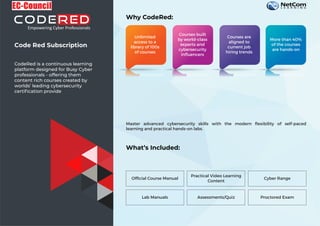
Code Red Subscription
CodeRed is a continuous learning
platform designed for Busy Cyber
professionals - offering them
content rich courses created by
worlds’ leading cybersecurity
certification provide
Master advanced cybersecurity skills with the modern flexibility of self-paced
learning and practical hands-on labs.
Why CodeRed:
What’s Included:
Unlimited
access to a
library of 100s
of courses
Courses built
by world-class
experts and
cybersecurity
influencers
Courses are
aligned to
current job
hiring trends
More than 40%
of the courses
are hands-on
Official Course Manual
Practical Video Learning
Content
Cyber Range
Lab Manuals Assessments/Quiz Proctored Exam
Course Description
Key Outcomes
Course Outline
Exam Information
42
https://www.netcomlearning.com/
Call to register: 888-563-8266

EC-Council Certification Roadmap and Course Catalog

  • 1.
  • 2.
    AGENDA Why NetCom LearningAs Your Training Partner? 03 Tracks Foundation 04 Vulnerability Assessment & Penetration Testing (VAPT) 05 Cyber Forensics 06 Network Defense (Incident Handling/Response) & Operations 07 Software Security 08 Governance 09 Cybersecurity Courses 10 Schedules 11 Certifications Certified Secure Computer User (CSCU) 14 EC-Council Certified Security Specialist (ECSS) 15 EC-Council Certified Encryption Specialist (ECES) 16 Certified Network Defender (CND) 17 Certified Ethical Hacker (CEH) 18 Certified Penetration Testing Professional (CPENT) 19 Certified Threat Intelligence Analyst (CTIA) 20 Certified SOC Analyst (CSA) 21 EC-Council Certified Security Analyst (ECSA) 22 EC-Council Certified Incident Handler (ECIH) 23 Computer Hacking Forensic Investigator (CHFI) 24 Certified Application Security Engineer (CASE) Java 25 Certified Application Security Engineer (CASE) .NET 26 The Licensed Penetration Tester (Master) Credential – LPT (Master) 27 EC-Council Disaster Recovery Professional (EDRP) 28 Certified Chief Information Security Officer (C|CISO) 29 Code Red Subscription 30
  • 3.
    WHY NETCOM LEARNINGAS YOUR TRAINING PARTNER? NetCom Learning is an Accredited Training Center of EC-Council meeting strict excellence standards for delivering instructor-led training. Our EC-Council enterprise skilling plan makes your employees competent in understanding information security's critical aspects, including ethical hacking, network defense, security analysis, and more. EC-Council training and certifications are considered the leading credentials in information security and electronic commerce. It has received endorsements from top-notch government agencies such as the US Federal Government, Committee on National Security Systems (CNSS), and the US Government National Security Agency (NSA).
  • 4.
  • 5.
    VULNERABILITY ASSESSMENT &PENETRATION TESTING (VAPT)
  • 6.
  • 7.
    NETWORK DEFENSE (INCIDENTHANDLING/RESPONSE) & OPERATIONS
  • 8.
  • 9.
  • 10.
    CYBERSECURITY COURSES EXECUTIVE MANAGEMENT CertifiedChief Information Security Officer (CCISO) ETHICAL HACKING Certified Ethical Hacker (CEH) NETWORK SECURITY Certified Network Defender (CND) COMPUTER FORENSICS Computer Hacking Forensic Investigator (CHFI) PEN TESTING Certified Penetration Testing Professional (CPENT) ENCRYPTION Certified Encryption Specialist (ECES) INCIDENT HANDLING Certified Incident Handler (ECIH) Certified SOC Analyst (CSA) Certified Threat Intelligence Analyst (CTIA) BUSINESS CONTINUITY & DISASTER RECOVERY Disaster Recovery Professional (EDRP) SECURE CODING/ APPLICATION SECURITY Certified Application Security Engineer (CASE .NET) Certified Application Security Engineer (CASE Java) FUNDAMENTALS Certified Secure Computer User (CSCU) Certified Security Specialist (ECSS)
  • 11.
    SCHEDULES džĞĐƵƚŝǀĞ DĂŶĂŐĞŵĞŶƚ EC-Council CCISO: CertifiedChief Information Security Officer 40 Hours | $3,595 Ethical Hacking EC-Council CEH: Certified Ethical Hacker v11 40 Hours | $3,595 Schedules 02/08/2021 – 02/12/2021 03/08/2021 – 03/12/2021 04/12/2021 – 04/16/2021 05/10/2021 – 05/14/2021 06/14/2021 – 06/18/2021 Network Security EC-Council CND: Certified Network Defender v2 40 Hours | $2,995 Schedules 03/01/2021 – 03/05/2021 04/05/2021 – 04/09/2021 05/03/2021 – 05/07/2021 06/07/2021 – 06/11/2021 Computer Forensics EC-Council CHFI: Computer Hacking Forensic Investigator v9 40 Hours | $3,295 Schedules 02/22/2021 – 02/26/2021 03/15/2021 – 03/19/2021 04/19/2021 – 04/23/2021 05/17/2021 – 05/21/2021 06/21/2021 – 06/25/2021 Pen Testing EC-Council CPENT: Certified Penetration Testing Professional 40 Hours | $3,595 Schedules 03/01/2021 – 03/05/2021 04/19/2021 – 04/23/2021 05/31/2021 – 06/04/2021 Encryption EC-Council ECES: Certified Encryption Specialist v2 24 Hours | $1,495 Schedules 03/15/2021 – 03/17/2021 04/26/2021 – 04/28/2021 06/14/2021 – 06/16/2021 07/26/2021 – 07/28/2021 09/20/2021 – 09/22/2021 Schedules 02/15/2021 – 02/19/2021 03/15/2021 – 03/19/2021 04/19/2021 – 04/23/2021 05/17/2021 – 05/21/2021 06/21/2021 – 06/25/2021
  • 12.
    SCHEDULES Incident Handling EC-Council ECIH:Certified Incident Handler 24 Hours | $2,995 Schedules 04/12/2021 – 04/14/2021 05/24/2021 – 05/26/2021 06/28/2021 – 06/30/2021 EC-Council CSA: Certified SOC Analyst 24 Hours | $2,495 Schedules 03/08/2021 – 03/10/2021 04/12/2021 – 04/14/2021 05/10/2021 – 05/12/2021 06/14/2021 – 06/16/2021 EC-Council CTIA: Certified Threat Intelligence Analyst 24 Hours | $2,995 Schedules 03/01/2021 – 03/03/2021 04/26/2021 – 04/28/2021 06/07/2021 – 06/09/2021 Disaster Recovery EC-Council EDRP: Disaster Recovery Professional v3 40 Hours | $3,595 Schedules 03/15/2021 – 03/19/2021 05/03/2021 – 05/07/2021 06/21/2021 – 06/25/2021 Secure Coding/ Application Security EC-Council CASE .NET: Certified Application Security Engineer 24 Hours | $1,495 Schedules 03/15/2021 – 03/17/2021 04/19/2021 – 04/21/2021 05/17/2021 – 05/19/2021 06/21/2021 – 06/23/2021 EC-Council CASE JAVA: Certified Application Security Engineer 24 Hours | $1,495 Schedules 03/22/2021 – 03/24/2021 04/26/2021 – 04/28/2021 05/24/2021 – 05/26/2021 06/28/2021 – 06/30/2021
  • 13.
    SCHEDULES Fundamentals EC-Council CSCU: CertifiedSecure Computer User v2 16 Hours | $995 Schedules 03/04/2021 – 03/05/2021 04/15/2021 – 04/16/2021 06/03/2021 – 06/04/2021 07/15/2021 – 07/16/2021 09/09/2021 – 09/10/2021 EC-Council ECSS: Certified Security Specialist 40 Hours | $2,495 Schedules 03/08/2021 – 03/12/2021 04/19/2021 – 04/23/2021 06/07/2021 – 06/11/2021 07/19/2021 – 07/23/2021 09/13/2021 – 09/17/2021
  • 14.
    Course Description Key Outcomes CourseOutline Exam Information 16 C Certified Secure Computer User CU S Certified Secure Computer User (CSCU) CSCU provides individuals with the necessary knowledge and skills to protect their information assets. This course covers fundamentals of various computer and network security threats such as identity theft, credit card fraud, phishing, virus and backdoors, emails hoaxes, loss of confidential information, hacking attacks, and social engineering. • Fundamentals of various computer and network security threats • Understanding of identity theft, phishing scams, malware, social engineering, and financial frauds • Learn to safeguard mobile, media and protect data • Protecting computers, accounts, and social networking profiles as a user • Understand security incidents and reporting • Exam Title: Certified Secure Computer User • Exam Code: 112-12 • Number of Questions: 50 • Duration: 2 Hours • Availability: ECC Exam Portal • Test Format: Multiple Choice • Passing Score: 70% • Introduction to Security • Securing Operating Systems • Malware and Antivirus • Internet Security • Security on Social Networking Sites • Securing Email Communications • Securing Mobile Devices • Securing Cloud • Securing Network Connections • Data Backup and Disaster Recovery
  • 15.
    Course Description Key Outcomes CourseOutline Exam Information 17 E C S S EC-Council Certified Security Specialist T M EC-Council Certified Security Specialist (ECSS) EC-Council Certified Security Specialist (ECSS) is an entry level security program covering the fundamental concepts of information security, computer forensics, and network security. It enables students to identify information security threats which reflect on the security posture of the organization and implement general security controls. This program will give a holistic overview of the key components of information security, computer forensics, and network security. This program provides a solid fundamental knowledge required for a career in information security. • It facilitates your entry into the world of Information Security • It provides professional understanding about the concepts of Information Security, Network Security, and Computer Forensics • It provides best practices to improve organizational security posture • It enhances your skills as a Security Specialist and increases your employability • Exam Title: EC-Council Certified Security Specialist • Exam Code: ECSS • Number of Questions: 50 • Duration: 2 hours • Availability: ECC Exam Portal • Test Format: Multiple Choice • Passing Score: 70% • Information Security Fundamentals • Networking Fundamentals • Secure Network Protocols • Information Security Threats and Attacks • Social Engineering • Hacking Cycle • Identification, Authentication, and Authorization • Cryptography • Firewalls • Intrusion Detection System • Data Backup • Virtual Private Network • Wireless Network Security • Web Security • Ethical Hacking and Pen Testing • Incident Response • Computer Forensics Fundamentals • Digital Evidence • Understanding File Systems • Windows Forensics • Network Forensics and Investigating Network Traffic • Steganography • Analyzing Logs • E-mail Crime and Computer Forensics • Writing Investigative Report
  • 16.
    Course Description Key Outcomes CourseOutline Exam Information 18 EC-Council Certified Encryption Specialist (ECES) The EC-Council Certified Encryption Specialist (ECES) program introduces professionals and students to the field of cryptography. The participants will learn the foundations of modern symmetric and key cryptography including the details of algorithms such as Feistel Functions, DES, and AES. • Develop skills to protect critical data in organizations with encryption • Develop a deep understanding of essential cryptography algorithms and their applications • Make informed decisions about applying encryption technologies • Save time and cost by avoiding common mistakes in implementing encryption technologies effectively • Develop working knowledge of cryptanalysis • Exam Title: EC-Council Certified Encryption Specialist • Exam Code: 212-81 • Number of Questions: 50 • Duration: 2 hours • Availability: ECC Exam Portal • Test Format: Multiple Choice • Passing Score: 70% • Introduction and History of Cryptography • Symmetric Cryptography and Hashes • Number Theory and Asymmetric Cryptography • Applications of Cryptography • Cryptanalysis
  • 17.
    Course Description Key Outcomes CourseOutline Exam Information 19 Certified D Network Defender N C Certified Network Defender (CND) The CND certification program focuses on training Network Administrators to protect, detect, respond to, and predict threats on the network. This builds upon the typical knowledge and skills of Network Administrators in network components, traffic, performance and utilization, network topology, system locations, and security policies. • Exam Title: Certified Network Defender • Exam Code: 312-38 • Number of Questions: 100 • Duration: 4 hours • Availability: ECC Exam Portal • Test Format: Multiple Choice • Passing Score: Please refer to • Passing Score: Please refer to https://cert.eccouncil.org/faq.html • Adaptive Security Strategy - Protect, Detect, Respond, and Predict. • IoT Security - challenges and measures to mitigate. • Implementing and managing the security of virtualization technologies. • Mobile security measures and enterprise mobile device security. • Cloud security with enterprise cloud security. • Threat intelligence concepts Module 01: Network Attacks and Defense Strategies Module 02: Administrative Network Security Module 03: Technical Network Security Module 04: Network Perimeter Security Module 05: Endpoint Security-Windows Systems Module 06: Endpoint Security-Linux Systems Module 07: Endpoint Security- Mobile Devices Module 08: Endpoint Security-IoT Devices Module 09: Administrative Application Security Module 10: Data Security Module 11: Enterprise Virtual Network Security Module 12: Enterprise Cloud Network Security Module 13: Enterprise Wireless Network Security Module 14: Network Traffic Monitoring and Analysis Module 15: Network Logs Monitoring and Analysis Module 16: Incident Response and Forensic Investigation Module 17: Business Continuity and Disaster Recovery Module 18: Risk Anticipation with Risk Management Module 19: Threat Assessment with Attack Surface Analysis Module 20: Threat Prediction with Cyber Threat Intelligence
  • 18.
    Course Description Key Outcomes CourseOutline Exam Information 20 C EH TM Certified Ethical Hacker Certified Ethical Hacker (C|EH) CEH is the leading ethical hacking training and certification program in cybersecurity. Students audit a system for weaknesses and vulnerabilities using the same tools and exploits as malicious hackers, but under proper legal circumstances and in the best interest of assessing the security posture of a target system and organization. It teaches how hackers think and act maliciously so you can learn to better position your organization’s security infrastructure and defend against future attacks. • Thorough introduction to ethical hacking • Exposure to threat vectors and countermeasures • Addresses emerging areas of IoT, cloud and mobile hacking • Prepares you to combat Trojans, malware, backdoors, and more • Enables you to hack using mobile • Exam Title: Certified Ethical Hacker (ANSI) • Exam Code: 312-50 (ECC EXAM), 312-50 (VUE) • Number of Questions: 125 • Duration: 4 hours • Availability: ECC Exam Portal, VUE • Test Format: Multiple Choice • Passing Score: Please refer to https://cert.eccouncil.org/faq.html • Introduction to Ethical Hacking • Footprinting and Reconnaissance • Scanning Networks • Enumeration • Vulnerability Analysis • System Hacking • Malware Threats • Sniffing • Social Engineering • Denial-of-Service • Session Hijacking • Evading IDS, Firewalls, and Honeypots • Hacking Web Servers • Hacking Web Applications • SQL Injection • Hacking Wireless Networks • Hacking Mobile Platforms • IoT Hacking • Cloud Computing • Cryptography
  • 19.
    Course Description Key Outcomes CourseOutline Exam Information 22 Certified Penetration Testing Professional (CPENT) Rewriting the standards of penetration testing skill development with the Certified Penetration Testing Professional or the CPENT certification program, for short. What makes this program unique is our approach that provides you a chance to attain 2 certifications with just one exam. The key philosophy behind the CPENT is simple – a penetration tester is as good as their skills, that’s why we urge you to go beyond kali, and go beyond tools. Not that we don’t believe in the OS or tools. Candidates with an over-reliance on Kali tools, will find it incredibly difficult to adapt to the multi-disciplinary approach of the real-world penetration testing engagements. We urge you to still go beyond and explore the vast horizons of penetration testing that differentiate the great from the good. • 100% mapped with the NICE framework. • Comes Blended with both manual and automated penetration testing approach • Maps to the job role of a penetration tester and security analyst, based on major job portals. • Gives a real-world experience through an Advanced Penetration Testing Range. • 100% methodology-based penetration testing program. • Is designed based on the most common penetration testing services offered by the best service providers in the market. • Provides strong reporting writing guidance. • Offers standard templates that can help during a penetration test. A Hands-On Exam Like No Other. The 24 hours that will define your career CPENT is a fully online, remotely proctored practical exam, which challenges candidates through a gruelling 24-hour performance-based, hands-on exam, categorized into 2 practical exams of 12-hours each, which will test your perseverance and focus by forcing you to outdo yourself with each new challenge. Candidates have the option to choose either 2 12- hour exams or one 24-hour exam depending on how straining they would want the exam to be. Candidates who score more than 90%, will establish themselves as Penetration Testing Masters and will therefore win a chance to attain the prestigious LPT (Master) credential! • Module 01: Introduction to Penetration Testing • Module 02: Penetration Testing Scoping and Engagement • Module 03: Open Source Intelligence (OSINT) • Module 04: Social Engineering Penetration Testing • Module 05: Network Penetration Testing – External • Module 06: Network Penetration Testing– Internal • Module 07: Network Penetration Testing – Perimeter Devices • Module 08: Web Application Penetration Testing • Module 09: Wireless Penetration Testing • Module 10: IoT Penetration Testing • Module 11: OT/SCADA Penetration Testing • Module 12: Cloud Penetration Testing • Module 13: Binary Analysis and Exploitation • Module 14: Report Writing and Post Testing Actions
  • 20.
    Course Description Key Outcomes CourseOutline Exam Information 23 Certified IA Threat Intelligence Analyst C T Certified Threat Intelligence Analyst (CTIA) C|TIA is a method-driven program that uses a holistic approach, covering concepts from planning the threat intelligence project to building a report to disseminating threat intelligence. These concepts are highly essential while building effective threat intelligence and, when used properly, can secure organizations from future threats or attacks. This program addresses all the stages involved in the Threat Intelligence Life Cycle. This attention to a realistic and futuristic approach makes C|TIA one of the most comprehensive threat intelligence certifications on the market today. • Enable individuals and organizations with the ability to prepare and run a threat intelligence program that allows evidence-based knowledge and provides actionable advice about existing and unknown threats • Ensure that organizations have predictive capabilities rather than just proactive measures beyond active defense mechanism • Empower information security professionals with the skills to develop a professional, systematic, and repeatable real-life threat intelligence program • Differentiate threat intelligence professionals from other information security professionals • Provide an invaluable ability of structured threat intelligence to enhance skills and boost their employability • Exam Title: Certified Threat Intelligence Analyst • Exam Code: 312-85 • Number of Questions: 50 • Duration: 2 hours • Availability: EC-Council Exam Portal • Test Format: Multiple Choice • Passing Score: 70% • Introduction to Threat Intelligence • Cyber Threats and Kill Chain Methodology • Requirements, Planning, Direction, and Review • Data Collection and Processing • Data Analysis • Intelligence Reporting and Dissemination
  • 21.
    Course Description Key Outcomes CourseOutline Exam Information 24 Certified SOC Analyst (CSA) The Certified SOC Analyst (CSA) program is the first step to joining a security operations center (SOC). It is engineered for current and aspiring Tier I and Tier II SOC analysts to achieve proficiency in performing entrylevel and intermediate- level operations. CSA is a training and credentialing program that helps the candidate acquire trending and in-demand technical skills through instruction by some of the most experienced trainers in the industry. The program focuses on creating new career opportunities through extensive, meticulous knowledge with enhanced level capabilities for dynamically contributing to a SOC team. Being an intense 3-day program, it thoroughly covers the fundamentals of SOC operations, before relaying the knowledge of log management and correlation, SIEM deployment, advanced incident detection, and incident response. Additionally, the candidate will learn to manage various SOC processes and collaborate with CSIRT at the time of need. • Gain Knowledge of SOC processes, procedures, technologies, and workflows. • Able to recognize attacker tools, tactics, and procedures to identify indicators of compromise (IOCs) that can be utilized during active and future investigations. • Gain experience and extensive knowledge of Security Information and Event Management. • Able to develop threat cases (correlation rules), create reports, etc. • Plan, organize, and perform threat monitoring and analysis in the enterprise. • Able to prepare briefings and reports of analysis methodology and results. • Gain understating of SOC and IRT collaboration for better incident response. • Exam Title: Certified SOC Analyst • Exam Code: 312-39 • Number of Questions: 100 • Duration: 3 hours • Availability: EC-Council Exam Portal (please visit https://www. eccexam.com) • Test Format: Multiple Choice • Passing Score: 70% • Module 1: Security Operations and Management • Module 2: Understanding Cyber Threats, IoCs, and Attack Methodology • Module 3: Incidents, Events, and Logging • Module 4: Incident Detection with Security Information and Event Management (SIEM) • Module 5: Enhanced Incident Detection with Threat Intelligence • Module 6: Incident Response
  • 22.
    Course Description Key Outcomes CourseOutline Exam Information 25 Certified EC-Council A Security Analyst TM C E S EC-Council Certified Security Analyst (ECSA) ECSA is a globally accepted hacking and penetration testing program that covers the testing of modern infrastructures, operating systems, and application environments while teaching the students how to document and write a penetration testing report. This program takes the tools and techniques covered in C|EH to next level by utilizing EC-Council’s published penetration testing methodology. • Introduction to security analysis and penetration testing methodologies • In-depth vulnerability analysis, network penetration testing from external and internal evading firewalls and IDS • Learn to own web applications and databases, and take over cloud services • Analyze security of mobile devices and wireless networks • Present findings in a structured actionable report • Exam Title: EC-Council Certified Security Analyst • Exam Code: 412-79 • Number of Questions: 150 • Duration: 4 hours • Availability: ECC Exam Portal • Test Format: Multiple Choice • Passing Score: 70% • Penetration Testing Essential Concepts (Student Introduction) • Introduction to Penetration Testing and Methodologies • Penetration Testing Scoping and Engagement Methodology • Open-Source Intelligence (OSINT) Methodology • Social Engineering Penetration Testing Methodology • Network Penetration Testing Methodology – External • Network Penetration Testing Methodology – Internal • Network Penetration Testing Methodology – Perimeter Devices • Web Application Penetration Testing Methodology • Database Penetration Testing Methodology • Wireless Penetration Testing Methodology • Cloud Penetration Testing Methodology • Report Writing and Post Testing Actions
  • 23.
    Course Description Key Outcomes CourseOutline Exam Information 27 E C I H EC-Council Certified Incident Handler TM EC-Council Certified Incident Handler (ECIH) The ECIH program is designed to provide the fundamental skills to handle and respond to the computer security incidents in an information system. The course addresses various underlying principles and techniques for detecting and responding to current and emerging computer security threats. The comprehensive training program will make students proficient in handling as well as responding to various security incidents such as network security incidents, malicious code incidents, and insider attack threats. • Principals, processes and techniques for detecting and responding to security threats/ breaches • Liaison with legal and regulatory bodies • Learn to handle incidents and conduct assessments • Cover various incidents like malicious code, network attacks, and insider attacks • Exam Title: EC-Council Certified Incident Handler • Exam Code: 212-89 • Number of Questions: 50 • Duration: 2 hours • Availability: ECC Exam Portal • Test Format: Multiple Choice • Passing Score: 70% • Introduction to Incident Response and Handling • Risk Assessment • Incident Response and Handling Steps • CSIRT • Handling Network Security Incidents • Handling Malicious Code Incidents • Handling Insider Threats • Forensic Analysis and Incident Response • Incident Reporting • Incident Recovery • Security Policies and Laws
  • 24.
    Course Description Key Outcomes CourseOutline Exam Information 28 C HFI Computer Hacking Forensic INVESTIGATOR TM Computer Hacking and Forensic Investigator (CHFI) CHFI is a comprehensive course covering major forensic investigation scenarios, enabling students to acquire hands-on experience. The program provides a strong baseline knowledge of key concepts and practices in the digital forensic domains relevant to today’s organizations. Moreover, CHFI provides firm grasp on the domains of digital forensics. • Comprehensive forensics investigation process • Forensics of file systems, operating systems, network and database, websites, and email systems • Techniques for investigating on cloud, malware, and mobile • Data acquisition and analysis as well as anti-forensic techniques • Thorough understanding of chain of custody, forensic report, and presentation • Exam Title: Computer Hacking Forensic Investigator • Exam Code: 312-49 exam • Number of Questions: 150 • Duration: 4 hours • Availability: ECC Exam Portal • Test Format: Multiple Choice • Passing Score: Please refer to https://cert. eccouncil.org/faq.html • Computer Forensics in Today’s World • Computer Forensics Investigation Process • Understanding Hard Disks and File Systems • Data Acquisition and Duplication • Defeating Anti-Forensics Techniques • Operating System Forensics • Network Forensics • Investigating Web Attacks • Database Forensics • Cloud Forensics • Malware Forensics • Investigating Email Crimes • Mobile Forensics • Forensics Report Writing and Presentation
  • 25.
    Course Description Key Outcomes CourseOutline Exam Information 29 Certified Application Security Engineer (CASE) Java The CASE Java program is designed to be a hands-on, comprehensive application security training course that will help software professionals create secure applications. It trains software developers on the critical security skills and knowledge required throughout a typical software development life cycle (SDLC), focusing on the importance of the implementation of secure methodologies and practices required in today’s insecure operating environment. • Security Beyond Secure Coding - Challenging the traditional mindset where secure application means secure coding • Testing and credentialing secure application development across all phases of the SDLC • CASE Program maps to many Specialty Areas under“Securely Provision category”in the NICE 2.0 Framework • Covers techniques such as Input Validation techniques, Defense Coding Practices, Authentications and Authorizations, Cryptographic Attacks, Error Handling techniques, and Session Management techniques, among many others • Exam Title: Certified Application Security Engineer (Java) • Exam Code: 312-96 • Number of Questions: 50 • Duration: 2 hours • Availability: ECC Exam Portal • Test Format: Multiple Choice • Passing Score: 70% • Understanding Application Security, Threats, and Attacks • Security Requirements Gathering • Secure Application Design and Architecture • Secure Coding Practices for Input Validation • Secure Coding Practices for Authentication and Authorization • Secure Coding Practices for Cryptography • Secure Coding Practices for Session Management • Secure Coding Practices for Error Handling • Static and Dynamic Application Security Testing (SAST DAST) • Secure Deployment and Maintenance Certified C A S E Security Application Engineer JAVA
  • 26.
    Course Description Key Outcomes CourseOutline Exam Information 30 Certified C A S E Security Application Engineer .NET Certified Application Security Engineer (CASE) .Net CASE goes beyond just the guidelines on secure coding practices but include secure requirement gathering, robust application design, and handling security issues in post development phases of application development. This makes CASE one of the most comprehensive certifications for secure software development in the market today. It’s desired by software application engineers, analysts, testers globally, and respected by hiring authorities. The hands-on training program encompasses security activities involved in all phases of the Secure Software Development Life Cycle (SDLC): planning, creating, testing, and deploying an application. • Ensure that application security is no longer an afterthought but a foremost one. • It lays the foundation required by all application developers and development organizations, to produce secure applications with greater stability and fewer security risks to the consumer. • Ensure that organizations mitigate the risk of losing millions due to security compromises that may arise with every step of application development process. • Helps individuals develop the habit of giving importance to security sacrosanct of their job role in the SDLC, therefore opening security as the main domain for testers, developers, network administrator etc. • Exam Title: Certified Application Security Engineer (.NET) • Exam Code: 312-95 • Number of Questions: 50 • Duration: 2 hours • Availability: ECC Exam Portal • Test Format: Multiple Choice • Passing Score: 70% • Understanding Application Security, Threats, and Attacks • Security Requirements Gathering • Secure Application Design and Architecture • Secure Coding Practices for Input Validation • Secure Coding Practices for Authentication and Authorization • Secure Coding Practices for Cryptography • Secure Coding Practices for Session Management • Secure Coding Practices for Error Handling • Static and Dynamic Application Security Testing (SAST DAST) • Secure Deployment and Maintenance
  • 27.
    Course Description Key Outcomes CourseOutline Exam Information 32 Course Description Key Outcomes Testimonials Exam Information The Licensed Penetration Tester (Master)Credential– LPT(Master) The LPT (Master) credential is developed in collaboration with SMEs and practitioners around the world after a thorough job role, job task, and skills-gap analysis. The LPT (Master) practical exam is the capstone to EC-Council’s entire information security track, right from the CEH to the ECSA Program. The LPT (Master) exam covers the skill-sets, technical analysis and report writing, required to be a true professional penetration tester. • Mastery of penetration testing skills • Ability to perform repeatable methodology • Commitment to code of ethics • Ability to present analysed results through structured reports 32 “Converting fear into confidence with LPT(Master) ” by Adithya Naresh “Proud to attain the LPT(Master) credential” by Ali Isikli “LPT(Master) : Extremely challenging and one of the toughest exams” by Mark Horvat “Real-life penetration testing with LPT(Master) ” by Moustafa Mohamed Mohsen LPT Demonstrates 18 Hours 3 Levels 9 Challenges Fully Proctored Live Online
  • 28.
    Course Description Key Outcomes CourseOutline Exam Information 34 EC-Council Disaster Recovery Professional TM EC-Council Disaster Recovery Professional (EDRP) The EDRP course identifies vulnerabilities and takes appropriate countermeasures to prevent and mitigate failure risks for an organization. It also provides the networking professional a foundation in disaster recovery course principles, including preparation of a disaster recovery plan, assessment of risks in the enterprise, development of policies and procedures, an understanding of the roles and relationships of various members of an organization, implementation of a plan, and recovering from a disaster. • Introduction to business continuity, risk management, and disaster recovery • Disasters and emergency management, and applicable regulations • DR planning process, preparation, recovery of systems and facilities • Incident response and liaison with public services and regulatory bodies • Exposure to various services from government and other entities • Exam Title: EC-Council Disaster Recovery Professional • Exam Code: 312-76 • Number of Questions: 150 • Duration: 4 hours • Availability: ECC Exam Portal • Test Format: Multiple Choice • Passing Score: 70% • Introduction to Disaster Recovery and Business Continuity • Business Continuity Management (BCM) • Risk Assessment • Business Impact Analysis (BIA) • Business Continuity Planning (BCP) • Data Backup Strategies • Data Recovery Strategies • Virtualization-Based Disaster Recovery • System Recovery • Centralized and Decentralized System Recovery • Disaster Recovery Planning Process • BCP Testing, Maintenance, and Training
  • 29.
    Course Description Key Outcomes CourseOutline Exam Information 35 Course Description Key Outcomes Domains Exam Information Certified Chief Information Security Officer (C|CISO) The C|CISO certification is an industry-leading program that recognizes the real-world experience necessary to succeed at the highest executive levels of information security. Bringing together all the components required for a C-Level positions, the C|CISO program combines audit management, governance, IS controls, human capital management, strategic program development, and the financial expertise vital for leading a highly successful IS program. The C|CISO Training Program can be the key to a successful transition to the highest ranks of information security management. • Establishes the role of CISO and models for governance • Core concepts of information security controls, risk management, and compliance • Builds foundation for leadership through strategic planning, program management, and vendor management • Governance • Security Risk Management, Controls, Audit Management • Security Program Management Operations • Information Security Core Competencies • Strategic Planning, Finance, Vendor Management • Number of Questions: 150 • Duration: 2.5 hours • Test Format: Multiple Choice
  • 30.
    Course Description Key Outcomes CourseOutline Exam Information 37 Code Red Subscription CodeRed is a continuous learning platform designed for Busy Cyber professionals - offering them content rich courses created by worlds’ leading cybersecurity certification provide Master advanced cybersecurity skills with the modern flexibility of self-paced learning and practical hands-on labs. Why CodeRed: What’s Included: Unlimited access to a library of 100s of courses Courses built by world-class experts and cybersecurity influencers Courses are aligned to current job hiring trends More than 40% of the courses are hands-on Official Course Manual Practical Video Learning Content Cyber Range Lab Manuals Assessments/Quiz Proctored Exam
  • 31.
    Course Description Key Outcomes CourseOutline Exam Information 42 https://www.netcomlearning.com/ Call to register: 888-563-8266