1
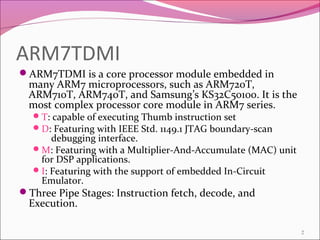
ARM7TDMI
ļ‚—ARM7TDMI is a core processor module embedded in
many ARM7 microprocessors, such as ARM720T,
ARM710T, ARM740T, and Samsung’s KS32C50100. It is the
most complex processor core module in ARM7 series.
ļ‚—T: capable of executing Thumb instruction set
ļ‚—D: Featuring with IEEE Std. 1149.1 JTAG boundary-scan
debugging interface.
ļ‚—M: Featuring with a Multiplier-And-Accumulate (MAC) unit
for DSP applications.
ļ‚—I: Featuring with the support of embedded In-Circuit
Emulator.
ļ‚—Three Pipe Stages: Instruction fetch, decode, and
Execution.
2
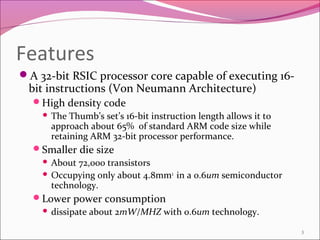
Features
ļ‚—A 32-bit RSIC processor core capable of executing 16-
bit instructions (Von Neumann Architecture)
ļ‚—High density code
ļ‚— The Thumb’s set’s 16-bit instruction length allows it to
approach about 65% of standard ARM code size while
retaining ARM 32-bit processor performance.
ļ‚—Smaller die size
ļ‚— About 72,000 transistors
ļ‚— Occupying only about 4.8mm2
in a 0.6um semiconductor
technology.
ļ‚—Lower power consumption
ļ‚— dissipate about 2mW/MHZ with 0.6um technology.
3
Features Cont!
ļ‚—Memory Access
ļ‚—Data cab be
ļ‚— 8-bit (bytes)
ļ‚— 16-bit (half words)
ļ‚— 32-bit (words)
ļ‚—Memory Interface
ļ‚—Can interface to SRAM, ROM, DRAM
ļ‚—Has four basic types of memory cycle
ļ‚— idle cycle
ļ‚— nonsequential cycle
ļ‚— sequential cycle
ļ‚— coprocessor register cycle
4
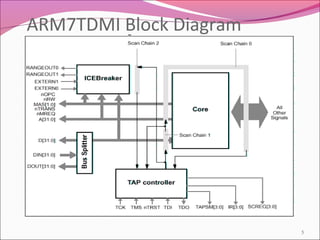
ARM7TDMI Block Diagram
5
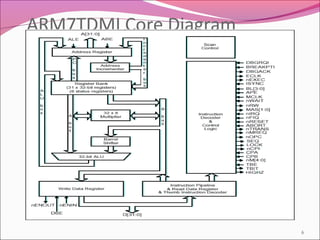
ARM7TDMI Core Diagram
6
Memory Interface
ļ‚—32-bit address bus
ļ‚—32-bit data bus
ļ‚—D[31:0]: Bidirectional data bus
ļ‚—DIN[31:0]: Unidirectional input bus
ļ‚—DOUT[31:0]: Unidirectional output bus
ļ‚—Control signals
ļ‚—Specified the size of the data to be transferred and the
direction of the transfer
7
Cycle Types (1)
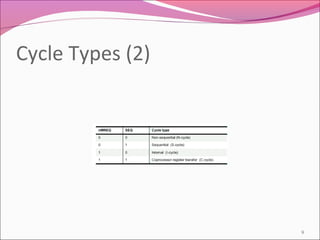
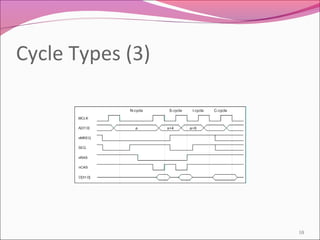
ļ‚—Non-sequential cycle
ļ‚—Requests a transfer to or from an address which is unrelated to the
address used in the preceding cycle.
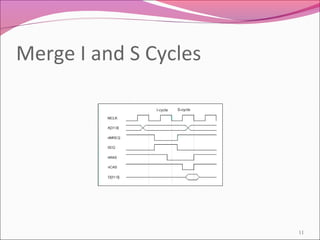
ļ‚—Sequential cycle
ļ‚—Requests a transfer to or from an address which is either the same
as the address in the preceding cycle, or is one word or halfword
after the preceding cycle. But should not occur at the page end.
ļ‚—Internal cycle
ļ‚—Does not require a transfer.
ļ‚—Coprocessor register transfer
ļ‚—Wishes to use the data bus to communicate with a coprocessor,
but does not require any action by the memory system.
8
Cycle Types (2)
9
Cycle Types (3)
10
Merge I and S Cycles
11
Bus Configuration
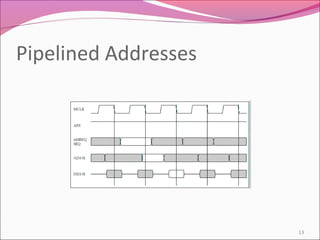
ļ‚—Pipelined
ļ‚—Interface to DRAM
ļ‚—Set APE to 1
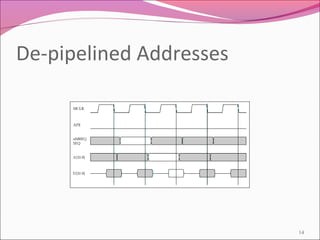
ļ‚—De-pipelined
ļ‚—Interface to SRAM or ROM
ļ‚—Set APE to 0
12
Pipelined Addresses
13
De-pipelined Addresses
14
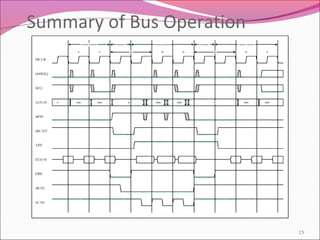
Summary of Bus Operation
15
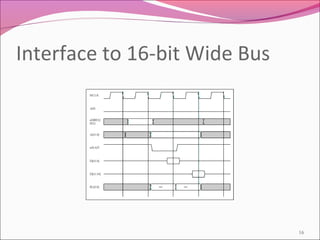
Interface to 16-bit Wide Bus
16
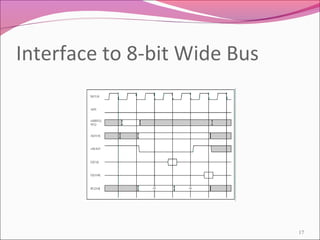
Interface to 8-bit Wide Bus
17
Coprocessor Interface
ļ‚—Can have 16 coprocessors
ļ‚—If the designated coprocessor
ļ‚—exists, a coprocessor instruction will be executed by the
coprocessor;
ļ‚—does not exist, the ARM7TDMI will take the undefined
instruction trap and a software will be executed to
emulate the coprocessor. The execution of a
coprocessor instruction is done by software.
18
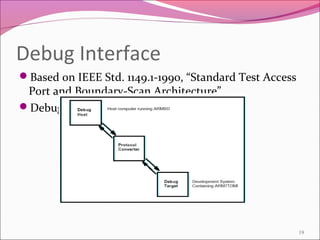
Debug Interface
ļ‚—Based on IEEE Std. 1149.1-1990, ā€œStandard Test Access
Port and Boundary-Scan Architectureā€.
ļ‚—Debug systems
19
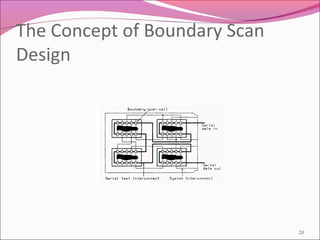
The Concept of Boundary Scan
Design
20
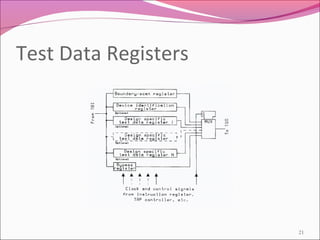
Test Data Registers
21
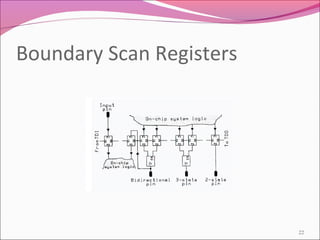
Boundary Scan Registers
22
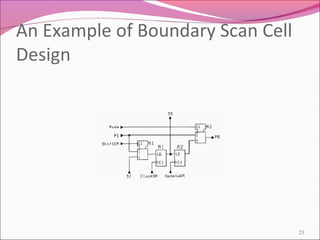
An Example of Boundary Scan Cell
Design
23
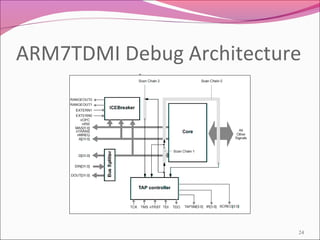
ARM7TDMI Debug Architecture
24
Enter Debugging State
ļ‚—ARM7TDMI is forced into debug state after a breakpoint,
watchpoint, or debug request has occurred.
ļ‚—Breakpoint: Set for a particular instruction. When this
instruction is executed, the machine is forced into debug
state.
ļ‚—Watchpoint: Set for a data access. When data access occurs
for a particular address for a particular data, the machine is
forced into debug state.
ļ‚—Setting the breakpoint and watchpoint by
ļ‚—issuing debug request, DBGRQ.
ļ‚—ICEBreaker programming
25
Action In Debug State
ļ‚—Once enter into debug state
ļ‚—The internal states of the machine can be examined.
ļ‚—The system’s external state can be examined.
ļ‚—The memory bus of the machine (ARM7TDMI) is
forced to indicate internal cycles and the machine’s
outputs will change asynchronously to the memory
system.
ļ‚—Then, the internal state of the machine can be scanned
out through scan chain for examination.
26
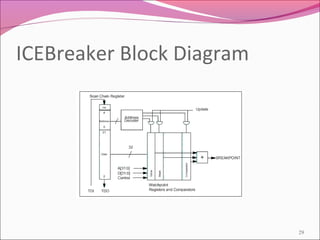
ARM7TDMI ICEBreaker
ļ‚—It is programmed through TAP controller.
ļ‚—It consists of two real-time watchpoint units with a
control and status register.
ļ‚—Each watchpoint unit can be configured to be a
watchpoint or a breakpoint.
ļ‚—Execution of ARM7TDMI is halted when
ļ‚—a match occurs between the values programmed into
ICEBreaker and the values currently appearing on the
address bus, data bus and various control signals.
27
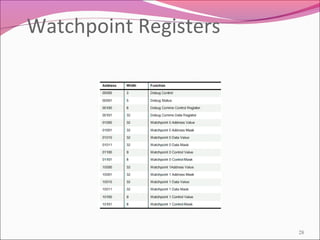
Watchpoint Registers
28
ICEBreaker Block Diagram
29
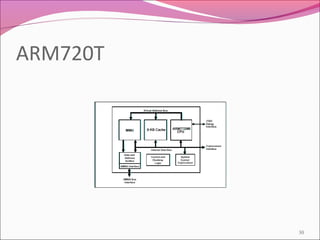
ARM720T
30
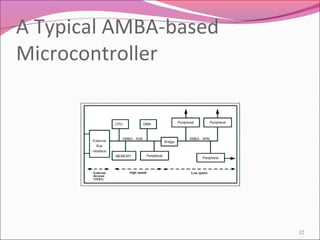
AMBA
ļ‚—AMBA: Advanced Microcontroller Bus Architecture
ļ‚— It is a specification for an on-chip bus, to enable
macrocells (such as a CPU, DSP, Peripherals, and
memory controllers) to be connected together to form a
microcontroller or complex peripheral chip.
ļ‚—It defines
ļ‚— A high-speed, high-bandwidth bus, the Advances System Bus
(ASB).
ļ‚— A simple, low-power peripheral bus, the Advanced Peripheral
Bus (ASP).
ļ‚— Access for an external tester to permit modular testing and
fast test of cache RAM
ļ‚— Essential housing keeping operations (reset/power-up, …) 31
A Typical AMBA-based
Microcontroller
32
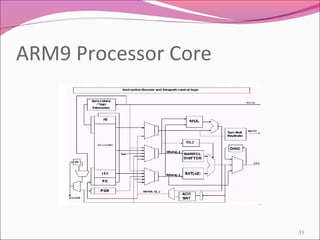
ARM9 Processor Core
33

ARM7TDM

  • 1.
  • 2.
    ARM7TDMI ļ‚—ARM7TDMI is acore processor module embedded in many ARM7 microprocessors, such as ARM720T, ARM710T, ARM740T, and Samsung’s KS32C50100. It is the most complex processor core module in ARM7 series. ļ‚—T: capable of executing Thumb instruction set ļ‚—D: Featuring with IEEE Std. 1149.1 JTAG boundary-scan debugging interface. ļ‚—M: Featuring with a Multiplier-And-Accumulate (MAC) unit for DSP applications. ļ‚—I: Featuring with the support of embedded In-Circuit Emulator. ļ‚—Three Pipe Stages: Instruction fetch, decode, and Execution. 2
  • 3.
    Features ļ‚—A 32-bit RSICprocessor core capable of executing 16- bit instructions (Von Neumann Architecture) ļ‚—High density code ļ‚— The Thumb’s set’s 16-bit instruction length allows it to approach about 65% of standard ARM code size while retaining ARM 32-bit processor performance. ļ‚—Smaller die size ļ‚— About 72,000 transistors ļ‚— Occupying only about 4.8mm2 in a 0.6um semiconductor technology. ļ‚—Lower power consumption ļ‚— dissipate about 2mW/MHZ with 0.6um technology. 3
  • 4.
    Features Cont! ļ‚—Memory Access ļ‚—Datacab be ļ‚— 8-bit (bytes) ļ‚— 16-bit (half words) ļ‚— 32-bit (words) ļ‚—Memory Interface ļ‚—Can interface to SRAM, ROM, DRAM ļ‚—Has four basic types of memory cycle ļ‚— idle cycle ļ‚— nonsequential cycle ļ‚— sequential cycle ļ‚— coprocessor register cycle 4
  • 5.
  • 6.
  • 7.
    Memory Interface ļ‚—32-bit addressbus ļ‚—32-bit data bus ļ‚—D[31:0]: Bidirectional data bus ļ‚—DIN[31:0]: Unidirectional input bus ļ‚—DOUT[31:0]: Unidirectional output bus ļ‚—Control signals ļ‚—Specified the size of the data to be transferred and the direction of the transfer 7
  • 8.
    Cycle Types (1) ļ‚—Non-sequentialcycle ļ‚—Requests a transfer to or from an address which is unrelated to the address used in the preceding cycle. ļ‚—Sequential cycle ļ‚—Requests a transfer to or from an address which is either the same as the address in the preceding cycle, or is one word or halfword after the preceding cycle. But should not occur at the page end. ļ‚—Internal cycle ļ‚—Does not require a transfer. ļ‚—Coprocessor register transfer ļ‚—Wishes to use the data bus to communicate with a coprocessor, but does not require any action by the memory system. 8
  • 9.
  • 10.
  • 11.
    Merge I andS Cycles 11
  • 12.
    Bus Configuration ļ‚—Pipelined ļ‚—Interface toDRAM ļ‚—Set APE to 1 ļ‚—De-pipelined ļ‚—Interface to SRAM or ROM ļ‚—Set APE to 0 12
  • 13.
  • 14.
  • 15.
    Summary of BusOperation 15
  • 16.
  • 17.
    Interface to 8-bitWide Bus 17
  • 18.
    Coprocessor Interface ļ‚—Can have16 coprocessors ļ‚—If the designated coprocessor ļ‚—exists, a coprocessor instruction will be executed by the coprocessor; ļ‚—does not exist, the ARM7TDMI will take the undefined instruction trap and a software will be executed to emulate the coprocessor. The execution of a coprocessor instruction is done by software. 18
  • 19.
    Debug Interface ļ‚—Based onIEEE Std. 1149.1-1990, ā€œStandard Test Access Port and Boundary-Scan Architectureā€. ļ‚—Debug systems 19
  • 20.
    The Concept ofBoundary Scan Design 20
  • 21.
  • 22.
  • 23.
    An Example ofBoundary Scan Cell Design 23
  • 24.
  • 25.
    Enter Debugging State ļ‚—ARM7TDMIis forced into debug state after a breakpoint, watchpoint, or debug request has occurred. ļ‚—Breakpoint: Set for a particular instruction. When this instruction is executed, the machine is forced into debug state. ļ‚—Watchpoint: Set for a data access. When data access occurs for a particular address for a particular data, the machine is forced into debug state. ļ‚—Setting the breakpoint and watchpoint by ļ‚—issuing debug request, DBGRQ. ļ‚—ICEBreaker programming 25
  • 26.
    Action In DebugState ļ‚—Once enter into debug state ļ‚—The internal states of the machine can be examined. ļ‚—The system’s external state can be examined. ļ‚—The memory bus of the machine (ARM7TDMI) is forced to indicate internal cycles and the machine’s outputs will change asynchronously to the memory system. ļ‚—Then, the internal state of the machine can be scanned out through scan chain for examination. 26
  • 27.
    ARM7TDMI ICEBreaker ļ‚—It isprogrammed through TAP controller. ļ‚—It consists of two real-time watchpoint units with a control and status register. ļ‚—Each watchpoint unit can be configured to be a watchpoint or a breakpoint. ļ‚—Execution of ARM7TDMI is halted when ļ‚—a match occurs between the values programmed into ICEBreaker and the values currently appearing on the address bus, data bus and various control signals. 27
  • 28.
  • 29.
  • 30.
  • 31.
    AMBA ļ‚—AMBA: Advanced MicrocontrollerBus Architecture ļ‚— It is a specification for an on-chip bus, to enable macrocells (such as a CPU, DSP, Peripherals, and memory controllers) to be connected together to form a microcontroller or complex peripheral chip. ļ‚—It defines ļ‚— A high-speed, high-bandwidth bus, the Advances System Bus (ASB). ļ‚— A simple, low-power peripheral bus, the Advanced Peripheral Bus (ASP). ļ‚— Access for an external tester to permit modular testing and fast test of cache RAM ļ‚— Essential housing keeping operations (reset/power-up, …) 31
  • 32.
  • 33.