SPONSORED CONTENT HYDROCARBON PROCESSING engineering and construction
I E-123
Engineering and construction 2011
corporate profile: KTI
SCR Retrofits of FCC Units
KTI focuses on quality project execution
KTI Corporation has a successful track record for retrofit of Fluid Catalytic
Cracking Units (FCCUs) with Selective Catalytic Reduction (SCR) emission reduction
systems.As the primary money maker in refinery operations,the FCCU is considered
to be one of the most important secondary conversion processing units in modern
petroleum refineries. FCCUs are also primary sources of NOx, SO2, CO and Particu-
late Matter (PM),thereby requiring effective emission reduction strategies to ensure
compliance with environmental regulations.
Of available options to mitigate FCCU emissions, an SCR is the most effective
and commonly applied technology for reducing NOx. Given that FCCUs generate
more NOx than any other refinery combustion process, they are the primary focus
of any overall plant NOx reduction strategy. As a continuous process operation,
FCCUs must operate with minimal downtime and disruption.Hence,the importance
of executing a FCCU SCR retrofit project on time and on budget while achieving
target emission reductions.Missing schedule by one day,or failing to meet emission
targets consistently, can be extremely costly to the refinery operator.
Quality solutions begin with detailed planning.
There is a simple rule of thumb—the more detailed the plan; the higher quality the
engineered solution.Successful retrofit projects are predicated on detailed up-front
planning,application of highly qualified expertise and proven methods,and rigorous
quality control of which SCR retrofits are no exception.It is the client’s responsibility
to define the overall emission reduction objective,and together with an experienced
engineering contractor, to define the project scope, cost, and schedule in execution
of a successful FCCU SCR retrofit project.
Once an engineering firm, such as KTI, is engaged to design an SCR system,
they will begin to evaluate the design parameters necessary for successful imple-
mentation and post install operation and maintenance.A few engineering design
considerations for an FCCU SCR retrofit include:
•  Size catalyst pitch and volume appropriately for anticipated normal and
upset operating conditions,
•  Achieve required uniformity of flow and ammonia concentration to meet NOx
and ammonia slippage specifications,
•  Design the SCR reactor housing for construction and maintenance friendly
access and ensure the structural support can withstand the potential weight of large
quantities of fine particles carried over from the FCCU reactor, and
•  Consider the need for a design that incorporates standby reactor capacity in
the event that a problem occurs with the primary catalyst bed.
Be on the lookout for common project execution
issues. With experience in thousands of new capital and retrofit projects, KTI
has faced and successfully overcome just about every retrofit project execution
challenge imaginable. For an FCCU SCR retrofit, the primary execution challenges
include:
•  Clearly document, articulate and manage project objectives,
•  Engage qualified suppliers of specialized components early in the project
to assure that design solutions are compatible and overall schedule objectives are
achieved,
•  Validate fabrication QA (KTI uses in-house inspectors) to ensure that the SCR
system components (ammonia skid, distribution grid, mixers, turning/distribution
devices and maintenance/handling provisions) function as intended,
•  Protection of the most critical component—the catalyst—to ensure proper
handling during transport, storage, installation and commissioning leading up to
successful start up of the unit, and
•  Stay focused on Health, Safety and Environment during the entire project
execution cycle.
Contact information
11720 Katy Freeway, Suite 110
Houston,TX 77079
Phone: 281.249.2400
Fax: 281.249.2328
Email: sales@kticorp.com
Website: www.kticorp.com
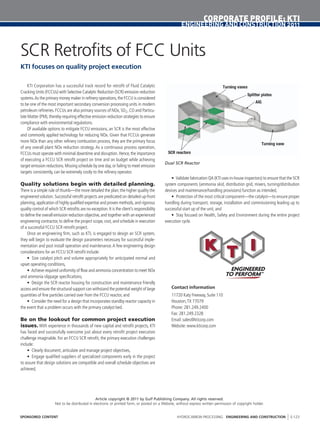
Dual SCR Reactor
Article copyright © 2011 by Gulf Publishing Company. All rights reserved.
Not to be distributed in electronic or printed form, or posted on a Website, without express written permission of copyright holder.

E&C Profilep123

  • 1.
    SPONSORED CONTENT HYDROCARBON PROCESSINGengineering and construction I E-123 Engineering and construction 2011 corporate profile: KTI SCR Retrofits of FCC Units KTI focuses on quality project execution KTI Corporation has a successful track record for retrofit of Fluid Catalytic Cracking Units (FCCUs) with Selective Catalytic Reduction (SCR) emission reduction systems.As the primary money maker in refinery operations,the FCCU is considered to be one of the most important secondary conversion processing units in modern petroleum refineries. FCCUs are also primary sources of NOx, SO2, CO and Particu- late Matter (PM),thereby requiring effective emission reduction strategies to ensure compliance with environmental regulations. Of available options to mitigate FCCU emissions, an SCR is the most effective and commonly applied technology for reducing NOx. Given that FCCUs generate more NOx than any other refinery combustion process, they are the primary focus of any overall plant NOx reduction strategy. As a continuous process operation, FCCUs must operate with minimal downtime and disruption.Hence,the importance of executing a FCCU SCR retrofit project on time and on budget while achieving target emission reductions.Missing schedule by one day,or failing to meet emission targets consistently, can be extremely costly to the refinery operator. Quality solutions begin with detailed planning. There is a simple rule of thumb—the more detailed the plan; the higher quality the engineered solution.Successful retrofit projects are predicated on detailed up-front planning,application of highly qualified expertise and proven methods,and rigorous quality control of which SCR retrofits are no exception.It is the client’s responsibility to define the overall emission reduction objective,and together with an experienced engineering contractor, to define the project scope, cost, and schedule in execution of a successful FCCU SCR retrofit project. Once an engineering firm, such as KTI, is engaged to design an SCR system, they will begin to evaluate the design parameters necessary for successful imple- mentation and post install operation and maintenance.A few engineering design considerations for an FCCU SCR retrofit include: •  Size catalyst pitch and volume appropriately for anticipated normal and upset operating conditions, •  Achieve required uniformity of flow and ammonia concentration to meet NOx and ammonia slippage specifications, •  Design the SCR reactor housing for construction and maintenance friendly access and ensure the structural support can withstand the potential weight of large quantities of fine particles carried over from the FCCU reactor, and •  Consider the need for a design that incorporates standby reactor capacity in the event that a problem occurs with the primary catalyst bed. Be on the lookout for common project execution issues. With experience in thousands of new capital and retrofit projects, KTI has faced and successfully overcome just about every retrofit project execution challenge imaginable. For an FCCU SCR retrofit, the primary execution challenges include: •  Clearly document, articulate and manage project objectives, •  Engage qualified suppliers of specialized components early in the project to assure that design solutions are compatible and overall schedule objectives are achieved, •  Validate fabrication QA (KTI uses in-house inspectors) to ensure that the SCR system components (ammonia skid, distribution grid, mixers, turning/distribution devices and maintenance/handling provisions) function as intended, •  Protection of the most critical component—the catalyst—to ensure proper handling during transport, storage, installation and commissioning leading up to successful start up of the unit, and •  Stay focused on Health, Safety and Environment during the entire project execution cycle. Contact information 11720 Katy Freeway, Suite 110 Houston,TX 77079 Phone: 281.249.2400 Fax: 281.249.2328 Email: sales@kticorp.com Website: www.kticorp.com Dual SCR Reactor Article copyright © 2011 by Gulf Publishing Company. All rights reserved. Not to be distributed in electronic or printed form, or posted on a Website, without express written permission of copyright holder.