Commercializing an advanced Fischer-
Tropsch synthesis technology
ENFL: Fischer-Tropsch Chemistry & Catalysis
248th ACS National Meeting
Soumitra Deshmukh,
Stephen LeViness, Heinz Robota, Matthew Davis, Thomas Yuschak, Amanda Miller
August 13, 2014
• Leader in smaller scale gas-to-liquids technology
— 15 years and >$300 million invested in product development
— Exhaustive global patent protection (>7,500 granted GTL patent
claims)
• World class partners offering a complete GTL solution
— Haldor Topsøe, Ventech, Hatch, Toyo, Mourik, SGS, Shiloh
• Commercial roll-out underway
• Well capitalized with strong resources
— Commercial center in Houston, Texas; technical centers near
Columbus, Ohio and Oxford, UK
— Permanent pilot plant in operation
Leader in smaller scale GTL
2
Velocys
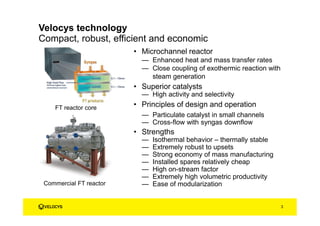
Commercial FT reactor
FT reactor core
Velocys technology
• Microchannel reactor
— Enhanced heat and mass transfer rates
— Close coupling of exothermic reaction with
steam generation
• Superior catalysts
— High activity and selectivity
• Principles of design and operation
— Particulate catalyst in small channels
— Cross-flow with syngas downflow
• Strengths
— Isothermal behavior – thermally stable
— Extremely robust to upsets
— Strong economy of mass manufacturing
— Installed spares relatively cheap
— High on-stream factor
— Extremely high volumetric productivity
— Ease of modularization
Compact, robust, efficient and economic
3
Process performance
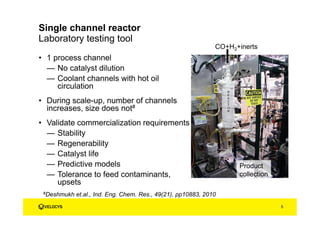
• 1 process channel
— No catalyst dilution
— Coolant channels with hot oil
circulation
• During scale-up, number of channels
increases, size does not#
• Validate commercialization requirements
— Stability
— Regenerability
— Catalyst life
— Predictive models
— Tolerance to feed contaminants,
upsets
Single channel reactor
Laboratory testing tool
CO+H2+inerts
Product
collection
5
#Deshmukh et.al., Ind. Eng. Chem. Res., 49(21), pp10883, 2010
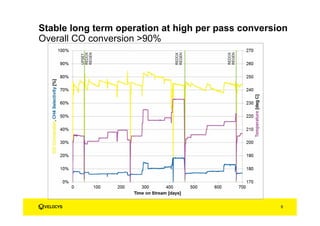
Stable long term operation at high per pass conversion
Overall CO conversion >90%
6
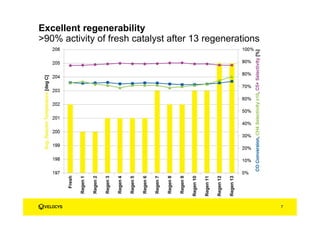
Excellent regenerability
>90% activity of fresh catalyst after 13 regenerations
7
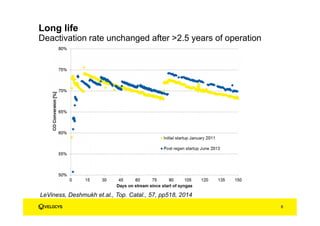
Long life
Deactivation rate unchanged after >2.5 years of operation
LeViness, Deshmukh et.al., Top. Catal., 57, pp518, 2014
8
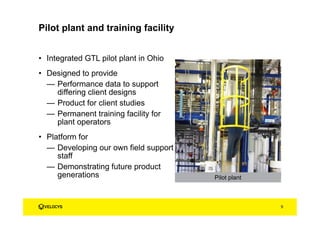
Pilot plant and training facility
• Integrated GTL pilot plant in Ohio
• Designed to provide
— Performance data to support
differing client designs
— Product for client studies
— Permanent training facility for
plant operators
• Platform for
— Developing our own field support
staff
— Demonstrating future product
generations
Add pilot plant photo
Pilot plant
9
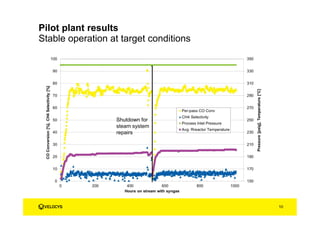
Pilot plant results
Stable operation at target conditions
Shutdown for
steam system
repairs
10
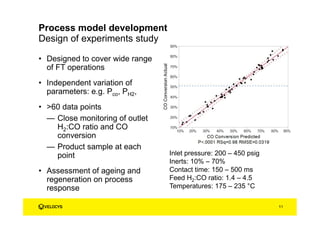
• Designed to cover wide range
of FT operations
• Independent variation of
parameters: e.g. Pco, PH2,
• >60 data points
— Close monitoring of outlet
H2:CO ratio and CO
conversion
— Product sample at each
point
• Assessment of ageing and
regeneration on process
response
11
Process model development
Design of experiments study
Inlet pressure: 200 – 450 psig
Inerts: 10% – 70%
Contact time: 150 – 500 ms
Feed H2:CO ratio: 1.4 – 4.5
Temperatures: 175 – 235 °C
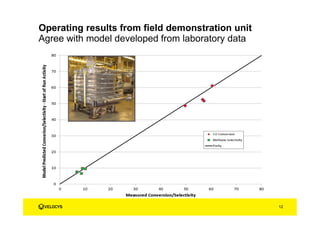
Operating results from field demonstration unit
Agree with model developed from laboratory data
12
Path to commercialization
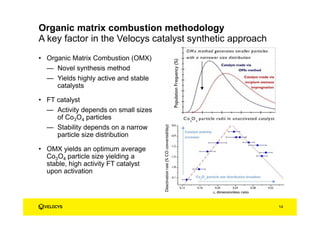
• Organic Matrix Combustion (OMX)
— Novel synthesis method
— Yields highly active and stable
catalysts
• FT catalyst
— Activity depends on small sizes
of Co3O4 particles
— Stability depends on a narrow
particle size distribution
• OMX yields an optimum average
Co3O4 particle size yielding a
stable, high activity FT catalyst
upon activation
14
Organic matrix combustion methodology
A key factor in the Velocys catalyst synthetic approach
1
10
100
0 10 20 30 40 50
TOFx1000/s
Co diameter nm
den Breejen JACS 2009 131 p. 7197
35 bar 210 C
Logdberg J. Catalysis 274 2010 p.
84 20 bar 210 C
Velocys 25 bar 205 C
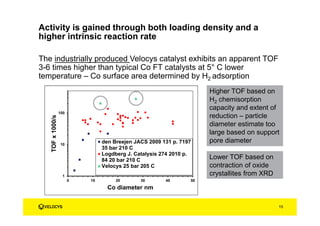
The industrially produced Velocys catalyst exhibits an apparent TOF
3-6 times higher than typical Co FT catalysts at 5° C lower
temperature – Co surface area determined by H2 adsorption
15
Activity is gained through both loading density and a
higher intrinsic reaction rate
Lower TOF based on
contraction of oxide
crystallites from XRD
Higher TOF based on
H2 chemisorption
capacity and extent of
reduction – particle
diameter estimate too
large based on support
pore diameter
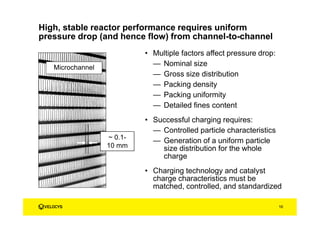
High, stable reactor performance requires uniform
pressure drop (and hence flow) from channel-to-channel
• Multiple factors affect pressure drop:
— Nominal size
— Gross size distribution
— Packing density
— Packing uniformity
— Detailed fines content
• Successful charging requires:
— Controlled particle characteristics
— Generation of a uniform particle
size distribution for the whole
charge
• Charging technology and catalyst
charge characteristics must be
matched, controlled, and standardized
~ 0.1-
10 mm
Microchannel
16
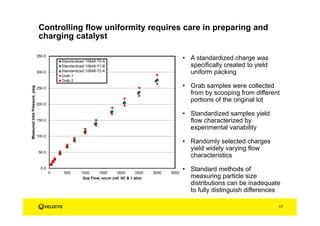
Controlling flow uniformity requires care in preparing and
charging catalyst
• A standardized charge was
specifically created to yield
uniform packing
• Grab samples were collected
from by scooping from different
portions of the original lot
• Standardized samples yield
flow characterized by
experimental variability
• Randomly selected charges
yield widely varying flow
characteristics
• Standard methods of
measuring particle size
distributions can be inadequate
to fully distinguish differences
0.0
50.0
100.0
150.0
200.0
250.0
300.0
350.0
0 500 1000 1500 2000 2500 3000 3500
MeasuredInletPressure,psig
Gas Flow, sccm (ref. 0C & 1 atm)
Standardized 10648-70-A
Standardized 10648-71-B
Standardized 10648-72-A
Grab 1
Grab 2
17
18
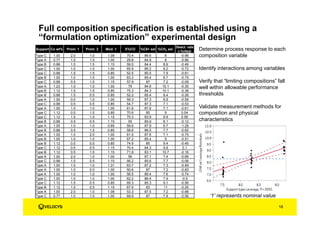
Full composition specification is established using a
“formulation optimization” experimental design
Support Co wt% Prom. 1 Prom. 2 Mod. 1 X%CO %C5+ sel %CH4 sel.
Deact. rate
(-%/day)
Type C 1.00 2.0 1.0 1.08 70.4 86.6 8 -0.96
Type A 0.77 1.0 1.0 1.00 29.8 84.9 8 -0.86
Type B 0.88 1.5 1.5 1.15 59.5 84.4 8.9 -0.49
Type C 1.00 1.0 1.0 1.00 65.9 86.2 8.2 -0.72
Type C 0.88 1.5 1.5 0.85 52.5 85.5 7.9 -0.81
Type B 1.00 1.0 1.0 1.00 63.3 85.4 8.7 -0.75
Type C 0.88 0.5 1.5 1.15 57.9 87 7.2 -0.09
Type A 1.23 1.0 1.0 1.00 79 84.6 10.1 -0.35
Type B 1.12 1.5 1.5 0.85 75.3 84.3 10.1 -0.38
Type B 0.88 1.5 0.5 0.85 52.2 85.4 8.4 -0.26
Type A 1.00 0.0 1.0 1.00 59.3 87.3 6.9 -0.59
Type C 0.88 0.5 0.5 0.85 54.7 87.3 7.1 -0.53
Type A 1.00 1.0 1.0 1.00 61.6 87.6 7.1 -0.61
Type C 1.12 0.5 1.5 0.85 70.6 85 9 0.04
Type C 1.12 1.5 1.5 1.15 70.3 83.9 9.9 0.56
Type B 0.88 0.5 0.5 1.15 55 85.9 8.1 -0.12
Type A 1.00 1.0 1.0 0.69 59.6 87.9 6.7 -1.29
Type B 0.88 0.5 1.5 0.85 58.6 86.5 7.7 -0.62
Type A 1.00 1.0 2.0 1.00 61.5 87.6 7.1 -0.75
Type B 1.00 1.0 1.0 1.00 67.2 85.4 9 -0.51
Type B 1.12 0.5 0.5 0.85 74.9 85 9.4 -0.45
Type C 1.12 0.5 0.5 1.15 70.4 84.3 9.8 0.1
Type B 1.12 0.5 1.5 1.15 71.8 83.1 10.7 -0.16
Type A 1.00 2.0 1.0 1.00 56 87.1 7.4 -0.66
Type C 0.88 1.5 0.5 1.15 56.2 85.6 7.7 -0.06
Type A 1.00 1.0 1.0 1.31 63.7 87.2 7.3 -0.49
Type A 1.00 1.0 0.0 1.00 50.6 87 7.2 -0.83
Type A 1.00 1.0 1.0 1.00 56.5 86.4 7.6 -0.74
Type C 1.00 1.0 1.0 1.00 62.2 86.4 7.9 -0.5
Type C 1.12 1.5 0.5 0.85 69.3 85.3 9.1 -0.56
Type B 1.12 1.5 0.5 1.15 67.9 83 11 -0.25
Type A 1.00 2.0 1.0 1.08 53.3 87.5 7.2 -0.88
Type C 0.77 1.0 1.0 1.00 69.9 87 7.8 -0.56
Determine process response to each
composition variable
Identify interactions among variables
Verify that “limiting compositions” fall
well within allowable performance
thresholds
Validate measurement methods for
composition and physical
characteristics
‘1’ represents nominal value
19
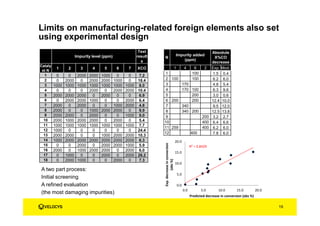
Limits on manufacturing-related foreign elements also set
using experimental design
Impurity level (ppm)
Test
result
s
Cataly
st N
1 2 3 4 5 6 7 XCO
1 0 0 2000 2000 1000 0 0 7.2
2 0 2000 0 2000 2000 1000 0 18.4
3 1000 1000 1000 1000 1000 1000 1000 8.0
4 0 0 0 2000 0 2000 2000 10.4
5 2000 2000 2000 0 2000 0 0 6.9
6 0 2000 2000 1000 0 0 2000 6.4
7 2000 0 2000 0 0 1000 2000 4.8
8 2000 0 0 1000 2000 2000 0 9.9
9 2000 2000 0 2000 0 0 1000 9.0
10 2000 1000 2000 2000 0 2000 0 5.4
11 1000 1000 1000 1000 1000 1000 1000 7.7
12 1000 0 0 0 0 0 0 24.4
13 2000 2000 0 0 1000 2000 2000 10.3
14 1000 2000 2000 2000 2000 2000 2000 6.3
15 0 0 2000 0 2000 2000 1000 5.9
16 2000 0 1000 2000 2000 0 2000 6.0
17 0 1000 0 0 2000 0 2000 26.2
18 0 2000 1000 0 0 2000 0 7.3
N
Impurity added
(ppm)
Absolute
X%CO
decrease
1 4 6 2 Exp. Mod.
1 100 1.5 0.4
2 100 100 6.2 6.0
3 170 4.8 5.4
4 170 100 6.3 9.6
5 200 3.0 0.6
6 200 200 12.4 10.0
7 340 9.5 12.0
8 340 200 12.5 13.8
9 200 3.2 2.7
10 400 6.4 6.6
11 259 400 6.2 6.0
12 400 7.8 6.0
R² = 0.8429
0.0
5.0
10.0
15.0
20.0
0.0 5.0 10.0 15.0 20.0
Exp.decreaseinconversion
(abs%)
Predicted decrease in conversion (abs %)
A two part process:
Initial screening
A refined evaluation
(the most damaging impurities)
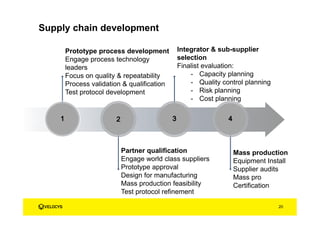
Supply chain development
Prototype process development
Engage process technology
leaders
Focus on quality & repeatability
Process validation & qualification
Test protocol development
Integrator & sub-supplier
selection
Finalist evaluation:
- Capacity planning
- Quality control planning
- Risk planning
- Cost planning
Partner qualification
Engage world class suppliers
Prototype approval
Design for manufacturing
Mass production feasibility
Test protocol refinement
Mass production
Equipment Install
Supplier audits
Mass pro
Certification
20
• FT reactor designed to ASME, boiler and pressure vessel
code, section VIII, division 1
• FEED review
— Design criteria, material selection, operating
conditions, fabrication process
• FMEA
— Reactor manufacture, FT process impact, equipment
operation, corrosion/life
• Reactor testing
— Weld inspection, temperature cycles, pressure cycles,
reactor autopsy
Mechanical integrity testing
21
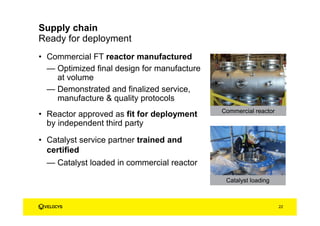
• Commercial FT reactor manufactured
— Optimized final design for manufacture
at volume
— Demonstrated and finalized service,
manufacture & quality protocols
• Reactor approved as fit for deployment
by independent third party
• Catalyst service partner trained and
certified
— Catalyst loaded in commercial reactor
Ready for deployment
Supply chain
Commercial reactor
Catalyst loading
22
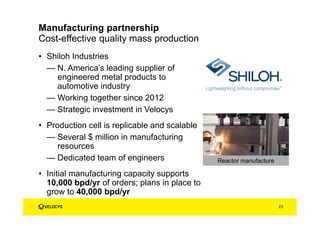
• Shiloh Industries
— N. America’s leading supplier of
engineered metal products to
automotive industry
— Working together since 2012
— Strategic investment in Velocys
• Production cell is replicable and scalable
— Several $ million in manufacturing
resources
— Dedicated team of engineers
• Initial manufacturing capacity supports
10,000 bpd/yr of orders; plans in place to
grow to 40,000 bpd/yr
Cost-effective quality mass production
Manufacturing partnership
Reactor manufacture
23
• Project description
— First GTL plant that will use a combination of
renewable biogas and natural gas
• Enabling factors
— Low cost landfill gas as feedstock
— RIN credits under the Renewable Fuel
Standards
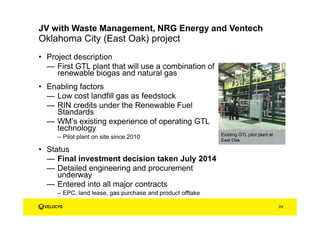
— WM’s existing experience of operating GTL
technology
– Pilot plant on site since 2010
• Status
— Final investment decision taken July 2014
— Detailed engineering and procurement
underway
— Entered into all major contracts
– EPC, land lease, gas purchase and product offtake
Oklahoma City (East Oak) project
24
JV with Waste Management, NRG Energy and Ventech
Existing GTL pilot plant at
East Oak
• Project description
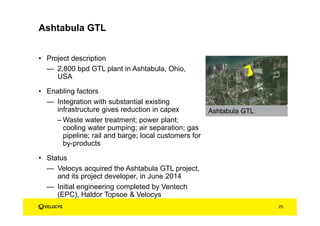
— 2,800 bpd GTL plant in Ashtabula, Ohio,
USA
• Enabling factors
— Integration with substantial existing
infrastructure gives reduction in capex
– Waste water treatment; power plant;
cooling water pumping; air separation; gas
pipeline; rail and barge; local customers for
by-products
• Status
— Velocys acquired the Ashtabula GTL project,
and its project developer, in June 2014
— Initial engineering completed by Ventech
(EPC), Haldor Topsoe & Velocys
25
Ashtabula GTL
Ashtabula GTL
GreenSky London
• Project description
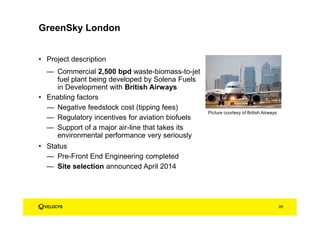
— Commercial 2,500 bpd waste-biomass-to-jet
fuel plant being developed by Solena Fuels
in Development with British Airways
• Enabling factors
— Negative feedstock cost (tipping fees)
— Regulatory incentives for aviation biofuels
— Support of a major air-line that takes its
environmental performance very seriously
• Status
— Pre-Front End Engineering completed
— Site selection announced April 2014
Picture courtesy of British Airways
26
Red Rock Biofuels
• Project description
– 1,100 bpd forestry waste to liquids plant in
Oregon, USA
• Enabling factors
– Supported by US DoD and US DoE
• Received $4.1m phase 1 grant for
engineering
• 1 of 4 projects eligible to apply for $70m
construction grant
• Status
– FEED study complete and submitted with
phase 2 proposal
– US DOD targeting late August for phase 2
grant decision
27
• Velocys: leader in advanced FT technology
• Superior catalyst and reactor design leading to exceptional
process performance
• Leveraging on key partnerships for deployment of our technology
• Financial commitment secured for construction of first commercial
plant. Detailed engineering and procurement underway. Orders
received for reactors and catalyst.
28
Summary

Velocys ppt140813_ENFL-ACS_2014

  • 1.
    Commercializing an advancedFischer- Tropsch synthesis technology ENFL: Fischer-Tropsch Chemistry & Catalysis 248th ACS National Meeting Soumitra Deshmukh, Stephen LeViness, Heinz Robota, Matthew Davis, Thomas Yuschak, Amanda Miller August 13, 2014
  • 2.
    • Leader insmaller scale gas-to-liquids technology — 15 years and >$300 million invested in product development — Exhaustive global patent protection (>7,500 granted GTL patent claims) • World class partners offering a complete GTL solution — Haldor Topsøe, Ventech, Hatch, Toyo, Mourik, SGS, Shiloh • Commercial roll-out underway • Well capitalized with strong resources — Commercial center in Houston, Texas; technical centers near Columbus, Ohio and Oxford, UK — Permanent pilot plant in operation Leader in smaller scale GTL 2 Velocys
  • 3.
    Commercial FT reactor FTreactor core Velocys technology • Microchannel reactor — Enhanced heat and mass transfer rates — Close coupling of exothermic reaction with steam generation • Superior catalysts — High activity and selectivity • Principles of design and operation — Particulate catalyst in small channels — Cross-flow with syngas downflow • Strengths — Isothermal behavior – thermally stable — Extremely robust to upsets — Strong economy of mass manufacturing — Installed spares relatively cheap — High on-stream factor — Extremely high volumetric productivity — Ease of modularization Compact, robust, efficient and economic 3
  • 4.
  • 5.
    • 1 processchannel — No catalyst dilution — Coolant channels with hot oil circulation • During scale-up, number of channels increases, size does not# • Validate commercialization requirements — Stability — Regenerability — Catalyst life — Predictive models — Tolerance to feed contaminants, upsets Single channel reactor Laboratory testing tool CO+H2+inerts Product collection 5 #Deshmukh et.al., Ind. Eng. Chem. Res., 49(21), pp10883, 2010
  • 6.
    Stable long termoperation at high per pass conversion Overall CO conversion >90% 6
  • 7.
    Excellent regenerability >90% activityof fresh catalyst after 13 regenerations 7
  • 8.
    Long life Deactivation rateunchanged after >2.5 years of operation LeViness, Deshmukh et.al., Top. Catal., 57, pp518, 2014 8
  • 9.
    Pilot plant andtraining facility • Integrated GTL pilot plant in Ohio • Designed to provide — Performance data to support differing client designs — Product for client studies — Permanent training facility for plant operators • Platform for — Developing our own field support staff — Demonstrating future product generations Add pilot plant photo Pilot plant 9
  • 10.
    Pilot plant results Stableoperation at target conditions Shutdown for steam system repairs 10
  • 11.
    • Designed tocover wide range of FT operations • Independent variation of parameters: e.g. Pco, PH2, • >60 data points — Close monitoring of outlet H2:CO ratio and CO conversion — Product sample at each point • Assessment of ageing and regeneration on process response 11 Process model development Design of experiments study Inlet pressure: 200 – 450 psig Inerts: 10% – 70% Contact time: 150 – 500 ms Feed H2:CO ratio: 1.4 – 4.5 Temperatures: 175 – 235 °C
  • 12.
    Operating results fromfield demonstration unit Agree with model developed from laboratory data 12
  • 13.
  • 14.
    • Organic MatrixCombustion (OMX) — Novel synthesis method — Yields highly active and stable catalysts • FT catalyst — Activity depends on small sizes of Co3O4 particles — Stability depends on a narrow particle size distribution • OMX yields an optimum average Co3O4 particle size yielding a stable, high activity FT catalyst upon activation 14 Organic matrix combustion methodology A key factor in the Velocys catalyst synthetic approach
  • 15.
    1 10 100 0 10 2030 40 50 TOFx1000/s Co diameter nm den Breejen JACS 2009 131 p. 7197 35 bar 210 C Logdberg J. Catalysis 274 2010 p. 84 20 bar 210 C Velocys 25 bar 205 C The industrially produced Velocys catalyst exhibits an apparent TOF 3-6 times higher than typical Co FT catalysts at 5° C lower temperature – Co surface area determined by H2 adsorption 15 Activity is gained through both loading density and a higher intrinsic reaction rate Lower TOF based on contraction of oxide crystallites from XRD Higher TOF based on H2 chemisorption capacity and extent of reduction – particle diameter estimate too large based on support pore diameter
  • 16.
    High, stable reactorperformance requires uniform pressure drop (and hence flow) from channel-to-channel • Multiple factors affect pressure drop: — Nominal size — Gross size distribution — Packing density — Packing uniformity — Detailed fines content • Successful charging requires: — Controlled particle characteristics — Generation of a uniform particle size distribution for the whole charge • Charging technology and catalyst charge characteristics must be matched, controlled, and standardized ~ 0.1- 10 mm Microchannel 16
  • 17.
    Controlling flow uniformityrequires care in preparing and charging catalyst • A standardized charge was specifically created to yield uniform packing • Grab samples were collected from by scooping from different portions of the original lot • Standardized samples yield flow characterized by experimental variability • Randomly selected charges yield widely varying flow characteristics • Standard methods of measuring particle size distributions can be inadequate to fully distinguish differences 0.0 50.0 100.0 150.0 200.0 250.0 300.0 350.0 0 500 1000 1500 2000 2500 3000 3500 MeasuredInletPressure,psig Gas Flow, sccm (ref. 0C & 1 atm) Standardized 10648-70-A Standardized 10648-71-B Standardized 10648-72-A Grab 1 Grab 2 17
  • 18.
    18 Full composition specificationis established using a “formulation optimization” experimental design Support Co wt% Prom. 1 Prom. 2 Mod. 1 X%CO %C5+ sel %CH4 sel. Deact. rate (-%/day) Type C 1.00 2.0 1.0 1.08 70.4 86.6 8 -0.96 Type A 0.77 1.0 1.0 1.00 29.8 84.9 8 -0.86 Type B 0.88 1.5 1.5 1.15 59.5 84.4 8.9 -0.49 Type C 1.00 1.0 1.0 1.00 65.9 86.2 8.2 -0.72 Type C 0.88 1.5 1.5 0.85 52.5 85.5 7.9 -0.81 Type B 1.00 1.0 1.0 1.00 63.3 85.4 8.7 -0.75 Type C 0.88 0.5 1.5 1.15 57.9 87 7.2 -0.09 Type A 1.23 1.0 1.0 1.00 79 84.6 10.1 -0.35 Type B 1.12 1.5 1.5 0.85 75.3 84.3 10.1 -0.38 Type B 0.88 1.5 0.5 0.85 52.2 85.4 8.4 -0.26 Type A 1.00 0.0 1.0 1.00 59.3 87.3 6.9 -0.59 Type C 0.88 0.5 0.5 0.85 54.7 87.3 7.1 -0.53 Type A 1.00 1.0 1.0 1.00 61.6 87.6 7.1 -0.61 Type C 1.12 0.5 1.5 0.85 70.6 85 9 0.04 Type C 1.12 1.5 1.5 1.15 70.3 83.9 9.9 0.56 Type B 0.88 0.5 0.5 1.15 55 85.9 8.1 -0.12 Type A 1.00 1.0 1.0 0.69 59.6 87.9 6.7 -1.29 Type B 0.88 0.5 1.5 0.85 58.6 86.5 7.7 -0.62 Type A 1.00 1.0 2.0 1.00 61.5 87.6 7.1 -0.75 Type B 1.00 1.0 1.0 1.00 67.2 85.4 9 -0.51 Type B 1.12 0.5 0.5 0.85 74.9 85 9.4 -0.45 Type C 1.12 0.5 0.5 1.15 70.4 84.3 9.8 0.1 Type B 1.12 0.5 1.5 1.15 71.8 83.1 10.7 -0.16 Type A 1.00 2.0 1.0 1.00 56 87.1 7.4 -0.66 Type C 0.88 1.5 0.5 1.15 56.2 85.6 7.7 -0.06 Type A 1.00 1.0 1.0 1.31 63.7 87.2 7.3 -0.49 Type A 1.00 1.0 0.0 1.00 50.6 87 7.2 -0.83 Type A 1.00 1.0 1.0 1.00 56.5 86.4 7.6 -0.74 Type C 1.00 1.0 1.0 1.00 62.2 86.4 7.9 -0.5 Type C 1.12 1.5 0.5 0.85 69.3 85.3 9.1 -0.56 Type B 1.12 1.5 0.5 1.15 67.9 83 11 -0.25 Type A 1.00 2.0 1.0 1.08 53.3 87.5 7.2 -0.88 Type C 0.77 1.0 1.0 1.00 69.9 87 7.8 -0.56 Determine process response to each composition variable Identify interactions among variables Verify that “limiting compositions” fall well within allowable performance thresholds Validate measurement methods for composition and physical characteristics ‘1’ represents nominal value
  • 19.
    19 Limits on manufacturing-relatedforeign elements also set using experimental design Impurity level (ppm) Test result s Cataly st N 1 2 3 4 5 6 7 XCO 1 0 0 2000 2000 1000 0 0 7.2 2 0 2000 0 2000 2000 1000 0 18.4 3 1000 1000 1000 1000 1000 1000 1000 8.0 4 0 0 0 2000 0 2000 2000 10.4 5 2000 2000 2000 0 2000 0 0 6.9 6 0 2000 2000 1000 0 0 2000 6.4 7 2000 0 2000 0 0 1000 2000 4.8 8 2000 0 0 1000 2000 2000 0 9.9 9 2000 2000 0 2000 0 0 1000 9.0 10 2000 1000 2000 2000 0 2000 0 5.4 11 1000 1000 1000 1000 1000 1000 1000 7.7 12 1000 0 0 0 0 0 0 24.4 13 2000 2000 0 0 1000 2000 2000 10.3 14 1000 2000 2000 2000 2000 2000 2000 6.3 15 0 0 2000 0 2000 2000 1000 5.9 16 2000 0 1000 2000 2000 0 2000 6.0 17 0 1000 0 0 2000 0 2000 26.2 18 0 2000 1000 0 0 2000 0 7.3 N Impurity added (ppm) Absolute X%CO decrease 1 4 6 2 Exp. Mod. 1 100 1.5 0.4 2 100 100 6.2 6.0 3 170 4.8 5.4 4 170 100 6.3 9.6 5 200 3.0 0.6 6 200 200 12.4 10.0 7 340 9.5 12.0 8 340 200 12.5 13.8 9 200 3.2 2.7 10 400 6.4 6.6 11 259 400 6.2 6.0 12 400 7.8 6.0 R² = 0.8429 0.0 5.0 10.0 15.0 20.0 0.0 5.0 10.0 15.0 20.0 Exp.decreaseinconversion (abs%) Predicted decrease in conversion (abs %) A two part process: Initial screening A refined evaluation (the most damaging impurities)
  • 20.
    Supply chain development Prototypeprocess development Engage process technology leaders Focus on quality & repeatability Process validation & qualification Test protocol development Integrator & sub-supplier selection Finalist evaluation: - Capacity planning - Quality control planning - Risk planning - Cost planning Partner qualification Engage world class suppliers Prototype approval Design for manufacturing Mass production feasibility Test protocol refinement Mass production Equipment Install Supplier audits Mass pro Certification 20
  • 21.
    • FT reactordesigned to ASME, boiler and pressure vessel code, section VIII, division 1 • FEED review — Design criteria, material selection, operating conditions, fabrication process • FMEA — Reactor manufacture, FT process impact, equipment operation, corrosion/life • Reactor testing — Weld inspection, temperature cycles, pressure cycles, reactor autopsy Mechanical integrity testing 21
  • 22.
    • Commercial FTreactor manufactured — Optimized final design for manufacture at volume — Demonstrated and finalized service, manufacture & quality protocols • Reactor approved as fit for deployment by independent third party • Catalyst service partner trained and certified — Catalyst loaded in commercial reactor Ready for deployment Supply chain Commercial reactor Catalyst loading 22
  • 23.
    • Shiloh Industries —N. America’s leading supplier of engineered metal products to automotive industry — Working together since 2012 — Strategic investment in Velocys • Production cell is replicable and scalable — Several $ million in manufacturing resources — Dedicated team of engineers • Initial manufacturing capacity supports 10,000 bpd/yr of orders; plans in place to grow to 40,000 bpd/yr Cost-effective quality mass production Manufacturing partnership Reactor manufacture 23
  • 24.
    • Project description —First GTL plant that will use a combination of renewable biogas and natural gas • Enabling factors — Low cost landfill gas as feedstock — RIN credits under the Renewable Fuel Standards — WM’s existing experience of operating GTL technology – Pilot plant on site since 2010 • Status — Final investment decision taken July 2014 — Detailed engineering and procurement underway — Entered into all major contracts – EPC, land lease, gas purchase and product offtake Oklahoma City (East Oak) project 24 JV with Waste Management, NRG Energy and Ventech Existing GTL pilot plant at East Oak
  • 25.
    • Project description —2,800 bpd GTL plant in Ashtabula, Ohio, USA • Enabling factors — Integration with substantial existing infrastructure gives reduction in capex – Waste water treatment; power plant; cooling water pumping; air separation; gas pipeline; rail and barge; local customers for by-products • Status — Velocys acquired the Ashtabula GTL project, and its project developer, in June 2014 — Initial engineering completed by Ventech (EPC), Haldor Topsoe & Velocys 25 Ashtabula GTL Ashtabula GTL
  • 26.
    GreenSky London • Projectdescription — Commercial 2,500 bpd waste-biomass-to-jet fuel plant being developed by Solena Fuels in Development with British Airways • Enabling factors — Negative feedstock cost (tipping fees) — Regulatory incentives for aviation biofuels — Support of a major air-line that takes its environmental performance very seriously • Status — Pre-Front End Engineering completed — Site selection announced April 2014 Picture courtesy of British Airways 26
  • 27.
    Red Rock Biofuels •Project description – 1,100 bpd forestry waste to liquids plant in Oregon, USA • Enabling factors – Supported by US DoD and US DoE • Received $4.1m phase 1 grant for engineering • 1 of 4 projects eligible to apply for $70m construction grant • Status – FEED study complete and submitted with phase 2 proposal – US DOD targeting late August for phase 2 grant decision 27
  • 28.
    • Velocys: leaderin advanced FT technology • Superior catalyst and reactor design leading to exceptional process performance • Leveraging on key partnerships for deployment of our technology • Financial commitment secured for construction of first commercial plant. Detailed engineering and procurement underway. Orders received for reactors and catalyst. 28 Summary