The Rise of New (Online)
Populism in Europe: Is There
Room for
(Media) Education
Maria Ranieri,
Department of Education and
Psychology
University of Florence (IT)
11th
March, 2016
The project
3
• Who Department of Education and Psychology, University of Florence
(IT), University of Vienna (AT), Media Animation (BE), New Bulgarian
University (BU), Peace Institute (SI), Université Paris VIII (FR), University of
Leicester (UK)
• When 2012-2014
• What Contrasting far right populism and new forms of discrimination
transmitted through digital media and social networks by promoting
young people awareness towards violent media contents and
empowering them through civic engagement (or also e-engagement) and
media/digital literacy.
Research Questions
Q1. How populism can be defined? What are the new forms of populism
emerging through the web and how they are addressing young people in the
European context?
Q2. How stereotypes about the ‘other’ are constructed through the use of
digital media? What are the rhetoric and the communication strategies
adopted by populist organizations to reach consensus, especially among
young people?
Q3. How to deconstruct populist hate speech towards the 'other' and raise
young people and minorities' awareness? How to promote children voice
appropriation and participatory skills? Can media education play a role in the
process of raising awareness against discrimination?
4
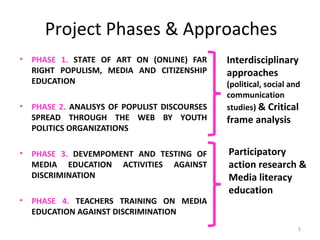
Project Phases & Approaches
• PHASE 1. STATE OF ART ON (ONLINE) FAR
RIGHT POPULISM, MEDIA AND CITIZENSHIP
EDUCATION
• PHASE 2. ANALISYS OF POPULIST DISCOURSES
SPREAD THROUGH THE WEB BY YOUTH
POLITICS ORGANIZATIONS
• PHASE 3. DEVEMPOMENT AND TESTING OF
MEDIA EDUCATION ACTIVITIES AGAINST
DISCRIMINATION
• PHASE 4. TEACHERS TRAINING ON MEDIA
EDUCATION AGAINST DISCRIMINATION
5
Interdisciplinary
approaches
(political, social and
communication
studies) & Critical
frame analysis
Participatory
action research &
Media literacy
education
Interdisciplinary research on communicative
strategies of othering on the web.
What we have done
What have we learnt
6
On Air Project Presentation 7
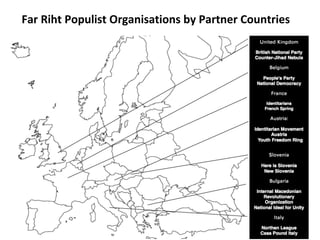
Far Riht Populist Organisations by Partner Countries
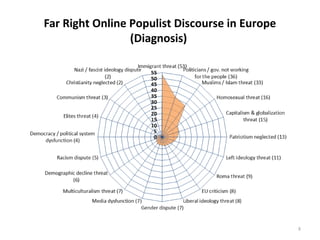
Far Right Online Populist Discourse in Europe
(Diagnosis)
8
Far Right Online Populist Discourse in Europe
(Prognosis)
9
Representing the ‘people’
10
A stereotypical representation of the family by Youth Freedom Ring (Austria)
Othering and discriminating minority groups
“Love of the homeland is not a crime!” (Identitarian Movement Austria)
11
Anti-elism and anti-system rhetoric as discursive
strategies of othering
Example of anti-elitism as reiforcement of othering discourse
(Northen League, Italy)
12
Participatory action research
and media literacy education.
What we have done
What have we learnt
13
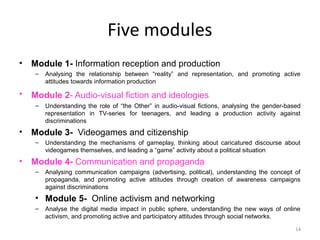
Five modules
14
• Module 1- Information reception and production
– Analysing the relationship between “reality” and representation, and promoting active
attitudes towards information production
• Module 2- Audio-visual fiction and ideologies
– Understanding the role of “the Other” in audio-visual fictions, analysing the gender-based
representation in TV-series for teenagers, and leading a production activity against
discriminations
• Module 3- Videogames and citizenship
– Understanding the mechanisms of gameplay, thinking about caricatured discourse about
videogames themselves, and leading a “game” activity about a political situation
• Module 4- Communication and propaganda
– Analysing communication campaigns (advertising, political), understanding the concept of
propaganda, and promoting active attitudes through creation of awareness campaigns
against discriminations
• Module 5- Online activism and networking
– Analyse the digital media impact in public sphere, understanding the new ways of online
activism, and promoting active and participatory attitudes through social networks.
A guide for teens
15
Interactive &
Collaborative
eBook
multimedia
glossary
editable by teachers
hyperlinks
On Air Project Presentation 16
Step 3. Testing
17
18
On Air Project Presentation 19
More information
20
Thanks!

Eav media learning_2016_ranieri

  • 1.
    The Rise ofNew (Online) Populism in Europe: Is There Room for (Media) Education Maria Ranieri, Department of Education and Psychology University of Florence (IT) 11th March, 2016
  • 3.
    The project 3 • WhoDepartment of Education and Psychology, University of Florence (IT), University of Vienna (AT), Media Animation (BE), New Bulgarian University (BU), Peace Institute (SI), Université Paris VIII (FR), University of Leicester (UK) • When 2012-2014 • What Contrasting far right populism and new forms of discrimination transmitted through digital media and social networks by promoting young people awareness towards violent media contents and empowering them through civic engagement (or also e-engagement) and media/digital literacy.
  • 4.
    Research Questions Q1. Howpopulism can be defined? What are the new forms of populism emerging through the web and how they are addressing young people in the European context? Q2. How stereotypes about the ‘other’ are constructed through the use of digital media? What are the rhetoric and the communication strategies adopted by populist organizations to reach consensus, especially among young people? Q3. How to deconstruct populist hate speech towards the 'other' and raise young people and minorities' awareness? How to promote children voice appropriation and participatory skills? Can media education play a role in the process of raising awareness against discrimination? 4
  • 5.
    Project Phases &Approaches • PHASE 1. STATE OF ART ON (ONLINE) FAR RIGHT POPULISM, MEDIA AND CITIZENSHIP EDUCATION • PHASE 2. ANALISYS OF POPULIST DISCOURSES SPREAD THROUGH THE WEB BY YOUTH POLITICS ORGANIZATIONS • PHASE 3. DEVEMPOMENT AND TESTING OF MEDIA EDUCATION ACTIVITIES AGAINST DISCRIMINATION • PHASE 4. TEACHERS TRAINING ON MEDIA EDUCATION AGAINST DISCRIMINATION 5 Interdisciplinary approaches (political, social and communication studies) & Critical frame analysis Participatory action research & Media literacy education
  • 6.
    Interdisciplinary research oncommunicative strategies of othering on the web. What we have done What have we learnt 6
  • 7.
    On Air ProjectPresentation 7 Far Riht Populist Organisations by Partner Countries
  • 8.
    Far Right OnlinePopulist Discourse in Europe (Diagnosis) 8
  • 9.
    Far Right OnlinePopulist Discourse in Europe (Prognosis) 9
  • 10.
    Representing the ‘people’ 10 Astereotypical representation of the family by Youth Freedom Ring (Austria)
  • 11.
    Othering and discriminatingminority groups “Love of the homeland is not a crime!” (Identitarian Movement Austria) 11
  • 12.
    Anti-elism and anti-systemrhetoric as discursive strategies of othering Example of anti-elitism as reiforcement of othering discourse (Northen League, Italy) 12
  • 13.
    Participatory action research andmedia literacy education. What we have done What have we learnt 13
  • 14.
    Five modules 14 • Module1- Information reception and production – Analysing the relationship between “reality” and representation, and promoting active attitudes towards information production • Module 2- Audio-visual fiction and ideologies – Understanding the role of “the Other” in audio-visual fictions, analysing the gender-based representation in TV-series for teenagers, and leading a production activity against discriminations • Module 3- Videogames and citizenship – Understanding the mechanisms of gameplay, thinking about caricatured discourse about videogames themselves, and leading a “game” activity about a political situation • Module 4- Communication and propaganda – Analysing communication campaigns (advertising, political), understanding the concept of propaganda, and promoting active attitudes through creation of awareness campaigns against discriminations • Module 5- Online activism and networking – Analyse the digital media impact in public sphere, understanding the new ways of online activism, and promoting active and participatory attitudes through social networks.
  • 15.
    A guide forteens 15 Interactive & Collaborative eBook multimedia glossary editable by teachers hyperlinks
  • 16.
    On Air ProjectPresentation 16
  • 17.
  • 18.
  • 19.
    On Air ProjectPresentation 19
  • 20.
  • 21.

Editor's Notes

  • #4 Mettere una cartina EU