RECIPROCAL ROLE OF MEDIA AND CIVIC 
LITERACIES: CASE STUDY ON THE NEWS 
AND YOUNG CITIZENS IN PORTUGAL 
MARIA JOSÉ BRITES 
MEDIA AND JOURNALISM RESEARCH 
CENTRE/NEW UNIVERSITY OF LISBON 
LUSOPHONE UNIVERSITY OF PORTO 
BRITESMARIAJOSE@GMAIL.COM 
ICA's 63rd Annual Conference: 
Challenging Communication Research 
17-21 June 2013, London, UK
STRUCTURE 
 Media literacy is considered in its connections with 
civic literacy. 
Do these poles act in a virtuous cycle? 
 Methodological approach 
 Construction of profiles 
 Profiles 
 Final marks
METHODOLOGICAL APPROACH 
News and Participation 
 Direct observation. 
 2010: interviews with 35 Portuguese (mostly 15-18) 
youngsters with diverse experiences of civic and political 
participation. 
 School Parliament Program, youth political parties, graffiti, 
school newspapers and assembly in a low income area 
 Different backgrounds 
 2011: interviews that involved 30 of the initial interviewees. 
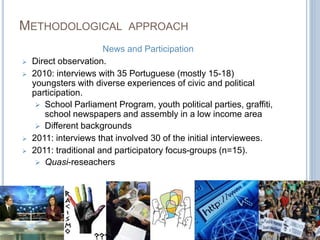
 2011: traditional and participatory focus-groups (n=15). 
 Quasi-reseachers
CONSTRUCTION OF PROFILES 
 General news; 
 Political news; 
 Forms of participation.
Occasional participation and low consume 
of news 
(N=5 | F=2, M=3 | 3=15, 1=17, 1=18) 
“I watch the news with my mother and my brother. We 
comment on that, my mother talks about dangers.[...] 
A few days ago, we talked about swimming pool dangers. 
She said: ‘Don't jump like that’. My mother alerted my brother 
and I.” (Girl, 15, low income area assembly) 
Opportunities that come and go; 
Low intensity of participation in time. 
News box (political news) 
Coffee shop 
Popular news
EMERGENT PARTICIPANTS AND EMERGENT 
CONSUMERS 
(N=10 | F=6, M=4 | 6=16, 3=17, 1=21) 
“Television is the basis of my family life” (Girl, 15, 
School Parliament Program) 
Diverse types of participation in time. 
Talk about news (Family and School); 
Directions to act in daily life
ALTERNATIVE/NON MAINSTREAM PARTICIPANTS 
AND ONLINE CITIZENS 
(N=6 | F=5, M=1 | 1=14, 1=16, 1=17, 2=18, 1=21) 
“[I share on the web] Issues such as LGBT, racism, 
discrimination, contemporary issues such as Egypt, Tunisia, 
economical issues.” (Girl, Political Party/NGO on Racism) 
Mainly internet; 
News related to participation activities. 
Political news (Family); arts, human rights (Friends)
INFORMED AND ENGAGED CITIZENS 
(N=7 | F=3, M=4 | 2=15, 2=17, 3=18); 
“What media did you use to get information during the elections? 
So many people! My family, colleges from the political party, 
thousands of contact activities during the political campaign 
[...] with everyone that I know 
(girl, Youth political party) 
Multiple forms in time; 
Produsers. 
News everywhere and power fuel to participate.
THE RELEVANCE OF THE SELF-CENTRED 
(N=7 | M=7 | 1=15, 2=16, 3=17, 1=18) 
“Music, I like what I produce. I follow my blog [it is a MySpace 
webpage], to know who follows me. And, after that, I ask people if 
they enjoyed my music.” (boy, 17, MC) 
Non conventional; 
Self-centred ; 
Boys; 
Intense participation in time related to self centred activities and 
specific activities; 
Produsers. 
More diverse; 
Different contexts; 
But political news = family.
FINAL MARKS 
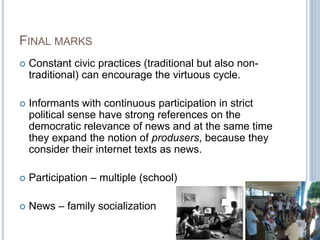
 Constant civic practices (traditional but also non-traditional) 
can encourage the virtuous cycle. 
 Informants with continuous participation in strict 
political sense have strong references on the 
democratic relevance of news and at the same time 
they expand the notion of produsers, because they 
consider their internet texts as news. 
 Participation – multiple (school) 
 News – family socialization
Resilience 
• Non traditional; deprived areas 
Virtuous circle 
• Media and civic literacy
Thank You! 
 Maria José Brites | britesmariajose@gmail.com

The Reciprocal Role of Media and Civic Literacies: A Case Study of News and Young Citizens in Portugal

  • 1.
    RECIPROCAL ROLE OFMEDIA AND CIVIC LITERACIES: CASE STUDY ON THE NEWS AND YOUNG CITIZENS IN PORTUGAL MARIA JOSÉ BRITES MEDIA AND JOURNALISM RESEARCH CENTRE/NEW UNIVERSITY OF LISBON LUSOPHONE UNIVERSITY OF PORTO BRITESMARIAJOSE@GMAIL.COM ICA's 63rd Annual Conference: Challenging Communication Research 17-21 June 2013, London, UK
  • 2.
    STRUCTURE  Medialiteracy is considered in its connections with civic literacy. Do these poles act in a virtuous cycle?  Methodological approach  Construction of profiles  Profiles  Final marks
  • 3.
    METHODOLOGICAL APPROACH Newsand Participation  Direct observation.  2010: interviews with 35 Portuguese (mostly 15-18) youngsters with diverse experiences of civic and political participation.  School Parliament Program, youth political parties, graffiti, school newspapers and assembly in a low income area  Different backgrounds  2011: interviews that involved 30 of the initial interviewees.  2011: traditional and participatory focus-groups (n=15).  Quasi-reseachers
  • 4.
    CONSTRUCTION OF PROFILES  General news;  Political news;  Forms of participation.
  • 5.
    Occasional participation andlow consume of news (N=5 | F=2, M=3 | 3=15, 1=17, 1=18) “I watch the news with my mother and my brother. We comment on that, my mother talks about dangers.[...] A few days ago, we talked about swimming pool dangers. She said: ‘Don't jump like that’. My mother alerted my brother and I.” (Girl, 15, low income area assembly) Opportunities that come and go; Low intensity of participation in time. News box (political news) Coffee shop Popular news
  • 6.
    EMERGENT PARTICIPANTS ANDEMERGENT CONSUMERS (N=10 | F=6, M=4 | 6=16, 3=17, 1=21) “Television is the basis of my family life” (Girl, 15, School Parliament Program) Diverse types of participation in time. Talk about news (Family and School); Directions to act in daily life
  • 7.
    ALTERNATIVE/NON MAINSTREAM PARTICIPANTS AND ONLINE CITIZENS (N=6 | F=5, M=1 | 1=14, 1=16, 1=17, 2=18, 1=21) “[I share on the web] Issues such as LGBT, racism, discrimination, contemporary issues such as Egypt, Tunisia, economical issues.” (Girl, Political Party/NGO on Racism) Mainly internet; News related to participation activities. Political news (Family); arts, human rights (Friends)
  • 8.
    INFORMED AND ENGAGEDCITIZENS (N=7 | F=3, M=4 | 2=15, 2=17, 3=18); “What media did you use to get information during the elections? So many people! My family, colleges from the political party, thousands of contact activities during the political campaign [...] with everyone that I know (girl, Youth political party) Multiple forms in time; Produsers. News everywhere and power fuel to participate.
  • 9.
    THE RELEVANCE OFTHE SELF-CENTRED (N=7 | M=7 | 1=15, 2=16, 3=17, 1=18) “Music, I like what I produce. I follow my blog [it is a MySpace webpage], to know who follows me. And, after that, I ask people if they enjoyed my music.” (boy, 17, MC) Non conventional; Self-centred ; Boys; Intense participation in time related to self centred activities and specific activities; Produsers. More diverse; Different contexts; But political news = family.
  • 10.
    FINAL MARKS Constant civic practices (traditional but also non-traditional) can encourage the virtuous cycle.  Informants with continuous participation in strict political sense have strong references on the democratic relevance of news and at the same time they expand the notion of produsers, because they consider their internet texts as news.  Participation – multiple (school)  News – family socialization
  • 11.
    Resilience • Nontraditional; deprived areas Virtuous circle • Media and civic literacy
  • 12.
    Thank You! Maria José Brites | britesmariajose@gmail.com

Editor's Notes

  • #2 Reciprocal role of media and civic literacies: case study on the news and young citizens in Portugal Maria José Brites, Media and Journalism Research Centre/ New University of Lisbon; Lusophone University of Porto This presentation reflects on the ambivalent daily life tensions between news (consumption and production) and civic practices among young citizens (15-18). Media literacy is considered in its connections with civic literacy. Both poles are deeply connected, engaged in prismatic views and in a virtuous cycle. Reflection will focus on data from a longitudinal participatory research (2009-2011; direct observation, semi-structured interviews and focus groups) with more than 30 young people with diverse experiences of civic and political participation (writers, MC, political parties and NGO, among others). The results indicate that constant civic practices (traditional but also non-traditional) can encourage the virtuous cycle. Informants with continuous participation in strict political sense have firm references on the democratic relevance of news and at the same time they expand the notion of produsers, because they consider their internet texts as news.
  • #6 Quasi reserchers
  • #7 Quasi researchers
  • #9 Quasi researchers