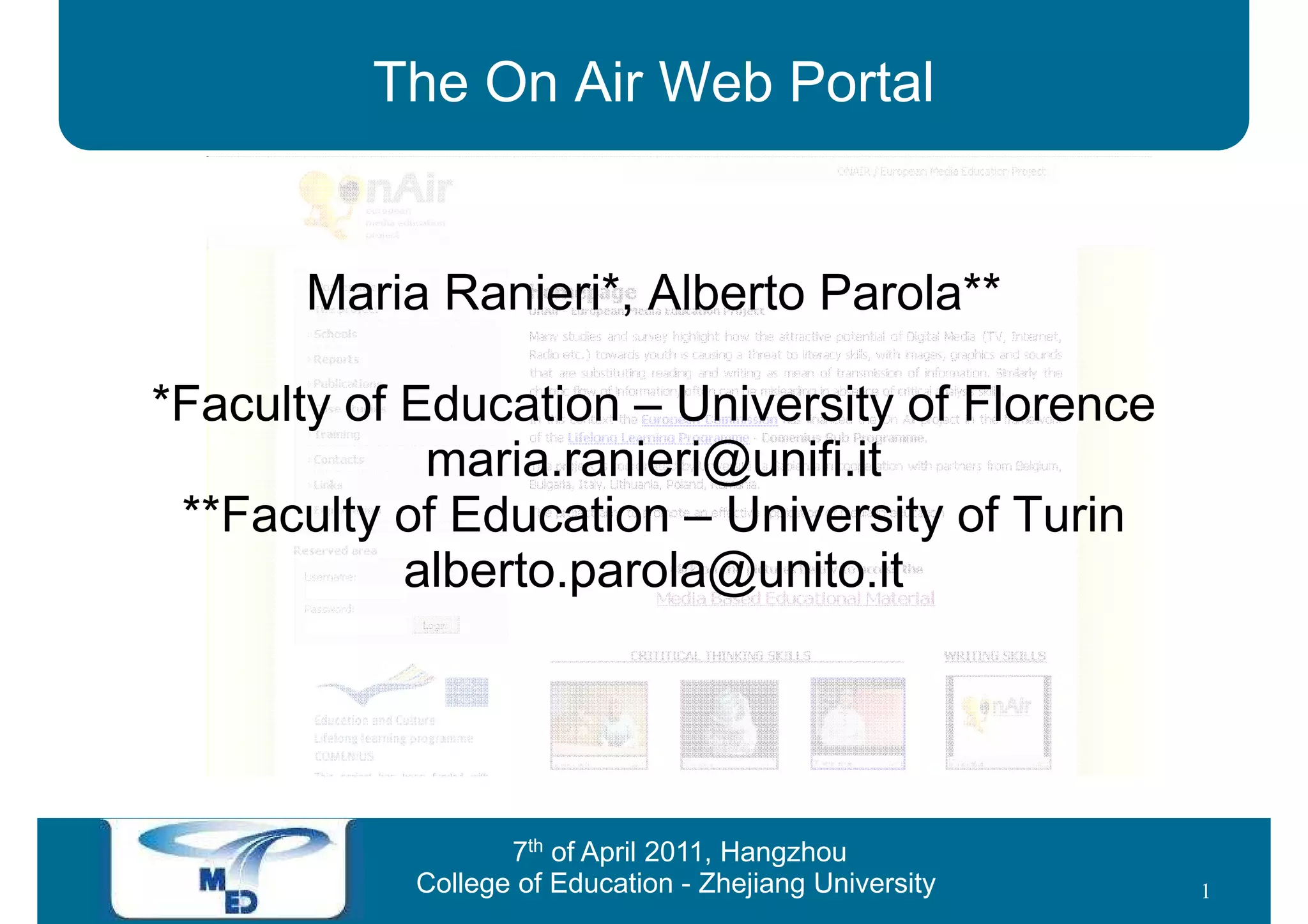
The On Air Web Portal


       Maria Ranieri*, Alberto Parola**

*Faculty of Education – University of Florence
             maria.ranieri@unifi.it
 **Faculty of Education – University of Turin
            alberto.parola@unito.it


                   7th of April 2011, Hangzhou
            College of Education - Zhejiang University   1
Media Education in Europe.
                The normative context
 Over the last ten years the European Commission (EC) has promoted
several initiatives in order to encourage the development of digital and media
literacy in the EU Member States.
Just to mention some initiatives, In December 2006 the European Parliament
(EP) and the Council released:

• Recommendation on Key Competences for Lifelong Learning
(2006/962/EC), a new framework for key competences including digital
competence among the competences for lifelong learning.

• Recommendation on the protection of minors and human dignity
(2006/952/EC), where the following aspects are emphasized: the need for
teacher training on media literacy; the inclusion of media literacy in the
curriculum to enhance children’s capacity of self-protection and promote
responsible attitudes among all users.


See: http://ec.europa.eu/culture/media/literacy/docs/studies/country/europe.pdf

                             6th of April 2011, Hangzhou
                      College of Education - Zhejiang University                  2
Media Education in Europe.
             Scholars and Research
Faced with these booming initiatives, some research areas
deserve further development, particularly on the pedagogical-
educational and assessment levels (Ceretti, Felini, Giannatelli,
2006; Trinchero in Parola, 2008).

This dimension has recently been highlighted by various writers. For
example, Jacquinot (2009) observes: “too often we forget to work on
educational theories or concepts that are at the root of media
education problems, and in schools, on the pedagogical methods
used by media education experts” (p.145). The (undesirable) side
effects of this scarce awareness of theories and methods are
interventions often based on implicit assumptions which are not
discussed or are not very clear: “Actions are taken, (so-called good)
practices are catalogued, policies are developed and assessments
are made, but most of the times the theories that inspire them are
not made clear” (p.147), and – we add – nor are the relative
assessment criteria.
                          6th of April 2011, Hangzhou
                   College of Education - Zhejiang University       3
The On Air Project
The European Project «On Air» stems from the wide framework previuosly
outlined and constitutes an attempt at considering media educational practices as
research objects, reflecting on pedagogical models and teaching instruments used
in the field of ME, and defining tools for the documentation and assessment of
practices.

The project was funded by the European Commission within the Life Long
Learning Program 2008/2010.
It was promoted by the Italian Association of Media Education (MED) and the
Faculty of Communication (La Sapienza, Rome, Italy).
Other partners were: INFOREF (Belgium), Zinev Art Technologies (Bulgaria), Pixel
(Italy), Easy Technology (Italy), Kaunas University of Technology (Lithuania),
WSinf (Poland), ActiveWatch-Media Monitoring Agency (Romania).


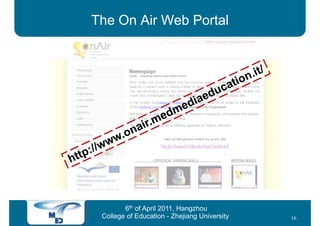
http://www.onair.medmediaeducation.it/


                              6th of April 2011, Hangzhou
                       College of Education - Zhejiang University              4
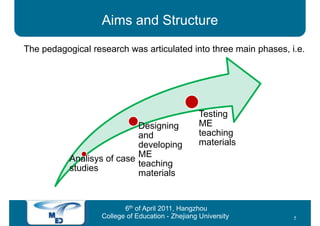
Aims and Structure
The pedagogical research was articulated into three main phases, i.e.


                                                   Testing
                            Designing              ME
                            and                    teaching
                            developing             materials
           Analisys of case ME
           studies          teaching
                            materials


                          6th of April 2011, Hangzhou
                   College of Education - Zhejiang University     5
First phase: Analisys of case studies
This first phase of the research consisted of identifying, collecting and
documenting ME practices and experiences carried out in the national
contexts of the countries involved in the project.

The purpose was twofold:

• analyze all the collected practices to discover possible trends in ME
practices with a focus on media skills/competences and pedagogical
issues;
• valorise teachers’ work, by selecting and disseminating significant
ME experiences carried out in schools.


                            6th of April 2011, Hangzhou
                     College of Education - Zhejiang University       6
Second Phase: Designing and Developing
               ME Modules
The purpose of this phase was to plan and develop eight ME modules
regarding four media competence areas:

(1) reading the media: the ability to read media and decode media
languages;
(2) write the media: the capacity of producing the media text and to use
digital instruments for creative purposes;
(3) critical understanding and evaluating the media: entails the
complex attitude to observe media contents and objects with a distance;
(4) media consumption awareness: the capacity of creating awareness
as to choices in the consumption of media understanding their explicit
and implicit messages in different situations.


                           6th of April 2011, Hangzhou
                    College of Education - Zhejiang University     7
Third phase: Testing ME Modules
The last research phase focused on the experimentation of the eight ME
modules with two purposes:

• define and try a common testing protocol, possibly re-usable or
transferable to other contexts;
• test the effectiveness and the quality of educational processes
promoted with the ME modules.


                           6th of April 2011, Hangzhou
                    College of Education - Zhejiang University      8
Results Fhase One (a)
About 300 ME practices were collected through the filling out of a form
structured in a way to acquire information about the media competence
areas involved, teaching methods used, documentation and assessment
tools, challenges and problems, results and transferability levels.
The forms were published in English on the online database of the OnAir
portal and are freely accessible.

The practices collected in this way underwent a quantitative analysis
through a long and complex encoding procedure, and they were also
analysed, discussed and assessed by expert teachers on the basis of a
common set of indicators.


                           6th of April 2011, Hangzhou
                    College of Education - Zhejiang University    9
Results Fhase One (b)
Emerging trends and issues:

• A first interesting point regards competence areas. Among the
typical objectives of the media education practices, the most frequent
ones are related to media writing and reading skills, while skills related
to media consumption are the least frequent ones irrespective of the
specific national contexts.

This fact seems to suggest that, on one hand, ME gets more feedback
when it is combined with the development of skills that are more easily
referable to the traditional curriculum. On the other hand, it could be
indicative of the difficulty of teachers to structure teaching activities
aimed at fostering aware consumption of media, a difficulty that
should/could be overcome by developing more tools in this less familiar
area of ME.

                            6th of April 2011, Hangzhou
                     College of Education - Zhejiang University      10
Results Fhase One (c)
Emerging trends and issues:

• A second point that deserves attention is the fact that the so-called
digital media are clearly prevalent: computers and Web 1.0/2.0 seem
to dominate school media practices. In order to reflect over this point and
its implications we should also mention another element related to the
large number of media education practices oriented at the production of
media, which is probably a consequence of the proliferation of
user-friendly digital tools for media creation.

At the same time, it should also be pointed out that classic Media
Education topics, like analysis of stereotypes and of representation or
the study of forms of media like cinema, are almost completely lacking.


                             6th of April 2011, Hangzhou
                      College of Education - Zhejiang University      11
Results Fhase One (d)
Emerging trends and issues:

• Another element stands out in the data collected. It regards the
scarce attention given to documentation of media education activities
carried out in class.
We know that documentation is far from being simple and that it presents
the teacher with a real challenge: how can a teaching experience be
described? How can a multidimensional and complex activity like teaching
be translated into words?

At the same time, if it is deemed necessary to enhance and improve
research around practices, documentation becomes just about inevitable,
especially in the perspective pursued in this study and inspired by
research-action. And yet, the documentation field is still weak.


                            6th of April 2011, Hangzhou
                     College of Education - Zhejiang University    12
Results Fhase One (e)
Emerging trends and issues:

• Let us finally consider assessment. Most of the collected experiences
did not plan any tools explicitly and consciously aimed at assessing
students’ learning. We are all interested in carrying out learning activities
that are effective, but few focus on the problem of assessment and the
construction of adequate tools. As some scholars (Bisogno,1995) reminds
us to consider documentation as “knowing what was done to be able to do”,
we ask to consider assessment as “evaluating carefully what was done
to be able to do better”.


                             6th of April 2011, Hangzhou
                      College of Education - Zhejiang University      13
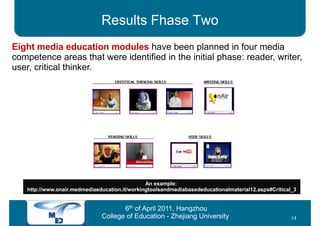
Results Fhase Two
Eight media education modules have been planned in four media
competence areas that were identified in the initial phase: reader, writer,
user, critical thinker.


                                               An example:
   http://www.onair.medmediaeducation.it/workingtoolsandmediabasededucationalmaterial12.aspx#Critical_3


                                     6th of April 2011, Hangzhou
                              College of Education - Zhejiang University                             14
Results Phase Three
Apart from the specific results achieved in the single countries,
three elements deserve being highlighted

• The importance of the theory-practice circle

•The importance of the dialogical and peer reviewing activities

•The importance of the Project, the Process, the Product


                            6th of April 2011, Hangzhou
                     College of Education - Zhejiang University     15
The On Air Web Portal


        6th of April 2011, Hangzhou
 College of Education - Zhejiang University   16
Thank you!

For further details, see:

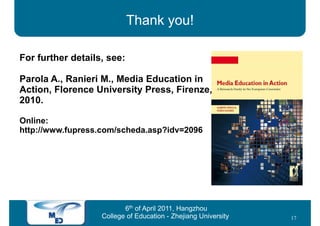
Parola A., Ranieri M., Media Education in
Action, Florence University Press, Firenze,
2010.

Online:
http://www.fupress.com/scheda.asp?idv=2096


                          6th of April 2011, Hangzhou
                   College of Education - Zhejiang University   17

On Air, The European project on Media Education

  • 1.
    The On AirWeb Portal Maria Ranieri*, Alberto Parola** *Faculty of Education – University of Florence maria.ranieri@unifi.it **Faculty of Education – University of Turin alberto.parola@unito.it 7th of April 2011, Hangzhou College of Education - Zhejiang University 1
  • 2.
    Media Education inEurope. The normative context Over the last ten years the European Commission (EC) has promoted several initiatives in order to encourage the development of digital and media literacy in the EU Member States. Just to mention some initiatives, In December 2006 the European Parliament (EP) and the Council released: • Recommendation on Key Competences for Lifelong Learning (2006/962/EC), a new framework for key competences including digital competence among the competences for lifelong learning. • Recommendation on the protection of minors and human dignity (2006/952/EC), where the following aspects are emphasized: the need for teacher training on media literacy; the inclusion of media literacy in the curriculum to enhance children’s capacity of self-protection and promote responsible attitudes among all users. See: http://ec.europa.eu/culture/media/literacy/docs/studies/country/europe.pdf 6th of April 2011, Hangzhou College of Education - Zhejiang University 2
  • 3.
    Media Education inEurope. Scholars and Research Faced with these booming initiatives, some research areas deserve further development, particularly on the pedagogical- educational and assessment levels (Ceretti, Felini, Giannatelli, 2006; Trinchero in Parola, 2008). This dimension has recently been highlighted by various writers. For example, Jacquinot (2009) observes: “too often we forget to work on educational theories or concepts that are at the root of media education problems, and in schools, on the pedagogical methods used by media education experts” (p.145). The (undesirable) side effects of this scarce awareness of theories and methods are interventions often based on implicit assumptions which are not discussed or are not very clear: “Actions are taken, (so-called good) practices are catalogued, policies are developed and assessments are made, but most of the times the theories that inspire them are not made clear” (p.147), and – we add – nor are the relative assessment criteria. 6th of April 2011, Hangzhou College of Education - Zhejiang University 3
  • 4.
    The On AirProject The European Project «On Air» stems from the wide framework previuosly outlined and constitutes an attempt at considering media educational practices as research objects, reflecting on pedagogical models and teaching instruments used in the field of ME, and defining tools for the documentation and assessment of practices. The project was funded by the European Commission within the Life Long Learning Program 2008/2010. It was promoted by the Italian Association of Media Education (MED) and the Faculty of Communication (La Sapienza, Rome, Italy). Other partners were: INFOREF (Belgium), Zinev Art Technologies (Bulgaria), Pixel (Italy), Easy Technology (Italy), Kaunas University of Technology (Lithuania), WSinf (Poland), ActiveWatch-Media Monitoring Agency (Romania). http://www.onair.medmediaeducation.it/ 6th of April 2011, Hangzhou College of Education - Zhejiang University 4
  • 5.
    Aims and Structure Thepedagogical research was articulated into three main phases, i.e. Testing Designing ME and teaching developing materials Analisys of case ME studies teaching materials 6th of April 2011, Hangzhou College of Education - Zhejiang University 5
  • 6.
    First phase: Analisysof case studies This first phase of the research consisted of identifying, collecting and documenting ME practices and experiences carried out in the national contexts of the countries involved in the project. The purpose was twofold: • analyze all the collected practices to discover possible trends in ME practices with a focus on media skills/competences and pedagogical issues; • valorise teachers’ work, by selecting and disseminating significant ME experiences carried out in schools. 6th of April 2011, Hangzhou College of Education - Zhejiang University 6
  • 7.
    Second Phase: Designingand Developing ME Modules The purpose of this phase was to plan and develop eight ME modules regarding four media competence areas: (1) reading the media: the ability to read media and decode media languages; (2) write the media: the capacity of producing the media text and to use digital instruments for creative purposes; (3) critical understanding and evaluating the media: entails the complex attitude to observe media contents and objects with a distance; (4) media consumption awareness: the capacity of creating awareness as to choices in the consumption of media understanding their explicit and implicit messages in different situations. 6th of April 2011, Hangzhou College of Education - Zhejiang University 7
  • 8.
    Third phase: TestingME Modules The last research phase focused on the experimentation of the eight ME modules with two purposes: • define and try a common testing protocol, possibly re-usable or transferable to other contexts; • test the effectiveness and the quality of educational processes promoted with the ME modules. 6th of April 2011, Hangzhou College of Education - Zhejiang University 8
  • 9.
    Results Fhase One(a) About 300 ME practices were collected through the filling out of a form structured in a way to acquire information about the media competence areas involved, teaching methods used, documentation and assessment tools, challenges and problems, results and transferability levels. The forms were published in English on the online database of the OnAir portal and are freely accessible. The practices collected in this way underwent a quantitative analysis through a long and complex encoding procedure, and they were also analysed, discussed and assessed by expert teachers on the basis of a common set of indicators. 6th of April 2011, Hangzhou College of Education - Zhejiang University 9
  • 10.
    Results Fhase One(b) Emerging trends and issues: • A first interesting point regards competence areas. Among the typical objectives of the media education practices, the most frequent ones are related to media writing and reading skills, while skills related to media consumption are the least frequent ones irrespective of the specific national contexts. This fact seems to suggest that, on one hand, ME gets more feedback when it is combined with the development of skills that are more easily referable to the traditional curriculum. On the other hand, it could be indicative of the difficulty of teachers to structure teaching activities aimed at fostering aware consumption of media, a difficulty that should/could be overcome by developing more tools in this less familiar area of ME. 6th of April 2011, Hangzhou College of Education - Zhejiang University 10
  • 11.
    Results Fhase One(c) Emerging trends and issues: • A second point that deserves attention is the fact that the so-called digital media are clearly prevalent: computers and Web 1.0/2.0 seem to dominate school media practices. In order to reflect over this point and its implications we should also mention another element related to the large number of media education practices oriented at the production of media, which is probably a consequence of the proliferation of user-friendly digital tools for media creation. At the same time, it should also be pointed out that classic Media Education topics, like analysis of stereotypes and of representation or the study of forms of media like cinema, are almost completely lacking. 6th of April 2011, Hangzhou College of Education - Zhejiang University 11
  • 12.
    Results Fhase One(d) Emerging trends and issues: • Another element stands out in the data collected. It regards the scarce attention given to documentation of media education activities carried out in class. We know that documentation is far from being simple and that it presents the teacher with a real challenge: how can a teaching experience be described? How can a multidimensional and complex activity like teaching be translated into words? At the same time, if it is deemed necessary to enhance and improve research around practices, documentation becomes just about inevitable, especially in the perspective pursued in this study and inspired by research-action. And yet, the documentation field is still weak. 6th of April 2011, Hangzhou College of Education - Zhejiang University 12
  • 13.
    Results Fhase One(e) Emerging trends and issues: • Let us finally consider assessment. Most of the collected experiences did not plan any tools explicitly and consciously aimed at assessing students’ learning. We are all interested in carrying out learning activities that are effective, but few focus on the problem of assessment and the construction of adequate tools. As some scholars (Bisogno,1995) reminds us to consider documentation as “knowing what was done to be able to do”, we ask to consider assessment as “evaluating carefully what was done to be able to do better”. 6th of April 2011, Hangzhou College of Education - Zhejiang University 13
  • 14.
    Results Fhase Two Eightmedia education modules have been planned in four media competence areas that were identified in the initial phase: reader, writer, user, critical thinker. An example: http://www.onair.medmediaeducation.it/workingtoolsandmediabasededucationalmaterial12.aspx#Critical_3 6th of April 2011, Hangzhou College of Education - Zhejiang University 14
  • 15.
    Results Phase Three Apartfrom the specific results achieved in the single countries, three elements deserve being highlighted • The importance of the theory-practice circle •The importance of the dialogical and peer reviewing activities •The importance of the Project, the Process, the Product 6th of April 2011, Hangzhou College of Education - Zhejiang University 15
  • 16.
    The On AirWeb Portal 6th of April 2011, Hangzhou College of Education - Zhejiang University 16
  • 17.
    Thank you! For furtherdetails, see: Parola A., Ranieri M., Media Education in Action, Florence University Press, Firenze, 2010. Online: http://www.fupress.com/scheda.asp?idv=2096 6th of April 2011, Hangzhou College of Education - Zhejiang University 17