Terrain
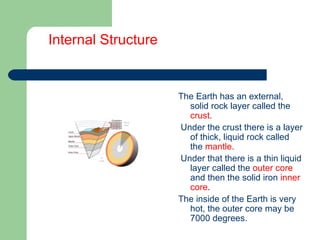
Internal Structure The Earth has an external, solid rock layer called the  crust . Under the crust there is a layer of thick, liquid rock called the  mantle . Under that there is a thin liquid layer called the  outer core  and then the solid iron  inner   core . The inside of the Earth is very hot, the outer core may be 7000 degrees.
Surface Over 70% of the Earth  surface  is covered by water.The  underwater surface  has also got  volcanoes ,  mountains  and  trenches . The 30% not covered by water is basically  forests ,  deserts ,  plains ,  mountains  and  plateaus .  Many things can change the surface of the Earth, for example  erosion  from  wind  and  rain , erosion by the  oceans  or  meteorite  impacts, vegetation and the human being.
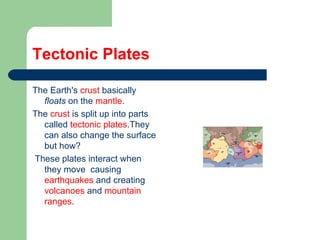
Tectonic Plates The Earth's  crust  basically  floats  on the  mantle . The  crust  is split up into parts called  tectonic   plates .They can also change the surface but how? These plates interact when they move  causing  earthquakes  and creating  volcanoes  and  mountain ranges .
Earthquakes When the  tectonic plates  move, they don’t move carefully so an  earthquake  happens. Earthquakes  send  surface waves  through the earth and the ground moves.They usually last a few seconds.
Earthquakes When the earth moves in an  earthquake , it can cause waves in the ocean. A big wave in the ocean caused by an  earthquake  is called a  tsunami .  We give the earthquake a number ( the  Richter scale ) to say if it is  big or small.
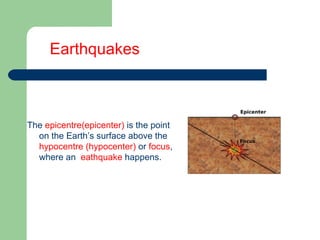
The  epicentre(epicenter)  is the point on the Earth’s surface above the  hypocentre (hypocenter)  or  focus ,  where an  eathquake  happens.   Earthquakes
Volcanoes Volcanoes  are usually made when two  tectonic plates  move towards each other. When these two plates meet, one of them goes under the other one. Then, it melts and forms  magma  (inside the  magma chamber ), and the pressure builds up until the magma bursts through the Earth's  crust .
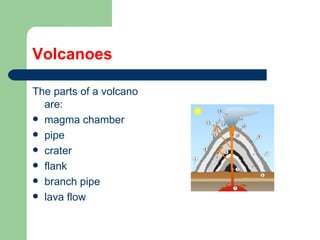
Volcanoes The parts of a volcano are: magma chamber pipe crater flank branch pipe lava flow
Landforms The most important  landforms  are: mountain  and  mountain range valley drainage basin plateau plain island/archipelago  peninsula ria/fjiord cape gulf/bay
Landforms And now we are going to see some of the  landforms

Terrain

  • 1.
  • 2.
    Internal Structure TheEarth has an external, solid rock layer called the crust . Under the crust there is a layer of thick, liquid rock called the mantle . Under that there is a thin liquid layer called the outer core and then the solid iron inner core . The inside of the Earth is very hot, the outer core may be 7000 degrees.
  • 3.
    Surface Over 70%of the Earth surface is covered by water.The underwater surface has also got volcanoes , mountains and trenches . The 30% not covered by water is basically forests , deserts , plains , mountains and plateaus . Many things can change the surface of the Earth, for example erosion from wind and rain , erosion by the oceans or meteorite impacts, vegetation and the human being.
  • 4.
    Tectonic Plates TheEarth's crust basically floats on the mantle . The crust is split up into parts called tectonic plates .They can also change the surface but how? These plates interact when they move causing earthquakes and creating volcanoes and mountain ranges .
  • 5.
    Earthquakes When the tectonic plates move, they don’t move carefully so an earthquake happens. Earthquakes send surface waves through the earth and the ground moves.They usually last a few seconds.
  • 6.
    Earthquakes When theearth moves in an earthquake , it can cause waves in the ocean. A big wave in the ocean caused by an earthquake is called a tsunami . We give the earthquake a number ( the Richter scale ) to say if it is big or small.
  • 7.
    The epicentre(epicenter) is the point on the Earth’s surface above the hypocentre (hypocenter) or focus , where an eathquake happens. Earthquakes
  • 8.
    Volcanoes Volcanoes are usually made when two tectonic plates move towards each other. When these two plates meet, one of them goes under the other one. Then, it melts and forms magma (inside the magma chamber ), and the pressure builds up until the magma bursts through the Earth's crust .
  • 9.
    Volcanoes The partsof a volcano are: magma chamber pipe crater flank branch pipe lava flow
  • 10.
    Landforms The mostimportant landforms are: mountain and mountain range valley drainage basin plateau plain island/archipelago peninsula ria/fjiord cape gulf/bay
  • 11.
    Landforms And nowwe are going to see some of the landforms