Topics to be covered:
• What is Earthquake?
• Terms related to Earthquake
• What are the causes of Earthquake?
• Waves of the earthquake
• Measurement and Scale of Earthquake
• Advantages of the Earthquake
• other disasters accompanied with Earthquake
• Safety and preparedness
Earth quake is the shaking of earth surface
caused by sudden release of energy, the
release of energy may be due to:
 rupture and sudden movement of rocks
 release of stresses that accumulates over
long period of time
 any other movement in the earth crust
What is Earthquake?
Continue…
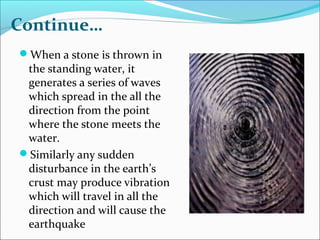
When a stone is thrown in
the standing water, it
generates a series of waves
which spread in the all the
direction from the point
where the stone meets the
water.
Similarly any sudden
disturbance in the earth’s
crust may produce vibration
which will travel in all the
direction and will cause the
earthquake
Terms related to earthquake
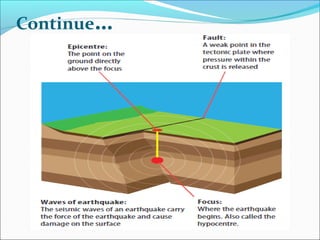
Focus: The focus or hypocenter of an earthquake is
where the earthquake originated from, usually
underground on the fault zone.
Epicenter: The epicenter of an earthquake is the
point on the surface of Earth directly above the
hypocenter.
Fault: A fault is a weak point within a tectonic plate
where pressure from beneath the surface can break
through and causing shaking in an earthquake.
Continue…
Aftershock: Aftershocks are smaller earthquakes
that may occur in the same area after the large
earthquake, that are caused by the area readjusting to
the fault movement.
Foreshocks: These are smaller earthquakes occur
in the same area before a large earthquake. Not all
earthquakes have foreshocks or aftershocks,
Sometimes a series of similar sized earthquakes, called
an earthquake swarm happens over months
without any significantly large earthquake.
Continue…
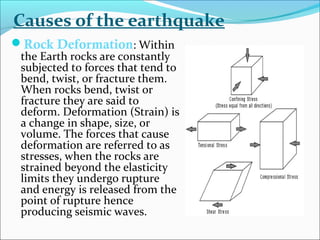
Rock Deformation: Within
the Earth rocks are constantly
subjected to forces that tend to
bend, twist, or fracture them.
When rocks bend, twist or
fracture they are said to
deform. Deformation (Strain) is
a change in shape, size, or
volume. The forces that cause
deformation are referred to as
stresses, when the rocks are
strained beyond the elasticity
limits they undergo rupture
and energy is released from the
point of rupture hence
producing seismic waves.
Causes of the earthquake
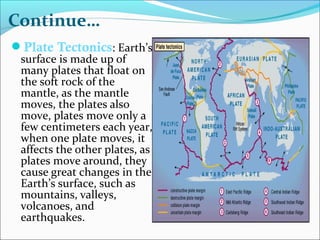
Plate Tectonics: Earth’s
surface is made up of
many plates that float on
the soft rock of the
mantle, as the mantle
moves, the plates also
move, plates move only a
few centimeters each year,
when one plate moves, it
affects the other plates, as
plates move around, they
cause great changes in the
Earth’s surface, such as
mountains, valleys,
volcanoes, and
earthquakes.
Continue…
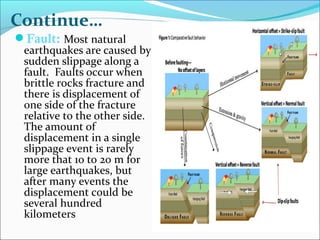
Fault: Most natural
earthquakes are caused by
sudden slippage along a
fault. Faults occur when
brittle rocks fracture and
there is displacement of
one side of the fracture
relative to the other side.
The amount of
displacement in a single
slippage event is rarely
more that 10 to 20 m for
large earthquakes, but
after many events the
displacement could be
several hundred
kilometers
Continue…
Other major causes of earthquakes:
Volcanic eruption
Great explosions
Landslides
Avalanches
Take of/landing of supersonic aircraft and jet
(especially whose speed is more than the speed
of sound in the air)
Mining
Vibration of the earth
Continue…
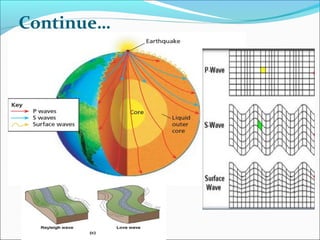
The waves of earthquake or Seismic waves are the
waves of energy that travel through the Earth's layers,
and are a result of earthquakes, volcanic eruptions,
magma movement, large landslides and large man-made
explosions…etc.
There are the following types of Seismic Waves:
Body Waves:
 Primary Waves (P waves)
 Secondary Waves (S Waves)
Surface Waves:
 Rayleigh Waves (R Waves)
 Love Waves (L Waves)
Waves Produced due to Earthquake
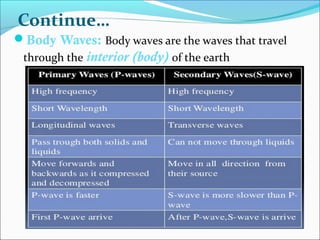
Body Waves: Body waves are the waves that travel
through the interior (body) of the earth
Continue…
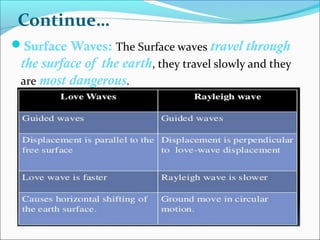
Surface Waves: The Surface waves travel through
the surface of the earth, they travel slowly and they
are most dangerous.
Continue…
Continue…
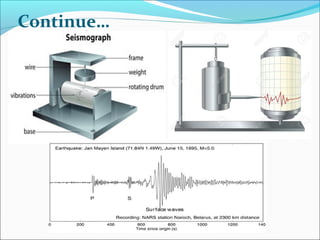
Earthquakes are measured by instruments called
seismographs. It has a base that sets firmly in the
ground, and a heavy weight that hangs free. When an
earthquake causes the ground to shake, the base of the
seismograph shakes too, but the heavy weight does not.
The spring that it is hanging from absorbs all the
movement. The seismograph records the difference in
position between the shaking part and the motionless
part.
The recording is called a seismogram. It is used to
determine how large the earthquake was. A short wiggly
line that wiggles very little means a small earthquake. A
long wiggly line that wiggles a lot means a large
earthquake.
Measurement of the Earthquake
Continue…
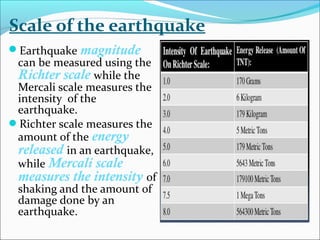
Earthquake magnitude
can be measured using the
Richter scale while the
Mercali scale measures the
intensity of the
earthquake.
Richter scale measures the
amount of the energy
released in an earthquake,
while Mercali scale
measures the intensity of
shaking and the amount of
damage done by an
earthquake.
Scale of the earthquake
Landslide
Fissures/Ground rupture
Fire
Soil Liquefaction
Tsunami
Flood
Other disasters caused by
earthquake
Does the earthquake always cause
harms?
It is obvious that earthquake is always accompanied with
huge destruction and damage, but following are some of
the points which can be considered as advantages.
The stresses which have been accumulated over long
period of time gets released as earthquakes. This means
after a big earthquake chances for another big one
reduces considerably.
When these stresses are released they create new fault
planes or movement along old planes
This movement can help oil and gas reservoirs to get
punctured and seep through this new structure. This may
bring them to shallower depth where we can exploit
them easily.
Advantages of the earthquake
Continue…
This movement can create new islands as the block
beneath the ocean can get lifted above mean sea level.
They can bring mineral deposits to shallower depth as
the block is up thrown.
Perhaps the biggest advantage of earthquake to
mankind is about revealing its inner structure more
precisely and the geodynamics of the earth internal
layers. If you are looking for other advantages.
Safety against earthquake
Remove or secure heavy overhead items which
may fall on you or block your egress.
Secure breakables with Quake Putty or Museum
Gel.
Large Heavy Objects on Lower Shelves.
Breakables on Lower Shelves/Closed Cabinets.
Overhead Cabinets Closed/Latched.
No Heavy Objects Above Your Desk.
Establish Family Earthquake Plan
Learn First Aid/CPR
Prepare Earthquake Emergency Kit
Continue…
Know Dangerous Spots in Every Room.
Know Safe Spots in Every Room.
Face Away from Windows.
Watch for Falling Objects and take cover.
Wrench Near Emergency Gas Shut Off
Be aboutBe about
Earthquake SafetyEarthquake Safety
Smart
24

Earthquake

  • 2.
    Topics to becovered: • What is Earthquake? • Terms related to Earthquake • What are the causes of Earthquake? • Waves of the earthquake • Measurement and Scale of Earthquake • Advantages of the Earthquake • other disasters accompanied with Earthquake • Safety and preparedness
  • 3.
    Earth quake isthe shaking of earth surface caused by sudden release of energy, the release of energy may be due to:  rupture and sudden movement of rocks  release of stresses that accumulates over long period of time  any other movement in the earth crust What is Earthquake?
  • 4.
    Continue… When a stoneis thrown in the standing water, it generates a series of waves which spread in the all the direction from the point where the stone meets the water. Similarly any sudden disturbance in the earth’s crust may produce vibration which will travel in all the direction and will cause the earthquake
  • 5.
    Terms related toearthquake Focus: The focus or hypocenter of an earthquake is where the earthquake originated from, usually underground on the fault zone. Epicenter: The epicenter of an earthquake is the point on the surface of Earth directly above the hypocenter. Fault: A fault is a weak point within a tectonic plate where pressure from beneath the surface can break through and causing shaking in an earthquake.
  • 6.
    Continue… Aftershock: Aftershocks aresmaller earthquakes that may occur in the same area after the large earthquake, that are caused by the area readjusting to the fault movement. Foreshocks: These are smaller earthquakes occur in the same area before a large earthquake. Not all earthquakes have foreshocks or aftershocks, Sometimes a series of similar sized earthquakes, called an earthquake swarm happens over months without any significantly large earthquake.
  • 7.
  • 8.
    Rock Deformation: Within theEarth rocks are constantly subjected to forces that tend to bend, twist, or fracture them. When rocks bend, twist or fracture they are said to deform. Deformation (Strain) is a change in shape, size, or volume. The forces that cause deformation are referred to as stresses, when the rocks are strained beyond the elasticity limits they undergo rupture and energy is released from the point of rupture hence producing seismic waves. Causes of the earthquake
  • 9.
    Plate Tectonics: Earth’s surfaceis made up of many plates that float on the soft rock of the mantle, as the mantle moves, the plates also move, plates move only a few centimeters each year, when one plate moves, it affects the other plates, as plates move around, they cause great changes in the Earth’s surface, such as mountains, valleys, volcanoes, and earthquakes. Continue…
  • 10.
    Fault: Most natural earthquakesare caused by sudden slippage along a fault. Faults occur when brittle rocks fracture and there is displacement of one side of the fracture relative to the other side. The amount of displacement in a single slippage event is rarely more that 10 to 20 m for large earthquakes, but after many events the displacement could be several hundred kilometers Continue…
  • 11.
    Other major causesof earthquakes: Volcanic eruption Great explosions Landslides Avalanches Take of/landing of supersonic aircraft and jet (especially whose speed is more than the speed of sound in the air) Mining Vibration of the earth Continue…
  • 12.
    The waves ofearthquake or Seismic waves are the waves of energy that travel through the Earth's layers, and are a result of earthquakes, volcanic eruptions, magma movement, large landslides and large man-made explosions…etc. There are the following types of Seismic Waves: Body Waves:  Primary Waves (P waves)  Secondary Waves (S Waves) Surface Waves:  Rayleigh Waves (R Waves)  Love Waves (L Waves) Waves Produced due to Earthquake
  • 13.
    Body Waves: Bodywaves are the waves that travel through the interior (body) of the earth Continue…
  • 14.
    Surface Waves: TheSurface waves travel through the surface of the earth, they travel slowly and they are most dangerous. Continue…
  • 15.
  • 16.
    Earthquakes are measuredby instruments called seismographs. It has a base that sets firmly in the ground, and a heavy weight that hangs free. When an earthquake causes the ground to shake, the base of the seismograph shakes too, but the heavy weight does not. The spring that it is hanging from absorbs all the movement. The seismograph records the difference in position between the shaking part and the motionless part. The recording is called a seismogram. It is used to determine how large the earthquake was. A short wiggly line that wiggles very little means a small earthquake. A long wiggly line that wiggles a lot means a large earthquake. Measurement of the Earthquake
  • 17.
  • 18.
    Earthquake magnitude can bemeasured using the Richter scale while the Mercali scale measures the intensity of the earthquake. Richter scale measures the amount of the energy released in an earthquake, while Mercali scale measures the intensity of shaking and the amount of damage done by an earthquake. Scale of the earthquake
  • 19.
  • 20.
    Does the earthquakealways cause harms? It is obvious that earthquake is always accompanied with huge destruction and damage, but following are some of the points which can be considered as advantages. The stresses which have been accumulated over long period of time gets released as earthquakes. This means after a big earthquake chances for another big one reduces considerably. When these stresses are released they create new fault planes or movement along old planes This movement can help oil and gas reservoirs to get punctured and seep through this new structure. This may bring them to shallower depth where we can exploit them easily. Advantages of the earthquake
  • 21.
    Continue… This movement cancreate new islands as the block beneath the ocean can get lifted above mean sea level. They can bring mineral deposits to shallower depth as the block is up thrown. Perhaps the biggest advantage of earthquake to mankind is about revealing its inner structure more precisely and the geodynamics of the earth internal layers. If you are looking for other advantages.
  • 22.
    Safety against earthquake Removeor secure heavy overhead items which may fall on you or block your egress. Secure breakables with Quake Putty or Museum Gel. Large Heavy Objects on Lower Shelves. Breakables on Lower Shelves/Closed Cabinets. Overhead Cabinets Closed/Latched. No Heavy Objects Above Your Desk. Establish Family Earthquake Plan Learn First Aid/CPR Prepare Earthquake Emergency Kit
  • 23.
    Continue… Know Dangerous Spotsin Every Room. Know Safe Spots in Every Room. Face Away from Windows. Watch for Falling Objects and take cover. Wrench Near Emergency Gas Shut Off Be aboutBe about Earthquake SafetyEarthquake Safety Smart
  • 24.