CHAPTER 20 Section 1: The British Empire in the  Postwar Era Section 2: Turkey, Persia, and Africa Section 3: Unrest in China Section 4:   Imperialism in Japan Section 5:   Latin America Between  the Wars Nationalist Movements Around  the World
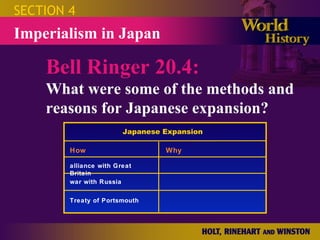
SECTION 4 Imperialism in Japan Japanese Expansion How Why alliance with Great Britain war with Russia Treaty of Portsmouth Bell Ringer 20.4: What were some of the methods and reasons for Japanese expansion?
Dancing the foxtrot.  Listening to jazz.  Playing baseball.  This was Japan in the 1920s …. SECTION 4 Imperialism in Japan
Two reasons for expansion New territory would provide raw materials for its factories and markets for its products. It would show the West just how much Japan had progressed. SECTION 4 Imperialism in Japan The Meiji Restoration had changed Japan into a modern industrial and military power. Now Japan would expand beyond its islands ….
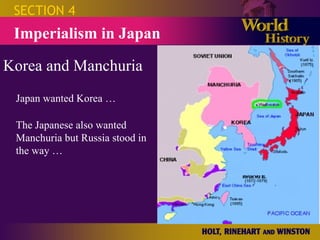
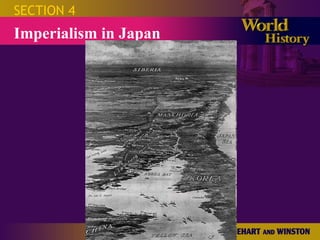
Korea and Manchuria SECTION 4 Imperialism in Japan Japan wanted Korea … The Japanese also wanted Manchuria but Russia stood in the way …
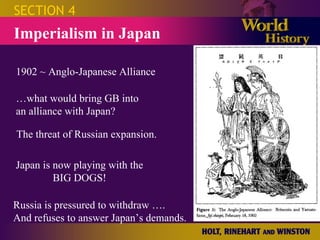
SECTION 4 Imperialism in Japan 1902 ~ Anglo-Japanese Alliance … what would bring GB into an alliance with Japan? The threat of Russian expansion. Japan is now playing with the BIG DOGS! Russia is pressured to withdraw …. And refuses to answer Japan’s demands.
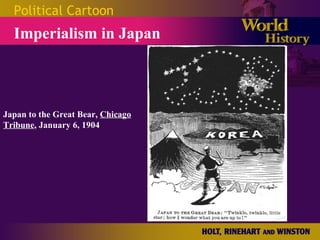
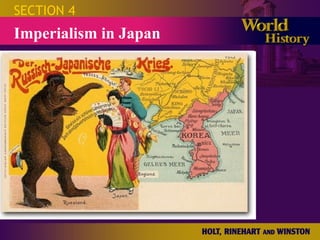
Political Cartoon Imperialism in Japan Japan to the Great Bear,  Chicago Tribune , January 6, 1904
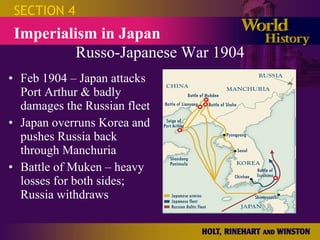
Russo-Japanese War 1904 Feb 1904 – Japan attacks Port Arthur & badly damages the Russian fleet Japan overruns Korea and pushes Russia back through Manchuria Battle of Muken – heavy losses for both sides; Russia withdraws SECTION 4 Imperialism in Japan
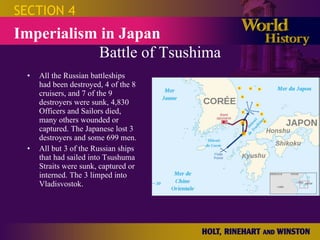
Battle of Tsushima All the Russian battleships had been destroyed, 4 of the 8 cruisers, and 7 of the 9 destroyers were sunk, 4,830 Officers and Sailors died, many others wounded or captured. The Japanese lost 3 destroyers and some 699 men. All but 3 of the Russian ships that had sailed into Tsushuma Straits were sunk, captured or interned. The 3 limped into Vladisvostok. SECTION 4 Imperialism in Japan
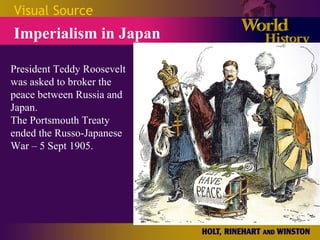
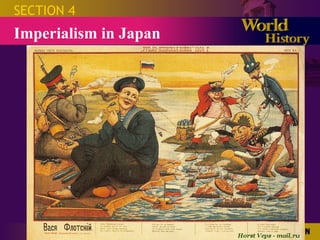
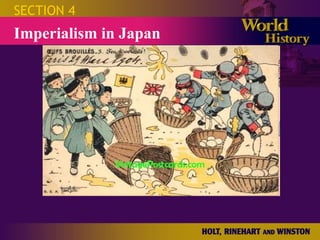
Visual Source Imperialism in Japan President Teddy Roosevelt was asked to broker the peace between Russia and Japan. The Portsmouth Treaty ended the Russo-Japanese War – 5 Sept 1905.
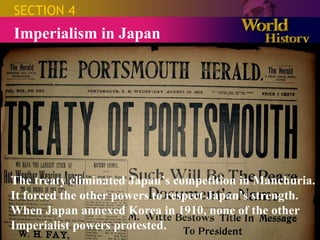
SECTION 4 Imperialism in Japan The treaty eliminated Japan’s competition in Manchuria. It forced the other powers to respect Japan’s strength. When Japan annexed Korea in 1910, none of the other Imperialist powers protested.
Problems of Modernization SECTION 4 Imperialism in Japan In less than fifty years, Japan went from a feudal agricultural society to one of the world’s leading industrial and military powers. This leap created problems for the island nation.
Increasing Population People were living longer. cities grew rapidly and land was scarce food production could not match growth US prohibited immigration SECTION 4 Imperialism in Japan
Economic Trouble Did not have many raw materials needed for industries Had to import materials Had to sell goods abroad – but many countries had passed tariffs to protect their own economies The Japanese economy had to expand or collapse! SECTION 4 Imperialism in Japan
Social Tensions ~ Westernization All this great development had changed traditional Japanese attitudes. Industrial workers organized and called for strikes for better conditions & pay. Tenant farms demanded lower rents. Intellectuals argued for democratic reforms. Young Japanese began to question traditional values ~ new ideas ~ work roles changed ~ women took jobs! SECTION 4 Imperialism in Japan
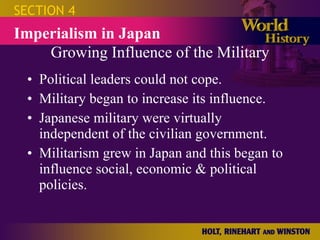
Growing Influence of the Military Political leaders could not cope. Military began to increase its influence. Japanese military were virtually independent of the civilian government. Militarism grew in Japan and this began to influence social, economic & political policies. SECTION 4 Imperialism in Japan
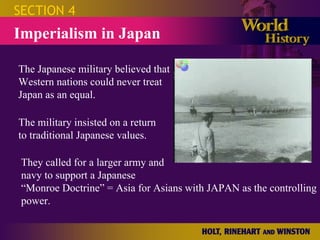
SECTION 4 Imperialism in Japan The Japanese military believed that Western nations could never treat Japan as an equal. The military insisted on a return to traditional Japanese values. They called for a larger army and navy to support a Japanese “Monroe Doctrine” = Asia for Asians with JAPAN as the controlling power.
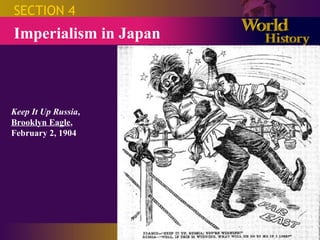
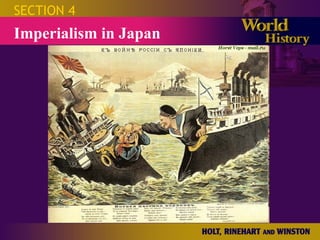
SECTION 4 Imperialism in Japan Keep It Up Russia ,  Brooklyn Eagle , February 2, 1904
SECTION 4 Imperialism in Japan
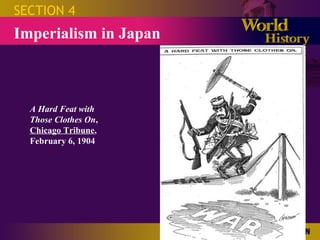
SECTION 4 Imperialism in Japan A Hard Feat with Those Clothes On ,  Chicago Tribune , February 6, 1904
SECTION 4 Imperialism in Japan
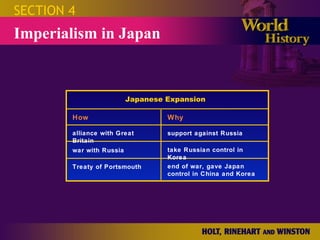
SECTION 4 Imperialism in Japan Japanese Expansion How Why alliance with Great Britain support against Russia war with Russia take Russian control in Korea Treaty of Portsmouth end of war, gave Japan control in China and Korea
Chapter Wrap-Up CHAPTER 20 1. How did the military affect Japan’s government? 2. How did cultural issues affect nationalistic movements in Africa? 3. How did economic issues influence political events in Latin America?

Ch 20.4

  • 1.
    CHAPTER 20 Section1: The British Empire in the Postwar Era Section 2: Turkey, Persia, and Africa Section 3: Unrest in China Section 4: Imperialism in Japan Section 5: Latin America Between the Wars Nationalist Movements Around the World
  • 2.
    SECTION 4 Imperialismin Japan Japanese Expansion How Why alliance with Great Britain war with Russia Treaty of Portsmouth Bell Ringer 20.4: What were some of the methods and reasons for Japanese expansion?
  • 3.
    Dancing the foxtrot. Listening to jazz. Playing baseball. This was Japan in the 1920s …. SECTION 4 Imperialism in Japan
  • 4.
    Two reasons forexpansion New territory would provide raw materials for its factories and markets for its products. It would show the West just how much Japan had progressed. SECTION 4 Imperialism in Japan The Meiji Restoration had changed Japan into a modern industrial and military power. Now Japan would expand beyond its islands ….
  • 5.
    Korea and ManchuriaSECTION 4 Imperialism in Japan Japan wanted Korea … The Japanese also wanted Manchuria but Russia stood in the way …
  • 6.
    SECTION 4 Imperialismin Japan 1902 ~ Anglo-Japanese Alliance … what would bring GB into an alliance with Japan? The threat of Russian expansion. Japan is now playing with the BIG DOGS! Russia is pressured to withdraw …. And refuses to answer Japan’s demands.
  • 7.
    Political Cartoon Imperialismin Japan Japan to the Great Bear, Chicago Tribune , January 6, 1904
  • 8.
    Russo-Japanese War 1904Feb 1904 – Japan attacks Port Arthur & badly damages the Russian fleet Japan overruns Korea and pushes Russia back through Manchuria Battle of Muken – heavy losses for both sides; Russia withdraws SECTION 4 Imperialism in Japan
  • 9.
    Battle of TsushimaAll the Russian battleships had been destroyed, 4 of the 8 cruisers, and 7 of the 9 destroyers were sunk, 4,830 Officers and Sailors died, many others wounded or captured. The Japanese lost 3 destroyers and some 699 men. All but 3 of the Russian ships that had sailed into Tsushuma Straits were sunk, captured or interned. The 3 limped into Vladisvostok. SECTION 4 Imperialism in Japan
  • 10.
    Visual Source Imperialismin Japan President Teddy Roosevelt was asked to broker the peace between Russia and Japan. The Portsmouth Treaty ended the Russo-Japanese War – 5 Sept 1905.
  • 11.
    SECTION 4 Imperialismin Japan The treaty eliminated Japan’s competition in Manchuria. It forced the other powers to respect Japan’s strength. When Japan annexed Korea in 1910, none of the other Imperialist powers protested.
  • 12.
    Problems of ModernizationSECTION 4 Imperialism in Japan In less than fifty years, Japan went from a feudal agricultural society to one of the world’s leading industrial and military powers. This leap created problems for the island nation.
  • 13.
    Increasing Population Peoplewere living longer. cities grew rapidly and land was scarce food production could not match growth US prohibited immigration SECTION 4 Imperialism in Japan
  • 14.
    Economic Trouble Didnot have many raw materials needed for industries Had to import materials Had to sell goods abroad – but many countries had passed tariffs to protect their own economies The Japanese economy had to expand or collapse! SECTION 4 Imperialism in Japan
  • 15.
    Social Tensions ~Westernization All this great development had changed traditional Japanese attitudes. Industrial workers organized and called for strikes for better conditions & pay. Tenant farms demanded lower rents. Intellectuals argued for democratic reforms. Young Japanese began to question traditional values ~ new ideas ~ work roles changed ~ women took jobs! SECTION 4 Imperialism in Japan
  • 16.
    Growing Influence ofthe Military Political leaders could not cope. Military began to increase its influence. Japanese military were virtually independent of the civilian government. Militarism grew in Japan and this began to influence social, economic & political policies. SECTION 4 Imperialism in Japan
  • 17.
    SECTION 4 Imperialismin Japan The Japanese military believed that Western nations could never treat Japan as an equal. The military insisted on a return to traditional Japanese values. They called for a larger army and navy to support a Japanese “Monroe Doctrine” = Asia for Asians with JAPAN as the controlling power.
  • 18.
    SECTION 4 Imperialismin Japan Keep It Up Russia , Brooklyn Eagle , February 2, 1904
  • 19.
  • 20.
  • 21.
  • 22.
  • 23.
    SECTION 4 Imperialismin Japan A Hard Feat with Those Clothes On , Chicago Tribune , February 6, 1904
  • 24.
  • 25.
  • 26.
  • 27.
    SECTION 4 Imperialismin Japan Japanese Expansion How Why alliance with Great Britain support against Russia war with Russia take Russian control in Korea Treaty of Portsmouth end of war, gave Japan control in China and Korea
  • 28.
    Chapter Wrap-Up CHAPTER20 1. How did the military affect Japan’s government? 2. How did cultural issues affect nationalistic movements in Africa? 3. How did economic issues influence political events in Latin America?

Editor's Notes

  • #9 In December 1897, a Russian fleet appeared off Port Arthur. After three months, in 1898, a convention was agreed between China and Russia by which Russia was leased Port Arthur, Talienwan and the surrounding waters. It was further agreed that the convention could be extended by mutual agreement. The Russians clearly believed that would be the case for they lost no time in occupation and in fortifying Port Arthur, their sole warm-water port on the Pacific coast, and of great strategic value. A year later, in order to consolidate their position, the Russians began a new railway from Harbin through Mukden to Port Arthur. The Russians also began to make inroads into Korea, by 1898 they acquired mining and forestry concessions near Yalu and Tumen rivers, causing the Japanese much anxiety. Japan decided to strike before the Trans-Siberian Railway was complete.