What is Earth?
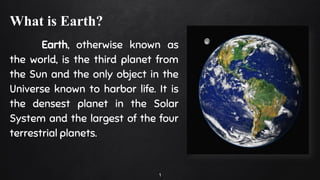
Earth, otherwise known as
the world, is the third planet from
the Sun and the only object in the
Universe known to harbor life. It is
the densest planet in the Solar
System and the largest of the four
terrestrial planets.
1
What is Earth?
Earth is also often called as the
“Blue Marble” because of it looks like a
blue globe encircled by swirling white
clouds as seen from the outer space.
As of today, Earth is the only planet in
the Solar System that is habitable or
where living things can exist although
scientists are now looking at
exoplanets that are potentially
habitable.
2
Scientists coined the term Goldilocks zone (habitable or
life zone) for the regions in the space where a planet is just in
the right distance from its home star (usually a low-mass star)
so that its surface is neither too hot nor too cold.
The term Goldilocks is related to the story of “Goldilocks
and the Three Bears.” It is because of how a little girl named
Goldilocks, who was lost in the woods and entered the house of
the three bears, liked everything that is just right. She chose the
porridge that is not too hot or too cold, the bed that is not too
hard or too soft, and so on. Just like Goldilocks’ choices, our
planet – Earth has factors necessary for life in just the right
amount.
3
Earth is so terrific that it is the only planet known
in the Solar System that can support life but the
question is, “What makes Earth unique among other
planets?” and “What are the factors to consider a
habitable planet?”
4
What makes Earth unique?
✘ the existence of water at the Earth’s surface - neither too
much nor too little - that is in liquid form.
✘ proximity to the sun - neither too much heat nor too little.
✘ system of plate tectonics that enables the carbon-silicate
cycle regulating temperature.
✘ the right size - large enough to hang on to its atmosphere,
but not so large to hold on to too much atmosphere and
consequently too much heat.
5
What makes Earth unique?
✘ its protection by “big brother Jupiter,” whose gravity helps
divert and vacuum up incoming debris and keep Earth safe.
✘ the only moon and its stabilizing effect on our planetary
rotation, which prevents the poles from shifting
unexpectedly.
6
What makes Earth capable of supporting life?
1. Water – is an excellent solvent,
capable of dissolving many
substances, 70% of Earth’s surface is
covered by water.
Firstly, it is the only substance on Earth
that is in liquid form at the temperatures
commonly found on the Surface of our
planet.
7
Secondly, it is a superb solvent, meaning that other substances regularly and
easily dissolve into it. This allows water to carry nutrients to cells, and carry
waste away from them.
What makes Earth capable of supporting life?
2. Plate Tectonics – is vital for a world to
host life — that is, a planet whose shell
is broken up into plates that
constantly move around.
Plates cover the entire Earth, and their
boundaries play an important role in
geologic happenings. The movement of
these plates atop a thick, fluid "mantle" is
known as plate tectonics and is the
source of earthquakes and volcanoes.
8
What makes Earth capable of supporting life?
3. Atmosphere – contains 78% nitrogen, 21% oxygen, and 1% argon. It blocks
some of the Sun's dangerous rays from reaching Earth. It traps heat,
making Earth a comfortable temperature. And the oxygen within our
atmosphere is essential for life.
9
EARTH
SUBSYTEMS
The Earth is a system consisting of four major interacting
components:
❑ The atmosphere,
❑ The biosphere,
❑ The hydrosphere, and
❑ The geosphere.
11
ATMOSPHERE
• Atmos means “Vapor” and Sphaira
which means “Ball or sphere”.
• The Earth is surrounded by a
blanket of air, which is the
atmosphere.
• The atmosphere consists of four
unique layers:
13
Troposphere
❑ The troposphere which is the lowest region of the
atmosphere. The troposphere is important because it is
where weather occurs. The troposphere provides oxygen
that we can breathe, keeps Earth at a livable temperature,
and allows for weather to occur, making it a very important
part of the atmosphere.
14
15
Stratosphere
❑ Above the troposphere and below the mesosphere, we have
the stratosphere. The stratosphere is where you'll find the
very important ozone layer. The ozone layer helps protect
us from ultraviolet radiation (UV) from the sun. In fact, the
ozone layer absorbs most of the UV radiation the sun sends
to us.
16
17
Mesosphere
❑ The mesosphere is very important for earth's protection.
The mesosphere burns up most meteors and asteroids
before they are able to reach the earth's surface.
18
19
Thermosphere
❑ The thermosphere is the layer in the Earth's atmosphere
directly above the mesosphere and below the exosphere.
Within this layer of the atmosphere, ultraviolet radiation
causes photoionization/photodissociation of molecules,
creating ions; the thermosphere thus constitutes the larger
part of the ionosphere.
20
21
Exosphere
❑ Its functions to act as a transitional medium to a zone under the
influence of gravity. It also helps the atoms to escape from the
atmosphere to outer space.
❑ Unlike other atmospheric layers, it is the only layer of the atmosphere
that has a definite shape.
❑ The molecules and gases in the Exosphere are available in a limited
quantity. Also, these gaseous molecules are distant from each other.
They travel at quite a high speed, and it is the reason they face
minimum or negligible or minimum collisions.
❑ It is much farther away from Earth than anybody can imagine, and thus
there can be no chance of meteorological phenomenon.
22
23
HYDROSPHERE
Hydrosphere
❑ Hydro means “water”
❑ The hydrosphere contains all the water found on our planet.
❑ Surface water: Includes the ocean as well as water from
lakes, rivers and creeks.
❑ Ground Water: Includes water trapped in the soil and
groundwater.
❑ Atmosphere: water vapor.
❑ Frozen water: Includes ice caps and glaciers. Also called the
cryosphere.
25
26
GEOSPHERE
Geosphere
❑ The geosphere is the solid part of the earth, from the core to
the surface.
❑ Includes volcanoes, rocks, minerals, coal, oil etc.
❑ Mineral resources are mined from the geosphere.
28
29
BIOSPHERE
Biosphere
❑ Bio means “life”.
❑ The biosphere is the “zone of life” of the Earth, and includes
all living organisms (including humans), and all organic
matter that has not yet decomposed.
❑ The biosphere is structured into a hierarchy known as a food
chain.
❑ Energy and nutrients, like carbon, are transferred from one
level of the food chain to the next.
31
32
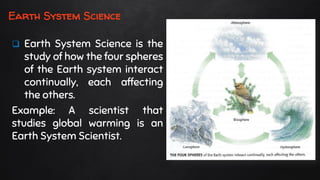
Earth System Science
❑ Earth System Science is the
study of how the four spheres
of the Earth system interact
continually, each affecting
the others.
Example: A scientist that
studies global warming is an
Earth System Scientist.
System Interactions
Volcanoes erupt, sending ash and gases into the air and
sending lava and ash down onto surrounding forests and
human habitations.
Geosphere
Biosphere
Atmosphere
System Interactions
Hurricanes sweep across the ocean and onto the land,
damaging the dwellings of people who live along the coast.
Hydrosphere
Atmosphere Geosphere
Biosphere
System Interactions
Earthquakes can damage buildings which may kill people, as
well as cause fires which release gases into the air.
Earthquakes in the ocean may cause a tsunami which can
eventually hit land and kill both animals and people.
Hydrosphere
Atmosphere
Geosphere
Biosphere

EARTH-SUBSYSTEMS.pdf

  • 1.
    What is Earth? Earth,otherwise known as the world, is the third planet from the Sun and the only object in the Universe known to harbor life. It is the densest planet in the Solar System and the largest of the four terrestrial planets. 1
  • 2.
    What is Earth? Earthis also often called as the “Blue Marble” because of it looks like a blue globe encircled by swirling white clouds as seen from the outer space. As of today, Earth is the only planet in the Solar System that is habitable or where living things can exist although scientists are now looking at exoplanets that are potentially habitable. 2
  • 3.
    Scientists coined theterm Goldilocks zone (habitable or life zone) for the regions in the space where a planet is just in the right distance from its home star (usually a low-mass star) so that its surface is neither too hot nor too cold. The term Goldilocks is related to the story of “Goldilocks and the Three Bears.” It is because of how a little girl named Goldilocks, who was lost in the woods and entered the house of the three bears, liked everything that is just right. She chose the porridge that is not too hot or too cold, the bed that is not too hard or too soft, and so on. Just like Goldilocks’ choices, our planet – Earth has factors necessary for life in just the right amount. 3
  • 4.
    Earth is soterrific that it is the only planet known in the Solar System that can support life but the question is, “What makes Earth unique among other planets?” and “What are the factors to consider a habitable planet?” 4
  • 5.
    What makes Earthunique? ✘ the existence of water at the Earth’s surface - neither too much nor too little - that is in liquid form. ✘ proximity to the sun - neither too much heat nor too little. ✘ system of plate tectonics that enables the carbon-silicate cycle regulating temperature. ✘ the right size - large enough to hang on to its atmosphere, but not so large to hold on to too much atmosphere and consequently too much heat. 5
  • 6.
    What makes Earthunique? ✘ its protection by “big brother Jupiter,” whose gravity helps divert and vacuum up incoming debris and keep Earth safe. ✘ the only moon and its stabilizing effect on our planetary rotation, which prevents the poles from shifting unexpectedly. 6
  • 7.
    What makes Earthcapable of supporting life? 1. Water – is an excellent solvent, capable of dissolving many substances, 70% of Earth’s surface is covered by water. Firstly, it is the only substance on Earth that is in liquid form at the temperatures commonly found on the Surface of our planet. 7 Secondly, it is a superb solvent, meaning that other substances regularly and easily dissolve into it. This allows water to carry nutrients to cells, and carry waste away from them.
  • 8.
    What makes Earthcapable of supporting life? 2. Plate Tectonics – is vital for a world to host life — that is, a planet whose shell is broken up into plates that constantly move around. Plates cover the entire Earth, and their boundaries play an important role in geologic happenings. The movement of these plates atop a thick, fluid "mantle" is known as plate tectonics and is the source of earthquakes and volcanoes. 8
  • 9.
    What makes Earthcapable of supporting life? 3. Atmosphere – contains 78% nitrogen, 21% oxygen, and 1% argon. It blocks some of the Sun's dangerous rays from reaching Earth. It traps heat, making Earth a comfortable temperature. And the oxygen within our atmosphere is essential for life. 9
  • 10.
  • 11.
    The Earth isa system consisting of four major interacting components: ❑ The atmosphere, ❑ The biosphere, ❑ The hydrosphere, and ❑ The geosphere. 11
  • 12.
  • 13.
    • Atmos means“Vapor” and Sphaira which means “Ball or sphere”. • The Earth is surrounded by a blanket of air, which is the atmosphere. • The atmosphere consists of four unique layers: 13
  • 14.
    Troposphere ❑ The tropospherewhich is the lowest region of the atmosphere. The troposphere is important because it is where weather occurs. The troposphere provides oxygen that we can breathe, keeps Earth at a livable temperature, and allows for weather to occur, making it a very important part of the atmosphere. 14
  • 15.
  • 16.
    Stratosphere ❑ Above thetroposphere and below the mesosphere, we have the stratosphere. The stratosphere is where you'll find the very important ozone layer. The ozone layer helps protect us from ultraviolet radiation (UV) from the sun. In fact, the ozone layer absorbs most of the UV radiation the sun sends to us. 16
  • 17.
  • 18.
    Mesosphere ❑ The mesosphereis very important for earth's protection. The mesosphere burns up most meteors and asteroids before they are able to reach the earth's surface. 18
  • 19.
  • 20.
    Thermosphere ❑ The thermosphereis the layer in the Earth's atmosphere directly above the mesosphere and below the exosphere. Within this layer of the atmosphere, ultraviolet radiation causes photoionization/photodissociation of molecules, creating ions; the thermosphere thus constitutes the larger part of the ionosphere. 20
  • 21.
  • 22.
    Exosphere ❑ Its functionsto act as a transitional medium to a zone under the influence of gravity. It also helps the atoms to escape from the atmosphere to outer space. ❑ Unlike other atmospheric layers, it is the only layer of the atmosphere that has a definite shape. ❑ The molecules and gases in the Exosphere are available in a limited quantity. Also, these gaseous molecules are distant from each other. They travel at quite a high speed, and it is the reason they face minimum or negligible or minimum collisions. ❑ It is much farther away from Earth than anybody can imagine, and thus there can be no chance of meteorological phenomenon. 22
  • 23.
  • 24.
  • 25.
    Hydrosphere ❑ Hydro means“water” ❑ The hydrosphere contains all the water found on our planet. ❑ Surface water: Includes the ocean as well as water from lakes, rivers and creeks. ❑ Ground Water: Includes water trapped in the soil and groundwater. ❑ Atmosphere: water vapor. ❑ Frozen water: Includes ice caps and glaciers. Also called the cryosphere. 25
  • 26.
  • 27.
  • 28.
    Geosphere ❑ The geosphereis the solid part of the earth, from the core to the surface. ❑ Includes volcanoes, rocks, minerals, coal, oil etc. ❑ Mineral resources are mined from the geosphere. 28
  • 29.
  • 30.
  • 31.
    Biosphere ❑ Bio means“life”. ❑ The biosphere is the “zone of life” of the Earth, and includes all living organisms (including humans), and all organic matter that has not yet decomposed. ❑ The biosphere is structured into a hierarchy known as a food chain. ❑ Energy and nutrients, like carbon, are transferred from one level of the food chain to the next. 31
  • 32.
  • 33.
    Earth System Science ❑Earth System Science is the study of how the four spheres of the Earth system interact continually, each affecting the others. Example: A scientist that studies global warming is an Earth System Scientist.
  • 34.
    System Interactions Volcanoes erupt,sending ash and gases into the air and sending lava and ash down onto surrounding forests and human habitations. Geosphere Biosphere Atmosphere
  • 35.
    System Interactions Hurricanes sweepacross the ocean and onto the land, damaging the dwellings of people who live along the coast. Hydrosphere Atmosphere Geosphere Biosphere
  • 36.
    System Interactions Earthquakes candamage buildings which may kill people, as well as cause fires which release gases into the air. Earthquakes in the ocean may cause a tsunami which can eventually hit land and kill both animals and people. Hydrosphere Atmosphere Geosphere Biosphere