THE AMPHIBIOUS STRUCTURE
Bolstering d world..
BY
T.PREM SAI REDDY
B.RAHUL KUMAR
Y.V.SHASHI KIRAN
CMRCET
INTRODUCTION:
The impact on the environment of everyday materials is
increasingly important if we are to reduce our carbon
footprint and protect our natural heritage for future
generations. Our aim, therefore, in this presentation is to
provide you with factual, well-documented information
about the environmental credentials and planning a
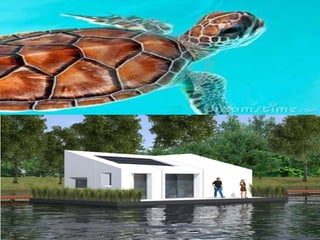
FLOATING STRUCTURE and make it resistant to flood and
earth quakes. By these type of construction we can save the
life of the people without hampering to their usual life .
• Introducing novel techniques in construction world which
creates new era .we aim to make a structure amphibious to
overcome the real world problems.
The theme is to provide a perpetual plan to the world of
construction where a sustainable livelihood , eco-friendly
structure can be made possible.
• The whole thought, gets its roots from only the materials
which are light weight and also having considerable strength.
• Our structure which we plan survives on land and also against
heavy floods ,where it rises on top level of the floods by
providing ample safety to the living.
• The only material which makes out way to unleashment of the
structure can be done only by EPS.
• What is EPS ?
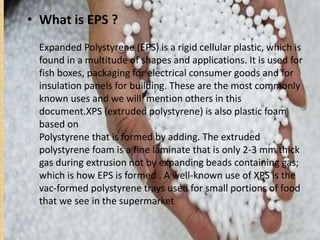
Expanded Polystyrene (EPS) is a rigid cellular plastic, which is
found in a multitude of shapes and applications. It is used for
fish boxes, packaging for electrical consumer goods and for
insulation panels for building. These are the most commonly
known uses and we will mention others in this
document.XPS (extruded polystyrene) is also plastic foam
based on
Polystyrene that is formed by adding. The extruded
polystyrene foam is a fine laminate that is only 2-3 mm thick
gas during extrusion not by expanding beads containing gas;
which is how EPS is formed . A well-known use of XPS is the
vac-formed polystyrene trays used for small portions of food
that we see in the supermarket
• EPS consists of a variety of “pearls” or a closed cell structure,
which consist of approximately 98% air; this accounts for the
buoyancy. Tests have shown that fully submerged EPS only
absorbs about 7% water. Because of the potential degradation
due to chemicals and insects; the foam is covered with
concrete and poly urea. This helps to reinforce the structure
of the home .
• EPS is extremely easy to design since it is built directly on the
surface of the water , therefore the only constraint on the size
of a floating structure is the formation of the concrete . The
larger the floating structure, the more stable structure will be.
EPS(EXPANDED POLYSTYRENE)
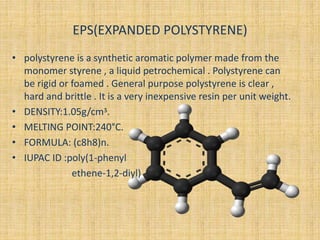
• polystyrene is a synthetic aromatic polymer made from the
monomer styrene , a liquid petrochemical . Polystyrene can
be rigid or foamed . General purpose polystyrene is clear ,
hard and brittle . It is a very inexpensive resin per unit weight.
• DENSITY:1.05g/cmᶾ.
• MELTING POINT:240°C.
• FORMULA: (c8h8)n.
• IUPAC ID :poly(1-phenyl
ethene-1,2-diyl)
APPLICATIONS OF EPS :
The range of applications for expanded polystyrene is very wide. The
main ideal properties are:
1)packaging
2)construction
3)other applications.
PROPERTIES OF EPS:
1)RETENTION OF VITAMIN C
2)RESISTANCE TO HUMIDITY
3)COMPRESSIVE RESISTANCE SHOCK ABSORPTION
4)THERMAL INSULATION
5)LOW WEIGHT
6)CHEMICAL RESISTANCE
APPLICATIONS AS A CONSTRUCTION MATERIAL
1)LOW THERMAL CONDUCTIVITY
2)LOW WEIGHT
3)MECHANICAL RESISTANCE
4)LOW WATER ABSORPTION
5)VERSATILITY
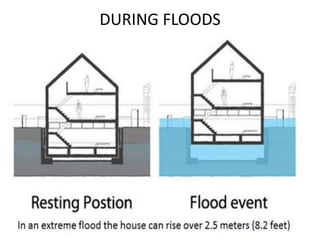
• The basic characteristic of floating homes is that the building
is not supported by a firm foundation , but floats on water.
• Traditional foundations are therefore not required. the
position of the floating home is permanently fixed in a
horizontal direction, while it can flexibly follow vertical
variations in water level.
• A floating home is recognised as immovable real estate ,
because a buildings position is fixed in horizontal direction.
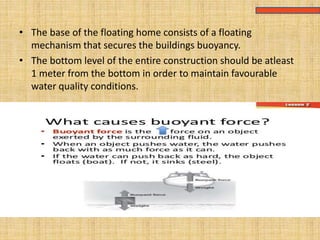
• The base of the floating home consists of a floating
mechanism that secures the buildings buoyancy.
• The bottom level of the entire construction should be atleast
1 meter from the bottom in order to maintain favourable
water quality conditions.
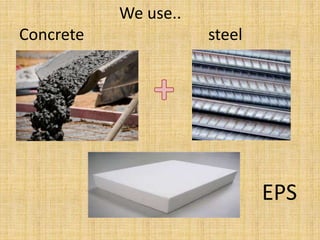
We use..
Concrete steel
EPS
DURING FLOODS
Conclusion:
o EPS is a good example of the efficient use of natural
resources-it is 98%air.
o The manufacture and use of EPS does not generate any risk to
health or to the environment.
o EPS does not damage the ozone layers since it does not use
CFC or HCFCs in the manufacturing process.
o The use of EPS for the thermal insulation in the construction
industry contributes significant savings on heating and cooling
buildings and a drastic reduction in the emission of pollutiong
gases CO₂ and SO₂.
o The transformation process process consumes little energy
and does not generate waste.
o EPS packaging protects products , helping to reduce the
wastage and its light weight nature helps to reduce fuel
consumption.
o Fungi and bacteria cannot easily grow on EPS.
o EPS makes up only a tiny part to Muncipal solid waste(0.1%).
o As it does not biodegrade EPS does not contaminate the air or
water with gases or hydro soluble substances.
Disadvantages:
 EPS requires an additional poly urea coating
for the incrementation of resistance from
exposure to surroundings which is costly.
 A minimum depth of 1m should be considered
for effective placing of structure.
 Proper clearance meshes have to be installed
in order to restrict the masses from entering
in the area excavated beneath.
FINAL CONCLUSION:
• Considering the design stated above we infer that the
proposed structure can float and stand with stability
and can be made use of for the purpose for which it is
designed.
• The total cost incurred in the construction of the
structure is optimal at the general appliances , hence
making the structure economical and also provide
safety at the extremities if the floods.
CIVIL ENGINEERING
Nothing is impossible
The amphibious structure

The amphibious structure

  • 1.
    THE AMPHIBIOUS STRUCTURE Bolsteringd world.. BY T.PREM SAI REDDY B.RAHUL KUMAR Y.V.SHASHI KIRAN CMRCET
  • 3.
    INTRODUCTION: The impact onthe environment of everyday materials is increasingly important if we are to reduce our carbon footprint and protect our natural heritage for future generations. Our aim, therefore, in this presentation is to provide you with factual, well-documented information about the environmental credentials and planning a FLOATING STRUCTURE and make it resistant to flood and earth quakes. By these type of construction we can save the life of the people without hampering to their usual life .
  • 4.
    • Introducing noveltechniques in construction world which creates new era .we aim to make a structure amphibious to overcome the real world problems. The theme is to provide a perpetual plan to the world of construction where a sustainable livelihood , eco-friendly structure can be made possible. • The whole thought, gets its roots from only the materials which are light weight and also having considerable strength. • Our structure which we plan survives on land and also against heavy floods ,where it rises on top level of the floods by providing ample safety to the living. • The only material which makes out way to unleashment of the structure can be done only by EPS.
  • 5.
    • What isEPS ? Expanded Polystyrene (EPS) is a rigid cellular plastic, which is found in a multitude of shapes and applications. It is used for fish boxes, packaging for electrical consumer goods and for insulation panels for building. These are the most commonly known uses and we will mention others in this document.XPS (extruded polystyrene) is also plastic foam based on Polystyrene that is formed by adding. The extruded polystyrene foam is a fine laminate that is only 2-3 mm thick gas during extrusion not by expanding beads containing gas; which is how EPS is formed . A well-known use of XPS is the vac-formed polystyrene trays used for small portions of food that we see in the supermarket
  • 6.
    • EPS consistsof a variety of “pearls” or a closed cell structure, which consist of approximately 98% air; this accounts for the buoyancy. Tests have shown that fully submerged EPS only absorbs about 7% water. Because of the potential degradation due to chemicals and insects; the foam is covered with concrete and poly urea. This helps to reinforce the structure of the home . • EPS is extremely easy to design since it is built directly on the surface of the water , therefore the only constraint on the size of a floating structure is the formation of the concrete . The larger the floating structure, the more stable structure will be.
  • 7.
    EPS(EXPANDED POLYSTYRENE) • polystyreneis a synthetic aromatic polymer made from the monomer styrene , a liquid petrochemical . Polystyrene can be rigid or foamed . General purpose polystyrene is clear , hard and brittle . It is a very inexpensive resin per unit weight. • DENSITY:1.05g/cmᶾ. • MELTING POINT:240°C. • FORMULA: (c8h8)n. • IUPAC ID :poly(1-phenyl ethene-1,2-diyl)
  • 8.
    APPLICATIONS OF EPS: The range of applications for expanded polystyrene is very wide. The main ideal properties are: 1)packaging 2)construction 3)other applications. PROPERTIES OF EPS: 1)RETENTION OF VITAMIN C 2)RESISTANCE TO HUMIDITY 3)COMPRESSIVE RESISTANCE SHOCK ABSORPTION 4)THERMAL INSULATION 5)LOW WEIGHT 6)CHEMICAL RESISTANCE
  • 9.
    APPLICATIONS AS ACONSTRUCTION MATERIAL 1)LOW THERMAL CONDUCTIVITY 2)LOW WEIGHT 3)MECHANICAL RESISTANCE 4)LOW WATER ABSORPTION 5)VERSATILITY
  • 10.
    • The basiccharacteristic of floating homes is that the building is not supported by a firm foundation , but floats on water. • Traditional foundations are therefore not required. the position of the floating home is permanently fixed in a horizontal direction, while it can flexibly follow vertical variations in water level. • A floating home is recognised as immovable real estate , because a buildings position is fixed in horizontal direction.
  • 11.
    • The baseof the floating home consists of a floating mechanism that secures the buildings buoyancy. • The bottom level of the entire construction should be atleast 1 meter from the bottom in order to maintain favourable water quality conditions.
  • 13.
  • 14.
  • 15.
    Conclusion: o EPS isa good example of the efficient use of natural resources-it is 98%air. o The manufacture and use of EPS does not generate any risk to health or to the environment. o EPS does not damage the ozone layers since it does not use CFC or HCFCs in the manufacturing process. o The use of EPS for the thermal insulation in the construction industry contributes significant savings on heating and cooling buildings and a drastic reduction in the emission of pollutiong gases CO₂ and SO₂. o The transformation process process consumes little energy and does not generate waste.
  • 16.
    o EPS packagingprotects products , helping to reduce the wastage and its light weight nature helps to reduce fuel consumption. o Fungi and bacteria cannot easily grow on EPS. o EPS makes up only a tiny part to Muncipal solid waste(0.1%). o As it does not biodegrade EPS does not contaminate the air or water with gases or hydro soluble substances.
  • 17.
    Disadvantages:  EPS requiresan additional poly urea coating for the incrementation of resistance from exposure to surroundings which is costly.  A minimum depth of 1m should be considered for effective placing of structure.  Proper clearance meshes have to be installed in order to restrict the masses from entering in the area excavated beneath.
  • 18.
    FINAL CONCLUSION: • Consideringthe design stated above we infer that the proposed structure can float and stand with stability and can be made use of for the purpose for which it is designed. • The total cost incurred in the construction of the structure is optimal at the general appliances , hence making the structure economical and also provide safety at the extremities if the floods.
  • 19.